
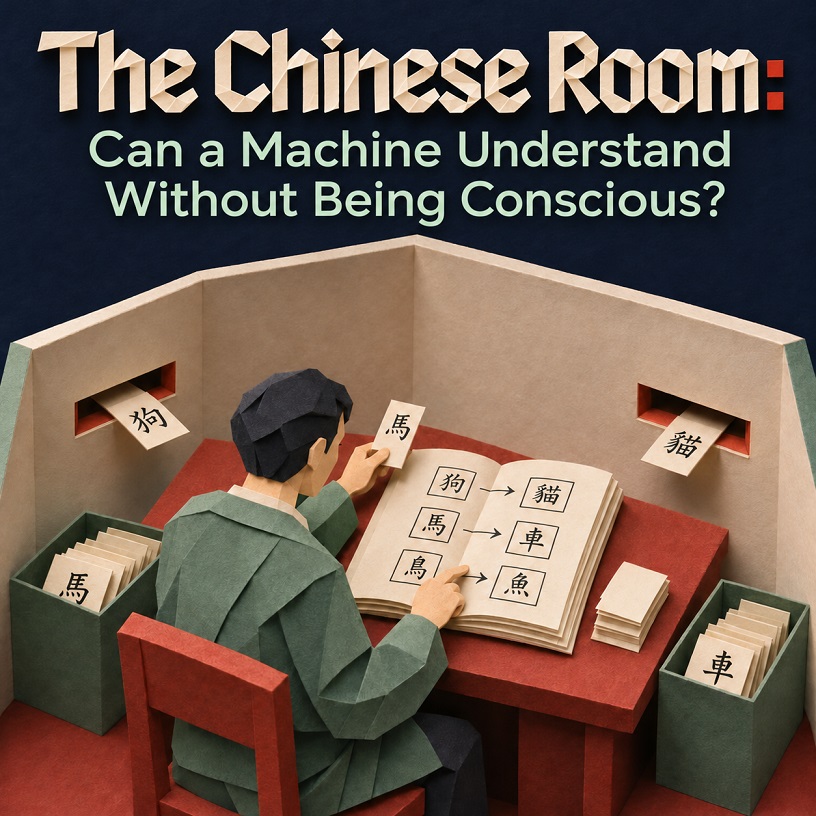
Imagine a person locked inside a room who does not understand a single word of Chinese. Through a narrow opening, people pass sheets covered with Chinese characters. Inside the room is an enormous instruction manual written in a language the person understands. It specifies which shapes to recognize, which rules to apply, and which other characters to send back. The person follows the instructions so accurately that the people outside receive coherent answers to their questions. To them, it appears that someone inside the room speaks Chinese fluently. Yet the person inside understands neither the questions nor the answers.
This is the heart of the Chinese Room thought experiment, introduced by the American philosopher John Searle in 1980. He used it to challenge a compelling assumption: if a computer manipulates symbols and converses indistinguishably from a human being, running the appropriate program is sufficient for genuine understanding. The question goes far beyond whether machines can be useful, intelligent, or convincing conversational partners. It concerns the nature of meaning itself.
Today, computer systems translate languages, write essays, analyze images, solve problems, and sustain lengthy conversations. Their responses can create the impression that we are speaking to something that knows what it is talking about. That is why the Chinese Room remains relevant. It forces us to distinguish outward behavior from internal mechanisms, the correct use of words from understanding their meaning, and intelligent information processing from subjective experience.
The philosophical debate does not end with a simple yes or no. The thought experiment has generated powerful objections, some of which challenge its very assumptions. To understand its significance, we need to examine the origins of the idea of a thinking machine, what Searle actually argued, why his critics disagree, and how contemporary artificial intelligence changes the context without automatically resolving the controversy.
Before the Chinese Room: Can Machines Think?

The question of machine intelligence did not begin with Searle. In 1950, the British mathematician Alan Turing published “Computing Machinery and Intelligence,” proposing that we replace the ambiguous question “Can machines think?” with a more specific inquiry. His imitation game involves communication through text, with an interrogator attempting to distinguish a human participant from a machine. Turing explored whether a computer could perform convincingly in such an exchange.
The proposal was methodologically important. Rather than starting with a controversial definition of thinking, Turing directed attention toward abilities that could be demonstrated in conversation. If a machine answers complicated questions, sustains dialogue, corrects mistakes, and uses language flexibly, the reasons for denying it intelligence deserve careful examination.
The popular version of the Turing test is often presented as a definitive examination for consciousness. That interpretation is inaccurate. Convincing linguistic behavior is not a direct measurement of subjective experience. Turing explored an operational approach to intelligent behavior, not an instrument capable of detecting whether a machine feels pain, happiness, or a sense of existing.
As computers developed, researchers increasingly explored the idea that thinking involves information processing. If the mind operates through representations and rules, it seems natural to ask whether a sufficiently sophisticated program could realize comparable processes. This perspective inspired early artificial intelligence, symbolic reasoning systems, and significant parts of cognitive science.
Searle entered precisely this debate. He did not deny that computers could imitate linguistic skills or perform valuable tasks. His target was narrower and more ambitious: the claim that executing the right computer program is, by itself, sufficient for genuine understanding.
What Exactly Happens Inside the Chinese Room?

Consider the experiment carefully. Inside a closed room sits a person who understands English but knows no Chinese. The person receives strings of Chinese characters and has access to detailed instructions for arranging and transforming them. The rules never explain what the characters mean. They specify actions solely according to the symbols’ shapes, order, and combinations.
Chinese-speaking people outside send questions into the room. The person compares the incoming characters with tables, follows the instructions, and returns new strings of symbols. We assume the rulebook is extraordinarily effective: the answers are grammatically correct, contextually appropriate, and convincing. The people outside have every reason, based on the conversation, to believe that someone inside understands their language.
But the experience inside is entirely different. The person sees only shapes. One character does not mean water to them, another does not mean friend, and a complete sentence does not express a question about the weather. The person carries out operations without knowing what those operations are about. The system produces correct answers, while the individual executing the rules does not understand their content.
Searle compares this person to a processor executing a program. A computer manipulates symbols according to formal rules, while the meanings people assign to those symbols are not explicitly contained in the electronic operations themselves. His challenge follows: why should the successful execution of a program be considered sufficient for understanding merely because its output looks meaningful?
The Chinese Room is a thought experiment, not a practical blueprint for a machine. It does not claim that a human could manually perform the operations of a modern language model in a reasonable amount of time. Its purpose is to isolate the principle of formal symbol manipulation and ask whether that principle alone can produce meaning.
Syntax and Semantics: The Distinction at the Center of the Debate

The key to Searle’s argument is the distinction between syntax and semantics. Syntax concerns the rules governing the arrangement and transformation of symbols. Semantics concerns meaning: what words refer to, what statements express, and how language relates to the world. In everyday communication, the two work together, but they are not identical.
Imagine receiving instructions to replace every occurrence of the symbol A with B and every B with C. You can perform this task without knowing whether the symbols represent numbers, chemical elements, names, or words in an unfamiliar language. The operation requires recognizing patterns and applying rules. It does not require grasping the subject matter.
Now consider the sentence “The child put the book on the table.” Someone who understands English connects the words with objects, actions, and spatial relationships. They can explain what happened, identify a book resting on a table, and distinguish that situation from placing the table on the book. Understanding involves more than reproducing the arrangement of letters.
Conventional computers process representations through operations physically implemented in electronic states. Whether those states possess meaning in themselves, or acquire meaning through their use, training, and relations to the environment, is a philosophical question. Searle argues that formal structure alone cannot generate semantics.
This is a more precise claim than the sweeping declaration that computers understand nothing. It concerns the sufficient conditions for understanding. Even if syntax is necessary for some kinds of thought, it does not follow that syntax is sufficient. The transition from processing information to possessing meaning is exactly what requires explanation.
Strong and Weak Artificial Intelligence

Searle distinguishes between positions he calls weak and strong artificial intelligence. In his terminology, weak AI treats computers as instruments for studying and modeling mental processes. A program can help researchers formulate theories, simulate behavior, and test hypotheses without literally possessing the mental states it models.
Strong AI, as Searle defines the position he opposes, claims something more: an appropriately programmed computer literally has mental states, and running the correct program is sufficient for understanding. Under this view, a program is not merely a useful model of thought. Its execution constitutes thought.
A simulation of a thunderstorm helps illustrate the distinction. A computer model can calculate atmospheric motion, predict rainfall, and display swirling clouds. Yet rain does not fall inside the processor. Searle uses related reasoning: simulating understanding is not necessarily the same as understanding.
However, the analogy has limits. Thinking is not a physical process in the same straightforward sense as making an object wet. Some philosophers argue that mental states are defined by their functional organization rather than the material that realizes them. If they are right, the correct implementation of a cognitive process could constitute genuine thinking rather than a mere picture of thinking.
The disagreement therefore reaches into the nature of mind itself. Does understanding require a particular biological foundation? Is the right organization of causal relationships sufficient? Must symbols be connected with a body and an environment? The Chinese Room does not settle all these questions, but it places them at the center of the argument.
Why a Correct Answer Does Not Automatically Prove Understanding

In ordinary life, we judge understanding largely through behavior. If someone gives accurate directions, answers our questions, and corrects our mistakes, we reasonably conclude that they understand the subject. We cannot inspect another person’s thoughts directly, so we rely on language, action, and context as evidence of mental abilities.
The Chinese Room forces us to distinguish evidence from logical proof. Outward behavior can be consistent with understanding, but it can also be consistent with a procedure that produces the same output without understanding on the part of its operator. Identical answers do not guarantee identical internal mechanisms.
Consider a student who memorizes model answers for an examination. The student may perform well on familiar questions yet struggle when asked to apply the underlying ideas in an unfamiliar situation. This illustrates the distinction between reproducing information and grasping its meaning. The Chinese Room imagines a far more powerful rulebook, capable of handling complex and unfamiliar questions, but the central concern remains.
Modern AI systems complicate the comparison. They can explain concepts in different ways, transfer information between domains, and identify mistakes in arguments. These abilities extend beyond simply retrieving memorized sentences. The relevant question is no longer whether a system does anything sophisticated, but which account of understanding best explains what it does.
For that reason, the Chinese Room should not be treated as universal proof that all successful machine behavior is empty imitation. It is a conceptual challenge to a particular philosophical claim. Evaluating actual technologies also requires empirical investigation of their abilities, architectures, and limitations.
The Systems Reply: What If the Whole System Understands?

The best-known response to Searle is the systems reply. It argues that the person inside the room is not the only possible bearer of understanding. That person belongs to a larger system comprising the rulebook, memory, symbols, and operations. The fact that one component does not understand Chinese does not establish that the entire organized system lacks understanding.
The human brain offers an illuminating analogy. An individual neuron does not understand the question “What time is it?” It transmits signals through electrochemical processes. Yet we do not conclude that a person cannot understand the question. Understanding could be a property of an organized whole rather than of each component separately.
Searle replies that the person could memorize the entire rulebook, internalize every procedure, and carry out all the operations mentally. In that case, the formal system would be implemented within the person. Yet the person would still not understand Chinese.
Critics remain unconvinced. They argue that a person might implement a functional system without consciously accessing the knowledge attributed to that system. A structure can possess properties that are not experienced by the individual performing its operations. The dispute depends on how we identify the relevant system and the proper bearer of understanding.
There is no universally accepted resolution. Searle maintains that memorizing formal procedures adds no meaning. Defenders of the systems reply argue that he confuses the perspective of a component with the capacities of the organized whole. This disagreement matters for both philosophy of mind and the evaluation of complex artificial systems.
The Robot Reply: What If the Machine Has a Body?

Another influential objection argues that the Chinese Room is too isolated from the world. The person receives symbols and returns symbols without seeing the objects under discussion, moving through an environment, or experiencing the consequences of actions. Human understanding, however, develops through perception, movement, interaction, and practical experience.
Imagine a robot equipped with cameras, microphones, touch sensors, and mechanical arms. It hears the word “cup,” identifies the corresponding object, picks it up, moves it, and checks whether it has completed the task. Its representations are connected with actions and stable relationships in the environment. This looks closer to the way humans learn what words mean.
Searle responds that we can imagine the person inside the room receiving and processing all the signals from the robot’s sensors and sending instructions to its motors. The person would still be manipulating symbols according to rules. If they do not understand Chinese, adding cameras and wheels does not automatically solve the problem.
Advocates of embodied cognition dispute this conclusion. They argue that genuine interaction with the environment is not merely another stream of symbols. It can be part of the mechanism through which meaning arises. Knowing what weight, distance, or an obstacle means involves practical abilities that are difficult to capture as an isolated internal table.
This debate matters particularly for robotics. It does not prove that every robot is conscious, nor that a system without a physical body cannot understand. It shows that the question of meaning may require examining the entire relationship between information processing, action, and the world.
The Brain Simulator Reply: Can a Program Reproduce the Brain?

Imagine a program that does not merely follow conversational rules but models the activity of a human brain in extensive detail. It represents neural interactions, signals, and causal relationships. If such a system reproduced every functionally relevant process, would it understand? This is one of the strongest tests of Searle’s argument.
Searle insists that simulating brain activity is not equivalent to possessing the actual causal powers of a brain. A computer model of digestion does not digest food. In the same way, he argues, formally modeling a brain does not guarantee consciousness or understanding.
His opponents ask a difficult question: which properties of the brain are essential? If the crucial properties are causal relationships between components, a system built from different materials but realizing those relationships could have similar mental abilities. If biological material is indispensable, we need an explanation of exactly which characteristics produce understanding.
It is not enough to say that the brain is natural while the computer is artificial. Artificial hearts can perform some functions of biological hearts through different mechanisms. Yet not every simulation of a function is a realization of that function. The philosophical task is to identify the difference rather than rely on labels.
Neuroscience investigates perception, memory, attention, and consciousness, but no universally accepted theory specifies the necessary and sufficient physical conditions for every form of subjective experience. The brain simulation question therefore remains an active philosophical and scientific problem.
Functionalism: The Mind as Organization Rather Than Material

Functionalism is an influential position in philosophy of mind. In its various forms, it characterizes mental states through the roles they play in networks of perceptions, other states, and actions. Pain, for example, has characteristic relationships with bodily damage, avoidance, attention, and behavior. What matters is the organization of these relationships.
From this perspective, a mental function can be realized by different physical substrates. Just as a mathematical operation can be performed by a mechanical calculator, an electronic computer, or a person, some cognitive abilities could have more than one material realization. This idea is known as multiple realizability.
The Chinese Room challenges functionalism. If a system has the right inputs, outputs, and internal relationships, but the person executing its rules understands nothing, is functional organization enough? Searle says no. His critics reply that the operator’s lack of understanding does not rule out understanding at the level of the complete system.
Functionalism itself comes in different forms. Not every functionalist believes that any program producing convincing answers possesses a mind. Some accounts require a suitable causal structure, environmental connections, learning capacities, or other features. Defeating an oversimplified version of functionalism would not establish that every functionalist theory is false.
The deeper lesson is that the question of machine understanding depends on our theory of human understanding. If we do not know which properties of the mind are decisive, it is difficult to determine whether an artificial system possesses them. The Chinese Room makes that dependence impossible to ignore.
The Symbol Grounding Problem

How does a word come to mean anything? For a child learning language, the answer involves much more than consulting a dictionary. The child hears the word “apple,” sees the fruit, touches it, tastes it, and gradually connects different experiences with a stable category. Meaning develops through relationships between language and the world.
In 1990, philosopher and cognitive scientist Stevan Harnad formulated the symbol grounding problem. If the meaning of every symbol is explained only through other symbols, the explanation risks becoming circular. A dictionary in which every unfamiliar word is defined entirely through other unfamiliar words does not give a beginner a direct foundation for understanding.
The Chinese Room is closely related to this concern. The person can follow rules for manipulating characters without having any connection between those characters and the things they represent. Whether perception, action, and learning from the environment are sufficient for understanding remains disputed. Nevertheless, these features identify something absent from a purely formal description.
Modern language models learn complex relationships from vast collections of text and other data. Some systems also process images, audio, and video. These capabilities allow them to develop relationships between linguistic expressions and different representations of the world. Describing them as machines that merely look up prepared answers in a table is misleading.
Yet statistical, visual, or practical connections do not automatically settle the philosophical question. We must distinguish successful use of an expression, an internal representation of what it refers to, and a conscious experience of understanding it. These matters are connected, but they are not interchangeable.
Understanding and Consciousness Are Not the Same Question

Discussions of the Chinese Room frequently merge two questions: can a machine understand, and can a machine be conscious? They are not identical. Understanding usually concerns grasping meaning, identifying relationships, and using knowledge. Consciousness, when understood as subjective experience, concerns whether there is anything it is like to be the system.
A person can understand a rule without constantly thinking about it consciously. We use grammar without explicitly considering every principle. Conversely, someone can consciously experience pain without that sensation requiring sophisticated linguistic understanding. Semantic abilities and subjective experience do not completely overlap.
Philosophers often distinguish phenomenal consciousness from information that is accessible for reasoning and action. The former concerns the felt quality of experience: what it is like to see red or experience fear. The latter concerns information that can guide reports, decisions, and behavior. Different theories disagree about how these dimensions relate.
The Chinese Room primarily addresses understanding and intentionality, the directedness of mental states toward objects or situations. It is not a direct experiment measuring phenomenal consciousness. Searle connects these questions, but the absence of semantic understanding does not, by itself, constitute a complete theory of subjective experience.
This distinction is essential when discussing AI. A system can demonstrate considerable competence in linguistic tasks without giving us sufficient grounds to conclude that it experiences anything. Equally, it is not scientifically established that every possible artificial system is incapable of consciousness. Both extreme claims require arguments beyond conversational performance.
What Does It Mean to Know What You Are Talking About?

When we say that someone understands a subject, we generally expect more than accurate reproduction of information. They should explain causal relationships, distinguish essential from incidental details, transfer knowledge to new situations, and recognize the limitations of their own explanations. Understanding involves flexibility and sensitivity to context.
Consider a person who has memorized a definition of gravity but cannot explain why objects fall or what happens during free fall. They possess some information without grasping the relevant conceptual connections. Another person may lack a perfect scientific definition yet explain familiar phenomena and make accurate predictions.
Understanding also comes in degrees. There is no simple division between complete understanding and none at all. Children, students, and experts possess different depths of knowledge. Someone may understand the practical meaning of a word without knowing every philosophical or scientific implication of the concept.
This complicates the evaluation of machines. A system can demonstrate an impressive ability to summarize, compare, and apply concepts while still making serious mistakes when conditions change. Such observations matter when assessing competence. They do not, on their own, determine whether the system has a subjective sense of meaning.
We therefore need to use the word “understanding” carefully. In engineering, it can refer to successful modeling and use of information. In cognitive science, it can describe particular abilities and internal representations. In philosophy of consciousness, it raises deeper questions about mental content and experience. Arguments often become confused when these meanings are exchanged without notice.
Why the Human Brain Is Not Simply an Enormous Rulebook

The human brain processes information, but it does not operate like a person following an unchanging table of symbolic substitutions. Neural systems change through learning, interact with the body, and continuously receive signals from the environment. Perception, memory, attention, emotion, and action are deeply interconnected.
When a child learns the word “hot,” they do not merely memorize a connection between two expressions. They experience temperature, observe other people’s reactions, learn to avoid danger, and develop practical expectations. The word participates in a network of bodily and social relationships. Human learning is therefore different from the isolated manipulation of symbols.
These facts do not establish that machines are incapable of developing analogous functional relationships. Systems already exist that learn through interaction, control robots, and use feedback from their environments. Differences between biological and artificial cognition must be investigated rather than assumed in advance.
Searle defends the view that brains possess causal powers that produce mental states. His position does not necessarily require the claim that only biological carbon-based systems can be conscious. His central objection is that formal program execution, considered independently of its physical realization, is not sufficient.
Neuroscience continues to investigate how brain activity relates to experience and understanding. Discovering neural correlates is important, but correlation alone does not fully explain why subjective experience occurs. The Chinese Room remains useful because it highlights the difference between describing operations and explaining mental content.
Modern Language Models: More Than Rules on Paper

When Searle published his argument in 1980, symbolic programming strongly influenced prevailing ideas about artificial intelligence. Today’s large language models are built differently. They use neural networks trained on enormous quantities of data, adjusting many parameters to learn patterns and generate contextually appropriate outputs.
This does not mean that such systems simply select random words or assemble prepared sentences. They can develop complex representations, use context, solve certain multistep problems, and combine information in ways that were not explicitly written as individual rules. Their capabilities deserve accurate description rather than dismissal through outdated analogies.
At the same time, impressive performance does not guarantee reliability. A language model can confidently produce false claims, overlook essential context, or fail at a task that appears straightforward to a person. These failures reveal limitations of particular systems and methods, but they do not independently prove the absence of every possible form of understanding.
Whether Searle’s argument applies to neural networks depends on how we interpret program execution and whether formal organization exhausts the relevant causal mechanisms. Some philosophers maintain that the central objection remains intact: processing information is not enough for meaning. Others argue that learned representations and functional capacities require a more sophisticated analysis.
Neither a convincing conversation nor an appeal to the Chinese Room settles the matter. Evaluating contemporary systems requires empirical tests, architectural analysis, clear definitions of understanding, and philosophical argument. These tools help us avoid both naive anthropomorphism and premature dismissal.
When a Machine Is Convincingly Wrong

One practical difficulty with conversational AI is that fluent language can create an impression of reliable knowledge. A system can deliver a polished explanation, use technical vocabulary, and sound confident even when its claims are mistaken. This makes it important to distinguish linguistic persuasiveness from factual accuracy.
Human communication presents a similar risk. An eloquent speaker can mislead an audience, while a knowledgeable expert may speak cautiously. Style provides a signal, not proof of truth. Automatically generated language makes this distinction increasingly important for education, journalism, and professional decision-making.
The Chinese Room reminds us that an observer sees the answer without necessarily seeing how it was produced. When evaluating a system, we should verify important facts, examine supporting evidence, and compare results with independent information. Such precautions are particularly necessary in medicine, law, science, and finance.
Two criticisms must not be confused. One is practical: the system can make mistakes. The other is philosophical: even a system producing perfectly correct answers raises the question of whether it understands. The first can be studied through measures of accuracy and reliability. The second requires an account of meaning and mental states.
This distinction supports responsible technology use. We do not need to resolve machine consciousness before determining whether a tool is helpful or risky in a particular setting. Responsible deployment depends on demonstrated capabilities, known limitations, and clear human accountability.
Is Communication With a Machine Genuine Communication?

When we speak with another person, we ordinarily assume that their words express thoughts, intentions, and experiences. Communication involves not only information exchange but also mutual recognition between participants. With conversational AI, the situation is more complicated: we can receive meaningful responses without knowing whether the system possesses subjective understanding.
Communication also has a functional dimension. A navigation system gives directions that we understand and follow. An automated translator helps two people exchange ideas across a language barrier. The technology participates in a genuine transfer of meaning, even if the software itself has no conscious inner life.
That is why the question must be framed carefully. A machine can mediate meaning between people without necessarily possessing the same kind of understanding as those people. It can perform communicative functions with real consequences. Yet successful performance does not automatically establish an internal point of view.
There is a further danger in attributing intentions to systems without sufficient evidence. When a response sounds warm and sympathetic, users can feel emotionally understood. That feeling is real as a human experience, but it does not prove that the system experiences compassion. The effect on the user must be distinguished from the properties of the technology.
Philosophical caution does not require us to dismiss the benefits of such interactions. Language technologies can support learning, accessibility, and creativity. The challenge is to use them with a clear understanding of what has and has not been established, without treating them either as people or as worthless imitations.
The Problem of Other Minds

The Chinese Room connects with an older philosophical problem: how do we know that other people are conscious? We observe their behavior, hear their words, and see their bodily reactions. Yet we do not directly experience their sensations. Another person’s inner perspective is not accessible to us in the same way as our own.
In everyday life, this does not lead us to doubt the consciousness of friends and family. We have powerful reasons to recognize it: shared biology, similar development, behavior, language, and the ability to communicate experiences. Our conclusion rests on many mutually supporting facts.
With artificial systems, some of these grounds are absent or fundamentally different. A machine may use language convincingly without sharing human biology or embodied life. The analogy with other people therefore cannot simply be transferred without further argument. We must examine the mechanisms considered relevant to consciousness.
The opposite conclusion is not automatic either. The fact that a machine differs from a human does not logically prove that every possible artificial form of experience is impossible. If consciousness depends on a certain organization, different substrates could realize it. If it depends on specific biological properties, the material will matter. The dispute requires theory and evidence.
The Chinese Room thus belongs to a broader problem of knowledge. We cannot observe understanding as though it were an object on a table. We infer it from behavior, structure, causal mechanisms, and theoretical explanations. Philosophy asks which of these inferences are justified.
What Would Count as Evidence of Machine Understanding?

To investigate whether a machine understands, we must first specify what understanding means. Is correct language use sufficient? Must the system explain causal relationships? Does it need to learn through direct interaction with the world? Or do we require evidence of subjective experience? Different definitions produce different criteria.
Empirical tests can examine the stability of knowledge, the ability to generalize, performance on unfamiliar tasks, and sensitivity to causal changes. If a system consistently demonstrates these abilities, that is meaningful evidence of a particular kind of cognitive competence. Such evidence should be acknowledged even when the results are surprising.
However, a behavioral test is not automatically a test of experience. A system can describe pain without our having established that it feels pain. Another system could possess internal states that it does not express in human language. The assessment of consciousness cannot therefore be reduced to conversational persuasiveness.
Some researchers propose examining architectural and functional indicators associated with scientific theories of consciousness. Such approaches can make the discussion more testable, but they depend on theories that remain contested. There is no universally accepted test that conclusively identifies subjective experience in every possible system.
Intellectual discipline therefore requires distinguishing three claims: what a system demonstrably does, what we infer about its internal mechanisms, and what we claim about its consciousness. Confusing them leads to both exaggerated promises and unjustified denials.
Can a Machine Have Intentionality of Its Own?

One of Searle’s central philosophical concepts is intentionality. In philosophy of mind, this term does not merely mean a conscious plan to perform an action. It refers to the directedness of mental states toward something: believing that it is raining, wanting water, remembering a place, or fearing a future event.
When the word “apple” appears on a computer screen, we can interpret it as referring to a fruit. But is the machine’s internal state itself directed toward apples? Or is its meaning derived from human purposes, design decisions, and interpretation? This is the question of original versus derived intentionality.
Searle argues that human mental states possess intrinsic intentionality, whereas computer symbols acquire meaning through interpretation. In the Chinese Room, the rules can be followed without the operator having any thoughts about the objects represented by the symbols. Formal manipulation therefore does not automatically generate directedness toward the world.
Critics challenge the sharpness of this distinction. If a system learns from its environment, develops stable representations, uses them to make predictions, and adjusts its behavior in response to outcomes, there are reasons to examine those representations as bearers of content. The question is whether that content qualifies as genuine intentionality.
Here philosophical debate approaches cognitive science. We need to explain how brains or machines represent objects, distinguish truth from error, and connect actions with goals. Merely using the word “intention” does not resolve the problem; it identifies a phenomenon that requires investigation.
Why Language Is More Than Arranging Words

Language follows rules, but it also belongs to shared practices. When we make a promise, we do more than produce a grammatically correct sentence: we undertake an obligation. When we warn someone about danger, we attempt to influence their behavior. When we ask a question, we seek information relevant to our purposes.
Philosophers such as Ludwig Wittgenstein emphasized the role of use and human forms of life in linguistic meaning. Words acquire significance within patterns of action, rules, relationships, and social expectations. This perspective challenges the idea that meaning can be understood solely as a private mental image.
This matters for the Chinese Room. If meaning depends on participation in practices, we should ask whether the complete system participates in those practices, not merely whether the person inside consciously understands the characters. On the other hand, if participation is only outward imitation without any capacity for understanding, Searle’s objection remains.
Linguistic competence also involves sensitivity to what is left unsaid. When someone remarks, “It is cold in here,” they might be describing the temperature, complaining, or asking us to close a window. Meaning depends on the situation and the relationship between speakers. A system using language successfully must navigate these contextual differences.
Yet successful navigation leaves a philosophical question: is participation in linguistic practices itself understanding, or merely evidence of understanding? Different philosophical traditions answer differently. The Chinese Room asks us to explain our preference rather than assume that a suitable reply settles the issue.
Could the Person in the Room Eventually Learn Chinese?

An intriguing question is what would happen if the person followed the rules for years. They would encounter recurring characters, observe patterns, and receive feedback. Could they gradually learn the meanings without being given direct translations? The answer depends on the information available and how learning is organized.
Human beings can discover patterns in unfamiliar languages. But statistical recognition of forms alone does not guarantee full understanding. Learning what a word means ordinarily involves context, interaction, and connections with familiar concepts. If the room provides no access to those connections, the person’s learning remains constrained.
In Searle’s original scenario, it is stipulated that the person follows formal rules without understanding Chinese. That assumption is part of the thought experiment. If we alter the conditions so that the person actually learns the language, we are investigating a different situation rather than automatically refuting the original argument.
The question is nevertheless valuable because it highlights the importance of learning. Modern systems do not rely exclusively on handwritten instructions. They develop representations through training. This raises the issue of whether learning can establish meaningful relationships absent from a static rulebook.
Searle would maintain that even highly sophisticated formal processing is insufficient by itself. His opponents would argue that real cognitive systems cannot be judged solely from the subjective perspective of an imaginary operator. The question of learning reveals both the limitations of the analogy and the importance of examining concrete mechanisms.
Where Searle’s Argument Is Strongest

The Chinese Room is most powerful when challenging the hasty identification of behavior with understanding. A system’s ability to produce correct sentences does not establish, without additional assumptions, that it experiences their meaning in a humanlike way. The experiment forces us to identify what understanding adds to formal information processing.
The argument is particularly useful against the claim that any program successfully imitating conversation must possess the same mental states as a human being. It demonstrates that we can conceive of rule execution in which an operator has no grasp of the symbols’ meaning. This is a serious challenge to simplified versions of strong AI.
Searle also directs attention toward causal mechanisms. Naming a process “thinking” is not enough to explain why it constitutes thinking. We need to establish why a particular physical or functional organization produces mental states. That question remains important in philosophy and neuroscience alike.
Another strength is the experiment’s clarity. It requires no advanced mathematics to reveal the tension. Anyone can imagine a person manipulating unfamiliar symbols and recognize that the operator’s outward success is not identical to their internal understanding.
But clarity also creates a risk. A vivid story can make the debate appear settled before its objections have been considered. The deeper philosophical work begins when we ask whether the person inside the room is the relevant bearer of understanding and whether the formal system has been adequately characterized.
The Most Serious Limitations of the Chinese Room

The first limitation is that the experiment relies on our intuition that the person following the rules does not understand. But the disputed claim often concerns the entire system. If a property belongs to an organized whole, its absence in an individual component is not decisive. This is the central point of the systems reply.
The second limitation concerns the meaning of “syntax alone.” Real computer systems have physical implementations, training histories, internal states, and environmental interactions. If particular causal relationships are essential for meaning, we need to investigate them rather than exclude them in advance as meaningless manipulation.
The third limitation concerns our theory of understanding. Without an agreed explanation of how the human brain produces meaning, proving that a different system is incapable of it is difficult. Searle presents a philosophical argument, not a complete neurobiological theory of semantics.
The fourth limitation is historical. Contemporary AI differs considerably from the symbolic programs that dominated the early debate. This does not automatically invalidate the argument, but it requires precision about which systems and claims are being evaluated.
Finally, the Chinese Room cannot replace empirical research. It does not measure cognitive abilities, establish the presence or absence of experience in a particular machine, or predict the limits of future technologies. It is an instrument of conceptual analysis. Its value depends on using it for the questions it can genuinely illuminate.
Ethical Consequences: How Should We Treat Intelligent Machines?

The debate about machine understanding has practical consequences. If a system performs highly complex tasks, society must decide how to use it, how to verify its results, and who bears responsibility for mistakes. These questions arise regardless of whether the system is conscious. A useful tool can be dangerous when trusted without adequate safeguards.
A separate question concerns the possible moral status of future artificial systems. If a system were capable of genuine suffering or well-being, its treatment would require serious ethical consideration. But attributing those capacities solely on the basis of convincing textual statements would not be justified.
Two kinds of caution are necessary. We should not anthropomorphize technologies merely because they use human language. Equally, we should not assume that no possible artificial organization could possess experience. Both extreme positions reach beyond what has been established.
For present-day applications, priorities include reliability, transparency, privacy protection, the prevention of discrimination, and meaningful human oversight of important decisions. These requirements do not depend on a final philosophical solution to the problem of consciousness. They arise from actual consequences for people who use the systems.
The Chinese Room contributes by reminding us that humanlike language should not be confused with a demonstrated inner perspective. A machine can discuss responsibility without thereby relieving its developers, operators, or users of their own responsibilities.
What We Should Really Ask About Artificial Intelligence

Instead of asking only “Does the machine understand?”, we can distinguish several more precise questions. Which concepts can it use successfully? Can it apply them in unfamiliar situations? How does it respond to incomplete information? Can it recognize contradictions? Can it connect language with observations and actions? What do investigations of its internal mechanisms reveal?
A separate philosophical question follows: which of these abilities are sufficient for understanding in the strict sense? If subjective experience is required, we need to explain why. If functional competence is enough, we must identify what distinguishes it from superficial imitation. Every position carries its own burden of argument.
A third question concerns consciousness. What grounds would justify believing that a system possesses an inner point of view? Which scientific theories and observations support that conclusion? What alternative explanations fit the same evidence? Without these distinctions, discussion easily becomes an exchange of impressions.
The fourth question is practical: for which tasks can the system be used safely? It may be valuable for translation, summarization, or education while remaining insufficiently reliable for independent high-stakes decisions. Philosophical uncertainty does not eliminate the need for concrete assessments of quality.
This approach allows a more mature conversation. It does not force us to choose between enthusiasm and dismissal. It asks us to distinguish demonstrated abilities, theories explaining them, and ethical decisions based on what we know.
Conclusion: Between the Right Words and Genuine Understanding

The person in the Chinese Room receives questions they cannot read and returns answers whose meaning they do not know. To those outside, the conversation appears entirely meaningful. To the operator, it is a sequence of operations. This contrast is enough to raise one of the central questions in the philosophy of artificial intelligence: what transforms information processing into understanding?
John Searle argues that syntax alone is insufficient for semantics. His critics reply that understanding could belong to the entire system, that interaction with the world matters, and that functional organization should not be dismissed merely because an individual operator is unaware of the meaning of the operations they perform.
Modern language models make the controversy more urgent without bringing it to an end. They demonstrate capabilities that deserve serious scientific explanation. Yet convincing language does not automatically establish subjective experience, and Searle’s argument does not establish that every future machine must be incapable of understanding.
The essential task is to keep three questions separate: what a system can do, how it processes information, and whether it has an inner experience. We possess many empirical methods for studying the first. We are developing technical and scientific accounts of the second. The third remains among the most difficult problems in philosophy of mind.
The Chinese Room does not give us permission to underestimate intelligent technologies or to attribute humanlike inner lives to them without evidence. It teaches something more valuable: producing the right answer and understanding that answer are not concepts we should treat as identical without argument. In a world where machines use human language with increasing sophistication, that distinction deserves more attention than ever.
Author: Vasil Stoyanov