
At this very moment, you are looking at text on a screen. You feel the weight of your body, hear sounds around you, and assume that you inhabit a real world. Your senses tell you that objects, space, and other people exist. Yet the fact that an experience feels real does not logically establish that reality is exactly as you perceive it. This is one of the deepest difficulties in the theory of knowledge.
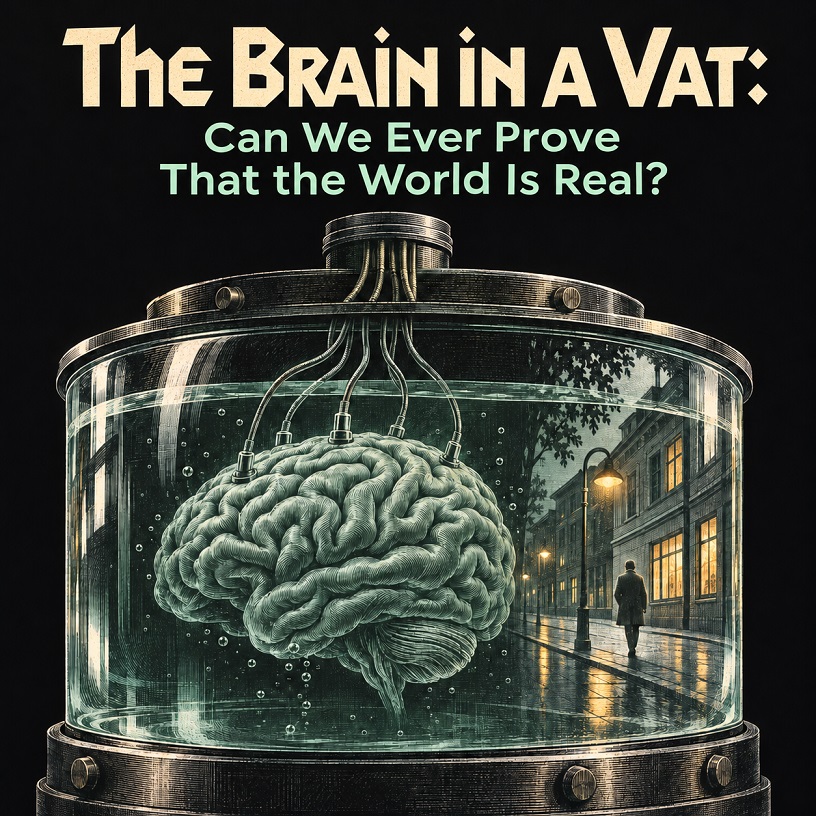
Imagine a human brain removed from its body and kept alive in a special vat. Its nerve endings are connected to an extraordinarily powerful computer that sends signals indistinguishable from those a brain receives during ordinary life. The computer reproduces sights, sounds, touch, pain, pleasure, and memories. The brain experiences an entire world without having access to the world responsible for generating those experiences.
This is the thought experiment known as the “brain in a vat,” most closely associated with the American philosopher Hilary Putnam. It is not a scientific hypothesis about humanity’s secret origins. It is a philosophical instrument that puts our ideas of truth, proof, and knowledge under pressure. Its question is not whether someone actually keeps brains in a laboratory. Its question is what grounds we have for claiming to know the external world when everything we learn about it passes through experience.
From Ordinary Doubt to Radical Skepticism

Everyday doubt has a clear purpose. If you are unsure whether it is raining, you look through the window. If you doubt the accuracy of a clock, you compare it with another. If witnesses give conflicting accounts of an event, you look for additional evidence. In each case, you test one claim by relying on other parts of your experience.
Radical skepticism attacks the very foundation of such testing. What happens if the window, the clock, the witnesses, and every other means of establishing the truth belong to the same deception? Gathering more observations would not solve the problem, because those observations would also arise within the very system of experiences being questioned.
This distinction is essential. The skeptic does not have to prove that the world is an illusion. It is enough to show that the available grounds fail to exclude an alternative scenario in which identical experiences arise in a radically different way. The burden falls on the claim to certain knowledge.
Suppose you see a tree outside your home. In ordinary conversation, that is sufficient reason to say that a tree stands there. But if you must exclude every logically compatible alternative to your experience, the task changes. A sensory impression cannot, by itself, certify its own origin. That is where the philosophical problem begins.
Descartes and the Doubt That Predated the Computer

Long before the invention of electronics, René Descartes formulated a similar challenge. In his Meditations on First Philosophy, published in 1641, he subjects seemingly secure beliefs to methodical doubt. The senses sometimes deceive us. Dreams can appear convincing while we are experiencing them. Therefore, the immediate feeling of reality is not an infallible criterion of truth.
Descartes goes further with the image of a powerful deceiver capable of systematically misleading a thinking subject. This figure plays the role that the computer assumes in the modern experiment: it makes possible the systematic misrepresentation of the entire field of experience.
But Descartes discovers a limit to doubt. Even if he is deceived about everything else, the act of thinking itself establishes that thinking is taking place. The famous formula “I think, therefore I am” expresses this immediate certainty. It does not prove the existence of a body, a room, or a planet. It establishes something narrower: doubt cannot eliminate the fact that doubting thought is occurring.
Thus even the most extreme skeptical scenario does not destroy every possible form of knowledge. It leaves open, however, the question of how we move from the certainty of experience to knowledge of a reality independent of it. This gap makes the problem central to modern epistemology, the branch of philosophy that investigates knowledge and its justification.
How the Brain-in-a-Vat Thought Experiment Works
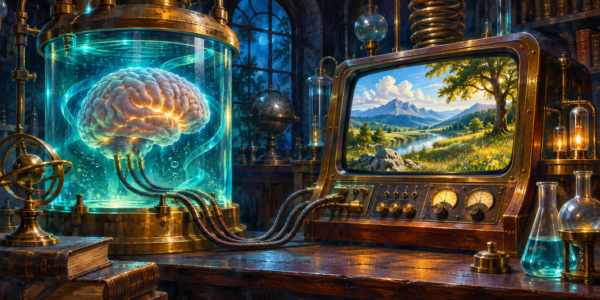
To understand the force of the experiment, we must remove several misconceptions. We do not need to assume that present-day technology can actually sustain an isolated brain with a fully conscious life. We do not need to explain every biological detail. The thought experiment stipulates that, for the sake of argument, the system reproduces the same experiences a person would have in the ordinary world.
Imagine that the virtual environment is entirely consistent. If you drop a glass, it falls. If you walk through a door, you see a street. If you return an hour later, the book is still on the table. The computer maintains a history, causal relationships, and stable regularities. From the subject’s perspective, there is no obvious crack in reality.
Now compare two situations. In the first, a person has a body and perceives actual objects through the senses. In the second, a brain in a vat receives the corresponding electrical signals from a computer. If all experiences are identical, their contents alone cannot allow the subject to distinguish the two cases.
This is the problem of scenarios indistinguishable from the first-person perspective. From the outside, they are radically different; from the inside, they appear the same. The experiment does not prove that we are brains in vats. It shows that a particular kind of evidence, based entirely on those same experiences, is insufficient to exclude the scenario.
There is also an important limit: the logical conceivability of a situation does not establish that it is physically possible or actually realized. Philosophical doubt is not an empirical discovery. It investigates the structure of our grounds for knowledge.
Hilary Putnam: Not Just Doubt, but the Meaning of Words
Hilary Putnam examines brains in vats in his 1981 book Reason, Truth and History. His contribution is frequently misrepresented. Putnam does not merely repeat the question of whether a computer is deceiving us. He develops an argument according to which a particular version of the brain-in-a-vat hypothesis runs into trouble when we attempt to state it.
The key is a theory of meaning and of how words refer to the world. In an ordinary understanding, it seems that the word “tree” means a tree because the speaker has the appropriate mental image. Putnam challenges the sufficiency of this explanation. Meaning and reference do not depend solely on internal images. The speaker’s actual relationship with the environment in which words are used also matters.
Imagine someone who has never seen a real tree and has grown up in an environment containing only computer-generated images of trees. Their word “tree” is connected to those images and to established practices of use within that environment. The mere fact that they imagine what a person in the ordinary world imagines does not establish that both uses have the same reference.
This is the decisive turn in the reasoning. The radical skeptic asks what happens if our representations fail to correspond to the world. Putnam replies that the very content of our thoughts and words depends on our relationships with the world. We cannot automatically assume that identical internal experiences guarantee identical meanings.
Why the Sentence “I Am a Brain in a Vat” Becomes Problematic

Consider the classic version of the argument. Suppose someone has always been a brain in a vat, has never interacted in the ordinary way with real brains and vats, and has acquired all their language within the simulated environment. In that case, their words “brain” and “vat” do not automatically acquire the same references as the words used by a person who lives among actual bodies and laboratory vessels.
If such a subject says, “I am a brain in a vat,” their words will refer to the objects and images with which they are associated inside the simulation, or to other elements of that causal and linguistic environment. They will not simply designate the actual brain and actual vat outside it. The sentence therefore cannot, without additional conditions, express precisely what the skeptical hypothesis requires.
If, on the other hand, the speaker is a person in the ordinary world, their words can designate actual brains and vats. But in the version under discussion, that person is not an always-simulated brain whose language was formed entirely inside the simulation. Putnam uses this dependence of meaning on environment to challenge the possibility of the subject truthfully stating the relevant skeptical hypothesis.
The argument is semantic: it concerns the conditions under which words successfully designate particular things. It does not involve discovering a laboratory test that reveals where the brain is located. Nor is it proof that every form of virtual reality is impossible.
That is precisely its philosophical originality. Rather than seeking another piece of sensory evidence against the skeptic, Putnam analyzes the language in which the skeptic formulates the doubt.
What Putnam’s Argument Does Not Prove

It would be a mistake to declare that Putnam has conclusively proved the reality of the entire external world. His argument depends on particular assumptions about meaning, reference, and the subject’s history. Philosophers debate the strength of these assumptions and the scope of the conclusion.
One important distinction is between someone who has always been a brain in a vat and someone who lived in the ordinary world, learned language there, and was only later connected to a simulation. In the second case, their words can retain connections to objects in the earlier environment. The semantic argument does not operate in exactly the same way.
Another question is whether the hypothesis can be formulated by an outside observer who possesses the appropriate concepts and references. Even if the simulated subject cannot designate the actual vat with their words, that does not make the existence of such a vat impossible. The problem of stating a claim and the question of what actually exists are different problems.
There is a broader difficulty as well. From the claim that a particular sentence cannot be used truthfully under certain conditions, it does not automatically follow that we possess ordinary empirical knowledge of every object around us. The semantic response to skepticism must be assessed within its proper limits.
Putnam’s contribution, then, is not the final elimination of doubt but a change in the terrain on which doubt is discussed. To doubt the world meaningfully, we must first clarify how our words and thoughts refer to it.
The Problem of Knowledge: What Do We Mean by “I Know”?

In everyday language, knowledge means more than strong conviction. A person can sincerely believe that a train leaves at eight and still be mistaken. Knowledge requires truth and appropriate justification, although philosophers disagree about exactly how its sufficient conditions should be formulated.
Traditionally, knowledge has often been presented as justified true belief. In the twentieth century, Edmund Gettier showed through famous counterexamples that a person can have a true and justified belief because of a coincidence without intuitively possessing knowledge. The connection between justification and truth is therefore more complex than it initially appears.
The brain in a vat presents a different but related challenge. If all your evidence for the external world would look exactly the same under total simulation, what makes your belief that you are sitting before a real screen knowledge? The skeptic insists that you cannot exclude the alternative. The defender of ordinary knowledge challenges the requirement that knowledge must exclude every conceivable possibility of error.
This dispute is not resolved by stronger conviction. Confidence is a psychological state; justification concerns the relationship between belief, evidence, and truth. A person can be completely confident and mistaken, just as a person can know something without experiencing absolute subjective certainty.
The Senses Are Not a Window Without Glass

Vision does not provide the world as an unprocessed copy. Light reaches the retina, is converted into neural signals, and undergoes complex processing through which we perceive shapes, movement, color, and depth. Comparable processes underlie hearing and the other senses. The brain does not simply receive a finished picture; perception depends on interactions among sensory signals, context, and previous experience.
Visual illusions demonstrate this particularly clearly. Two lines of equal length can look different because of arrow-shaped endings. A stationary image can create the impression of movement. Under certain conditions, the color of an object is perceived differently depending on illumination and its surroundings.
But the fact that perception is constructed and sometimes mistaken does not imply that everything perceived is invented. We recognize illusions precisely through comparison, measurement, and further testing. Sensory systems are imperfect, but in many situations they provide reliable information about the environment.
We must avoid a popular logical error here: “The brain processes experience; therefore, no external world exists.” The conclusion does not follow from the premise. All human perception is mediated by biological processes; that fact alone establishes neither realism nor idealism.
The philosophical problem is more precise: what permits us to move from access to experiences toward justified claims about their independent causes?
Can Science Prove That We Are Not Living in a Simulation?

Science develops and tests models through observations, experiments, measurements, and predictions. It can establish that a hypothesis conflicts with the data or that one explanation has greater predictive power than its competitors. This is an extraordinarily powerful method of investigating reality.
But the radical brain-in-a-vat hypothesis is constructed to reproduce every accessible observation. If every measurement, experiment, and scientific instrument appears as part of the same simulation, those observations cannot by themselves exclude its existence. This result follows from the way the hypothesis is formulated, not from a weakness in any particular laboratory.
We must, however, distinguish the radical hypothesis from testable proposals about specific simulations. If someone claims that a simulated world has measurable limitations, particular anomalies, or predictable traces, those claims can be assessed empirically. The absence of such traces would matter for that particular model. It would not refute every possible simulation, including those defined as indistinguishable from ordinary reality.
We should therefore not confuse “there is no conclusive refutation of a logically constructed scenario” with “there is evidence that the scenario is true.” The absence of a decisive refutation is not positive evidence. For a hypothesis to be compelling, it must offer grounds that go beyond the mere possibility of telling its story.
G. E. Moore: Two Hands Against the Skeptic
The British philosopher G. E. Moore offers a famous response to skepticism by raising one hand, then the other, and declaring that two human hands exist. It follows that external objects exist. For Moore, ordinary knowledge of the world is more secure than the abstract premises with which the skeptic attempts to undermine it.
This approach seems almost too simple. The skeptic immediately objects that the reality of the hands is precisely what is in question. Moore does not provide a test independent of all sensory experience that excludes the brain-in-a-vat scenario. Instead, he challenges the skeptic’s philosophical entitlement to strip our most ordinary beliefs of their status as knowledge.
The dispute reveals a conflict between two intuitions. The first is that we know many things: we have bodies, speak with people, and live in a shared world. The second is that knowledge requires us to exclude every alternative that would make our belief false. If we accept the second without qualification, the first comes under threat.
Moore chooses to defend ordinary knowledge. The skeptic insists on a stricter standard. Their disagreement concerns not merely what we see but what conditions a belief must satisfy to count as knowledge.
Contextualism and Reliability: Two Other Responses

One influential approach is epistemological contextualism. According to this view, the conditions under which we correctly say “I know” depend on the conversational context. In everyday life, someone knows that their car is parked outside their home when they left it there and have no reason to suspect a change. In a conversation devoted to radical skeptical scenarios, the standards applied to the same claim become much stricter.
Contextualism does not say that truth changes arbitrarily. It examines how the standards governing the use of “know” change. This helps explain why ordinary knowledge claims appear justified in everyday life but become problematic in a specially constructed philosophical debate.
Another approach is reliabilism, which connects knowledge to beliefs produced by sufficiently reliable cognitive processes. Under normal conditions, vision, memory, and careful checking often function reliably. A person does not need a proof excluding every logical alternative.
These approaches have difficulties of their own. The contextualist must explain exactly how standards change and why. The reliabilist must specify which processes are being assessed, in which environment, and what happens when an apparently normal process systematically produces errors. Yet they show that the skeptical challenge does not leave philosophy without possible responses.
What Does It Actually Mean for the World to Be “Real”?

The question in the title conceals several different questions. The first is whether a reality exists independently of our experiences. The second is whether reality has the structure our senses present to us. The third is whether we can know that structure with certainty. The fourth is whether experiences have significance if their immediate environment is artificial.
Imagine someone experiencing joy during a conversation with a friend in a completely simulated environment. The joy is a real experience. But the claim that this particular friend exists as an embodied person with an independent life requires separate assessment. The reality of an experience is not identical to the reality of its supposed object.
Likewise, the existence of a simulation does not mean the absence of all reality. For a simulation to exist, there must be some system, process, or structure in which it occurs. The skeptical hypothesis does not eliminate reality altogether; it questions whether we correctly know its organization and our own place within it.
This distinction changes the question. “Is the world real?” sounds like a choice between absolute existence and complete deception. Philosophically, it is more precise to ask which parts of our beliefs about the world are justified, through which methods we test them, and what limits those methods have.
Why Radical Doubt Does Not Cancel Everyday Life

Suppose we cannot obtain an absolute proof against every form of total simulation. It does not follow that all decisions are equally reasonable. There is no contradiction between acknowledging a philosophical limit on certainty and using the best available evidence.
When you cross a street, you watch the traffic. When you become ill, you seek medical assessment. When you decide whom to trust, you compare words with actions. These practices work because experience reveals stable regularities, while checking allows us to discover and correct many errors. They do not require us to solve every metaphysical puzzle beforehand.
Radical skepticism is valuable when it protects us from overconfidence. It becomes unproductive when it turns into a refusal to distinguish between well-supported and arbitrary claims. The fact that no human investigation provides an absolute guarantee against every imaginable deception does not make scientific evidence equivalent to fantasy.
Philosophical maturity does not require a choice between dogmatic certainty and complete distrust. It requires understanding what evidence establishes, what it does not establish, and why, despite its limits, we still have grounds to act reasonably.
Conclusion: The Boundary Between Experience and Truth

The brain-in-a-vat thought experiment is so powerful because it does not ask us to doubt a single detail. It forces us to examine the entire relationship between experience, language, and reality. If every accessible impression can be reproduced in a different world, sensory vividness alone cannot guarantee that we have established reality’s ultimate nature.
Descartes shows how far methodical doubt can reach. Putnam reveals that doubt is not independent of the meanings of the words used to express it. Moore defends the credibility of ordinary knowledge. Contemporary epistemology explores different ways of explaining why knowledge remains possible without requiring an unattainable absolute guarantee.
We do not possess a generally accepted philosophical proof that excludes every radical skeptical hypothesis logically compatible with our experiences. But this is not proof that we live in a simulation. It means we must distinguish the limits of certainty from the grounds for reasonable belief.
The most important lesson is not that we should stop trusting the world. It is that we should understand why we trust it, how we test our beliefs, and what genuinely follows from the evidence. Philosophy does not turn reality into an illusion. It teaches us not to confuse the force of an experience with conclusive proof of its origin.
Sources and Further Reading

Hilary Putnam, Reason, Truth and History, Cambridge University Press, 1981 - especially the first chapter, “Brains in a Vat,” which presents the semantic argument.
René Descartes, Meditations on First Philosophy, 1641 - especially the First and Second Meditations, devoted to methodical doubt and the certainty of thinking.
G. E. Moore, “Proof of an External World,” 1939 - a classic defense of knowledge of the external world.
Edmund L. Gettier, “Is Justified True Belief Knowledge?”, Analysis, 1963 - a brief but influential examination of the limits of the traditional definition of knowledge.
Stanford Encyclopedia of Philosophy - the entries “Skepticism,” “Epistemology,” “The Analysis of Knowledge,” and “Semantic Externalism” offer systematic overviews of the relevant philosophical debates.
Author: Vasil Stoyanov