

Every journey has a moment when we stop looking only at the places we have passed through and begin to ask what has changed within us. In philosophy, that moment is especially important. For if, after encountering the great thinkers, all we have retained are their names, concepts, and answers, we may have learned a great deal about the history of ideas without yet truly beginning to philosophize.
Our Journey through Socrates, Plato, and Aristotle has taken us from questions about human knowledge to the broadest questions about reality, from the organization of society to personal choice, from the meaning of a good life to the possible causes of the universe’s existence. Each of these questions deserves independent examination and has already found its place in the preceding articles. We will therefore not retell the teachings of the three philosophers or explain their most famous concepts once again. Instead, we will turn to something easily overlooked: what happens to a person when they stop looking for ready-made answers and begin taking responsibility for their own questions.
The True End of a Philosophical Journey

We usually understand an ending as reaching a particular destination. We have read the final page, learned the central concepts, and can explain what each author thought. Yet a philosophical journey is not quite like a road that ends at a closed door. Rather, it brings us to a place from which the familiar world begins to look different.
We can understand an idea without allowing it to change anything in our lives. We can agree with a convincing argument and then, the very next day, continue acting according to the same unexamined habits. We can admire a philosopher without ever daring to disagree with them. In this sense, the most important question at the end of the Journey is not how much we remember, but whether we have acquired the courage to think independently.
This does not mean rejecting what we have learned. On the contrary, respect for an idea is expressed most fully when we take it seriously enough to test how far it reaches. If it withstands our questions, our understanding grows deeper. If we discover a weakness, we do not destroy philosophy; we continue its conversation.
Not Turning Great Thinkers into Final Authorities
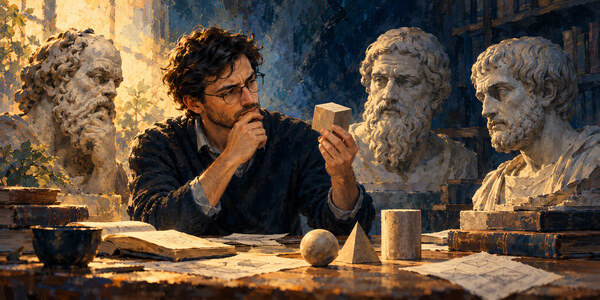
There is a peculiar paradox in studying philosophy. It teaches us to question what seems self-evident, yet philosophers themselves can easily become new authorities whose words we accept without examination. Instead of investigating reality, we then begin searching for a suitable quotation to confirm an opinion we have already chosen. The thinker’s name replaces the argument, and admiration replaces understanding.
No great author lived outside their own time. Even the most penetrating ideas emerge amid particular social conditions, available knowledge, and human limitations. This does not diminish their value, but it reminds us that philosophical truth is not established merely by the age of a text or the fame of its author. The question always remains whether a claim is justified and what follows from it.
We therefore do not need to choose between unconditional reverence and complete rejection. We can learn from Socrates without expecting every conversation to end in the same way. We can appreciate the scope of Plato‘s thought without accepting every political proposal he makes. We can use Aristotle’s questions without treating his answers as the final boundary of human knowledge.
From Someone Else’s Answer to Our Own Question

At the beginning of learning, we naturally ask what a particular philosopher said. This is necessary, because without carefully understanding another person’s thought, we can easily end up arguing against an invented version of it. Gradually, however, another question emerges: what do I think, and why? It is more difficult because we can no longer hide responsibility behind an authoritative name.
Having a position of our own does not necessarily mean inventing a theory no one has ever proposed before. Sometimes it begins with the honest admission that an argument convinces us only in part. At other times it arises when we discover a question that the text we have read has not addressed. And sometimes genuine progress consists in understanding why we are not yet ready to draw a conclusion.
Independent thinking is not arbitrariness. It requires us to distinguish observations from assumptions, what is possible from what has been demonstrated, and personal preference from an argument that claims wider validity. If an idea strikes us as beautiful, that is not sufficient reason to regard it as true. If another idea troubles us, our discomfort is not evidence against it either. Philosophical maturity begins when we allow arguments to matter even when they do not confirm our expectations.
When a Question Reaches the Boundaries of the Universe

One of the articles in this Journey took a step beyond the historical presentation of Aristotle. Using his four causes, it raised questions about the universe, possible creation, God, and whether existence implies a purpose. There, an ancient philosophical framework became a starting point for the author’s own reflections. This transition illustrates what can happen when reading develops into independent thought.
Yet this transition requires particular care. Applying a philosophical system to the universe does not automatically mean that we have proved how the universe came into being. Imagining multiple universes does not mean that we have established their existence. Nor can the assumption that the world does or does not have a purpose, by itself, settle the question of God’s existence. Such reflections may be fruitful philosophical hypotheses, but they must be clearly distinguished from scientifically confirmed claims.
Here we encounter not a weakness but an opportunity. Philosophy can examine the meaning of concepts, the logical consequences of assumptions, and the limits of possible explanations. Science requires observations, models, and testable predictions when dealing with empirical claims about nature. The two pursuits can raise important questions for one another, but we should not replace evidence with a persuasive analogy. Knowing where our argument ends is just as important as having the courage to begin it.
Why Unanswered Questions Are Not a Failure

We often expect knowledge to eliminate uncertainty. We hope that after reading enough books, we will reach a point where the great questions no longer trouble us. Yet every deeper understanding may also reveal new difficulties. An answer to one question sometimes shows us that we have failed to ask another, even more important one.
This does not make philosophical effort meaningless. There is an essential difference between the confusion with which we begin and a clear understanding of why a problem remains open. In the first case, we do not even know exactly what we are seeking. In the second, we can distinguish the different possibilities, see the strengths and weaknesses of arguments, and explain what would be needed for a more convincing conclusion.
Leaving a question unresolved can be an expression of intellectual honesty. Sometimes the most accurate answer is that we do not yet have sufficient grounds. It may feel less satisfying than a categorical statement, but it protects us from self-deception. Philosophy does not promise to eliminate every unknown; it can teach us to live with the unknown without abandoning the search for truth.
Thinking Has Consequences

It is easy to imagine philosophy as an activity that takes place only in the silence of a library. Yet the way we think gradually influences the way we speak, disagree, and make decisions. If we are accustomed to accepting the first explanation that suits us, we will probably do the same when judging other people. If we have learned to examine our reasons, we may become more attentive to the consequences of our own certainty.
This does not mean that people educated in philosophy necessarily behave better. Knowing arguments does not guarantee honesty, and the ability to debate is not the same as respect for one’s conversation partner. Intellectual skills can sometimes even be used to devise more ingenious justifications for our own weaknesses. That is precisely why it matters to ask not only whether we can defend a position, but also whether we are willing to change it when we encounter a sound objection.
One of the most difficult forms of thinking is admitting that the person opposite us may see something we have overlooked. This admission does not oblige us to agree with them. It simply opens the possibility that a conversation can be more than a contest for dominance. If the philosophical Journey has taught us something practical, perhaps it is this very ability to seek understanding without turning every disagreement into hostility.
Choosing the Questions Worth Devoting Our Lives To

No one can investigate everything. Our time is limited, while the world offers more mysteries than a single lifetime could encompass. What matters, therefore, is not only how we answer questions but also which questions we choose to pursue. Some arise from curiosity, others from personal pain, and still others from the feeling that a particular injustice must not go unchallenged.
Choosing a question is not a final decision for an entire lifetime. Our interests can change, and new experiences may lead us in unexpected directions. But it matters to recognize the difference between a question that genuinely concerns us and a subject we discuss only because it seems prestigious. Philosophy acquires personal meaning when we stop using it to impress others and start using it to understand.
Questions about truth, justice, happiness, existence, and death will not receive the same answer from everyone. This does not mean that every answer is equally well supported. It means that the conversation remains open and that participating in it requires both conviction and a willingness to change. This dual responsibility is what makes philosophical inquiry difficult, but also worthy of continuation.
After the Final Page

At the beginning of this Journey, we encountered thinkers whose names have become symbols of philosophy. At its end, what matters more is that we do not leave them as mere symbols. Their works belong to history, but the questions they raise return whenever we must decide what to believe, how to treat another person, or what it means to seek meaning in the world.
We do not need to finish with a unified theory that combines Socrates, Plato, and Aristotle without contradiction. Such a synthesis would conceal the real differences between them. It is more valuable to have gained the ability to read carefully, distinguish questions from answers, and recognize the moment when we must continue on our own. A great teacher is not someone after whom there is nothing left to ask, but someone after whom we begin asking better questions.
The seventh article, therefore, does not put an end to philosophy. It brings only this part of our Journey to a close. From here onward, there is no final chapter written in advance, because the next questions will arise from life, new knowledge, encounters with other people, and our own doubts. If we have become more attentive to truth, more honest about our limitations, and more courageous in independent thought, then the Journey has fulfilled its purpose.
And perhaps this is where its most meaningful conclusion lies: not in the certainty that we now know how the world must be ordered, but in the willingness to keep trying to understand it. Not in wanting some great philosopher to think in our place, but in taking responsibility for seeking the grounds of our own beliefs. After Socrates, Plato, and Aristotle, what remains is not a ready-made truth for us simply to possess, but an open path. From here onward, it is ours.
Author: Vasil Stoyanov