
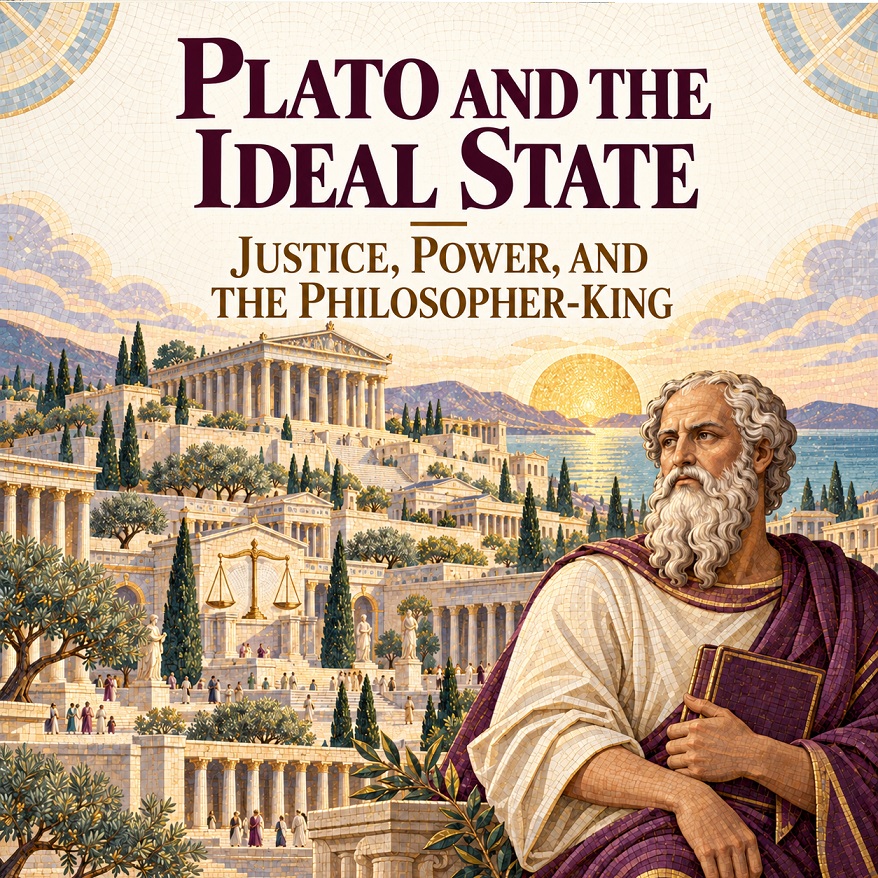
What makes a state just? Does justice mean that everyone receives what they deserve, should laws express the will of the majority, or does genuinely good government require something more than elections, wealth, and political influence? These questions sound modern, yet approximately two and a half thousand years ago Plato was already asking them with remarkable urgency. In his dialogue Republic, he transforms the debate about justice into an extensive investigation of the human soul, education, knowledge, and political power.
Plato’s ideal state is not merely a proposal for a capital city, institutions, and rules. It is a thought experiment through which the philosopher seeks to explain why being just is better even when injustice promises rewards. To understand the just individual, Plato suggests that we first examine justice on a larger scale-in the organization of a community. This begins an unusual journey through the division of labor, education, the governance of desires, and the famous figure of the philosopher-king.
Yet this journey does not lead to an unquestionable recipe for a perfect society. Plato’s proposals raise difficult problems concerning freedom, equality, censorship, family life, and citizens’ right to participate in government. Some ideas can be read as an attempt to ground political authority in knowledge and virtue, while others seem to offer a dangerous justification for strict political control. To understand their significance, we must examine not only what Plato proposes but also why he proposes it, how he argues for it, and where the strongest objections remain.
The Historical Background: Why Plato Lost Confidence in Ordinary Politics
Plato lived approximately between 427 and 347 BCE, during a period when Athens experienced profound political crises. The Peloponnesian War shattered confidence in Athenian power, and defeat by Sparta was followed by a brief oligarchic government known as the Thirty Tyrants. After democracy was restored, the city remained an intellectual center, but it was marked by mutual distrust and disputes about legitimacy. Plato witnessed how different political systems could permit violence, injustice, and abuses of authority.
The fate of Socrates, sentenced to death by an Athenian court in 399 BCE, was especially important to him. In Plato’s writings, Socrates appears as a man who investigates virtue and insists that opinion is not equivalent to knowledge. His conviction raises a painful question: how could a society that prided itself on public debate condemn one of its most persistent thinkers? We need not assume that this event explains every aspect of Plato’s political philosophy to appreciate how strongly the problem of incompetent and unjust government shaped his thinking.
For Plato, politics is not simply a struggle among interests but an activity that ought to rest on knowledge of the good life. When a captain commands a ship, we expect expertise in navigation, and when a physician treats a patient, we expect medical knowledge. Why, then, should governing an entire city be entrusted solely to popularity, inherited position, or the ability to deliver a persuasive speech? This question lies behind Plato’s criticism of the political habits of his time and his search for a different foundation of legitimate authority.
The Republic: A Dialogue About Justice, Not an Ordinary Political Manual
The principal source for Plato’s model is the dialogue Republic, whose Greek title, Politeia, concerns the constitution of a community and its civic order. The work is not written like a modern legislative proposal, nor does it provide an administrative blueprint ready for implementation. It is a philosophical conversation in which Socrates and his companions examine competing definitions of justice. The political construction gradually emerges as a means of investigating the soul of the individual as well.
At the beginning, Cephalus associates justice with honesty and fulfilling obligations, while Polemarchus understands it through our treatment of friends and enemies. Thrasymachus offers the more provocative claim that justice is whatever benefits the stronger party. Later, Glaucon and Adeimantus insist that Socrates show why justice is valuable in itself, rather than merely because it produces a good reputation and social rewards. This demand makes the conversation far more complex than a dispute over the proper distribution of political power.
Plato is not satisfied with the claim that a just person usually earns respect. He must defend a stronger thesis: that a just life is better even when external circumstances appear unfavorable. The construction of the ideal city therefore serves two purposes. It shows how different social activities might be organized, while also providing an enlarged image of the individual’s inner organization.
The Challenge of Thrasymachus: Justice as the Interest of the Stronger
Thrasymachus challenges the idea that justice exists independently of political power. According to his provocative position, rulers establish rules for their own benefit and call obedience to those rules just. Law can therefore appear moral while actually serving the interests of a particular group. His thesis is uncomfortable because it exposes the possibility that political authority may use the language of virtue to conceal domination.
Socrates responds by asking what the genuine art of governing involves. If medicine aims at the patient’s benefit and navigation at the safety of the voyage, should governing not serve the governed? This introduces a distinction between exercising authority for personal profit and fulfilling a public responsibility. The issue is not whether actual rulers always behave properly, but what would justify political authority as an activity.
This debate remains important because every political system must confront the possibility that institutions will be captured by private interests. Plato’s proposed solution is to educate rulers who are not motivated primarily by wealth and prestige. Yet his answer generates another difficulty: who can establish that those presumed to possess knowledge genuinely act for the common good? Thus, from the beginning of the dialogue, we encounter the tension between the need for competence and the danger of unchecked power.
The Ring of Gyges: Why Be Just When Nobody Is Watching?

Glaucon tells the story of a ring that gives its wearer the ability to become invisible. Someone possessing such power could break the rules without fearing the usual consequences. The thought experiment subjects justice to an extreme test: would we remain honest if nobody could discover what we had done? If the answer is no, perhaps moral behavior is merely a protective strategy rather than a genuine value.
Glaucon intensifies the challenge by contrasting an unjust person with a flawless reputation and a just person whom everyone regards as a criminal. External rewards are thereby separated from actual character. It is not enough to say that honesty earns respect, because in this example respect goes to the person who does not deserve it. Plato must demonstrate that justice matters for the structure of the soul itself and for the quality of life.
The story of Gyges also matters today, when technology, anonymity, and complex institutions can conceal responsibility for actions. It forces us to distinguish behavior under observation from behavior arising from inner conviction. Society can establish punishments and incentives, but these do not fully explain why someone chooses not to abuse their opportunities. Plato will seek the explanation in a well-ordered, rational, and just soul.
Why Plato Begins with the Origins of the City
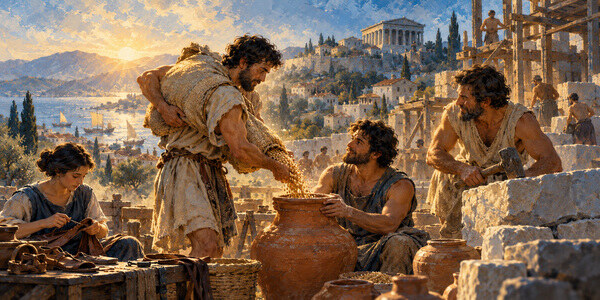
To discover justice on a larger scale, Socrates proposes that we imagine observing how a city comes into existence. People cannot easily satisfy all their needs alone, so they gather into a community. One person cultivates the land, another builds houses, a third makes shoes, and others provide the necessary tools. The division of labor emerges not as an arbitrary command but as a response to human interdependence.
The original city is relatively simple and mainly concerned with the necessities of life. Glaucon, however, considers it too modest, because human beings also desire comforts, arts, and pleasures. As needs expand, the demand for resources, territory, and protection increases, opening the way to conflict and war. Plato thus shows how social order becomes more complicated when desires extend beyond immediate necessities.
This is not a historical account of how all actual states originated. It is a philosophical construction examining how needs and human abilities generate social interdependence. One of the dialogue’s central ideas already appears here: a community is not merely a collection of self-sufficient individuals but a system of complementary activities. Later, the proper distribution of these activities becomes the foundation of Plato’s definition of justice.
The Three Classes: Producers, Guardians, and Rulers
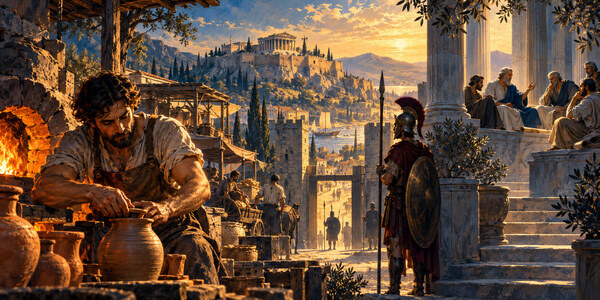
In the developed model of the ideal city, Plato distinguishes three principal social functions. Producers engage in agriculture, crafts, commerce, and the material provision of life. The auxiliary guardians defend the community and must combine courage with discipline. Rulers make the most important decisions and are supposed to possess the deepest understanding of the common good.
This distinction is not simply an economic classification. It reflects the conviction that different tasks require different abilities and appropriate education. A good soldier does not automatically become a good statesman, just as a wealthy merchant does not acquire political wisdom merely through commercial success. Ideally, social responsibilities should correspond to abilities and moral preparation rather than simply to birth or wealth.
At the same time, the system carries an obvious risk of rigid social divisions and restrictions on individual choice. Plato allows that children may possess qualities different from those of their parents, but the social model remains strongly hierarchical. Its aim is not modern equality of opportunity but the functional unity of the city. We must therefore distinguish the proposal’s internal logic from the values by which we might evaluate it today.
The Four Virtues of the Just City
Once the city has been constructed in thought, Socrates begins searching for its principal virtues. Wisdom is associated with good government and knowledge of the community as a whole. Courage belongs especially to the guardians, who must preserve the correct understanding of what is dangerous and worthy of fear. Moderation represents agreement among the different parts of the city about who should govern.
Justice emerges as the principle that maintains the other virtues within a common order. In Plato’s model, it means that each part performs its own function without appropriating another part’s responsibilities. This is not identical to the modern conception of justice as equal rights, equality before the law, or the protection of personal autonomy. Plato is concerned primarily with the harmony of the whole organism rather than with the freedom of individual citizens to choose any social role they wish.
The idea has a certain appeal because every complex community genuinely requires competence, responsibility, and cooperation. Yet it becomes problematic when an existing division of roles is declared natural and placed beyond criticism. Those who decide which people are suited to particular tasks then acquire enormous power over other lives. Plato’s justice must therefore be understood both as a philosophical theory of order and as a proposal requiring serious political scrutiny.
The Three Parts of the Soul: Reason, Spirit, and Appetite

Having identified corresponding functions in the city, Plato turns to the inner life of the human being. He distinguishes a rational part that seeks truth and judges what is good, an appetitive part associated with bodily needs and material acquisition, and a spirited part expressed through ambition, anger, and the desire for recognition. The last is often identified by the Greek word thumos. This division is not a modern psychological theory but a philosophical attempt to explain inner conflict.
Plato uses examples in which a person simultaneously desires something and refrains from it. Thirst may urge someone to drink, while rational judgment warns that the drink is dangerous. Anger, meanwhile, can sometimes support reason against appetite when someone feels indignation at their own weakness. Such situations suggest that different motivations cannot be reduced to one undifferentiated force.
A just soul is one in which reason governs, the spirited part supports it, and appetites are properly educated and restrained. Injustice arises when a part that should not rule takes control of the whole person. Greed, uncontrolled ambition, or the pursuit of pleasure can then turn the individual into a site of continual conflict. The political model and psychological theory mirror each other because Plato sees a similar problem in the disordered state and the disordered soul.
Justice as Inner Harmony Rather Than Mere External Obedience

One of the most original ideas in the Republic is that justice cannot be reduced to visible actions. A person may obey the law out of fear of punishment without achieving moral integrity. By contrast, a just character is expressed through properly ordered motivations that make rational action consistent. Plato compares this organization to harmony, in which different elements do not disappear but perform coordinated functions.
Here we also find his answer to the story of the Ring of Gyges. If an unjust action damages the soul’s internal order, it causes harm even when it remains hidden from everyone else. Profit obtained through deception cannot adequately compensate for the loss of rational self-government. This is a powerful moral thesis because it shifts the value of justice from external consequences to the quality of human existence itself.
Of course, the question remains whether Plato fully demonstrates that moral order always produces a better life. Someone might object that just people sometimes endure severe suffering while unjust people appear satisfied. Plato would answer that pleasure and success are not the only measures of well-being, but this does not eliminate every difficulty. The debate reveals how closely ethics, psychology, and political organization are connected in his philosophy.
Who Should Govern? The Birth of the Philosopher-King
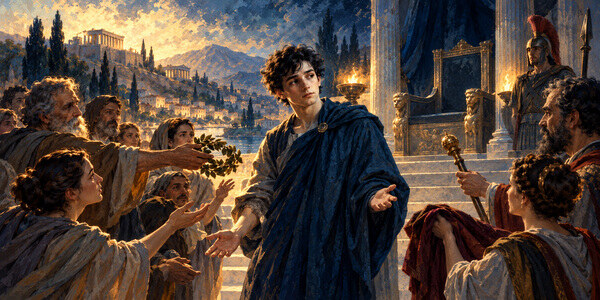
Plato’s most famous and controversial proposal is that cities will not escape their serious troubles until philosophers become rulers or rulers genuinely begin to philosophize. This does not mean that everyone who enjoys books and debates should receive political power. Plato has in mind someone capable of distinguishing knowledge from opinion and directing decisions toward the community’s good. Governing is presented as a responsible activity requiring prolonged education and moral self-restraint.
The image of the philosopher-king arises from distrust of power based solely on the desire for power. A candidate who longs to govern for prestige or wealth already displays a dangerous motivation in Plato’s view. The most suitable ruler is therefore someone who would prefer a life of contemplation and knowledge but accepts public responsibility out of necessity. This paradoxical idea attempts to separate political authority from personal ambition.
Yet it generates a fundamental political objection. Even a highly educated person is not guaranteed to make flawless decisions or understand the needs of every citizen. Moreover, knowledge of mathematics and philosophy does not automatically amount to practical competence in complex social situations. Plato’s model sharpens the question of competent government, but it offers no indisputable mechanism by which society can identify and control supposedly wise rulers.
The Philosopher Is Not Merely a Scholar: Knowledge and Opinion

For Plato, a philosopher is distinguished less by the quantity of memorized information than by the direction of their thinking. Many people may admire beautiful objects, just actions, and good decisions without asking what makes beauty, justice, or goodness possible. The philosopher searches for a stable foundation behind numerous changing manifestations. This task is connected with Plato’s theory of Ideas or Forms, explored more fully in other parts of his philosophical work.
In the Republic, the distinction between opinion and knowledge has immediate political significance. A ruler who follows only the majority’s changing moods risks becoming subordinate to shifting desires. A ruler who claims knowledge should be able to explain why a decision is good beyond its immediate popularity. Plato believes that genuine knowledge allows a more stable orientation toward justice.
Yet this introduces an important problem concerning the limits of human certainty. Political decisions often depend on incomplete information, conflicting interests, and unpredictable consequences. Even if an objective good exists, it is not obvious that any individual knows it sufficiently to govern without correction. A modern reader may therefore accept Plato’s demand for reasoned competence without accepting the unrestricted authority of a philosophical elite.
The Form of the Good: Why Politics Needs a Highest Principle

At the center of Plato’s philosophy lies the question of what makes other things genuinely good. It is not enough for a ruler to know how to build fortifications or organize an economy if they do not understand the purpose for which those abilities should be used. Knowledge of means is not the same as knowledge of the right end. This is why Plato places the Form of the Good above particular practical skills.
In the famous analogy of the sun, the Good is presented as a condition of the intelligibility and value of things. Just as sunlight makes visible objects accessible to sight, the Good enables the mind to understand truth and the significance of what is known. This is a philosophical analogy, not a physical theory of light or consciousness. Its purpose is to show why the highest question is not only what exists but also why knowledge and right action share a common direction.
Politically, the idea has decisive importance. A ruler must evaluate laws and decisions not merely according to immediate advantage but according to whether they contribute to a well-ordered life. Plato does not provide an easy list of concrete policies that automatically follow from the Good. Instead, he demands philosophical orientation, a requirement that is both elevated and difficult to verify in practice.
The Divided Line: Stages Between Appearance and Understanding

In Book Six of the Republic, Plato uses the image of a divided line to explore different degrees of cognition. The lowest levels are associated with images, shadows, and reflections, followed by perceptions of visible objects. Higher up stands mathematical reasoning, which works with assumptions and abstract relationships. At the highest level, dialectic seeks to examine the very foundations of knowledge.
This arrangement is not simply a dismissal of sensory experience. It shows that different ways of thinking offer different degrees of justification and stability. Mathematics, for example, is not satisfied with how a triangle drawn in sand appears but investigates relationships independent of the drawing’s imperfections. Dialectic goes further by questioning the assumptions that other disciplines employ.
For the future ruler, this educational structure has a specific purpose. They must learn to distinguish immediate impressions from considered reasons and private interest from general principles. Plato hopes that such preparation will reduce the danger of politics becoming a manipulation of public moods. Yet a high level of abstract reasoning does not itself guarantee moral integrity, which remains one of the project’s weaknesses.
The Allegory of the Cave: Education as the Turning of the Soul

Book Seven of the Republic presents one of philosophy’s most influential allegories. People are chained inside a cave and can see only shadows moving across the wall before them. Because they know nothing else, they take the shadows to be the whole of reality. One prisoner is released and gradually begins to see objects, sources of light, and finally the world outside the cave.
The ascent is painful because the liberated person’s eyes are unaccustomed to the new light. Knowledge does not arrive as an instantly pleasant revelation but through a difficult process of adjustment, doubt, and reorientation. When the prisoner returns to the others, the shadows appear different to him, yet he may encounter distrust and hostility. The allegory explores both the difficulty of learning and the resistance that new understanding can provoke within a community.
In its political context, the most important moment is the return. The philosopher who has reached a higher understanding should not simply remain outside the cave enjoying knowledge. They have a duty to participate in governing the community, even if this activity is less attractive than contemplation. Education is therefore presented not merely as personal achievement but as a source of public responsibility.
Educating the Guardians: Music, Gymnastics, and Character
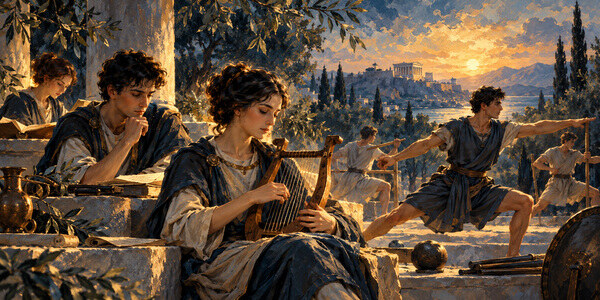
Plato believes that a good political order cannot be maintained through laws and punishments alone. Those entrusted with defending the city must be educated from an early age. In its broad ancient sense, music includes poetry, stories, rhythm, and cultural education, while gymnastics develops physical endurance and discipline. The aim is to cultivate a character that combines firmness in the face of danger with moderation toward fellow citizens.
This program follows from the observation that strength without moral preparation can become violence. A guardian must be resolute against external threats without behaving like a predator toward the people they protect. Plato seeks a balance between energy and self-control, courage and reason. Here we see his conviction that political institutions depend on the education of the individuals who serve them.
But the program also raises a serious question about cultural freedom. If the state decides which stories are suitable for future guardians, who determines acceptable images of heroism, fear, and virtue? Plato believes that education is not morally neutral, which is a defensible observation. The problem arises when this is taken to mean that rulers should control almost the entire imaginative world of those being educated.
Mathematics, Dialectic, and the Long Road to Government
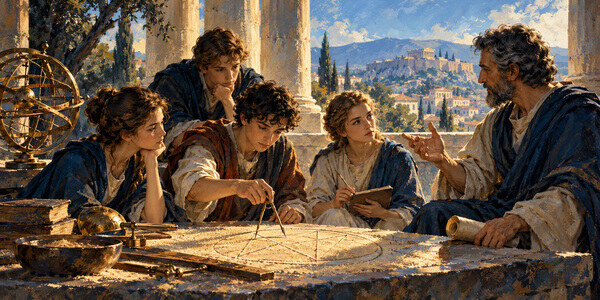
The education of future philosopher-kings does not end in childhood. Plato proposes extended preparation involving arithmetic, geometry, astronomy, and the study of harmonic relationships. These disciplines are intended to free thought from dependence on immediate sensory impressions and direct it toward stable relationships. They prepare the mind for dialectic, which investigates the deeper foundations of knowledge.
The dialogue also outlines successive stages of age, practical testing, and philosophical study. Intellectual talent alone is insufficient; candidates must demonstrate resilience in the face of temptation and a sense of public responsibility. Government is entrusted to mature individuals who have undergone prolonged examination. This model contrasts slow preparation with rapid advancement through wealth, family background, or charismatic speaking.
From a modern perspective, the idea that public leaders require preparation is entirely understandable. Complex institutions demand knowledge, experience, and the ability to think in the long term. Yet no single philosophical curriculum can guarantee the proper government of every society. Democratic systems attempt to combine competence with elections, accountability, separation of powers, and the peaceful replacement of leaders-mechanisms that are not central to Plato’s ideal model.
Why Rulers Should Not Accumulate Personal Wealth

Plato fears that political power can easily become a means of personal enrichment. He therefore proposes restrictions on private property and lifestyle for the guardian and ruling classes. They should not possess large private fortunes that might separate them from the community or turn them into competing economic factions. Their material needs should be provided for in a way that prevents their public responsibilities from becoming subordinate to personal profit.
This idea has a clear moral logic. When someone both controls the rules and derives private benefits from them, a conflict of interest arises. Plato attempts to eliminate the possibility of a ruler turning the state into personal property. He does not propose an identical property system for every social class, an important distinction when comparing his ideas with modern economic ideologies.
However, these restrictions do not solve every problem of power. Even without private wealth, rulers may seek prestige, influence, control, and privileges that cannot be measured in money. Dependence on collectively organized provision may also create new forms of coercion. Plato’s proposal is a strong warning against corruption, but it is not sufficient proof that eliminating property automatically produces virtue.
Women Among the Guardians: A Radical Idea with Important Limits
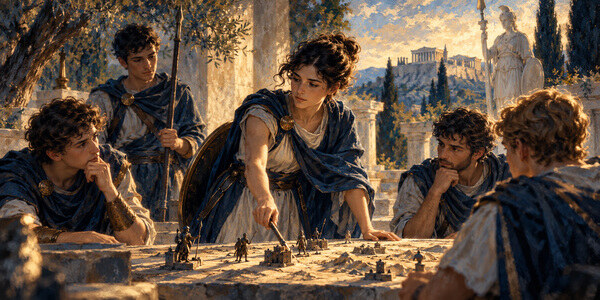
One of the most unexpected positions in the Republic is that women can serve as guardians and rulers if they possess the necessary abilities. Plato challenges the notion that differences between the sexes automatically determine every social task. He uses analogies to show that selecting someone for a particular activity should depend on qualities relevant to that activity. If a woman possesses the appropriate nature and preparation, there is no reason to exclude her simply because she is a woman.
For the ancient context, this is a remarkable proposal because women’s political rights in Athens were severely restricted. Plato envisages shared education and women’s participation in the guardian class. However, he continues to accept certain hierarchical assumptions about physical abilities and does not advocate universal equality in the modern sense. His argument is directed toward the functions of the ideal city rather than individual rights as an independent political principle.
This duality makes his position particularly interesting. On one hand, Plato expands the conceivable participation of women in public life. On the other, their opportunities are determined by the needs of the state and the judgment of its rulers. We can recognize the philosophical breakthrough without overlooking the limitations of his understanding of freedom and equality.
Family and Community: The Most Controversial Part of the Ideal City

Plato proposes even more radical changes to family life among the guardians. In the ideal model, traditional private family relationships within this group are to be replaced by collectively organized child-rearing. The aim is to prevent guardians from placing the narrow interests of their own families above the welfare of the entire city. Plato thereby attempts to prevent favoritism toward relatives and the transformation of public office into inherited property.
The proposals include regulation of unions and reproduction through decisions made by the rulers. This is among the most troubling aspects of the project because it directly affects personal autonomy and human dignity. Such measures should not be presented as harmless simply because they belong to a philosophical thought experiment. They demonstrate how far political reasoning can go when communal unity is placed above the freedom of personal relationships.
Modern readers must distinguish intentions from methods. The desire to prevent corruption, inherited privilege, and conflicts of interest may be understandable. But coercive regulation of family life and reproduction creates problems that cannot be justified merely by promises of social harmony. Here Plato’s ideal state most clearly reveals the danger of government that claims to know what is best for everyone better than individuals themselves.
The Noble Lie: Can the State Use a Myth to Create Unity?
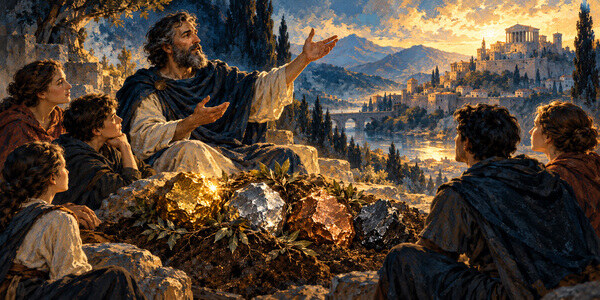
The Republic introduces the idea of a story intended to strengthen the conviction that citizens belong to one community and that their different functions have a shared origin. It is known as the myth of the metals or the “noble lie.” According to the story, people possess different qualities, symbolically represented by gold, silver, iron, and bronze. The narrative is meant to encourage acceptance of social roles while also allowing that a child may possess qualities different from those of their parents.
This creates a serious tension between truth and political usefulness. If philosophers are supposed to be devoted to knowledge, why would they use a fabricated story to organize citizens’ beliefs? Plato seems to allow that certain shared representations can serve social stability even when they are not literally true. Yet such an assumption can easily justify manipulation if those in power decide for themselves which falsehoods are beneficial.
The problem remains relevant in every society that uses symbols, national myths, and simplified historical narratives. Shared stories can create belonging, but they can also conceal inequality or restrict critical thinking. Plato’s example forces us to ask whether durable political unity can be built on a deliberately maintained falsehood. The question is especially uncomfortable because it comes from a philosopher for whom knowledge of truth is a supreme value.
Poetry, Art, and Censorship: Who Educates the Imagination?
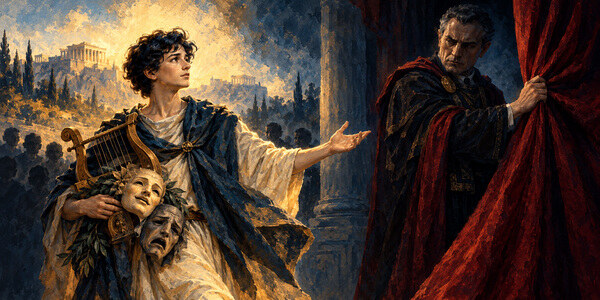
Plato regards poetry and storytelling as forces that influence character long before a person can analyze them rationally. If young people continually hear stories in which gods deceive, heroes obey uncontrolled anger, and injustice earns admiration, these images may shape their moral habits. He therefore proposes careful selection of works used in educating the guardians. This position reflects a serious appreciation of culture’s psychological influence.
In the later books of the Republic, the criticism of representational art also acquires an epistemological dimension. Plato worries that an artist or poet can produce a convincing image without possessing knowledge of the actual subject. The emotional power of representation does not guarantee its truth. Certain forms of poetry consequently become problematic for the ideal community.
From a modern perspective, this raises the question of who has the right to decide which artistic works are permissible. Art does not serve only moral education; it can explore contradictions, challenge authority, and give voice to different human experiences. Restricting it in the name of virtue may destroy the very space for criticism that philosophy requires. Plato’s concern about education deserves attention, but his proposed solution calls for firm critical distance.
The Criticism of Democracy: Unrestrained Freedom and the Danger of Demagoguery
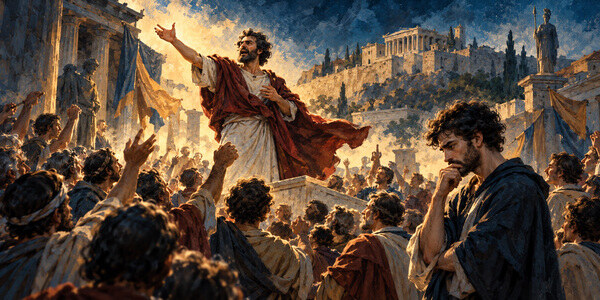
Plato does not regard democracy as unquestionably the best political system. In Book Eight of the Republic, he describes it as a regime characterized by strong freedom and diversity, but one that may weaken shared standards of order and competence. Citizens gain opportunities to choose different ways of life, which Plato presents as both attractive and potentially unstable. His fear is that freedom may turn into a rejection of every reasonable hierarchy.
He is especially concerned that political popularity may become separated from actual governing ability. An orator can win support by promising immediate satisfaction of desires instead of proposing difficult but necessary decisions. Plato sees in this dynamic the danger of demagoguery, in which the majority’s emotions become instruments of personal power. This criticism can still be discussed today without accepting his preference for philosophical rule.
Modern democratic theories would respond that free participation need not be mechanically opposed to competence. Representative institutions can employ expert knowledge, public reasoning, independent courts, and mechanisms of accountability. Democracy also offers a way to replace mistaken leaders peacefully without assuming that anyone is infallible. These advantages do not eliminate the danger of demagoguery, but they show why Plato’s criticism is not a final refutation of democratic government.
The Five Regimes: How States Move Away from Justice in Plato’s Account
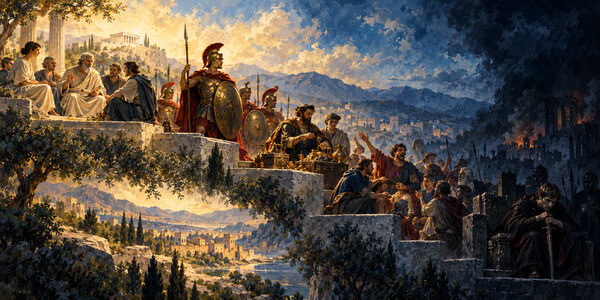
Plato presents a sequence of political constitutions beginning with the ideal aristocracy of virtuous rulers and proceeding through timocracy, oligarchy, democracy, and tyranny. Here “aristocracy” means rule by the best in moral and intellectual qualities, not necessarily hereditary aristocracy. Timocracy places honor and military recognition at its center, while oligarchy organizes political authority around wealth. Democracy expands freedom, and tyranny, according to Plato, emerges when unrestrained desires and political conflicts destroy stable order.
This sequence should not be read as a universal historical law according to which every real state inevitably passes through exactly the same stages. It is a philosophical typology connected with different conceptions of human character. Each regime corresponds to a kind of soul in which one motivation dominates the others. Political transformations are thus understood as manifestations of different moral orientations.
The model’s strength is that it shows how institutions can be influenced by the values a society rewards. If wealth becomes the sole measure of success, political power may become subordinate to economic inequality. If glory and military prestige become supreme, public decisions may turn toward rivalry and conflict. Actual political systems, however, are more varied and historically complex than Plato’s scheme allows.
The Tyrant: Why Unlimited Power Is Not Genuine Freedom

At the end of his political typology, Plato examines tyranny as the most extreme form of disorder. The tyrant appears able to do whatever he wishes, yet inwardly he is ruled by fear, suspicion, and insatiable desires. He must constantly defend his power and finds it difficult to trust others. External freedom from restraint is therefore combined with inner dependence.
This idea is directly connected to Plato’s theory of the soul. Someone subordinate to uncontrolled desires does not truly govern themselves, even when commanding an enormous state. Their condition is the opposite of that of the just person, whose reason creates a stable order among different motivations. Plato uses this contrast to defend the thesis that genuine freedom is not identical to the unrestricted ability to impose one’s will.
In a modern context, we can read this as a warning against power without limits. The more decisions depend on one person, the greater the possibility that their fears and desires become a public problem. But the same argument must also be applied to the supposed philosopher-king if that ruler’s power is beyond scrutiny. Plato’s model can therefore be criticized using concerns arising from his own awareness of human weaknesses.
Can the Philosopher-King Become a Tyrant?
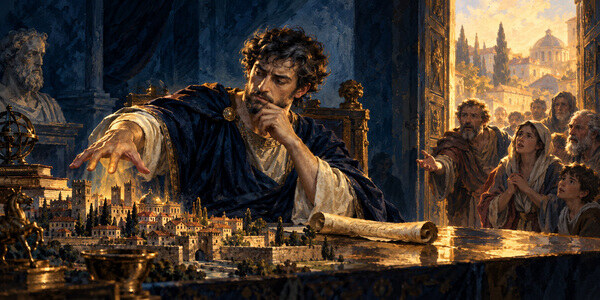
Plato believes that genuine philosophical education directs a person toward the Good and reduces the desire for private advantage. Yet every political theory must explain not only how an ideal ruler would act but also what happens when an actual ruler makes mistakes. If authority is concentrated and independent checks are absent, even good intentions can produce severe consequences. Confidence that someone knows the common good can become a reason to ignore dissenting voices.
There is also the problem of who will select the philosophers. If the rulers themselves decide who is sufficiently wise, the system may reproduce its own beliefs and interests. If citizens cannot challenge the selection, mistakes may remain uncorrected for a long time. If the choice instead depends on public judgment, Plato’s opposition between knowledge and mass opinion becomes complicated once again.
It is therefore useful to separate two principles closely connected in the Republic. The first is that governing requires knowledge, character, and orientation toward the common good. The second is that these qualities can justify especially concentrated political authority. The first principle can be defended within a modern democracy, while the second remains deeply controversial.
Plato and Aristotle: Two Different Visions of the Good Community

Aristotle, who studied at Plato’s Academy, later developed his own political philosophy and criticized some of his teacher’s proposals. In the Politics, he examines the human being as a creature naturally living in a political community, while placing greater emphasis on the diversity of its constituent parts. In his view, excessive unity can destroy what makes a city a genuine community of different people. Plato’s pursuit of harmony thus encounters an objection grounded in the need for diversity.
Aristotle particularly criticizes the community of women, children, and property proposed for the guardian class. He doubts that removing private relationships will necessarily strengthen responsibility and care. When something belongs to everyone in an unclear way, people may feel less personally obliged to look after it. This criticism does not prove that every form of common ownership is unsuccessful, but it reveals a weakness in the assumption that unity automatically produces virtue.
The difference between the philosophers is deeper than a disagreement about individual institutions. Plato searches for an ideal principle according to which the entire city should be ordered, while Aristotle more often investigates existing political forms and the conditions of their stability. Both connect politics with ethics and the good life, but they offer different approaches to the actual diversity of citizens. Their disagreement would continue to influence European political thought for centuries.
Statesman and Laws: Does Plato Change His Approach to Government?
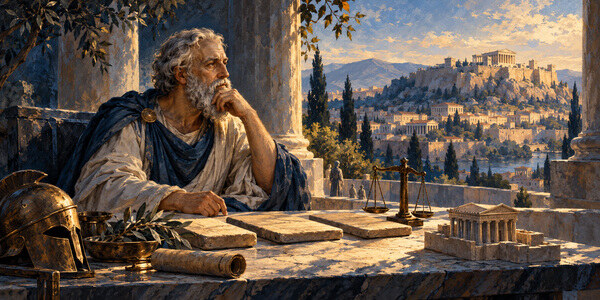
Plato’s political philosophy is not exhausted by the Republic. In the dialogue Statesman, he continues to investigate what distinguishes the genuine expertise of governing. In Laws, one of his latest and longest works, attention turns toward more concrete legislation and the organization of a community. These texts show that Plato’s political thinking should not be reduced to one fixed model.
In Laws, the role of written rules and educational institutions becomes much more visible. Instead of relying exclusively on the ideal philosophical ruler, the work examines how a community can be organized through laws, customs, and stable practices. This does not mean that Plato suddenly adopts modern liberal democracy or abandons the pursuit of moral education. It does show, however, that the question of good government can also be approached through the limitations of actual human societies.
Comparing these works is important because it prevents the simplistic impression that Plato authored only one political plan. Different dialogues employ different philosophical situations, speakers, and purposes. Some ideas remain consistent, while others receive new emphasis or a different institutional form. A serious understanding of Plato’s politics therefore requires reading beyond his most famous work and considering his broader philosophical legacy.
Is the Ideal State a Literal Project or a Philosophical Model?

Scholars disagree about how to understand the practical purpose of Plato’s ideal city. Some regard the Republic as containing a serious political ideal whose institutions should be evaluated as real proposals. Others believe that the city serves primarily as a thought experiment for understanding justice in the soul. Still others combine these perspectives because political and moral arguments are continuously intertwined throughout the dialogue.
The text itself raises the question of whether such a city could ever be realized. Socrates considers the model a standard by which reality can be assessed, even when reality does not fully correspond to it. Like a geometrical figure used to investigate relationships, the ideal city may clarify principles without existing in pure form. Yet this does not exempt its political proposals from moral criticism, particularly when they involve coercion and personal freedoms.
The distinction between an ideal and a plan is essential. An ideal can reveal deficiencies in the present and direct efforts toward better institutions. A concrete political plan, however, must account for human diversity, historical circumstances, and the danger of abuse. Reading the Republic becomes more productive when we preserve both dimensions rather than treating the dialogue only as a utopia or only as a warning.
The Main Criticisms: Authoritarianism, Freedom, and Political Knowledge
One of the most influential modern criticisms of Plato’s political philosophy concerns the danger of a closed and authoritarian society. Karl Popper, for example, interprets certain Platonic ideas as incompatible with the principles of an open society. This interpretation is itself debated, as other scholars emphasize the dialogue’s literary character and moral aims. Nevertheless, the criticism raises a genuine question: how can we prevent a claim to truth from becoming a justification for political coercion?
Particularly controversial is the subordination of personal life to the community’s goals. Restrictions on art, family relationships, and social roles demonstrate that Plato does not place individual autonomy at the center of his ideal. For him, the well-ordered whole takes priority, whereas modern theories of rights often begin with the inviolability of the individual. These are different moral starting points that cannot be reconciled simply by changing terminology.
Another criticism concerns the very idea of political knowledge. In mathematics, we can prove relationships under clearly defined assumptions, but social life contains competing values and legitimate disagreements. Different citizens may reasonably disagree about the distribution of resources, freedom, and security without one side necessarily being ignorant. Government therefore requires not only expertise but also procedures for public discussion, compromise, and the protection of dissenters.
What Remains Valuable in Plato’s Political Philosophy Today?

Despite justified objections, Plato raises questions that no society can easily avoid. How should we prepare people who make decisions affecting millions? How can we reduce politics’ dependence on personal enrichment and short-term popularity? What place should education, character, and reasoned judgment occupy in public life? These questions remain significant whether or not we accept Plato’s answers.
Plato also reminds us that politics cannot be reduced to the technical management of resources. Every society presupposes certain understandings of justice, dignity, well-being, and living together. Even when we disagree about these matters, we should be able to discuss them openly and through arguments. Political philosophy is necessary not because it supplies ready-made solutions but because it clarifies the ends toward which institutions strive.
The most productive contemporary reading may combine Plato’s demand for competence with the principle that no ruler is beyond criticism. We can value education and virtue without abandoning civil rights and the separation of powers. We can oppose demagoguery without believing that the majority should be deprived of a political voice. And we can seek the common good without allowing it to be defined unilaterally by people who are not accountable to others.
The Just Individual and the Just State: Two Sides of the Same Question

By the end of the inquiry, it becomes clear why Plato begins with the seemingly simple question of what justice is. He cannot answer it without examining human desires, the role of reason, education, and political institutions. The just city serves as an image of coordinated functions, while the just soul represents an inner organization in which reason is not enslaved by passing impulses. The two perspectives support one another, but they are not entirely identical.
We can be attracted to the idea of inner harmony without accepting rigid divisions of social roles. We can believe that government should rest on knowledge without supporting the unrestricted power of a few. We can regard education as a condition of a good life without approving state censorship. The possibility of making these distinctions keeps our philosophical conversation with Plato alive rather than turning it into a choice between unconditional admiration and total rejection.
The question of justice has no easy answer because it unites numerous values that sometimes conflict. Freedom can collide with security, equality with differences in ability, and the common good with personal aspirations. Plato offers a bold picture of a society in which these tensions are ordered through philosophical knowledge. Our task is to consider how desirable, possible, and compatible with each person’s dignity such an arrangement would be.
Conclusion: Can Power Be Wise Without Ceasing to Be Free?

Plato’s Republic is at once a defense of the just life, an investigation of the human soul, and a challenge to ordinary assumptions about political authority. Its philosopher-king embodies the hope that knowledge and virtue can rise above greed, vanity, and the desire to dominate. Yet the ideal city also reveals the danger of a society that sacrifices freedom for the sake of a predetermined harmony. This duality explains why the work continues to inspire both admiration and disagreement.
Plato leaves us not only answers but questions that have become part of political thinking itself. Who should govern, by what standard, and under whose supervision? Do good institutions create good people, or do good people make just institutions possible? Can a community pursue high moral aims without turning individual human beings into instruments for achieving them?
In our philosophical journey, this article extends our exploration of Plato beyond the world of Forms and the nature of the soul, showing how those ideas become a political theory. The next major step leads toward Aristotle, who will examine the good life, virtue, and the state using different concepts and methods. The two thinkers nevertheless share a central conviction: politics is not merely about who possesses power but about the kind of human life that power should serve. Perhaps Plato’s most valuable lesson is that justice requires not only rules and strength but also a continuous effort to understand what the common good truly means.
Author: Vasil Stoyanov