To ask why consciousness exists is like asking why there is light in the cosmos. We can describe the mechanism, we can measure the energy, but the experience itself – the very “feeling” – remains elusive. And yet, it is precisely this feeling that makes us human.
Consciousness is not just a function. It is an experience. It is not only thinking, but awareness that you are thinking. It is not only life, but knowing that you are alive.
The Path from Matter to Thought
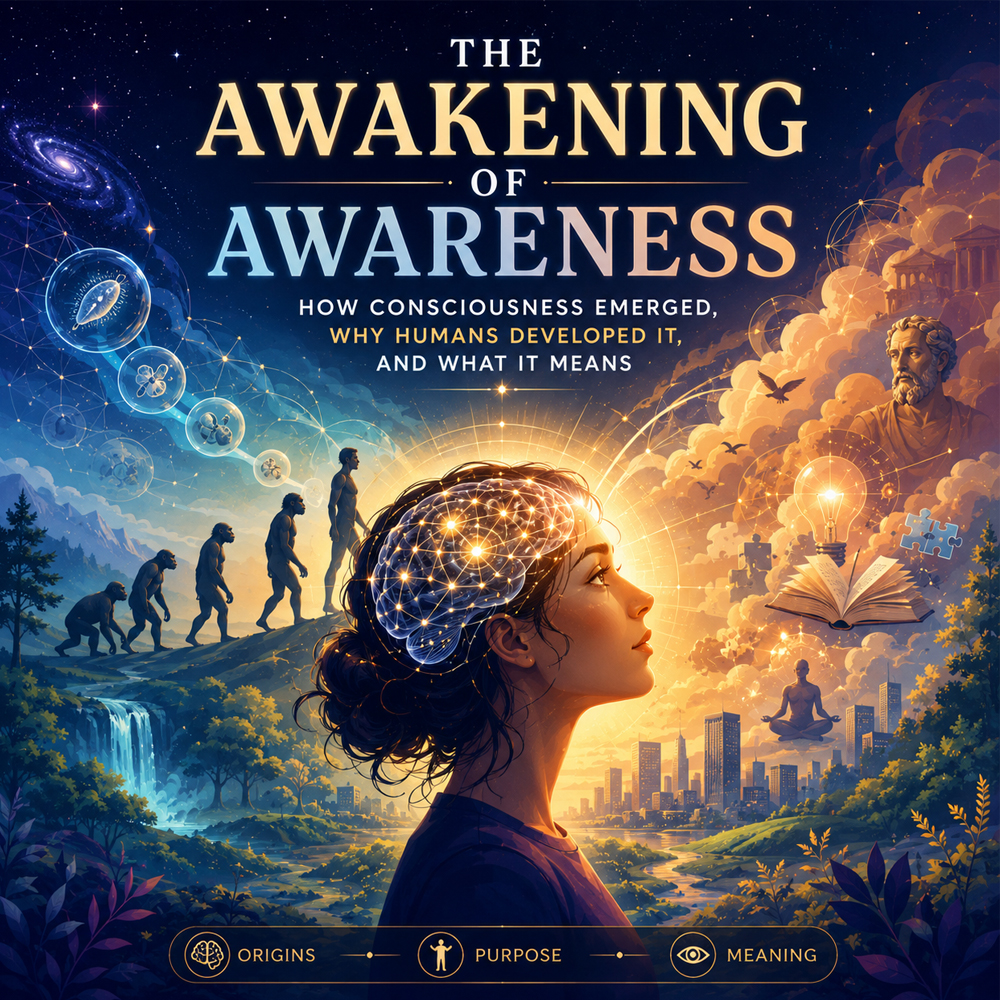
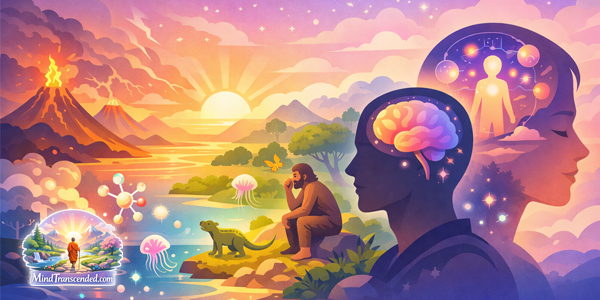
Billions of years ago, Earth was a silent stage of chemical reactions. There was no observer to marvel at the sunrise. There were no eyes to see, nor a mind to ask “why.” And yet, from this blindness, something strange gradually emerged. First – life. Then – sensation. And after that – consciousness. Evolution does not plan. It has no goal. It simply “tries.” But in this endless process of trial and error, organisms that can sense and predict begin to gain an advantage. To sense danger before seeing it. To imagine a future that has not yet happened. To remember the past and use it. Thus, an inner model of the world gradually appears. A kind of “simulation” that takes place in the mind. And at some point, this simulation becomes so complex that it begins to include the observer itself. There, perhaps, consciousness is born.
The Mirror of Others and the Birth of the “Self”
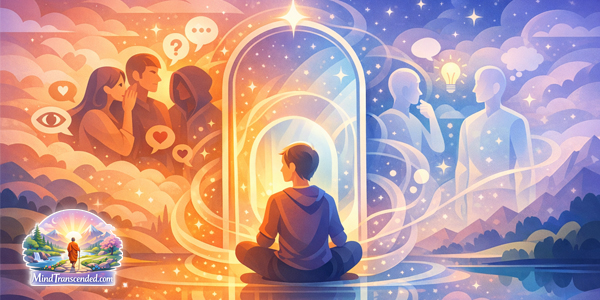
Human beings have never been solitary creatures. We are created in the gaze of others. Imagine a world in which you must understand the intentions of those around you – whether they will help you or harm you, whether they are telling the truth or lying. This requires more than reaction. It requires imagination. To imagine what another person is thinking. But in this process, something deep and unexpected happens. When you begin to imagine the minds of others, you also begin to create an image of your own mind. Thus the “self” is born. Not as a physical body, but as a story. As a narrative that the mind constantly writes about itself. With the emergence of language, consciousness makes an enormous leap. Words are not just sounds. They are tools for thinking. Through them
we begin to build abstractions – time, meaning, truth, future. We begin to tell stories not only to others, but also to ourselves. And perhaps most importantly – we begin to hear an inner voice. This voice that comments, analyzes, doubts. It is like a quiet companion that never leaves us. Sometimes it guides us, sometimes it confuses us, but it is always there. And precisely this inner dialogue is one of the clearest manifestations of consciousness.
The Hard Problem of Consciousness
What we call “the hard problem of consciousness” is a term introduced by David Chalmers in the 1990s to describe something deeply strange about the way we understand the mind. It is not simply about how the brain processes information – these are the so-called “easy problems.” They include questions such as: how we recognize faces, how we make decisions, how memory is encoded in neurons. All of these processes, although complex, seem in principle explainable through neuroscience, cognitive science, and computational models.
But the hard problem begins where subjective experience arises.
When you see red, it is not only that a certain wavelength activates receptors in the retina, which send signals to the visual cortex. All of this can be described completely objectively. And yet the question remains: why is this experienced as “red” at all? Why is there a feeling, and not merely information processing? This inner quality of experience is often called “qualia” – a term used in the philosophy of consciousness to describe “what it is like to be” in a given state.
You can imagine a fully functioning system – for example, artificial intelligence or even a human being that reacts to stimuli, speaks, recognizes objects – but without any inner experience. This is the thought experiment of the “philosophical zombie.” Such a “zombie” would be indistinguishable from the outside from a conscious being, but inside it would be “empty.” If this is logically possible, then consciousness is not exhausted by physical processes.
Here the tension appears: science traditionally works with objective, measurable phenomena. It describes structures, functions, cause-and-effect relationships. But consciousness, in its essence, is subjective. It is accessible only from the first-person perspective. You cannot directly measure what it is like to be someone else. You can measure their brain activity, but not the experience itself.
Some scientists and philosophers, such as Daniel Dennett, argue that the “hard problem” is actually an illusion – that once we understand the functions of the brain well enough, nothing mysterious will remain. According to them, the feeling of “inexplicability” comes from the way we think about consciousness, not from a real gap in science.
Others, including David Chalmers himself, believe that consciousness requires a new kind of explanation – perhaps new fundamental laws of nature. Just as electromagnetism or gravity are basic properties of reality, consciousness may be something fundamental that cannot be reduced to something simpler.
There are also intermediate positions. Some researchers try to connect consciousness with specific structures or processes in the brain – for example, the integration of information, the global broadcasting of signals, or the complexity of neural networks. They do not deny the difficulty, but believe that it will be overcome with the progress of science.
But even if we discover a perfect correlation between brain states and experiences – for example, that a certain pattern of activity always corresponds to the sensation of pain – the question remains: why is exactly this pattern experienced as pain? Why is it not merely “silent” computation?
This “why” is the core of the hard problem.
And perhaps the most provocative thing about it is that it questions the limits of scientific explanation. Is it possible that there are aspects of reality that cannot be fully captured by objective science? Or have we simply not yet discovered the right language and theory?
So when we speak about consciousness, we are not speaking only about the brain. We are speaking about the very fact that there is “something it is like to be.” And this, at least for now, remains one of the deepest mysteries science and philosophy have ever encountered.
Global Workspace Theory
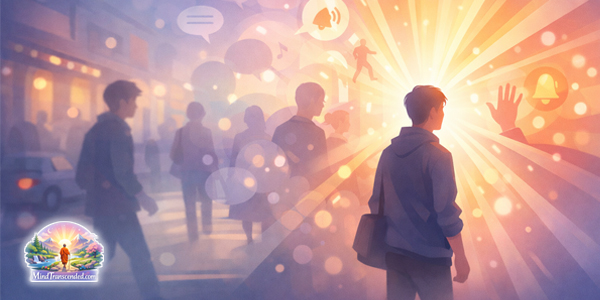
Imagine that you are walking down a street without thinking much about anything. The day simply unfolds. Your eyes glide across shop windows, people pass by you, somewhere in the distance a conversation can be heard, your steps alternate evenly. All of this is happening – quietly, smoothly, almost silently. And yet, if you think about it, at that moment an enormous amount of information is being processed inside you. Colors, shapes, movements, sounds, memories, expectations. An entire world is being arranged within you… but you do not “see” all of it. It is as if most of it remains in the periphery, like a background that simply exists.
Then something changes. A sharp sound. Or someone’s voice saying your name. Or a sudden movement in your peripheral vision. And without consciously deciding, your attention gathers. Everything else fades. The moment becomes sharper. This is not just another signal. It is something that “comes forward.” And this is exactly where the Global Workspace Theory tries to capture what is happening. Your
brain does not work as one whole, but as many separate processes – quiet, specialized, almost independent. One “looks,” another “listens,” a third “predicts,” a fourth “remembers.” Most of them never become part of your consciousness. They simply do their work. But sometimes something crosses an invisible boundary. Not because it is the strongest. Not because it is the brightest. But because, in some way, it has become significant enough.
And then – instead of remaining local, hidden in one part of the brain – it spreads. Like light suddenly filling a room. Different parts of the brain begin to “talk” about the same thing. The information no longer belongs to one small process. It becomes common. Accessible. Shared. And this feeling – that you “know,” that you “see,” that you “are aware” – arises precisely there. Not in the information itself, but in its spread. As if the thought is no longer locked in one room, but echoes throughout the entire house. In this sense, consciousness is not a stream of everything happening inside you. It is rather a carefully selected excerpt – that which was “important enough” to be shared everywhere.
And if you look more closely at your own experience, you will sense it: how many things happen without you noticing them. And how few of them suddenly become clear, distinct, almost illuminated from within. Exactly these moments – when something comes out of the darkness of the background and becomes the center of your experience – are what this theory calls consciousness. Not as a mystery that appears from nothing. But as a moment when your brain stops whispering to itself… and begins to speak out loud.
Integrated Information Theory
Imagine that you are sitting somewhere quietly and suddenly realize: “I am experiencing something.” You see colors, hear sounds, have thoughts. This is consciousness. Most theories start from the brain and ask how it produces it. Giulio Tononi turns the question upside down: he says – let us begin with the experience itself and ask what properties a system must have in order to have such an experience.
And here comes his idea: consciousness is not just information. It is not enough for there to be a lot of data. What matters is that this information is “glued” into a single whole, so that you cannot tear it into independent parts without destroying the experience itself.
Think of it this way – if you have many separate devices working independently, each doing something on its own, there is no shared picture. There is no single “I” experiencing all of it together. Now imagine the brain: billions of neurons that constantly influence one another. Information does not merely exist – it is intertwined. When you see something, it is not just vision – it connects with memory, emotions, expectations. All of this becomes one whole experience.
This “becoming one whole” is the key. The theory calls it integrated information and denotes it with Φ (phi). It is like a measure of how indivisible the system is as an experience. If you can cut it into parts and nothing essential is lost – it has no consciousness. But if every division destroys something important – then you have consciousness.
And here it becomes interesting. According to this idea, there is no sharp boundary between “has consciousness” and “does not have consciousness.” There are degrees. A human brain has a very high Φ – that is why our experience is rich and complex. But a very simple system may have a tiny, almost zero, but not entirely zero Φ. This leads to the rather strange, almost philosophical idea close to panpsychism – that consciousness may exist to different degrees everywhere, not only in humans.
Even more interestingly, the theory does not say “the brain is special because it is biological.” It says: any system that has a sufficiently complex and integrated structure could have consciousness. This means that the question “can a machine be conscious?” is not philosophical, but technical – it depends on how it is organized.
There is also a very strong point in this theory: it claims that consciousness is not something that “comes out” of the brain as a side effect. It is a real property of the system itself – just as mass is a property of an object or temperature is a property of a gas. If the structure is right, consciousness is simply there.
But here come the difficulties. This Φ is very difficult to calculate in real systems like the brain. And sometimes the theory produces results that sound strange – for example, that some simple devices have miniature consciousness, while some complex computers may not, if they are not connected in the right way.
And despite this, there is something very appealing about the idea. It tries to answer one of the deepest questions: why is there experience at all, and not merely information processing? And it says – experience appears when information becomes an indivisible whole. If we reduce it to the most intuitive form: consciousness is not simply “many things happening,” but “many things happening together as one.”
Roger Penrose’s Theory: Consciousness Beyond Classical Physics
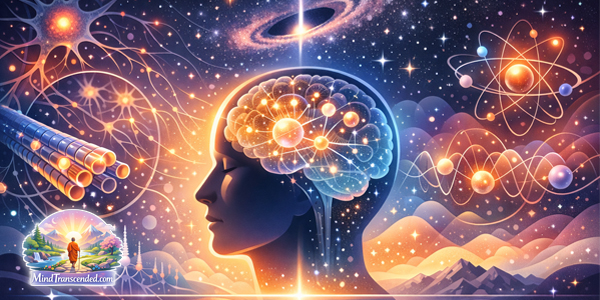
One of the most interesting and bold attempts to explain consciousness comes from the British physicist and mathematician Roger Penrose. Penrose does not believe that consciousness can be explained only through classical
neuroscience or computer models. According to him, the human mind does something that algorithms cannot fully reproduce.
To understand his idea, we must imagine the brain not simply as a computer, but as something much more subtle and mysterious. Penrose, together with anesthesiologist Stuart Hameroff, proposes a theory known as “orchestrated objective reduction” (Orch-OR). It sounds complicated, but we can explain it more accessibly. Inside our brain cells there are extremely small structures called microtubules. They are part of the inner “skeleton” of the cells. According to this theory, quantum processes occur precisely in these microscopic structures. The quantum world is strange. There, particles can be in two places at once, existing in multiple states until they are “observed.”
Penrose suggests that consciousness may be connected to such quantum events. In other words, consciousness is not merely the result of neurons “firing” electrical signals. It may be connected to the fundamental structure of reality. He even goes further, to an even deeper idea – that consciousness may be something like an “embedded property” of the Universe, which manifests through the brain. This means that the mind does not simply arise from matter… but that matter may have always contained the potential for consciousness.
Of course, this theory is controversial. Many scientists criticize it because there is not enough experimental evidence. But it remains one of the most beautiful and daring explanations of what consciousness might be.
Consciousness as a Way for the Universe to See Itself
If we step back for a moment from science and look more philosophically, an almost poetic possibility arises. Perhaps consciousness is not merely a tool for survival. Perhaps it is the way the Universe becomes aware. Stars burn, but they do not know that they burn. Planets rotate, but they do not feel their motion. Only through us – through our thoughts, questions, and doubts – does existence begin to observe itself. When you wonder why you exist, perhaps the Universe itself is wondering through you. In the end, consciousness remains a mystery. We can study it, describe it, create theories about it, but we cannot step outside it in order to see it from the outside. It is the stage on which everything unfolds. And perhaps that is exactly why the question “why did humans evolve consciousness” has no single answer. It is a bridge between biology and philosophy, between science and poetry.
But if there is one thing certain, it is this:
Consciousness is not just another human trait. It is the deepest human dimension. And when you close your eyes tonight and hear your thoughts, do not take them for granted. They are proof that in a cold and infinite cosmos… something has appeared that can wonder.
Read more:
Author: Vasil Stoyanov