
The Surface of Reality
When we observe the world around us, it appears stable, solid, and clearly defined. The mass of objects, their shape, their motion – all of this creates the sense of an objective, solid reality. But modern physics gradually reveals that this intuitive picture is only a surface layer.
For centuries, the atom was considered the smallest indivisible unit of matter. Today we know that it is a complex system – a nucleus of protons and neutrons, surrounded by electrons that do not “orbit” in the classical sense, but exist as probability distributions. Even deeper in the structure of matter, we discover that protons and neutrons themselves are made of quarks, bound together by the strong nuclear interaction.
From Particles to Fields
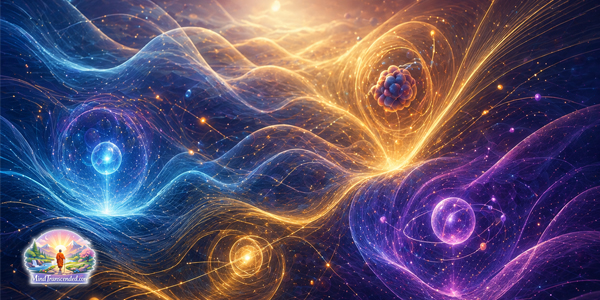
The true conceptual revolution came with the development of Quantum Field Theory. It fundamentally changes the way we understand existence. Instead of treating particles as basic objects, this theory places something more abstract at the center – quantum fields.
In this model, every elementary particle is a localized excitation of its corresponding field. This means that the electron is not a “little ball,” but a specific state of the electron field. In the same way, the photon is an excitation of the electromagnetic field, and quarks are excitations of quark fields. These are not metaphors in a poetic sense, but mathematically precise statements that provide the most accurate predictions in the history of science.
It is especially important to understand that these fields are not located in space like objects. They are fundamental structures that exist everywhere. Space, as we perceive it, is inseparably connected with them. When we say that a particle is located in a specific place, we are actually describing a local state of a field.
The Vacuum That Is Not Empty
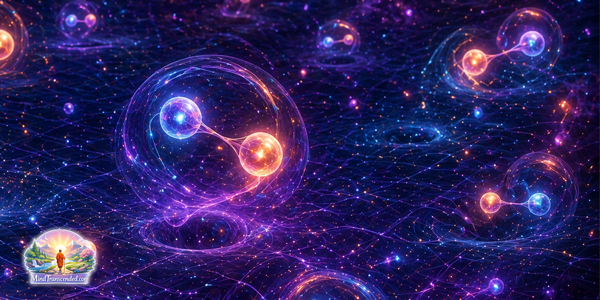
This leads to a seemingly paradoxical picture: if everything is a field, then what is “empty space”? In classical intuition, the vacuum is absolute emptiness. In quantum physics, it represents the lowest-energy state of all fields.
But even this state is not completely calm. Because of the quantum nature of reality, fields inevitably exhibit fluctuations – small, short-lived deviations that can be interpreted as the appearance and disappearance of particles.
These phenomena are not philosophical speculation. They have been indirectly observed and measured in experiments, including studies at CERN, and are part of the theoretical framework of the Standard Model – the most successful theory of elementary particles to date.
The Origin of Mass
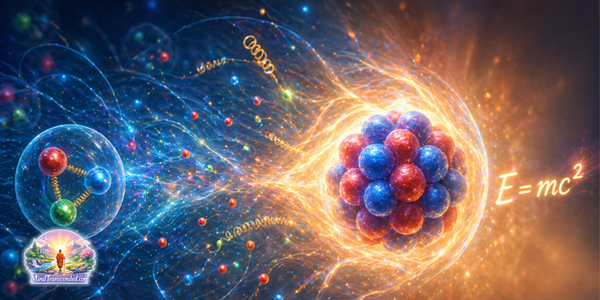
One of the most interesting consequences of this picture is the origin of mass. Intuitively, we would expect the mass of protons and neutrons to come from the mass of the quarks that make them up. In reality, however, most of this mass comes from the energy of the interactions between quarks and gluons.
This is a direct illustration of the relationship between mass and energy formulated by Einstein. Matter, which we perceive as solid and stable, is to a significant extent the result of dynamic processes rather than static components.
What Does “Existence” Mean?
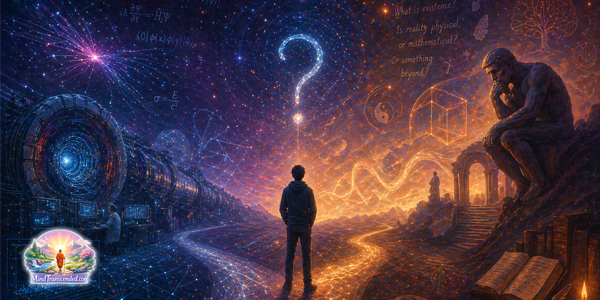
Here we reach the boundary where physics begins to intertwine with philosophy. If particles are merely excitations of fields, and mass arises from energy interactions, what does it mean to say that something “exists”?
From a strictly scientific point of view, the answer is clear: what exists is what can be measured, predicted, and verified. Particles exist because they leave traces in detectors, interact in predictable ways, and participate in processes that we can describe mathematically. Fields exist because they are the most fundamental model that explains these observations.
But when we try to interpret this picture on a deeper level, questions without unambiguous answers appear. Are fields “real” in the same sense in which we perceive the objects around us? Or are they simply the best description we have? Is reality essentially physical, or mathematical?
The Boundary of Science
These questions go beyond the limits of experimental science. They belong to philosophy. And here it is important to make a clear distinction: physics tells us how the Universe behaves, but not necessarily what it means.
Nevertheless, the picture that emerges is deeply impactful. The world no longer looks like a collection of solid objects, but like a continuous dynamic structure. Particles are not fundamental “bricks,” but temporary manifestations of something deeper. Even the vacuum is not empty, but filled with potential and motion.
Conclusion
Perhaps the most accurate way to express this idea is the following: what we perceive as stable matter is the result of stable patterns in quantum fields. These patterns are stable enough to appear permanent, but in their essence they are processes, not objects.
And here we return to the original question – does anything “real” exist?
If by “real” we mean something solid, unchanging, and independent of any description, then quantum field theory calls this intuitive image into question. But if we accept that reality can be dynamic, structural, and describable through mathematical relationships, then the answer is rather positive.
The Universe exists – but not in the way it appears at first glance.
And perhaps the most powerful conclusion is that, in its deepest layer, it is not made of things, but of processes. Not of objects, but of interacting fields whose continuous dynamics create everything we call reality.
Read more:
- Dark Matter and Dark Energy: The Invisible Architecture of the Universe
- Black Holes: What They Are and Why They Hold the Greatest Secrets of the Univers
Author: Vasil Stoyanov