
What Black Holes Actually Are – and Why the Universe Guards Them So Jealously
In the silence of space, there are places where the laws of common sense bend almost as strongly as space itself. There, time stretches, light is refracted like in a dream, and matter loses its form. These are black holes – not merely objects, but boundaries of our understanding. If the Universe has secrets, they are guarded precisely there.
How the Idea of Black Holes Emerged
The idea of black holes did not appear suddenly as a complete scientific concept, but developed gradually over more than two centuries, beginning as a purely theoretical assumption.
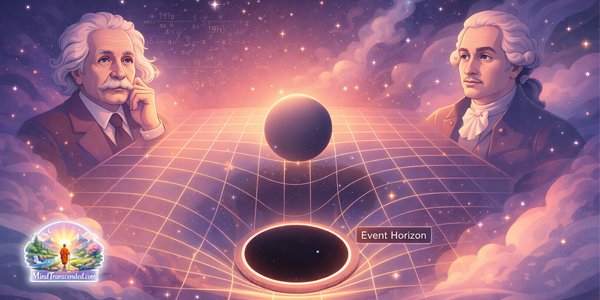
As early as the 18th century, the English scientist John Michell proposed a surprising idea. He reflected on gravity and the speed of light and concluded that if a sufficiently massive and compact star existed, its gravity could be so strong that even light would not be able to leave it. Independently of him, the French mathematician Pierre-Simon Laplace reached a similar conclusion. At that time, however, these ideas remained on the margins of science, because the understanding of light and gravity was still limited.
The real breakthrough came at the beginning of the 20th century with the work of Albert Einstein and his General Theory of Relativity. In this theory, gravity is no longer simply a force, but a curvature of spacetime caused by mass. The equations of the theory allow the existence of objects in which this curvature becomes infinitely strong.
Only a few months after the publication of the theory, the German physicist Karl Schwarzschild found an exact solution to Einstein’s equations. This solution describes an object with a boundary beyond which nothing can escape – what we today call the event horizon. At that time, however, most scientists considered this result a mathematical curiosity rather than a real physical object.
In the 1930s, the idea began to be taken more seriously. The Indian-American astrophysicist Subrahmanyan Chandrasekhar showed that there is a mass limit above which stars cannot remain stable after exhausting their fuel. A little later, Robert Oppenheimer and his colleagues described how such a collapse could lead to an object from which light cannot escape.
Despite these developments, black holes remained a controversial idea for a long time. Only in the second half of the 20th century, with the development of astrophysics and observational technologies, did scientists begin to regard them as real objects. The term “black hole” itself was introduced by John Wheeler in 1967, which helped popularize the concept.
Today, black holes are no longer just a theoretical possibility. They have been observed indirectly through the motion of stars and gas around them, through gravitational waves, and even through images of their shadows. The idea that began as a philosophical reflection on invisible stars has become one of the most important and well-confirmed concepts in modern physics.
How Black Holes Are Born
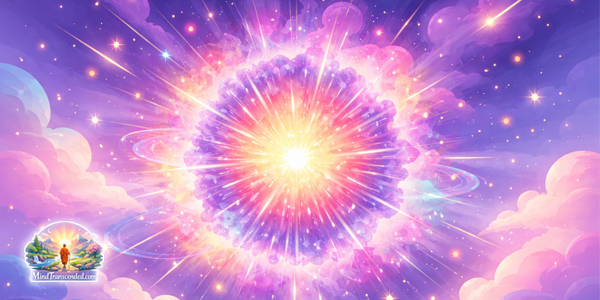
Black holes are born in some of the most dramatic moments in the Universe – when matter loses the battle against its own gravity. Most often, this happens at the end of the lives of very massive stars. For millions of years, these stars maintain a balance between two opposing forces: inward-acting gravity and the pressure created by nuclear fusion in their core. As long as fusion continues, the star remains stable. But when the fuel is exhausted, the pressure decreases and gravity begins to dominate.
What follows is a rapid and catastrophic collapse of the core. The outer layers of the star are expelled in a powerful explosion known as a supernova, and what remains at the center contracts into an extremely small and dense object. If the mass of this remnant is large enough, no known physical interaction can stop the contraction. Matter is compressed to a point where gravity becomes so strong that it creates a boundary called the event horizon. This is the moment when the black hole is born – a region of space from which nothing, not even light, can escape.
There are also other paths for the formation of black holes. Sometimes two neutron stars or already existing black holes can collide and merge. During this process, they lose energy in the form of gravitational waves and gradually approach each other until they finally unite into a larger black hole. Such events are extremely energetic and today can be detected by detectors on Earth.
There is also a hypothesis that some black holes formed in the early Universe, shortly after the Big Bang. According to this idea, small irregularities in the distribution of matter could have led to local collapses in which so-called primordial black holes formed. Their existence has not yet been definitively confirmed, but they remain an important topic in modern cosmology.
In all these cases, the essence of the process is the same: a sufficient amount of matter is concentrated into such a small volume that gravity becomes insurmountable. Thus the black hole appears – not merely an object, but the final form of gravitational collapse, which sets the limits of our understanding of physics.
Why We Cannot See Inside a Black Hole
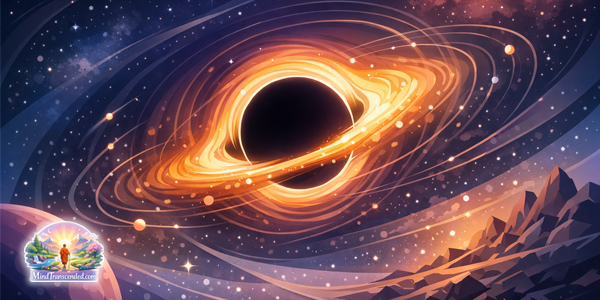
The reason we cannot see what is inside a black hole is connected to a fundamental boundary in space called the event horizon. This is not a physical surface like a wall, but a boundary beyond which all possible paths lead inward.
In order to “see” something, light or another form of information must reach us. Under normal conditions, objects reflect or emit light that travels through space and reaches our eyes or telescopes. In the case of a black hole, however, gravity is so strong that it distorts space and time to the extreme. Once something crosses the event horizon, even light can no longer return outward.
This can be understood through the General Theory of Relativity, formulated by Albert Einstein. According to it, massive objects distort spacetime, and a black hole is the extreme case of such distortion. Inside the event horizon, space itself is “tilted” in such a way that all directions lead toward the center. There is no path that leads outward – not even theoretically.
Another way to think about this is through the idea of “escape velocity.” For Earth it is about 11 km/s; for the Sun, it is much greater. In a black hole, this speed exceeds the speed of light. And since nothing can move faster than light, nothing can escape once it is inside.
That is why the interior of a black hole remains hidden from us. It is not simply that it is dark or far away, but that information from there cannot, in principle, reach the outside world. Everything we know about black holes comes from observations of what happens around them – for example, the motion of matter, radiation from heated gas, or gravitational waves during collisions. What exactly happens beyond this boundary remains one of the deepest questions in modern physics.
How Scientists Prove Their Existence
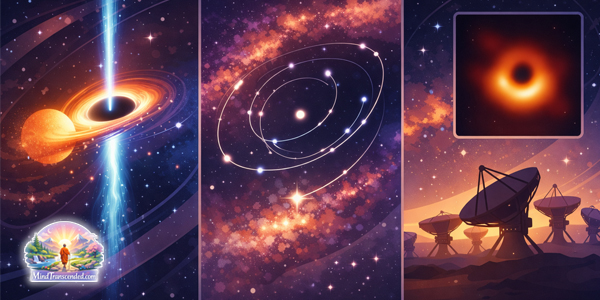
But how do we know that these objects exist if we cannot see them directly? Here, science shows its most beautiful side – it sees the invisible through its effects.
Scientists do not “see” black holes directly because they do not emit light, but they prove their existence through the effects they have on their surroundings. In other words, we observe the traces of their presence.
One of the earliest and most important methods is observing the motion of stars. At the center of our galaxy, Sagittarius A*, scientists track the orbits of stars moving at enormous speeds around an invisible object. The only way to explain this behavior is the presence of an extremely massive and compact object – a supermassive black hole. Similar observations have been carried out for decades and provide very precise estimates of the mass and size of this object.
Another key method is through the radiation of matter falling toward the black hole. When gas and dust spiral around it, they form a so-called accretion disk. This material heats up to millions of degrees and begins to emit strongly in the X-ray range. Such X-ray sources have been discovered in binary star systems, where one star “feeds” the black hole.
In 2015 came one of the strongest pieces of evidence – the direct detection of gravitational waves by the LIGO detectors. These waves are the result of the merger of two black holes. The signal matches the theoretical predictions of the General Theory of Relativity extremely precisely, which is strong confirmation of their existence.
An even more impressive piece of evidence came in 2019, when the international Event Horizon Telescope project managed to create the first image of the “shadow” of a black hole in the galaxy M87*. This is not a photograph of the black hole itself, but of the light around it, distorted by its strong gravity. Later, an image was also made of the black hole at the center of the Milky Way.
All these observations – the motions of stars, X-ray radiation, gravitational waves, and direct images – complement one another. Each of them individually is strong evidence, but together they build an extremely convincing picture: black holes are not just a theory, but real objects in the Universe.
Quantum Physics and Black Holes
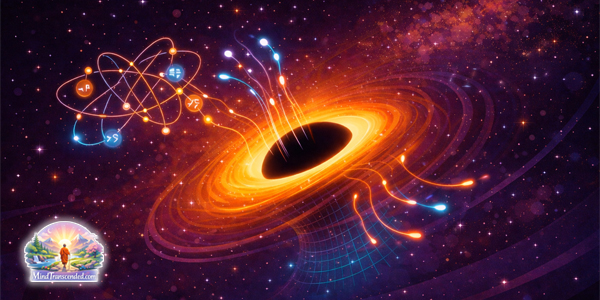
Black holes are places where two “rules” of nature meet that do not fit well together.
On one hand, we have quantum mechanics – it describes the world of very small things, such as atoms and particles. There, everything is somewhat “blurred” and unpredictable. Even empty space is not completely empty – tiny particles constantly appear and disappear in it.
On the other hand, there is the General Theory of Relativity – it describes gravity and large objects such as planets, stars, and black holes. According to it, a black hole is a place with such strong gravity that nothing can escape from it.
The problem is that when we try to understand what happens inside a black hole, we have to use both theories at the same time – and they give different “rules of the game.”
Here is the most interesting part. According to Stephen Hawking’s ideas, black holes are actually not completely black. Because of the strange behavior of empty space around them, they can very slowly “leak” energy. This is called Hawking radiation. Imagine it as a very slow “evaporation.”
Here comes the big question. If something falls into a black hole and then it disappears over time, what happens to the information about that thing? It is like burning a book and having no way to restore its contents. But according to quantum physics, this should not be possible – information should not be lost.
This confuses scientists because it means that either we do not understand black holes well, or we do not understand quantum physics well… or both.
That is why black holes are so important. They are not simply “cosmic vacuum cleaners,” but places where nature shows us that we still do not know everything. They are like a riddle that may help us discover deeper laws of how the Universe works.
What a Person Would Feel Near a Black Hole
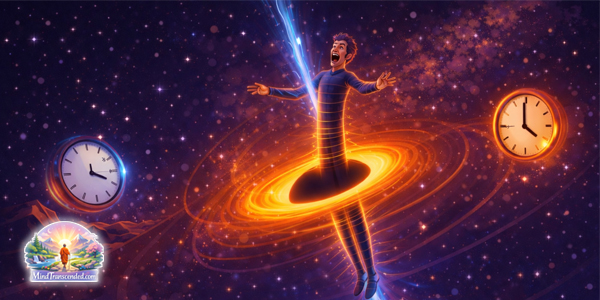
If a person approached a black hole, the experience would be extremely strange and unlike anything familiar, because there gravity changes not only motion, but time and space themselves.
The closer you get, the stranger the feeling of time becomes. If someone observes you from far away, they will see your movements slow down. When you reach the event horizon, to the outside observer you almost “freeze” in time. For you, however, nothing special happens at that moment – you simply continue falling inward.
The real danger comes from so-called tidal forces. The difference in gravity between your feet and your head becomes enormous. This leads to a phenomenon called “spaghettification” – the body stretches into a long, thin shape. With small black holes, this would happen even before you reached the horizon. With very large (supermassive) black holes, you could even cross the horizon without immediately feeling these forces.
If you continue inward, there is no way back. All paths lead to the center. According to current understanding, there lies a singularity – a point where the known laws of physics stop working. What exactly a person would feel there, we cannot say, because we do not have a theory that describes conditions at such extreme values.
Interestingly, the experience depends greatly on the point of view. For you, everything may end in a relatively short time. But to an outside observer, it will look as if you never fully pass inside.
This makes black holes not only dangerous, but also deeply paradoxical – they divide reality into what happens for you and what can be seen by the rest of the Universe.
Their Role in the Universe
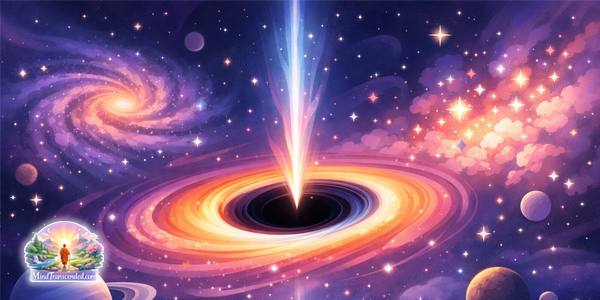
Black holes are not merely exotic objects; they play an important role in the structure and development of the Universe. Although they are often presented as destructive, they are also “organizing” forces on a cosmic level.
At the center of almost every large galaxy lies a supermassive black hole. These objects have masses millions or billions of times greater than that of the Sun. They do not “eat” the entire galaxy, as is sometimes thought, but their gravity influences the motion of stars and gas in the central regions. It is believed that there is a connection between the mass of the black hole and the size of the galaxy, suggesting that they evolved together.
In addition, black holes can regulate the growth of galaxies. When they absorb matter, part of the energy is released in the form of powerful jets and radiation. These processes can heat and disperse the gas in the galaxy, preventing the formation of new stars. Thus, black holes act as a kind of “control mechanism” that influences how quickly a galaxy develops.
During collisions of galaxies, their central black holes can also merge. This leads to the emission of gravitational waves – waves in spacetime itself. Such events are among the most powerful in the Universe and give us information about the evolution of large cosmic structures.
Black holes also participate in the “recycling” of matter. Although everything that falls into them disappears for the outside observer, the processes around them – especially in accretion disks and jets – can return energy and particles back into interstellar space. This affects the chemical composition and dynamics of galaxies.
The Greatest Mystery
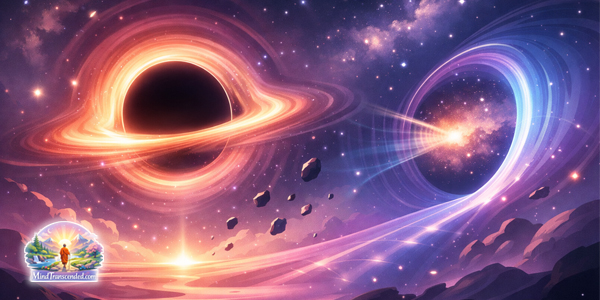
And perhaps the greatest mystery remains: what lies beyond the event horizon? There, our equations break down, and familiar physics loses its meaning. Some theories suggest that information is never lost. Others hint at bridges to other parts of the Universe – the so-called wormholes. For now, this remains within the realm of theoretical physics, but history teaches us that today’s speculation may become tomorrow’s discovery.
Black holes are not just the end of stars. They are the beginning of questions. And perhaps that is exactly why they attract us so strongly – because in them we see the boundary between what we know and what we have yet to discover.
Read More:
- Dark Matter and Dark Energy: The Invisible Architecture of the Universe
- The Big Bang and the Different Theories About the End of the Universe
- How Do Solar Systems and Meteor Showers Form?
Author: Vasil Stoyanov