
Introduction: The Universe We Cannot See
When a person looks at the night sky, they feel as though they are observing the entire Universe. The stars shine, galaxies glow in the distance, and telescopes reveal incredible cosmic structures. For thousands of years, humanity believed that what we see represents almost everything that exists. But in the 20th and 21st centuries, science reached one of the most shocking discoveries in history: the vast majority of the Universe is invisible.
It turns out that stars, planets, nebulae, black holes, and all known forms of matter represent only about five percent of the cosmic content. The remaining ninety-five percent consists of two mysterious ingredients – dark matter and dark energy.
These two concepts sound almost like science fiction. They cannot be seen directly. They do not emit light. They cannot be easily captured by our instruments. And yet their influence on the cosmos is so enormous that without them, galaxies would not exist, and the Universe itself would probably look completely different.
Dark matter acts like the invisible skeleton of the cosmos. It holds galaxies together and shapes the large-scale structure of the Universe. Dark energy, on the other hand, appears to be a mysterious force that causes space to expand faster and faster. One attracts, the other repels. One builds cosmic structures, the other drives them apart.
These phenomena call into question the very foundations of physics. They force scientists to rethink gravity, the structure of space, quantum theory, and even the nature of reality. In a certain sense, humanity today lives in an age of cosmic ignorance – we understand well only a small part of what exists.
This article will examine in detail what dark matter and dark energy are, how they were discovered, why they are so important, and what the newest theories about them are. We will trace the history of some of the greatest scientific mysteries and try to understand why the Universe appears so strange, mysterious, and at the same time majestic.
The Story of an Invisible Mystery
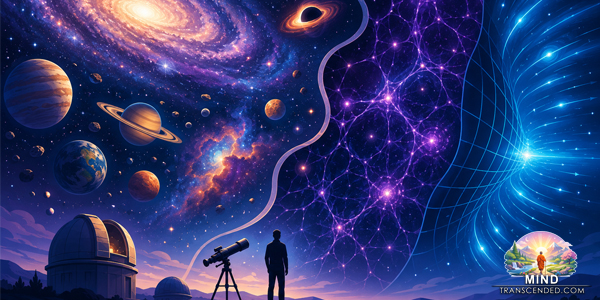
At the beginning of the 20th century, astronomers already had powerful telescopes and began studying the motion of stars and galaxies with unprecedented accuracy. The expectation was that Newton’s laws, and later Einstein’s General Theory of Relativity, would be able to explain the behavior of cosmic objects.
But something strange began to appear in the observations.
In 1933, the Swiss astronomer Fritz Zwicky studied a cluster of galaxies known as the Coma Cluster. He measured the speeds at which the galaxies were moving inside the cluster and reached a shocking conclusion. The galaxies were moving so fast that the visible mass in the cluster was not enough to hold them together gravitationally.
According to classical physics, this galactic cluster should have fallen apart.
Zwicky proposed a bold idea: there must be an enormous amount of invisible matter that provides additional gravity. He called it “dunkle Materie” – dark matter.
At the time, the idea attracted almost no attention. Many scientists thought it was a measurement error or an incomplete understanding of galaxies.
But the mystery was only just beginning.
The Rotation of Galaxies
In the 1970s, the astronomer Vera Rubin carried out a series of revolutionary observations of the rotation of spiral galaxies. She expected the stars on the outskirts of galaxies to move more slowly, similar to the planets in the Solar System.
In the Solar System, Mercury moves much faster than Neptune because it is closer to the Sun. The same logic should also apply to galaxies.
But the results were completely different.
The stars at the distant edges of galaxies move at almost the same speed as the stars near the center. This means that there must be much more mass there than we see. Invisible mass. It was precisely these observations that turned dark matter from an eccentric hypothesis into a serious scientific problem.
What Dark Matter Actually Is
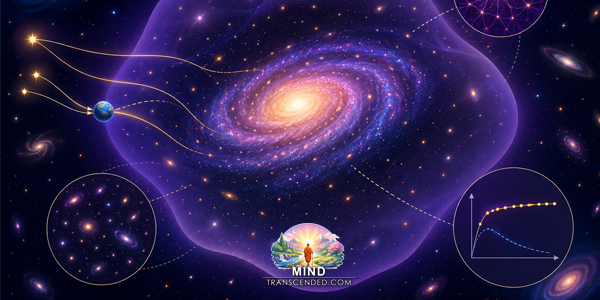
Dark matter is not “dark” in the traditional sense of the word. It is not dark like coal or cosmic dust. It is called that because it does not interact with light.
It does not emit electromagnetic radiation. It does not reflect light. It does not absorb photons in a way that we can detect. The only way we know it exists is through its gravity.
When scientists observe the motion of galaxies, the bending of light, or the formation of cosmic structures, they see the effects of something invisible. This something is everywhere around galaxies and between them.
Today it is believed that dark matter makes up approximately 27 percent of the entire Universe.
The “Halos” of Galaxies
Modern models suggest that every galaxy is immersed in a huge halo of dark matter, called a “halo.” This halo is much larger than the visible galaxy itself. While the stars and gas form a glowing disk, dark matter creates an invisible structure around it.
Without this invisible mass, galaxies would fall apart. It could be said that stars exist thanks to the gravitational framework built by dark matter.
The Evidence for the Existence of Dark Matter
Gravitational Lensing
One of the strongest pieces of evidence for dark matter comes from a phenomenon predicted by Einstein – gravitational lensing.
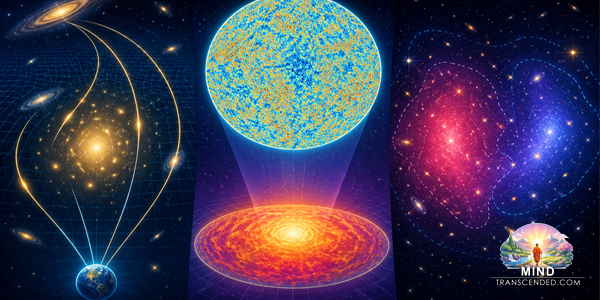
According to General Relativity, massive objects distort spacetime. Light passing near them bends. When astronomers observe distant galaxies, they often see that their light is distorted by invisible mass between them and Earth.
The problem is that visible matter is not sufficient to cause such strong bending. Therefore, there must exist an enormous amount of invisible mass.
Dark matter.
The Cosmic Microwave Background
After the Big Bang, the Universe was filled with hot plasma. As it cooled, ancient light was released, which today we call the cosmic microwave background. This radiation contains information about the early Universe.
Satellites such as WMAP and Planck measure tiny variations in the temperature of this radiation. The analysis shows that ordinary matter is not sufficient to explain the observed structure of the cosmos. The models work only if we include a large amount of dark matter.
The Collision of Galaxy Clusters
One of the most impressive pieces of evidence is the so-called Bullet Cluster. These are two galaxy clusters that have collided. During the collision, ordinary matter – the gas – slows down and heats up. But most of the mass passes through with almost no interaction.
Measurements show that the main mass does not coincide with the visible gas. It is located where there is almost nothing visible. This is one of the strongest direct pieces of evidence that dark matter is a real physical component of the Universe.
What Dark Matter Could Be
WIMP Particles
One of the most popular hypotheses suggests that dark matter consists of unknown elementary particles.
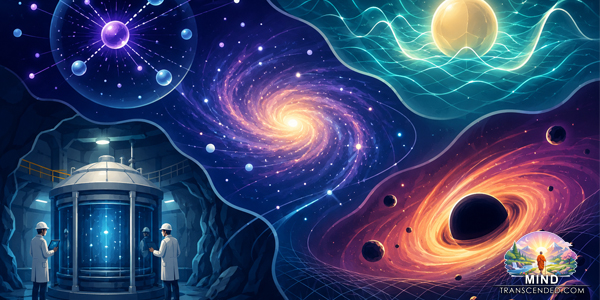
The best-known candidate is the so-called WIMP particles – weakly interacting massive particles. They would have mass, but would hardly interact with ordinary matter. This would explain why we cannot see them. For decades, scientists have been building giant underground detectors in an attempt to capture such particles.
So far, without success.
Axions
Another possible candidate is axions – hypothetical ultralight particles. They could fill the entire Universe like an invisible quantum field. Some scientists believe that axions could solve several fundamental problems in physics at the same time.
Primordial Black Holes
There is also a more exotic idea: dark matter could be composed of ancient black holes formed immediately after the Big Bang. These miniature black holes would be practically invisible, but they would have a gravitational influence.
So far, there is no definitive evidence for this theory.
Dark Energy: An Even Greater Mystery
If dark matter is a mystery, then dark energy is a true cosmic nightmare for physics.
Until the end of the 20th century, scientists believed that the expansion of the Universe was gradually slowing down under the influence of gravity. The big question was whether the cosmos would expand forever or one day begin to contract.
But in 1998, two independent scientific teams made a sensational discovery. They studied distant supernovae, which serve as cosmic markers for measuring distances.
The results were astonishing.
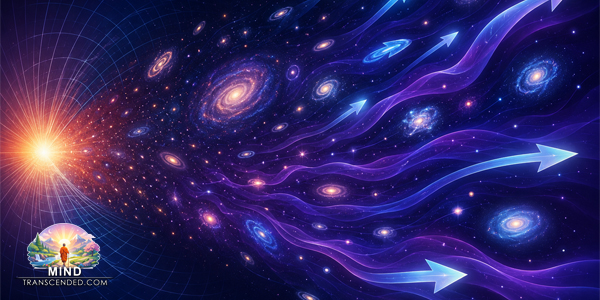
The Universe is not slowing its expansion.
It is accelerating its expansion.
This means that there is an unknown force that overcomes gravity and causes space to expand faster and faster. This force was given the name dark energy.
Cosmic Antigravity
Dark energy appears to act in the opposite way to gravity.
While gravity attracts mass and slows expansion, dark energy accelerates the separation of galaxies. It does not resemble any known form of energy.
Even stranger is that it makes up about 68 percent of the Universe. This means that the largest part of reality is made of something we barely understand.
Possible Explanations for Dark Energy
The Cosmological Constant
One of the leading ideas goes back to Einstein.
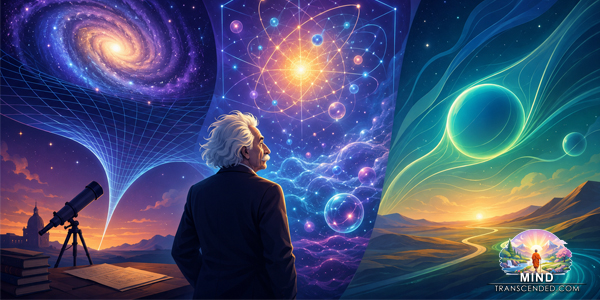
When he created the General Theory of Relativity, his equations showed that the Universe could not be static. It had to either expand or contract. Because at that time scientists believed in a static Universe, Einstein added a special term to the equations – the cosmological constant.
Later, after the discovery of the expansion of the Universe, he called this the “biggest mistake” of his life. But after the discovery of accelerated expansion, the cosmological constant returned. Today, many scientists believe that dark energy may be precisely the energy of empty space.
The Quantum Vacuum
In quantum physics, empty space is not truly empty. It boils with virtual particles that constantly appear and disappear. These quantum fluctuations possess energy.
The problem is that the calculations of quantum theory give a value for vacuum energy that is monstrously larger than what is observed.
The difference is so enormous that it may be the greatest discrepancy between theory and observation in the history of physics.
Dynamic Fields
Some theories suggest that dark energy is not constant, but is due to a new field called quintessence. This field could change over time and influence cosmic evolution. If this is true, the future of the Universe may be very different from current predictions.
The Connection Between Dark Matter and Dark Energy
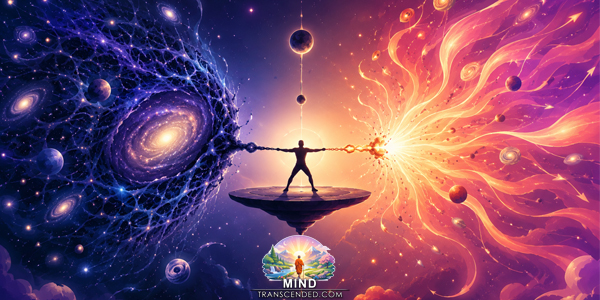
Dark matter and dark energy act as two opposing forces in the cosmos.
Dark matter creates structure. It gathers gas, forms galaxies, and keeps cosmic systems stable. Dark energy does the opposite. It expands space and drives galaxies apart.
We can imagine the Universe as a giant arena in which these two invisible forces take part in a cosmic battle. One builds. The other breaks the connections between objects. It is precisely the balance between them that determines the fate of the cosmos.
How Dark Matter Shaped Galaxies
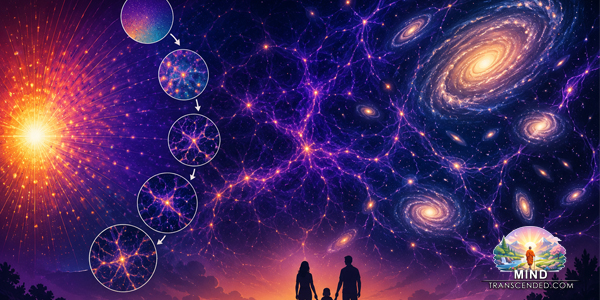
Simulations of the early Universe show that dark matter played a key role in the formation of galaxies.
After the Big Bang, matter was not evenly distributed. There were small fluctuations in density. Dark matter amplified these irregularities through gravity. Gradually, giant filaments and clusters formed – the so-called cosmic web.
Galaxies formed precisely in these regions with a high concentration of dark matter. Without it, stars would probably never have gathered quickly enough to create galaxies.
This means that our own existence may depend on dark matter.
Could We Be Completely Wrong
Alternative Theories
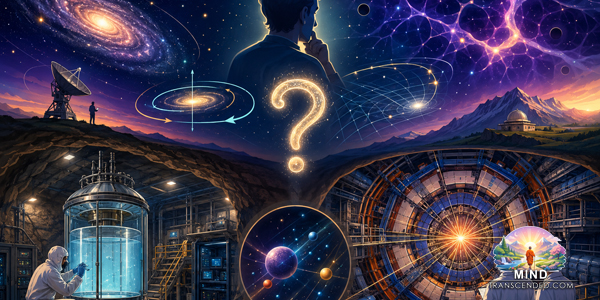
Some physicists believe that dark matter and dark energy may not exist at all. According to them, the problem lies in our understanding of gravity.
One of the best-known alternatives is MOND – modified Newtonian dynamics. This theory suggests that in very weak gravitational fields, the laws of physics change.
MOND manages to explain some galactic observations without dark matter, but it has serious difficulties on larger scales.
Most scientists today still support the existence of dark matter because the evidence is too abundant and comes from various independent sources.
Underground Laboratories
To avoid cosmic radiation, scientists build detectors deep underground. These experiments use liquid xenon, ultrasensitive crystals, and complex sensors that wait for a dark matter particle to interact with an atom.
The problem is that interactions are extremely rare. It is possible that billions of dark matter particles pass through our bodies every second without leaving any trace.
The Large Hadron Collider
Scientists hope that dark matter particles may also be created in accelerators such as the Large Hadron Collider.
If missing energy appears in the collisions, this could be a sign of invisible particles. So far, there has been no definitive discovery, but the search continues.
The Philosophical Dimensions of the Mystery
Cosmic Ignorance
Dark matter and dark energy remind us how limited human knowledge is.
We live on a small planet around an ordinary star on the outskirts of a galaxy, and yet we try to understand the entire Universe. And just when we have begun to believe that we understand nature, it turns out that almost everything around us is unknown. This is both humbling and inspiring.
The Possibility of New Physics
Many scientists believe that solving the mystery of dark matter and dark energy will lead to a revolution comparable to the discovery of quantum mechanics or the theory of relativity.
It is possible that current physics is only an approximation of a deeper reality. Perhaps space and time are not fundamental. Perhaps additional dimensions exist. Perhaps the Universe is part of a larger multiversal process. Dark matter and dark energy may be the key to these secrets.
The New Generation of Observatories
Modern astronomy is entering a golden age. Telescopes such as the James Webb Space Telescope allow scientists to observe extremely distant galaxies and the early stages of cosmic history.
Projects such as Euclid and the Vera Rubin Observatory were created specifically to study dark matter and dark energy. They will map billions of galaxies and measure how space expands. It is possible that in the coming decades we will witness one of the greatest scientific discoveries in human history.
Dark Matter and Life
Few people realize that our very existence probably depends on dark matter.
Without it, galaxies would not have formed quickly enough. Without galaxies, there would be no stars. Without stars, there would be no heavy chemical elements. Without these elements, there would be no planets and no life.
So although it is invisible and mysterious, dark matter may be one of the most important reasons we are here at all.
Could Humanity Ever Control These Forces
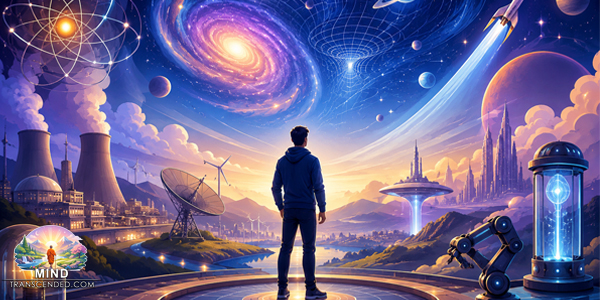
Today, the idea of using dark matter or dark energy sounds fantastic.
But history shows that human civilization constantly turns the impossible into reality. Electricity once seemed like magic. Nuclear energy was unthinkable. Quantum mechanics sounds absurd even to many scientists.
If one day we understand the true nature of these phenomena, technologies may emerge that today we cannot even imagine. Perhaps we will be able to manipulate gravity. Perhaps we will use the energy of the vacuum. Perhaps interstellar travel will become possible.
Of course, this remains speculation, but great scientific discoveries often begin precisely as speculation.
The Greatest Mystery of Modern Science
Dark matter and dark energy are not just curious astronomical concepts. They are a fundamental problem for understanding reality.
At present, science cannot explain what ninety-five percent of the Universe consists of. This is an incredible admission of the limits of human knowledge. But it is precisely such mysteries that drive science forward.
When physicists cannot explain a given phenomenon, it means that a new revolution is ahead. Dark matter and dark energy may be the doorway to the next era of physics.
Conclusion: The Universe of Shadows
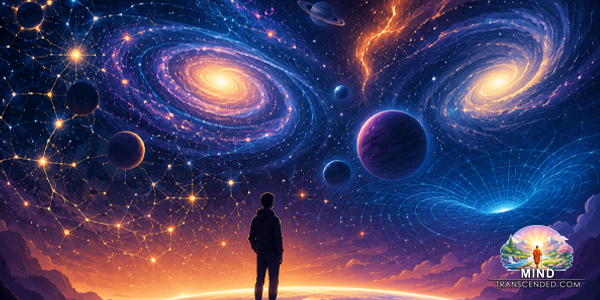
Dark matter and dark energy are two of the deepest mysteries in human history. They show that the Universe is far stranger than we imagined.
What we see – the stars, planets, galaxies, and even ourselves – is only a small part of reality. The vast majority of the cosmos remains hidden behind invisible forces and unknown forms of matter and energy.
Dark matter builds the cosmic structure. It holds galaxies together and shapes the invisible skeleton of the Universe. Dark energy, in turn, expands space and determines the fate of the cosmos.
Today, humanity stands on the threshold of a new scientific revolution. Huge telescopes, quantum experiments, and supercomputer simulations are trying to reveal the truth behind these mysteries.
Perhaps in a few decades we will understand what dark matter and dark energy are. Perhaps we will discover new laws of physics. Perhaps we will realize that reality is far more complex than we assumed.
But even today, one thing is certain: the Universe is far more majestic, mysterious, and unknown than the human imagination ever thought.
And that is exactly what makes studying it so beautiful.
Read More:
- Black Holes: What They Are and Why They Hold the Greatest Secrets of the Universe
- The Big Bang and the Different Theories About the End of the Universe
- How Do Solar Systems and Meteor Showers Form?
Author: Vasil Stoyanov