
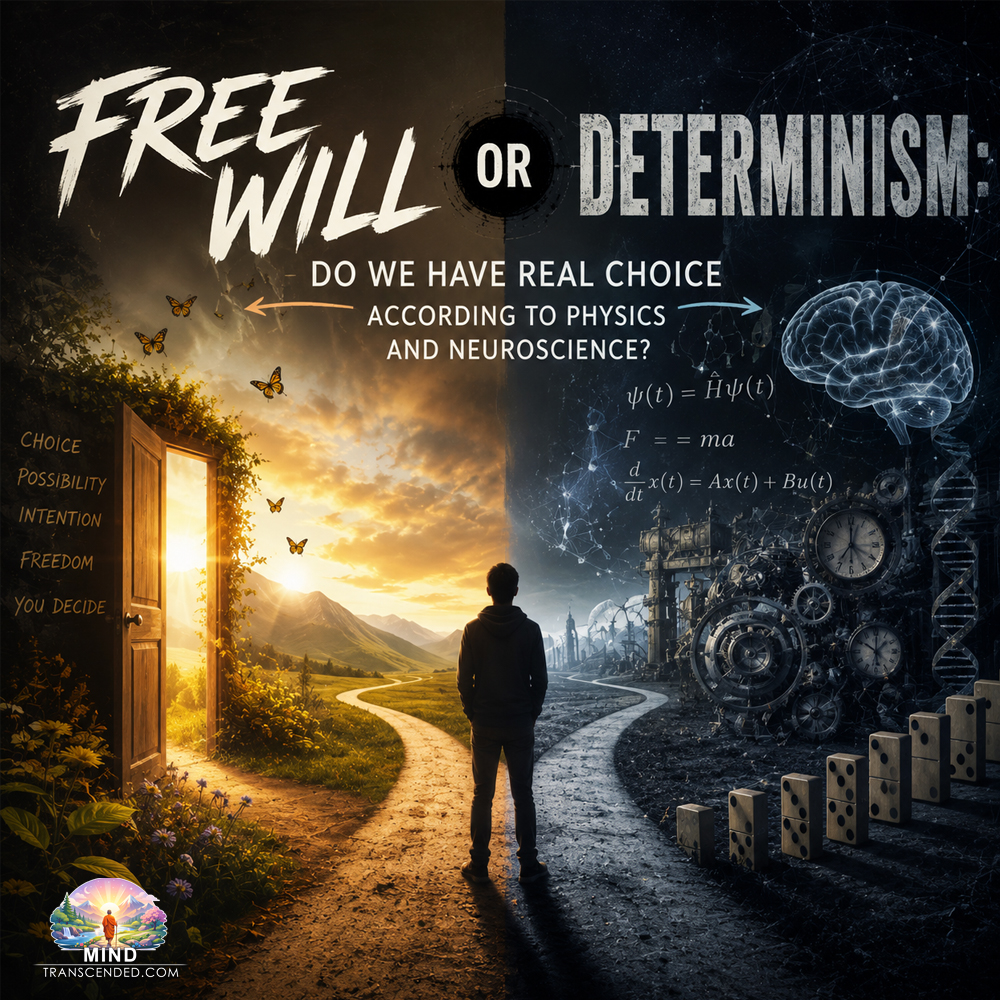
Do We Really Have a Choice… or Has Everything Already Been Decided?
Every day we make dozens, even hundreds of decisions.
What to say, what to do, which direction to take. Some of them are small and almost unnoticeable; others change our lives. And yet we rarely think about something that lies at the foundation of every single one of them – whether we actually have a real choice at all.
At first glance, the answer seems obvious. Of course we do. We feel hesitation, consider options, and choose. But this feeling may be misleading. More and more ideas in science and philosophy call into question not the decisions themselves, but their origin. Is it possible that our thoughts are simply the result of processes we do not control? Is it possible that everything we will ever do is already “encoded” in the very structure of the Universe?
This is not just an abstract philosophical question. It is an intersection between physics, neuroscience, and artificial intelligence. And the more our knowledge advances, the more uncomfortable this question becomes.
The Universe as a System of Laws
To understand where the idea of the absence of free will comes from, we must begin with something more fundamental – the laws of physics.
Everything that exists is subject to them. Atoms, molecules, stars, galaxies, life itself. Without electromagnetism, atoms could not exist. Without gravity, there would be no stars, planets, or conditions for life to arise. The Universe is not chaotic in an absolute sense – it follows certain rules.
This means something very important. Every event has a cause. Every movement, every reaction, every change – everything arises from a previous state governed by these laws. If we imagine the Universe as a vast system, it functions as a continuous chain of causes and effects.
And this is where the idea of determinism is born.
Determinism: If We Know Everything, Can We Predict the Future?
Determinism claims that if we fully know the state of a system at a given moment and understand the laws that govern it, we can calculate its future.
This sounds almost like science fiction, but in fact it has deep roots in classical physics. Imagine watching a ball thrown into the air. If you know its speed, angle, gravity, and air resistance, you can predict almost exactly where it will fall. This is a simple example, but the principle is the same.
The difference comes when the system becomes extremely complex. The human brain contains about one hundred billion neurons connected in a network of almost unimaginable complexity. Each neuron interacts with thousands of others. Calculating all these interactions is practically impossible.
But here we must make an important distinction. Impossible for us does not mean impossible in principle. The fact that we do not have a sufficiently powerful tool does not mean that the future is not determined. It only means that we cannot calculate it.
In this sense, the Universe can be viewed as a vast chain of events, similar to a row of dominoes. The first piece falls, hits the second, the second hits the third. In this model, the tenth piece has no “choice” whether to fall. Its fall is an inevitable consequence of the beginning.
If we apply this logic to reality, the conclusion is unsettling. Every event, including human actions, may be part of such a chain.
The Brain as a Physical System
When we talk about free will, we inevitably arrive at the brain. It is the organ that creates thoughts, decisions, and the feeling of “I.”
But what exactly is the brain?
From a scientific point of view, it is a physical system. It is composed of cells that communicate through electrical impulses and chemical signals. Every thought, every feeling, every decision can be connected to specific activity in this network.
Modern neuroscience shows something even more interesting. In a number of experiments, it has been observed that the brain begins to “make a decision” before the person becomes aware of doing so. In other words, the neural activity that leads to a given action appears before the conscious feeling of choice.
This calls into question the very feeling of control. If the brain has already begun the process and consciousness registers it with a delay, then who is actually “deciding”?
The Illusion of Choice
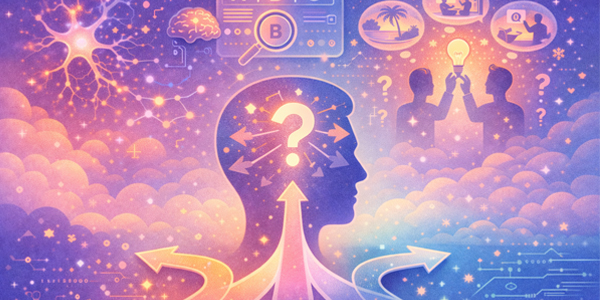
The feeling of free will is extremely convincing. We feel that we can choose between different options. We imagine future scenarios, weigh them, doubt, hesitate. All of this looks like a process of free choice.
But if we look more closely, this process too can be explained as a sequence of physical events. The brain simulates different possibilities, but the simulation itself is part of its activity. Hesitation is not proof of freedom, but simply another stage in information processing.
This can be compared to the way we perceive the world. Our eyes do not “see” reality directly. They capture light that the brain interprets. What we perceive as a solid and clear picture is actually a processed signal.
In a similar way, the feeling of choice may be an interpretation of a process that is already happening. The brain creates the feeling of control, but that does not mean the control is real in the traditional sense.
Quantum Mechanics: A Doorway to Freedom or an Illusion?
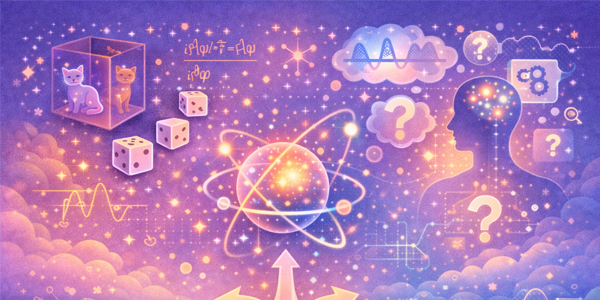
So far, the picture looks rather deterministic. But quantum mechanics introduces something different – fundamental uncertainty.
At the level of elementary particles, we cannot predict exactly what will happen. We can only speak in terms of probabilities. A particle does not have a precisely defined state until it is measured.
At first glance, this looks like a breakthrough in determinism. If there is true randomness, perhaps there is room for freedom as well.
But here comes an important point. Randomness is not the same as free will. If an action is the result of a random process, that does not mean it is controlled. It simply means that it is unpredictable.
Free will implies something different – conscious control. And randomness does not provide such control.
In addition, the effects of quantum mechanics appear mainly on very small scales. In the world we perceive every day, these effects are “averaged out.” This phenomenon, known as decoherence, leads to stable behavior of macro-objects. That is why we can predict the motion of a ball, but not the behavior of a single particle.
The question of whether quantum effects play a role in the brain remains open. Some theories suggest there may be a connection, but so far there is no convincing evidence.
Artificial Intelligence and the Boundary of Understanding
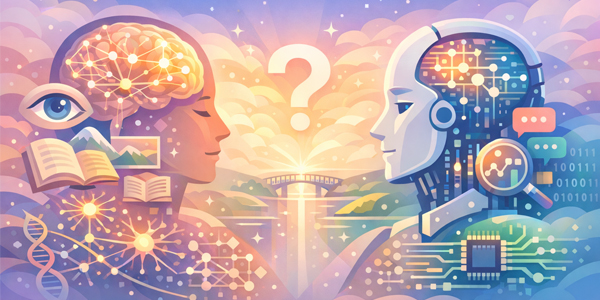
The topic of free will becomes even more interesting when we include artificial intelligence. Modern systems can already perform tasks that until recently seemed entirely human. They recognize images, understand text, generate responses, and make decisions in complex situations.
This raises the question – what does it actually mean to “understand”?
In humans, understanding arises through the accumulation of experience. We perceive the world through our senses, create memories and categories, and use these categories to interpret new information. When we see something unfamiliar, the brain compares it with what is already known and derives meaning.
This process can be described algorithmically. This is exactly what modern artificial intelligence systems do. They also compare new information with accumulated patterns and produce results.
The difference lies in the way it is implemented. The human brain uses biological structures and chemical processes. Machines use silicon and electronic circuits. But from the point of view of information, both systems process data.
This leads to an important conclusion. If the process of thinking is physical and can be simulated, there is no fundamental reason for it to be limited only to biological systems.
Consciousness: The Boundary of Knowledge
And yet something remains that we cannot easily explain – consciousness.
What does it mean to be “conscious”? To have an experience? To feel? To have an inner world?
One possible idea is that consciousness is perception itself. Not something separate from it, but the very process of experience. When you see something, the seeing itself is consciousness. When you think, the thinking is consciousness.
This leads to an interesting perspective. The difference between us and the world may not be as clear as it seems. The perception of the world is part of us, not something external.
But this raises new questions. If consciousness is connected to perception, can it exist without it? And if perception can be simulated, does that mean machines can be conscious?
There is no clear answer. Some theories suggest that consciousness is something that emerges with sufficient complexity. Others allow that it may be a more fundamental property of reality.
There are even ideas that consciousness is not limited only to humans. Plants react to their environment; microorganisms interact with the world. Is this a form of primitive perception? We do not know.
Where Does Free Will Remain?
After everything said so far, the picture is complex.
On one hand, physics and neuroscience point toward a deterministic model. The brain is a system that follows laws. Thoughts are the result of processes. Decisions may be predetermined.
On the other hand, quantum mechanics introduces uncertainty, and consciousness remains a mystery. We do not fully understand how inner experience arises. We do not know whether it plays a role in the decision-making process or is simply a side effect.
It is possible that the truth is not found in the extremes. Perhaps free will is not absolute, but it is not completely illusory either. Perhaps it is a limited form of control within the framework of physical laws.
Or perhaps the feeling of choice is simply part of the way the brain functions, without reflecting real independence.
Conclusion: The Question Remains Open
The idea that everything is predetermined is both logical and unsettling. It calls into question not only free will, but also the way we perceive ourselves.
But science still does not have a final answer. We are in the process of understanding. With every new discovery, we approach the boundary, but it constantly shifts.
Perhaps we will never have complete clarity. Or perhaps the answer will be so different from our intuition that it will require an entirely new way of thinking.
Until that happens, one simple but profound question remains.
If all your thoughts and decisions are the result of physical processes that you do not fully control…
does that change anything in the way you live?
Read More:
- How Consciousness Emerged: Why Humans Developed It and What It Means
- Why the Brain Searches for Meaning in Everything – The Scientific Explanation
- Who Am I? The Neurobiology of Consciousness, the Brain, and Human Identity
- Inside the Human Connectome Project: Revealing the Brain’s Hidden Connections
Author: Vasil Stoyanov