
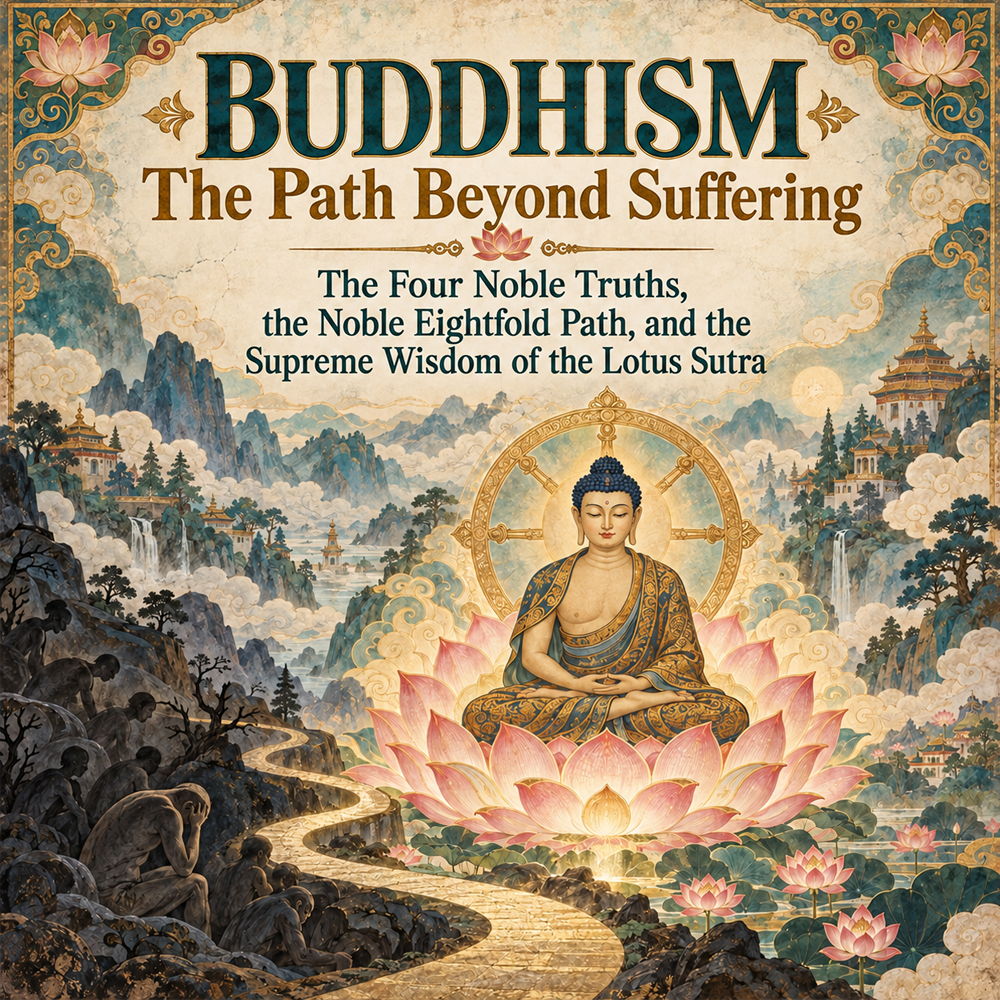
Part One – Awakening Begins Where Illusions End
Imagine a person who possesses everything society considers necessary for a happy life. He has a secure home, sufficient wealth, the respect of those around him, and the freedom to pursue his desires. Yet when he finds himself alone in the silence of the evening, he experiences an inexplicable sense of dissatisfaction, as though something essential continues to elude him. Sometimes he silences this feeling through work, at other times through entertainment, travel, or new ambitions, but after every temporary satisfaction, the feeling gradually returns. Eventually, he begins to wonder whether the problem truly lies in the things he does not yet possess, or in the very way he seeks happiness.
This question lies at the heart of Buddhist teaching. Unlike religious traditions that place the creation of the world or the relationship between humanity and an omnipotent God at their center, Buddhism begins with the direct investigation of human existence. It seeks to understand why people suffer, how suffering arises, and whether there is a way to overcome its causes completely. The answer is not sought exclusively in sacred beliefs or philosophical reasoning, but in transforming the way a person perceives reality and responds to it. Buddhist practice requires understanding, ethical discipline, and direct investigation of one’s own consciousness.
One of the most distinctive characteristics of this teaching is its practical nature. The Buddha does not present spiritual development as the accumulation of knowledge through which a person might impress others, nor as a competition to achieve extraordinary mystical experiences. Instead, he directs attention toward processes that everyone can observe in their own lives – the arising of desires, the fear of loss, the pursuit of recognition, anger, envy, and the relentless search for security. Each of these states reveals something about the way the mind constructs its relationship with the world. When a person begins to understand them, spiritual practice ceases to be a distant ideal and becomes a direct investigation of life itself.
An important comparison found in the early Buddhist texts concerns a man wounded by a poisoned arrow. Instead of immediately allowing the arrow to be removed, the injured man insists on first learning who shot it, what kind of wood it was made from, which feathers were used, and what social class the archer belonged to. While he attempts to obtain answers to all these questions, the poison continues to spread through his body. The meaning of the parable is not that philosophical questions are useless, but that some of them can distract our attention from the most urgent problem of human existence. Before attempting to solve every mystery of the universe, a person must understand the suffering already present in his own life.
This gives Buddhism a distinctive philosophical rigor. The teaching does not demand that the world be rejected, nor does it insist that a person stop experiencing joy, love, or an attachment to life. Instead, it questions the mistaken expectations through which we turn natural changes into sources of inner resistance. A person can love deeply without believing that another human being belongs to them, and can rejoice in personal achievements without making their continued preservation a condition of self-worth. It is precisely the difference between directly experiencing something and clinging to it that gradually reveals the essence of the Buddhist path.
The First Noble Truth – Why Even Happiness Cannot Give Us Lasting Security
Imagine a family that has dreamed for years of building a home of their own. After years of hard work, sacrifice, and saving, their dream finally becomes reality, and moving day becomes one of the happiest moments of their lives. The first few weeks are filled with excitement, as every room, every window, and every piece of furniture reminds them of the goal they have achieved. Gradually, however, the novelty fades, maintenance expenses arise, new desires emerge, and their attention begins to shift toward what is still missing. The house has not ceased to be valuable, but the initial feeling of having achieved lasting fulfillment proves to be temporary.
This characteristic of human life is connected to the First Noble Truth – the truth of dukkha. The word is often translated as „suffering,“ but its meaning is broader, encompassing unsatisfactoriness, instability, and the inability of conditioned experiences to provide lasting security. Dukkha does not mean that every experience is painful or that happiness is an illusion. Rather, it reveals that even pleasant states cannot satisfy our longing for something absolutely permanent, because they themselves depend on changing conditions. A person can experience genuine joy and still discover that it cannot protect them forever from loss, uncertainty, and disappointment.
In the Buddhist tradition, suffering is understood on several levels. The most obvious includes physical pain, illness, old age, death, and emotional experiences that people immediately recognize as unpleasant. A subtler level appears when pleasant states change and a person experiences dissatisfaction because of their impermanence. The deepest level concerns the conditioned nature of existence itself, in which all experiences depend on processes that cannot be brought under absolute control. This is why Buddhist teaching does not limit itself to relieving obvious pain, but investigates the fundamental instability that accompanies human life.
Particularly revealing is the way people experience anticipation. Before achieving something they desire, they believe that future success will resolve a significant portion of their inner conflicts. When the goal is reached, the satisfaction is often genuine, but gradually becomes an ordinary state and no longer feels extraordinary. The mind then creates a new goal, a new comparison, or a new condition that must be fulfilled before true happiness can finally arrive. In this way, a person may spend decades continuously pursuing future satisfaction without ever examining the mechanism that causes them to keep postponing their inner peace.
Yet the First Noble Truth is not an invitation to pessimism. It is a diagnosis that identifies the problem accurately enough to make its resolution possible. A physician who discovers an illness is not being cruel by telling the patient the truth, because without an accurate diagnosis, effective treatment would be impossible. In much the same way, the Buddha begins by acknowledging dukkha, not to diminish the value of life, but to reveal why our usual strategies for achieving happiness so often prove insufficient. In this respect, Buddhist teaching points not toward despair, but toward the possibility of no longer seeking absolute security where it cannot be found.
The Second Noble Truth – The Craving That Turns Desires into Chains
In a certain city lived a famous collector of rare objects. His house was filled with works of art, ancient manuscripts, and possessions that few people could afford. Every new acquisition brought him intense satisfaction, but before long, his attention would turn toward the next object he did not yet possess. Over the years, his collection grew so extensive that he began spending more time worrying about theft, damage, and loss than enjoying the beauty of the treasures he had gathered. Eventually, he realized that although he possessed enormous wealth, he had lost the peace of mind he had once hoped to find through it.
This story reveals the mechanism described in the Second Noble Truth – the truth of the origin of dukkha. The Buddha identifies tanha, or craving, as a fundamental cause of the continuation of suffering. Craving is not synonymous with every desire, since Buddhist practice itself involves the aspiration toward ethical development, wisdom, and liberation. Rather, craving is a particular way of desiring in which the mind clings to experiences and insists that they satisfy its need for security, pleasure, or affirmation of its own existence. It is precisely this insistence that transforms natural human needs into sources of inner dependence.
The early Buddhist texts distinguish three principal manifestations of craving. The first is craving for sensual pleasures, through which a person continually pursues pleasant sensations, impressions, and experiences. The second is craving for existence or becoming, which manifests as the desire to be a particular kind of person, occupy a particular position, and maintain a desired identity. The third is craving for non-existence, associated with the desire to escape unpleasant aspects of reality or eliminate whatever we do not wish to experience. These three forms reveal that the problem extends far beyond material greed and encompasses even the subtlest forms of psychological attachment.
Craving for existence is particularly difficult to recognize because it often hides behind socially approved ambitions. A person may devote their life to achievement, recognition, and social prestige, gradually coming to believe that their entire worth depends upon these things. When praised, they experience satisfaction, but when ignored or criticized, they feel as though their very identity has been threatened. External recognition thus becomes a means of maintaining an inner image that constantly requires confirmation. The problem is not the desire to develop one’s abilities, but the belief that without a particular achievement, one’s existence would somehow be incomplete.
Equally significant is the craving to avoid unpleasant experiences. Some people constantly seek entertainment because they cannot tolerate the silence in which their own anxieties begin to make themselves heard. Others refuse to discuss painful experiences because they fear that acknowledging them will make them unbearable. Still others attempt to control every circumstance around them in order to prevent uncertainty from arising. Yet the more a person insists that life must be completely free from unpleasant experiences, the more vulnerable they become to every event that contradicts their expectations.
Buddhist teaching does not propose that people forcibly suppress all their desires. Such an approach would create a new conflict in which the mind begins fighting against itself, turning spiritual practice into yet another form of coercion. Instead, the Buddha directs attention toward understanding craving directly – how it arises, what promises it makes, and what happens when a person stops following it automatically. The moment a desire is recognized as a changing state rather than an unconditional command, the possibility of relating to it differently emerges. It is precisely this possibility that prepares the way for understanding the Third Noble Truth.
The Third Noble Truth – Nirvana and the Extinguishing of the Inner Fire
Imagine a man who has spent many years in constant hostility toward his neighbor. Every morning, he wakes thinking about past insults, and every evening, he falls asleep remembering the injustices he believes he has suffered. Gradually, the conflict begins to shape his relationships with other people, his mood, and even the way he interprets his own past. One day, after a long period of reflection, he realizes that his hatred has not punished the person toward whom it is directed, but has instead turned his own life into a continuation of the conflict. He then begins gradually releasing his need to sustain this hostility and discovers a peace that does not depend on any change in his neighbor’s behavior.
This example does not encompass the full meaning of nirvana, but it helps illuminate the direction of the Third Noble Truth. This truth states that suffering can cease through the complete extinguishing of the craving that sustains it. The word nirvana, or nibbana in Pali, is traditionally associated with the image of a fire going out when it is no longer supplied with fuel. In the Buddhist context, this extinguishing refers to the cessation of greed, hatred, and delusion – the three fundamental unwholesome roots that sustain conditioned suffering. Nirvana does not simply mean temporary tranquility, a pleasant mood, or the absence of external problems, but liberation from the very causes that give rise to spiritual bondage.
One of the most common misunderstandings is to regard nirvana as a state of complete indifference. If a person ceases to cling to pleasures, this does not mean they lose the ability to experience joy or appreciate beauty. If they become free from hatred, this does not mean they stop recognizing injustice or opposing harmful behavior. On the contrary, the weakening of greed and hostility creates the possibility of making clearer decisions that are no longer governed by the relentless pursuit of personal gain or revenge. In this sense, freedom is not the absence of sensitivity, but the liberation of sensitivity from the power of ignorance.
In the early Buddhist tradition, a distinction is made between the liberation experienced by an awakened person during their lifetime and final nirvana at death. An awakened person continues to possess a body, experience physical sensations, and participate in human life, but no longer sustains suffering through craving and clinging in the same way as before. After the death of one who has attained complete liberation, there is no further rebirth within samsara, because the causes sustaining that cycle have ceased. The Buddha, however, does not describe final liberation through the ordinary categories of existence and non-existence that we use to understand conditioned phenomena. This emphasizes the limitations of the concepts through which the human mind attempts to grasp a reality that transcends its familiar oppositions.
Nirvana is not a reward received after performing religious duties for a sufficiently long time. It cannot be purchased through accumulated merit, nor can it be possessed like an object added to one’s other achievements. In the early Buddhist texts, it is described as the unconditioned, because it is not simply another temporary state produced by the ordinary causes operating within samsara. The path toward it involves cultivating particular qualities and removing the obstacles to liberation, but nirvana itself cannot be reduced to a psychological product of effort. This distinction is essential because it demonstrates why Buddhist practice is not merely a technique for improving one’s mood, but a radical transformation of one’s relationship with existence.
The Third Noble Truth gives Buddhism its profoundly liberating character. If the causes of suffering are conditioned, then their cessation becomes possible through the removal of the conditions that sustain them. A person is not condemned to remain forever under the power of greed, fear, or hatred, regardless of how long these forces have been present in their life. Yet liberation does not arise merely from the desire to be free, because that very desire can become another object of attachment. What is needed is a path that gradually transforms understanding, behavior, and consciousness.
The Fourth Noble Truth – The Middle Way and the Beginning of True Practice
An old story tells of a spiritual student who attempted to attain perfection through relentless effort. He meditated to the point of exhaustion, denied himself rest, and regarded every sign of fatigue as proof that his determination was insufficient. Despite his efforts, however, he did not achieve greater clarity, but gradually became increasingly irritable and discouraged. When his teacher learned of his condition, he asked what happens to the strings of a musical instrument when they are stretched too tightly. The student replied that they might break, while if they were too loose, they would fail to produce the proper sound. The teacher then explained that spiritual effort also requires balance, because neither self-punishment nor careless indulgence in pleasure leads to genuine wisdom.
This story reflects the principle of the Middle Way, which occupies a central place in Buddhist teaching. The Buddha rejects two extremes – a life devoted exclusively to sensual pleasures and severe self-mortification that turns the body into an enemy of spiritual development. The first extreme sustains dependence on pleasant experiences, while the second creates suffering without necessarily eliminating ignorance. The Middle Way is not simply a moderate compromise between pleasure and deprivation, but a comprehensive method for developing wisdom, ethical conduct, and concentration. Its practical expression is the Noble Eightfold Path.
The Fourth Noble Truth presents precisely this path toward the cessation of dukkha. It consists of Right Understanding, Right Intention, Right Speech, Right Action, Right Livelihood, Right Effort, Right Mindfulness, and Right Concentration. The word „right“ should not be understood merely as an external judgment of moral acceptability, but as a designation of what is aligned with liberating wisdom. These eight elements are not independent rules to be followed mechanically, one after another, but interconnected dimensions of spiritual development. Together, they create the conditions for the gradual weakening of ignorance and craving.
Traditionally, the Eightfold Path is understood through three principal areas of training. The first is wisdom, which includes Right Understanding and Right Intention. The second is ethical discipline, encompassing speech, actions, and livelihood. The third is mental development through Right Effort, Right Mindfulness, and Right Concentration. This distinction demonstrates that Buddhist practice cannot be reduced to moral instructions, meditative exercises, or philosophical knowledge alone. It requires the coordinated transformation of all these dimensions, because each influences the others.
One person may possess extensive knowledge of Buddhist texts and yet remain governed by pride and irritation. Another may spend long hours in meditation while behaving dishonestly and cruelly toward others. A third may be virtuous and well-intentioned, yet fail to understand the mechanisms through which their own consciousness creates unnecessary suffering. The Eightfold Path unites these seemingly separate areas because genuine liberation cannot be achieved by developing only one human capacity. Wisdom must find expression in action, ethical conduct must be supported by clear understanding, and meditation must serve liberation rather than spiritual vanity.
Here, one of the most important features of the Buddhist understanding of spiritual progress becomes apparent. A person does not have to become a perfect being before beginning the practice, because the practice itself is the process through which they gradually overcome their limitations. Their mistakes can become sources of understanding when observed without self-deception or the desire for justification. Their difficulties can reveal attachments that remain unnoticed during peaceful moments. And everyday relationships provide opportunities to cultivate patience, honesty, and compassion in ways that no amount of theoretical knowledge can replace.
Thus, the Four Noble Truths form a coherent teaching on human liberation. The first identifies the unsatisfactoriness of conditioned existence, the second reveals the craving that sustains suffering, the third affirms the possibility of its cessation, and the fourth points toward the path through which that cessation can be realized. Their power comes not only from their philosophical logic, but from the possibility of examining them through direct observation and consistent practice. They do not require a person to abandon reason, but to use it to investigate their own experiences and the causes behind them. In this sense, Buddhism does not offer an escape from human life, but a method for understanding it more deeply.
Yet knowing the path does not necessarily mean that a person has truly begun to walk it. Many people can explain why anger causes suffering, yet continue to surrender to it at the first serious disappointment. Others understand the impermanence of material possessions, yet experience overwhelming fear at the thought of losing some of them. Still others sincerely wish to become more compassionate, but discover that good intentions easily give way to old habits. It is precisely this difference between intellectual understanding and genuine transformation that makes the Eightfold Path so essential.
The next question is no longer simply why a person suffers, but how they can live in a way that gradually weakens the causes of their own suffering. How should they speak when angry, act when faced with an ethical choice, and direct their attention when the mind is constantly distracted? How can they develop inner discipline without turning spiritual life into another form of coercion? And how can the Buddha’s philosophical insights find expression in the ordinary decisions a person makes every day? The answers lie in the eight interconnected dimensions of the Noble Eightfold Path, where the teaching gradually becomes a way of life.
Part Two – The Noble Eightfold Path: The Art of Transforming Your Own Life
Imagine a person who has lived since childhood in a room with stained-glass windows. Through one window, the world appears red; through another, blue; and through a third, everything takes on a dark green hue. He has never ventured outside, and so he is convinced that the colors he sees belong to reality itself. When other people tell him about different colors, he accuses them of ignorance, because his own eyes provide what he considers irrefutable proof of his beliefs. One day, however, a window opens, and for the first time, he looks at the world without the glass that has shaped his perceptions for so long. He then realizes that throughout his entire life, he has been seeing reality through the limitations of his own perspective.
This story reveals the essence of the first element of the Noble Eightfold Path – Right Understanding, known in the Buddhist tradition as samma ditthi. It does not simply mean possessing correct beliefs or being able to recite sacred texts with flawless accuracy. Right Understanding involves gradually freeing oneself from the misconceptions through which the mind distorts reality. It begins with recognizing that actions have consequences, that experiences arise in dependence upon particular conditions, and that not everything that appears secure truly possesses the stability we attribute to it. In its deepest sense, this understanding culminates in direct insight into the Four Noble Truths.
In everyday life, people rarely realize how much of their experience is determined not by events themselves, but by the meanings they assign to them. Two people may receive exactly the same criticism, yet one may regard it as a valuable opportunity for growth, while the other experiences it as humiliation. Two people may spend several days alone, yet one discovers peace and space for reflection, while the other feels abandoned and anxious. The external circumstances are similar, but each person’s inner world creates a different experience. Buddhism directs attention precisely toward this process, because wherever perception becomes distorted by delusion, the possibility of unnecessary suffering also arises.
One of the clearest examples is the way people relate to their own thoughts. When the thought arises that someone despises us, we often react as though we have already established an objective fact. We begin recalling past conversations, interpreting gestures, constructing accusations, and preparing defenses against someone who may not even suspect the inner conflict we have created. An unverified thought gradually becomes an emotional reality, and that reality begins to determine our behavior. Right Understanding introduces a crucial distinction: a thought is an event in consciousness, but not every event in consciousness is an accurate description of the world.
This insight does not lead to endless doubt or an inability to make decisions. On the contrary, it creates the conditions for clearer judgment, because a person stops confusing direct perception with automatic interpretation. They begin to notice how fear exaggerates dangers, how pride distorts criticism, and how desire transforms ordinary objects into promises of ultimate happiness. Instead of blindly trusting every thought, they investigate its origin, its reliability, and the consequences of following it. In this way, wisdom gradually ceases to be an abstract philosophy and becomes the ability to live with fewer illusions.
Right Intention – The Invisible Force Behind Human Actions
In a village lived two brothers who inherited fields of equal size. The first cultivated his land with the constant thought that he must become wealthier than everyone else, while the second sought to provide enough food for his family and share any surplus with those in need. Both rose early, worked beneath the scorching sun, and worried about the weather, the harvest, and the fertility of the soil. Yet when drought came, the first brother regarded it as a humiliation and a threat to his superiority, while the second accepted it as a difficulty to be overcome through reason and mutual assistance. Their actions appeared similar, but the intentions driving them created entirely different inner lives.
The second element of the Eightfold Path is Right Intention, known as samma sankappa. It directs attention toward the motives behind human actions, because outwardly good behavior does not always arise from a free and benevolent mind. A person may demonstrate generosity in order to receive praise, speak kindly to gain an advantage, or appear humble while secretly enjoying a sense of spiritual superiority. Buddhist practice is not satisfied merely with visible results, but investigates the inner direction of the will. It is intention that determines whether an action strengthens greed, hostility, and delusion, or contributes to their weakening.
In the early Buddhist tradition, Right Intention is associated with three principal orientations: renunciation, goodwill, and harmlessness. The first does not require a person to abandon all worldly responsibilities, but to stop making possessions the foundation of their identity. The second involves consciously cultivating an attitude free from hatred and the desire for revenge. The third extends ethical sensitivity beyond personal interests by placing the suffering of other beings at the center of our decisions. Together, these three orientations transform not only individual actions, but the very way a person exists in the world.
Imagine that someone publicly insults you in front of people whose opinions you value. The mind’s first reaction is often the desire to retaliate, humiliate the aggressor, or prove your superiority. At that moment, it may seem that only two possibilities exist – to attack or to endure the humiliation without resistance. Right Intention reveals a third possibility: to defend your dignity calmly and firmly without turning the other person into an enemy whose suffering would bring you satisfaction. This requires greater inner strength than impulsive revenge, because it means remaining in control of your own response at a moment when your emotions are demanding control.
Buddhist goodwill does not mean naively trusting everyone, nor does it impose an obligation to tolerate injustice. A person can establish boundaries, oppose harmful behavior, and end destructive relationships without taking pleasure in another person’s suffering. Compassion does not require denying the reality of malicious actions, but understanding that hatred rarely creates the conditions for genuine liberation. When a person stops nourishing hostility, they are not excusing the mistakes of others, but refusing to allow those mistakes to determine their inner world. In this way, Right Intention becomes the art of acting firmly without being governed by cruelty.
Right Speech – The Words That Can Build and Destroy Worlds
In an instructive story, a man visited a wise teacher after spreading a malicious rumor about his neighbor. When he realized the consequences of his words, he wanted to make amends and asked how he could restore things to the way they had been. The teacher instructed him to take a pillow filled with feathers, tear it open outdoors, and allow the wind to scatter its contents. The following day, he told the man to collect every feather and put them all back into the pillow. The man protested that this was impossible, because the wind had scattered them throughout the village. The teacher then explained that words often share the same fate – once spoken, they can reach places their speaker will never visit and cause consequences that can no longer be controlled.
The third element of the Noble Eightfold Path is Right Speech, or samma vaca. In the early Buddhist texts, it involves refraining from lying, malicious and divisive speech, harsh words, and meaningless chatter. These principles are not merely rules of polite behavior, but a practical recognition of the enormous influence language has on human relationships. Through words, people establish trust, transmit knowledge, build communities, and express love, yet through those same words, they can destroy reputations, fuel hostility, and transform minor disagreements into conflicts lasting for years. This is why Buddhism regards speech as a form of action that carries ethical responsibility.
The relationship between truthfulness and intention is particularly important. A statement may be factually true and yet be used for the purpose of humiliation, manipulation, or revenge. Someone who exposes another person’s weakness solely to cause pain does not make the act virtuous simply because what they say is factually accurate. Buddhist wisdom requires more careful judgment, taking into account truthfulness, usefulness, appropriate timing, and the speaker’s underlying motive. Sometimes the best response is an honest conversation, at other times patient listening, while in certain situations silence prevents the harm that hasty words might cause.
Imagine an argument between two close friends who have known and valued each other for years. One makes a thoughtless remark, and the other interprets it as proof that their friendship was never sincere. Instead of clarifying what happened, they begin recalling old disappointments and using them as weapons. Soon, the conversation is no longer about the original remark, but about each person’s desire to prove that they have been the better friend. If, at that moment, at least one of them manages to abandon the desire to win and asks what has truly hurt the other, the conversation may take an entirely different direction.
Here, Right Speech meets the profound art of listening. A person cannot speak wisely if, throughout the time someone else is expressing their thoughts, they are preparing their own objection. Genuine listening requires temporarily letting go of the need to be right in order to understand what the other person is actually trying to communicate. This does not mean agreeing with every opinion, but being willing to encounter a different perspective before rejecting it. In a world where people frequently use words to defend their own identities, the ability to listen without immediate resistance becomes a rare form of wisdom.
Right Action – Ethical Conduct as the Foundation of Inner Freedom
In a forest lived a hunter renowned for his accuracy and unfailing instincts. He knew the animals’ paths, could distinguish their tracks, and was capable of spending hours motionless while waiting for the right moment. One day, he came upon a wounded creature lying helpless beside a drying stream. Instead of raising his weapon, the hunter knelt down and, for the first time, looked at the animal not as prey, but as a living being capable of experiencing fear and pain. In that moment, nothing in the forest had changed, but the way the man understood his own power had been transformed. He realized that the ability to cause suffering was not the same as the right to inflict it.
Right Action, known as samma kammanta, translates ethical understanding into concrete behavior. In its classical formulation, it involves refraining from taking life, taking what has not been freely given, and engaging in sexual conduct that causes harm. These principles express respect for life, property, trust, and the dignity of other beings. They are not based on the idea of a divine judge who monitors every deed, but on the understanding that actions arise from particular mental states and produce consequences both for the person performing them and for others. Ethical conduct, therefore, is not an externally imposed restriction, but an essential foundation for liberation from greed and cruelty.
A person who constantly exploits others for personal gain gradually begins to perceive the world as a place of competition and danger. They fear being deceived because they themselves are well acquainted with the art of deception. Someone who continually betrays trust begins to live surrounded by suspicion, because they understand how easily promises can be disregarded. In this way, behavior not only changes external circumstances, but also shapes the inner environment in which a person must live. Buddhism emphasizes precisely this interconnected relationship between actions and the state of the mind.
The principle of non-harming is particularly profound. It does not mean that a person will always succeed in living without causing any pain, because existence is filled with complex interdependencies and unavoidable conflicts. Rather, it means consciously refraining from cruelty and reducing harm whenever there is an opportunity to choose. Sometimes this requires giving up an immediate advantage; at other times, protecting a vulnerable person or showing mercy toward a creature that cannot offer anything in return. In every case, ethical action begins with recognizing that the suffering of others is no less real simply because we do not experience it ourselves.
Buddhist ethics does not regard a person as permanently defined by past mistakes. If behavior arises from causes and conditions, then changing those conditions also makes it possible to transform future actions. Someone who has been cruel can begin cultivating compassion, just as someone who has lived through deception can gradually develop honesty. This does not erase the consequences of past actions or release anyone from responsibility, but it rejects the idea that moral character is an unchangeable sentence. The possibility of transformation is an essential part of the Buddhist path, because without it, the very teaching of liberation would lose its meaning.
Right Livelihood – When One’s Profession Becomes an Ethical Choice
Imagine a merchant who owns a flourishing shop in a bustling city. Every morning, he opens his doors, greets his customers, and carefully arranges the goods he sells. People respect him for his wealth, his family lives comfortably, and his name gradually becomes a symbol of success. Yet the merchant knows that part of his profit comes from dishonest transactions and the sale of products that cause harm to others. In the evening, when he closes his shop, he is left alone with a contradiction that no amount of public recognition can resolve: his prosperity is sustained by actions he would never wish to have directed against himself.
The fifth element of the Eightfold Path is Right Livelihood, or samma ajiva. It raises the question of how a person earns a living and whether their professional activities are compatible with the principles of non-harming and honesty. In the early Buddhist teachings addressed to lay followers, certain kinds of trade are identified as practices to avoid, including trade in weapons, living beings, meat, intoxicants, and poisons. These restrictions reflect the aspiration to prevent professional life from becoming a source of systematic suffering. The fundamental principle is that spiritual practice cannot be separated from the way a person participates in economic and social life.
This teaching is particularly important because people often divide their lives into different areas governed by different moral standards. Someone may be a loving parent at home, yet ruthless toward employees in the workplace. Another may speak about compassion and spiritual development while making professional decisions based solely on profit, regardless of the consequences for others. A third may meditate every morning, yet spend the rest of the day deliberately misleading the people on whom their income depends. Right Livelihood dismantles this artificial boundary, because ethical responsibility does not disappear when a person crosses the threshold of their workplace.
The Buddhist approach does not require every follower to abandon society and become a monk. Lay life also offers opportunities for generosity, integrity, responsible management of resources, and concern for others. A physician can turn their profession into an expression of compassion by seeing the patient as a human being rather than merely a medical case. A teacher can cultivate wisdom through the patience with which they help students overcome their difficulties. Even someone performing ordinary physical labor can demonstrate honesty, attentiveness, and respect, transforming daily responsibilities into part of their ethical development.
The deeper question raised by Right Livelihood concerns what success actually means. If a person measures the value of life exclusively by accumulated wealth, they may easily begin treating others as instruments for achieving personal goals. If, however, they understand well-being as a combination of sufficiency, integrity, and inner peace, professional decisions acquire a different meaning. Wealth in itself is not equivalent to moral corruption, just as poverty in itself is not evidence of spiritual wisdom. What matters is one’s relationship with possessions, the means by which they are acquired, and the consequences one’s actions leave in the world.
Right Effort – How the Habits of the Mind Are Transformed
A gardener inherited a neglected piece of land overgrown with thorns, weeds, and dry bushes. At first, he felt overwhelmed, because everywhere he looked, he saw only disorder and the traces of years of neglect. Instead of attempting to transform the entire garden in a single day, he began working carefully, removing harmful plants, protecting young shoots, and nourishing the soil. Over time, the land gradually changed, and in places where only thorns had once grown, flowers and fruit trees began to appear. The gardener had not created life with his own hands, but he had understood the conditions under which beneficial things could flourish and harmful things could diminish.
The sixth element of the Noble Eightfold Path is Right Effort, or samma vayama. In the Buddhist tradition, it is described through four principal tasks: preventing unwholesome mental states from arising, overcoming those that have already arisen, cultivating wholesome states that have not yet appeared, and maintaining and strengthening those that already exist. This is a practical understanding of inner discipline, because it is not limited to struggling against negative tendencies. It also involves consciously cultivating kindness, patience, clarity, concentration, and wisdom. The human mind is regarded as a dynamic system of habits and tendencies whose development depends on the attention and effort devoted to them.
Imagine a person who becomes angry whenever someone disagrees with them. For years, they have reacted with irritation so frequently that anger has become an almost automatic response. Each time they lose their temper, they later regret it, yet during the next disagreement, they repeat the same behavior. Right Effort does not require them simply to command themselves never to feel anger again, because such a command does not eliminate the causes that produce it. Instead, they begin observing the situations that provoke them, the bodily sensations that precede an outburst, and the thoughts through which they justify their reaction.
Gradually, the person discovers that between the initial irritation and the resulting action, there is a space they had never noticed before. Within that space, they can remain silent, step away briefly, direct attention toward their breathing, or consider the situation from a different perspective. At first, these efforts seem insignificant because the old habit remains powerful. Yet every conscious interruption of an automatic reaction weakens its hold and creates the conditions for different behavior. In this way, change does not occur through a single heroic decision, but through repeatedly exercising freedom in the small moments of everyday life.
Right Effort, however, must not become a continuous war against one’s own mind. Someone who experiences anger and then begins hating themselves for being angry merely adds another unwholesome state to the original one. Similarly, a person who becomes excessively proud of their spiritual discipline may unknowingly turn practice into a means of strengthening the ego. Buddhist wisdom requires effort combined with clear understanding and patience, because inner development cannot be accelerated through self-punishment. The gardener does not make flowers grow by pulling on their stems, but by creating the conditions in which growth can naturally occur.
Right Mindfulness – The Art of Being Present in Your Own Life
Imagine a person walking through a beautiful garden on an early spring morning. White blossoms cover the branches, the air is filled with birdsong, and sunlight glides across the dew-covered grass. Yet the person notices almost nothing, because their mind is still replaying yesterday’s argument with a colleague while simultaneously worrying about tomorrow’s meeting. Their feet move through the garden while their consciousness remains occupied with the past and the future. By the time they reach the other side, they cannot remember the fragrance of the flowers or the sounds of the birds, because their physical presence was not accompanied by genuine attention.
The seventh element of the Noble Eightfold Path is Right Mindfulness, or samma sati. In the modern world, it is often presented as a technique for relaxation, stress reduction, or improving concentration, but its classical Buddhist meaning is considerably deeper. Mindfulness is the ability to sustain clear and continuous attention to the body, feelings, states of mind, and phenomena understood in the light of the Dharma. It is not merely a pleasant feeling of being present, but a disciplined observation through which a person begins to understand how experiences arise, change, and disappear. It is precisely this understanding that gradually weakens the tendency toward automatic clinging and rejection.
One of the best-known ways of developing mindfulness is observing the breath. The practitioner sits quietly and directs attention toward the natural process of inhaling and exhaling, without attempting to control it by force. They soon discover that the mind constantly wanders toward memories, plans, desires, and anxieties, even when the task appears extremely simple. Instead of regarding every distraction as a failure, they recognize what has happened and gently return their attention to the breath. Over time, they begin noticing not only the content of their thoughts, but the very process through which consciousness becomes absorbed in them.
Here, one of the most important transformations in our relationship with inner life becomes possible. Ordinarily, a person says, „I am angry,“ „I am afraid,“ or „I am unhappy,“ as though these states represented their entire identity. Mindful observation makes it possible to see that anger arises under particular conditions, intensifies through certain thoughts, and gradually weakens when those conditions change. Fear likewise manifests through bodily sensations, images, and expectations that do not remain unchanged. When these processes are observed clearly, a person begins to identify with them less strongly and gains greater freedom in how they respond.
The Buddhist tradition describes four principal foundations of mindfulness. The first is the body, observed through breathing, posture, movement, and its impermanent nature. The second is the feeling tone of experience – whether a sensation is pleasant, unpleasant, or neutral, before the mind constructs an entire story around it. The third is the state of consciousness, including the presence of greed, anger, distraction, tranquility, or concentration. The fourth encompasses particular categories of Buddhist teaching through which the practitioner recognizes obstacles to liberation and the conditions that support the development of awakening.
Observing pleasant and unpleasant sensations is especially important. When a person experiences something pleasant, the mind often immediately attempts to preserve or repeat it, while an unpleasant experience gives rise to the desire for it to disappear. These reactions seem so natural that they usually go unnoticed, yet it is precisely through them that much of our clinging is sustained. Mindfulness makes it possible to observe what is pleasant without immediately turning it into craving, and what is unpleasant without automatically generating hostility. This does not eliminate sensitivity, but frees experience from some of the reactions that transform it into suffering.
Gradually, the practice begins to extend beyond formal meditation. A person can observe their body while walking, recognize impatience while waiting, and notice their own reactions while speaking with someone close to them. When eating, they can genuinely experience the taste of their food instead of mechanically swallowing each bite while their mind is consumed by worries. When experiencing joy, they can embrace it fully without immediately beginning to fear its end. In this way, mindfulness transforms ordinary moments into opportunities for directly understanding reality.
Right Concentration – The Silence in Which the Mind Reveals Its Depth
At the foot of a towering mountain lay a lake whose surface was almost constantly disturbed by the wind. Travelers passing by could see only fragmented reflections of clouds and trees, because the water never remained still long enough to reflect the surrounding world clearly. One morning, the wind subsided, and the surface gradually became smooth until the mountain appeared in the lake with astonishing precision. Nothing new had been added to the water, and no one had painted the reflection upon it. The movement that had prevented clarity had simply ceased.
The eighth element of the Noble Eightfold Path is Right Concentration, known as samma samadhi. It refers to the development of a stable, unified, and deeply tranquil mind that is no longer constantly scattered among different objects. In the early Buddhist texts, Right Concentration is particularly associated with the four states of meditative absorption known as jhanas. These states represent successive deepening of mental stability, during which the usual obstacles of distraction and attachment to sensory experience gradually subside. The goal is not simply to feel pleasant during meditation, but to develop a mind capable of penetrating insight.
In its ordinary state, the human mind often resembles a restless traveler who continually changes direction. One thought gives rise to another, a memory leads to a desire, desire leads to anxiety, and anxiety leads to another series of imagined events. A person may spend hours in this kind of mental movement without noticing how little of their attention is actually under conscious control. Meditative concentration gradually changes this situation by developing the ability to keep attention steadily focused on a chosen object. In this way, the mind ceases to be merely a place where thoughts happen and becomes an instrument that can be trained.
The first jhana is characterized by withdrawal from sensual desires and unwholesome states, accompanied by joy and pleasure born of seclusion, together with certain forms of directed and sustained thought. In the second jhana, these movements of thought subside, and a deeper inner unification emerges, accompanied by joy and pleasure arising from concentration. In the third, joyful excitement gives way to quieter contentment, equanimity, and clear awareness. The fourth jhana is described in terms of purity of mindfulness and equanimity, beyond the ordinary opposition between pleasure and pain. These descriptions demonstrate how deeply early Buddhism investigated the different qualities of consciousness.
Yet the Buddha does not present meditative absorption as an end in itself. A person may develop extraordinary concentration and still remain attached to the idea of their own spiritual achievement. They may begin pursuing pleasant meditative states with the same craving that once drove them to pursue material pleasures. In this case, the external object of desire has changed, but the inner mechanism of clinging continues to operate. This is why concentration must be connected with wisdom, which reveals the impermanent and conditioned nature of even the most exalted experiences.
Here, one of the subtlest aspects of Buddhist spiritual practice becomes apparent. A person does not merely seek to replace unpleasant states with pleasant ones, nor to escape the world into uninterrupted meditative silence. Instead, they use the tranquility of the mind to penetrate more deeply into the nature of experience and recognize the mechanisms that sustain ignorance. Concentration creates the conditions for clear seeing, and clear seeing gradually frees consciousness from clinging. Thus, silence is not the end of the path, but a space in which truth can be understood without the usual noise of desires and fears.
Eight Paths That Become One
Imagine a person attempting to cross a dense forest while following an old map. At first, they see numerous separate trails and cannot understand how they are connected. One leads toward a river, another toward a mountain slope, a third toward an open meadow, while a fourth is almost invisible among the tall grasses. But when the traveler climbs to higher ground, they discover that all these trails belong to a larger network leading toward the same distant mountain pass. What appeared from below to be a collection of unrelated directions is revealed from above as a single unified path.
The same is true of the eight elements of Buddhist practice. Right Understanding guides intention, intention determines the quality of speech and action, and ethical behavior creates the conditions for a calmer mind. Right Effort develops wholesome mental qualities, mindfulness reveals the movements of the mind, and concentration gives it stability and depth. In turn, this mental clarity strengthens Right Understanding, which continues transforming every other area of life. The path, therefore, is not a straight line with eight separate stops, but an interconnected process of gradual liberation.
This explains why Buddhism does not reduce spiritual development to a single technique. Meditation without ethical conduct can become a means of strengthening selfish ambitions, while ethical conduct without wisdom can deteriorate into the mechanical observance of rules. Intellectual understanding without practice remains confined to the world of concepts, while effort without mindfulness can easily become a fruitless inner struggle. The Eightfold Path unites these dimensions because liberation requires a transformation of one’s entire way of being. No single virtue can fully replace the others.
In this sense, Buddhist practice is not separate from everyday life, but unfolds precisely within it. When a person refuses to lie, even though lying would bring them an advantage, they cultivate Right Speech and Right Action. When they notice anger arising and choose not to nourish it, they practice Right Effort and mindfulness. When they examine their own desire for recognition and realize how unstable the foundation of their self-respect has become, they deepen Right Understanding. In this way, every ordinary event can become a place where the teaching ceases to be theory and begins to manifest as genuine freedom.
And yet, behind all these practices, an even deeper question remains. Who, exactly, is the person walking the path, observing their thoughts, cultivating virtues, and striving for liberation? Is there some unchanging essence behind the constantly shifting experiences that we can call our true „self“? If the body changes, memories fade, beliefs transform, and even the strongest emotions arise and disappear, what remains permanent amid all this movement? It is precisely toward this question that Buddhism directs one of its most radical insights – an insight that transforms not only our understanding of human identity, but our very conception of reality.
Part Three – The Three Marks of Existence: Impermanence, Non-Self, and the Invisible Web of Life
On the bank of a wide river lived an elderly monk who spent every morning watching the current from a small wooden bench. One day, a young student came to him, tormented by the thought that everything he loved would sooner or later disappear. He spoke of his fear of old age, of losing those closest to him, and of the inevitable end of his own existence. The monk listened attentively, then pointed toward the river and asked whether the water he was seeing today was the same water that had flowed past the bank yesterday. The student replied that the water was constantly changing, but the river continued to exist. The monk then asked whether he would prefer the current to stop forever so that he would never again have to lose a single drop.
The young man reflected on the question and realized that a motionless river would cease to be a river in the ordinary sense of the word. Its beauty lay precisely in its movement, in the ceaseless passage of water over stones and around bends. If the current stopped, the water would lose its freshness, and the life that depended upon it would be threatened. The monk was not trying to convince the student that loss was painless or that separation from a loved one was an insignificant event. He wanted to show him that change is not an accidental flaw in the structure of the world, but a fundamental characteristic of existence itself.
In Buddhist philosophy, this truth is called anicca, or impermanence. It means that all conditioned phenomena arise, change, and cease to exist in dependence upon particular causes and conditions. Mountains gradually erode, trees grow and die, human bodies age, and thoughts and feelings change even when we do not notice their movement. Nothing that depends upon changing conditions can remain forever in exactly the same state. This does not mean that everything changes at the same speed, but that the stability we observe is always relative.
Impermanence, however, does not concern only the obvious changes in the external world. It also permeates those experiences we regard as most personal and enduring. A person may be convinced that a particular pain will never diminish, only to discover years later that the memory remains while its emotional intensity has changed. That same person may recall a passionate desire that once determined every decision they made, yet now seems almost incomprehensible. Even the beliefs we defend with the greatest confidence can gradually give way to new knowledge and experiences. Thus, impermanence reveals that the human inner world is not a motionless structure, but a continuous process.
One of the deepest consequences of this insight is a transformation in our relationship with time. People often live as though the present were merely preparation for some future moment when they will finally be completely satisfied. They postpone important conversations, overlook ordinary expressions of affection, and take the presence of loved ones for granted. Yet impermanence reveals that every encounter, every conversation, and every shared moment exists under conditions that will never be repeated in exactly the same form. This insight does not demand constant anxiety about the future, but a more attentive relationship with what is actually present.
Impermanence also has a liberating dimension that is easily overlooked when it is considered only through the fear of loss. If everything were unchanging, a person could never overcome harmful habits, heal old wounds, or develop new understanding. Anger would remain eternal, ignorance would be insurmountable, and every human mistake would forever define the person who committed it. But because mental states are conditioned and changeable, the possibility of ethical and spiritual transformation exists. In this sense, impermanence is not merely the reason we cannot hold on to pleasant experiences, but also the condition that makes liberation possible.
The Five Aggregates – What Is a Human Being Really Made Of?
Imagine an old wooden ship that has sailed across the seas for decades. With every voyage, some of its planks wear out, its ropes are replaced, and its sails tear and must be renewed. After many years, almost all of its original parts have disappeared, yet the sailors continue to call the vessel by the same name. When a young sailor asks where exactly the real ship is located, the captain cannot point to a single plank that, by itself, constitutes the whole. The ship exists as a particular organization of interconnected parts, rather than as a hidden essence separate from them.
A similar logic can be found in the Buddhist teaching of the Five Aggregates, known as skandhas in Sanskrit and khandhas in Pali. According to this analysis, what we ordinarily call a person can be understood through five interconnected groups of phenomena: material form, feeling, perception, volitional formations, and consciousness. These categories are not five separate parts of some hidden soul, but different aspects of conditioned experience. Through them, Buddhism investigates how the sense of personal identity arises without assuming in advance the existence of an unchanging inner owner. The purpose is not to deny the ordinary existence of a person, but to understand more precisely what we mean when we use the word „I.“
The first aggregate is material form, which includes the body and the material aspects of experience. The body appears to be the most immediate evidence of personal identity because it is through the body that we move, perceive the world, and interact with others. Yet it is constantly undergoing biological changes that we cannot fully control. A person cannot freely choose whether to age, whether to need sleep, or whether to be vulnerable to illness. For this reason, Buddhist analysis questions the belief that the body can be the absolute and unchanging possession of some independent „self.“
The second aggregate is feeling, or vedana, which in this context refers to the pleasant, unpleasant, or neutral quality of an experience. It should not be confused with the entire range of complex human emotions. When someone touches a warm cup of tea, hears unpleasant news, or observes an ordinary object, the experience carries a particular feeling tone that influences subsequent reactions. The third aggregate is perception, or samjna, through which we recognize, distinguish, and name the objects of experience. Thanks to perception, we see not merely shapes and colors, but faces, objects, situations, and meanings that we have learned to recognize.
The fourth aggregate encompasses volitional formations, or samskara, including intentions and numerous mental factors that shape reactions and behavior. This is where habits, tendencies, and the various ways consciousness responds to experience become apparent. The fifth aggregate is consciousness, or vijnana, which in classical Buddhist analysis is understood in relation to the different sense faculties and their objects. It is not necessarily a single unchanging substance that observes all the other processes from outside. Rather, conscious experience arises under particular conditions and is understood as part of the same conditioned stream to which the other aggregates belong.
This distinction becomes particularly important when a person attempts to discover where exactly their unchanging „self“ is located. If they identify it with the body, they must explain why the body changes independently of their wishes. If they identify it with feelings, they discover that feelings arise and disappear, sometimes within a matter of minutes. If they search for it in thoughts, intentions, or consciousness, they once again encounter processes that depend on conditions and cannot be kept unchanged through a single act of will. Thus, the Five Aggregates do not reveal a hidden master behind experience, but a complex interdependence through which the sense of personhood arises.
In the Buddhist philosophical tradition, this idea is illustrated through the famous dialogue between the monk Nagasena and King Milinda. The king asks what the name „Nagasena“ actually refers to, since neither the hair, nor the bones, nor the sensations, nor consciousness can individually be identified as Nagasena himself. The monk responds by asking about the chariot in which the king arrived, leading him to acknowledge that neither the wheels, nor the axle, nor the frame alone constitutes the entire chariot. Nevertheless, the name has meaning when it refers to a particular combination of parts organized in a specific way. Similarly, a person exists at the level of conventional designation without requiring the discovery of a separate, unchanging essence behind the Five Aggregates.
Anatta – Liberation from the Illusion of an Unchanging Self
In an old house lived a man who was convinced that somewhere behind its walls lay a secret room containing the true owner of the home. He spent years searching, opening doors, exploring cellars, and attempting to discover a passage that the other inhabitants had overlooked. The more he searched, the more convinced he became that his failure to find anything merely proved how well the secret room was hidden. One day, an elderly builder showed him the plans of the house and explained how its various rooms, corridors, and supporting structures formed the whole. The man then realized that he had spent all those years searching for a separate owner where there was only a complex system of interconnected parts.
The Buddhist teaching of anatta, or non-self, challenges precisely the belief in a permanent, independent, and fully controlling essence that possesses our experiences. It does not claim that human beings are nonexistent ghosts or that their individual actions have no significance. In ordinary life, a person continues to have a name, a history, responsibilities, and relationships with others, and Buddhist ethics takes the consequences of their actions entirely seriously. Yet when experience is carefully examined, no unchanging soul is discovered that exists independently of the body and mental processes. This distinction between the conventional concept of a person and the idea of an independent essence lies at the heart of anatta.
The most immediate significance of this teaching becomes apparent in the way people defend their image of themselves. When someone challenges their beliefs, they often react as though not merely a particular opinion, but their very existence has been threatened. When they lose their social position, they may feel that they no longer know who they are, because they have spent so long building their identity around a particular role. When loved ones begin to see them differently, they sometimes desperately attempt to restore the image those people once held of them. These experiences reveal how deeply suffering can be connected to the need to maintain a particular conception of one’s own identity.
Anatta does not require a person to stop using the word „I“ or to abandon their individuality. Instead, it directs attention toward the danger of transforming conventional descriptions of personhood into absolute truths. Someone may be a teacher, a parent, an artist, or a scientist, but none of these roles encompasses their entire existence. They may possess certain qualities without being forever confined to them, just as they may remain responsible for past actions without believing that they can never change. In this way, the teaching of non-self frees a person from the need to constantly prove, defend, and reinforce an imagined, unchanging identity.
Here, Buddhist philosophy arrives at a particularly subtle distinction. Failing to discover an unchanging „self“ does not mean that experience does not exist, nor that it is meaningless to speak of human dignity and ethical responsibility. It means that personhood must be understood as a conditioned process rather than an independent substance existing outside causality. This is precisely why a person can be both responsible for their actions and capable of profound transformation. Their history matters, but it does not constitute an unchangeable sentence determining everything that lies ahead.
Dependent Origination – The Invisible Web That Connects Reality
At the foot of a mountain grew an enormous tree beneath whose branches generations of travelers had found shade. People often spoke of its strength and beauty as though the tree possessed the ability to exist entirely independently of everything around it. But one day, a young student began investigating the conditions that sustained its life. He discovered the roots that drew water from the soil, the leaves that absorbed sunlight, the air necessary for its vital processes, and the countless living beings involved in spreading its seeds. Gradually, he understood that what appeared to be a single, separate organism was actually part of an immense system of mutual dependencies.
This perspective is expressed in the Buddhist teaching of dependent origination, known as pratityasamutpada in Sanskrit and paticcasamuppada in Pali. Its fundamental principle states that phenomena arise in dependence upon particular causes and conditions, and when those conditions cease, the corresponding phenomena may also cease to exist. This is not simply a claim that everything is connected to everything else in some vague or mystical way. It is an analysis of conditionality through which Buddhism explains both the arising of suffering and the possibility of its cessation. It is precisely causal dependence that makes spiritual practice meaningful, because changing the conditions makes it possible to change the consequences.
In the early Buddhist texts, this principle is frequently presented through a sequence of twelve interconnected links. It begins with ignorance and proceeds through volitional formations, consciousness, name-and-form, the six sense bases, contact, feeling, craving, clinging, becoming, birth, and aging and death. This framework should not be understood merely as a simple chronological story in which each link appears once and for all. Different Buddhist traditions interpret it both in relation to the continuation of existence across multiple lifetimes and through immediate processes that can be observed in present experience. Its central purpose is to reveal how ignorance and craving sustain the cycle of suffering.
Imagine someone hearing an unpleasant remark directed at them. The sound reaches their ears, the words are recognized, and the experience acquires an unpleasant feeling tone. If the person immediately clings to the thought that they have been humiliated, a powerful desire to retaliate may arise, followed by anger and hostile behavior. But if they recognize the unpleasant sensation before transforming it into an entire story about their own dignity, the reaction may unfold differently. This example does not capture the full complexity of the twelve links, but it illustrates how careful observation of conditioned processes creates the possibility of interrupting habitual patterns of suffering.
In later Mahayana philosophy, dependent origination receives particularly profound development through the teaching of emptiness, or shunyata. The philosopher Nagarjuna demonstrates that phenomena do not possess an independent, self-existing nature precisely because they arise in dependence upon causes, conditions, and relationships. Emptiness does not mean that the world is unreal or that nothing matters, but that things do not exist in the way the mind often imagines them – as entirely self-sufficient and unchanging entities. An object can be real and useful in ordinary life without possessing an independent essence separate from the conditions of its existence. This understanding preserves the significance of causality and ethical responsibility while simultaneously freeing thought from the extremes of absolute existence and complete negation.
Interdependence also has an important ethical dimension. The food a person eats, the clothes they wear, the knowledge they possess, and the language through which they think are all the results of the efforts of countless other beings. Even what we call personal success usually depends on opportunities, relationships, and circumstances that no individual has created entirely alone. Recognizing these dependencies can weaken self-satisfaction and cultivate gratitude toward the world that sustains individual life. But it also brings responsibility, because our own decisions become conditions that influence the experiences of others.
Karma – Why Fate Is Not Punishment, but Consequence
In a village lived two farmers who cultivated their fields every spring. The first carefully selected his seeds, prepared the soil, and consistently tended his crops, while the second neglected his land and hoped that favorable weather would compensate for his lack of effort. When autumn arrived, their harvests were often different, but no reasonable person would claim that every plant was the result of the farmer’s will alone. Rainfall, temperature, soil quality, and numerous unpredictable circumstances also influenced the outcome. The story illustrates that actions matter without being the sole cause of everything that happens.
This distinction is essential for understanding karma correctly. In the Buddhist tradition, the word karma, or kamma in Pali, primarily refers to intentional action performed through the body, speech, or mind. Its ethical quality depends to a significant extent on the intention that gives rise to it. Actions rooted in greed, hatred, and delusion produce different consequences from actions arising from generosity, goodwill, and wisdom. Karma is not a cosmic system of rewards and punishments administered by an invisible judge, but part of the Buddhist understanding of moral causality.
One of the most widespread misconceptions is that every misfortune represents a deserved punishment for past actions. Such an interpretation can lead to cruelty when the suffering of someone who is ill, poor, or injured is explained as the inevitable consequence of their own wrongdoing. Yet the early Buddhist texts do not reduce all experiences to karma alone, but recognize the influence of numerous other causes and conditions. Illnesses can arise from bodily and natural factors, while social injustices may result from the decisions of other people and the circumstances in which we live. Karma, therefore, provides no justification for blaming those who suffer or refusing assistance to those in need.
The deeper meaning of this teaching becomes apparent in the way repeated actions shape human character. A person who constantly reacts with suspicion gradually develops a tendency to perceive threats even where no real danger exists. Someone who regularly practices generosity begins to recognize opportunities to help others more easily. Such changes do not encompass the entire traditional Buddhist understanding of karma, which also includes consequences extending beyond the present life, but they demonstrate an immediately observable aspect of moral causality. Every intentional action not only changes the world, but also participates in shaping the tendencies through which a person will encounter future situations.
This understanding should not be transformed into fatalism. If everything in the present were completely determined by past actions, spiritual practice would lose its transformative power. Buddhist teaching, however, emphasizes the importance of present intention and the possibility of creating new conditions through conscious decisions. A person cannot always choose the circumstances surrounding them, but they can gradually develop a different relationship with those circumstances and change the way they act. This is why karma concerns not only the consequences of the past, but also responsibility in the present.
Rebirth – What Continues When There Is No Unchanging Soul?
Imagine two candles standing beside each other in a dark room. The flame of the first is brought close to the wick of the second, and a moment later, both begin to burn. If we ask whether the flame of the second candle is absolutely identical to that of the first, the answer is not as simple as it might appear. The new flame depends upon the previous one, but it is not an unchanging object that has moved from one wick to another. There is a causal connection without any need to assume that an immutable substance has changed its location.
This image is often used to explain the Buddhist understanding of rebirth. In traditional Buddhism, the cycle of birth, death, and renewed birth is called samsara and is closely connected with the operation of ignorance, craving, and karma. But unlike teachings that accept the existence of an eternal individual soul, Buddhism rejects the idea of an unchanging inner subject that simply passes from one body into another. Instead, different traditions describe a causal continuity through which conditioned processes continue without the existence of a permanent personal essence. Here, Buddhist thought attempts to avoid both the idea of an eternal soul and the notion that causal continuity has no significance.
At first glance, a serious philosophical question arises. If the person who is born is not absolutely identical to the one who died, how can the actions of one have consequences for the other? But if the two are completely identical, how can that claim be reconciled with the teaching of non-self? Buddhist philosophers approach this problem by distinguishing between absolute identity and causal continuity. Similarly, the person we were as children is not entirely identical in body, thoughts, and experiences to the person we are today, yet there is a continuity between these periods that allows us to speak of a single life story.
This comparison, however, has its limitations, because rebirth is a traditional religious and philosophical teaching that has not been established as a scientific fact. Different Buddhist schools have developed complex explanations of causal continuity between lives, including teachings concerning streams of consciousness and various forms of conditioned continuation. These models should be understood within the context of Buddhist metaphysics rather than as proven descriptions of physical processes. At the same time, rebirth is not an insignificant addition to traditional Buddhism, because the teaching of liberation has historically been connected with the cessation of samsara. Understanding this relationship means taking the Buddhist tradition’s own philosophical logic seriously.
The most important question that arises here is not simply what happens after death, but what sustains the continuous arising of suffering. Buddhism directs attention toward the causes that generate clinging and perpetuate conditioned existence. When these causes are completely extinguished, the tradition speaks of liberation from the cycle of rebirth. Yet this liberation is not described as the eternal life of an unchanging soul, nor as the simple destruction of some independent personal substance. It represents the cessation of a process whose nature must first be understood through the teachings of ignorance, karma, and dependent origination.
The Three Marks of Existence – The Wisdom That Transforms the Way We Live
In the Buddhist tradition, impermanence, unsatisfactoriness, and non-self are regarded as the three fundamental marks of existence. They are not three independent theories, but interconnected ways of investigating reality. Impermanence reveals that conditioned phenomena arise and disappear, while unsatisfactoriness explains why they cannot provide lasting security. Non-self challenges the notion that an independent and unchanging owner exists among these processes. Together, the three marks transform the way a person understands both their own identity and the world with which they constantly interact.
In the classical formulation, an important distinction is made: all conditioned formations are impermanent and unsatisfactory, while all phenomena are regarded as devoid of an unchanging „self.“ This distinction is essential because Buddhism does not present nirvana as merely another conditioned state that arises and disappears in the ordinary way. Consequently, the three marks should not be used as a crude generalization that erases the philosophical differences between conditioned existence and unconditioned liberation. Their purpose is to guide the practitioner toward direct insight into the nature of experience, rather than merely memorizing abstract definitions. When understood in this light, they become the foundation of liberating wisdom.
Imagine a person holding a handful of fine sand gathered from the seashore. The more tightly they squeeze their fingers, the more grains slip through the spaces between them. When they finally open their hand, the sand remains there without being subjected to the same pressure. The person has not gained power over the nature of the grains, nor discovered a way to make them eternal. They have simply changed their relationship with what they hold and stopped turning possession into a constant struggle for control.
This image reveals the practical value of Buddhist wisdom. A person continues to love, work, create, and participate in life, but gradually stops expecting transient things to provide what they cannot offer. They understand that feelings are not eternal promises, that social roles do not constitute their ultimate essence, and that their own beliefs must remain open to examination and change. This does not eliminate the natural pain of loss, but it can weaken the additional suffering that arises from resisting inevitable change. Wisdom does not turn a person into an unfeeling observer, but allows them to participate in the world with greater clarity and less fear.
Yet the development of Buddhist thought does not end with the analysis of individual liberation. Over the following centuries, teachings emerged within the Mahayana tradition that expanded the spiritual horizon toward the ideal of complete Buddhahood and the liberation of countless beings. Among the texts expressing this perspective, the Lotus Sutra became particularly influential. It presents the different spiritual paths as means through which the Buddha gradually guides beings toward a single supreme goal. Its parables reveal an extraordinary vision of compassion, while its teaching of the One Vehicle raises the question of whether the limits people attribute to their own spiritual development are far narrower than their true potential.
Part Four – The Lotus Sutra: The One Vehicle, Boundless Awakening, and the Supreme Wisdom of the Buddha
Imagine an immense assembly of monks, sages, bodhisattvas, and countless beings gathered around the Buddha on Mount Gridhrakuta, known as Vulture Peak. Everyone is waiting to hear his teaching, but instead of immediately beginning to speak, the Buddha enters a state of profound meditative concentration. According to the narrative of the Lotus Sutra, an extraordinary ray of light emerges from the space between his eyebrows, illuminating thousands of worlds and revealing to those assembled countless beings, spiritual practices, and manifestations of awakening. The earth trembles, flowers rain down from the heavens, and the entire assembly is filled with astonishment at the magnificence of what is unfolding. Among those present, a feeling arises that a teaching is about to be revealed whose significance surpasses everything they have understood until that moment.
Thus begins one of the most influential texts in the history of Mahayana Buddhism – the Saddharmapundarika Sutra, known as the Lotus Sutra or the „Sutra of the Lotus of the True Dharma.“ Its language is filled with majestic imagery, extraordinary events, and parables that transform philosophical ideas into memorable spiritual stories. Unlike many early Buddhist discourses, which focus on the immediate overcoming of suffering, the Lotus Sutra presents awakening on a cosmic scale, encompassing immeasurable periods of time and countless living beings. The text took shape within the Mahayana tradition centuries after the historical Buddha and cannot be regarded as an independently verified historical record of a discourse he actually delivered. Its power lies in the religious and philosophical message that generations of Buddhist thinkers and practitioners have discovered within its narrative.
The lotus is a particularly fitting symbol for the spiritual perspective of this sutra. Its roots lie in the mud at the bottom of a pond, its stem rises through the murky water, and its flower opens above the surface, facing the sunlight. In a similar way, human beings begin their spiritual journey amid the contradictions, fears, and limitations of ordinary life. Yet it is precisely within these conditions that the possibility arises to develop wisdom and compassion, gradually transforming the way a person perceives themselves and the world. The flower could not blossom without the conditions that sustain its growth, just as spiritual development does not take place outside the reality in which a person lives.
The most important question raised by the Lotus Sutra concerns the ultimate purpose of Buddhist teaching. Why are there different spiritual paths intended for students with different abilities and aspirations? Do the liberation of the arhat, the awakening of the solitary Buddha, and perfect Buddhahood represent entirely separate final attainments? Or can these different teachings be understood as stages of a broader process through which the Buddha gradually guides beings toward complete awakening? The answer offered by the Lotus Sutra lies in one of its most significant teachings – the One Vehicle.
The One Vehicle – Why the Buddha Teaches Different Paths
In the Buddhist tradition, the vehicle symbolizes the spiritual path that carries beings beyond ignorance and suffering. The Lotus Sutra describes three principal vehicles: the path of the disciples who seek the liberation of the arhat, the path of the independently awakened Buddhas, and the path of the bodhisattvas who aspire to complete Buddhahood. According to its teaching, however, these three approaches do not represent three ultimately different destinations. They are presented as appropriate means through which the Buddha guides students according to their abilities, needs, and level of spiritual development. Behind them stands the One Vehicle, or ekayana, whose supreme goal is the complete awakening of a Buddha.
This understanding is connected with the concept of upaya, meaning skillful or expedient means. According to this principle, a genuine spiritual teacher does not necessarily teach the same truth in exactly the same way to everyone. Instead, the teacher adapts instructions to the capacities of the students, using appropriate explanations, examples, and practices that gradually prepare them for deeper understanding. Someone still overwhelmed by immediate fears may first need to learn how to overcome particular forms of suffering before becoming capable of embracing the broader ideal of the bodhisattva. In this way, different teachings become expressions of pedagogical wisdom rather than merely competing philosophical systems.
The One Vehicle has another important implication. In the Lotus Sutra, even disciples who have already attained liberation as arhats receive predictions that they will eventually realize complete Buddhahood. This expands the spiritual perspective beyond the idea that certain categories of practitioners can reach only a predetermined and limited attainment. Within the sutra itself, the ultimate goal of Buddhist training is presented as common to all beings, regardless of the differences in their present abilities. This is a distinctive position of the Lotus Sutra and should not be attributed indiscriminately to all Buddhist schools, which have their own understandings of arhatship, nirvana, and Buddhahood.
The Burning House – The Parable That Reveals the Meaning of Skillful Means
One of the most memorable stories in the Lotus Sutra begins with a wealthy man who owned an enormous but old and deteriorating house. His many children lived in the building, spending their days playing and amusing themselves without paying attention to its condition. One day, a fire broke out, and the flames began rapidly engulfing the wooden walls, beams, and roof. The father realized that his children were in mortal danger and immediately called for them to leave the house. But they were so absorbed in their games that they failed to recognize the seriousness of the situation and continued playing.
The father then decided to make use of what he understood best – the desires of his own children. He called out that wonderful carts were waiting for them outside, the very kinds they had long dreamed of possessing. He promised them three different varieties – carts drawn by goats, deer, and oxen, each of which would bring them great delight. As soon as they heard these words, the children abandoned their games and rushed outside, where they were finally safe. But instead of the different carts he had promised, the father gave each child a magnificent great carriage drawn by a white ox and adorned with precious jewels. The gift surpassed everything the children had expected.
The parable contains the heart of the teaching of the One Vehicle. The burning house symbolizes samsara, in which living beings are exposed to suffering without always recognizing its deeper causes. The children represent beings absorbed in their immediate desires, while the father symbolizes the Buddha, who understands their limitations and uses appropriate means to guide them toward liberation. The three promised vehicles correspond to the different spiritual paths, while the magnificent great carriage represents complete Buddhahood. In this story, the difference between the original promise and the final gift is not an expression of selfish deception, but of compassionate action intended to save the children.
The deepest message of the story concerns the difference between what a person desires and what can truly liberate them. The children want toys because they do not understand the danger they are in, while the father sees a situation that extends far beyond their immediate interests. Similarly, a spiritual student may initially seek nothing more than relief from personal pain, peace of mind, or freedom from particular fears. Yet according to the Lotus Sutra, these aspirations can gradually prepare the student for a higher ideal that encompasses the complete development of wisdom and compassion. Thus, the teaching reveals that genuine help does not always consist of immediately satisfying human desires, but sometimes of guiding them toward a goal they are not yet capable of understanding.
The Hidden Treasure – The Spiritual Wealth You Do Not Know You Carry
Another parable in the Lotus Sutra tells of a poor man who visited a wealthy friend. During his visit, he became intoxicated and fell asleep, and before departing, his friend sewed a priceless jewel into the lining of his clothing. The poor man had no idea what gift he had received and continued wandering from place to place, forced to work hard to earn his living. Years later, the two met again, and the wealthy friend was astonished to discover that the man was still living in poverty. He then showed him the precious jewel that had been hidden in his clothing all along, and the poor man realized that he had been carrying enormous wealth without even knowing it existed.
Within the context of the sutra, the jewel symbolizes the spiritual potential that the disciples have not yet fully recognized. They believed they had already attained the ultimate goal, while the teaching of the One Vehicle reveals to them the broader horizon of Buddhahood. The parable does not mean that a person is already fully awakened without any need for practice, nor that some eternal and unchanging soul is hidden within them. It shows that our conception of our own spiritual possibilities may be considerably more limited than the path that actually lies ahead. Sometimes the greatest obstacle is not the absence of an opportunity for growth, but the inability to recognize that such an opportunity exists.
A similar idea appears in the parable of the poor son who, after many years of wandering, finds himself standing before the wealth of his own father. The son does not recognize his father and feels frightened by the splendor of his home, because he cannot imagine that such wealth could have anything to do with him. The father does not immediately reveal the entire truth, but gradually draws his son closer through ordinary work and the careful building of trust. Only when the son is prepared to accept his new position does he learn that the immense inheritance belongs to him. This story complements the teaching of skillful means by showing why spiritual development sometimes requires a gradual expansion of the image a person holds of themselves.
In the Lotus Sutra, this perspective leads to extraordinarily bold conclusions. Among its narratives are predictions of the future Buddhahood of individuals who, according to conventional expectations, appear far removed from such an attainment. Particularly famous is the story of the daughter of the Dragon King, who demonstrates exceptional spiritual ability despite her young age. The scene challenges certain assumptions about who can attain awakening, although the narrative itself also reflects the historical limitations of its cultural environment, including its description of her transformation into a male before her final attainment. Thus, the sutra simultaneously expands the religious horizons of its time while remaining connected to the cultural assumptions within which it emerged.
The Bodhisattva Who Never Despised Anyone
Among the most moving stories in the Lotus Sutra is the account of the bodhisattva known as Never Disparaging. He was not renowned for extraordinary philosophical debates, elaborate rituals, or lengthy sermons. His practice consisted of bowing respectfully before the people he encountered and telling them that he would never dare despise them, because they would all become Buddhas. Some received his words with gratitude, but others regarded them as strange or insulting and began mocking him. There were even those who attacked him with stones and sticks, yet he continued expressing respect for their future spiritual potential.
This story reveals one of the most important ethical implications of the teaching of universal Buddhahood. If even someone who presently displays ignorance, cruelty, or spiritual immaturity is not forever deprived of the possibility of awakening, then no one should be permanently reduced to their present limitations. This does not mean that harmful actions should be excused or that everyone should be trusted unconditionally. It means that an ethical judgment about particular behavior is not equivalent to a final verdict on a person’s entire existence. Within this distinction lies the possibility of compassion that does not deny responsibility.
The bodhisattva Never Disparaging does not attempt to win the approval of those he encounters. His respect does not depend on whether others respond with gratitude, understand his words, or acknowledge his spiritual qualities. It arises from the conviction that present behavior does not exhaust a being’s ultimate potential for development. This is precisely why his practice is so extraordinary – he sees in people not only what they are at the present moment, but also the spiritual goal toward which, according to the sutra, they can be guided. This perspective transforms respect into something deeper than social courtesy and connects it with an understanding of the very nature of awakening.
The Eternal Buddha – The Most Extraordinary Revelation of the Lotus Sutra
One of the most significant teachings of the Lotus Sutra is revealed in its sixteenth chapter, devoted to the lifespan of the Tathagata. There, the Buddha declares that his awakening did not occur solely within the familiar span of his earthly life, but was accomplished an immeasurably long time ago. His historical appearance, his teaching, and his apparent final departure from the world are presented as manifestations of skillful means through which he guides beings toward liberation. This perspective expands the image of the Buddha beyond the boundaries of an ordinary human biography. He appears as an awakened teacher whose activity encompasses immeasurable ages and whose compassion is not exhausted by a single historical lifetime.
To explain this, the sutra employs the parable of the skilled physician and his children. The physician had many sons who, during his absence, swallowed poison and became seriously ill. When he returned, he prepared a wonderful medicine, but some of the children were so confused by the poison that they refused to take it. The physician then left home and sent a message announcing that he had died, hoping to awaken in them an awareness of their own danger. Shaken by the loss, the children finally took the medicine and recovered, after which their father returned to them. The parable illustrates how the apparent absence of a teacher can become a means of awakening the determination of the students.
In this story, the physician symbolizes the Buddha, the poison represents delusions, and the medicine represents the liberating teaching. The physician’s apparent death expresses the idea that the Buddha uses even the perception of his own final departure to guide beings toward spiritual practice. If students regard his presence as something permanently available, they may become complacent and postpone their own development. When, however, they recognize the impermanence of the opportunity to receive instruction, a stronger determination to follow the path arises within them. Thus, the sutra presents the Buddha’s appearance and withdrawal as aspects of his compassionate activity.
This teaching should not be confused with the idea of an eternal creator God who governs the universe. The Lotus Sutra does not transform the Buddha into the creator of the world, nor does it abolish the Buddhist understanding of causality and liberation from ignorance. Its perspective concerns the extraordinary duration and all-encompassing nature of the Buddha’s activity, as well as the possibility of understanding awakening beyond the ordinary limitations of human time. Different Mahayana traditions have developed different philosophical and religious interpretations of this idea. Yet its central message remains that the Buddha’s compassion and wisdom are not confined to a single historical moment.
Supreme Wisdom – When Liberation Becomes Compassion
If we were to identify the most essential message of the Lotus Sutra, it would be found in the inseparable relationship between wisdom, compassion, and the universal possibility of awakening. The Four Noble Truths reveal why human beings suffer, the Eightfold Path shows how they can become free, and the teachings of impermanence and non-self dismantle the illusions that sustain their clinging. The Lotus Sutra expands this perspective by presenting complete Buddhahood as the ultimate destination of all spiritual vehicles. Within it, liberation is not understood solely as the cessation of personal suffering, but is connected with the ideal of perfect wisdom acting for the benefit of countless beings. It is here that compassion ceases to be merely an ethical quality and becomes an essential dimension of the highest spiritual attainment.
This ideal finds its expression in the figure of the bodhisattva. The bodhisattva strives for complete awakening not only for the sake of personal liberation, but in order to help all beings overcome ignorance and suffering. This path involves cultivating generosity, ethical conduct, patience, diligence, meditative stability, and wisdom. Yet the deepest characteristic of this ideal is that compassion does not arise from a sense of superiority over those who suffer, but from an understanding of the interdependence of life. When a person stops perceiving themselves as an entirely separate and independent entity, the well-being of others ceases to appear unrelated to their own existence.
In different Buddhist traditions, the highest teaching is expressed through different philosophical concepts and spiritual practices. Early Buddhism places the complete cessation of greed, hatred, and delusion at its center, while Mahayana schools develop the teachings of emptiness, the bodhisattva ideal, and complete Buddhahood. The Lotus Sutra occupies a special place among them because it unites the various paths through the teaching of the One Vehicle and presents awakening as a universal spiritual possibility. There is, however, no single definition of the „highest teaching“ that all Buddhist schools accept in exactly the same way. This diversity does not eliminate the common foundation of Buddhism, but reveals the many different philosophical and practical dimensions the teaching has acquired over the centuries.
Ultimately, the deepest message of the Buddhist path is not contained solely in the complexity of its philosophical concepts. It manifests in the person who begins to see their own delusions more clearly, free themselves from unnecessary clinging, and show greater compassion toward the beings around them. A genuine understanding of impermanence does not make them indifferent to life, but allows them to appreciate its fleeting beauty without attempting to possess it forever. Insight into non-self does not destroy human dignity, but weakens pride, fear, and the constant need for self-defense. And the wisdom of the Lotus Sutra reminds them that spiritual development does not end with the satisfaction of one’s own salvation, but finds its highest expression in the ability to become a source of understanding and help for others.
Imagine once again the lotus whose roots lie in the dark mud at the bottom of a pond. It does not deny the water through which it must rise, does not struggle against the mud from which it draws its nourishment, and does not seek to keep the sunlight exclusively for itself. The flower simply opens when the conditions for its blossoming have matured, revealing a beauty that could never have emerged without the entire process that preceded it. In the same way, human awakening is not an escape from reality, but a profound transformation of one’s relationship with it. A person does not become free when the world begins to fulfill their desires, but when they cease to be a slave to their own ignorance. And in this freedom, according to the highest ideal of Buddhist teaching, wisdom and compassion meet – not as two separate virtues, but as two inseparable expressions of an awakened life.
Author: Vasil Stoyanov
Любов