ZEN
❖Bodhidharma – The Fierce Zen Master Who Brought Buddhism to China
Bodhidharma was the twenty-eighth successor in the lineage of the Buddha and the first patriarch of Chan (Zen) Buddhism. In this context, the word „successor“ does not refer to anything material, nor to some secret knowledge reserved for a chosen few. The inheritance consisted of the direct transmission of the One Mind. What the Buddha transmitted to his first successor, Mahākāśyapa, was the Mind completely free from birth and death…

Life in a Zen Monastery: The Rigorous Path to Enlightenment, Satori, and One’s True Nature
Life in any monastery is far too broad a subject to generalize, as every monastery – even those sharing the same religious foundation – is unique in its own way. Zen monasteries are rooted in Buddhism, yet their specific practices and rules are often shaped by the roshi. The word roshi is a Japanese term meaning “old teacher” or “venerable master.” In Zen monasteries, the roshi is the master who breathes life into the practice. A monastery without a living master is deprived of its essence…

Nansen: Zen Koans, the Story of the Cat, and the Power of the Ordinary Mind
The Zen tradition preserves at its heart figures who do not merely teach truths, but embody them in actions, gestures, and paradoxes. One of the most enigmatic and deeply influential among them is Nansen – also known as Nansen Fugaku, or by his Chinese name Nanquan Puyuan. He is one of those teachers who did not leave behind a systematic philosophy, but rather a living presence that shakes the mind and opens consciousness…

Zen: The Path Beyond Words – History, Development, and the Living Presence of Awakening
The history of Zen does not begin with a system or a dogma, but with a single moment – quiet, almost imperceptible, yet containing the entire essence of the teaching. It is said that during a gathering of his disciples, Siddhartha Gautama Buddha simply held up a flower and said nothing. This was highly unusual from the perspective of his students. Until then, Gautama had always spoken during such gatherings, but this time was different. Everyone remained puzzled except for one disciple – Mahākāśyapa – who simply smiled…

Bankei Yōtaku and the Unborn Mind: Suffering and Truth in Zen
There are individuals in history whose influence is measured not in institutions, armies, or political power, but in the silence they leave behind – a silence in which one begins to hear something deeper than words. One of these rare spiritual teachers is Bankei Yōtaku, a seventeenth-century Japanese Zen master who transformed the way people understood enlightenment, not through complex doctrines, but through something surprisingly simple: returning to our own natural nature…

If You Meet the Buddha, Kill Him: The Radical Zen of Linji
Linji Yixuan did not leave behind a neatly constructed philosophy, arranged like a garden of stones. He left a crack. A rupture. A break in thought through which something deeper than any word rushes in. In his presence, questions do not find answers – they dissolve. Born in ninth-century China, during an age when spiritual teachings intertwined with poetry and politics, Linji entered monastic life not as a student seeking knowledge, but as someone who sensed that there was something fundamentally flawed…

Hakuin Ekaku – The Great Master Who Revived Zen in Japan
Hakuin Ekaku was born in 1686 into a rural family in Japan. From an early age, he displayed a deep curiosity about the spiritual world, and at seventeen he decided to dedicate his life to the monastic path. The young Hakuin began his training in various temples, striving to understand the true meaning of enlightenment. During his early years, he endured intense spiritual struggles and profound doubts, feeling that the traditional methods of meditation were not bringing him complete awakening…

Buddha – The Story of Siddhartha Gautama and His Enlightenment
The name of the man known as “Buddha” is Gautama Siddhartha. The term “Buddha” comes from Sanskrit and is composed of two separate words: buddhi and dada. Buddhi means intellect, while dada means “above” or “beyond.” The word “Buddha” is used for anyone who has transcended their intellect. For this reason, both in the past and in the present, there have been many “Buddhas.” Gautama Siddhartha is one of the people who reached the state of “Bu-ddha.” Followers of Buddhism often use different expressions when referring to him, such as “World-Honored One” or “Tathagata.”…

Buddhism and Stoicism: “A Complete Philosophical Comparison and Practical Application”
In recent years, a particular trend has emerged: People are returning to ancient philosophies, as if they contain something the modern world has failed to replace. Among the most frequently mentioned are Stoicism and Buddhism. They appear in podcasts, self-help books, business strategies, and even in everyday conversations about how to deal with stress. On the surface, it seems that these two systems are saying almost the same thing: do not worry about what you cannot control, accept reality as it is, and seek inner peace…

Buddhism, Hinduism, and Taoism – “The Deep Differences Behind the Apparent Similarities”
When a person first comes into contact with Eastern philosophy, they often get the impression that Buddhism, Hinduism, and Taoism are almost the same thing. All three traditions speak of inner peace, harmony, liberation from suffering, and life beyond the ego. All three use practices of contemplation, meditation, and discipline of consciousness. In popular culture, they are often blended into one general category called “Eastern wisdom,” without distinguishing between their historical roots, philosophical foundations, and ultimate goals…

TAOISM
❖Zhuangzi – The Sage of the Free Spirit and the Infinite Tao
Among the great thinkers of the ancient world, there are figures who changed philosophy, there are those who changed religion, and there are rare individuals who changed the very way a person perceives life. Zhuangzi belongs to the last category. He is not simply a philosopher in the traditional sense of the word. He is not a dogmatist, not the creator of a closed system of rules, not a moralist seeking to impose one single correct way of life…

Lao Tzu: The Sage of Tao and the Secret of Eternal Simplicity
The name Lao Tzu echoes through the millennia as a symbol of profound wisdom, inner peace, and philosophical simplicity. He is regarded as one of the most influential thinkers in human history and as the founder of Taoism-a philosophical and religious tradition that has had an immense influence on Chinese culture, thought, medicine, politics, and spirituality…

Liezi – The Sage of Wind and Freedom
Among the great figures of Chinese philosophy are names that have become almost mythical. Most people have heard of Confucius, Laozi, and Zhuangzi, yet few are deeply familiar with the enigmatic Liezi. And yet he is one of the most remarkable figures in the entire history of Daoist thought. His name is shrouded in legend, and the book that bears his name remains one of the most poetic and, at the same time, one of the most profound works of ancient China.

Confucianism as a Living Philosophy: The Profound Art of Being Human
When we attempt to understand Confucianism, we inevitably encounter a paradox: it is a philosophy that does not seek to explain the world through abstract categories, but rather to organize it through human behavior. At its center is not the question “What is reality?”, but “How should I live?”. And precisely here lies both its strength and its difficulty…

SUFISM
❖Jalal ad-Din Rumi – “The Poet Who Turned Pain into a Path to God”
Jalal ad-Din Muhammad Rumi is one of those figures in human history who do not belong to just one era, religion, or culture. He is a poet, mystic, philosopher, and spiritual teacher whose words continue to feel relevant even eight centuries after his death. Born in 1207 in Balkh, a city within the borders of present-day Afghanistan, Rumi grew up in a world shaken by political conflicts, invasions, and spiritual crises…

Farid ud-Din Attar – “The Mystic Who Turned the Soul into a Journey”
In the history of Persian literature, there are names that do not simply belong to one era, but continue to live on as spiritual worlds. Among them shines the figure of Farid ad-Din Attar – a man whose poetry and wisdom have outlived the centuries and reach the modern reader with extraordinary power. Attar is not merely a poet. He is an alchemist of the human soul, a teller of parables, a healer of inner wounds, and one of the greatest mystics in the Islamic spiritual tradition…

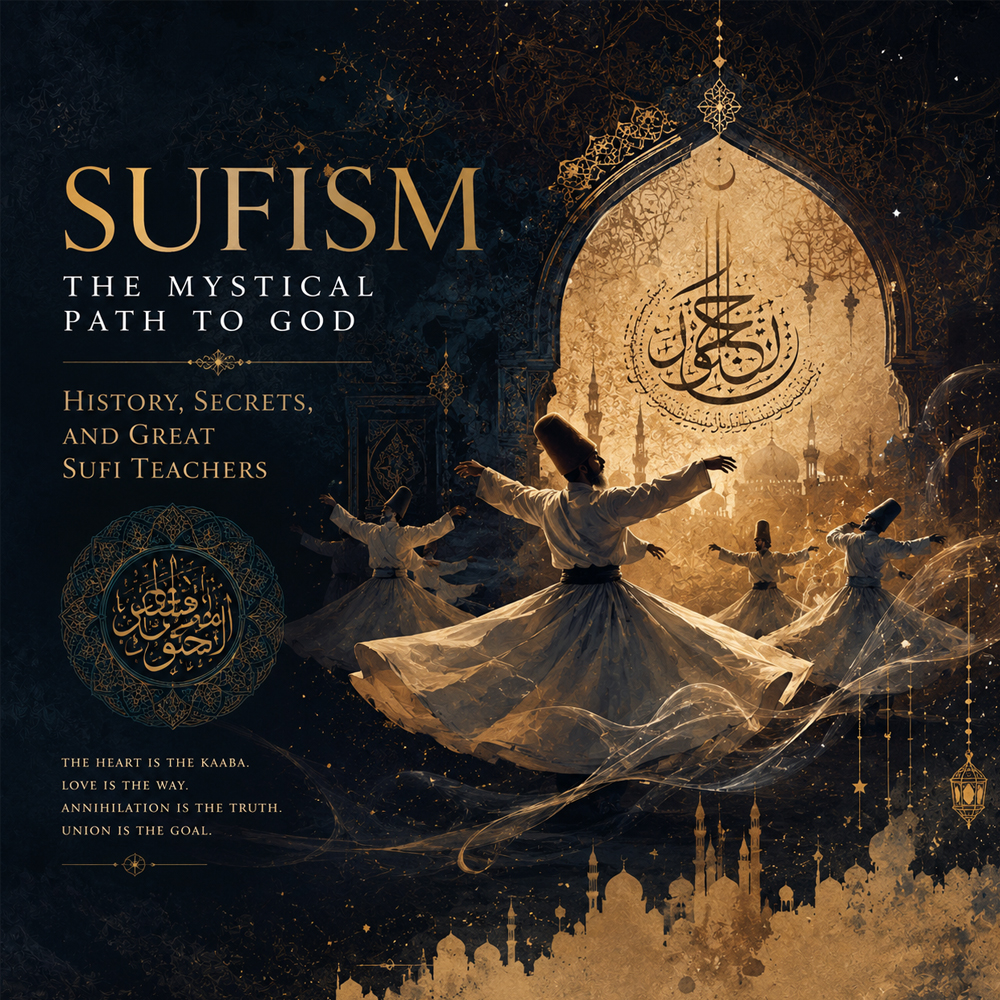
Sufism: The Mystical Path to God – History, Secrets, and Great Sufi Teachers
There is something almost elusive about Sufism – something that cannot be fully explained in words nor confined within academic definitions. It is a tradition that is experienced more than understood. Yet throughout the centuries, people from different cultures and religions have attempted to describe this inner mystical dimension of Islam, which places love, the experience of God, and inner purification above external forms and dogma…

G.I. Gurdjieff – The Mystic, Occultist, and Teacher of the Fourth Way
From an early age, Gurdjieff received an unconventional education shaped by circumstance and destiny. In his book Meetings with Remarkable Men, he recounts some of the individuals who influenced his development and the unique methods through which they taught him. His education was comprehensive, combining both practical skills and theoretical knowledge…

YOGA
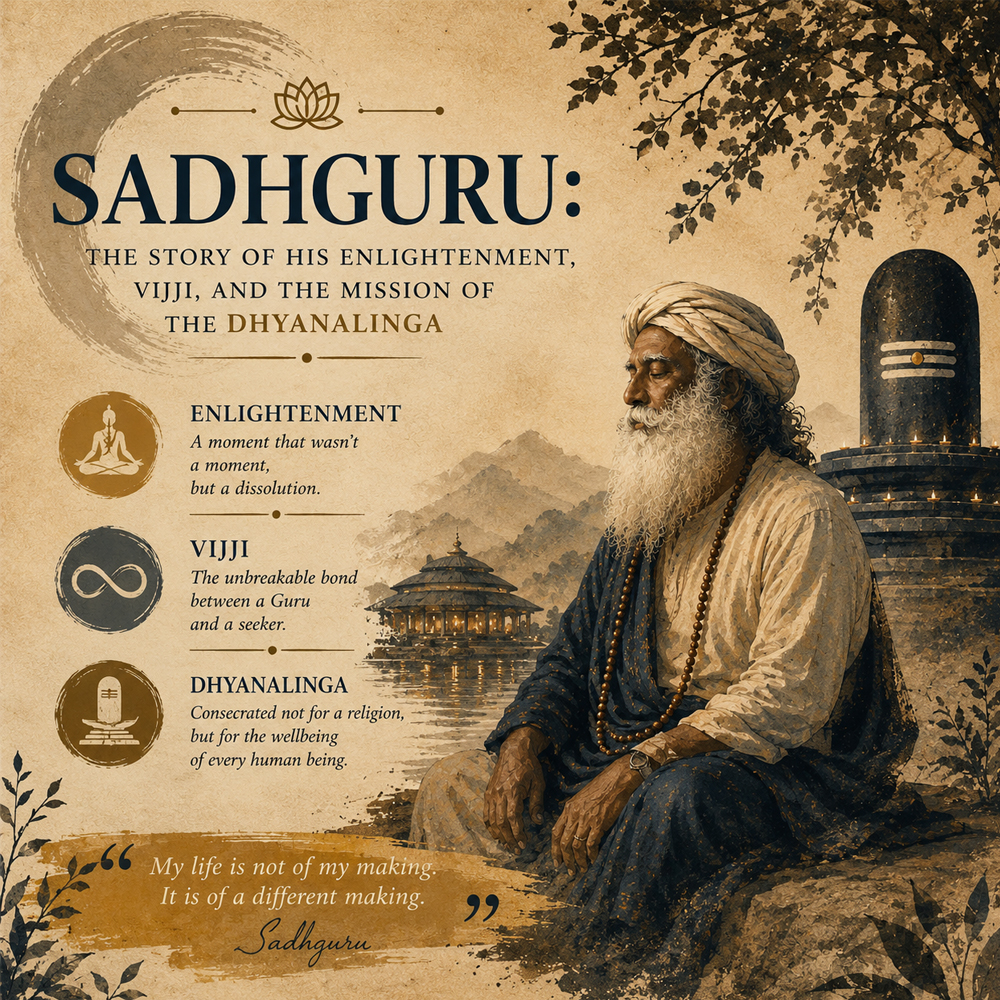
❖Sadhguru: The Story of His Enlightenment, Vijji, and the Mission of the Dhyanalinga
The story of the man whom millions today know as Sadhguru began far from the spiritual stages he would later fill with his presence. Born as Jagadish Vasudev in 1957 in Mysore, India, he grew up in a relatively ordinary family, yet possessed an extraordinary inner sensitivity to the world around him. From an early age, he displayed an independent spirit, a passion for exploration, and a deep attentiveness to life that often set him apart from his peers…

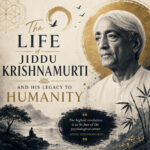
The Life of Jiddu Krishnamurti and His Legacy to Humanity
Jiddu Krishnamurti was born in South India in 1895 into a poor family and passed away in the United States in 1986. When he was thirteen years old, one of the founders of the Theosophical Society, Charles Leadbeater, came across the young Krishnamurti playing on a beach and declared that he radiated “the most wonderful aura he had ever seen, without a trace of selfishness.”…

Shiva – The First Yogi and Guru, the Originator of Spirituality
The term Shiva carries many different meanings. Sometimes it symbolizes God, sometimes one aspect of the cosmic duality (Shiva and Shakti), and at other times it refers to a being regarded as the first yogi to walk the Earth – the first guru (Adiyogi) who initiated the very process of spirituality within humanity. It is extremely difficult to clearly distinguish which stories about Shiva as a being represent historical events, which are symbols…

Yoga: Karma, Life, Death, and Rebirth
Death is a concept we believe we fully understand. The heart stops, the circulatory system is interrupted, the organs no longer receive oxygen and stop functioning, the brain ceases its activity, and we declare the person dead. Centuries ago, a person was declared dead when they were unable to wake up for one reason or another. Later, humanity took a step forward, and people were considered dead when breathing could no longer be detected. Even later, death was believed to occur when the heart stopped beating…

TANTRA
❖Naropa – Life, Teachings, and the Six Yogas | The Path to Enlightenment
Among the great figures of the Buddhist tradition who combined profound scholarship with radical spiritual realization, Naropa occupies a unique place. He was an Indian yogi and teacher of the 11th century, regarded as one of the 84 Mahasiddhas and as a key figure in the transmission of teachings that would later shape the Tibetan Kagyu lineage…

Tilopa – The Mystical Master of Mahamudra and the Beginning of a Spiritual Lineage
The history of human spirituality knows figures who stand at the boundary between mythology and historical reality. One of the most mysterious and influential among them is Tilopa, an Indian tantric master of the 10th-11th century whose impact on Tibetan Buddhism is difficult to overstate. He is regarded as one of the 84 Mahasiddhas – enlightened yogis who…

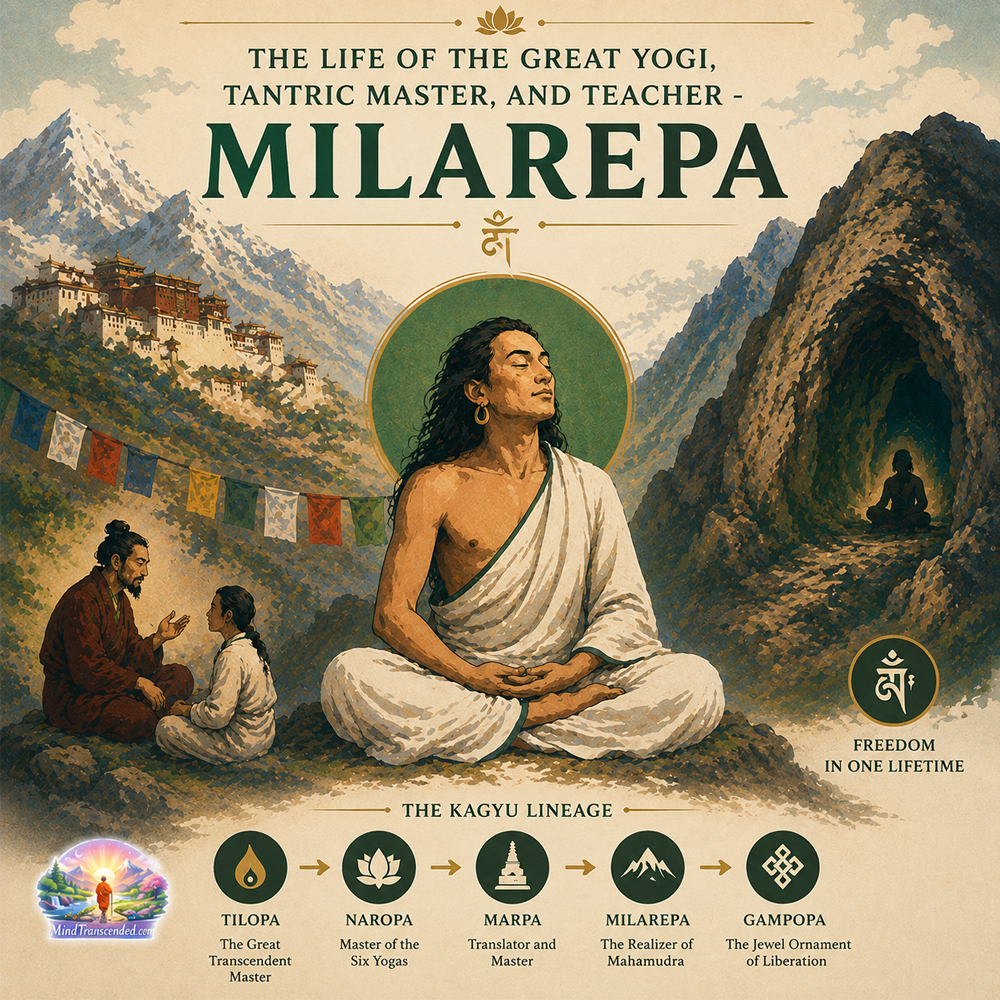
The Life of the Great Yogi, Tantric Master, and Teacher – Milarepa
Milarepa can be said to be the person most responsible for the spiritual character of Tibet as we know it today. He lived during the 11th and 12th centuries – a time when Buddhism had already entered Tibet, yet after Milarepa, nothing remained quite the same. He is a figure comparable to individuals such as Socrates, who drew a line between philosophers…

What Are Yoga and Tantra: Differences, Philosophy, and the Role of “Sexual Energy”
When we speak about the sciences of the objective external world, they are precise and definitive. But the sciences of the inner, subjective world cannot be so. Every person experiences inner reality differently, and therefore the paths toward its realization are also different. According to the Hindu tradition, there are 112 methods for working with the inner world, which can be applied in various ways. Yoga and Tantra both employ these methods, but they approach them differently…

ESOTERICISM
❖Kabbalah – The Secret Map of Creation and the Hidden Language of God
Among all the mystical traditions of the world, few teachings are surrounded by as much mystery, reverence, and spiritual power as Kabbalah. For centuries, its name has inspired both admiration and awe. To some, it is the supreme wisdom of ancient Israel; to others, it is the secret key to understanding the universe; and to still others, it represents a lost science of the structure of reality and the nature of the human soul…

Hermeticism – The Secret Wisdom of the Universe and the Path to Divine Knowledge
Among the countless spiritual traditions that have left their mark on human history, few are shrouded in such profound mystery and sacred silence as Hermeticism. It is neither merely a philosophical school nor an ordinary religious system. Hermeticism represents an ancient stream of knowledge that seems to flow from the very dawn of civilization and continues to whisper its secrets to those who are ready to hear them…

Alchemy – An Understandable Explanation of an Ancient Science
Alchemy is considered one of the oldest sciences, alongside astrology. The word itself originates from a blend of ancient cultures and carries the meaning of “divine chemistry.” While ordinary chemistry deals with physical elements, alchemy focuses on the deeper, invisible principles behind them – those that lie beyond the purely material. In other words, alchemy is not simply about substances and metals, but about processes of transformation – both in the external world and within the human being…

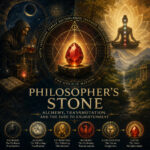
The Philosopher’s Stone: Alchemy, Transmutation, and the Path to Enlightenment
The Philosopher’s Stone (lapis philosophorum) was regarded as the highest goal of alchemy. According to this ancient doctrine, it possessed the power to transform mercury into gold or silver. However, the term “mercury” in alchemical texts should not be understood literally, but rather as a symbol representing aspects of existence unknown to the purely material world. Mercury was seen as analogous to the vital essence present within all living beings, while gold and silver – the most perfect of metals – symbolized its purest, most refined, and most beautiful expression…

OTHERS
❖Michael Newton and Between-Lives Regression: What Happens After Death According to Hypnosis
There are countless philosophical, religious, and spiritual doctrines, each offering its own perspective on life after death and the existence of a spiritual realm. If we assume that human beings possess some form of memory related to the afterlife, the very fact that such memories are not accessible to our ordinary consciousness suggests that we must look into the depths of our unconscious nature. According to certain spiritual and hypnotherapeutic traditions, one method through which these deeply buried memories may be accessed is regression, or in other words, hypnosis…

Hasidism: Mystical Philosophy, Stories, and the Secrets of Spiritual Life in Judaism
Hasidism is one of the most fascinating, controversial, and at the same time deeply human phenomena in the history of Judaism. It is not merely a religious movement, but a complete way of life, a spiritual philosophy, and a social structure that has left a lasting imprint on millions of people over the past three centuries. To truly understand its essence, it is not enough to view it solely as a historical movement or as a collection of religious practices…