
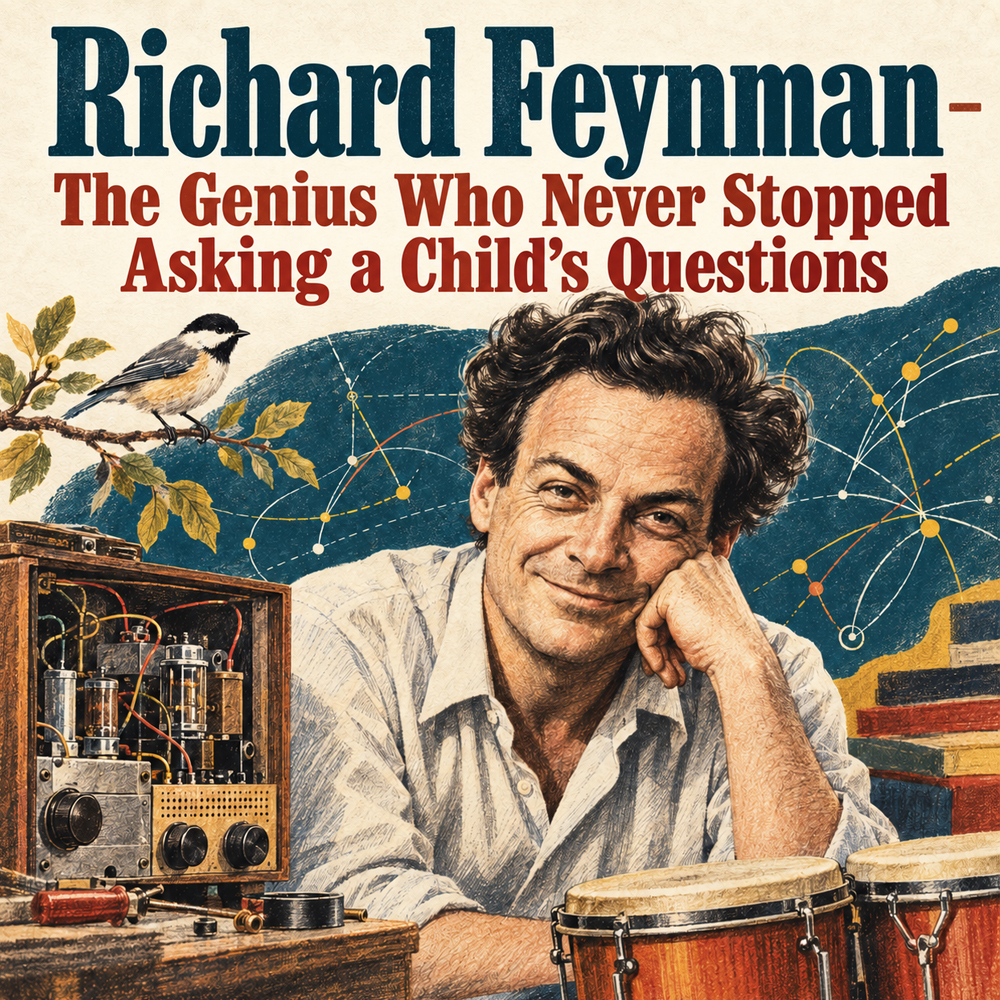
Part One: How to Raise a Mind That Refuses to Bow to Authority
A man has a problem with his radio and calls a boy to repair it. When the boy arrives, the owner can barely conceal his doubts: standing before him is a child, while the faulty set produces a deafening noise before finally settling into normal operation. The young repairman switches on the radio, listens, and begins pacing back and forth instead of immediately attacking its components. To someone expecting a repair, this looks like a waste of time, but for the boy, the work has already begun. He is trying to understand what is happening inside before deciding what to change.
The boy is Richard Feynman, and the incident he later recounts in his memoirs contains, in miniature, his future approach to science. The radio makes noise when switched on and then quiets down, and that sequence directs his attention to the warming of its vacuum tubes. He suspects that different parts of the circuit are becoming operational in the wrong order, exchanges compatible tubes, and tests the result. The radio now starts quietly, and the skeptical customer becomes an enthusiastic admirer. According to Feynman’s recollection, the man begins recommending him with amazement that this boy repairs radios by thinking.
It is easy to notice the talent in this story, but what the boy does with that talent is more interesting. He does not rush to look busy merely to reassure the adult, nor does he abandon his reasoning because someone considers him too young. He allows the observed behavior of the device to determine his next step. Between the noise and the repair lies invisible work that looks, from the outside, like inactivity: the construction of an explanation. It is there, in the willingness to stay with a question long enough, that we begin to recognize the man who will change how physicists calculate interactions between light and matter.
The Father Who Showed Him How Interesting the World Was
Richard Phillips Feynman was born on May 11, 1918, in New York City and grew up in Far Rockaway, Queens. His father, Melville, worked in sales but had a strong interest in science, although he was not a professional scientist. His mother, Lucille, brought a sense of humor into family life that her son would retain as an adult. Richard thus grew up with two influences that would later seem almost inseparable in his character: seriousness about understanding and the ability to laugh at human self-importance. In his home, curiosity had a place, while solemn regard for one’s own importance received no such privilege.
Even before Richard was born, Melville declared that if he had a son, the boy would become a scientist. That wish could have become a burdensome parental demand, but according to Feynman’s later accounts, his father chose a different approach. He did not repeatedly tell the child what he had to become; instead, he continually drew his attention to interesting phenomena. He showed him the world as a place worth examining closely. Rather than turning a future profession into an obligation, he created the conditions in which the search for explanations could itself become a pleasure.
This distinction matters because a child can fulfill a parent’s expectations without developing independent curiosity. Under that kind of instruction, the question can easily shift from “How does this work?” to “What answer do they want from me?” Melville’s approach, as his son described it, directed attention toward the subject being investigated. The interesting thing lay in the behavior of a bird, the workings of a mechanism, or something the child could observe for himself. The adult’s authority opened space for thought instead of filling that space with ready-made conclusions.
The Bird Whose Name Was Not Enough
One of the most famous stories from Feynman’s childhood begins with walks in nature with his father. Later, another boy asks whether he knows the name of a particular bird and takes his ignorance as proof that his father teaches him nothing. Richard, however, has already received a different lesson: knowing what people call an animal does not mean understanding the animal itself. Melville has shown him that names in different languages can accumulate without teaching him how the bird lives. After naming comes the real work: looking at it and seeing what it does.
In his account of this education, Feynman describes his father drawing attention to a bird pecking at its feathers. Richard proposes an explanation involving the straightening of feathers after flight, and Melville turns the suggestion into a testable question. If that explanation is correct, the behavior should occur more frequently immediately after flying and decrease once the bird has remained on the ground for a while. The child receives an exercise in scientific thinking without a laboratory or complicated instruments. A hypothesis now has a consequence that can be compared with observation.
The strength of this lesson lies in its simplicity. Many people can invent a convincing explanation for something they have seen, but persuasiveness alone does not establish whether the explanation is true. The next step requires asking what else should happen if you are right. At that point, the idea leaves the comfort of its own internal logic and exposes itself to a test. For the future physicist, this becomes a fundamental habit: an idea must risk being wrong, or it remains a story that cannot be tested.
Feynman also retained a sense of humor about his own dislike of names. As an adult, he admitted that it sometimes caused difficulties when a colleague named an experiment and he first had to establish what had actually been done. He added that his father had neglected to emphasize one practical benefit of names: they help people talk about the same thing. That admission makes the lesson more precise because it reveals its limits. Terms are necessary for communication, but using them does not relieve anyone of the responsibility to understand what lies behind them.
A Room Where Curiosity Acquired Wires
Richard’s interest did not remain confined to conversations with his father. As a child, he set up a home laboratory, experimented with electrical circuits, and took apart radio receivers. He worked with light bulbs and even built an electric alarm. He read and learned mathematical ideas before encountering them in the usual school sequence. His room became a place where a question about how something worked could be followed by action: connect it, dismantle it, change it, and observe the result.
There is a particular satisfaction in making something you have assembled begin to work. The result does not depend on a teacher’s approval or the impression you make with your explanation. The circuit either performs as intended or reveals that something in the design or construction is wrong. That does not make the task easy, but it makes the feedback immediate. For a curious child, such work offers a rare freedom: you can pose the question yourself and receive an answer from the thing you are investigating.
Here, too, the relationship between imagination and discipline begins to take shape. To invent a device, you must imagine behavior that does not yet exist before you. To build it, you must accept the limitations of real materials and connections. If you work with imagination alone, you produce a wonderful design that does nothing; if you follow instructions without understanding, you struggle to identify the cause when something goes wrong. The real pleasure comes when the two meet and you begin to recognize why the result differs from your expectation.
Humor as Permission to Try
In Feynman’s family portrait, his father occupies a central place, but his mother also matters to the way he begins to relate to the world. Biographical accounts connect Lucille with his sense of humor and the ease with which he later tells stories. Her influence complements the serious curiosity encouraged by Melville. Richard grows up with an example showing that someone can work carefully at a task without behaving solemnly. In his future personality, that combination will allow the great scientist to remain an irreverent joker.
Humor also matters to learning because it reduces the fear of looking foolish. When someone becomes too concerned with protecting a reputation for knowledge, an ordinary question starts to seem dangerous. They conceal their lack of understanding and thereby defend the appearance of competence at the expense of actual competence. Laughter can interrupt that dependence by bringing the situation back to human proportions. You do not have to appear infallible to do something well.
This does not mean that every joke is an expression of wisdom or that a cheerful person automatically thinks freely. What is interesting about Feynman is the combination of playfulness and persistence. A question can begin as entertainment, but solving it requires effort that continues after the initial enthusiasm fades. You have to endure confusion, unsuccessful attempts, and moments when there is nothing impressive to show. The freedom to enjoy a problem becomes valuable precisely when it helps you stay with it.
Finding His Own Place Among the Sciences
As he grew up, Feynman became interested in various scientific fields and displayed strong mathematical abilities. Eventually, he chose physics, a field in which mathematical reasoning must continually confront the behavior of nature. He graduated from the Massachusetts Institute of Technology in 1939 and then continued his education at Princeton, where he received his doctorate. His path now extended far beyond experiments at home, but the central question retained its familiar form. What is actually happening, and how can we establish it?
Physics requires more than speed in solving problems. You must recognize which details matter, which approximations are permissible, and when an elegant mathematical description fails to match the phenomenon. Sometimes the hardest work comes before the calculation because you have to find the right way to formulate the problem. At other times, the obstacle appears after a lengthy calculation, when the result reveals that the original picture was inadequate. In this continuous exchange between conception and verification, Feynman’s childhood habits acquire a new depth.
He would later become famous for his unusual way of representing physical processes, but that originality should not be confused with arbitrariness. A different approach has value when it allows you to calculate something more clearly, discover an overlooked connection, or pose a more precise question. Disagreement with established thinking is not, by itself, a scientific contribution. You must do the work that makes your idea available for others to test and use. Between independent thinking and discovery stand hours of effort that the legend of genius often conceals.
Love Enters the Story Before Fame
While still young, Feynman grew close to Arline Greenbaum, who would become his first wife. Their relationship began before his great scientific fame and developed during the years when he was establishing his professional path. Later, Arline contracted tuberculosis, a disease that at the time posed a serious and immediate threat to life. In 1942, the two married despite her illness. That decision brought a responsibility into the young physicist’s life that could not be resolved through ingenuity or a correct calculation.
The story of a scientist can easily be arranged around universities, publications, and prizes, but that approach loses the life in which those achievements emerge. For Feynman, love for Arline and concern for her would coexist with one of the century’s most demanding scientific tasks. His ability to understand nature would not give him power over everything that affected him. He would have to live with a limit that every person encounters: you can do everything within your power and still fail to obtain the outcome you want. Behind the future image of the witty, unstoppable physicist stands a young man who has no protection against loss.
A Question That Now Carries the Weight of War
In 1942, Feynman was recruited to work on the American effort to create an atomic bomb. He subsequently went to Los Alamos and became a group leader in the immense scientific and engineering undertaking known as the Manhattan Project. The young scientist who had begun with radio receivers and electrical circuits was now participating in work whose outcome would have global consequences. The task demanded extraordinary ingenuity, but its success meant creating a weapon of unprecedented destructive power. Curiosity entered a setting in which the correct scientific answer was not enough to resolve the moral question.
Up to this point, his story seems like the gradual unfolding of a talent that had been happily encouraged. A father who teaches his son to observe, a mother who passes on a sense of humor, experiments at home, education, and love come together in a young man with tremendous intellectual drive. War will change the setting in which that drive finds expression. Feynman will have to work amid secrecy, pressure, and competition while Arline’s illness advances. At Los Alamos, his talent will reveal itself with remarkable force, and life will confront him with questions that genius alone cannot answer.
Part Two: Los Alamos – Between an Extraordinary Task and an Irreversible Loss
Richard Feynman did not greet the proposal to work on the atomic bomb with enthusiasm. When physicist Robert Wilson told him about a secret project to separate uranium isotopes, the young doctoral student initially declined because he wanted to continue his own work. Wilson nevertheless told him the time of the upcoming meeting and left him to think. Feynman later recalled that he managed to return to his dissertation for about three minutes. Then the thought of a possible atomic bomb in Hitler’s hands pushed everything else aside.
That fear took him to the meeting, and shortly afterward he already had a desk and was beginning calculations. His decision emerged in wartime, when none of the participants possessed a complete picture of Germany’s efforts. For Feynman, the danger was serious enough to interrupt his preferred research and join a task with an immediate military objective. He nevertheless managed to finish his doctoral dissertation before leaving for Los Alamos. The man who had previously studied nature primarily out of curiosity was now working with the conviction that the speed of a scientific solution mattered to the outcome of the war.
This beginning is essential to understanding his involvement. His biography does not show a young scientist who dreamed from the outset of creating weapons, but someone who accepted a particular danger as a reason to participate. Yet the original justification does not remove responsibility for the eventual result. A painful distance would emerge between the reason some scientists began their work and the circumstances in which the resulting weapon was used. For Feynman, that distance would become part of the difficult reckoning after the war.
The Young Physicist Who Argued with Hans Bethe
In 1943, Feynman arrived at Los Alamos, where scientific leadership had been entrusted to Robert Oppenheimer. He joined Hans Bethe’s theoretical division and soon became a group leader. His work included calculations concerning the behavior of the future weapon, and together with Bethe he developed a formula for estimating the energy released in a nuclear explosion. This was participation in an enormous collective effort in which theory had to connect with experiments, production, and engineering decisions. His scientific ingenuity was now judged by its ability to help solve concrete and urgent problems.
His relationship with Bethe reveals why the young Feynman quickly found a place among much more experienced scientists. According to his own recollections, when discussing physics, he concentrated so intensely on the problem that he stopped thinking about the status of the person speaking to him. If he considered an idea wrong, he objected directly, and Bethe had to show him where he himself was mistaken. That was precisely the kind of partner useful to the head of the theoretical division: someone who offered genuine resistance to his reasoning. Their conversations became tests of ideas in which the youth of one participant and the reputation of the other could not replace an argument.
This quality can easily be mistaken for simple audacity. The difference is that scientific debate obliges the person raising an objection to accept correction when the evidence goes against them. Telling a famous scientist that he is wrong is easy; understanding exactly why he is wrong, or why you are mistaken, requires work. In a productive argument, the freedom to challenge goes together with the willingness to concede. For Feynman, that freedom came from the habit of looking at the question itself before looking at the person presenting it.
The Computational Work Behind the Great Achievement
When we imagine Los Alamos, we usually picture celebrated physicists standing before blackboards. But between an equation and a useful result lay an enormous volume of numerical work, performed by people using mechanical calculators and gradually supported by punched-card machines. Feynman helped organize and improve this work alongside other scientists and technical specialists. It was an environment in which a good idea about the sequence of operations could have practical importance comparable to a new theoretical argument. A calculation had to be correctly conceived and also executable within the available time.
Historical studies of this activity emphasize the contribution of participants who are often missing from popular accounts, including the women who performed numerical calculations. Their work transformed mathematical formulations into results that could be compared and used. Feynman was an important figure in this story, but he was not the sole driving force behind the computational effort. Progress depended on people who checked results, repeated operations, found mistakes, and kept the process running. The scale of the task itself shows how misleading the image of a solitary genius producing everything necessary in a sudden flash can be.
The Man Who Also Tested Locked Doors
Outside his work in physics, Feynman found another outlet for his curiosity: the laboratory’s security. Los Alamos held exceptionally sensitive documents, but the presence of fences, guards, and locked cabinets did not mean that every safeguard worked as people assumed. He began experimenting with opening locks and combination-locked cabinets, turning this into one of his most famous pursuits. His reputation as someone capable of getting into another person’s cabinet brought his colleagues both amusement and discomfort. His curiosity exposed the difference between feeling secure and having protection that could withstand a test.
The same spirit appeared in his encounters with the perimeter guards. According to the historical account published by the National Park Service, he would slip outside through the fence and then return through the official entrance, confusing the guards. The incident was comic because the system expected a particular sequence of actions, while he appeared from a direction he should not have been coming from. But the difficulty for the guards was real: the man standing before them was demonstrating a gap that the formal procedure did not cover. For Feynman, disrupting an expectation was often a way to establish what actually worked.
These stories should not turn every action of his into an example of flawless judgment. He enjoyed the challenge itself, the pleasure of solving a problem, and people’s reactions when they were surprised. His behavior contained competitiveness and a desire to show that he had noticed something others had missed. That is precisely what gives the portrait its vitality: his independent mind was inseparable from his temperament, vanity, and mischievousness. Ingenuity can expose a weakness in a system, while the person displaying it can still be difficult for those around him.
Letters That Troubled the Censors
Secrecy at Los Alamos extended into personal correspondence. Letters were inspected, and information about the laboratory’s location, work, and personnel was restricted. Arline sent Feynman coded puzzles to decipher, but the censors could not simply accept that an incomprehensible text was an innocent game. Eventually, an arrangement was reached: she would include a key so that the inspectors could read the contents first. Their private amusement thus acquired its own bureaucratic procedure, which itself sounds like a Feynman joke.
This exchange shows that their relationship had a life beyond illness and worry. They continued sending each other things that required participation, attention, and an understanding of the other person. A puzzle was an invitation to share an activity despite their physical separation. A letter could contain playfulness, impatience, tenderness, or irritation, as in any real intimacy. Arline was present in his life as a companion and partner, rather than simply as someone whose condition worried him.
Arline and the Limits of Understanding
While Feynman worked at the laboratory, Arline received treatment at a sanatorium in Albuquerque. The surviving letters from the spring of 1945 reveal his efforts to remain close to her despite the distance and his work. They also show tension, followed by attempts to understand her better and become a more dependable source of support. These pages contain no flawless hero who always knows what to say. They reveal a young husband who loves deeply, makes mistakes in communicating, and gradually recognizes how serious his beloved’s condition has become.
Arline died on June 16, 1945, at the age of twenty-five. Feynman managed to reach her and remain at her bedside during her final hours. The first nuclear test was one month away, and work at Los Alamos continued under mounting pressure. In his professional life, the moment that would reveal whether the enormous effort had succeeded was approaching. In his personal life, something had already happened that no future success could repair.
A powerful intellect does not eliminate helplessness in the face of such a loss. A person can understand an illness, know the prognosis, and be prepared for death as a fact without being prepared for the absence that follows. Everyday closeness leaves habits that continue searching for the person they once reached. You want to tell them something, ask a question, or share a small discovery, but the conversation can no longer take place. In Feynman’s life, that silence would remain beneath his exuberant public personality.
The Light of Trinity
On July 16, 1945, the first nuclear test, known as Trinity, took place in the New Mexico desert. Feynman was present and watched the explosion through a vehicle’s windshield instead of using the dark protective glasses provided. The incident became part of the stories about his unconventional character, but what unfolded before everyone’s eyes mattered far more. Calculations, materials, and engineering decisions produced a physical result on an unprecedented scale. The ability to release that energy had now been demonstrated beyond the pages of theoretical work.
The test occurred after Germany’s surrender and immediately before the opening of the Potsdam Conference. In August, atomic bombs were used against Hiroshima and Nagasaki, and the world entered an era in which a single weapon could destroy a city. That sequence gave new weight to the original fear that had drawn Feynman into the project. The German threat that shaped his decision was no longer the circumstance in which the weapon was being used. Scientific success and human consequences became parts of the same history, a history that allowed no convenient separation.
After the War, the Man Remains
When the war ended, Feynman left Los Alamos and accepted a teaching position at Cornell University. He carried with him the experience of working with extraordinary scientists, solving difficult practical problems, and participating in a project with immense consequences. He also carried the loss of Arline, which did not end with a move to another city. Before him stood the opportunity to choose his own scientific questions again. But freedom after prolonged pressure does not automatically become inspiration.
In October 1946, he wrote a letter to his deceased wife. In it, he tried to express a love that continued even though his reason clearly understood the finality of death. He wrote of wanting to talk and do things together, then added a bitterly tender joke that he did not know her new address. Humor here does not diminish the pain; it exists within it. The man who could make audiences laugh found, in the same language, a way to address someone who could no longer answer.
Los Alamos left Feynman with more than professional experience and a supply of entertaining stories. There, his mind learned to work under extraordinary pressure, while life showed him how different a solvable problem was from an irreversible event. After the war, he would have to rediscover his personal reason for doing physics. That reason would gradually return through the pleasure of examining something interesting without first demanding that it lead to a great achievement. From that recovered freedom to explore would grow the work that brought him the Nobel Prize-and the conviction that the true reward had already been received in the discovery itself.
Part Three: The Discovery Is the Prize
After the war, Feynman found himself in a position that looked wonderful from the outside. He was a young physicist with proven abilities, had worked alongside some of the strongest scientists of his time, and held a university position at Cornell. But his inner condition did not match that promising picture. After the pressure of Los Alamos and Arline’s death, he struggled to return to independent research. According to his own recollections, the expectation that he should produce something significant began to weigh on the very activity of doing physics.
The way out came when he allowed himself to work on things that interested him without first having to establish their importance. In the university cafeteria, he saw someone toss a plate into the air and noticed its peculiar combination of spinning and wobbling. He began investigating the motion because he wanted to understand it. When he told Hans Bethe about what he was doing, Bethe asked what importance it had, and Feynman replied that he was doing it for fun. In the story he later told, the plate became a symbol of his recovered freedom to enjoy physics.
The plate did not contain a hidden solution to quantum electrodynamics, and it should not be turned into a magical object in the legend of genius. The significance of the incident lies in his changed relationship with his work. When he stopped demanding that every question lead to a major achievement, he regained the space to think. Curiosity began to lead, while concern about future fame receded. In Feynman’s account, this change brought him back to his earlier theoretical problems and to the work that would make him famous.
This is a recognizable human paradox. The desire to do something extraordinary can make you reject every activity that does not yet look extraordinary. In doing so, you lose precisely those small questions from which deeper understanding grows. Feynman found a way to interrupt that pressure by engaging with a specific phenomenon again rather than with his own future. Before him was a motion he did not understand well enough, and that was sufficient reason to begin.
Why Light and Matter Caused So Much Trouble
The field in which Feynman would make his most celebrated contribution was quantum electrodynamics. It describes electromagnetic interactions in the quantum world, including interactions between electrons and photons. Behind that name lie processes involved in the structure of atoms, the emission and absorption of light, and numerous properties of matter. Classical electromagnetic theory was already extraordinarily successful, but at the atomic level, quantum laws had to be taken into account. Combining them with special relativity placed demanding requirements on the mathematical description.
One of the major obstacles was the appearance of infinite quantities in calculations. Physicists wanted to predict a measurable result, yet mathematical operations sometimes produced values that could not be directly compared with observations. The problem could not be solved by arbitrarily crossing out inconvenient terms. It was necessary to establish consistently how the theory’s parameters related to measured mass and charge, and how finite predictions could be obtained from the calculations. The development of such methods, associated with renormalization, was a central part of the progress recognized by the 1965 Nobel Prize.
The difficulty can be appreciated even without mastering the necessary mathematics. Imagine a theory with strong foundations that correctly describes numerous phenomena but begins producing an unusable answer when asked a more precise question. You must then establish whether you have applied the method incorrectly, whether the method itself is inadequate, or whether something is missing from the underlying picture. Each possibility requires a different kind of work. In such situations, originality matters when it offers a new way to organize the problem and test the result.
Adding Up All the Paths
One of Feynman’s great ideas was the formulation of quantum mechanics through path integrals. In the classical picture, motion is described by a particular trajectory connecting an initial and a final state. In Feynman’s approach, the quantum calculation includes contributions from all possible trajectories between them. A probability amplitude is assigned to each trajectory, and those amplitudes are added together. The resulting total is then used to determine the probability of the observed event.
There is a detail here without which the explanation becomes misleading. Amplitudes are not ordinary positive probabilities that simply accumulate. They have a phase, and when combined, they can reinforce or cancel one another, much like interfering waves. The quantum result is therefore not obtained by listing possible paths and counting votes for each of them. What matters is how the individual contributions combine when the alternatives have not been distinguished by measurement.
This picture does not authorize us to claim that an electron is a tiny ball that literally travels every route and then chooses one. It is a mathematical formulation through which quantum phenomena can be calculated. What is particularly striking is that, in the appropriate classical limit, contributions from many trajectories cancel one another, while contributions near the classical trajectory remain coherent. Familiar motion thus emerges from the quantum description under the relevant conditions. Classical physics finds its place within a more general theory instead of simply being discarded.
In this idea, we can recognize Feynman’s characteristic desire to find a way of seeing the problem. He was not satisfied with being able to carry out formal operations if he lacked a picture that organized his thinking. Such a picture does not replace rigorous calculation, but it helps him pose questions and recognize connections. Sometimes a new representation of familiar laws opens possibilities that an earlier representation concealed. Originality here lies in making the same nature more accessible to investigation.
Drawings That Are Actually Calculations
Feynman’s most recognizable legacy is the diagrams bearing his name. They use lines and connecting points to represent terms in calculations of interactions between particles. In quantum electrodynamics, for example, different lines denote electrons, positrons, and photons, while vertices represent interactions. But the drawing is not sufficient by itself: mathematical rules are applied to each of its elements. Through those rules, the diagram becomes a contribution to the amplitude of the process being considered.
This explains why the diagrams are so useful. They allow a complicated expression to be organized into distinguishable parts and help physicists keep track of which contributions must be included. In more precise calculations, the number of necessary diagrams grows and the work remains difficult, but there is now a systematic way to organize it. The picture serves as a tool for mathematical thought. Feynman’s publications established the rules and their justification so that other researchers could use the method.
A diagram, however, is not a photograph of what happened between two measurements. Not every internal line can be interpreted as a separate, directly observable particle moving along the route drawn on the page. Different diagrams contribute to the overall prediction that is compared with experiment. Their strength lies in accurate calculation, while reading them too literally can create false impressions. Feynman gave physicists a tool that was both visual and rigorous, but using it requires an understanding of the relationship between the image and the formula.
Three Laureates and One Theory
In 1965, the Nobel Prize in Physics was awarded jointly to Richard Feynman, Julian Schwinger, and Shin’ichirō Tomonaga. The award recognized their fundamental work in quantum electrodynamics and its consequences for the physics of elementary particles. The three developed different approaches to the theory’s central difficulties. Their achievements showed how the same physical content could be reached and organized through different intellectual paths. The Nobel recognition therefore belongs to a history with several central figures rather than to a single hero who solved everything alone.
In his own Nobel lecture, Feynman described the development of his ideas through difficulties, changes of direction, and attempts that failed to produce the expected result. He acknowledged the influence of other scientists and explained how he sometimes understood a connection only after prolonged effort. His account does not resemble a flawless plan carried out from beginning to end. Thought advances through reconsidering the question and finding a representation that allows the calculation to continue. Scientific success appears far more laborious than the retrospective legend of a sudden flash of insight.
This does not diminish his achievement. On the contrary, it reveals the kind of persistence behind it. A quick mind must also endure periods when there is no quick answer. Ingenuity must confront mathematical obstacles that do not yield to wit. Feynman succeeded in creating methods that worked for other people, and that is a stronger criterion than the impression an unusual person makes in conversation.
The Quantum World in Liquid Helium
His work did not end with quantum electrodynamics. During the 1950s, Feynman investigated the superfluidity of liquid helium and sought to understand the phenomenon through the quantum behavior of its atoms. At sufficiently low temperatures, helium-4 exhibits properties that cannot be explained through an ordinary picture of a liquid. Among them is the ability of the superfluid component to flow without viscous resistance. Feynman developed important ideas about the states and excitations of this system, connecting its microscopic description with its observed behavior.
This field presents a different challenge from the interaction of a few particles. Here, an enormous number of atoms form a collective system whose properties cannot easily be read from the behavior of a single isolated atom. An appropriate way of describing the overall organization must be found. Feynman used approximate quantum states and connections with measurable properties of the liquid to investigate its excitations. His talent for choosing a useful physical picture thus also appeared in a problem where complexity arose from collective behavior.
Later, together with Murray Gell-Mann, he made an important contribution to the theory of weak interactions, associated with processes such as beta decay. He also developed the parton model, through which high-energy interactions with the proton could be treated as interactions with its internal constituents. These ideas belong to different stages in the development of physics and emerged through work involving many other scientists. What they share is his ability to find a description that extracts the essential features of a complicated problem. His contribution is therefore measured through several influential ways of thinking as well as through one celebrated breakthrough.
“I’ve Already Got the Prize”
When Feynman spoke in a 1981 interview about his attitude toward honors, he stated directly that he did not like them. For him, the essential things had already happened: he had made a discovery, experienced the pleasure of it, and seen other physicists use his work. An academy’s decision to distinguish him added no new scientific substance to that experience. He did not deny that people appreciated his contribution; he pointed to that appreciation, expressed through understanding and use, as sufficient. His concise formulation was: “I’ve already got the prize.”
He then explained what he meant by a prize: the pleasure of finding something out, the thrill of discovery, and the opportunity to see it become useful to other people. Honors seemed external to that reality. He associated them with the insignia through which people emphasize their status and identified his father’s upbringing as part of the reason he reacted that way. His aversion was directed toward turning recognition into a hierarchy of human importance. Behind the objection stood the conviction that the importance of the work did not require its author to be placed above others.
He nevertheless accepted the Nobel Prize and participated in the ceremonies in Stockholm. His position must therefore be described accurately: it was not a rejection of the award itself, but a clearly expressed unwillingness to let it define the meaning of his scientific life. The medal confirmed public recognition, but it did not create the discovery’s value. That value appeared in predictions that survived testing and in methods that allowed other people to make progress. The award came after the work, while his satisfaction arose within it.
What Remains After the Award
For someone who continually seeks new questions, a great prize also carries a risk. It can turn a completed achievement into a role that must constantly be maintained. A laureate is expected to sound important, have an opinion about everything, and produce only ideas worthy of that reputation. Such expectations can easily obstruct work because research includes ignorance, mistaken attempts, and small tasks. The freedom to begin again requires being unafraid of a modest beginning.
In this sense, Feynman’s attitude toward honors connects with the story of the tossed plate. In both cases, he defended the freedom to pursue a question for its own sake. The Nobel Prize should not close off that possibility by turning every future activity into a test of greatness. The world continued to offer things he did not understand, regardless of how much he had achieved. His willingness to remain the person asking questions would lead him toward pursuits far beyond theoretical physics-to drawing, music, teaching, and an investigation in which a simple experiment would prove more eloquent than official assurances.
Part Four: The Man Who Always Found Something Else Interesting
A world-famous physicist stands before several thousand children and must hold their attention for almost forty minutes. Such a task can prove more difficult than a university lecture because an eight-year-old audience feels no obligation to admire the speaker’s Nobel Prize. According to a colleague’s recollection, Feynman arrives informally dressed and captivates the children so completely that they barely move. He has the ability to make the question before him interesting even to people who know nothing about it yet. In such moments, his talent as a teacher appears in its purest form: attention comes from curiosity rather than discipline.
For Feynman, an explanation begins with something the listener can imagine. Then the familiar gradually turns out to be stranger than it appears, and the listener wants to understand why. He does not rely solely on a definition that must be memorized; he tries to set thought in motion. A good lecture has a tension of its own: a question emerges, the expected answer proves insufficient, and another step becomes necessary. Physics thus takes the form of an investigation in which the listener participates.
The Lectures That Outlived Their Audience
In the early 1960s, Feynman became involved in renewing introductory physics instruction at the California Institute of Technology. His lectures, with major contributions from Robert Leighton and Matthew Sands in shaping them for publication, became the three volumes of The Feynman Lectures on Physics. They combine a broad view of the subject with unusual explanations and connections between different fields. Rather than leading readers only along the familiar sequence of textbook exercises, they often make them see a known law from a new angle. That quality makes them valuable even to people who completed their introductory education long ago.
Feynman himself, however, was not entirely satisfied with the outcome. In his preface, he expressed disappointment with how many students handled examination problems and questioned the success of his approach. That admission sometimes turns into an exaggerated account in which the entire course was a failure. The history is more complicated, and testimony from his collaborators does not support such an unambiguous conclusion. Nevertheless, his concern is revealing: admiration for a lecture was not enough if the listener failed to acquire the ability to work with what had been taught.
Here he encountered a difficulty familiar to every form of education. While someone explains convincingly, the connections seem clear because the speaker has already organized everything necessary. When you are left alone with a new problem, you must recognize those connections without that guidance. The difference between following someone else’s thinking and constructing your own solution can be enormous. Feynman took that difference seriously instead of treating his fame as proof that his teaching must have succeeded.
In a speech about physics education, he openly acknowledged that there was no generally accepted, reliable answer to how best to teach. In his view, the existence of numerous new educational plans demonstrated dissatisfaction with existing methods. That position is striking in someone who already had a reputation as an extraordinary explainer. He could know a great deal of physics and still not know enough about how another person learned it. His authority did not remove the need to examine the results of his own efforts.
The Nobel Laureate Behind the Drums
There are photographs of Feynman that seem to belong to another biography. In them, he sits with drums, his face absorbed in the rhythm, far from the familiar image of a professor before a blackboard. His musical pursuits were not a one-time performance intended to amuse his colleagues. With his friend Ralph Leighton, he played and created percussion music for productions by a small ballet company. In Leighton’s recollections, these performances appear as a perfectly natural part of their lives, even though one of the participants was among the most celebrated physicists in the world.
The humor in this picture comes from expectations about famous scientists. The public tends to assign them a narrow role in which every action must testify to their intellectual importance. Feynman unsettles that arrangement because he clearly wants to do things that require no academic title. Behind the drums, he has to listen, maintain a rhythm, and coordinate with the other performers. His reputation in physics cannot play his part for him.
That gives the activity a particular charm. Someone who has achieved so much in one field voluntarily enters another, where different abilities must be practiced. Mistakes, awkwardness, and the need to learn exist there again. Such behavior keeps a person from becoming a monument to their own achievements. His life retains room for the immediate pleasure of participating in something.
Drawing Lessons in Exchange for Physics Lessons
Another door opened through his friendship with the artist Jirayr Zorthian. The two agreed to exchange knowledge: Zorthian would teach Feynman to draw, and Feynman would teach him physics. The physics instruction did not continue for long, but drawing remained a lasting pursuit for the scientist. He turned toward the human figure and portraiture, where he had to observe proportions, posture, and expression. Their friendly exchange became the beginning of an interest that required no justification through his scientific work.
Drawing demands a particular kind of attention. Everyday recognition allows us to see a face and immediately say whose it is without closely examining the relationships between its parts. An artist must remain with those relationships because the hand cannot reproduce a general impression without specific decisions. Familiarity with a subject is not enough to draw it. In this, there is an affinity with scientific observation, but also an experience of its own that cannot be reduced to science.
Feynman’s interest in art shows that his curiosity was not confined to what could be measured and calculated. He could pursue a question whose result was a drawing rather than a formula. He also had to accept judgments that did not arrive in the form of experimental confirmation. That was a different challenge for someone accustomed to testing physical predictions. Instead of demanding that every activity follow the rules of his profession, he learned the rules of the new pursuit.
A Place Worth Visiting Because of Its Name
In 1977, a conversation over dinner with Ralph Leighton became the beginning of a long adventure. The two decided to visit Tuva, a distant region in Central Asia that Feynman also remembered through its unusual postage stamps. He was particularly attracted to the name of its capital, Kyzyl. According to Leighton’s recollection, Feynman considered that spelling alone sufficient reason for the place to be interesting. From a cheerful conversation emerged an intention that would occupy them over the following decade.
There is something wonderfully impractical about this desire. Feynman is not seeking a conference, a prestigious invitation, or an opportunity to be welcomed as a celebrity. He wants to reach a place that has captured his imagination. Their preparations encounter geographical remoteness and the bureaucratic difficulties of the Cold War. The journey does not take place during his lifetime, but the attempts to arrange it remain part of his final years and are later described by Leighton.
This story shows how much can begin with a small spark. A name on a map or an image on a stamp can awaken an interest in an unfamiliar culture. No advance guarantee of usefulness is required. What matters is allowing your attention to be drawn toward something and then making the effort to learn more. In Feynman, that readiness survives even his greatest professional achievements.
The Future at a Small Scale
His curiosity also turned toward technological possibilities that had not yet been developed. In his 1959 lecture, “There’s Plenty of Room at the Bottom,” he explored what could be achieved by working with exceptionally small structures. He discussed storing enormous quantities of information in a small volume, miniaturizing devices, and manipulating matter at the atomic level. At the same time, he emphasized that reducing size introduced new physical difficulties and did not simply mean shrinking familiar machines. His question was what the laws of nature permitted, even when available technology did not yet permit it.
Later, he also raised the question of how computers could simulate quantum systems. Ordinary numerical descriptions of such systems encounter severe difficulties as their complexity increases. Feynman explored the possibility of using quantum physics itself to construct a computational model capable of reproducing that behavior. His work became one of the important early contributions to the ideas of quantum computation and quantum simulation. Once again, his characteristic move was to examine the physical nature of the task instead of accepting the available tool as the ultimate limit.
Cold Water Against Confident Words
On January 28, 1986, the space shuttle Challenger broke apart shortly after launch, killing all seven people on board. Feynman joined the commission investigating the disaster. Attention turned toward the seals in the joints of the solid rocket boosters and their behavior at low temperatures. The investigation also established serious problems in how information about risk had been communicated and assessed. The commission faced a task involving both a physical failure and the human decisions that had allowed the flight to proceed.
At the public hearing on February 11, Feynman performed a demonstration that became one of the investigation’s most memorable moments. He placed a compressed sample of the seal material in ice water and then released the pressure. He showed that, at that temperature, the material did not immediately recover its shape. He calmly explained that this delayed recovery mattered to the problem under examination. The audience was presented with a direct observation that made a technical danger understandable.
This experiment did not, by itself, contain the entire explanation of the disaster. The investigation required evidence about the design, temperatures, previous flights, the behavior of the joints, and the decision-making process. The demonstration mattered because it took a particular property of the material out of an abstract discussion and placed it before everyone’s eyes. If a seal had to respond quickly, its delayed response could not be removed through a confident statement. At that moment, Feynman did what he had learned as a child: he looked at what the object actually did.
When the Absence of Disaster Becomes Proof of Safety
In his own appendix to the report, Feynman examined the enormous difference between the estimates of working engineers and management concerning the probability of a serious failure. He also criticized the way deviations and damage could gradually become accepted as permissible when a previous flight had ended successfully. That is a dangerous substitution in reasoning. The fact that a risk did not produce a catastrophe on one occasion does not establish that the risk has disappeared. Repeated success can increase confidence without increasing reliability.
His final sentence in that text expressed the position clearly: “For a successful technology, reality must take precedence over public relations, for nature cannot be fooled.” It is also a practical warning to any organization that begins preferring its desired picture to inconvenient information. A material will not change its properties because a schedule requires a flight. A physical failure will not accommodate an institution’s reputation. That is precisely why honestly communicating risk is part of technical work rather than an addition to it.
The Hardest Person to Expose Is Yourself
As early as 1974, in a speech to graduating students at Caltech, Feynman warned against research that imitated the outward features of science without practicing the necessary intellectual honesty. For him, that honesty required presenting evidence that challenged a preferred conclusion. Avoiding deliberate lies was not enough. You had to actively examine whether your own desires had determined what you noticed and what you overlooked. An intelligent person could also deceive themselves, including through arguments constructed with great skill.
This warning is particularly important in the biography of a genius. Admirers can easily begin treating every answer as correct and every action as evidence of exceptional ability. In doing so, they create precisely the kind of protection from criticism that his scientific approach rejects. Feynman had a strong personality, enjoyed making an impression, and did not show equal sensitivity toward others in every situation. His value does not require those human characteristics to be erased, nor does it require his stories to be accepted without scrutiny.
The Final Question Remains Open
Richard Feynman died on February 15, 1988, at the age of sixty-nine, after a prolonged illness. Until the end, his life remained connected to science, family, friendships, and interests that could not fit within a professional biography alone. He left behind mathematical methods, scientific ideas, lectures, drawings, and stories in which work and play continually meet. He also left the example of someone who could have extraordinary confidence in his ability to think without assuming that he already knew everything. That combination is what keeps his presence so vivid after his death.
At the beginning of the story stands a father directing his child’s attention toward a bird instead of being satisfied with its name. At the end stands a scientist showing a commission how a material responds to cold instead of being satisfied with assurances about its reliability. Between those moments lie war, love, loss, discoveries, and immense fame. Yet throughout it all, the habit survives of placing observation ahead of a convenient explanation. That habit turns curiosity into work and work into understanding that can be shared.
For Feynman, the world does not become less interesting as you learn more about it. New knowledge reveals details you could not previously notice and questions you did not previously know how to ask. A great discovery is therefore not a final stop after which only honors remain. It is a moment when part of nature becomes clearer and the next unknown appears beyond it. The man who repaired radios by thinking retained that readiness to the end: to pause, look closely, and want to understand more.
Author: Vasil Stoyanov