
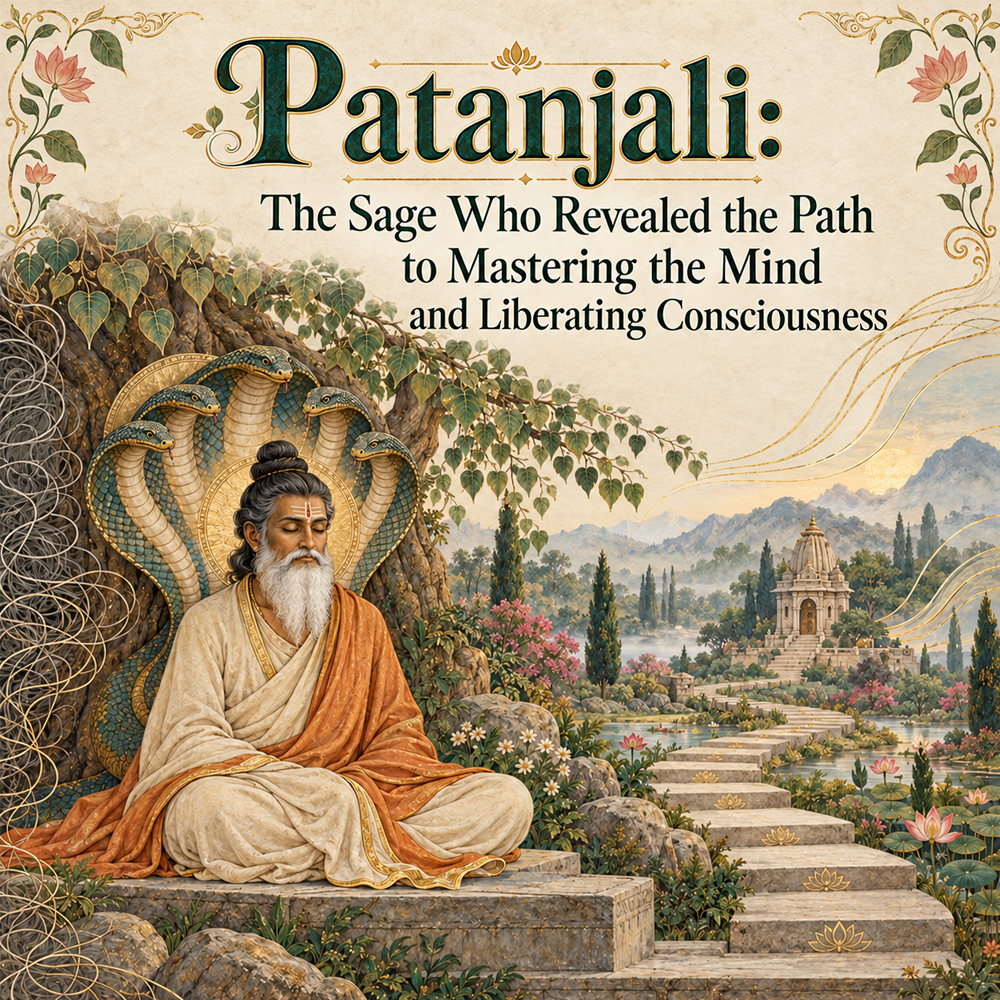
Part One: The Man Who Turned the Inner World into a Path to Knowledge
Imagine a man sitting on the banks of the Ganges in the early hours of the morning. A thin mist rises above the river, the first rays of sunlight touch the water, and the world around him slowly awakens. Birds fill the air with their calls, fishermen prepare their boats, and life follows its familiar course. Yet this man’s attention is not directed toward the river, the trees, or the people passing by. He is observing something far more difficult to understand: his own mind.
For years, he has searched for answers in sacred texts, listened to teachers, and reflected on the nature of existence. He has learned that the world is constantly changing, that pleasure is fleeting, and that every human being eventually faces loss. Yet one contradiction continues to trouble him. He understands many of these truths when he reflects calmly, but the moment someone insults him, his anger flares; the moment he desires something, his thoughts begin to revolve around it; the moment he remembers an old wound, suffering returns. His knowledge is not enough to change the way he experiences the world.
This scene is not a historical account of a particular person. It illustrates the question around which classical yoga takes shape. Why does the mind continue to generate suffering even when a person understands its causes? Why is consciousness so easily carried away by its own thoughts, while decisions made in moments of calm lose their strength under the pressure of emotion? How can a person move from intellectual understanding to actual inner transformation? It is to this problem that Patanjali dedicates the system presented in the Yoga Sutras.
Ancient India already possesses a rich heritage of spiritual practices, philosophical debates, and contemplative traditions when the teaching associated with Patanjali’s name acquires its classical form. Thinkers and ascetics investigate the relationship between the individual and the cosmos, the causes of suffering, the workings of karma, and the possibility of liberation from conditioned existence. Different schools offer their own explanations, yet share the conviction that ordinary human experience does not exhaust the possibilities of knowledge. Among these traditions, yoga gradually develops into a disciplined path that combines philosophical understanding with direct practice. Patanjali systematizes this path with remarkable consistency, making mastery of the mind the central task of spiritual development.
Who Is Patanjali? The History Behind the Legend
The name Patanjali holds a distinctive place in India’s cultural heritage. It is associated above all with the Yoga Sutras, but tradition also connects it with other fields of knowledge, including Sanskrit grammar and medicine. The historical identities of the authors bearing this name have not been established in a way that allows all the works attributed to them to be confidently linked to a single individual. The historical Patanjali must therefore be distinguished from his image within spiritual tradition. This distinction does not diminish the teaching’s importance; it allows us to examine it both as a philosophical text and as part of a spiritual culture spanning many centuries.
In traditional depictions, Patanjali often appears with a human upper body and a serpent’s lower body, sometimes beneath a spread canopy of serpent heads. This image is associated with Ananta, or Shesha, the cosmic serpent who embodies infinity in Hindu mythology and supports the divine order. According to one traditional account, Patanjali appears as an incarnation of this sacred power to impart knowledge of spiritual liberation to humanity. His name is explained through a legend in which he falls into the hands of a woman holding her palms together in prayer. These stories belong to the symbolic world of religious tradition and express reverence for a teacher whose legacy extends beyond the boundaries of an ordinary biography.
Yet behind this legendary image stands a work that impresses not through accounts of miracles, but through its exceptionally concise presentation of spiritual practice. Patanjali does not establish his authority by describing personal feats, journeys, or encounters with rulers. Instead, the text opens directly with the subject of its inquiry and proceeds to define yoga. There is no lengthy background, no elaborate cosmology, and no attempt to impress the reader with literary grandeur. All attention is directed toward a single task: establishing how the mind functions and how the movements that sustain conditioned experience can be brought to an end.
This feature distinguishes Patanjali from many spiritual teachers whose teachings have been preserved as parables, dialogues, or life stories. His work resembles a carefully arranged map in which every concept has a specific place. From its foundational definitions, the text moves to the causes of suffering, the means of overcoming them, the states of meditation, and final liberation. The reader receives no ready-made consolation, but a system that demands discipline and direct inquiry. It is precisely this rigor that makes the Yoga Sutras one of the most influential texts in classical Indian philosophy.
The Yoga Sutras: Brief Sentences That Demand a Lifetime of Practice
The Yoga Sutras consist of brief aphoristic statements called sutras. The word “sutra” means “thread” and expresses the way the central ideas are woven into a coherent exposition. These formulations are extremely condensed, which means they often cannot be fully understood without their philosophical context and traditional commentaries. A single short sentence can contain a definition that requires extensive explanation and years of practical reflection. The Yoga Sutras are therefore not a book intended for a quick reading, but a text whose meaning gradually unfolds through study and practice.
The work is divided into four chapters, each addressing a different aspect of the spiritual path. The first, Samadhi Pada, presents the nature of yoga, the movements of the mind, and the principal states of meditative absorption. The second, Sadhana Pada, examines the causes of suffering and the disciplines through which the practitioner begins to overcome them. The third, Vibhuti Pada, describes deep concentration and the extraordinary abilities that tradition associates with it. The fourth, Kaivalya Pada, turns attention toward the most subtle questions concerning consciousness, karma, and final liberation.
The structure of the work shows that Patanjali does not regard spiritual development as a chaotic pursuit of mystical experiences. Each successive subject emerges from a specific philosophical problem introduced earlier. If the mind generates suffering through its movements, the nature of those movements must be understood. If they are sustained by habits and ignorance, their causes and the means of bringing them to an end must be established. If discipline leads to deeper states of knowledge, it must be made clear which of those states represent progress and which can become new obstacles.
This approach reveals why yoga, for Patanjali, is far more than a physical practice. It is a comprehensive philosophical discipline in which ethical conduct, self-observation, bodily steadiness, and meditation serve a common purpose. None of these activities is sufficient on its own, because the problem of human suffering cannot be reduced to a single aspect of life. Patanjali seeks to transform the very mechanism through which perception, memory, and identification construct ordinary experience. His path therefore begins not with a promise of bliss, but with a precise definition of what must be mastered.
“Yoga Is the Cessation of the Movements of the Mind”
The second sutra contains the definition around which the entire system is built: “Yoga is the cessation of the movements of chitta.” In Sanskrit, the formulation is “Yogash chitta-vritti-nirodhah,” and it is among the most famous statements in the history of Indian philosophy. Its brevity conceals extraordinary conceptual depth, because each of its central words denotes an important aspect of mental life. To understand Patanjali’s teaching, we must carefully examine the concepts of chitta, vritti, and nirodha. Through them, he defines both the problem and the direction of its resolution.
Chitta denotes the mental instrument through which perception, thought, memory, and various forms of inner activity occur. This concept does not correspond exactly to the modern psychological understanding of the mind, because it belongs to the specific philosophical system of classical yoga. Within that system, chitta is part of prakriti: nature, which encompasses both material and mental manifestations. The mind is therefore not identical with pure consciousness, but is an instrument through which objects can be known. This distinction will prove decisive for understanding liberation.
Vrittis are the modifications or movements of chitta through which different forms of mental content arise. When a person sees an object, remembers an event, reasons through a problem, or imagines a situation that does not exist, the mind assumes a particular form. These movements are not necessarily unpleasant or destructive, since much of ordinary knowledge occurs through them. The problem arises when witnessing consciousness identifies with them and takes them to be its own nature. Every change in mental content then acquires the power to determine how a person experiences themselves.
Nirodha means the cessation, restraint, or settling of these movements into stillness. It should not be understood as a harsh assault on the mind in which thoughts are driven away through tension and fear. Such an attempt usually produces additional mental activity, because the struggle against thoughts itself becomes another movement of chitta. Patanjali describes a disciplined process in which these movements gradually subside through practice, non-attachment, and deep concentration. The ultimate aim is a state in which witnessing consciousness is no longer confused with the changing contents of the mental instrument.
The Lake That Cannot Reflect the Sky
Imagine a lake whose surface is continually swept by a strong wind. The water is filled with waves that cross, break apart, and arise again, leaving not a single moment of stillness. The sky stretches above the lake, but its reflection is shattered into countless moving fragments. Clouds become distorted, stars tremble, and the moon appears as a multitude of scattered lights. The water itself possesses the capacity to reflect clearly, but its constant movement prevents that capacity from expressing itself.
This image helps us understand the role of mental steadiness in Patanjali’s teaching. When the mind is filled with unceasing desires, fears, memories, and contradictory thoughts, every experience is refracted through their movement. A person rarely perceives a situation simply as it is, because expectations and judgments are immediately added to it. An ordinary conversation can be experienced as a threat if the mind is filled with suspicion, or as a promise if it is seized by powerful desire. The external event remains the same, but its inner reflection changes according to the state of the mental instrument.
When the wind dies down, the surface of the lake gradually becomes calm. The waves diminish, reflections grow clear, and the sky begins to appear without its former distortion. The lake does not need to create a new sky or acquire an unfamiliar ability. It is enough for the movement that prevented a clear reflection to cease. In a similar way, the discipline of yoga seeks to remove the mental disturbances that sustain mistaken perception.
Yet the analogy also has limits, which Patanjali’s philosophy makes clear. In classical yoga, pure consciousness is not simply the calmest state of the mind. It is distinct from the mental instrument itself, whether that instrument is restless or still. The stillness of chitta creates the conditions in which this distinction can be known, but it does not turn chitta into purusha. This is why Patanjali’s ultimate aim extends beyond ordinary relaxation and psychological balance.
The Five Movements of the Mind: How Human Experience Arises
After defining yoga, Patanjali divides the movements of chitta into five principal types. They are pramana, viparyaya, vikalpa, nidra, and smriti. This distinction shows that mental life does not consist solely of chaotic thoughts, but includes different ways in which the mind constructs the content of experience. Some of these movements involve valid knowledge, while others involve mistaken perception, imagination, sleep, or memory. Understanding them allows the practitioner to recognize more precisely the processes they usually take to be immediate reality.
The first movement, pramana, denotes valid knowledge. Patanjali identifies three sources of it: direct perception, logical inference, and reliable testimony. When a person sees a fire, they directly perceive a particular object; when they notice smoke and conclude that a fire is burning somewhere, they use inference. When they receive knowledge from a reliable source, they rely on testimony that extends the reach of their own perception. These forms of knowledge are necessary for finding our way in the world, yet according to Patanjali, even valid knowledge is a movement of chitta because it has a particular content.
The second movement is viparyaya, or erroneous knowledge. It arises when the mind takes an object to be something it is not. The classical example from Indian philosophical tradition is a person who sees a rope in the dim light and mistakes it for a snake. Fear arises immediately, the body tenses, and the person begins to react to a danger that does not actually exist. Only when light reveals the rope does the mistaken perception cease, and the suffering it produced loses its foundation.
This example has significance far beyond ordinary visual illusions. In human relationships, the mind often interprets incomplete information through existing beliefs and emotional expectations. A brief reply can be perceived as a sign of contempt, and another person’s silence as evidence of hostility. A person begins to experience real anger or anxiety, even though their initial conclusion does not correspond to reality. Viparyaya reveals how erroneous knowledge can produce entirely real consequences.
The third movement, vikalpa, concerns mental constructions based on words without a corresponding object behind them. Human language allows us to form concepts, images, and ideas that are not present as concrete objects in reality. This capacity is necessary for abstract thought, creativity, and complex communication. Yet it also allows the mind to lose itself in endless assumptions and imagined situations. A person can experience an entire sequence of emotions because of an event that exists only in their thoughts.
The fourth movement is nidra, or sleep, understood as a particular mental state. Patanjali includes it among the movements of chitta because even the absence of ordinary waking perception does not mean that mental activity has finally ceased. After waking, a person can recognize that they slept deeply, indicating the presence of a particular experience associated with sleep. In classical yoga, this state differs from meditative clarity, even though the ordinary stream of thought can be diminished in both. Patanjali thus prevents spiritual concentration from being confused with simply slipping into unconscious repose.
The fifth movement is smriti, or memory. Through it, what has been experienced can be retained and later recalled in the mind. Memory makes learning, personal history, and the recognition of familiar objects possible, but it also sustains the powerful influence of the past over the present. One memory can evoke joy, while another revives pain long after the original event has passed. Through smriti, the mind possesses the ability to turn what is absent into immediate mental content.
These five movements should not be regarded as five separate enemies that a person must destroy. They are the principal forms through which the mental instrument functions and have a definite place in ordinary life. The importance of distinguishing them lies in the practitioner’s ability to recognize which process is unfolding at a given moment. When a thought arises, they can determine whether it is based on perception, a mistaken conclusion, imagination, or memory. This recognition is the first step toward freedom from automatic submission to every form of mental content.
Abhyasa and Vairagya: Perseverance and Non-Attachment
After describing the movements of the mind, Patanjali identifies two principal means of mastering them: abhyasa and vairagya. The first denotes sustained practice, and the second non-attachment. At first glance, these principles seem opposed, because one requires effort while the other involves release from the desire to acquire. Yet their interaction creates the balance without which spiritual discipline easily becomes either passivity or an exhausting struggle. Patanjali places them together because each corrects the extremes of the other.
Abhyasa means prolonged and consistent effort to establish the mind in a steady state. It is not limited to a brief period of enthusiasm followed by a long interruption. Patanjali emphasizes that practice acquires a firm foundation when it is maintained over a long period, without interruption and with the necessary care. This requirement reveals the difference between temporary inspiration and actual discipline. A person can be deeply moved by a spiritual idea, but only its consistent application has the power to transform the mind’s entrenched habits.
Imagine a beginner taking a musical instrument into their hands for the first time. They understand where their fingers should be placed, hear the melody they wish to play, and have a clear idea of the desired result. Yet between understanding and performance lies a long process of repetition, mistakes, and gradual improvement. Neither intense desire nor intellectual knowledge of music can replace that process. In the same way, mastery of attention requires practice through which the capacity for concentration gradually becomes stable.
Vairagya complements this effort through release from the craving for sensory and mental experiences. It does not mean indifference to life or the rejection of every form of action. Its essence lies in ending the dependence that makes a person feel compelled to pursue particular objects and states continually. The practitioner develops the ability to experience pleasure without being seized by the need for it to recur. Attention thus gradually ceases to be drawn away by the constant anticipation of new rewards.
The greatest test of vairagya arises when spiritual practice itself becomes an object of attachment. A person begins to meditate in the hope of attaining a particular state, then continually checks whether they are progressing quickly enough. Every calm practice brings satisfaction, while every distraction becomes evidence of failure. The desire for liberation thus begins to generate a new form of tension. Vairagya interrupts this mechanism by allowing the practitioner to make the necessary effort without becoming obsessed with the immediate result.
Abhyasa and vairagya therefore represent two aspects of a single discipline. Perseverance prevents a person from giving up at the first obstacle, while non-attachment protects them from turning practice into another means of self-assertion. One builds steadiness, and the other releases inner compulsion. Together, they create the conditions for development that does not depend on short-lived enthusiasm or the continuous pursuit of pleasant experiences. It is on this foundation that Patanjali builds the further discipline of yoga.
Purusha and Prakriti: The Two Foundations of Classical Yoga
Patanjali’s philosophical system is closely related to Samkhya, one of the classical schools of Indian thought. At its center lies the distinction between purusha and prakriti: two fundamentally different principles. Purusha denotes pure consciousness, which witnesses experiences but is not itself a mental or material phenomenon. Prakriti is nature, from which all changing manifestations arise, including the body, the senses, thought, and the individual mental instrument. Understanding their relationship is necessary because confusion between them lies at the root of the problem that classical yoga seeks to resolve.
Prakriti should not be understood solely as the external material world. In this philosophical system, it also includes what a modern person usually perceives as the most intimate part of their personality. Thoughts, desires, intellectual decisions, emotions, and the sense of individuality belong to its manifestations. They can be extraordinarily subtle and complex, but they remain subject to change. Purusha, by contrast, is not a thought, a feeling, or a mental act, but the principle of pure awareness in whose presence these phenomena become knowable.
Here, classical yoga differs from philosophical views that regard consciousness as a function of material processes. For Patanjali, purusha does not arise from the activity of chitta, because chitta itself belongs to prakriti. The mental instrument can assume different forms, becoming active or calm, clear or confused, but all these states are objects of knowledge. Pure consciousness is understood as distinct from them and does not change with their modifications. This is the metaphysical foundation on which Patanjali builds his understanding of spiritual liberation.
It is especially important that classical yoga does not reduce purusha to a single universal self that simply manifests through multiple bodies. The traditional system of Samkhya and yoga accepts a plurality of purushas, each of which is pure consciousness distinct from nature. This understanding separates it from other Indian philosophical schools that describe ultimate reality through different metaphysical models. Patanjali does not seek to erase all philosophical differences between spiritual traditions. His system has its own coherent structure, in which liberation means ending the mistaken relationship between a particular purusha and prakriti.
The Three Gunas: The Hidden Dynamics of Nature
According to classical Samkhya philosophy, prakriti manifests through the interaction of three fundamental qualities called gunas. These are sattva, rajas, and tamas, which determine the different states and transformations of nature. These principles should not be regarded as separate substances or as three independent forces existing outside the world. They are interconnected characteristics of prakriti whose continuous interaction gives rise to the diversity of its manifestations. Through them, classical yoga explains why mental life passes through different states even when external conditions do not change substantially.
Sattva is associated with clarity, balance, and the capacity for knowledge. When it predominates in the mental instrument, the mind acquires greater transparency and steadiness. A person perceives situations more calmly, their thinking becomes more coherent, and their attention rests more easily on the chosen object. This state creates favorable conditions for philosophical understanding and meditative practice. Sattva nevertheless remains part of prakriti, which means that even the purest mental clarity is not identical with purusha.
Rajas denotes activity, movement, and agitation. When it predominates, the mind becomes restless, driven toward action, and continually occupied with desires or fears. A person feels the need to change circumstances, pursue new goals, and respond to emerging stimuli. This activity is necessary for many aspects of ordinary life, but its excessive influence obstructs meditative steadiness. Inner movement becomes so powerful that attention struggles to remain still even for a short time.
Tamas is associated with inertia, heaviness, and obscuration. Its predominance manifests as lethargy, confusion, lack of clarity, and a tendency toward passivity. A person can find it difficult to begin a necessary activity, sustain attention, or overcome habitual patterns of behavior. Unlike rajas, which continually drives the mind toward movement, tamas holds it in a state of immobility without alert concentration. This is precisely why classical yoga distinguishes true meditative calm from ordinary drowsiness and mental inertia.
The three gunas should never be regarded as completely isolated characteristics. A person can begin the day with clarity and calm, later fall into intense agitation, and by evening be overcome by heaviness and fatigue. These changes reveal different proportions among the fundamental qualities of prakriti. The discipline of yoga uses an understanding of them to create conditions in which clarity and steadiness can develop. Yet final liberation requires more than the predominance of sattva: it requires discerning purusha as distinct from every manifestation of the three gunas.
The Threshold of Inner Transformation
Once the principal movements of the mind and the philosophical foundations of classical yoga have been revealed, a decisive question arises. If a person possesses the ability to recognize mental processes, why do they continue to submit to them so easily? Why do certain desires acquire an almost irresistible force, while some fears persist even when reason clearly recognizes their lack of foundation? Why do old reactions return again and again, despite a sincere intention to overcome them? Patanjali’s answer lies in the deeper causes of human conditioning.
He does not regard suffering as an accidental consequence of isolated unfavorable events. According to his system, enduring causes lie behind recurring reactions, sustaining ignorance and shaping the way a person perceives themselves and the world. These causes do not disappear simply through acquiring new information or temporarily calming one’s thoughts. They must be recognized, weakened, and gradually overcome through purposeful spiritual discipline. This is where philosophical knowledge becomes a practical investigation into the roots of suffering.
In the next stage of his teaching, Patanjali examines the five kleshas: the fundamental causes that sustain human dependence on changing experiences. He then presents the disciplines through which practitioners begin to transform their behavior, habits, and attention. The eightfold path of yoga gradually unfolds, connecting ethical life with the deepest states of meditation. The first task is to understand the nature of the mind; the next is to overcome the forces that keep it conditioned. From this point, the practical journey toward inner freedom begins.
Part Two: The Five Roots of Suffering and the Eightfold Path of Yoga
Imagine a person who, after many years of effort, has finally achieved everything they have always dreamed of. They own a spacious home, have a respected profession, enjoy financial security, and receive public recognition. Each of these achievements once seemed like the final condition they needed to fulfill to become truly satisfied. Yet when they find themselves alone in the evening, they discover that their inner tension has not disappeared. New anxieties have taken the place of old desires, while the pleasure of what they have acquired has gradually given way to the fear of losing it.
For Patanjali, this contradiction is not an incidental feature of human character. It reveals the operation of particular mental mechanisms that turn transient experiences into sources of dependence. A person suffers not only because the world denies them what they desire, but also because the mind constructs mistaken expectations about the nature of pleasure, security, and personal identity. Even when circumstances change favorably, the underlying mechanism remains intact and begins to operate through new objects. This is why Patanjali directs attention toward the causes that sustain inner conditioning rather than the endless rearrangement of external life.
These causes are called kleshas and constitute five fundamental sources of suffering. Patanjali identifies them as avidya, asmita, raga, dvesha, and abhinivesha. They denote ignorance, mistaken identification, attachment, aversion, and clinging to existence, respectively. The five kleshas are not independent weaknesses that can be considered in isolation from one another. They form a coherent system in which fundamental ignorance sustains the other forms of psychological dependence.
It is especially important that the kleshas do not operate only when a person experiences a powerful emotion. Patanjali describes them as capable of existing in different states: dormant, weakened, temporarily interrupted, or fully active. A person can believe they have overcome a particular attachment until circumstances arise that awaken it again. Another can appear calm because nothing in the present moment threatens their desires or their ideas about themselves. Actual transformation begins only when the cause of a reaction is recognized, rather than when external conditions temporarily stop provoking it.
Avidya: The Ignorance That Distorts Reality
The first klesha, avidya, is the foundation of all the others. The word is usually translated as ignorance, but in Patanjali’s teaching it has a far deeper meaning than a simple lack of information. A person can possess vast knowledge, be exceptionally well educated, and understand complex philosophical ideas while remaining subject to avidya. The reason is that this ignorance concerns the very way they perceive the nature of existence. It is not simply a failure to know a particular fact, but a fundamentally mistaken understanding of reality.
Patanjali defines avidya through four principal confusions: taking the impermanent for the permanent, the impure for the pure, suffering for happiness, and the non-Self for the true Self. Each of these confusions has immediate consequences for human life. When a person takes the transient to be unchanging, they begin to build their security on things that, by their very nature, cannot remain the same. When they regard particular sources of pleasure as ultimate happiness, they become attached to experiences whose effects inevitably diminish. And when they identify their essential nature with the body, mental states, or social position, every change in these begins to appear as a threat to their very existence.
Imagine a celebrated musician who has devoted his life to his art. For decades, audiences greet him with enthusiasm, critics praise his performances, and his name becomes a symbol of excellence. Gradually, he begins to regard recognition not merely as a result of his work, but as proof of his own worth. When age changes his abilities and the audience’s interest turns toward new performers, he experiences a profound inner crisis. The loss of his former position becomes a loss of identity because a transient role has been mistaken for an unchanging essence.
Avidya cannot be overcome through positive thinking alone, or by replacing unpleasant beliefs with more agreeable ones. Patanjali directs the practitioner toward discriminative knowledge that reveals the true nature of the phenomena being observed. This knowledge does not deny the existence of the body, thoughts, or the material world; it ends the mistaken perception of them as the ultimate foundation of consciousness. When a person begins to distinguish clearly between the changing and the unchanging within the framework of classical yogic philosophy, old dependencies gradually lose their support. Overcoming avidya is therefore not merely the beginning, but the deepest task of the entire spiritual path.
Asmita: The Trap of Personal Identity
The second klesha is asmita, which denotes the mistaken identification of pure consciousness with the instrument of knowledge. In ordinary life, it manifests as the powerful sense that a person is identical with their thoughts, beliefs, qualities, and social roles. They construct a particular image of themselves and gradually begin to perceive everything that threatens it as a personal danger. A critical remark can provoke disproportionately intense anger because it touches an image to which the mind is deeply attached. The ego thus becomes an invisible center around which numerous human reactions begin to organize themselves.
Asmita does not mean only pride or arrogance. A person who continually sees themselves as unsuccessful, weak, or unworthy can also be deeply identified with a particular self-image. Whether that image is self-glorifying or self-degrading, it continues to govern the interpretation of experience. Praise becomes proof of personal importance, while criticism becomes confirmation of personal inadequacy. In both cases, attention remains fixed on a psychological image that the mind continually tries to defend or change.
This mechanism becomes clearest during an argument. Two people can begin discussing an insignificant question, only for their disagreement to gradually become a struggle for dominance. Each begins to defend not so much the idea itself as their own position as someone who must be right. Admitting a mistake feels like defeat because an opinion has been turned into part of personal identity. In this way, asmita transforms an ordinary difference in perception into a source of conflict.
Overcoming asmita does not mean destroying individuality or abandoning every personal position. A person continues to have a character, abilities, responsibilities, and a particular place among other people. The change occurs in their relationship to these characteristics, which are no longer regarded as their ultimate essence. Criticism can then be examined without automatically provoking an inner defense, and a mistake can be acknowledged without destroying the sense of one’s own existence. The weakening of asmita thus creates the conditions for clearer knowledge and freer action.
Raga and Dvesha: The Desire to Hold On to Pleasure and Escape Pain
The third and fourth kleshas form two opposing movements of the human psyche. Raga is the attachment that arises from experienced pleasure, while dvesha is the aversion produced by pain or an unpleasant experience. These forces operate through memory, which preserves the traces of past events and turns them into the foundation of future desires or fears. When the mind recognizes an opportunity to repeat something pleasant, an impulse to approach it arises. When it encounters something reminiscent of past pain, an impulse to withdraw appears.
Raga can be understood through the experience of a person receiving substantial public recognition for the first time. Praise brings satisfaction and leaves a vivid memory to which they begin to return. In their next action, they are no longer guided solely by the work itself, but also by the expectation of receiving the same response again. Gradually, approval becomes a condition for satisfaction, and its absence begins to feel like failure. An initially pleasant experience thus creates a dependence that did not exist before it.
Dvesha operates through the opposite mechanism. A person who has experienced painful public humiliation can begin to avoid every situation in which they have to speak before others. The past event has ended, but its impression continues to determine present behavior. Even when circumstances are different, the mind recognizes a similarity and triggers a defensive reaction. Gradually, the effort to avoid pain begins to restrict opportunities for action and development.
Patanjali regards raga and dvesha as interconnected forms of dependence because both place a person under the power of past impressions. One drives them toward repetition and the other toward avoidance, but neither allows them to perceive the present with complete freedom. While these forces govern attention, actions are often determined by automatic reactions rather than clear understanding. Spiritual discipline does not require a person to stop distinguishing the pleasant from the unpleasant. It directs them toward overcoming the compulsive dependence through which these distinctions begin to govern their entire inner life.
Abhinivesha: The Deepest Human Fear
The final klesha is abhinivesha: clinging to existence and fearing its end. Patanjali emphasizes that this force is present even in the wise, revealing how deeply rooted it is in conditioned life. It is not limited to the conscious fear of physical death, but includes a fundamental unwillingness to lose the familiar sense of individual existence. A person strives to preserve their identity, security, and predictability because any radical change can be experienced as a threat. In this way, abhinivesha permeates many reactions that, at first glance, seem to have no direct connection with death.
Imagine a person who has lived for years in circumstances that leave them dissatisfied. They clearly understand that a particular job, environment, or habit limits them, yet continue to cling to it. Familiar suffering seems more bearable than the uncertainty that would follow a change. Every attempt to take a decisive step produces anxiety because it requires abandoning an established pattern of life. The pursuit of security thus gradually becomes an obstacle to freedom from suffering itself.
In classical yoga, overcoming abhinivesha is connected with the deepest discrimination between consciousness and the transient manifestations of nature. As long as a person regards the body and individual psyche as their ultimate essence, changes in them inevitably acquire existential significance. Patanjali does not call for reckless disregard of life or the suppression of natural responses of self-preservation. His aim is to end the ignorance that makes attachment to transient existence the foundation of continual fear. The final klesha thus reveals how deeply spiritual knowledge must penetrate for ultimate freedom to be attained.
Karma and Samskaras: How Habits Forge Our Invisible Chains
After describing the principal causes of suffering, Patanjali examines how they continue to operate through the accumulated consequences of the past. In classical yoga, every action arising from particular mental tendencies contributes to the formation of future conditioning. The concept of karma denotes action and its consequences within a philosophical system that regards human existence as part of a broader causal order. Samskaras are the impressions left by experiences and actions that influence future mental processes. Through them, the past remains present even when the events themselves have long since ended.
Imagine a person who, since childhood, has become accustomed to reacting with irritation whenever their desires are obstructed. Initially, each reaction arises in a particular situation, but repeated responses gradually establish an enduring tendency. Years later, even a minor inconvenience can provoke intense anger before the person has had time to consciously assess what is happening. They begin to regard irritability as an unchanging part of their character. In reality, it is sustained by accumulated patterns that continue to be strengthened through repetition.
This mechanism explains why intellectual understanding is not always sufficient to change behavior. A person can clearly recognize that a particular reaction is harmful and nevertheless continue to repeat it. The reason is that enduring tendencies do not exist solely as conscious beliefs. They are part of the way the mental instrument has been conditioned through past actions and experiences. Transforming them requires prolonged practice that gradually weakens old patterns and stops reinforcing them.
Patanjali connects karmic accumulations with the kleshas because ignorance, attachment, and aversion sustain the actions that generate new conditioning. As long as these causes remain active, a person continues to create the conditions for future suffering. Spiritual development therefore involves more than mastering an individual emotion or acquiring temporary calm. It requires transforming the causal mechanism through which past impressions produce new reactions. It is for this task that Patanjali presents the practical disciplines of yoga.
Kriya Yoga: The Three Foundations of Spiritual Discipline
Before presenting the eightfold path, Patanjali describes kriya yoga: a practical discipline composed of three principal elements. These are tapas, svadhyaya, and Ishvara pranidhana, which denote disciplined effort, study and self-inquiry, and devotion to Ishvara, respectively. Their purpose is to weaken the kleshas and prepare the practitioner for samadhi. These three principles are not separate techniques to be performed mechanically. They establish an approach to spiritual life in which effort, knowledge, and humility work together.
Tapas is associated with the purifying power of discipline. It requires a willingness to endure the discomfort that inevitably accompanies the overcoming of old habits. When a practitioner chooses to remain focused despite the desire to stop, they develop the ability not to follow every impulse automatically. When they choose moderation over excessive pleasure or patience over an immediate reaction, they strengthen their inner steadiness. Tapas does not mean pointless self-torment, but conscious effort directed toward overcoming conditioned behavior.
Svadhyaya includes the study of spiritual texts, traditional forms of recitation, and inquiry into one’s own nature. Its meaning extends beyond the accumulation of philosophical concepts because knowledge must be connected with direct observation of mental processes. Practitioners begin to recognize their own motives, recurring reactions, and the beliefs through which they justify particular actions. Study thus ceases to be an external intellectual activity and becomes a means of inner knowledge. Svadhyaya develops the ability to confront one’s own contradictions without continually concealing them behind convenient explanations.
Ishvara pranidhana is devotion to Ishvara, whom Patanjali describes as a special purusha untouched by the kleshas, karma, and its consequences. In classical yoga, this devotion is a means of overcoming egocentric attachment to one’s actions and achievements. Practitioners direct their efforts toward a higher spiritual principle rather than continually turning them into proof of personal importance. This attitude develops humility and diminishes the obsessive desire to control every outcome. Kriya yoga thus combines the determination of personal effort with release from the pride that can easily arise through spiritual progress.
Ashtanga Yoga: The Eight Limbs of Inner Transformation
The best-known practical system presented by Patanjali is ashtanga yoga: the eightfold path. Its elements are yama, niyama, asana, pranayama, pratyahara, dharana, dhyana, and samadhi. They encompass ethical conduct, personal discipline, bodily steadiness, regulation of breathing, mastery of the senses, concentration, meditation, and the deepest meditative absorption. Each limb has its own function, but its full significance emerges through interaction with the others. Patanjali constructs a system in which the transformation of everyday behavior gradually prepares the conditions for the most subtle states of knowledge.
It is particularly revealing that the path does not begin with physical exercises or complex meditation techniques. The first two limbs concern ethical principles and personal discipline because a person’s actions continually influence the state of their mind. When life is filled with deception, aggression, greed, and conflicting desires, inner concentration can hardly become stable. Even if a person remains motionless for hours, the consequences of their own behavior continue to generate mental disturbances. The ethical foundation of yoga is therefore not an external addition to meditation, but an essential part of preparing for it.
Yama: The Five Principles That Transform Our Relationship with the World
The first limb of the eightfold path is yama, which includes five fundamental ethical principles. These are ahimsa, satya, asteya, brahmacharya, and aparigraha. Patanjali presents them as universal restraints that do not depend on social position, time, place, or particular circumstances. Their function is to bring an end to actions that sustain harmful mental tendencies and generate new inner conflicts. Through them, spiritual practice begins before a person has assumed a particular posture or closed their eyes to meditate.
Ahimsa means nonviolence and holds first place among these principles. Its meaning encompasses refraining from causing harm through actions, words, and intentions. Violence does not necessarily begin with a physical act, because it is often prepared through anger, hatred, fear, and the desire to dominate. A person can hurt another through a humiliating remark, cruel treatment, or deliberate disregard, even without using physical force. Ahimsa requires the gradual transformation of these impulses so that nonviolence becomes an enduring attitude toward living beings.
Satya is the principle of truthfulness, requiring consistency between perception, speech, and action. When a person lies, they must maintain the story they have created and adjust their future behavior to it. Every new deception creates a further need for defense and increases inner tension. Truthfulness ends this dependence on artificially constructed appearances and allows greater coherence in mental life. In the traditional understanding, satya is practiced in harmony with ahimsa so that the pursuit of truth does not become a justification for causing unnecessary harm.
Asteya means not taking what does not belong to oneself. Its meaning extends beyond the ordinary prohibition against theft because it concerns the inner tendency to appropriate. A person can never have taken someone else’s property and still be continually tormented by envy of what others possess. They begin to measure their own worth through comparison and regard other people’s achievements as evidence of personal inadequacy. Asteya directs the practitioner toward overcoming this attitude, in which desire for what belongs to others continually disturbs inner balance.
Brahmacharya concerns restraint and the proper direction of vital energy. In its traditional context, it includes sexual discipline and control of sensory impulses that can divert attention from spiritual practice. Patanjali regards mastery of these desires as a means of strengthening inner power. When a person continually follows every desire that arises, their capacity for sustained concentration weakens. Brahmacharya develops moderation and self-control through which behavior ceases to be governed by immediate impulses.
Aparigraha means non-possessiveness, or refraining from unnecessary accumulation. A person often acquires possessions and opportunities in the hope that they will provide greater freedom, only to gradually discover that what they own requires continual care and protection. The more their identity depends on material acquisitions, the stronger their fear of losing them becomes. Aparigraha does not prohibit the use of what is necessary for life, but directs attention toward freedom from excessive attachment to possession. A person thus begins to distinguish actual need from the endless desire to accumulate.
Niyama: The Five Disciplines of Personal Life
The second limb of the eightfold path is niyama, which includes five disciplines directed toward personal development. These are shaucha, santosha, tapas, svadhyaya, and Ishvara pranidhana. The last three already appear in kriya yoga and retain the same fundamental meaning, but here they are included in the broader structure of the eightfold path. Niyama creates the conditions for inner consistency by directing attention toward the way a person maintains their mental and bodily life. It makes spiritual discipline an everyday practice rather than an activity confined to particular hours.
Shaucha means purity and encompasses both care of the body and purification of the mental instrument. External cleanliness maintains the necessary conditions for discipline, while inner purity concerns the weakening of disturbing mental tendencies. Practitioners gradually begin to recognize how particular impressions, actions, and habits influence the state of their mind. They understand that inner clarity does not exist independently of the way they organize daily life. Shaucha directs them toward maintaining an environment and behavior that support concentration.
Santosha is contentment that does not depend entirely on the fulfillment of desires. It does not mean resignation to injustice or the abandonment of meaningful action, but an end to continual inner conflict with present circumstances. A person can work to improve their life without turning every unfulfilled expectation into a cause of suffering. They can recognize difficulties and take the necessary action while preserving their ability to experience the present. Santosha thus creates a balance between active participation in the world and freedom from constant dissatisfaction.
The remaining three disciplines complement this foundation through perseverance, knowledge, and devotion. Tapas strengthens the ability to overcome habits, svadhyaya develops self-observation, and Ishvara pranidhana weakens egocentric attachment to results. Together, they prevent spiritual practice from becoming a mechanical observance of rules. A person learns to make an effort, understand their own motives, and refrain from using every achievement as a reason for pride. In this way, niyama builds the inner steadiness necessary for the subsequent limbs of yoga.
Asana: Why the Body Must Become a Support for Meditation
The third limb of the eightfold path is asana, which in the modern world is most often associated with the physical postures of yoga. In the Yoga Sutras, however, Patanjali defines it with remarkable brevity: the posture should be steady and comfortable. This definition shows that its principal function in the classical system is to prepare the body for sustained meditative practice. Asana is not presented as a competition in flexibility or a means of demonstrating physical abilities. Its value lies in its capacity to provide stability without unnecessary tension.
When a person tries to remain motionless for an extended period, they quickly discover how often the body demands attention. They feel the urge to change the position of their legs, move their shoulders, or react to a minor sensation. Each such movement interrupts concentration and directs the mind toward a new object. Gradually developing a steady posture reduces the need to respond continually to bodily impulses. The body thus ceases to be a constant source of distraction and becomes a support for inner practice.
Patanjali connects the perfection of asana with the relaxation of effort and concentration on the infinite. This instruction shows that true steadiness does not arise through continually forcing the body into submission. Initially, practitioners use conscious effort to establish the appropriate posture, but unnecessary tension must gradually diminish. Stillness becomes natural when the body is sufficiently stable and simultaneously free from needless strain. In this way, asana prepares the transition from bodily discipline to the subtler regulation of breathing and attention.
Pranayama: Breathing as a Means of Inner Preparation
The fourth limb of the eightfold path is pranayama, which involves conscious regulation of the breathing process. Breathing holds a distinctive place among bodily functions because it occurs automatically, yet can also be observed and controlled voluntarily. It changes according to physical and emotional states, often reflecting a person’s tension or calm. In fear, breathing can become rapid and shallow, while in a state of rest it generally acquires a more even rhythm. Patanjali includes its regulation among the means of preparing the mind for deeper concentration.
In the Yoga Sutras, pranayama is examined through the movements of inhalation, exhalation, and breath retention. Patanjali states that the practice develops through attention to location, duration, and number, gradually becoming more subtle. His presentation is not a detailed manual containing numerous breathing exercises, but a philosophical account of their place within spiritual discipline. The aim is not merely to change the rhythm of breathing, but to prepare the mental instrument for sustained attention. According to Patanjali, pranayama weakens that which veils the light of knowledge and develops the capacity for concentration.
Pranayama requires gradual progression and precision because forceful breath retention is not equivalent to spiritual mastery. Advanced breathing techniques can place considerable physiological demands on the body and should not be practiced without competent guidance. In the context of classical yoga, the connection between breathing discipline and the practitioner’s overall condition is essential. Breathing is not regarded as a separate technique for pursuing unusual sensations, but as part of a systematic preparation for meditation. Mastering it creates a transition to the next limb, in which attention begins to free itself from the continual influence of sensory stimuli.
Pratyahara: When the Senses Stop Governing Attention
The fifth limb of the eightfold path is pratyahara, which denotes the withdrawal of the senses from their objects. In the ordinary state, human attention is continually directed toward sounds, images, smells, tastes, and bodily sensations. Every new stimulus has the power to interrupt the current activity and produce a sequence of thoughts. A person can begin reading a book, only to be drawn away a moment later by a noise, a movement, or a suddenly arising desire. Attention thus becomes a field in which external impressions continually compete for dominance.
Pratyahara does not mean physically shutting down the senses or becoming incapable of perceiving external objects. Its essence lies in changing the relationship between the sensory faculties and the mental instrument. Rather than attention automatically following every stimulus that arises, the senses gradually begin to follow its established direction. Practitioners can hear a sound without immediately becoming absorbed in thoughts about its origin and meaning. They can notice a bodily sensation without it necessarily interrupting their concentration.
This discipline acquires particular significance in the modern world, where attention is subjected to continual external influences. Screens, notifications, advertisements, and constant streams of information create an environment in which distraction gradually becomes a habit. A person begins to feel the need for a new stimulus even before the previous one has been understood. Pratyahara offers a different principle: the ability of attention to remain free from the automatic pursuit of every impression. This freedom does not require abandoning the sensory world, but overcoming dependence on its continual influence.
With pratyahara, the first five limbs of the eightfold path reach their natural completion. Ethical conduct has created a foundation for inner consistency, personal discipline has strengthened steadiness, and the body and breath have prepared the conditions for sustained practice. The senses no longer divert attention with the same force, and the mind gradually acquires the ability to remain directed toward a chosen object. Yet this is still not the final state toward which Patanjali directs his system. The deepest stage of yoga lies ahead, in which concentration becomes meditation and meditation reaches samadhi.
From External Discipline to the Deepest Knowledge
The first five limbs of the eightfold path show that spiritual liberation does not begin with extraordinary experiences. It begins with the way a person speaks, acts, responds, uses their body, and directs their attention. Each of these aspects contributes to the formation of mental tendencies that either support or obstruct inner clarity. Patanjali does not separate meditation from everyday life because behavior outside formal practice continually influences the state of the mind. True preparation for samadhi therefore encompasses one’s entire way of living.
When these disciplines begin to work together, practitioners acquire an ability that previously seemed beyond reach. They are no longer compelled to follow every desire, respond to every provocation, or direct their attention toward every stimulus that arises. An inner steadiness gradually emerges that does not depend entirely on immediate circumstances. Yet Patanjali does not regard this steadiness as the final goal, because it prepares the practitioner for a direct investigation of the most subtle processes of knowledge. Here begins the final part of his path: dharana, dhyana, and samadhi, through which the mind reaches states inaccessible to ordinary distracted perception.
Part Three: Beyond Thought – Meditation, Samadhi, and Final Liberation
Imagine a person attempting to observe a candle flame for ten minutes for the first time. They sit comfortably, place the candle before them, and direct their gaze toward the small flame flickering in the still air. During the first few seconds, the task seems extremely simple, but their attention soon begins to wander. They remember a conversation from the previous day, think about unfinished work, notice a shadow on the wall, and suddenly realize that they stopped observing the flame some time ago. Despite their sincere intention, they discover that their ability to choose the direction of their attention is far more limited than they had assumed.
This simple experiment reveals the essence of the sixth limb of yoga, called dharana. Patanjali defines it as fixing chitta upon a particular place or object. This can be an internal point of concentration, a mantra, an image, or another object suitable for meditative practice. What matters is not the outward splendor of the chosen object, but the mind’s ability to remain directed toward it. Dharana marks the beginning of conscious mastery of attention in its most concentrated form.
In ordinary life, a person rarely notices how often their attention shifts without their decision. While reading a book, they can begin reflecting on their own problems without realizing when they stopped following the text. While speaking with another person, they can be preparing a reply instead of actually listening to what is being said. Even during pleasant experiences, the mind often wanders toward comparisons, memories, and expectations. Dharana directs the practitioner toward overcoming precisely this scattered attention by developing the ability to remain focused on the chosen object.
In the beginning, concentration consists of numerous separate efforts. Practitioners establish their attention, notice when it wanders, and return it to the object. This process can repeat dozens of times within a single practice without making the effort useless. Every conscious return strengthens the ability to recognize distraction and restore the chosen direction. Gradually, periods of uninterrupted concentration grow longer, and distractions begin to lose their former power.
Yet dharana is not simply an exercise for improving memory or intellectual productivity. Its purpose in classical yoga is to prepare the mind for a state in which the object of knowledge can be observed without the usual interruptions. While attention continually shifts from one object to another, knowledge remains limited by superficial impressions. Steady concentration creates the conditions for a deeper understanding of the chosen object and of the process of perception itself. From this steadiness, the next limb of yoga gradually arises: dhyana.
Dhyana: Meditation as an Uninterrupted Flow of Consciousness
The seventh limb of the eightfold path is dhyana, usually translated as meditation. In modern language, this word denotes many different practices, including relaxation, observation of breathing, visualization, and mindful presence. For Patanjali, however, dhyana has a precisely defined meaning. It is the uninterrupted flow of cognitive attention toward the object upon which the mind has already been established through dharana. The difference between these two limbs lies less in the object of concentration than in the continuity of the process itself.
This difference can be understood through the image of flowing water. In dharana, attention resembles separate drops falling one after another onto the same spot. Each drop represents a renewed effort to restore concentration after a brief distraction. In dhyana, the separate drops become a continuous stream that maintains its direction without interruption. The mind no longer needs constant forceful redirection because it has acquired the ability to sustain steady meditative attention.
This state should not be confused with drowsiness, daydreaming, or ordinary relaxation. A person can remain motionless with their eyes closed while their imagination creates endless stories and still believe they are meditating. They can experience a pleasant sense of peace that gradually slips into a dreamy stupor without noticing the loss of clarity. Dhyana requires both steadiness and wakefulness because its purpose is the continuous illumination of the chosen object by the concentrated mind. It is not an escape from awareness, but a deepening of it.
As meditation develops, the way time is experienced also changes. In the ordinary state, a person continually compares the present with the past and future, measures the duration of their actions, and anticipates their completion. During sustained dhyana, these secondary movements gradually weaken because attention remains directed toward a single object. Experience acquires a continuity that does not require constant mental confirmation. It is this inner continuity that prepares the emergence of samadhi.
Samadhi: The Deepest State of Meditative Absorption
The eighth limb of yoga is samadhi, a concept that occupies a central place in Patanjali’s entire system. It denotes a state of meditative absorption in which the chosen object appears with exceptional clarity. The ordinary sense of being a separate meditator recedes into the background, and attention no longer sustains the continual opposition between observer and observed. Patanjali describes this state as the manifestation of the object itself, as though the mind had lost its own separate form. Samadhi thus represents a qualitative transformation of the process of knowing, rather than simply a longer period of concentration.
To understand this difference, we must examine how we ordinarily perceive the objects around us. When a person observes a flower, their attention rarely remains solely with direct perception. The mind names what it sees, compares it with other flowers, recalls previous impressions, and forms particular judgments. The object thus appears alongside numerous additional mental processes that gradually alter the character of the experience. As samadhi deepens, these secondary movements weaken, and the object acquires an extraordinary immediacy.
Patanjali does not regard samadhi as a single state that appears suddenly and remains unchanged. He describes different degrees of meditative absorption, distinguished by the nature of the object and the presence of particular cognitive processes. In some, conceptual distinctions continue to participate, while in others they are gradually transcended. This progression shows that even very deep meditation can be further refined. The path toward final liberation requires penetration beyond the most subtle forms of mental conditioning.
It is especially important that samadhi should not be equated with an ordinary loss of consciousness. In classical yoga, its value derives from the deepening of knowledge rather than the absence of wakefulness. Meditative absorption creates the conditions for revealing aspects of the mental instrument’s nature that remain hidden in ordinary distracted perception. Patanjali therefore connects samadhi with the gradual emergence of discriminative knowledge. It is a means of overcoming ignorance rather than a pursuit of extraordinary inner experiences for their own sake.
Samyama: The Three Inner Limbs as a Unified Process
Patanjali brings dharana, dhyana, and samadhi together through the concept of samyama. It denotes the combined application of concentration, meditation, and meditative absorption to the same object. The three limbs do not become wholly independent activities, but form a progressive deepening of a single process of knowing. Attention is first established, then acquires continuity, and finally reaches a state in which the object manifests with exceptional purity. Samyama represents refined mastery of this process.
In the third chapter of the Yoga Sutras, Patanjali describes the application of samyama to different objects and principles of nature. According to the traditional teaching, this allows particular forms of knowledge to arise that are inaccessible to ordinary sensory perception. These descriptions belong to the philosophical and spiritual cosmology of classical yoga and must be considered within its own context. They are not scientifically established abilities whose existence can be accepted solely on the authority of an ancient text. To understand Patanjali, however, it is essential to recognize that he connects refined concentration with the possibility of increasingly subtle knowledge.
Samyama also reveals an important feature of the spiritual path. Initially, practitioners use attention primarily to find their way among external events, but gradually begin to turn it into an instrument for directly investigating nature. This transition requires not only steadiness, but also the ability to distinguish actual knowledge from imagination and mistaken conclusions. The more unusual meditative experiences become, the more important it is for practitioners not to become attached to them. This is why Patanjali places warnings about spiritual obstacles alongside his descriptions of advanced practice.
The Different Degrees of Samadhi: From Mental Constructions to Direct Knowledge
In the first chapter of the Yoga Sutras, Patanjali examines different forms of meditative absorption in which the mind gradually frees itself from particular cognitive limitations. Among them are the states known as savitarka and nirvitarka samapatti. In savitarka, knowledge of the object is still associated with words, meanings, and accumulated ideas. The mind recognizes the object, but traces of previous knowledge also participate in that recognition. In nirvitarka, these additional constructions subside, and the object appears with greater immediacy.
This distinction reveals how deeply language participates in human perception. When a person sees a tree, they almost immediately name it and place it within a particular category. They can then begin to consider its species, age, usefulness, or beauty. All these processes are natural to ordinary knowledge, yet they also constitute additional movements of the mind. Patanjali describes the possibility of meditative attention penetrating beyond some of these constructions and reaching a more immediate manifestation of the object.
The next forms, savichara and nirvichara, concern the subtler objects of meditative knowledge. They denote a deepening of concentration beyond coarse sensory forms, as discriminative thought is gradually purified. As nirvichara is perfected, Patanjali describes the emergence of a particular inner clarity that prepares the way for higher forms of knowledge. Here, the subject is no longer ordinary reflection on philosophical concepts, but states defined through direct meditative practice. Their significance lies in the gradual overcoming of the limitations of ordinary mental processes.
Yet even these states do not constitute final liberation. As long as a particular object of meditative knowledge remains, the mind continues to function within a particular form of conditioning. The experience can be exceptionally subtle, clear, and stable, but it still belongs to the domain of mental manifestations. Patanjali regards these states as important stages rather than the ultimate goal. This distinction protects the practitioner from the mistaken belief that every extraordinary meditative experience represents a final spiritual attainment.
Nirbija Samadhi: When the Seeds of Mental Movement Are Brought to an End
Among the deepest states described by Patanjali is nirbija samadhi, which means seedless samadhi. The name is connected with the understanding that mental processes leave impressions capable of generating future movements of the mind. Even when a particular thought has disappeared, the tendency for it to arise again can remain. Past experiences thus sustain the possibility of new reactions and further conditioning. Nirbija samadhi denotes a state in which these seeds of mental activity are brought to an end.
Patanjali distinguishes between meditative states that still have a particular support and the state in which that support has been transcended. The former can be exceptionally useful for purifying the mental instrument because they gradually weaken the coarser forms of distraction. Yet they continue to leave particular impressions associated with the meditative activity itself. Complete mastery requires the cessation of even these most subtle remnants of conditioning. It is this uncompromising consistency that distinguishes Patanjali’s philosophical goal from the ordinary search for calm.
In nirbija samadhi, spiritual practice reaches a threshold beyond which ordinary ideas of achievement lose their meaning. A person no longer pursues a new object of knowledge or a particular pleasant state. The discipline is directed toward ending the very conditions that sustain the movements of chitta. This state should not be described as ordinary emptiness, sleep, or a loss of consciousness, because it belongs to the specific metaphysical system of classical yoga. Its significance lies in the complete overcoming of the mental conditioning that obstructs discriminative knowledge.
Siddhis: Extraordinary Abilities and the Danger of Spiritual Pride
The third chapter of the Yoga Sutras, called Vibhuti Pada, contains some of the work’s most enigmatic descriptions. In it, Patanjali examines extraordinary abilities known as siddhis, which tradition associates with the refined application of samyama. These include knowledge of past states, unusual forms of perception, and abilities that exceed ordinary human capacities. Such claims belong to the text’s religious and philosophical worldview and should not be presented as experimentally proven facts. Yet Patanjali’s attitude toward them reveals one of the most important ethical ideas in his teaching.
Rather than presenting extraordinary abilities as the ultimate goal, he warns that they can become obstacles to spiritual liberation. Practitioners who begin to take pride in their attainments risk restoring precisely those forms of attachment that the discipline is intended to overcome. The desire for recognition can shift from material life to spiritual practice without changing its fundamental nature. A person no longer seeks wealth or social position, but evidence of their own spiritual superiority. The outward form of ambition thus changes, while dependence on personal importance remains.
Imagine a teacher who initially devoted his life to the search for truth. After years of practice, followers begin to gather around him, regarding him as an extraordinary person. Gradually, their admiration becomes a source of satisfaction, and he begins to fear losing their recognition. Instead of freely continuing his own inquiry, he starts maintaining the image others expect of him. Spiritual authority thus becomes a new form of dependence, and the pursuit of liberation gives way to the need to defend a particular identity.
Patanjali regards this danger as especially serious because it arises at an advanced stage of practice. Coarse desires can be recognized relatively easily, while attachment to spiritual attainments often hides behind lofty motives. A person can believe they are serving truth when they are actually defending their own importance. Discriminative knowledge must therefore remain active even when practitioners encounter unusual experiences. In classical yoga, true progress is measured not by demonstrations of power, but by the weakening of ignorance and its consequences.
Viveka Khyati: The Knowledge That Reveals the True Nature of Consciousness
At the foundation of final liberation lies viveka khyati: uninterrupted discriminative knowledge of the distinction between purusha and prakriti. In the first part of this teaching, the distinction between consciousness and nature was presented as a fundamental philosophical principle. Yet Patanjali does not settle for an intellectual understanding of it. He directs practitioners toward direct knowledge in which this distinction ceases to be merely an idea and becomes enduring clarity. Here, philosophy and meditative discipline reach their deepest interconnection.
A person can study complex philosophical systems and explain their central concepts with exceptional precision. Yet when confronted with personal loss, humiliation, or intense fear, their reactions can reveal that this knowledge has not yet transformed the way they experience life. Intellectual understanding is present, but the old mechanisms of identification continue to operate. Viveka khyati denotes a different level of knowledge in which mistaken identification gradually loses its foundation. It is not confined to isolated moments of philosophical insight, but acquires an uninterrupted character.
This clarity results from the prolonged purification of the mental instrument. As the coarser movements of the mind subside, perception becomes less dependent on the usual disturbing tendencies. Meditative practice creates the conditions for penetrating the most subtle forms of cognitive activity until discriminative knowledge gradually becomes established. Through this process, a person ceases to mistake mental manifestations for witnessing consciousness itself. The ignorance that sustained mistaken identification thus begins to lose its power.
Patanjali describes this knowledge as the decisive means of liberation. It is not a new belief that must continually be defended through logical arguments. Its significance lies in directly recognizing the fundamental difference between the witnessing principle and all observed manifestations. When this discrimination reaches perfection, the kleshas cease to sustain the former conditioning. Viveka khyati thus becomes the foundation for the final overcoming of ignorance.
Dharma Megha Samadhi: The Cloud of Virtue
Among the most exalted states described in the final chapter of the Yoga Sutras is dharma megha samadhi. Its name is traditionally translated as “the cloud of virtue” or “the cloud of dharma” and denotes an exceptionally advanced stage of meditative development. Patanjali associates it with practitioners who have reached a high degree of discriminative knowledge and no longer feel attachment even to the fruits of that knowledge. Here, the pursuit of personal attainment has been overcome so thoroughly that spiritual wisdom itself ceases to be an object of possession. Practice is directed solely toward the final cessation of ignorance and its consequences.
The image of the cloud possesses a distinctive symbolic power. A cloud does not select a single plant upon which to pour its rain, nor does it retain the water for its own use. It becomes a source of abundance without demanding recognition for its action. In a similar way, dharma megha samadhi can be understood as a state in which spiritual knowledge is freed from the egocentric thirst for possession. Practitioners no longer seek to turn wisdom into a means of personal importance.
According to Patanjali, in this state the kleshas and karmic consequences come to an end. The mental mechanisms that sustained the cycle of ignorance, action, and suffering lose their ability to generate new conditioning. Knowledge acquires a particular clarity, and the limitations of ordinary perception cease to have their former significance. This state is not simply a higher degree of meditative pleasure, but a decisive stage in final liberation. Through it, Patanjali prepares the concluding concept of his philosophical system: kaivalya.
Kaivalya: The Final Independence of Pure Consciousness
Kaivalya is the ultimate goal of classical yoga and one of the deepest concepts in Indian philosophy. The word denotes isolation or absolute independence, but its meaning should not be understood as ordinary loneliness or withdrawal from society. In Patanjali’s system, kaivalya is the final liberation of purusha from mistaken identification with prakriti. Pure consciousness abides in its own nature without being confused with the movements of the mental instrument. This is the culmination of the spiritual process that began with the definition of yoga as the cessation of the movements of chitta.
According to classical philosophy, prakriti fulfills its function by providing experience and the possibility of liberation. As long as ignorance remains, purusha appears bound to the manifestations of nature and their changes. Yet when discriminative knowledge reaches perfection, this relationship ceases to sustain mistaken identification. Nature has now fulfilled its function in relation to the liberated purusha. Kaivalya thus denotes the final independence of consciousness from conditioned mental processes.
This goal differs fundamentally from the ordinary understanding of happiness. Happiness arising from favorable circumstances belongs to the changing life of the mind. Even exalted meditative bliss remains a particular experience as long as it is associated with a specific state of chitta. Kaivalya is not the longest-lasting or most intense form of pleasure, but liberation from the very conditioning that makes consciousness dependent on mental states. This is why Patanjali places final discrimination above all temporary experiences, however exalted they appear.
In the work’s final sutra, he describes kaivalya through the return of the gunas to their original state once they have fulfilled their function in relation to purusha. This does not mean the destruction of all nature, but the end of its binding role in relation to liberated consciousness. Purusha abides in its own nature, free from mistaken identification with changing manifestations. The philosophical system thus reaches its final coherence. What was initially presented as the task of mastering the mind culminates in liberation from fundamental ignorance.
Patanjali and the Modern World: Ancient Discipline Amid Endless Distraction
Modern people live in a world radically different from the historical environment in which Patanjali’s teaching took shape. Technology allows information to reach them almost instantly, and daily life is filled with opportunities for communication, work, and entertainment. Yet this development has also created an environment in which attention is continually drawn toward new stimuli. Screens, notifications, advertisements, and streams of information compete for concentration throughout much of the day. As a result, people often struggle to remain with a single task for an extended period without seeking a new impression.
Here, the principles of dharana and pratyahara acquire particular practical significance. The ability to choose an object of attention and remain focused on it represents an important form of inner discipline. It allows a person to read deeply, listen carefully, and work without continual interruption. Yet even more significant is the ability to recognize when attention has been drawn away automatically, without a conscious decision. This recognition creates the conditions for gradually overcoming the habit of allowing every external impression to determine the direction of mental activity.
Patanjali’s teaching also has significance for the way modern people construct their identities. Public recognition is increasingly measured through visible indicators that can be compared and evaluated. A person begins to regard the responses of others as immediate proof of their own worth. Every expression of praise can strengthen the desire for further approval, while every criticism can provoke the need for defense. The understanding of asmita reveals why such mechanisms can turn external judgment into a source of continual psychological dependence.
Yet Patanjali’s philosophy does not require modern people to abandon their professional goals, technology, or relationships with others. It asks how these activities influence the state of the mind and whether a person remains able to engage in them without destructive attachment. The discipline of yoga directs attention toward greater clarity in action rather than a mechanical rejection of the world. A person can be active, responsible, and creative while developing the ability to observe their own reactions. In this way, the ancient teaching offers a philosophical perspective that remains significant even amid the most modern forms of human existence.
Beyond Physical Postures: The True Legacy of Classical Yoga
In contemporary culture, the word “yoga” is often associated primarily with physical exercises, flexibility, and controlled breathing. These practices can have value, but they do not encompass Patanjali’s philosophical system. In his teaching, asana is only one of the eight limbs, and the principal goal is the liberation of consciousness from mistaken identification with mental and material manifestations. Even perfect mastery of the body is not equivalent to overcoming ignorance. A person can possess exceptional physical discipline and still remain governed by anger, envy, fear, or excessive pride.
The true depth of classical yoga is revealed in its wholeness. Ethical conduct prepares the foundation, personal discipline strengthens steadiness, and bodily and breathing practices create the conditions for concentration. Withdrawal of the senses reduces dependence on external stimuli, while concentration and meditation gradually transform the process of knowing itself. Samadhi leads practitioners toward the most subtle dimensions of the mental instrument, and discriminative knowledge reveals the ultimate distinction between consciousness and nature. All these elements form a unified system whose purpose cannot be reduced to physical health or temporary psychological relief.
This legacy also presents a serious challenge to the way a person understands spirituality. External symbols, rituals, and belonging to a particular tradition cannot by themselves replace direct inner work. Neither beautiful words about awareness nor knowledge of complex philosophical concepts guarantees the transformation of old habits. Patanjali demands consistency between understanding, action, and practice because true knowledge must manifest in one’s very way of living. In this sense, his teaching is both a philosophical system and a discipline directed toward the direct realization of the truth it describes.
Patanjali’s Final Lesson: The Path from the Restless Mind to Inner Freedom
Imagine once again the person who, at the beginning of their spiritual search, sat in a quiet room and discovered how restless their own mind was. They had believed that silence meant the absence of external sounds, only to discover that the loudest noise often arose within. Gradually, they began to recognize the thoughts they had previously followed automatically and the desires they had regarded as unavoidable commands. They learned to observe anger without immediately turning it into action, and fear without allowing it to determine every decision. Over time, they discovered that between the arising of a mental movement and the act of following it, there is an opportunity for conscious choice.
Yet Patanjali does not stop at this ability. He directs practitioners beyond ordinary behavioral control toward a direct investigation of the nature of knowledge. Attention gradually frees itself from distraction, concentration becomes meditation, and meditation reaches the deepest states of samadhi. Through this process, the mental instrument acquires the clarity necessary for discriminative knowledge to arise. The ultimate goal is not to create a perfect personality that never encounters difficulties, but to overcome completely the ignorance that sustains mistaken identification.
Here, the most radical feature of his teaching becomes apparent. A person spends an enormous part of life attempting to change the content of their experiences without investigating the nature of that which experiences them. They seek security through control, satisfaction through acquisition, and peace through the continual rearrangement of external circumstances. Yet every new achievement remains part of the changing world, and every pleasure is subject to time. Patanjali directs attention toward a different path, in which liberation depends not on finally mastering the world, but on direct knowledge of consciousness.
At the end of the Yoga Sutras, this idea reaches its fullest expression. When ignorance has been overcome and the gunas have fulfilled their function in relation to purusha, mistaken identification finally ceases. Pure consciousness abides in its own nature, free from the conditioning of the mental instrument. This is kaivalya: the ultimate goal of classical yoga and the culmination of the path presented by Patanjali. The path that began with observing a restless mind ends in freedom from the mistaken belief that this mind is one’s true essence.
Author: Vasil Stoyanov