
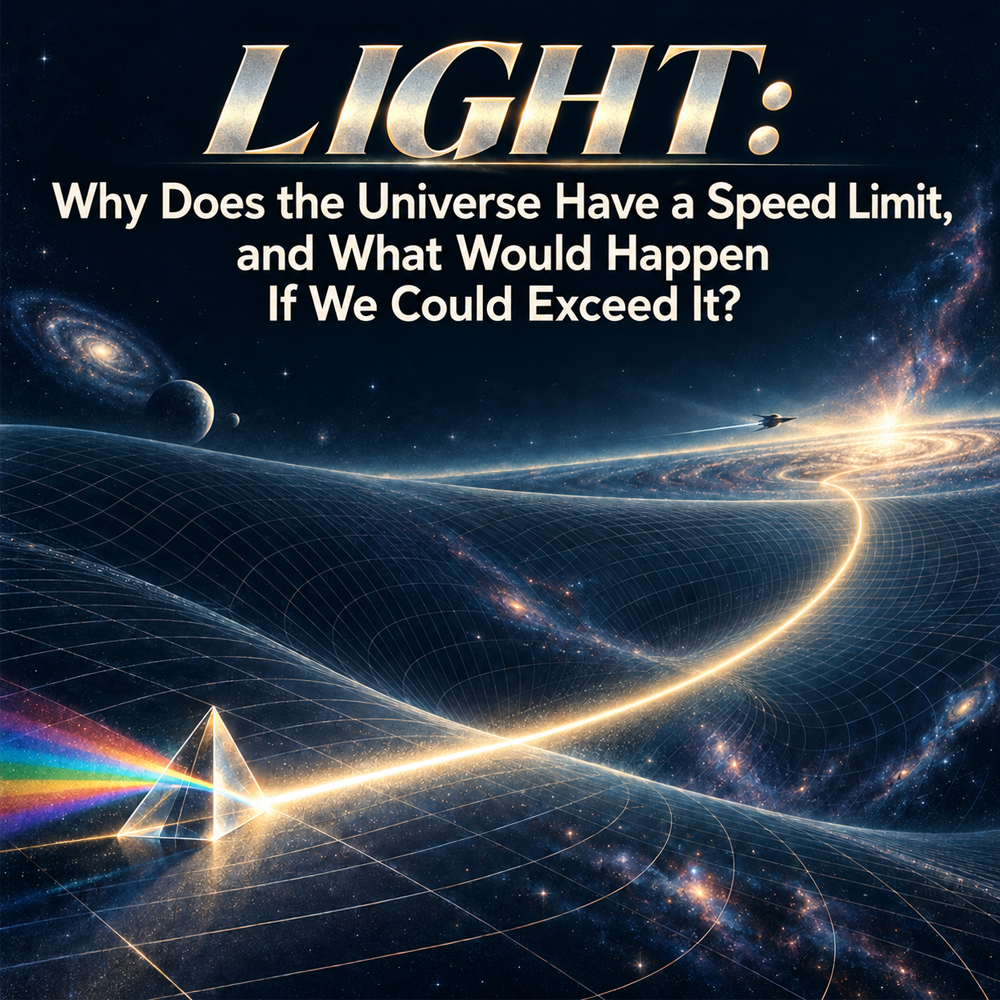
Part One: The Speed That Changed Our Understanding of the Universe
In 1676, the Danish astronomer Ole Rømer observed something that appeared to be an insignificant irregularity in the motion of one of Jupiter’s moons. Io, the innermost of the gas giant’s four largest moons, periodically disappeared into the planet’s shadow before emerging again. These eclipses occurred regularly enough for astronomers to predict their timing. But when Rømer compared his observations, he noticed that the events did not always occur at the expected moment. Sometimes Io appeared to be late, while at other times it emerged earlier than predicted.
At first glance, this discrepancy could have been explained by inaccurate clocks or imperfections in the calculations. But Rømer noticed a pattern that could not be ignored. As Earth moved farther away from Jupiter in its orbit around the Sun, the observed eclipses became progressively delayed. When Earth moved closer to the planet, the delay decreased. The astronomer reached the remarkable conclusion that the cause lay not in Io’s motion, but in the time required for light to travel the changing distance between Jupiter and Earth.
This was a revolutionary insight in an age when many still regarded light as an instantaneous phenomenon. If light reached every point in space without delay, the distance between Earth and Jupiter would have no effect on the observed timing of the eclipses. But if light traveled at a finite speed, every additional stretch of its journey would require additional time. This was precisely what the observations revealed. For the first time, astronomical data provided compelling evidence that light did not propagate instantaneously.
Rømer did not possess modern measuring instruments, nor did he determine the precise value we know today. His achievement was far more fundamental: he demonstrated that light takes a measurable amount of time to travel. From that moment onward, observing the heavens acquired an entirely new meaning. Astronomers were no longer simply looking at distant objects, but at events that had occurred before their light reached Earth. The cosmos had begun to reveal one of its deepest characteristics: distance and time are inseparably connected to the way we receive information.
Today, we know that light travels through a vacuum at exactly 299,792,458 meters per second. This means that in a single second, it covers almost 300,000 kilometers – a distance equivalent to approximately seven and a half journeys around Earth’s equator. Light from the Moon reaches us in about 1.3 seconds, while sunlight takes approximately eight minutes and twenty seconds to travel to Earth. When we look at the Sun, we see it as it existed more than eight minutes ago. Yet the most astonishing thing about this speed is not how enormous it is, but why it remains the same for all observers who measure it locally in a vacuum.
Maxwell and the Discovery That Light Is an Electromagnetic Wave
By the nineteenth century, scientists had already accumulated considerable knowledge about electricity and magnetism. They knew that electric charges produce electric fields, that electric currents generate magnetic fields, and that a changing magnetic field can induce an electric current. Yet these phenomena still appeared to be separate aspects of nature. Light, meanwhile, was studied primarily through optics – the science of reflection, refraction, and the propagation of light rays. A discovery was approaching that would unite these seemingly different phenomena within a single theory.
The Scottish physicist James Clerk Maxwell succeeded in formulating a mathematical system describing the behavior of electric and magnetic fields. His equations showed that a changing electric field could be linked to a changing magnetic field in a way that allowed electromagnetic waves to propagate. These waves did not require an electrical conductor to exist. They could travel even through a vacuum. When Maxwell calculated their speed using the known electromagnetic properties of a vacuum, he obtained a value that matched the measured speed of light within the accuracy available at the time.
The conclusion was astonishing. Light was not an isolated phenomenon unrelated to electricity and magnetism. It was an electromagnetic wave, and visible light was only a small part of an enormous family of electromagnetic phenomena. Radio waves, microwaves, infrared radiation, ultraviolet rays, X-rays, and gamma radiation all belong to the same family. They differ in frequency, wavelength, and energy, but in a vacuum they all propagate at the same fundamental speed.
This discovery marked the beginning of a new era in physics. It demonstrated that nature possesses an underlying unity that is not immediately apparent to the human senses. The radio waves we use for communication today and the light that reaches our eyes from distant stars are manifestations of the same electromagnetic field. The difference between them lies not in their speed through a vacuum, but in the characteristics of their oscillations. Maxwell, however, left behind a question that would eventually shake the foundations of classical physics.
At the time, scientists were accustomed to associating waves with a particular medium. Sound waves travel through air, water waves move across the surface of water, and vibrations along a string are transmitted through the string itself. It therefore seemed natural to assume that electromagnetic waves also required a medium filling all of space. This hypothetical medium became known as the luminiferous ether. If Earth moved through the ether, then measurements of the speed of light in different directions should reveal certain differences.
The Experiment That Shattered the Concept of Absolute Space
In 1887, Albert Michelson and Edward Morley conducted one of the most famous experiments in the history of science. Their goal was to detect Earth’s motion relative to the hypothetical luminiferous ether. To accomplish this, they used an interferometer – a device that splits a beam of light into two separate beams, sends them along different paths, and then recombines them. If the speed of light differed depending on the direction of motion relative to the ether, this difference should appear as a shift in the interference pattern. The experiment was sensitive enough to search for extraordinarily small variations.
The result did not match expectations. The scientists failed to detect the predicted effect of Earth’s motion through a stationary ether. This did not mean that a single experiment had resolved every question about the nature of light. But the result became part of a growing body of evidence suggesting that the classical concept of an absolute spatial medium was deeply problematic. Physicists began searching for new explanations, and some proposed mathematical transformations that preserved the form of the laws of electromagnetism.
In 1905, Albert Einstein took the decisive step. Instead of searching for a special medium relative to which light traveled, he adopted two fundamental principles. The first stated that the laws of physics have the same form in all inertial reference frames. The second established that light in a vacuum travels at the same speed, c, for all inertial observers, regardless of the motion of its source. From these principles followed consequences that contradicted almost everything people intuitively believed about space and time.
In everyday life, we are accustomed to adding velocities together. If a train is traveling at 100 kilometers per hour and a passenger walks forward along its corridor at 5 kilometers per hour relative to the train, an observer standing beside the tracks will measure the passenger’s speed as approximately 105 kilometers per hour. But when light is involved, this ordinary addition of velocities does not work. If a passenger aboard the train switches on a flashlight, the light will not travel relative to the observer on the ground at a speed equal to c plus the speed of the train. Both observers will measure the same value, c, when they perform the measurement correctly within their respective inertial reference frames.
For this to be possible, it is not the speed of light that must change, but our very understanding of how distances and time intervals are measured. The clocks of different observers do not necessarily record the same duration between the same events. Distances measured in different reference frames are not necessarily identical either. Even events that one observer considers simultaneous may not be simultaneous for another. In this way, light became the key to an entirely new understanding of reality.
The Train, the Lightning Strikes, and Time That Is Not the Same for Everyone
Imagine a long train moving at an enormous but constant speed along a straight railway track. A passenger stands in the middle of one of its carriages, while an observer on the platform watches the train pass by. At a particular moment, two lightning bolts strike the front and rear ends of the carriage. Let us assume that, according to clocks at rest relative to the platform, the two lightning strikes occur simultaneously. Light from both strikes begins traveling toward the middle of the carriage.
For the observer on the platform, who is positioned opposite the middle of the carriage at the instant of the strikes, the light from both lightning bolts will arrive simultaneously. But the passenger aboard the train is moving toward the point from which the light of the front strike originated and away from the point of the rear strike. Consequently, the passenger encounters the light from the front of the carriage before the light from the rear. Since light travels at the same speed in both directions within the passenger’s own reference frame, the passenger concludes that the two lightning strikes were not simultaneous. From the passenger’s perspective, the lightning at the front occurred earlier.
This is not an optical illusion that disappears once the observers account for the time required for light to travel. The two observers use different reference frames and different definitions of simultaneity, both of which are entirely consistent with the theory of relativity. Neither possesses a privileged perspective capable of defining the one true present for the entire universe. The temporal order of sufficiently distant events can depend on the observer’s motion when those events cannot be connected by a signal traveling at or below the speed of light. This is one of the most profound consequences of the constancy of the speed of light.
In the classical view, time was like an invisible universal clock, ticking away the seconds identically everywhere. Einstein demonstrated that no such clock exists within the framework of special relativity. Every observer measures time using their own clocks, and comparing distant events requires a particular method of synchronization. Space and time cannot be treated as completely independent quantities. They form a unified structure that later became known as spacetime.
The Light Clock and the Secret of Time Dilation
To understand why time changes with motion, imagine an unusual clock. It consists of two mirrors facing each other, with a pulse of light traveling back and forth between them. Each time the light travels from one mirror to the other and returns, the clock records a particular time interval. If the device is stationary relative to us, the light moves along a straight path upward and downward. The duration of each journey depends on the distance between the mirrors and the speed c.
Now place the same clock aboard a spacecraft traveling at high speed relative to Earth. For the astronaut inside the spacecraft, the light continues to move vertically between the mirrors. But for an observer on Earth, the mirrors move horizontally while the light travels between them. Consequently, the light pulse follows a diagonal trajectory and covers a longer distance between successive reflections. Since the speed of light remains c for the observer on Earth as well, traveling this longer path requires more time.
This means that the observer on Earth will find that the moving light clock measures time more slowly than a clock at rest relative to Earth. But the effect is not limited to clocks that use light. All physical processes within the moving system obey the same relativistic relationships. Biological processes, chemical reactions, and the operation of electronic devices are no exceptions. For the astronaut, however, their own clock, heartbeat, and every process aboard the spacecraft proceed normally.
This effect is called time dilation, and it has been experimentally confirmed many times. Extremely precise atomic clocks reveal measurable differences when they travel along different trajectories. Particles known as muons, which are produced high in Earth’s atmosphere, can reach the surface in significantly greater numbers than we would expect without relativistic effects. From the perspective of an observer on Earth, their lifetimes are extended because of their high speed. These results are not abstract mathematical predictions, but real physical phenomena.
Imagine two twins, one of whom remains on Earth while the other embarks on a journey through space at a speed close to that of light. When the traveler returns, they may discover that they have aged less than their sibling. This is not a paradox in the sense of a logical contradiction, because the two have followed different trajectories through spacetime. The traveling twin has changed direction and state of motion in order to return, and the accumulated proper time along their trajectory is different. Thus, a journey through space also becomes a journey through time of a different duration.
Why No Object With Mass Can Reach the Speed of Light
Imagine a spacecraft continuously accelerating through empty space. Initially, its speed is low, and its engines gradually accelerate it to thousands of kilometers per second. Over time, the spacecraft reaches one-tenth of the speed of light, then half that speed, and finally ninety percent of it. In classical mechanics, we would expect that if we continued supplying energy, sooner or later we would reach and surpass any predetermined speed. But relativistic physics reveals that approaching c becomes increasingly difficult.
The reason lies in the relationship between energy, momentum, and velocity. For an object with nonzero rest mass, the required energy increases ever more rapidly as its speed approaches c. At ninety percent of the speed of light, the relativistic factor is approximately 2.29. At ninety-nine percent, it is already about 7.09, and at ninety-nine point nine percent, it reaches approximately 22.37. The closer we approach the limiting speed, the more energy we must invest to achieve progressively smaller increases in velocity.
In the mathematical limit, as the speed of an object with nonzero rest mass approaches c, the energy required grows without bound. This means that no finite amount of energy can accelerate such an object to exactly the speed of light. This is not a matter of insufficiently powerful engines or a technological problem that will be solved several centuries from now. The limitation arises from the structure of the laws of relativity. Within these laws, an ordinary material object cannot continuously transition from slower-than-light motion to faster-than-light motion.
But if objects with mass cannot reach c, why do photons always travel at this speed in a vacuum? The answer is that a photon has no rest mass. It possesses energy and momentum, but there is no valid inertial reference frame in which a free photon is at rest. In relativistic physics, massless particles travel locally at the speed c in a vacuum. This is a fundamental qualitative difference between them and particles with nonzero rest mass, not simply a question of how much energy they possess.
The same principle is reflected in gravitational waves, whose propagation is described by the general theory of relativity. In 2017, astronomers observed gravitational waves from the merger of two neutron stars, followed by electromagnetic radiation from the same event. These observations placed extraordinarily strict limits on any possible difference between the speed of gravitational waves and the speed of light. The results confirmed the prediction that gravitational waves propagate at practically the same fundamental speed. Thus, the limit c is a characteristic not only of electromagnetism, but of the very causal structure of spacetime.
Why Is the Speed of Light Exactly 299,792,458 Meters per Second?
Here we arrive at a question that appears remarkably simple, yet is actually among the deepest in physics. Why does light travel at precisely this speed rather than twice as fast or ten times slower? Why has nature not chosen a different value that would allow stars to communicate more quickly and spacecraft to cross galaxies in less time? To answer correctly, we must distinguish between the numerical value of the speed and its fundamental physical significance. These two things are not entirely the same.
The number 299,792,458 is exact because, in the International System of Units, the meter is defined through the speed of light in a vacuum and the second. This does not mean that scientists have discovered some mystical necessity for light to travel at precisely that many meters per second. The meter and the second are human units of measurement, and the numerical value of c depends on their choice. If we use light-seconds as a unit of distance, light travels one light-second in one second. In theoretical physics, a system of units in which c equals one is frequently used.
The real question, therefore, is why the universe possesses this particular relationship between spatial and temporal dimensions, and why other physical quantities have the observed relationships to it. Fundamental dimensionless constants are especially important because their values do not depend on the choice of meters, seconds, or other units of measurement. One example is the fine-structure constant, which determines the strength of the electromagnetic interaction and has a value of approximately one divided by 137. It plays a role in describing atomic spectra, the interaction between light and matter, and numerous other physical processes. If its value were different, the properties of atoms and electromagnetic interactions would also be different.
Modern physics explains why electromagnetic waves propagate at the speed c within the framework of established laws. It demonstrates how this speed is connected to Maxwell’s equations, Lorentz symmetry, and the geometry of spacetime. However, we do not possess a universally accepted, experimentally confirmed explanation that derives all fundamental dimensionless constants from an even deeper principle. The possibility of such an explanation remains the subject of fundamental theoretical research. Science therefore understands the role of the speed of light extraordinarily well, but it has not definitively resolved the question of why all the characteristics of our universe have precisely the values we observe.
The Universe Where Light Travels Ten Times Slower
Let us imagine a thought experiment in which nature’s ultimate speed limit is ten times lower than the value we know. In such a world, light would travel approximately 30,000 kilometers per second, assuming we retain the same units of distance and time. A signal from the Moon would take about thirteen seconds to reach Earth, rather than just over one second. Light from the Sun would take approximately eighty-three minutes to reach our planet. Even communication between nearby celestial bodies would become a significantly slower process.
But this thought experiment comes with an important condition. We cannot simply change the numerical value of c and assume that everything else in physics remains unchanged without specifying which other constants and dimensionless relationships we are preserving. The speed of light appears in numerous equations describing electromagnetism, relativity, and the relationship between mass and energy. Different ways of changing the fundamental constants would produce different physical universes. Therefore, there is no single scientifically determined answer to what a universe with a value of c ten times lower would look like.
Nevertheless, we can explore specific consequences within an idealized model in which the remaining conditions are explicitly defined. If the characteristic speeds of our vehicles remained the same while the ultimate speed limit were reduced tenfold, relativistic effects would become noticeable at lower absolute velocities. A spacecraft traveling at one-tenth of c in our universe would reach the speed-of-light limit itself in such a hypothetical model and therefore could not maintain that velocity if it possessed nonzero rest mass. Time dilation and relativistic changes in measured distances would become significant under different practical conditions. Technologies, travel, and communication would face limitations unlike those we know today.
Now imagine the opposite scenario – a world in which the ultimate speed limit is a thousand times greater, with all other physical parameters clearly specified. In such a model, signals could cross enormous distances in much shorter periods of time. Interplanetary communication would appear almost instantaneous on human timescales, and the limitations on interstellar travel would be different. Yet even there, a finite causal speed would still exist if the geometry of spacetime retained its relativistic character. Changing its value would not eliminate the very concept of a limit.
These thought experiments help us recognize something important. The speed of light is not an arbitrary restriction imposed on the universe to make travel between the stars more difficult. It is woven into the very description of space, time, and the interactions between physical systems. If we change the fundamental relationships in which it participates, we do not simply obtain our universe with faster or slower beams of light. We obtain a physical model whose properties must be investigated anew, from the smallest atomic scales to the greatest cosmological distances.
The Light Cone: A Map of the Possible Future
Imagine switching on a flashlight at a particular moment in completely empty space. Light begins spreading in every direction, reaching increasingly distant points with each passing second. After one second, the expanding wavefront is almost 300,000 kilometers from its source. After two seconds, that distance is approximately twice as great, and after three seconds, three times as great. If we represent time as an additional dimension, these successive expanding spheres form a geometric structure known as the future light cone.
Inside this cone lie the events that can be reached by a physical signal sent from the starting point and traveling at a speed less than or equal to c. On the boundary of the cone lie the events that can be reached by light traveling through a vacuum. Outside it are events that no ordinary causal signal can reach from the initial event. Similarly, the past light cone contains the events from which information could have reached us. Every point in spacetime therefore possesses its own geometric structure of causal possibilities.
This picture explains why the ultimate speed limit has such profound significance. If all observers agree on which events can be connected by causal signals, then the laws of physics preserve the relationship between cause and effect. The light cone defines the boundaries of that relationship, regardless of how different observers measure time and spatial distances. Two people may disagree about how much time has elapsed between particular events, but they cannot arbitrarily alter the causal connections between them. This is one reason why the speed-of-light limit is so fundamental to relativistic physics.
Now imagine that someone discovers a way to send controllable signals beyond the light cone. Information could then reach events that standard theory identifies as causally inaccessible. If the usual principles of relativity remained valid, such a possibility would create serious problems with the temporal ordering of events. Under certain conditions, one observer could describe the reception of a signal as occurring before its transmission. And if faster-than-light communication allowed an appropriate exchange of messages between moving reference frames, causal loops could become possible.
This brings us to one of the most extraordinary boundaries of modern physics. The question of whether we can exceed the speed of light is not simply a matter of whether we possess a sufficiently powerful engine. It is connected to whether we can violate the causal structure of spacetime without destroying the logical sequence of physical events. This is where the territory of faster-than-light signals, tachyons, quantum entanglement, and hypothetical shortcuts through the cosmos begins. And the more carefully we investigate these possibilities, the clearer it becomes that the speed of light is not merely a number, but one of the defining characteristics of the world we inhabit.
Part Two: Beyond the Speed of Light – When Physics Reaches the Limits of Possibility
Imagine that humanity has entered an era in which space stations are scattered throughout the Solar System and interstellar expeditions have become part of everyday life. Despite technological progress, communication remains constrained by the enormous distances of space. A message sent from Earth to Mars may take between three and twenty-two minutes to arrive, depending on the positions of the planets. A conversation with a crew orbiting another star would require years of waiting for each reply. Then scientists announce a discovery that seems capable of transforming human civilization: a device that transmits information faster than light.
Initially, the technology appears to offer the ultimate solution to the problem of cosmic communication. Two stations separated by light-years can exchange messages in seconds. Spacecraft no longer have to wait long periods to receive instructions from Earth. Distant colonies can maintain constant contact with one another. But behind this apparent triumph lies a problem far more serious than the speed of transmission itself.
Suppose the first station sends a faster-than-light message to a second station moving at a constant velocity relative to it. According to the clocks of the first station, the message is sent at a particular moment and received shortly afterward. But special relativity shows that, at a sufficiently high relative velocity, the temporal order of these two events can be reversed in the reference frame of the second station. For its observer, the reception of the message may precede its transmission. This follows from the mathematical transformations that relate space and time for different inertial observers.
By itself, a difference in the temporal ordering of two spacelike-separated events does not constitute a contradiction. In standard physics, such events cannot be connected by an ordinary causal signal, so no observer can exploit the difference to change the past. But if we allow controllable faster-than-light transmission of information, the situation becomes entirely different. If the second station can send a reply using the same mechanism within its own reference frame, then under suitable conditions, the reply could reach the first station before the original message was sent. This creates the possibility of communicating with one’s own past.
Imagine that the operator at the first station receives a warning that reads: „Do not send the message you are planning to send in five minutes.“ The operator decides to follow the warning and switches off the transmitter. But if the original message is never sent, the second station will receive nothing and will have no reason to send the warning. The operator will then never receive the information that caused the decision to change. The result is a causal paradox in which an event must both happen and not happen.
This thought experiment is known as the tachyonic antitelephone. It demonstrates that the unrestricted transmission of controllable faster-than-light signals is incompatible with ordinary relativistic causality under certain conditions. This is not a mathematical proof that every future physical theory must necessarily prohibit all forms of effective faster-than-light travel. But it does mean that any theory permitting such signals must contain additional restrictions or a different structure of spacetime. So far, there is no experimental evidence of any technology or physical process that allows this kind of communication.
Tachyons: The Particles That Can Never Move Slowly
During the twentieth century, physicists began investigating an extraordinary mathematical possibility. If ordinary particles with nonzero rest mass always travel slower than light, could particles exist that always travel faster than it? Such hypothetical objects were given the name tachyons, derived from the Greek word for speed. Unlike ordinary matter, they were conceived as particles that could never slow down to c. The speed of light would represent an unreachable boundary for them as well, but from the opposite side.
This idea has a specific mathematical origin. The relativistic relationship between energy, momentum, and mass formally allows the consideration of states with a negative squared mass parameter. In historical tachyon models, such states were associated with faster-than-light motion. The closer a tachyon’s speed approaches c from above, the greater its energy becomes according to the corresponding mathematical construction. This means that a tachyon could not be slowed down to the speed of light, just as an ordinary particle cannot be accelerated to it.
But there is an enormous difference between mathematical possibility and physical existence. No experiment has ever detected free tachyons traveling through space and carrying information at faster-than-light speeds. Furthermore, such particles create serious problems for causality if they can be used to transmit controllable signals. In modern quantum field theory, the term „tachyonic“ often refers not to an actual faster-than-light particle, but to an instability in a particular state of a field. This is an essential distinction that is frequently overlooked in popular explanations.
Imagine a ball balanced at the top of a smooth hill. As long as it remains exactly at the summit, it occupies a position of equilibrium, but the slightest disturbance can cause it to roll downhill. In certain quantum models, a similar picture describes a field occupying an unstable state. The mathematical signature of this instability is sometimes called a tachyonic mass, but this does not mean that real particles are traveling through space faster than light. Once the field transitions to a stable state, its physical excitations can possess ordinary masses and obey the familiar relativistic limitations.
Tachyons remain a remarkable example of how theoretical physics explores the boundaries of its own laws. Scientists can investigate mathematical worlds in which certain quantities possess unusual properties without assuming that those worlds physically exist. Such investigations help reveal which structures are stable, which lead to contradictions, and which require new principles. But nature is under no obligation to realize every mathematically permissible construction. For a hypothesis to become a physical discovery, it must be supported by reliable observations and experiments.
Quantum Entanglement: The Connection That Needs No Ordinary Signal
Imagine two particles created in a shared quantum process and then sent in opposite directions. One reaches a laboratory on Earth, while the other continues toward a distant space station. The distance between them increases until they are eventually separated by millions of kilometers. In classical physics, we would expect that after their separation, each particle could be described independently of the other through its own set of properties. Quantum mechanics, however, allows states in which the complete description belongs to the combined system rather than to either particle individually.
This phenomenon is called quantum entanglement, and it is among the most extraordinary properties of the microscopic world. When two particles are entangled, the outcomes of certain measurements can exhibit correlations that cannot be explained by ordinary local models with predetermined properties. In 1935, Einstein, Boris Podolsky, and Nathan Rosen used similar quantum states to question whether quantum mechanics provided a complete description of reality. Einstein found these correlations so unusual that he used the famous expression „spooky action at a distance.“ The debate continued for decades, gradually evolving from a philosophical question into an experimental challenge.
In 1964, physicist John Bell formulated mathematical inequalities that made it possible to test certain assumptions about locality and the pre-existing properties of particles. Subsequent experiments demonstrated violations of these inequalities consistent with the predictions of quantum mechanics. In 2022, the Nobel Prize in Physics was awarded to Alain Aspect, John Clauser, and Anton Zeilinger for their research on entangled photons and their foundational contributions to quantum information science. The results demonstrated that quantum correlations cannot be explained by the entire class of local models satisfying the assumptions underlying Bell’s inequalities. Nature proved more extraordinary than the classical picture of independent particles possessing predetermined properties.
But this raises the question that inevitably emerges whenever the speed of light is discussed. If two entangled particles exhibit correlations regardless of the distance separating them, can we use this phenomenon for instantaneous communication? Could a scientist on Earth perform a measurement on one particle and thereby send a chosen message to a space station? If this were possible, quantum entanglement would become a means of communication that bypasses the usual limitations imposed by distance. But quantum theory does not permit the phenomenon to be used in this way.
The results of measurements performed on an individual entangled particle are statistically random. An observer cannot choose a particular outcome to encode a predetermined message. The correlations between the two particles can only be established once the measurement results are compared. This comparison requires an ordinary communication channel that obeys relativistic limitations. Quantum entanglement therefore allows correlations that transcend classical intuition, but it does not permit controllable information to be transmitted faster than light.
This distinction is extremely important because it demonstrates that not every unusual connection between distant objects constitutes a signal. The quantum world possesses a structure that cannot be reduced to the ordinary movement of particles through space. Entanglement already finds applications in quantum cryptography, quantum computing, and experimental communication technologies. But these applications do not eliminate the need for classical information channels when a specific message must be transmitted. In this way, quantum mechanics expands our understanding of reality without providing a proven method for violating the speed-of-light limit.
The Blue Glow of Cherenkov Radiation: When a Particle Outruns Light in Water
In the pools of certain nuclear reactors, an extraordinary blue glow can be observed. It appears almost unreal, as though the water itself were emitting light from its depths. The cause is neither ordinary reflection nor a chemical reaction that makes the water burn. The glow arises when sufficiently fast charged particles pass through the water and produce a characteristic form of electromagnetic radiation. This phenomenon is known as Cherenkov radiation.
At first glance, it appears to be a direct violation of the fundamental speed-of-light limit. A charged particle can indeed travel faster than the phase velocity of light in water. But light does not propagate through a material medium in the same way that it travels through a vacuum. The interaction between the electromagnetic field and the atoms of the medium changes the characteristics of its propagation. As a result, a particle traveling slower than c can exceed the phase velocity of light in a particular material.
This process resembles the formation of a shock wave when an aircraft breaks the sound barrier. During supersonic motion, sound disturbances arrange themselves into a characteristic shock front. In Cherenkov radiation, the electromagnetic response of the medium produces light emitted at a particular angle relative to the direction of the charged particle. This angle depends on the particle’s speed and the optical properties of the medium. That is precisely why the phenomenon can be used to measure and identify high-energy particles.
Cherenkov radiation plays an important role in modern experimental physics. Enormous underground detectors filled with water use the faint glow to detect charged particles produced by neutrino interactions. Sensitive photodetectors capture the light, allowing scientists to reconstruct information about the event that occurred. In this way, a phenomenon that appears to be an exception to the speed-of-light limit becomes a tool for studying fundamental particles. It demonstrates how important it is to distinguish between the speed of an electromagnetic wave in a material medium and the universal limiting speed in a vacuum.
The Experiment in Which Light Almost Stops
In 1999, a team led by physicist Lene Hau demonstrated a result that seemed almost unbelievable. The scientists succeeded in slowing a pulse of light to approximately 17 meters per second using a specially prepared cloud of ultracold atoms. This is a speed comparable to that of a moving car, rather than the ordinary propagation of light. The experiment demonstrated that, through carefully controlled interactions between light and matter, the group velocity of a light pulse can be reduced dramatically. Yet the fundamental speed c remained unchanged.
To understand this phenomenon, we must distinguish between the free propagation of light through a vacuum and its behavior within a material system. In transparent media, the electromagnetic field interacts with the electric charges of atoms. These interactions determine how the different frequency components of a light wave propagate. Under specially prepared atomic conditions, a phenomenon called electromagnetically induced transparency can be created. It allows an extraordinarily large change in the group velocity of a light pulse without the usual absorption that would destroy the signal.
In subsequent experiments, scientists also demonstrated the storage of optical information by converting it into a collective excitation of an atomic system. Popular descriptions often present this as stopping light. But free photons do not remain motionless in a vacuum while waiting for someone to release them. Instead, the quantum information associated with the light pulse is transferred into the state of matter and can subsequently be recovered as light. This principle is important for the development of quantum memories and future information-processing technologies.
These experiments reveal the astonishing flexibility of the interaction between light and matter. The propagation speed of a pulse in a specially prepared medium can be altered over an enormous range. This does not mean, however, that the fundamental structure of spacetime changes along with it. Light can be slowed through interactions with matter, but its limiting speed in a vacuum remains a characteristic of the laws of relativity. The distinction between these two kinds of speed is essential for understanding such experiments correctly.
The Galaxies That Are Receding Faster Than Light
In 1929, Edwin Hubble published observations revealing a relationship between the distances to galaxies and the speeds at which they appeared to be moving away from us. These results, building on the work of other astronomers, became one of the foundations of modern cosmology. The universe is not a stationary space in which galaxies simply move like ships across an ocean. On large scales, the spatial distances between galaxies themselves change over time. We call this phenomenon the expansion of the universe.
Imagine the surface of a balloon covered with numerous dots. As the balloon inflates, the distances between the dots increase, even though the dots do not necessarily move across the surface relative to their immediate surroundings. The greater the distance between two dots, the greater its increase can be over a given period of time. This analogy helps us understand why distant galaxies can recede from us at higher cosmological speeds. But it should not be taken literally, because the universe does not require an external space into which it can expand.
At sufficiently large distances, the rate at which the separation between two galaxies increases can exceed c. This does not mean that the galaxies are traveling through their immediate surroundings faster than light. In general relativity, local motion and global changes in distance are distinct concepts. The speed of cosmological recession is defined through a particular method of measuring distances in an expanding universe. It should therefore not be interpreted as an ordinary relative velocity between two nearby objects.
Even more extraordinary is the fact that we can observe light from galaxies that are currently receding from us at superluminal cosmological speeds. The reason is that the light has traveled through a universe whose rate of expansion has changed over time. A photon’s trajectory depends on the history of cosmic expansion, not merely on the present distance to its source. Consequently, light emitted billions of years ago can reach us even when the current distance to the corresponding galaxy is increasing faster than c. This is one reason why the observable universe has a radius significantly greater than its age multiplied by the speed of light.
Modern cosmology also considers an even more extreme process known as cosmic inflation. According to inflationary models, the very early universe underwent a period of extraordinarily rapid expansion during which spatial distances increased at tremendous rates. This idea offers an explanation for some of the most important properties of the observed universe, including its remarkable uniformity and nearly flat spatial geometry. However, the specific physical mechanism responsible for inflation has not yet been experimentally established. It remains an influential theoretical framework rather than a definitively proven description of the earliest moments of cosmic history.
The Alcubierre Drive: Traveling by Warping Space
In 1994, Mexican physicist Miguel Alcubierre published a theoretical study proposing an extraordinary way of thinking about interstellar travel. Rather than attempting to accelerate a spacecraft through space to a speed greater than c, he investigated a mathematical geometry in which spacetime itself changes around a particular region. In popular literature, this idea became known as the warp drive. The basic principle involves contracting space in front of the spacecraft while expanding it behind. In this way, the center of a particular region could move effectively relative to distant observers without the spacecraft locally violating the speed-of-light limit.
Imagine a spacecraft positioned at the center of a kind of spatial bubble. Inside it, the astronauts would not necessarily experience enormous acceleration, because their local motion could remain ordinary. But the geometry surrounding the bubble changes in such a way that it reaches distant locations in an unusually short period of time according to certain external observers. In this mathematical construction, the spacecraft does not locally overtake a beam of light traveling immediately beside it. Instead, the global geometry of the path between the starting and ending regions is altered.
This is one reason the idea has attracted so much interest. It does not simply attempt to disregard the theory of relativity, but instead explores the mathematical possibilities of Einstein’s general relativity. Yet there is an enormous difference between a geometry that can be described by equations and a physical system that can actually be created. Alcubierre’s original model requires an unusual distribution of energy, including regions with negative energy density relative to certain observers. Such requirements represent a serious obstacle because ordinary matter does not provide the necessary properties.
Quantum theory allows certain effects in which energy density can be negative relative to an appropriately chosen reference state. But these effects are constrained and provide no known method for producing arbitrary quantities of negative energy. Furthermore, superluminal versions of such geometries encounter problems involving stability, control, and causality. In some models, horizons appear that limit the ability to control the warp bubble from within. Other analyses suggest that quantum effects could make certain constructions physically unstable.
Over recent decades, various modifications of the original idea have been proposed. Some studies investigate geometries with different energy requirements, including subluminal configurations. But none of these developments has produced an experimentally confirmed engine capable of moving a spacecraft at an effectively faster-than-light speed. They remain mathematical and theoretical investigations into the possibilities of spacetime. Their real value lies in revealing just how complex the relationship between geometry, matter, and physical limitations truly is.
Wormholes: Tunnels Between Distant Regions of the Universe
Imagine two stars separated by tens of thousands of light-years. Even a spacecraft traveling at an enormous fraction of the speed of light would require an extraordinarily long time to cross the distance between them, according to the clocks of external observers. But now imagine that a tunnel exists, connecting two distant regions of spacetime through a significantly shorter route. Instead of traveling the entire distance through ordinary space, the spacecraft passes through the tunnel and emerges on the other side. Such a hypothetical structure is called a wormhole.
The idea has its roots in the mathematics of general relativity. In 1935, Albert Einstein and Nathan Rosen investigated a geometric construction that later became known as the Einstein–Rosen bridge. This bridge does not represent a traversable tunnel through which a spacecraft could safely pass. But later research demonstrated that the equations of general relativity also allow the consideration of other geometries, including hypothetical traversable wormholes. Thus, a mathematical idea gradually became the subject of serious theoretical investigation.
To visualize the principle, we can use a sheet of paper with two marked points. If we move only along the surface of the paper, we must travel the distance between them. But if we fold the paper so that the two points approach each other, we can imagine a tunnel connecting them through a shorter path. This analogy does not literally describe four-dimensional spacetime, but it illustrates how geometry can permit unusual routes. In the case of a wormhole, shortening the journey does not necessarily require the spacecraft to move locally faster than light.
In 1988, Michael Morris and Kip Thorne investigated the conditions under which such traversable tunnels might exist. Their results showed that classical models require unusual properties of matter and energy that violate certain standard energy conditions. For the tunnel to remain open, its geometry must be supported in a way that ordinary matter cannot provide. Furthermore, serious questions arise concerning the stability of the structure and the behavior of quantum fields in its vicinity. To date, no astronomical structure has been reliably identified as a traversable wormhole.
But the strangest consequence of such a tunnel is not merely the possibility of shortening cosmic distances. If its two entrances are subjected to different gravitational conditions, or if one of them is accelerated in a suitable way, a temporal offset can develop between them. In certain theoretical constructions, this could allow a traveler to pass through the tunnel and reach an event located in the past relative to a chosen external reference frame. Thus, a shortcut through space could also become a shortcut through time. It is precisely this possibility that connects wormholes to some of the most difficult questions surrounding causality.
In 1992, Stephen Hawking formulated the chronology protection conjecture. According to this hypothesis, the laws of physics prevent the formation of closed timelike curves under realistic conditions, ensuring that causal paradoxes cannot arise. This is not a definitively proven universal theorem, but a hypothesis supported by certain theoretical arguments. Fully resolving the question will likely require a deeper understanding of quantum gravity. Until we possess such a complete and experimentally tested theory, physics cannot provide a definitive answer as to whether all possible forms of travel into the past are fundamentally forbidden.
What Does Time Mean for a Photon?
Imagine a photon emitted from a distant galaxy billions of years ago. Throughout its immense journey, stars are born and die, galaxies change their shapes, and the universe continues to expand. Eventually, the photon reaches a telescope on Earth, carrying information about an event that occurred in the distant cosmic past. But what does this entire journey mean for the photon itself? Does it even make sense to speak of the time it experiences?
Popular explanations often claim that time does not exist for light. This idea originates from certain mathematical properties of relativistic spacetime, but it requires an important clarification. Special relativity does not permit a valid inertial reference frame in which a free photon is at rest. Consequently, we cannot place a clock that travels alongside the photon and speak of its perspective in the same way that we speak of an astronaut’s perspective. The expression „what a photon sees“ has no rigorous physical meaning within the standard theory.
Yet the mathematical description reveals something no less astonishing. In relativity, proper time is the quantity measured by an ideal clock traveling along a timelike trajectory. Light follows lightlike, or null, trajectories through spacetime. Along such a trajectory, the proper time interval is zero. This does not mean that a photon possesses consciousness that perceives billions of years as a single instant, but rather that the geometry of its trajectory differs fundamentally from the geometry of the paths followed by material observers.
This characteristic demonstrates why light should not be regarded simply as an extraordinarily fast object. It belongs to a different class of physical motion, defined by the structure of spacetime. Material observers can measure their own proper time, age, and compare their clocks after following different journeys. A free photon has no rest frame in which such a description could be applied. Its motion follows the very boundary between the directions that can be connected through the movement of matter and those that remain beyond that possibility.
Why Distance Is Not the Greatest Obstacle to Interstellar Travel
When we observe the night sky, the stars appear close together, as though they were scattered across an enormous celestial dome. But the actual distances between them are so vast that human intuition struggles to comprehend them. The closest star to the Sun, Proxima Centauri, lies approximately 4.24 light-years away. Even light requires more than four years to cross that distance. For a spacecraft traveling at speeds achievable with today’s technology, such a journey would take thousands of years.
But special relativity reveals an unexpected detail. If a spacecraft could reach a speed extremely close to c, the time experienced by its passengers could be significantly shorter than the time measured on Earth. With a sufficiently large relativistic factor, astronauts could cross enormous interstellar distances within a relatively short period of their own proper time. This does not mean that the spacecraft has exceeded the speed of light or violated the laws of relativity. The difference arises from the way different trajectories through spacetime determine the amount of proper time accumulated.
Here, however, another problem emerges – one that cannot be solved through mathematical descriptions alone. Accelerating a large spacecraft to relativistic speeds requires enormous amounts of energy. Furthermore, the spacecraft must be protected against collisions with dust particles and gas, which can pose extremely serious dangers at such velocities. Sustained acceleration, the necessary fuel, and safe deceleration upon arrival also present immense engineering challenges. Relativity therefore allows journeys that are unusually short according to the passengers’ clocks, but it does not provide us with an easy technological means of accomplishing them.
This brings us to one of the most important distinctions in the entire story of light. Physics does not claim that humanity will never reach distant stars, nor that interstellar travel is fundamentally impossible. It establishes the limitations within which such journeys must take place. Faster-than-light motion of ordinary matter is not permitted under special relativity, but relativistic travel at speeds below c remains physically possible. The greatest obstacle is not merely the enormous distance, but the energy and technology required to achieve such speeds.
This is precisely why light continues to serve as both a boundary and a guide for human ambition. It determines the maximum local speed of causal signals, while simultaneously revealing how space and time can be measured differently by observers following different trajectories. It imposes limitations on our technologies, but it does not prohibit the exploration of distant space itself. And the most extraordinary theoretical ideas – from tachyons to the warping of space – demonstrate just how far the human mind is willing to go in its attempt to understand these limitations. But to reach the very essence of light, one final question remains: what exactly is it at the most fundamental level?
Part Three: The Quantum Nature of Light and the Universe’s Final Mysteries
Imagine a laboratory in which scientists direct an extremely weak light source toward a barrier containing two narrow slits. Behind it stands a sensitive detector capable of registering individual photons. If light consisted of ordinary tiny particles moving along precisely defined classical trajectories, we would expect each particle to pass through one slit or the other. But when the experiment is conducted without measuring the paths of the photons, an interference pattern gradually emerges on the detector. Most extraordinary of all, this pattern builds up even when the photons are sent one at a time.
Each photon is registered as an individual event on the detector, yet the distribution of many such events follows the laws of wave interference. Quantum mechanics describes this behavior through probability amplitudes associated with different possible paths. When no information is available about which slit a photon passed through, these amplitudes can interfere. If the experiment is modified so that the path becomes distinguishable, the interference pattern disappears when the paths can be distinguished sufficiently well. This does not happen because of human consciousness, but because of the physical interaction that changes the quantum state and its coherence.
This experiment demonstrates that light cannot be fully understood through the classical picture of either waves or particles. In modern quantum theory, a photon represents a quantum excitation of the electromagnetic field. In certain experiments, light exhibits wave properties such as interference and diffraction, while in others it reveals the discrete nature of its interaction with matter. These manifestations do not contradict one another, but belong to a unified quantum description. Light is neither simply a stream of miniature balls nor an ordinary mechanical wave, but a physical phenomenon whose behavior requires the laws of quantum mechanics.
The Light That Bends Under the Gravity of Stars
In 1919, observations of a total solar eclipse provided important evidence for one of Einstein’s boldest predictions. Light from distant stars passing close to the Sun appeared to be deflected from its usual direction. General relativity predicted precisely such a phenomenon, because gravity is not simply a force acting between objects with mass. Matter and energy influence the geometry of spacetime, and that geometry determines the trajectories of freely moving objects and light rays. Thus, even photons, which have no rest mass, follow paths curved by gravity.
Today, this phenomenon is known as gravitational lensing, and it is used as a powerful tool for exploring the cosmos. When light from a distant galaxy passes near an enormous concentration of matter, its trajectory can be bent in such a way that an observer sees multiple images, luminous arcs, or nearly perfect rings. Astronomers use these images to study the distribution of matter, including invisible dark matter. In certain cases, gravitational lensing magnifies the apparent brightness of extremely distant galaxies, allowing objects that would otherwise remain beyond the reach of telescopes to be observed. The very geometry of spacetime becomes a kind of cosmic optical instrument.
But the most extreme example of the interaction between light and gravity is found around black holes. There, the curvature of spacetime is so intense that a boundary exists, known as the event horizon, beyond which future light trajectories cannot reach the distant external universe. Light continues to travel locally at the speed c, but geometry determines where its future trajectories can lead. A black hole, therefore, is not simply an object that attracts photons with a force greater than their speed. It is a region of spacetime with a specific causal structure that prevents signals from reaching outside observers.
The Vacuum That Is Never Completely Empty
For centuries, people imagined the vacuum as absolute emptiness, containing no matter, particles, or physical processes. But quantum field theory reveals a far more complex picture. Even when no real photons are present, the electromagnetic field continues to exist in its lowest-energy state. This state possesses quantum fluctuations and correlations that cannot be described through the classical image of a completely motionless void. The vacuum is not ordinary nothingness, but a physical state with specific properties.
One of the most famous manifestations of the quantum properties of the vacuum is the Casimir effect. When two conducting surfaces are placed extremely close together, a measurable force can arise between them, associated with the quantum properties of the electromagnetic field and its interaction with material boundaries. This does not mean that space is constantly filling with ordinary particles that emerge from nothing and then disappear. Such popular descriptions are simplified metaphors that should not be taken literally. The actual quantum description involves the states of fields, their fluctuations, and the interactions between them.
Here, science reaches one of its greatest unresolved challenges. Quantum theory describes electromagnetic phenomena with extraordinary precision, while general relativity explains gravity through the geometry of spacetime. But we still do not possess a complete, experimentally confirmed theory that unifies these two descriptions under all physical conditions. At extremely small scales associated with the Planck length, the quantum nature of gravity is expected to become significant. What space and time actually are at this level, and how causal structure is determined in a fully quantum theory of geometry, remain open questions.
Light and the Final Frontier of Human Knowledge
When we observe a distant galaxy, we do not see its present state, but the light that left its stars millions or billions of years ago. The farther our telescopes reach, the earlier the periods of cosmic history that become accessible to us. The oldest electromagnetic radiation we can directly observe as the cosmic microwave background originates from an era when the universe was approximately 380,000 years old. Before that period, the hot plasma scattered photons so intensely that the universe was opaque to their free propagation across great distances. Thus, the history of light itself determines how far back we can look through ordinary electromagnetic observations.
This boundary does not mean that earlier epochs are completely inaccessible to science. Scientists are investigating the possibility of obtaining information about them through other physical phenomena, including primordial gravitational waves and traces preserved in cosmological observations. But light remains the primary source of information about an enormous portion of the universe we know. Through it, we determine the chemical composition of stars, measure the motion of galaxies, and investigate the processes that have shaped the cosmos. Every new generation of telescopes expands the boundaries of what we can observe, but it does not eliminate the fundamental fact that information takes a finite amount of time to reach us.
It is here that the deepest significance of light becomes apparent. It is not merely the phenomenon that allows our eyes to see, nor simply an electromagnetic wave carrying energy through space. Its behavior is connected to the quantum structure of matter, the geometry of spacetime, and the limitations of causal interaction. It allows us to investigate events that occurred billions of years ago, while simultaneously reminding us that no observer can receive information from the entire universe at once. In this sense, light is both our most powerful instrument of knowledge and the natural boundary of what we can observe.
From Ole Rømer’s earliest observations to modern quantum experiments, the history of light is a history of continuously rethinking reality. Every major discovery has demonstrated that nature is more complex and more extraordinary than our immediate perceptions suggest. Maxwell revealed the unity of electricity, magnetism, and light; Einstein demonstrated the relationship between the speed of light and the structure of spacetime; and quantum physics uncovered behavior that cannot be explained through ordinary classical images. Yet despite this enormous progress, the fundamental question remains: why do the laws of the universe possess precisely this structure?
We know with extraordinary precision how light propagates, how it interacts with matter, and how it is influenced by gravity. We know that its speed in a vacuum is connected to the universal causal limit of relativistic physics. But we still do not know whether a deeper principle exists from which all the fundamental properties of space, time, and interactions emerge. It is this question that continues to drive physics toward new theories and experiments. For the light that reaches us from the most distant stars does more than reveal the history of the universe – it shows us how much we still have to discover about the very nature of reality.
Author: Vasil Stoyanov