
The Man Whose Name Did Not Belong to Him
In the middle of the first century AD, when the Roman Empire stretched its power from the shores of the Atlantic Ocean to the lands of the Middle East, a boy was born in the city of Hierapolis, in Phrygia, whose name would remain in the history of philosophy. The city was located in Asia Minor, in what is now Turkey, and formed part of the vast world governed by the Roman emperors. There, a person’s life depended not only on their abilities and origins but also on the social position assigned to them by law. For some, this meant inherited wealth, political opportunities, and education, while for others it meant a life subordinated to the will of a master.
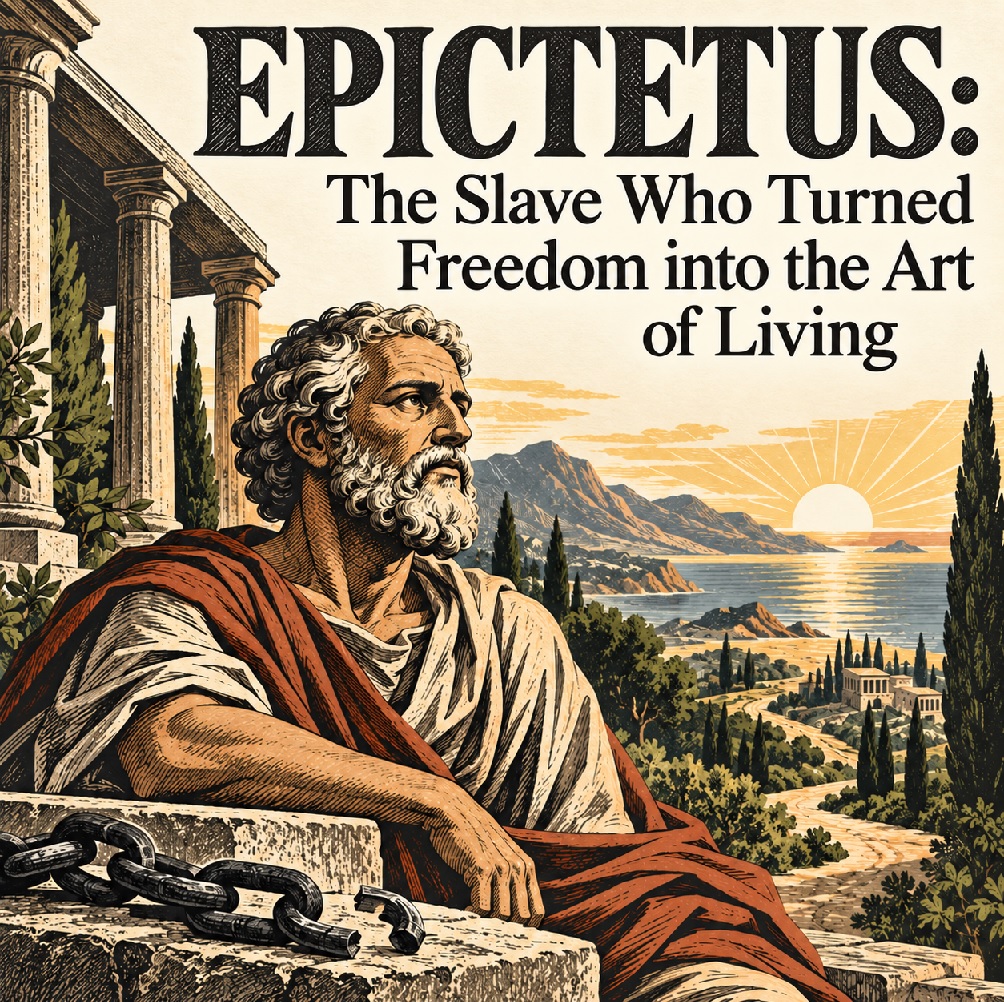
The boy who would later become known as Epictetus belonged to the second category. Little information about his childhood has survived, and the exact year of his birth remains uncertain, although it is generally placed around AD 50. The name by which history remembers him derives from a Greek word associated with acquisition or possession and is often interpreted as a designation for someone who belongs to another person. It is not certain whether this was his original personal name, but its symbolism has remained inseparably connected with his fate.
Slavery in the Roman Empire was not the same experience for everyone who lived under its authority. Some slaves worked in mines and agricultural estates under extremely harsh conditions, others served in wealthy households, while still others received an education and performed administrative duties. Despite these differences, they all lived within a system that restricted their right to determine their own future. A master could decide where they would live, what work they would perform, and under what circumstances they would be sold or freed.
Epictetus grew up in a world where such relationships were regarded as a natural part of the social order. Roman citizens spoke of honor, dignity, and freedom, while much of their daily existence depended on the labor of people who did not possess the same rights. Philosophers discussed justice, and politicians defended the greatness of the state, without necessarily questioning the institution of slavery. It was amid these contradictions that the life of a man began who would later make the question of human dignity central to his teaching.
No surviving account allows us to trace his early years in detail. We do not know who his parents were, what his childhood was like, or exactly when he was taken to Rome. Historical evidence becomes clearer only when he appears in the household of a man connected to the highest circles of imperial power. This circumstance would place him close to one of the most extraordinary and dangerous political worlds of antiquity.
Rome: The Splendor of an Empire and the Life Behind Its Walls
When Epictetus arrived in Rome, the capital was a city of enormous social contrasts. Senators, soldiers, merchants, officials, freedmen, and people from the most distant provinces moved through its streets. The imperial palaces were centers of wealth and influence, while public squares gathered citizens who discussed politics, legal disputes, and the latest events in the empire. Yet behind the magnificence of temples and monumental buildings stood a complex system of dependencies in which personal well-being was often determined by proximity to power.
Epictetus’s master was Epaphroditus, an influential freedman associated with the court of Emperor Nero. Epaphroditus had attained a position that demonstrated how unusual social relationships could be in Rome. A man who had once been a slave himself could, after gaining his freedom, acquire wealth, political influence, and access to imperial decisions. At the same time, he could own other human beings and exercise over them the authority from which he himself had been released.
Epaphroditus held important administrative responsibilities and belonged to the circle of associates on whom the emperor relied. During Nero’s final days, he was present at the ruler’s death, after his reign had collapsed under the pressure of military rebellions and political opposition. For someone like Epictetus, such an environment offered a direct view of the instability of social position. Those who possessed enormous influence one day could lose everything the next because of a change in imperial favor.
Life in such a household meant proximity to power, but not participation in it as an equal. Epictetus was the property of a man who had access to the highest political circles, yet he himself did not possess the same independence. This situation created a striking contrast between the outward prestige of the environment and the personal unfreedom of those who served within it. In imperial Rome, social greatness was not necessarily proof of moral dignity, just as low status did not imply a lack of reason or ability.
Even at this early stage of his biography, a question emerges that would later shape his understanding of human beings. Should a person be judged according to their social role or according to the quality of their character? Roman society offered one answer through its laws, titles, and hierarchies. The philosophy toward which Epictetus gradually turned would offer him another way of understanding human worth.
Musonius Rufus: The Teacher Who Turned Philosophy into a Duty
Among the most important events in Epictetus’s life was his education under the Stoic philosopher Gaius Musonius Rufus. Musonius was known for his strict moral character and his conviction that philosophy should be expressed through behavior rather than merely through eloquent speeches. He belonged to a generation of Roman thinkers who placed virtue above political convenience and were prepared to endure the consequences of that position. Because of his public activity and philosophical convictions, Musonius himself experienced exile.
Musonius Rufus did not regard philosophy as a privilege reserved for people who had time for intellectual entertainment. For him, it was necessary for anyone who wished to live honorably, regardless of origin or social position. He defended the education of women, insisted on moral discipline, and emphasized the importance of everyday duties. These views distinguished him from the image of the philosopher as someone who spends his life exclusively debating abstract concepts.
The distinction between knowledge and practice occupied a particularly important place in his teaching. A person could understand why moderation was a virtue and still remain subject to every pleasure. Someone could deliver convincing speeches about courage yet abandon their convictions at the first sign of danger. For Musonius, such a discrepancy demonstrated that philosophical education remained incomplete.
This educational approach had a profound influence on Epictetus. He would later insist that philosophy was not mastered by memorizing definitions but by transforming one’s habits. Musonius’s teaching showed him that a genuine mentor should not merely explain what is good but should also require students to examine their own behavior. This is why Epictetus’s teaching would be characterized by persistent questioning, severe criticism, and a constant return to specific human weaknesses.
His education under Musonius was remarkable for another reason. In a society where a slave was often regarded primarily as property, Epictetus gained access to a philosophical tradition that demanded independent thought. His teacher could not change his legal status with a single speech, but he could provide him with the intellectual means to understand human existence beyond established social categories. This was an education that promised no easy life but demanded something far more difficult: consistency between convictions and actions.
The Lame Philosopher and the Limits of Historical Legend
Epictetus also became known for a physical disability that made walking difficult. Ancient accounts describe him as having an impairment in one leg, but they do not allow us to establish its cause with complete certainty. A story gradually developed around him according to which his master subjected him to violence and caused the injury. In some later accounts, the philosopher is portrayed as a man who met this cruelty with extraordinary composure.
This story became popular because it seemed to embody Stoic resilience perfectly. It brought together the cruelty of slavery, bodily suffering, and the strength of philosophical character in a single dramatic moment. Yet its historical reliability has not been established, and it should not be presented as a certain event in Epictetus’s life. The different ancient accounts do not allow us to conclude unequivocally whether his disability was congenital, acquired through illness, or caused by violence.
This uncertainty is important for understanding Epictetus. His philosophical significance does not depend on the authenticity of a dramatic scene, however powerful it may appear. His life contains enough real contradictions and trials without the need to supplement them with unconfirmed details. The more significant historical fact is that a man with limited social standing and a physical disability managed to establish himself as one of the most influential teachers of his era.
The ancient world often associated physical beauty, strength, and health with ideas of social dignity. A person who did not conform to these ideals could easily be underestimated, regardless of intellectual ability. Epictetus did not attempt to build his philosophical authority upon outward grandeur or social prestige. His influence came from his teaching, the strength of his arguments, and the consistency with which he demanded that philosophy be applied to life.
Emancipation and the End of One Dependency
At some point in his life, Epictetus was granted freedom and ceased to be a slave. The exact date and circumstances of his emancipation are unknown, but it is clear that he subsequently lived as a free man and taught philosophy. This change carried enormous legal and social significance in the Roman world. It gave him opportunities that his previous position had restricted and opened the way toward a more independent life.
For a freed slave, however, society continued to impose certain boundaries. Roman laws and customs maintained distinctions between those born free and those who had subsequently been emancipated. The past did not disappear entirely with a change in legal status, and relationships with former masters could continue to matter. Consequently, emancipation did not automatically make a person an equal participant in every sphere of public life.
It was during this period that Epictetus began establishing his own place among the philosophers of Rome. He belonged to a tradition that already possessed a long history and considerable influence among educated circles. Stoic ideas were familiar to senators, statesmen, and intellectuals, while philosophical teachers participated in lively debates about morality and public responsibilities. Yet the attitude of imperial power toward them was far from consistently favorable.
Philosophers could be valued as mentors but also perceived as politically dangerous individuals. The teaching of independence in moral judgment could easily come into conflict with an environment that expected unconditional obedience to the ruler. The Stoic tradition was already associated with people who had opposed arbitrary power and suffered punishment for their convictions. Belonging to a philosophical school was therefore not merely an intellectual choice; it sometimes carried very real political risks.
Domitian and the Time When Philosophy Became Suspicious
After Nero’s death, Rome passed through a period of political upheaval before power became established in the hands of the Flavian dynasty. Vespasian and Titus ruled before Domitian, who became emperor in AD 81. His reign gradually acquired a reputation for harsh treatment of political opponents and those whose behavior was perceived as a threat to imperial authority. Philosophers also came under suspicion, particularly when they were associated with senatorial opposition.
Around AD 93, Domitian took measures that led to the expulsion of philosophers from Rome and Italy. The precise circumstances and extent of these measures remain subjects of historical discussion, but ancient tradition connects Epictetus’s departure from Rome with them. For a man who had already experienced slavery and succeeded in establishing himself as a teacher, this meant another interruption of his settled life. Political power was once again determining where he could live and work.
Exile was a frequently used instrument of punishment and political control in the Roman Empire. It did not always mean imprisonment or physical violence, but it could deprive a person of home, students, professional opportunities, and social standing. For a philosopher whose work depended on direct conversation with others, such forced relocation represented a serious trial. Epictetus had to leave the capital where he had received his education and developed his path as a teacher.
He chose to settle in Nicopolis, a city in the northwestern part of present-day Greece. The city had been founded by Octavian Augustus following his victory at Actium in 31 BC and bore a name meaning „City of Victory.“ Its location near important roads and maritime connections made it a significant center for travelers, merchants, and representatives of different social groups. It was there that Epictetus established the philosophical school that would bring him lasting historical recognition.
th
Nicopolis: The School Where No One Received Ready-Made Wisdom
Nicopolis did not possess the political grandeur of Rome, but it offered an environment in which philosophical conversation could continue far from immediate court intrigues. Epictetus began teaching students who arrived to receive an education and master the principles of Stoic philosophy. Among them were young men from wealthy families preparing for public life, as well as listeners from different backgrounds and with different interests. The school gradually acquired a reputation that extended beyond the boundaries of the city.
Studying under Epictetus was nothing like peacefully listening to carefully organized lectures, after which a student could return home satisfied with having acquired new knowledge. The philosopher used questions, objections, and immediate examples to expose contradictions in the thinking of his listeners. He did not seek to flatter them and did not regard intellectual ability as proof that a person already possessed good character. On the contrary, the more confident a student was in his own wisdom, the more reason the teacher had to put that confidence to the test.
In the surviving discourses, young people frequently appear who wish to be regarded as philosophers without being prepared to change their everyday behavior. They are interested in logical proofs, complex arguments, and the opportunity to impress others with their knowledge. Epictetus continually redirects their attention toward how they behave when insulted, when they fail to obtain what they desire, or when they must fulfill an unpleasant duty. For him, the true value of education becomes apparent precisely in these ordinary situations.
He was particularly critical of the pursuit of philosophical fame. A person could be familiar with the works of Chrysippus, quote complex arguments, and speak convincingly about virtue, yet this did not mean that he had become virtuous. If he remained vain, unjust, and dependent on the approval of others, his knowledge remained separated from his character. Epictetus insisted that philosophical texts should be used as instruments of education rather than ornaments of a self-important mind.
Such an approach transformed the school into a place of constant personal examination. Students were not encouraged merely to agree with their teacher but to investigate the foundations of their own convictions. Philosophical conversation often took a sharp tone because Epictetus believed that self-deception could not be overcome by politely affirming every opinion. He was convinced that a person must learn to endure the truth about their own weaknesses before they can begin to overcome them.
The Physician of the Soul and the Students Who Did Not Want to Be Healed
One of the most characteristic images in Epictetus’s teaching is the comparison between the philosopher and the physician. Just as a physician examines an illness to determine its causes, the philosopher must investigate the mistaken beliefs that govern human behavior. Treatment is not always pleasant because it requires a person to acknowledge their condition and undergo the necessary change. Epictetus did not regard the philosophical school as a place where visitors should experience nothing but pleasure from beautiful reflections.
This understanding also shaped his attitude toward the responsibility of teaching. A mentor who seeks only to be liked risks turning education into a performance. Such a teacher begins avoiding difficult questions, concealing obvious weaknesses, and offering listeners what they wish to hear. Epictetus rejected this approach because he believed that genuine education must be useful even when it is uncomfortable.
His discourses frequently feature people who want philosophy to help them achieve a particular external goal. One wishes to be respected, another worries about a future career, while a third fears losing social standing. Instead of offering ready-made reassurances, Epictetus examines the desires underlying these anxieties. He is interested not only in what a person wants to obtain but also in why that person has turned the desired outcome into a necessity for personal dignity.
This method recalls Socrates, whose philosophy exerted an enormous influence on the Stoic tradition. Socrates was not satisfied with elegant definitions of justice, courage, and virtue but insisted that his interlocutors examine whether they truly understood their own claims. Epictetus adopted the same willingness to question apparently obvious convictions. The difference was that he developed this approach within Stoic education, which was directed toward the systematic formation of character.
Arrian: The Student Who Preserved His Teacher’s Voice
Epictetus left no philosophical writings of his own intended for publication. This circumstance distinguishes him from Seneca and Marcus Aurelius, whose works have reached us as texts composed by the authors themselves. Almost everything we know about Epictetus’s teaching is connected with the efforts of one of his students to preserve the content of his conversations. That student was Lucius Flavius Arrianus, known in history as Arrian of Nicomedia.
Arrian came from a wealthy family in Nicomedia, a city in Asia Minor, and received an education that opened the way to a public career. He attended Epictetus’s school in Nicopolis and was deeply impressed by his teaching. He later attained high positions in the Roman administration, including the governorship of the province of Cappadocia. In addition to being a statesman, he was also a historian whose works on Alexander the Great and other subjects remain important testimonies to the ancient world.
Yet his most significant contribution to Epictetus’s legacy was preserving the philosophical conversations from Nicopolis. Arrian recorded discourses that were later circulated under the title Discourses, also known as Conversations. In his preface, he presents these texts as an attempt to preserve the manner in which Epictetus actually spoke to his students. This gives the work an unusual immediacy and often creates the impression that the reader is present in the school itself.
Originally, the discourses were collected in eight books, of which four have survived to the present day. This means that a substantial portion of the recorded teaching has been lost. Nevertheless, the surviving texts offer an exceptionally rich view of the philosopher’s personality, his methods, and his relationships with students. In them, Epictetus does not appear as a distant authority pronouncing final truths but as a persistent teacher who continually converses, objects, and demands clarity.
Arrian also compiled the short Handbook, known by its Greek title Enchiridion. It consists of a selection of essential instructions from Epictetus’s teaching, intended to be easily remembered and applied. While the Discourses reveal the process of philosophical conversation, the Handbook presents its practical conclusions in concentrated form. The two works complement one another and together form the foundation of the written legacy through which Epictetus reaches subsequent generations.
Without Arrian, Epictetus’s influence would probably have remained limited to the memories of his immediate students. Ancient philosophy knew numerous teachers whose ideas were lost because they were never recorded or because their writings did not survive. In the case of Epictetus, the student became the intermediary between oral teaching and historical memory. Thanks to this, a man who left no philosophical treatise written in his own hand ranks among the most widely read thinkers of antiquity.
The Three Disciplines: Education as the Transformation of Character
In Epictetus’s teaching, the division of philosophical education into three fundamental areas occupies a particularly important place. The first concerns desires and aversions, the second concerns actions and duties, and the third concerns correct judgment and assent to impressions. These areas are not independent activities from which a person can freely choose according to personal interests. They form an interconnected discipline through which philosophy must gradually transform the entire character.
Working with desires requires a person to examine the foundations of what they pursue. Epictetus observed how often people chase goals they have not chosen through careful reflection but have adopted from their social environment. Wealth appears necessary because others respect it, while fame appears desirable because it promises recognition. In this way, a person begins living according to assumptions that have never been subjected to serious examination.
The second discipline concerns actions and relationships with other people. Epictetus did not believe that a philosopher should withdraw from society and cease fulfilling personal responsibilities. A person remains a son, parent, friend, citizen, or participant in a particular profession and must understand their behavior in light of these relationships. Philosophical education has value when it improves the way a person fulfills their actual responsibilities.
The third discipline requires particular intellectual vigilance. It concerns the ability to examine whether the impressions arising in the mind deserve to be accepted as true. Epictetus regarded this ability as a necessary condition for consistent thinking and honorable action. A person who cannot distinguish a hasty impression from a justified judgment easily turns momentary reactions into guiding principles.
The three disciplines demonstrate that Stoic education is not limited to a single psychological technique. It encompasses desires, moral responsibilities, and the capacity for rational judgment. Epictetus insisted that progress required constant work in all these areas because weakness in one inevitably affected the others. His school therefore offered no shortcut to perfection but demanded prolonged and consistent training.
The Roles That Life Assigns Us
One of the distinctive aspects of Epictetus’s thought is his attention to human roles. He regarded people not as isolated beings whose decisions affect only their own well-being but as participants in a network of relationships. Every person has certain responsibilities arising from their position within the family and society. These responsibilities must be understood through reason and moral judgment rather than simply through the desire for personal convenience.
For Epictetus, the relationship between father and son, for example, cannot be reduced solely to whether the two like each other. The family bond creates certain responsibilities that do not automatically disappear when disagreements arise. This does not mean unconditional approval of every behavior, nor does it require a person to abandon their own moral judgment. It means that personal irritation is not sufficient reason to disregard the entire meaning of a relationship.
The same logic applies to friendship, public service, and professional duties. A person should not fulfill a particular role merely because of the possible rewards it offers. They must understand what honorable participation in that role requires and how their behavior affects others. In this way, Epictetus connects personal improvement with responsibility toward other people.
This aspect of his teaching often remains overshadowed by more popular reflections on personal tranquility. Yet for the ancient Stoics, human beings were social by nature, and a rational life presupposed participation in the community. Moral maturity was demonstrated not only through the ability to endure difficulties but also through the way a person fulfilled responsibilities toward others. Epictetus continually reminded his students that philosophy should be visible in their treatment of people, not merely in their private reflections.
Socrates, Diogenes, and the Models of the Philosophical Life
Although he belonged to the Stoic school, Epictetus frequently turned to figures from earlier Greek philosophical traditions. Among his most important models was Socrates, whom he regarded as a man who had transformed philosophical convictions into a consistent way of life. Socrates left no writings of his own, but his teaching and death exerted an enormous influence on the development of ancient philosophy. For Epictetus, he was an example of a thinker who did not separate reason from moral behavior.
Diogenes of Sinope, one of the best-known representatives of Cynic philosophy, also appears in his discourses. Epictetus portrayed him as a man who consciously rejected social conventions and used his own life as an instrument of moral instruction. This image was not merely a celebration of poverty or unusual behavior. It served to examine what qualities a person must possess when seeking to challenge commonly accepted ideas of happiness and success.
Epictetus did not encourage his students to imitate the outward lifestyles of such figures recklessly. He insisted that a person must first understand what inner preparation the chosen path requires. Wearing rough clothing or renouncing certain comforts does not automatically mean acquiring the virtues of Diogenes. Outward imitation can easily become another form of vanity when a person wishes to appear extraordinary without genuinely transforming their character.
This criticism reveals an important feature of Epictetus as a teacher. He did not wish to create followers who mechanically reproduced the behavior of their philosophical heroes. His goal was for students to understand the reasons behind their decisions and develop their own capacity for rational action. Historical examples therefore had value not as ready-made models to copy but as opportunities to examine the moral qualities underlying them.
The Simple Life of a Man Who Did Not Seek Greatness
Ancient tradition portrays Epictetus as a man who lived modestly and did not turn his reputation as a teacher into a means of accumulating wealth. Unlike philosophers who participated actively in political life, he remained primarily a mentor. His influence spread through his students and the conversations he conducted with them. This position allowed him to concentrate his life on education and moral questions.
Individual accounts of his personal habits have survived, but they do not provide a complete picture of his everyday life. Later authors associate him with simplicity, limited material needs, and independence from social grandeur. These testimonies must be approached carefully because ancient biographies often emphasize characteristics that correspond to the philosophical ideal of the person being described. Nevertheless, a modest way of life is consistent with the general image of Epictetus preserved in his teaching.
There is also a well-known account that, in old age, Epictetus took responsibility for an abandoned child. According to later ancient tradition, he accepted the responsibility of raising the child, and a woman came into his household to assist with the care. This episode is preserved in biographical testimonies that do not allow every detail to be independently verified. Yet the story itself demonstrates how ancient authors connected the memory of Epictetus with the idea that moral teaching should also be expressed through concrete care for another human being.
For a philosopher who placed such strong emphasis on duties, such an action carried particular significance. It directed attention away from abstract reflections and toward the real needs of human life. Speaking about justice and human community is one thing, while assuming long-term responsibility for a defenseless child is quite another. This distinction between words and actions was constantly present in Epictetus’s teaching.
The Philosopher and the Emperor Who Was Never His Student
Epictetus and Marcus Aurelius belong to the same great tradition, but their lives unfolded under radically different social circumstances. One began life as a slave and became a teacher in a provincial city, while the other was raised among the Roman aristocracy and ascended to the imperial throne. Despite this difference, Epictetus’s philosophical legacy exerted a significant influence on Marcus Aurelius‘s thinking. This influence reached the emperor through the recorded discourses rather than through direct instruction.
In his personal writings, Marcus Aurelius expresses gratitude to Junius Rusticus, one of his philosophical mentors. Among the things for which he is grateful is being introduced to the discourses of Epictetus. Thus, the teaching of a man who had once been a slave in imperial Rome reached a ruler who governed that same state. The historical irony is remarkable because the social distance between the two could hardly have been greater.
Marcus Aurelius did not regard Epictetus as merely a curious figure from the past but as a source of philosophical guidance. His writings contain ideas and formulations that testify to his familiarity with the teaching of the philosopher from Nicopolis. The emperor used such instructions to maintain his own moral discipline amid the burdens of government. In this way, discourses originally intended for students in a philosophical school found application in an entirely different historical environment.
This influence demonstrates how philosophical ideas can cross the boundaries of social position. Epictetus did not possess the political authority to change the laws of the empire, nor did he leave behind state institutions. Yet through his students, he reached people whose decisions carried enormous social significance. His influence rested not on the commands he could issue but on the questions he taught people to ask themselves.
The Final Years in Nicopolis
Little reliable information has survived about the final years of Epictetus’s life. It is known that he continued to be associated with Nicopolis and his teaching activity, while his death is generally placed around AD 135. The exact date remains unknown, and ancient sources provide no detailed account of his final days. This absence of a dramatic ending distinguishes his biography from the stories of certain other Roman Stoics whose deaths were directly connected with political events.
His life spanned several different eras in the history of the Roman Empire. He knew the world of Nero, experienced the political upheavals following his death, and was forced to leave Rome under Domitian. Later, he lived during a period when imperial power passed through the reigns of Nerva, Trajan, and Hadrian. Each of these changes brought different conditions for public life, but Epictetus remained known primarily as a philosophical teacher.
His school left no material legacy comparable to the magnificent buildings and monuments of Roman rulers. No surviving monument allows us to reconstruct precisely the space in which he taught. Nor do we possess a complete biography written by one of his immediate contemporaries. Instead, we have conversations, questions, and instructions preserved by a student who understood the significance of what he was hearing.
This characteristic of his historical legacy corresponds to the way Epictetus understood the purpose of philosophy. He did not seek to build literary fame through his own works or leave behind a political institution. His principal work was focused on the people who stood before him seeking education. His influence continued because some of those people carried what they had learned beyond the limits of his lifetime.
The Journey of the Handbook Through the Centuries
After Epictetus’s death, his teaching continued to spread throughout the Greco-Roman world. The Handbook proved particularly suitable for copying and study because it presented essential philosophical instructions in a concise and accessible form. Over time, the text began to be used in different intellectual environments, including among thinkers who did not belong to the original Stoic school. This allowed his legacy to survive the political and cultural changes that gradually transformed the ancient world.
In late antiquity, the Neoplatonic philosopher Simplicius wrote an extensive commentary on the Handbook. This work demonstrates that Epictetus continued to be read and discussed centuries after his death. Simplicius regarded the text as an instrument of moral education and interpreted it within the context of his own philosophical tradition. Thus, Epictetus’s instructions became part of the broader conversation about human nature, virtue, and the purpose of the philosophical life.
Over the following centuries, his works were copied, translated, and studied in different parts of Europe. Renaissance interest in ancient philosophy contributed to their renewed circulation, while the printed book made it possible for them to reach a considerably wider audience. Philosophers, theologians, and educated readers discovered different reasons for reflection within them. Some were interested in moral discipline, others in the relationship between reason and the passions, and still others in the possibility of preserving human dignity under unfavorable circumstances.
In the modern era, interest in Epictetus acquired a new dimension through the development of psychology and psychotherapy. Particularly well known is the connection between his understanding of human judgments and rational emotive behavior therapy, developed by Albert Ellis. Ellis openly acknowledged the influence of Stoic ideas on his approach to emotional difficulties. This does not mean that ancient philosophy and modern psychotherapy represent the same system, but it demonstrates how certain philosophical observations can be reconsidered within a new scientific context.
In this way, the legacy of Epictetus passed through numerous historical transformations. The teaching originally transmitted orally in Nicopolis reached a Roman emperor, late-antique philosophers, Renaissance scholars, and modern researchers of human behavior. Each generation read it through the questions and difficulties of its own time. Yet at the heart of this enduring interest remained the figure of a teacher who insisted that philosophy must change the way a person lives.
The Legacy of a Teacher Who Refused to Sell Comfort
The story of Epictetus differs from the biographies of Seneca and Marcus Aurelius not only in the social positions of the three thinkers. Seneca left a rich literary legacy in which philosophy intertwines with the political contradictions of his life. Marcus Aurelius created personal writings through which he sought to maintain his moral discipline amid the burdens of imperial power. Epictetus, by contrast, remained above all a teacher whose legacy was preserved by someone who sat among his listeners.
He did not seek to offer his students comfort that would free them from the need to change. When someone complained about circumstances, Epictetus directed attention toward the foundations of that person’s judgments. When someone wished to be recognized as wise, the philosopher examined whether their behavior truly deserved such recognition. When his listeners became absorbed in complex theoretical debates, he reminded them that knowledge must be tested through life.
This strictness did not arise from contempt for human weaknesses. It rested on the conviction that human beings possess the ability to develop their reason and character through education and practice. Epictetus did not regard his students as accomplished sages but as people who still needed to discover the contradictions in their own behavior. His philosophical school was therefore a place of sustained effort rather than a stage for demonstrating intellectual superiority.
It is particularly significant that he made teaching the central work of his life. He left behind no conquests, political reforms, or immense personal fortune. Instead, he established a tradition of moral education whose influence continued far beyond his own time. His historical reputation became connected not with the power he possessed over other people but with his ability to encourage them to think more carefully and live more consistently.
Epictetus began his life in a society that placed human beings into strictly separated categories. He was a slave in the household of an influential man, a student of a philosopher who had experienced political persecution, and a teacher forced to leave Rome. Later, his discourses reached the imperial court and readers who lived centuries after his death. This sequence of events demonstrates how the life of a person with limited initial opportunities can acquire historical significance through education and teaching.
At the end of this story remains not the image of a flawless sage, freed from every human difficulty, but that of a man who devoted his life to the demanding task of transforming philosophy into actual practice. His strength lies not in having experienced extraordinary events but in the way he developed a comprehensive teaching about moral education. Epictetus did not promise his students that they would become great in the eyes of the world. He called them toward something more difficult: to build a character that does not require outward greatness in order to be worthy of respect.
Author: Vasil Stoyanov