
For thousands of years, humanity has studied the cosmos through light. Even when telescopes began detecting radio waves, X-rays, and gamma radiation, the basic principle remained the same: we observe electromagnetic signals arriving from distant objects. Yet the most dramatic events in the universe can leave another kind of trace. They generate waves in spacetime itself, carrying information about the motion of matter and the nature of gravity.
Gravitational waves open a window onto cosmic phenomena that are sometimes almost invisible to conventional telescopes. They allow us to investigate merging black holes, colliding neutron stars, and the behavior of gravity under extreme conditions. Detecting them requires measuring changes in distance smaller than an atomic nucleus. The story of this achievement brings together theory, engineering, international collaboration, and a century of scientific patience.
Einstein’s Prediction
In 1915, Albert Einstein completed the general theory of relativity and proposed a new understanding of gravity. Rather than treating it solely as a force between massive bodies, the theory describes how matter and energy determine the geometry of spacetime. Planets and stars move within this geometry, and their trajectories reflect its curvature. This explanation changed not only our picture of motion but also the way physics understands space and time.
In 1916, Einstein showed that his equations admit wave solutions in the approximation of weak gravitational fields. These solutions imply that certain changes in the distribution of mass can produce disturbances propagating at the speed of light. Such disturbances are not waves in air or another material medium, but changes in the geometry of spacetime. Physicists later clarified how they carry energy and how they can affect measuring instruments.
For a long time, the existence of gravitational waves remained primarily a theoretical question. Scientists debated the physical meaning of some mathematical solutions and whether an effect so weak could ever be measured. Gradually, a consensus emerged that a real wave could produce relative motion between freely moving bodies. Physics thus acquired a concrete experimental challenge: building an instrument capable of registering that motion.
What Is a Wave in Spacetime?
When we throw a stone into water, we see a disturbance spreading across its surface. Sound is also a wave, but it travels through changes in pressure within a material medium. A gravitational wave is different because it changes the geometric relationships between events and freely moving bodies. It can pass through the vacuum of space without requiring air, water, or any other medium.
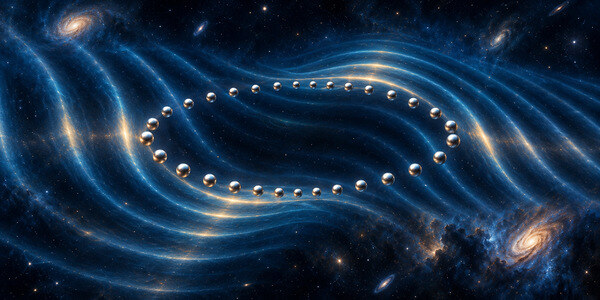
Imagine freely floating particles arranged in a circle in space. If a gravitational wave passes through them from a suitable direction, the distances between the particles begin to change in a characteristic pattern. For one polarization, the circle stretches along one axis and contracts along the other, and half a cycle later the effect reverses. This change is extraordinarily small for signals reaching Earth, but it has a precise mathematical form.
In general relativity, gravitational waves have two independent polarizations in the weak-field approximation. They are usually called plus and cross because they describe two differently oriented patterns of deformation. Detectors respond differently to these patterns depending on their orientation and location. Comparing measurements from several observatories makes it possible to extract more information about the source’s direction and properties.
Which Cosmic Events Produce Gravitational Waves?
Not every movement of a massive body produces significant gravitational radiation. The leading mechanism in many astrophysical systems is associated with changes in the mass quadrupole moment, which describes the spatial distribution of mass. Perfectly spherically symmetric expansion and contraction do not, by themselves, generate gravitational waves of this kind. Strong emission is especially associated with massive, compact systems whose asymmetric structure changes rapidly.
Two stars orbiting a common center of mass continuously change the distribution of mass in space. The system emits gravitational waves that carry away energy and angular momentum. As a result, the orbit gradually shrinks, and the two objects may begin moving faster and faster. For ordinary stars this process is often very slow, but for black holes and neutron stars it can become extraordinarily intense.
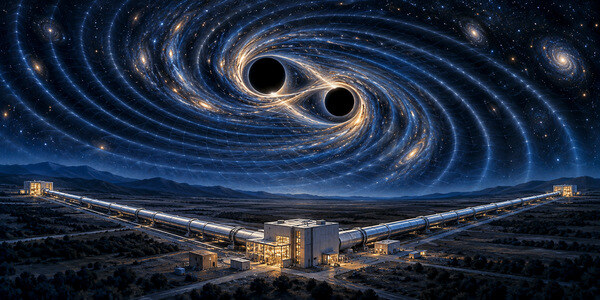
Black holes are especially interesting because they concentrate enormous mass in a region of strongly curved spacetime. As two black holes approach one another, they can reach speeds at which gravitational radiation becomes extraordinarily powerful. Their final orbits, the merger itself, and the subsequent fading oscillations of the new object form a characteristic signal. Its shape contains information about the masses, spins, and distance of the system.
The First Convincing Indirect Evidence
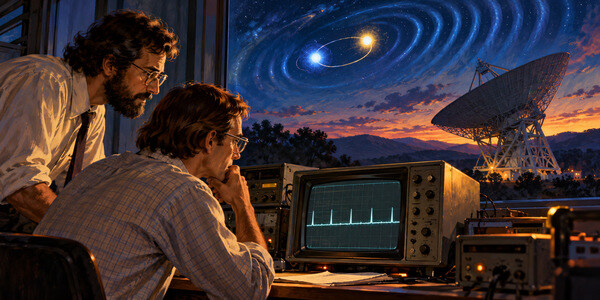
Before gravitational waves were measured directly, astronomers discovered their effect on a binary neutron-star system. In 1974, Russell Hulse and Joseph Taylor identified the pulsar PSR B1913+16, which orbits an unseen compact companion. The pulsar emits exceptionally regular radio pulses that can serve as a precise cosmic clock. By measuring the arrival times of those pulses, scientists track the motion of the system.
Observations show that the orbital period is gradually decreasing. This means the two neutron stars are losing orbital energy and slowly moving closer together. The measured loss agrees with remarkable precision with general relativity’s prediction for the emission of gravitational waves. The discovery earned Hulse and Taylor the 1993 Nobel Prize in Physics and provided strong support for the theory long before LIGO appeared.
From the First Experiments to Laser Interferometry
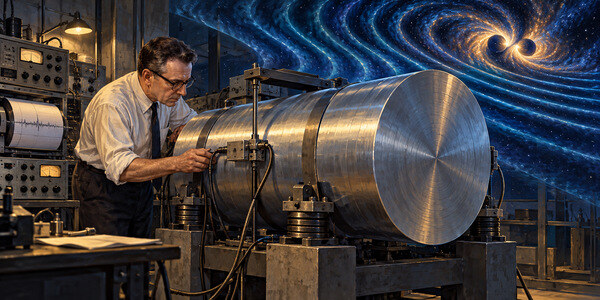
During the 1960s, American physicist Joseph Weber began developing detectors based on massive metal cylinders. His idea was that a passing gravitational wave could excite an extremely weak mechanical vibration in a suitable resonator. Weber reported possible signals, but other researchers could not reliably confirm his results. Nevertheless, his experiments turned the search for gravitational waves into a practical scientific program.
The next major step was the use of laser interferometry. In this method, a beam of light is split into two beams that travel along different optical paths and are then recombined. Even a very small change in the relative lengths of the paths can alter the interference signal. This property enables physicists to measure relative distances with a precision unattainable by ordinary mechanical devices.
LIGO: An Observatory for Almost Unimaginable Measurements
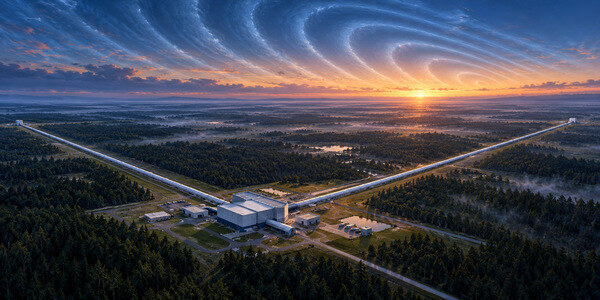
The American LIGO observatory uses two large interferometers located in Livingston, Louisiana, and Hanford, Washington. Each has two perpendicular arms four kilometers long. Laser light travels through the arms, reflects repeatedly between precision mirrors, and recombines in a measurement system. When a gravitational wave changes the relative distances along the two directions differently, the interference signal can change.
The characteristic relative strains of some observed waves are on the order of one part in ten to the twenty-first power. Across a four-kilometer arm, this corresponds to a change on the order of a few quintillionths of a meter. Such a distance is many times smaller than the size of a proton and cannot be measured with ordinary instruments. LIGO therefore uses exceptionally stable lasers, vacuum systems, specialized mirrors, and sophisticated isolation from ground vibrations.
The hardest task is not simply noticing a faint signal, but proving that it comes from space. Earthquakes, ocean waves, atmospheric conditions, and technical processes can introduce disturbances into the measurements. The two distant detectors make it possible to search for consistent signals with a small difference in arrival times. Complex statistical tests further assess how likely it is that an observation could be explained by random noise.
The Signal That Changed Astronomy
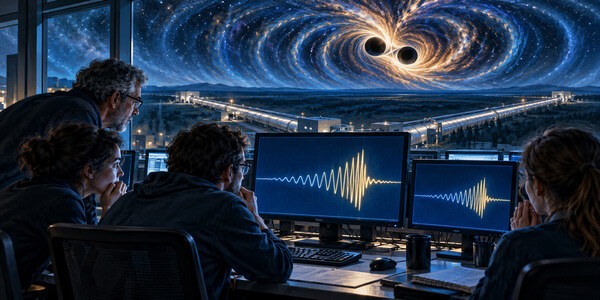
On September 14, 2015, LIGO’s two detectors recorded a brief signal later designated GW150914. Its shape showed a rapid increase in frequency and amplitude, followed by a fading oscillation. Analysis indicated that it came from the merger of two black holes with masses approximately 36 and 29 times that of the Sun. The resulting object had a mass of about 62 solar masses, with most of the difference radiated away as gravitational-wave energy.
The merger occurred approximately 1.3 billion years ago. Throughout that time, the waves traveled through space before reaching Earth. The two detectors registered the signal about seven milliseconds apart, consistent with the same wave passing through both of them. On February 11, 2016, the international team announced the first direct detection of gravitational waves.
The significance of this observation extends far beyond confirming a theoretical prediction. For the first time, humanity obtained direct information about the merger of two black holes through the dynamics of spacetime itself. The event demonstrated that processes difficult to observe through electromagnetic light could nonetheless be measured. A new branch of astronomy began, one in which cosmic objects are studied through the gravitational signals they create.
How Scientists Decode Gravitational Signals
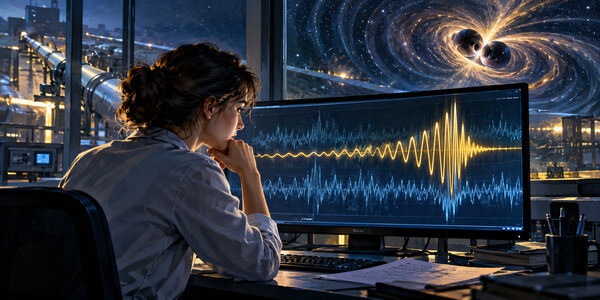
A detector does not receive a ready-made description of the black holes that produced a wave. It records time series of measurements in which a possible astrophysical signal is mixed with noise. Scientists compare the data with numerous theoretical models calculated for different masses, orbits, and spin rates. One of the principal methods for making this comparison is known as matched filtering.
The evolution of the frequency makes it possible to determine important combinations of the participating bodies’ masses. The amplitude provides information about distance, although the estimate also depends on the system’s orientation relative to the observer. The fading oscillations after the merger carry information about the final black hole’s mass and spin. All these parameters are inferred statistically, with estimates of uncertainty, rather than reported as perfectly exact numbers.
The method’s strength comes from the connection between mathematical theory and the measured signal. General relativity predicts how gravitational waves should evolve through the different stages of a merger. When observations agree with those predictions, they reveal properties of the source while simultaneously testing the theory itself. If reliable systematic deviations are found, they could point to limits in our current understanding of gravity.
Why We Say We Are Listening to the Universe
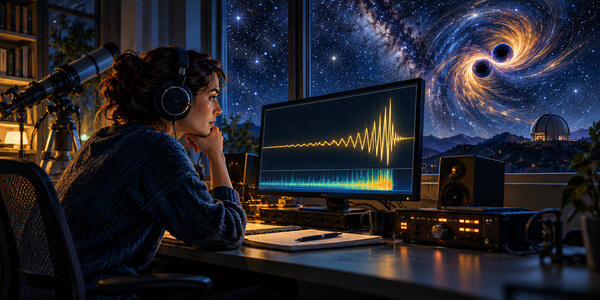
Gravitational waves are not sound in the ordinary physical sense. Sound waves propagate through a material medium, while gravitational waves are changes in spacetime. Nevertheless, some recorded signals have frequencies within the range of human hearing. After suitable conversion and amplification, they can be played as a brief rising tone.
That sound is a useful illustration, but the essence of the discovery is much deeper. Light tells us about electromagnetic processes, while gravitational waves carry information about the motion of massive bodies and the geometry around them. The two types of observations complement one another and can reveal different aspects of the same event. The metaphor of listening to the universe therefore refers to a new channel of information, not an actual sound traveling through the vacuum of space.
Neutron-Star Mergers and a New Era of Astronomy
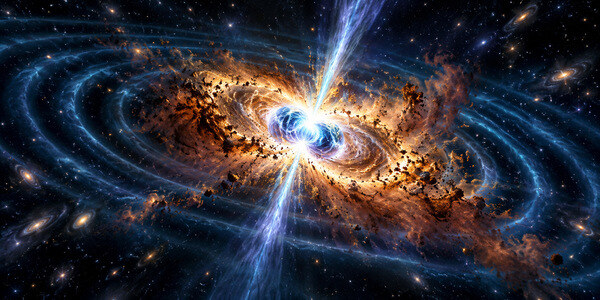
On August 17, 2017, the LIGO and Virgo observatories recorded the gravitational signal GW170817. It originated from the merger of two neutron stars, which were lighter than the black holes involved in the first observed event. Approximately 1.7 seconds after the end of the gravitational signal, space-based instruments detected a short burst of gamma radiation. This made it possible to study a single astrophysical event through both gravitational waves and electromagnetic radiation.
Follow-up observations located the source in the galaxy NGC 4993, approximately 130 million light-years from Earth. Telescopes around the world tracked the changing light of a phenomenon known as a kilonova. It occurs when a merger ejects neutron-rich matter in which intense nuclear reactions take place. GW170817 thus marked the beginning of an especially striking form of multi-messenger astronomy.
How Gravitational Waves Tell Us About the Origin of Gold
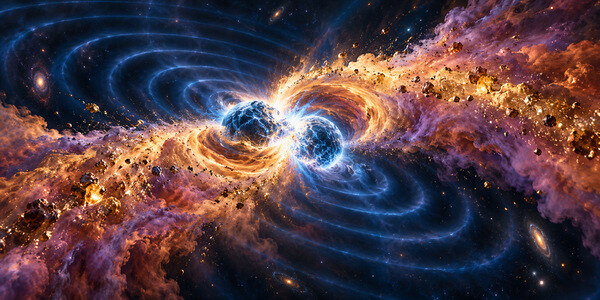
Many of the chemical elements that make up planets and living organisms originated inside stars or during other powerful astrophysical processes. Forming some of the heaviest atomic nuclei, however, requires conditions with enormous numbers of free neutrons. In the so-called r-process, atomic nuclei capture neutrons extremely rapidly and subsequently undergo radioactive transformations. This mechanism can create heavy elements, including elements such as gold and platinum.
The merger of two neutron stars provides a natural environment for such reactions. Some of the extraordinarily dense matter is ejected outward, expands, and gradually cools. The light from the kilonova associated with GW170817 provided compelling evidence for the formation of heavy nuclei in this process. This does not mean that every heavy element in the universe has a single origin, but it confirms the important role of neutron-star mergers.
Testing the Speed of Gravity
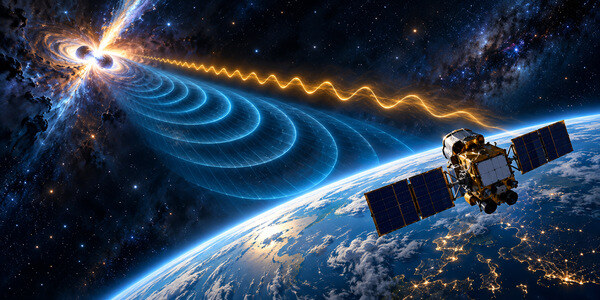
General relativity predicts that gravitational waves propagate through a vacuum at the speed of light. GW170817 provided an extraordinary opportunity to test that claim using two different signals from the same source. The gravitational waves and gamma rays traveled an immense cosmic distance before reaching Earth about 1.7 seconds apart. Interpreting this result requires accounting for the possibility that the two signals were not emitted at precisely the same moment.
After allowing for a possible delay at the source, the observation places extremely strict limits on the difference between the propagation speeds of the two kinds of radiation. The result agrees with Einstein’s prediction that gravitational waves travel at the speed of light. It also constrains several alternative models of gravity that allow these disturbances to propagate differently. A single neutron-star merger thus became both an astrophysical laboratory and a test of fundamental physical laws.
The International Network of Gravitational-Wave Observatories
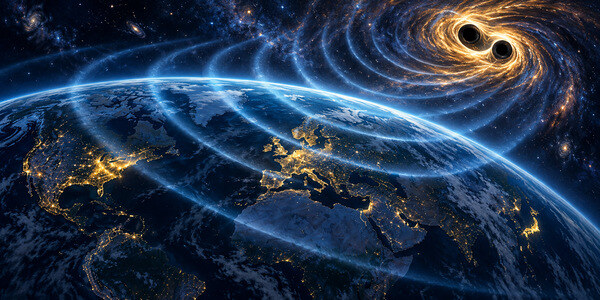
The two American LIGO observatories are not the only instruments designed to measure gravitational waves. The European Virgo detector in Italy and Japan’s KAGRA expand the international observing network. When more detectors register an event, differences in arrival times help narrow down the direction of the source. The instruments’ different orientations also allow better study of the signal’s polarizations and other properties.
Improving sensitivity gradually increases the number of events accessible to observation. Accumulated data allow astronomers to investigate the distribution of black-hole masses and the diversity of compact binary systems. Some mergers can provide insights into stellar evolution, while others draw attention to unusual scenarios for black-hole formation. Individual discoveries are therefore gradually becoming a statistical picture of a part of the universe that remained hidden for so long.
Pulsars and the Slowest Gravitational Waves
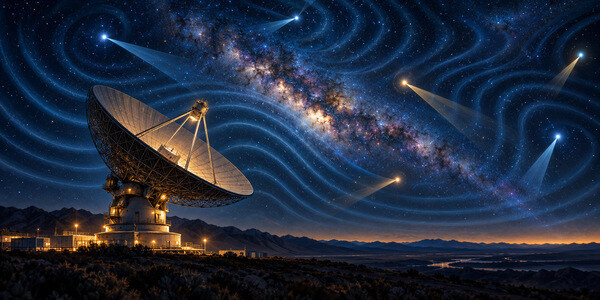
Ground-based laser interferometers are sensitive to a particular range of frequencies. The universe, however, also contains gravitational waves with periods lasting years, which cannot be observed in the same way. To search for them, astronomers use millisecond pulsars whose radio pulses arrive with extraordinary regularity. Many such stars can form a galactic network of natural clocks.
As low-frequency gravitational waves pass through space, they can change the measured arrival times of those pulses. Scientists look for characteristic correlations between deviations measured from pulsars in different directions across the sky. In 2023, international teams presented compelling evidence for a correlated low-frequency signal consistent with a gravitational-wave background. One leading scenario for its origin involves numerous pairs of supermassive black holes in the centers of galaxies.
LISA: Taking a Gravitational Observatory into Space
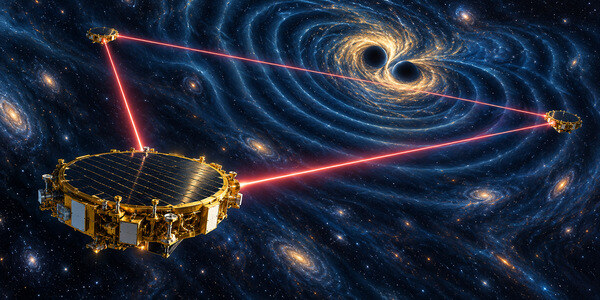
Earth’s surface imposes serious limitations on measuring very low-frequency gravitational signals. Seismic motion and other disturbances make it difficult for ground-based interferometers to operate in this range. The European Space Agency is therefore developing the LISA mission, which will use laser measurements between three spacecraft. They are intended to form an enormous triangular constellation with sides approximately 2.5 million kilometers long.
The space-based interferometer will be designed to study signals at much lower frequencies than those most accessible to LIGO. Its primary targets include mergers of supermassive black holes and the motion of compact objects around them. Such observations could reveal how black holes grow in galactic centers and how their surroundings evolve. They will also offer new opportunities to test general relativity in exceptionally strong gravitational fields.
Before LISA, scientists tested key technologies through the LISA Pathfinder mission. It demonstrated that freely falling test masses could be protected from external disturbances with extraordinary precision. This is important because the space observatory must distinguish genuine gravitational effects from influences acting on the spacecraft themselves. The success of those technological tests transformed an ambitious idea into a realistic scientific program.
Can Gravitational Waves Reveal the Early Universe?
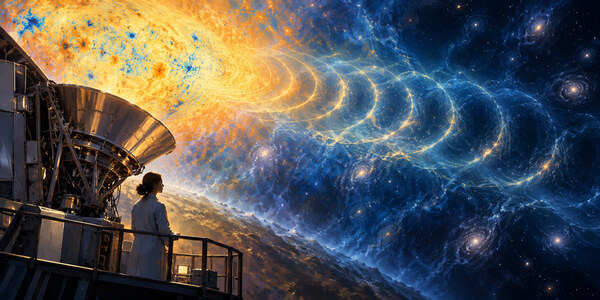
When astronomers observe the cosmic microwave background, they obtain information about the universe roughly 380,000 years after the beginning of its hot evolution. Before that period, matter was so hot and dense that light was constantly scattered by free charged particles. Electromagnetic observations therefore cannot directly show us every earlier stage. Gravitational waves offer a possibility of investigating physical processes that left traces before the universe became transparent to light.
Some models of cosmic inflation predict primordial tensor perturbations that could manifest as gravitational waves. Their traces may be sought in particular patterns of polarization in the cosmic microwave background. This research is difficult because interstellar dust and gravitational lensing also influence the observed polarization. So far, there has been no convincingly confirmed detection of a primordial gravitational-wave signal from the inflationary era.
If such a signal is reliably detected, it could provide information about the physics of the extremely early universe. Different theoretical models predict different characteristics for a possible gravitational background. Comparing these predictions with observations could help constrain scenarios for the initial stages of cosmic evolution. This remains one of the most exciting, but also most difficult, goals of modern cosmology.
Gravitational Waves as Cosmic Measuring Tools
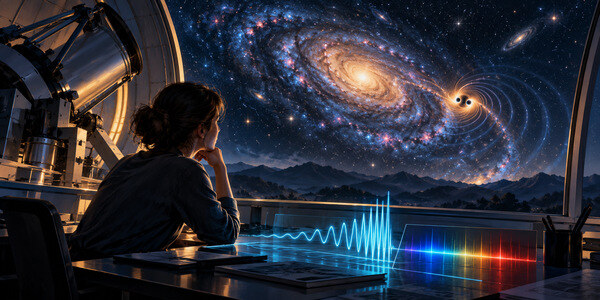
Distances to remote galaxies are difficult to determine and often require the successive calibration of different astronomical methods. Gravitational waves offer an independent approach based on the physics of compact binary systems. The frequency evolution of a signal provides information about masses, while its amplitude is related to the distance to the source. Such objects are called standard sirens, by analogy with standard candles in traditional astronomy.
The method is not entirely free from uncertainty because the observed amplitude also depends on the system’s orientation. When a gravitational event can be associated with a particular galaxy, its cosmological redshift can also be used. GW170817 demonstrated how the Hubble constant, which describes the present-day expansion of the universe, can be estimated in this way. As more events accumulate, standard sirens may provide an important independent check on cosmological measurements.
New Tests of the Laws of Physics
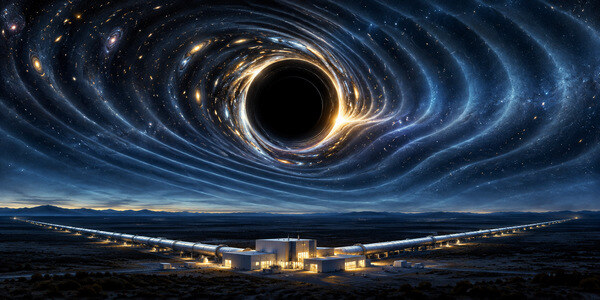
Black-hole mergers are natural laboratories for studying gravity under extreme conditions. In them, spacetime changes rapidly, and gravitational fields are much stronger than those usually encountered in the Solar System. The shape of the measured waves can be compared with detailed predictions from general relativity. Reliable observations so far show broad agreement with the theory in the regimes that have been tested.
The fading oscillations of a black hole after a merger are especially interesting. Their characteristic frequencies depend mainly on the mass and spin of the final object. If several independent oscillation modes can be measured precisely enough, scientists will be able to test more rigorously whether the object matches the predictions for a Kerr black hole. This approach is known as black-hole spectroscopy and is among the important objectives of future observatories.
Some alternative theories of gravity predict additional polarizations or different properties of wave propagation. Others allow changes in the way compact systems lose energy. Every new high-quality observation makes it possible to test these possibilities with greater precision. Science does not regard agreement with a theory as the final end of inquiry, but as a reason to conduct even stricter experiments.
The Future of Gravitational-Wave Astronomy
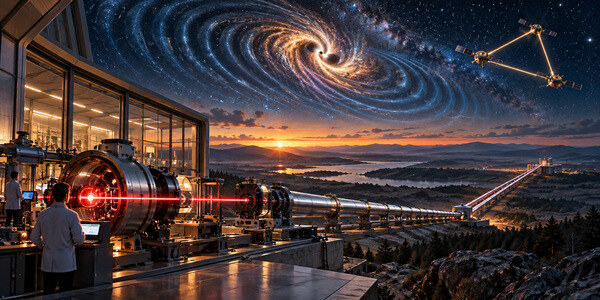
The first detection of gravitational waves was not the conclusion of a scientific story, but the beginning of a new way to observe the cosmos. Improved ground-based detectors will make it possible to investigate increasingly faint and distant signals. Space observatories will extend the frequency range toward processes associated with supermassive black holes. Pulsar networks will continue studying the slowest gravitational oscillations, whose periods can last for years.
Combining these methods will provide a much more complete picture of the gravitational universe. Astronomers will be able to study how compact objects form, how binary systems evolve, and how black holes grow at the centers of galaxies. Observations may also help answer questions about cosmic expansion and the early history of the universe. The most interesting discoveries will probably include phenomena that today’s models do not yet predict particularly well.
When the Silence of Space Becomes Information
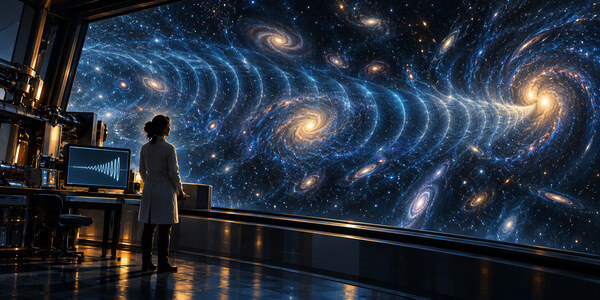
Outer space often seems silent because sound cannot travel through a vacuum as it does through air. Yet this silence does not mean that physical events or information are absent. Mergers of black holes and neutron stars send signals through spacetime that can be measured after immense journeys across the universe. These signals tell us about objects and processes that no human could ever observe directly.
Gravitational waves demonstrate how far scientific knowledge can reach when mathematical ideas meet technological ingenuity. A prediction made more than a century before the first direct observation became a new instrument for exploring the cosmos. Humanity has not literally begun to hear the stars, but it has acquired the ability to interpret changes in the very geometry of the universe. And with every newly detected wave, space that once seemed silent reveals another part of its history.
Author: Vasil Stoyanov