
When we look at the night sky, we naturally imagine that light from distant stars travels toward us in straight lines. In everyday life, this approximation works so well that we rarely have reason to question it. Across the immense distances of the universe, however, spacetime itself can be curved by massive objects, changing the paths followed by light. Sometimes this curvature turns entire galaxies and galaxy clusters into cosmic lenses that magnify, distort, or multiply images of even more distant worlds.
Gravitational lensing is one of the most beautiful manifestations of general relativity and, at the same time, a powerful tool of modern astronomy. It allows us to discover galaxies from the early history of the cosmos, measure the distribution of invisible dark matter, and investigate planets orbiting distant stars. In some cases, lensing makes it possible to observe objects that would otherwise be too faint for our telescopes. Thus, the universe not only sends light toward us but sometimes creates the optical systems through which we can come to understand it.
When Gravity Changes the Path of Light
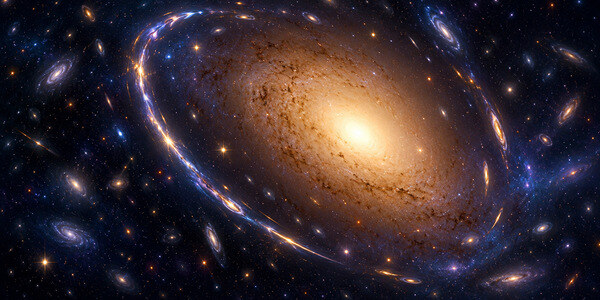
According to general relativity, gravity is not merely a force pulling bodies toward one another. Mass and energy change the geometry of spacetime, and light follows the available trajectories within that geometry. A light ray moves locally along its natural path, but that path can appear curved to a distant observer. Therefore, light passing near a massive body can arrive from a direction different from what we would expect in flat space.
A useful analogy is a traveler following the shortest route across a curved surface. The route may look unusual on a flat map, even though it follows a natural geometric line on the surface itself. The situation with light is more complex because it involves four-dimensional spacetime rather than a two-dimensional surface. Nevertheless, the analogy helps explain why bending the path of light does not require a photon to have rest mass.
From Einstein’s Idea to the First Major Confirmation
Even before general relativity was fully formulated, scientists discussed the possibility that gravity could affect light. In 1915, Einstein presented a theory that gave a quantitative prediction for the deflection of light near the Sun. For a ray passing close to the visible edge of the Sun, the predicted deflection is approximately 1.75 arcseconds. This is a very small angle, but one large enough to be tested through suitable astronomical observations.
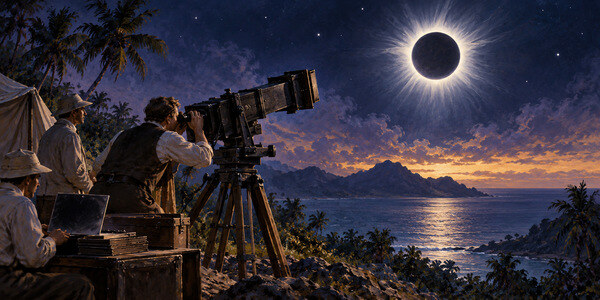
In 1919, expeditions associated with Arthur Eddington and Frank Dyson observed stars during a total solar eclipse. The eclipse made it possible to see stars near the Sun whose light would otherwise be concealed by the bright daytime sky. The measured positions of these stars were used to test the gravitational deflection of light. Although the historical measurements had substantial uncertainties, they became a symbol of the early experimental success of Einstein’s theory.
Later, radio astronomy and precise space-based measurements tested light deflection with much greater accuracy. Meanwhile, astronomers realized that the effect was not limited to the Sun or nearby stars. Entire galaxies could deflect light from objects behind them, while massive galaxy clusters could produce complex optical images. What began as a test of a physical theory gradually became an independent method for exploring the universe.
How a Cosmic Lens Forms
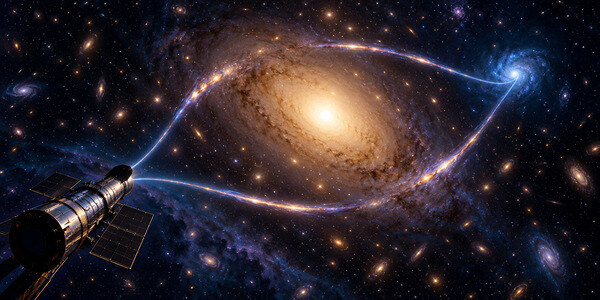
To observe a gravitational lens, we need a source of light, a massive object between that source and ourselves, and a suitable geometric arrangement. The distant source may be a star, a galaxy, or a bright active galactic nucleus called a quasar. The intervening object acts as a lens because its gravitational field changes the trajectories of passing light rays. An observer on Earth receives light along paths that can differ in length and geometry.
An ordinary glass lens refracts light because of the properties of the material from which it is made. A gravitational lens needs neither a transparent surface nor any particular chemical composition. Its action depends on the distribution of mass, including matter that does not emit visible light. This feature makes it especially valuable for investigating the invisible components of the cosmos.
The precise alignment of the source, lens, and observer is also important. When they lie almost along the same line, deflected rays can form bright arcs or multiple images. With less favorable alignment, the effect may be only a barely noticeable shift or stretching of an image. Consequently, the same massive galaxy can affect light from different background objects in different ways.
The Einstein Ring: The Beauty of Almost Perfect Alignment
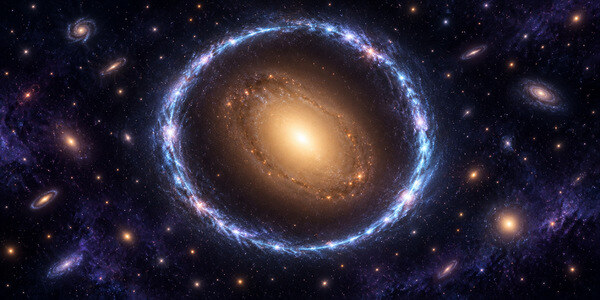
One of the most spectacular results of gravitational lensing is the so-called Einstein ring. It can appear when the source, lens, and observer are aligned almost exactly and the mass distribution is sufficiently symmetrical. Light from the distant source reaches the observer along different paths around the lens. Instead of an ordinary image, a glowing ring or an almost complete arc may appear.
Real cosmic lenses are rarely perfectly symmetrical, which is why we often see incomplete rings. Galaxies contain stars, gas, and dark matter distributed in complex structures. Additional galaxies along the line of sight can also influence the final image. The shape and brightness of the arcs therefore contain information about both the distant source and the mass of the lens.
Why We Sometimes See the Same Object Several Times
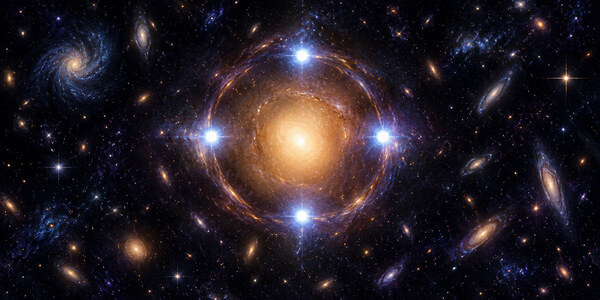
In strong gravitational lensing, light from one distant object can reach Earth along several different trajectories. As a result, a telescope records two, four, or more images of the same source. These are not different galaxies or different quasars, but separate images created by the geometry of the lens. Sometimes they have different brightnesses and appear arranged around a nearer galaxy.
A famous example is the Einstein Cross, in which four images of a single quasar appear around a central galaxy. This effect is possible because the mass distribution deflects light along several paths toward the observer. Each image carries information about the same distant source but has passed through a different region of the gravitational field. By comparing them, astronomers can test models of mass distribution and study additional structures along the line of sight.
The Three Main Forms of Gravitational Lensing
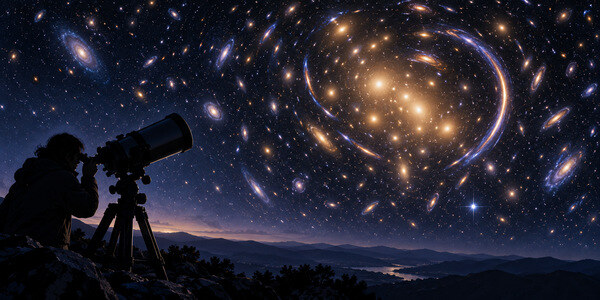
Astronomers usually distinguish strong lensing, weak lensing, and gravitational microlensing according to the observed effect and the method used. Strong lensing creates clearly distinguishable arcs, rings, and multiple images. Weak lensing produces small statistical distortions in the images of many galaxies, often too subtle to identify individually. Microlensing is most commonly detected through temporary changes in the brightness of a distant source when an individual compact object passes near the line of sight.
These three regimes are not separate physical laws but different manifestations of the same principle. In every case, mass changes the geometry of light paths. The differences involve scale, alignment, the nature of the source, and whether separate images can be resolved. Together, these approaches allow us to investigate structures ranging from planetary systems to the largest formations in the universe.
Galaxy Clusters as Natural Giant Telescopes
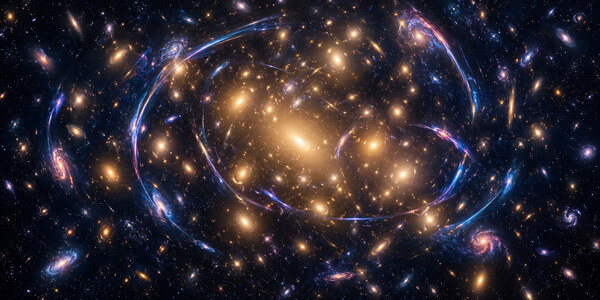
Galaxy clusters are among the most massive gravitationally bound structures in the cosmos. They contain hundreds or thousands of galaxies, hot intracluster gas, and large quantities of dark matter. Their combined gravitational field can strongly deflect light from galaxies even farther away. For this reason, some clusters become natural telescopes that magnify images of objects from the early universe.
Magnification is not an unconditional improvement in an image because the lens often stretches and distorts it. Nevertheless, it can increase the observed brightness of a distant source and reveal details that would otherwise be too faint. Astronomers construct mathematical models of the lens to reconstruct the likely appearance of the background galaxy. In this way, a massive cluster can complement the capabilities of humanity’s most powerful telescopes.
The Hubble and James Webb space telescopes use this natural effect when observing distant galaxies. Gravitational magnification can help researchers investigate young stellar systems and star formation during early cosmic epochs. Accurate interpretation, however, requires careful modeling because uncertainties in the lens mass affect the reconstructed brightness and size of the source. Every spectacular magnification is therefore both an opportunity and a scientific challenge.
How Gravitational Lenses Reveal Dark Matter
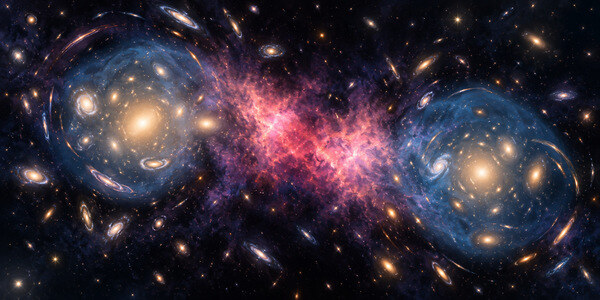
One of the most important features of gravitational lensing is that it responds to the total gravitating mass, not merely to visible stars. This makes it possible to measure the distribution of matter that does not emit enough light to be observed directly. When astronomers compare the gravitational mass of galaxies and clusters with their visible contents, they often find a substantial discrepancy. These observations are among the important lines of evidence for the existence of dark matter.
In weak lensing, the shapes of thousands or millions of distant galaxies are analyzed statistically. Their individual orientations vary, but the gravitational field along the line of sight introduces small, correlated distortions. From these distortions, scientists reconstruct maps of the projected mass distribution. The resulting maps can reveal structures that do not fully coincide with the distribution of visible light.
An especially famous example is the Bullet Cluster, a system of colliding galaxy clusters. Observations of its hot gas and gravitational lensing show that much of the mass is distributed differently from the main concentration of colliding gas. This provides strong evidence for models in which a significant fraction of matter interacts only weakly with ordinary matter apart from gravity. It does not directly reveal which particles constitute dark matter, but it places important constraints on its properties.
The Cosmic Web and the Universe’s Invisible Framework
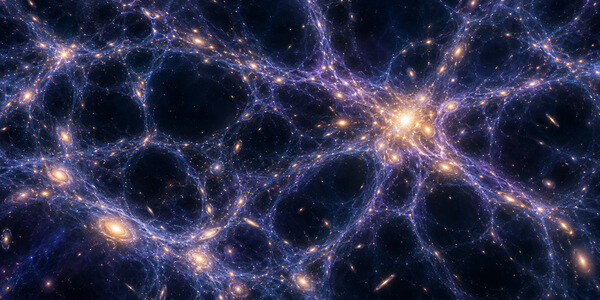
Galaxies are not scattered completely at random through space. On enormous scales, they form filaments, walls, nodes, and low-density regions that together make up the cosmic web. According to modern cosmological models, dark matter plays a crucial role in building these structures. Gravitational lensing allows us to trace the distribution of mass throughout this web, including regions where visible galaxies are relatively sparse.
Large astronomical surveys measure the shapes and distances of enormous populations of galaxies. Comparing the weak distortions in their images provides information about how cosmic structures have grown over time. These data can be compared with predictions from models incorporating dark matter, dark energy, and general relativity. Gravitational lensing thus becomes a tool for testing our overall picture of cosmic evolution.
Microlensing: When One Star Reveals the Presence of Another
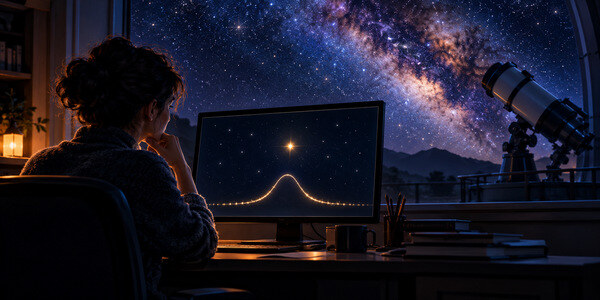
Not every gravitational lens creates beautiful arcs that can be photographed with a telescope. When the lens is a star or another relatively compact object, the separate images are often too close together to be distinguished. Instead, astronomers observe the total brightness of the background star temporarily increase. This effect is called gravitational microlensing.
If the intervening star moves relative to the line connecting us with the distant source, the magnification changes over time. The result is a characteristic light curve that can be described by a mathematical model. Under idealized conditions, the brightening is smooth and approximately symmetrical around the moment of closest alignment. Deviations from this pattern can reveal additional bodies or a more complicated structure in the system.
How Exoplanets Are Discovered Through Gravitational Lensing
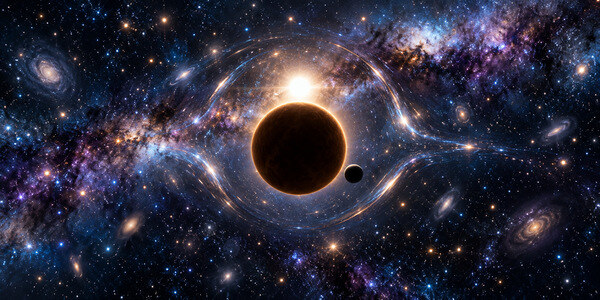
Gravitational microlensing is a valuable method for discovering planets around distant stars. When a star acts as a lens, a planet orbiting it can cause a brief additional change in the light curve. This signal depends on the geometry of the system and the ratio between the planet’s mass and the star’s mass. Through modeling, astronomers can establish the presence of a planet even when they cannot directly see it or resolve the separate lensed images.
The method is particularly useful for planets located relatively far from their host stars, as well as some objects that do not orbit a star. It complements the transit method, which measures periodic decreases in stellar brightness, and the radial-velocity method. Its main limitation is that a typical event occurs only once and is difficult to repeat with the same alignment. Even so, microlensing greatly expands the diversity of planetary systems that we can investigate.
Light Arrives Along Different Paths and at Different Times
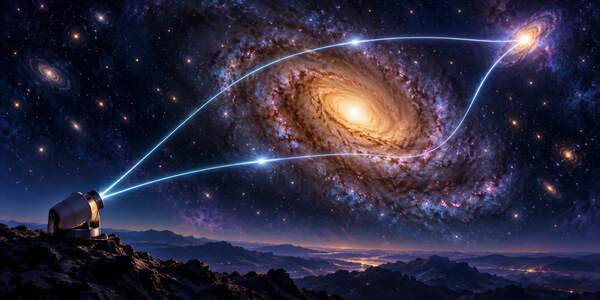
When a strong gravitational lens creates several images of a variable source, the light in those images does not necessarily arrive simultaneously. Different rays travel along different geometric paths and pass through different gravitational potentials. Therefore, the same change in a quasar’s brightness may appear first in one image and later in another. The difference in arrival times is called a gravitational-lens time delay.
These delays contain information about the geometry of the system and cosmological distances. If the mass distribution in the lens is sufficiently well understood, a measured delay can be used to estimate parameters of cosmic expansion. One of these is the Hubble constant, which describes the expansion rate of the universe in the present epoch. The method is substantially independent of some traditional measurements, but it remains sensitive to uncertainties in the lens model.
When a Gravitational Lens Shows the Same Supernova More Than Once
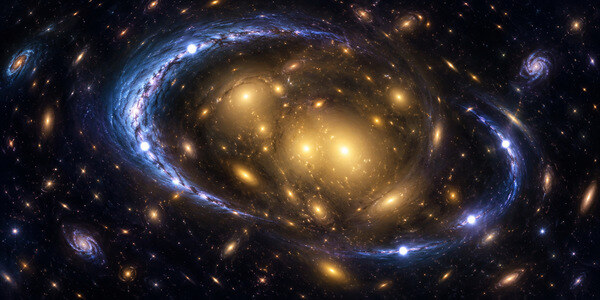
Gravitational lenses can create especially unusual observations when the distant source is an exploding star. If light from a supernova reaches us along several paths, the different images may show the event with different delays. This means astronomers can see the same cosmic explosion at more than one observational moment. In rare cases, a lens model can even predict when the next image should appear.
A well-known example is Supernova Refsdal, observed through the gravitational field of a massive galaxy cluster. Its images appeared in different places and at different times because of the lens’s complex geometry. Scientists used the system to test models of the mass distribution within the cluster. Such observations turn gravitational lenses into tools not only for magnifying distant objects but also for investigating the timing of light signals.
Can a Gravitational Lens Distort Our Picture of Reality?
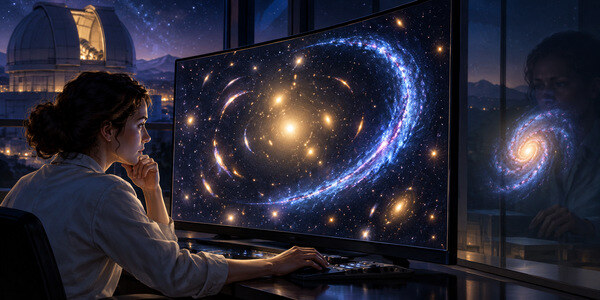
When we observe a strongly lensed galaxy, its visible image does not directly correspond to its true shape. It may appear larger, brighter, stretched, or divided into several parts. Without a correct model, the different images might even be mistaken for independent objects. Gravitational lensing is therefore both an astronomer’s ally and a source of difficult interpretive challenges.
Reconstructing the actual source requires calculating light paths through the assumed mass distribution of the lens. Some different mass distributions can produce similar observed images, creating mathematical degeneracies. To reduce them, scientists combine data from multiple background sources, stellar motions, and other measurements. In this way, a beautiful photograph becomes a quantitative reconstruction of an invisible cosmic structure.
The James Webb Space Telescope and the Most Distant Lensed Galaxies
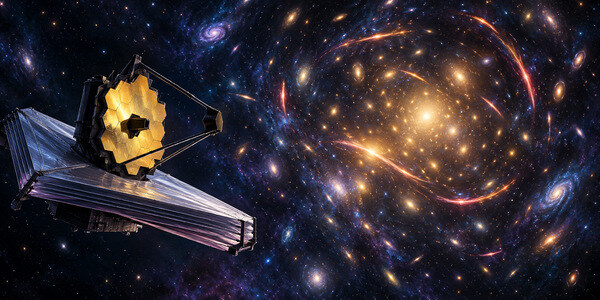
The James Webb Space Telescope observes the universe primarily in infrared light, where radiation from many distant galaxies reaches us after undergoing cosmological redshift. When these galaxies lie behind massive clusters, gravitational lensing can amplify their signals. Combining the telescope’s sensitive instruments with a natural lens provides access to exceptionally early stages of galactic evolution. In some cases, this allows scientists to investigate star formation and chemical composition in objects that would otherwise be inaccessible.
Magnification, however, does not create information from nothing or eliminate the limitations of measurement. The brightness, size, and structure of a background galaxy must be corrected according to the lens model. Different parts of the source may be magnified by different amounts, further complicating the analysis. The strongest scientific conclusions therefore come from combining high-quality observations with careful gravitational modeling.
Gravitational Lensing and Future Maps of the Cosmos
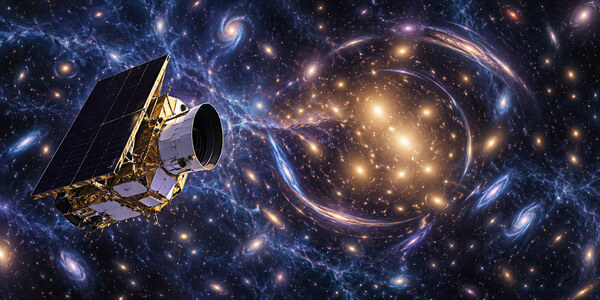
Modern cosmology needs increasingly precise measurements of matter distribution and the development of cosmic structures. Large sky surveys can record the shapes of enormous numbers of galaxies and search for faint lensing signatures. The European Euclid mission was designed with the important goal of studying cosmic geometry and structure through such observations. Ground-based surveys and future space programs will provide complementary data addressing the same fundamental questions.
One goal is to better understand how dark matter gathers under the influence of gravity. Another is to investigate how cosmic expansion affects the growth of structures over billions of years. Comparing these results with measurements from other astronomical methods may reveal discrepancies or reinforce existing models. In this sense, gravitational lenses do not merely magnify distant objects; they help test the history of the universe itself.
What Cosmic Lenses Teach Us About the Nature of Observation
Gravitational lensing reminds us that observation is never completely separate from the environment through which information reaches us. Light can carry faithful evidence of a distant source while simultaneously being transformed by the space along its journey. The image we see is the result of both the object itself and the entire geometry between that object and the observer. To understand a distant galaxy, we sometimes need to understand the invisible mass in front of it first.
This idea also has broader philosophical significance without departing from the boundaries of scientific knowledge. Nature does not necessarily provide us with a direct and unchanging image of reality, but with measurable signals that require interpretation. Science advances when it discovers the laws governing these transformations and turns an obstacle into a source of information. A gravitational lens is a remarkable example of how distortion can become an instrument of deeper understanding.
The Universe as Its Own Telescope
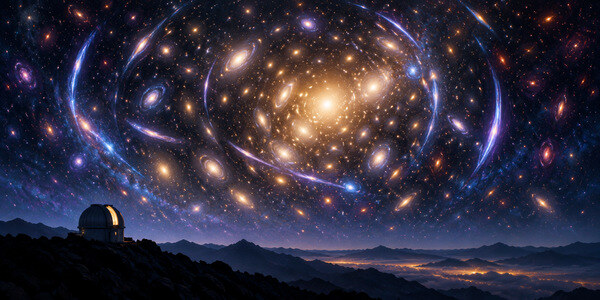
Humanity builds ever larger mirrors, more sensitive cameras, and more precise space instruments to reach farther across space and time. Yet nature has long created structures whose gravitational fields can act as enormous lenses. Galaxies and galaxy clusters direct light along complex paths and sometimes reveal objects we would otherwise miss. Their images are not always easy to interpret, but they contain information about visible and invisible matter across immense cosmic distances.
Gravitational lenses bring together Einstein’s ideas, the mystery of dark matter, the search for distant planets, and the investigation of the earliest galaxies. They show that gravity not only governs the motion of celestial bodies but also shapes the way the universe appears before our eyes. Every arc, ring, or brief amplification of starlight is a trace of this invisible geometry. And when we learn to interpret it, the curvature of spacetime itself becomes a window onto the cosmos.
Author: Vasil Stoyanov