
Modern physics possesses two extraordinarily successful pictures of nature, each describing a different aspect of the same universe. General relativity explains gravity, planetary motion, the structure of black holes, and the expansion of the cosmos. Quantum theory describes the behavior of atoms, elementary particles, and the interactions that make up matter. Both have been tested repeatedly, yet when we try to apply them simultaneously under the most extreme conditions, we encounter profound theoretical difficulties.
This problem does not mean that one theory is wrong or that scientists simply have not found the right mathematical formula. The two theories use different conceptions of space, time, and the way physical quantities are defined. Under ordinary conditions, these differences cause little trouble because gravity can be treated classically while quantum processes are studied against an approximately fixed background. Near the presumed singularity of a black hole or during the earliest stages of cosmic history, however, that separation is probably no longer adequate.
The search for a quantum theory of gravity is an attempt to understand what happens when the geometry of spacetime itself must obey quantum laws. It brings together questions about the origin of the universe, the nature of black holes, information, and the limits of measurement. Different research programs offer promising ideas, but none has yet received decisive experimental confirmation as a final theory. That is why quantum gravity remains one of the deepest open challenges in modern science.
The Two Theories That Transformed Our Understanding of the World
At the beginning of the twentieth century, physics underwent two revolutions that changed our understanding of reality. One began with the quantum ideas of Max Planck, Albert Einstein, and other researchers, gradually leading to quantum mechanics. The other reached its mature form in 1915 with Einstein’s general theory of relativity. Both overcame the limitations of classical physics, but they did so in very different ways.
General relativity describes gravity through the geometry of four-dimensional spacetime. Mass, energy, and pressure influence that geometry, which in turn determines the possible motion of matter and light. The theory predicts gravitational waves, the bending of light, and changes in the rate at which clocks run under different gravitational conditions. These effects have been confirmed by numerous observations and measurements.
Quantum mechanics, and later quantum field theory, describe matter through states, probability amplitudes, and operators. They explain why atoms are stable, how electrons and photons interact, and how processes unfold in the microscopic world. The Standard Model of particle physics is built upon quantum fields and describes the electromagnetic, weak, and strong interactions. Gravity, however, is not included in it as a complete quantum theory tested in the same way.
Spacetime: A Stage or a Participant?
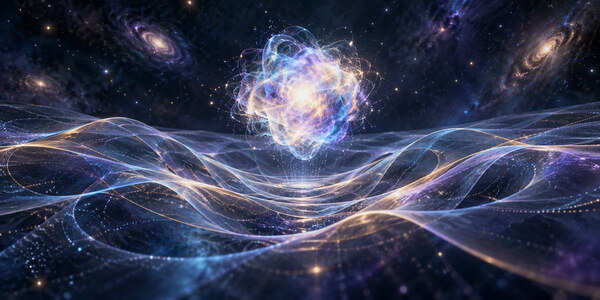
One of the most important differences between the two theoretical frameworks concerns the role of spacetime. In conventional formulations of quantum field theory, particles and fields are described on a predetermined spacetime. That spacetime may be flat or curved, but its geometry is often treated as an external background for quantum processes. In general relativity, the geometry itself is dynamic and changes in response to matter and energy.
This difference becomes a difficulty when the gravitational field can no longer be regarded as approximately classical. If matter exists in a quantum superposition of different distributions, the question arises of which geometry should correspond to it. If geometry is also quantum, then concepts such as distance, duration, and causal structure may require a new description. The challenge is therefore not merely to add another particle to the familiar list, but to understand what it means for the physical stage itself to possess quantum properties.
This does not mean that quantum theory cannot operate in curved spacetime at all. There is a well-developed quantum field theory on a classical curved background, which leads to important results concerning black holes and the early universe. It does not, however, fully describe quantum fluctuations of geometry itself and their backreaction in every regime. That is where the need for a more fundamental framework arises.
Why the Usual Quantization of Gravity Proves Difficult
For the other interactions, physicists have achieved major successes by turning classical fields into quantum fields. This naturally suggests applying the same procedure to the gravitational field. For weak deviations from flat spacetime, quantum excitations known as gravitons can be described. In this approximate sense, a quantum description of gravitational disturbances is possible and mathematically meaningful.
The problems become serious when we attempt to construct a theory that remains predictive at arbitrarily high energies using conventional perturbative methods. Ultraviolet divergences arise in the calculations, requiring an ever-growing number of independent parameters to absorb them. This means that standard perturbative quantization of general relativity is not renormalizable in the manner characteristic of successful quantum theories in the Standard Model. It does not prove that quantum gravity is impossible, only that this particular approach does not, by itself, provide a complete description at every energy.
At sufficiently low energies, gravity can nevertheless be treated as an effective quantum field theory. Within this framework, small quantum corrections are calculated and organized according to their significance, without claiming that the description remains valid at arbitrarily high energies. This is an important success because it demonstrates that general relativity and quantum principles can be combined in a controlled way within a particular domain. The open question is which more fundamental theory underlies this approximation.
The Planck Scale: Where Familiar Descriptions Reach Their Limits

Physicists use the fundamental constants of nature to define characteristic scales at which quantum and gravitational effects may become important simultaneously. Combining the speed of light, the gravitational constant, and the reduced Planck constant gives the Planck length. It is approximately 1.6 times ten to the minus thirty-fifth meters. This is incomparably smaller than atoms and than the scales we can directly investigate with today’s particle accelerators.
The corresponding Planck time is about 5.4 times ten to the minus forty-fourth seconds. The Planck energy is approximately 1.22 times ten to the nineteenth gigaelectronvolts, far beyond the energies of existing laboratory accelerators. These quantities do not prove that space must be composed of discrete units of precisely these dimensions. They indicate a natural scale at which the usual separation between quantum matter and classical gravity is expected to become inadequate.
The Planck length is often presented as the smallest possible length in the universe. That claim, however, is not an established experimental fact and does not automatically follow from known physical laws. Some candidates for quantum gravity propose minimum measurable scales, while others formulate the question differently. The Planck scale is therefore primarily a guide for fundamental physics, not a definitively measured boundary of space.
Black Holes: Where the Theories Meet
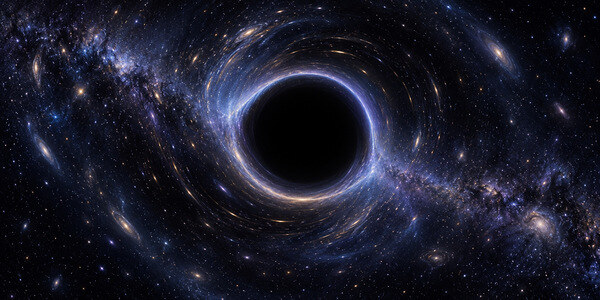
Black holes are especially important for quantum gravity because they combine strongly curved spacetime with questions about the behavior of quantum matter. According to classical general relativity, sufficiently compact mass can form an event horizon. Beyond that horizon, light signals cannot reach a distant observer in the usual way. Under certain conditions, classical solutions also predict singularities at which the mathematical description being used ceases to be reliable.
In the 1970s, Stephen Hawking showed that quantum fields around a black hole lead to the prediction of thermal radiation. This radiation, known as Hawking radiation, means that a black hole can gradually lose energy and mass. For astrophysical black holes, the expected temperature is extraordinarily low, making direct detection of such radiation an enormous challenge. The theoretical prediction itself, however, connects gravity, quantum theory, and thermodynamics in an unexpected way.
The work of Jacob Bekenstein and Hawking led to the understanding that black holes can be assigned an entropy proportional to the area of their horizons. This is unusual because in many familiar systems the number of possible microscopic states is associated with volume. The area law suggests that information and gravity may have a deeper connection. It became one of the starting points for ideas such as the holographic principle.
The Information Paradox: Can Information Disappear?
Quantum theory describes the evolution of an isolated system through rules that preserve information in a particular mathematical sense. Yet when a black hole forms from quantum matter and subsequently evaporates through approximately thermal radiation, a serious tension arises between familiar descriptions. If the final radiation does not contain sufficient information about the initial state, quantum evolution appears not to have preserved all its properties. This is the heart of the black hole information paradox.
The paradox does not mean that scientists have already observed information disappearing inside a real black hole. It arises from combining theoretical assumptions that appear convincing individually. In recent decades, new mathematical results have emerged, including calculations involving islands and the Page curve, which support the possibility that information is preserved. Despite this progress, a complete physical account of the process and its interpretation remain subjects of active research.
This problem matters because it raises questions about the compatibility of fundamental principles themselves. If information is preserved, we must explain how that happens in the presence of a horizon and a strong gravitational field. If one of the usual assumptions must change, we need to establish which one and why. Black holes thus become conceptual and mathematical laboratories for a future theory of quantum gravity.
The Graviton: Does Gravity Have a Quantum Particle?
In quantum field theory, interactions are often described through quantized fields and their excitations. The photon is the quantum of the electromagnetic field, while gluons participate in the description of the strong interaction. By analogy, the hypothetical quantum excitation of the gravitational field is called the graviton. In the standard weak-field description, it is expected to be a massless spin-two particle.
The graviton has not been observed directly as an individual particle. Gravitational waves recorded by LIGO and other observatories confirm the existence of propagating gravitational disturbances, but they do not by themselves prove their quantum nature. Much like a classical electromagnetic wave, a gravitational signal can be described without measuring individual quanta. Direct experimental confirmation of the quantum properties of gravity therefore remains a separate and exceptionally difficult task.
String Theory: What If Fundamental Objects Are Not Points?
One of the most extensively studied programs for unifying gravity with quantum physics is string theory. In this approach, fundamental excitations are described by one-dimensional objects rather than treating every particle as an ideal point. Different vibrational modes of strings can appear as different particles. In suitable formulations, these excitations naturally include a state with the properties expected of a graviton.
This is an important feature because gravity is not simply added to the theory as an external correction. Nevertheless, the mathematical consistency of many string models requires additional spatial dimensions and complex mechanisms for describing them. The theory includes a wide variety of possible solutions, making it difficult to derive unique predictions for the observed world. At present, there is no generally accepted experimental proof that the fundamental constituents of nature are strings.
Among the significant achievements of this research program are results concerning the microscopic entropy of certain idealized black holes and the development of holographic dualities. These results show that some gravitational systems can be connected to quantum theories without gravity in fewer dimensions. Such mathematical relationships are valuable regardless of whether a particular string model describes our universe. They offer a new way to think about space, information, and quantum interactions.
Loop Quantum Gravity: Can Geometry Have a Quantum Structure?
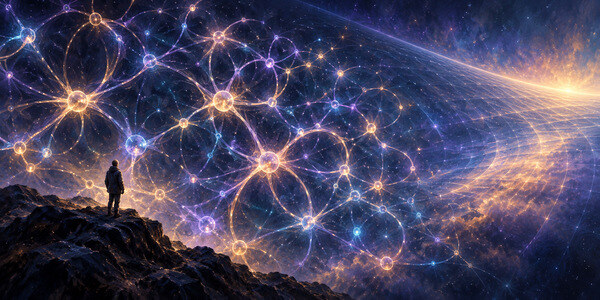
Another important approach is loop quantum gravity, which begins with the ambition to quantize the geometry of general relativity itself. Rather than introducing a fixed spacetime in advance, this program uses mathematical variables associated with the gravitational field. In some formulations, quantum states of geometry are described through spin networks. These networks should not be imagined as an ordinary grid placed inside preexisting space, but as a way of representing geometric relationships.
Within this approach, certain geometric operators associated with area and volume have discrete spectra under the usual mathematical assumptions. This suggests that some measurable geometric quantities may have a quantum structure. However, we should not automatically conclude that all of space consists of tiny rigid cubes or that discreteness has already been experimentally demonstrated. Major challenges include obtaining complete dynamics, recovering familiar smooth geometry, and producing testable predictions.
The related field of loop quantum cosmology investigates simplified models of the early universe. In some of them, the classical singularity is replaced by a quantum transition or bounce. This is an intriguing possibility because it suggests that the beginning of familiar cosmic expansion might have a more complicated prehistory. Nevertheless, the results depend on the approximations used and do not constitute proof that our universe actually underwent such a bounce.
Other Paths Toward Quantum Gravity
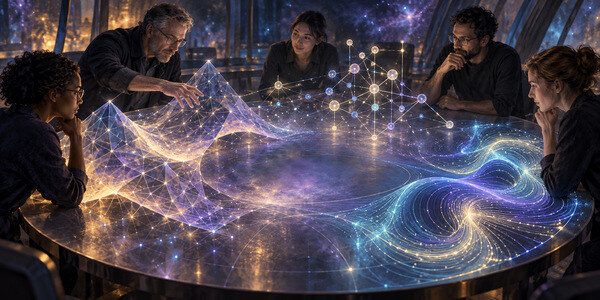
String theory and loop quantum gravity do not exhaust the scientific attempts to solve the problem. The asymptotic safety program investigates whether gravity can exhibit suitable behavior at very high energies through a nontrivial structure of the renormalization flow. Approaches such as causal dynamical triangulations use sums over discretized geometries to study the emergence of smooth spacetime. Other ideas investigate causal sets, group field theories, and various forms of emergent geometry.
Each program places a different emphasis on what should be fundamental. Some begin with quantum fields, others with geometric relationships, and still others with causality or information. Their differences are not merely matters of preferred mathematical language because they may lead to different physical predictions. So far, no experimental result has unambiguously selected one of these frameworks as the final theory of nature.
The Holographic Principle: Can a Volume Be Described by Its Boundary?
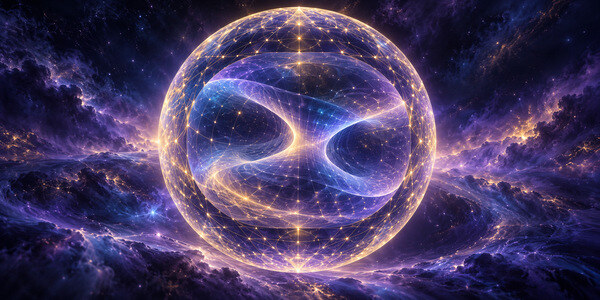
The entropy of black holes points physicists toward an unusual relationship between information and area. Inspired by this connection, researchers such as Gerard ’t Hooft and Leonard Susskind developed ideas known as the holographic principle. Broadly speaking, it suggests that a description of a certain region containing gravity may be related to a theory defined on its boundary. This does not mean that the world is literally an optical hologram or that we observe an illusion rather than physical reality.
An especially influential example is the AdS/CFT correspondence proposed by Juan Maldacena. It connects certain gravitational theories in a space with anti-de Sitter geometry to quantum field theories on its boundary. Within this framework, difficult questions about gravity can be reformulated as questions about a quantum theory without gravity. The correspondence is a powerful theoretical tool, but applying it directly to the actual cosmological geometry of our universe remains a nontrivial problem.
Could Spacetime Emerge from Quantum Information?
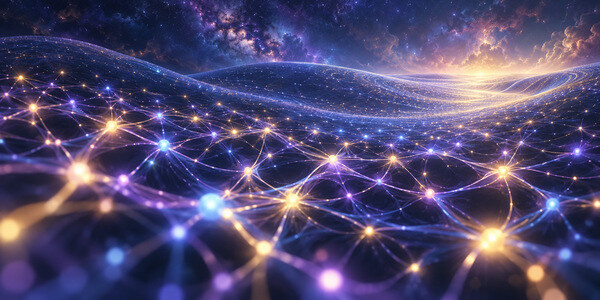
In recent decades, the idea has developed that geometry may be connected to quantum entanglement and the structure of information. Quantum entanglement describes correlations between parts of a system that cannot be represented by an ordinary independent description of each part. In certain holographic models, geometric quantities are related to measures of entanglement. This raises the possibility that some spatial relationships may emerge as a collective description of more fundamental quantum degrees of freedom.
Such ideas are scientifically interesting because they reverse the direction of the usual question. Instead of asking only how quantum particles exist in spacetime, we can ask whether spacetime itself arises from relationships among quantum states. The mathematical results in certain models are impressive, but their broader significance for our universe is still being investigated. There is no experimentally confirmed theory proving that all of spacetime is derived from quantum entanglement.
The Problem of Time: What Does Change Mean Without an External Clock?
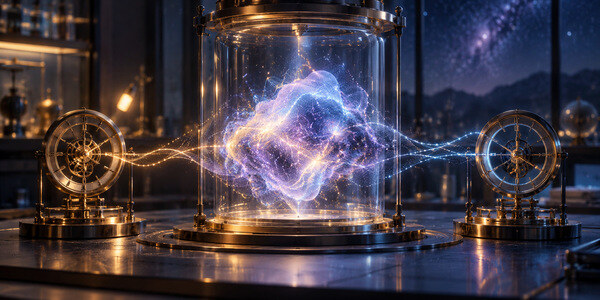
In ordinary quantum mechanics, time often appears as an external parameter relative to which the quantum state changes. In general relativity, time coordinates are part of the dynamic geometry, and different observers can measure different durations. When attempting a canonical quantization of gravity, this difference leads to the so-called problem of time. Some formulations appear as though the fundamental quantum description lacks the usual external time evolution.
This does not prove that time is an illusion or that nothing actually changes in the universe. It shows that the concepts of clock, observer, and change must be formulated carefully when geometry is also quantum. One possibility is to describe time through relationships among physical quantities rather than through a single universal external parameter. Another is that familiar time emerges as an approximation in certain states of a more fundamental theory.
Why Experimental Verification Is So Difficult
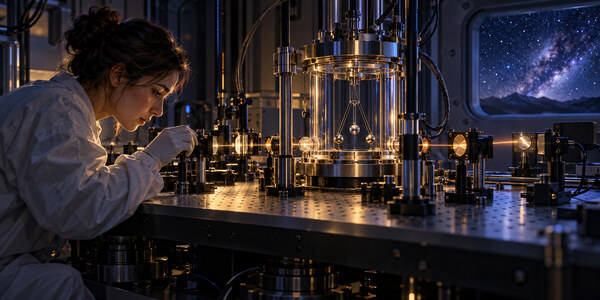
The main obstacle facing quantum gravity is not a shortage of mathematical ideas, but the difficulty of testing them. Characteristic Planck energies are beyond the reach of existing accelerators, while the gravitational interaction between individual microscopic objects is extraordinarily weak. Many predicted effects are too small to be distinguished from technical noise and other physical influences. Experimental strategies therefore often search for indirect signatures that accumulate over great distances or appear in specially prepared quantum systems.
Gravitational-wave observations allow gravity to be tested in strong fields and during rapid dynamical processes. Studies of the early universe search for traces of physics that operated at much higher energies than those accessible in laboratories. Precision quantum experiments offer possibilities for investigating gravitational interactions between small masses and testing potentially quantum characteristics of those interactions. None of these approaches has yet provided generally accepted direct evidence for a particular complete theory of quantum gravity.
Can Gravity Create Quantum Entanglement?
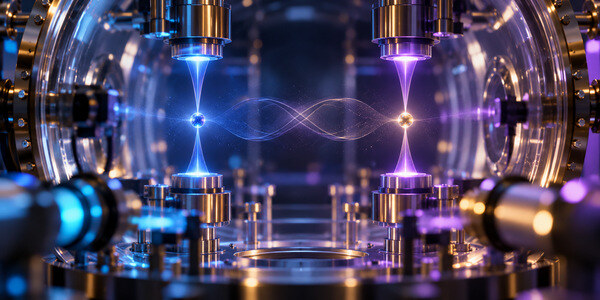
One proposed experimental strategy investigates whether two small quantum systems can become entangled through an interaction dominated by gravity. If such entanglement were established under strictly controlled conditions, the result would place important constraints on permissible descriptions of the gravitational mediator. The idea is especially attractive because it does not require reaching Planck energies. Instead, it uses the sensitivity of quantum states to extremely weak interactions.
Its implementation is exceptionally complex because electromagnetic forces, vibrations, and interactions with the environment can conceal the desired effect. Alternative mechanisms that could also produce correlations between the systems must be excluded. Even a positive result would require careful interpretation in relation to the specific theoretical assumptions. Nevertheless, proposals of this kind show that quantum gravity is gradually becoming a subject of laboratory experimental physics as well.
What Happened at the Very Beginning of the Universe?
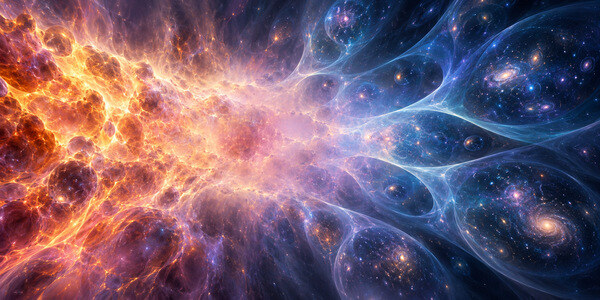
Cosmological models describe how the observable universe expanded and cooled from a very early hot and dense state. If we apply the classical equations of general relativity sufficiently far backward in time under certain assumptions, we reach limits of the description associated with singularities. This does not necessarily mean that science has already proved the existence of a physical point with infinite density. Rather, it indicates that the classical approximation being used is probably inadequate in the earliest regimes.
Quantum gravity could change our picture of these conditions in several different ways. Some models allow a cosmic bounce, others investigate the quantum emergence of geometry, and still others seek descriptions without a classical beginning of time. These ideas are not equivalent to established facts about the actual history of the cosmos. To become testable science, they must lead to specific observable consequences that can be compared with data.
Do the Two Theories Really Need to Be Unified?

Sometimes the question is framed as though nature must certainly obey one beautiful mathematical formula. The history of physics, however, shows that different effective descriptions can simultaneously be valid within their respective domains. Thermodynamics, for example, remains useful even though it has a microscopic statistical foundation. Similarly, general relativity may remain an extraordinarily accurate classical theory even if geometry is described differently at a deeper level.
The need for a more general framework arises not merely from a desire for mathematical unity, but from specific physical questions. Black holes, quantum states of gravitating matter, and early cosmology require a description in which the two sets of principles meet. A future theory may contain the familiar theories as approximations, just as they themselves contain older laws in appropriate limits. But it is also possible that the fundamental concepts with which we formulate the problem today will undergo profound change.
What We Actually Know and What We Still Do Not Know

We know that general relativity describes gravitational phenomena with extraordinary accuracy across a wide range of observed conditions. We also know that quantum theory is essential for understanding atoms, particles, and microscopic interactions. We can combine quantum fields with classical gravitational geometry and calculate controlled quantum corrections at low energies. But we still do not possess an experimentally confirmed, generally accepted fundamental theory of the quantum behavior of spacetime itself.
We do not know whether geometry is fundamental or emerges from deeper quantum relationships. We do not know whether singularities in classical solutions are replaced by a new physical structure. Nor do we know which of the existing research programs, if any, will prove closest to a final description. This uncertainty is not a weakness of science, but a clear distinction between established knowledge and possibilities under active investigation.
The Philosophical Question Behind the Mathematical Conflict
Quantum gravity challenges assumptions that seem so natural we rarely notice them. We take for granted that events happen somewhere, that time passes, and that distances have a definite meaning. General relativity shows that these quantities depend on dynamic geometry, while quantum theory assigns a fundamental role to superposition and probability amplitudes. When the two perspectives meet, the question arises of which of our intuitive concepts are basic and which are merely approximations.
This is a philosophically significant question, but its answer cannot be obtained through reflection or metaphor alone. Physical theories must be mathematically consistent and compared with measurements. Future results may change how we understand space, time, and causality without making our everyday experience invalid. Just as quantum mechanics does not eliminate the practical usefulness of classical mechanics, a future quantum geometry may explain why the familiar world appears smooth and stable.
The Final Frontier of Our Understanding
Gravitational waves taught us to interpret the dynamic ripples of spacetime, while gravitational lenses showed how its curvature transforms light from distant galaxies. Both phenomena are remarkable confirmations of the idea that the geometry of the universe is physically active rather than a passive background. Quantum gravity takes us one step further and asks whether that geometry itself has a quantum nature. In this way, the three subjects form a natural journey from the observable manifestations of gravity to the deepest questions about its origins.
The solution may come from new astronomical observations, precise laboratory experiments, or a mathematical idea we do not yet know. It is also possible that concepts such as space and time will turn out to be emergent features of a more fundamental reality. For now, science does not have a final answer, and there is no justification for presenting any competing hypothesis as proven truth. Yet the ability to identify the limits of knowledge and seek ways to test them is precisely what makes quantum gravity one of the most exciting journeys of the human mind.
Author: Vasil Stoyanov