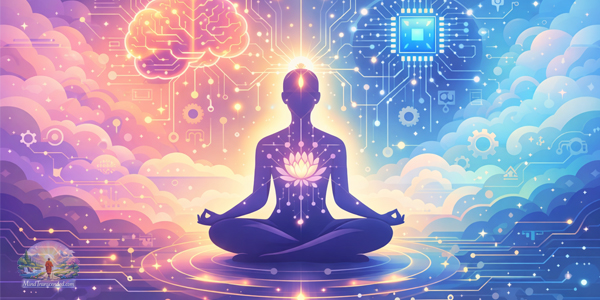
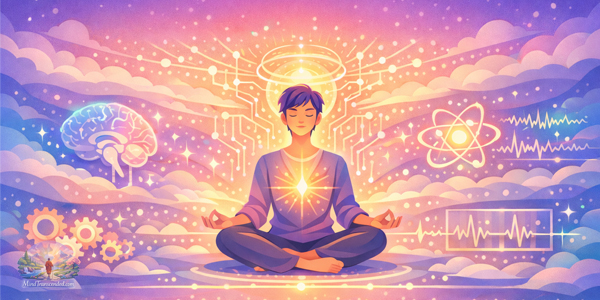
The Truth About Meditation: Scientific Facts, Benefits, and How to Begin
In a world that never stops talking, signaling, demanding, and distracting us, silence has become a rarity. Not just external silence, but that inner silence in which thoughts arrange themselves, emotions calm down, and a person meets themselves. It is there – in this almost forgotten inner territory – that meditation begins.
But if decades ago it was perceived as something mystical, exotic, or even incomprehensible to the Western mind, today science is beginning to tell its own story about it. A story that does not cancel spirituality, but rather illuminates it in a new way.
When Science Meets Silence
Imagine placing a person in an MRI scanner. They do nothing – they simply sit, breathe, and observe. And yet, something extraordinary is happening in their brain.
Studies show that with regular meditation, the brain literally changes. Not metaphorically, but physically. Gray matter in areas associated with memory and learning increases. The amygdala – the center of fear – begins to “quiet down.”
This means something profound: through conscious presence, a person can rewrite their own neurobiology.
And here the question arises – did ancient practices know this, without having technology?
Meditation as Inner Technology
The most world-famous yogi of the 21st century – Sadhguru – often says that meditation is not a practice, but a state. That it is not something we “do,” but something that happens when the inner conditions are right.
In his world, meditation is like tuning a complex instrument. If the body, mind, and energy are in harmony, silence does not need to be sought – it simply appears.
At first glance, this sounds poetic. But if we look at it through a scientific lens, we see something surprising: self-regulation. Balance of the nervous system. Synchronization of brain processes.
In other words – inner technology, as he calls it.
No Method, No Path – Only Observation
While some teachers offer techniques, another world-famous figure in the same field from the recent past – Jiddu Krishnamurti – went in a completely different direction.
He rejected all systems.
According to him, meditation begins when we stop trying to meditate.
When we simply observe – thoughts, reactions, fears – without changing them, without judging them. In this impartiality, something new is born: clarity.
Interestingly, modern psychology, especially mindfulness practices, reaches the same conclusion. That observation without interference reduces the reactivity of the mind and creates space between stimulus and response.
And then comes Osho, a contemporary of Krishnamurti – perhaps the most provocative of all.
He sees modern human beings as an accumulation of tension. Suppressed emotions, unexpressed impulses, constant inner noise.
That is why his meditation does not begin with silence.
It begins with chaos.
Breathing, movement, shouting, release – and only then silence.
Scientifically, this makes sense. The body stores stress. The nervous system cannot relax if tension is not released. Thus dynamic techniques act as a bridge – from chaos to calm.
Zen: The Beauty of Simple Sitting
In the Zen tradition, there is no need for complicated explanations. There are no philosophical constructions, no dogmas. There is simply sitting. Breathing. Presence.
This simplicity, however, is deceptive. Because sitting in silence and not following your thoughts is one of the most difficult things.
Neuroscience shows that during such practices, activity in the so-called default mode network decreases – the part of the brain responsible for mind-wandering and self-referential thinking.
In other words – the mind stops “telling stories” about itself.
And only the present remains.
Sufism: When Meditation Becomes Movement
If Zen is silence, then its opposite – Sufism – is movement.
The whirling dervishes, rhythmic repetitions, music – all of this looks like dance, but is actually a form of meditation.
Here the focus is not on the mind, but on the heart.
The repetition of sounds (dhikr), the rhythm, the spinning – all of this leads to an altered state of consciousness. And science has an explanation:
Rhythm synchronizes brain waves. Repetitive movements reduce cognitive noise. And emotional participation activates deep neural networks associated with a sense of meaning and belonging.
This is meditation that does not exclude the world – it embraces it.
The Great Discovery
If we bring together all these perspectives – scientific and spiritual – a simple but powerful truth begins to emerge:
Meditation is not escape. It is return. To the moment. To the body. To consciousness.
Science describes it with terms such as neural plasticity, stress regulation, cognitive flexibility. Spiritual traditions call it awakening, awareness, presence.
But the experience is one and the same.
Why Does This Matter Today?
In an age of constant stimuli, algorithms, and information overload, the ability to direct our attention becomes not just useful – it becomes critical.
Meditation is no longer a luxury. It is a necessity. It is a tool for:
mental health
clear thinking
emotional resilience
deep self-understanding
And perhaps most importantly – it reminds us that beyond everything we do, achieve, and pursue, there exists a space in which we simply are.
Why Is It Worth Trying?
Sadhguru would say that this is a path toward inner balance.