Nansen: Zen Koans, the Story of the Cat, and the Power of the Ordinary Mind
Nansen and Mazu Daoyi – Early Years
The Zen tradition preserves at its heart figures who do not merely teach truths, but embody them in actions, gestures, and paradoxes. One of the most enigmatic and deeply influential among them is Nansen – also known as Nansen Fugaku, or by his Chinese name Nanquan Puyuan. He is one of those teachers who did not leave behind a systematic philosophy, but rather a living presence that shakes the mind and opens consciousness. To speak of him means entering a world where logic falls apart, language proves insufficient, and truth is experienced rather than explained.
Nansen lived in the 9th century during the Tang dynasty – a period often called the “golden age” of Zen (Chan) Buddhism in China. This was a time of spiritual explosion, when many teachers developed different lineages of the teaching, and dialogues between master and student acquired an almost theatrical power. Nansen was a student of the great Mazu Daoyi, one of the most radical Zen masters, who initiated a new, more direct form of spiritual transmission. Under Mazu’s influence, Nansen developed his own unique style – at once gentle and ruthless, simple and devastatingly clear.
Born in China, Nansen entered a monastery while still young. Even in his early years he showed a deep interest in Buddhist philosophy, but also a restlessness toward purely intellectual explanations. His meeting with Mazu changed everything. There he did not merely study texts, but encountered the living transmission of Zen – through blows, shouts, paradoxes, and sudden flashes of realization. After years of training and his own enlightenment, Nansen became a teacher and created his own community.
The Case of Nansen and the Cat
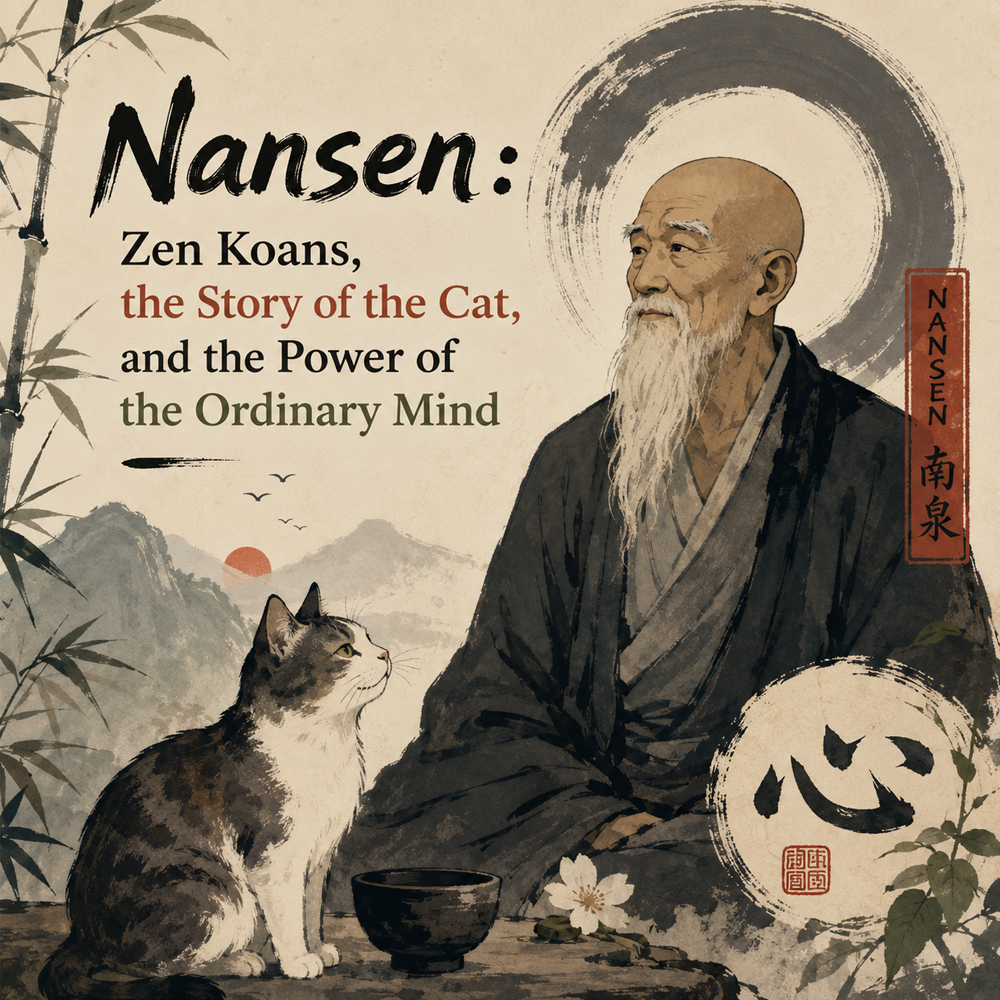
One of the most famous stories associated with him is the so-called “case of the cat.” This story is not merely an anecdote, but a koan – a riddle that cannot be solved through logic, but only through direct insight. Once, the monks from the eastern and western halls of the monastery were arguing over a cat. The dispute escalated and reached Nansen. He took the cat, lifted it up, and said: “If any of you can say a turning word, the cat will be saved. If not – I will kill it.” In the Zen tradition, a “turning word/expression” is a statement that possesses the power to turn the listener back toward their true nature. At that moment everyone began thinking about what to say, but no one managed to open their mouth, as a result of which Nansen killed the cat.
This story shocks the mind. How is it possible for an enlightened teacher to perform such an action? Precisely here the true understanding begins. This case should not be taken literally as an act of cruelty, but as an extreme demonstration that the mind which hesitates, thinks, and analyzes misses the moment of truth. The monks had a chance to respond from a place of pure awareness, beyond thought. But they failed. The cat becomes the victim of their hesitation.
Later, Nansen’s student Zhaozhou (known in Japan as Joshu) heard about the incident. When Nansen asked him what he would have done, Zhaozhou simply took off his sandal, placed it on his head, and walked out. Nansen said to him: “If you had been there, the cat would have been saved.” This gesture is absurd, illogical – and precisely for that reason it is true. It comes not from the mind, but from direct presence.
Zen Before and After Nansen
Zen is not a moral system. It does not teach what is right and what is wrong in the usual sense. Instead, it points toward a state of consciousness in which actions arise spontaneously, without the mediation of thought. In this context, Nansen is not cruel, but radical. He destroys illusions.
Another famous case involving Nansen is the question of the “ordinary mind.” A student asked him, “What is the Way?” Nansen replied, “Ordinary mind is the Way.” The student asked again, “Should I direct myself toward it?” and Nansen answered, “If you try to direct yourself toward it, you will move away from it.” This is the essence of Zen – the paradox that seeking obstructs finding. Truth is not something achieved, but something recognized.
This dialogue is like a key to understanding spirituality. It suggests that the human mind is like a dog chasing its tail – always in motion, always seeking, but never arriving. Nansen shows that the seeking itself is the problem. When the mind stops seeking, what is reveals itself.
Zen before Nansen had already been formed as a tradition, beginning with the legendary Bodhidharma – the Indian monk who brought Buddhism to China. This tradition emphasized direct experience outside the scriptures. Teachers such as Huineng, the Sixth Patriarch, had already laid the foundations of sudden enlightenment. But it was with Mazu and his students, including Nansen, that Zen reached a new radicalism. Here there is no longer room for gradual development – there is only breakthrough.
After Nansen, his students continued the lineage. Zhaozhou, for example, became one of the most famous Zen masters, known for his simple yet profound answers. Nansen’s line influenced many schools, including Rinzai and Soto in Japan. His influence was not in books or doctrines, but in the method of teaching – direct, sometimes shocking, always aimed at awakening.
The Heart of Nansen and Conclusion
One of the most memorable aspects of Nansen is his humor. Despite the seriousness of the teaching, he often used absurd or playful answers. This humor is not for entertainment, but for breaking thought patterns. When a student expects a serious answer and receives something illogical, the mind becomes confused – and precisely in that confusion, the possibility of insight appears.
The story of the cat, the dialogue about ordinary mind, and many other cases involving Nansen should not be analyzed, but experienced. When a person tries to understand them intellectually, they miss the essence.
In one of the cases, Nansen says: “Mind is not Buddha. Knowledge is not the Way.” This is a direct blow against all concepts. Even the idea of Buddha – the highest symbol in Buddhism – is denied. Why? Because every idea, even the most sacred one, can become an obstacle.
Nansen’s life is not described in detail like a classical biography. He remains in history through stories, dialogues, and brief anecdotes. But precisely there lies his power. He is not a figure from the past, but a living presence that continues to speak through these stories.
To understand Nansen means to accept that there is nothing to understand. This is the paradox that stands at the heart of Zen. And perhaps this is precisely why he continues to inspire – because he does not offer comfort, but truth. He does not offer a system, but freedom. He does not offer answers, but questions that dissolve the questioner himself.
In the world of modern people, filled with information, analysis, and constant searching, the figure of Nansen sounds almost like a challenge. He says: stop. Do not search. Do not think. Be. And in that “be” everything is contained.
Thus his life, his actions, and his words become not a story, but an invitation. An invitation to go beyond the mind. An invitation to see reality as it is. An invitation to die as a thinking being and be born as consciousness.
And perhaps Nansen’s greatest contribution to the Zen tradition is precisely this – to show that truth is not far away, not complicated, and not hidden. It is here. But in order to see it, everything we think we know must be abandoned.
Stories with Nansen
In his later years, Nansen lived more quietly. One day a monk asked him: – “Master, what do you do every day?” Nansen answered: – “I simply live.” The monk insisted: – “But everyone does that.” Nansen smiled: – “No. Most people think they are living.”
A student asked: – “What is the highest truth?” Nansen answered: – “Ordinary consciousness.” The student became angry: – “That does not sound like anything special!” Nansen smiled: – “That is exactly why it is true.”
A traveler met Nansen and asked him: – “Who are you?” Nansen answered: – “I am the one I am.” The traveler laughed: – “That is not an answer.” Nansen replied: – “Then who is asking?”
A student asked: – “How do I distinguish good from evil?” Nansen said: – “When you are not thinking – what is good and what is evil?” The student fell silent. Nansen continued: – “When you begin to think – you are already lost.”
A monk asked: – “Does a dog have Buddha-nature?” Nansen said: – “It does.” The monk asked: – “Then why is it not enlightened?” Nansen replied: – “Because you are asking it.”
This answer is almost joking, but also profound. The problem is not in the dog, but in the question itself. The mind creates problems that do not exist.