
Introduction
Among the great thinkers of the ancient world, there are figures who changed philosophy, there are those who changed religion, and there are rare individuals who changed the very way a person perceives life. Zhuangzi belongs to the last category. He is not simply a philosopher in the traditional sense of the word. He is not a dogmatist, not the creator of a closed system of rules, not a moralist seeking to impose one single correct way of life. On the contrary – he is a destroyer of illusions, a poet of freedom, a mystic of spontaneity, and one of the deepest explorers of human consciousness.
When a person reads the writings of Zhuangzi, they are not left with the feeling that they are studying an ancient philosopher from China more than two millennia ago. Rather, they feel as if they are speaking with someone extraordinarily alive, witty, and free, someone who sees through all the masks of society, through all claims to knowledge, through all human fears and ambitions. In his words there is at once humor and deep sadness, lightness and abyss, playfulness and insight.
Unlike many philosophers who strive to build orderly systems, Zhuangzi prefers paradox, story, metaphor, and the unexpected turn. He does not want to persuade the reader through logical force. He wants to shake them. To make them doubt what they take to be obvious. To open a crack in their thinking. To free them.
This is why his influence is felt not only in philosophy, but also in literature, art, political thought, spirituality, martial arts, psychology, and even modern ideas about authenticity and personal freedom. In China, Zhuangzi is considered one of the greatest figures of Daoism, alongside Laozi. But his influence goes beyond the boundaries of Daoism. His spirit can be found in Zen Buddhism, Eastern poetry, Chinese painting, the philosophy of spontaneity, and even modern critiques of society.
Zhuangzi is a thinker who refuses to be locked inside definitions. That is precisely why he remains so relevant. In a world obsessed with identities, positions, ideologies, and the constant need for control, his voice sounds almost shockingly fresh. He reminds us that a person can live in another way – without constant anxiety, without enslavement to ambition, without fear of change.
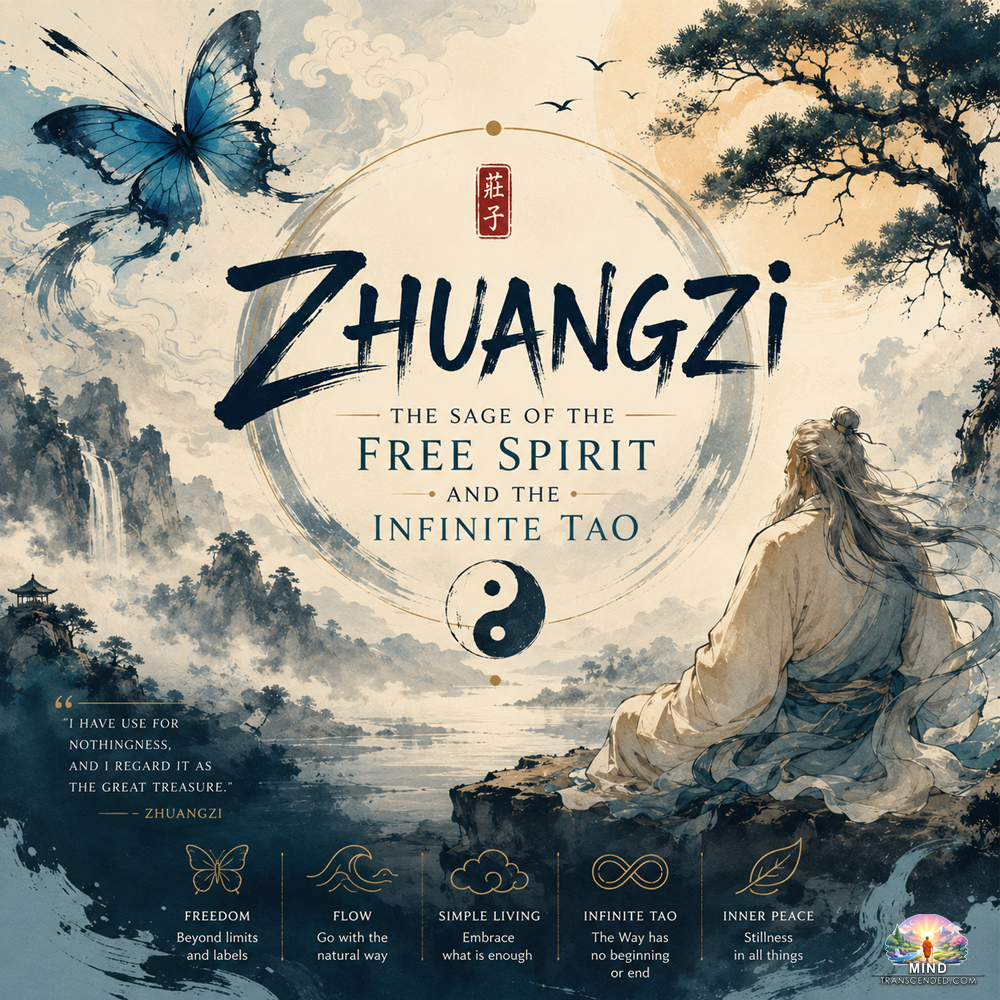
One of the most famous stories associated with him is the dream of the butterfly. Zhuangzi tells that once he dreamed he was a butterfly, flying freely and happily, with no awareness that he was a human being. When he woke up, he asked himself: “Am I Zhuangzi who dreamed he was a butterfly, or am I a butterfly now dreaming that it is Zhuangzi?” Hidden in these few sentences is an entire cosmos of philosophy. What is reality? What is personhood? How can we be certain of anything? And why do we cling so desperately to fixed ideas about ourselves?
This story has survived for more than two thousand years not because it offers an easy answer, but because it opens a door to mystery. Zhuangzi never seeks to remove mystery from life. On the contrary – he believes that true wisdom lies precisely in the ability to live within it without fear.
The Historical Context of Zhuangzi
To truly understand Zhuangzi, we must return to the period in which he lived. This was the era of the Warring States in ancient China – a time of political chaos, constant conflicts, intrigue, and struggles for power. Different states tried to dominate one another, while society was torn apart by violence, instability, and ambition.
Paradoxically, however, precisely such times often give birth to great philosophical ideas. When the old order collapses, people begin to ask fundamental questions. How should a person live? What is good governance? What is the meaning of life? How can one remain whole amid chaos?
Thus was born the period that would later be called the “Hundred Schools of Thought.” It is one of the richest intellectual periods in human history. Confucianism, Daoism, Legalism, Mohism, and many other currents competed with one another.
https://mindtranscended.com/confucianism-as-a-living-philosophy-the-profound-art-of-being-human/“>Confucius placed emphasis on morality, order, ritual, and social harmony. The Legalists insisted on strict laws and strong state power. The Mohists preached universal love and pragmatic ethics. And Zhuangzi seems to stand somewhat apart from all of them, observing human efforts with both compassion and irony.
He saw how people tried to repair the world through rules, moral systems, and political projects, while at the same time noticing how often these attempts created even more suffering. According to him, much of human pain comes from attempts to force reality to be something other than what it is.
Instead of preaching aggressive change of the world, Zhuangzi directs attention toward inner freedom. He believes that a person must learn to live in harmony with the Dao – the natural flow of existence.
The Dao is not a god in the usual sense. It is not a person. It is not a system of rules. It is the principle of the natural arising and movement of all things. The Dao is the river of being, flowing beyond human concepts.
While many philosophers try to define truth through precise formulations, Zhuangzi suspects that the very desire to fix truth already distances you from it. He writes: “The great Dao cannot be named. Great speech is beyond words.”
This does not mean that language is useless. But it means that words have limits. A person can speak about life, but cannot fully capture it in concepts.
It is in this historical context that Zhuangzi becomes a radical voice. While other philosophers argue about how to govern society, he asks whether the human obsession with control is not itself the problem.
The Life of Zhuangzi
Historical information about Zhuangzi’s life is limited. As often happens with ancient thinkers, legend and reality intertwine. It is believed that he lived around the 4th century BCE and that his real name was Zhuang Zhou.
He was probably born in the state of Song, in today’s Henan province. Unlike Confucius, around whom an almost official cult gradually formed, Zhuangzi remains a more elusive figure. This is somewhat symbolic, because his entire philosophy is directed against the pursuit of status, power, and official recognition.
According to tradition, he held a minor administrative position for a time, but showed no interest in a political career. There is a famous story according to which the ruler of the state of Chu offered him a high post in the government. Zhuangzi refused.
He gave a remarkable answer. He asked the envoys whether they had seen the sacred turtle in the ruler’s temple. They replied that the turtle was venerated, and its shell was preserved as a relic. Then Zhuangzi said: “If this turtle could choose, would it prefer to be dead and venerated, or alive and dragging its tail in the mud?” The envoys admitted that it would prefer to be alive. “Then go away,” Zhuangzi replied. “I too will drag my tail in the mud.”
This story beautifully reveals his spirit. For him, freedom is worth more than power. To remain alive in the deep sense of the word is more important than public greatness.
Zhuangzi sees how power often turns a person into a prisoner. The more status a person has, the more they begin to live according to the expectations of others. In this way, they gradually lose their spontaneity.
For Zhuangzi, the true sage does not seek to dominate. He does not try to be great. He does not struggle to be recognized. Precisely because of this, he can remain free.
Here appears one of the most important themes in his philosophy – the idea of naturalness. In Chinese, it is often associated with the concept of “ziran,” which literally means “so of itself,” “such as it is by itself.” This is a state of authenticity.
According to Zhuangzi, a person suffers because they are constantly pretending. They try to be something else. They compare themselves. They compete. They burden their life with artificial goals.
The sage, however, lives naturally. He does not force himself. He does not try to be different from what he is in his depth.
The Book “Zhuangzi”
The main source of his ideas is the text known as “Zhuangzi.” This work is at once a philosophical treatise, a literary masterpiece, and a spiritual journey.
The book differs drastically from most philosophical texts. Instead of dry arguments, it is filled with tales, dialogues, paradoxes, fantastic beings, jokes, and strange images.
In it one can encounter giant birds, talking skulls, trees that reflect on life, sages, butchers, and madmen. None of this is accidental. Zhuangzi uses imagination as a philosophical tool.
He understands that sometimes a story can reveal more truth than a long logical analysis. His stories act like koans in Zen Buddhism – they shake the mind and free it from the habit of thinking linearly.
One of the most memorable stories is that of the enormous bird Peng. Zhuangzi tells of a giant bird that flies across immeasurable distances, while the small birds mock it because they cannot understand why anyone would need to fly so far.
This story is an allegory for limited human consciousness. Most people are trapped in their small perspectives and cannot imagine a broader reality. Zhuangzi constantly attacks narrow-mindedness. He shows how relative human ideas of success, beauty, usefulness, and truth are.
In another famous story, a huge crooked tree survives precisely because it is useless to carpenters. Since no one cuts it down, it lives long.
Here Zhuangzi reverses ordinary values. Society praises usefulness, productivity, and efficiency. But precisely these qualities often turn a person into a resource that is exhausted.
The useless tree survives. The useless person remains free.
This idea has enormous significance even today. The modern world constantly evaluates people according to their productivity. Human worth is often measured through results, status, and achievements. Zhuangzi would see in this a form of spiritual slavery.
He would ask: if a person is constantly trying to be useful to the system, when will they have time simply to be alive?
Dao and Spontaneity
At the center of Zhuangzi’s philosophy stands the Dao. But unlike some later interpretations, for him the Dao is not a dogma. He constantly warns that any definition of the Dao that is too rigid already distorts it. The Dao is living movement. It cannot be enclosed in a concept.
According to Zhuangzi, a person suffers because they separate themselves from the natural flow of existence. Instead of living organically, they try to control everything. Here appears the important principle of “wu wei” – action without force, or non-coercive action.
This term is often misunderstood as passivity or inaction. But Zhuangzi does not mean a lazy refusal of life. On the contrary – he speaks of action that is so deeply in harmony with reality that it creates no inner friction.
This is a state in which a person does not force the world and does not force themselves. Like a good musician who no longer thinks about every note, or a master who works without tension, the sage acts naturally. His movements arise from alignment with the Dao.
One of the greatest examples in the book “Zhuangzi” is the story of Cook Ding. He carves an ox with such ease and grace that his knife remains sharp for years. When asked how this is possible, he explains that he does not struggle against the flesh. He follows the natural spaces between the joints.
This is more than a story about skill. It is a metaphor for the way a person can live. Most people constantly collide head-on with life. They push, force, and exhaust themselves. They want to control every situation and remove every uncertainty. But according to Zhuangzi, this is precisely what gives rise to suffering.
The wise person does not go against the flow of existence. They sense the rhythm of things. They know when to act and when to step back. They know when effort is necessary and when it is destructive. Here Zhuangzi’s philosophy acquires an almost psychological depth. He understands something that modern psychology is only now describing with concepts such as “flow,” “authenticity,” and “effortless awareness.” A person functions most fully not when they are obsessed with control, but when they cease to be internally divided.
Freedom from the Fixed Personality
One of Zhuangzi’s most radical ideas is that human identity is far more unstable than we imagine. Most people live as if there exists a solid and unchanging “self” that must constantly be defended, proven, and affirmed. It is around this “self” that ambitions, fears, jealousy, anger, and suffering are organized.
But Zhuangzi questions the very stability of this construction.
The story of the butterfly is not merely an intellectual game. It shakes the basic human feeling of security. Which is real? The dream or the waking state? The human or the butterfly?
And if consciousness can so easily move between different states, to what extent can we speak of a fixed identity?
For Zhuangzi, the wise person does not cling to rigid definitions of themselves. They do not say: “I am only this.” Because life is constantly changing. The attempt to freeze identity leads to fear. A person begins frantically defending their image, their status, their role. But the one who understands the changing nature of existence becomes freer.
Here Zhuangzi comes close to ideas that would later appear in Buddhism – especially the notion that suffering arises from attachment to an illusorily stable “self.” The difference is that in Zhuangzi this idea is often presented with humor and playfulness. He does not preach harsh asceticism. He does not insist that a person renounce the world. Rather, he invites them to relax into the mystery of life.
Death and the Acceptance of Change
Perhaps nowhere does Zhuangzi’s philosophy become as profound as in his attitude toward death. Most people perceive death as an absolute tragedy, as final loss and destruction. Zhuangzi looks at it differently.
There is a famous story in which his friend finds him singing after the death of his wife. Shocked, the friend reproaches him, saying that this is a sign of insensitivity. But Zhuangzi explains that at first he too felt grief. Then, however, he began to reflect. Before her birth, his wife had no form. Then she received form. Then she received life. And now she has passed into another change. Just as the seasons change, so life and death are parts of one continuous movement.
This does not mean that Zhuangzi denies human pain. He does not preach cold insensitivity, but he believes that much of suffering comes from our refusal to accept change. We want things to remain fixed. We want people, youth, success, and life itself to be permanent, but the Dao is movement. Everything arises and disappears, and the wise person does not try to stop the river.
This idea makes Zhuangzi’s philosophy astonishingly relevant even today. Modern people live in constant fear of loss – loss of status, work, relationships, youth, meaning. Zhuangzi would say that the problem is not change itself, but resistance to it.
The Critique of Society
Although he is often presented as a mystic, Zhuangzi is also an extremely perceptive critic of society. He sees how social systems turn people into prisoners of artificial values. Fame. Status. Prestige. Moral superiority. Political power. All of these things, according to him, easily become traps.
His criticism of excessive moralization is especially strong. This is one of the major differences between him and Confucianism. While Confucians believe that society can become harmonious through proper rituals and moral education, Zhuangzi suspects that the excessive imposition of morality often creates hypocrisy. The more society obsessively speaks about virtue, the more people begin to play roles. In this way, a person loses their naturalness.
Zhuangzi does not believe that wisdom can be reduced to a set of rules. The true sage is not a person who mechanically follows moral prescriptions. They are someone so connected with the Dao that their actions naturally become harmonious. This is a huge difference.
With external morality, a person constantly controls themselves. With inner harmony, right action arises spontaneously.
Here Zhuangzi’s deep distrust of political power is also revealed. He sees how rulers constantly try to shape society according to their own ideas. But the more they force reality, the more they destroy the natural balance. In this sense, Zhuangzi can be seen as one of the earliest philosophers of inner autonomy. He defends the human right to remain free from collective illusions.
Humor and Paradox
One of the reasons Zhuangzi remains so alive and readable is his extraordinary style. He does not write like a strict teacher. He writes like someone amused by human seriousness. In his stories, it is often the madmen, beggars, or wanderers who turn out to be wiser than respected scholars. This reversal has deep meaning.
According to Zhuangzi, society often calls “normal” precisely what is most deeply disconnected from life. People are so obsessed with ambition, competition, and fear that they no longer know how simply to exist. That is why paradox in his work is not literary decoration. It is a method of liberation.
When the mind encounters a true paradox, the old categories begin to fall apart, and precisely at that moment a deeper understanding may appear. This influence would later become extremely important for Zen Buddhism.
Zen teachers often use absurd or paradoxical stories precisely to interrupt automatic thinking. In many ways, the spirit of Zen is already present in Zhuangzi.
The Influence of Zhuangzi
Few philosophers have had such broad and deep cultural influence. In China, Zhuangzi gradually became one of the central figures of Daoism. But his influence extends far beyond the religious tradition. His spirit penetrates poetry, painting, calligraphy, and martial arts.
Chinese landscape painting, for example, often carries precisely that sense of spaciousness, lightness, and merging with nature that is present in his philosophy. In Zen Buddhism, many of his ideas find new life.
Especially important become:
- distrust of rigid concepts;
- the emphasis on direct experience;
- spontaneity;
- liberation from the ego;
- acceptance of paradox.
But Zhuangzi also influences modern thought.
Some modern philosophers see him as a predecessor of existentialism. Others find similarities with the postmodern critique of absolute truths. Psychologists and spiritual teachers, meanwhile, recognize in his ideas an early understanding of the flexibility of consciousness.
In a world dominated by anxiety, overload, and constant pressure to achieve, Zhuangzi’s philosophy sounds almost like an antidote. He does not promise control. He does not promise final certainty. He does not offer an ideological system.
Instead, he invites us toward something much more difficult – to learn to live freely amid uncertainty.
Conclusion
Zhuangzi is a philosopher of the free spirit, but his freedom is not a political slogan and not individualism in the modern sense. It is inner freedom – liberation from fear, from fixed identities, from obsession with control, and from the constant desire for life to be different from what it is.
He teaches us that wisdom does not consist in mastering the world, but in moving with it. That a person is not separate from nature, but part of a vast and constantly changing whole. That excessive seriousness is often a form of spiritual blindness. And that sometimes the deepest truth can be discovered not through effort, but through letting go.
Ultimately, Zhuangzi’s philosophy cannot be reduced to a set of doctrines. It is an invitation. An invitation to see the world less rigidly. To live with less fear. To laugh more at our own illusions. To accept change.
And perhaps – if only for a moment – to feel that infinite movement of the Dao that flows through all things. Then a person understands why, after more than two thousand years, Zhuangzi continues to seem not like an ancient philosopher, but like an extraordinarily living voice quietly reminding us:
Do not cling so tightly. Life is already flowing.
Read more:
- Lao Tzu: The Sage of Tao and the Secret of Eternal Simplicity
- Buddhism, Hinduism, and Taoism – “The Deep Differences Behind the Apparent Similarities”
Author: Vasil Stoyanov