
Beyond Space and Time
For centuries, humanity believed that space was an unchanging stage and that time flowed at the same rate for everyone. At the beginning of the twentieth century, this understanding changed forever. Albert Einstein's discoveries revealed a universe in which time depends on motion, space can curve, and gravity determines the very geometry of reality.
The journey "Beyond Space and Time" explores eight of the most significant topics in modern physics. It begins with the fundamental limit imposed by the speed of light, continues through special and general relativity, and reveals how gravitational lensing and gravitational waves allow scientists to investigate invisible and distant phenomena throughout the universe.
Next comes an encounter with black holes-regions where our familiar understanding of space and time faces its most extreme challenges. From there, the journey explores the mystery of time itself and concludes with one of the greatest unsolved problems in science: how gravity and quantum physics can be described within a unified fundamental theory.
Each step builds upon the previous one, revealing another layer of the universe's underlying structure. After completing all eight articles, you will face a final quiz of 30 questions, giving you the opportunity to test your knowledge and earn a special trophy for your profile.
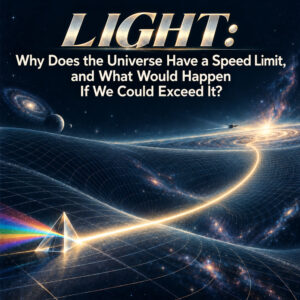 1
Light: Why Does the Universe Have a Speed Limit, and What Would Happen If We Could Exceed It?
Why does the universe have an ultimate speed limit, and what would it mean to exceed it? Follow the discoveries that transformed light into a key to understanding space, time, and the fundamental relationships between cause and effect in nature.
 2
The Genius of Albert Einstein: Understanding the Special Theory of Relativity
Discover how Einstein overturned the traditional concepts of absolute space and time. Understand why moving clocks measure different time intervals, why lengths depend on motion, and why simultaneity is not the same for all observers.
 3
Einstein’s General Theory of Relativity: How Gravity Shapes Space, Time, and the Universe
Gravity is more than a simple force of attraction. Explore how matter and energy curve spacetime, why clocks run at different rates in gravitational fields, and how Einstein developed an entirely new picture of the universe.
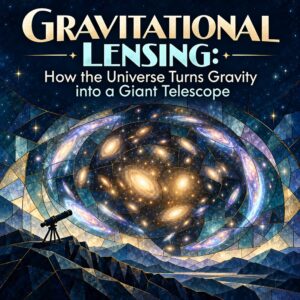 4
Gravitational Lensing: How the Universe Turns Gravity into a Giant Telescope
How does gravity transform galaxies and galaxy clusters into natural cosmic telescopes? Discover how distorted light reveals distant galaxies, invisible matter, exoplanets, and events from the early history of the universe.
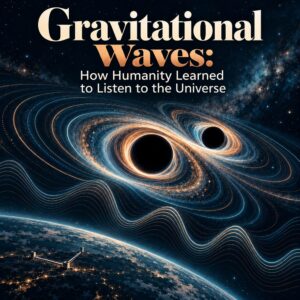 5
Gravitational Waves: How Humanity Learned to Listen to the Universe
In 2015, humanity directly detected ripples in spacetime for the first time. Follow the story of how scientists captured a signal from the merger of two black holes and opened an entirely new way of exploring the universe.
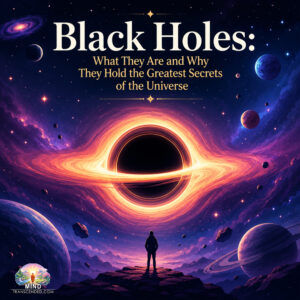 6
Black Holes: What They Are and Why They Hold the Greatest Secrets of the Universe
Enter the world of the most extreme gravitational objects in the universe. Understand how black holes form, what the event horizon represents, and why their existence raises fundamental questions about matter, time, and information.
 7
The Mystery of Time – Why Does It Flow, Can It Stop, and Does It Exist at All?
What is time, and why do we experience it as a movement from the past toward the future? Explore the relationship between relativity, entropy, and the arrow of time, along with the mystery of whether the present holds a special place in physical reality.
 8
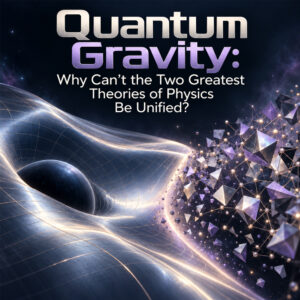
Quantum Gravity: Why Can’t the Two Greatest Theories of Physics Be Unified?
The final step leads to one of the greatest mysteries of modern physics. Why do general relativity and quantum theory still lack a unified fundamental description? Explore string theory, quantum geometry, and the possibility that spacetime itself emerges from a deeper underlying structure.
Test your knowledge
Answer every question correctly to complete the journey and unlock your badge.
Mark the core articles as read to unlock the test. Supplemental Premium reading is optional.