
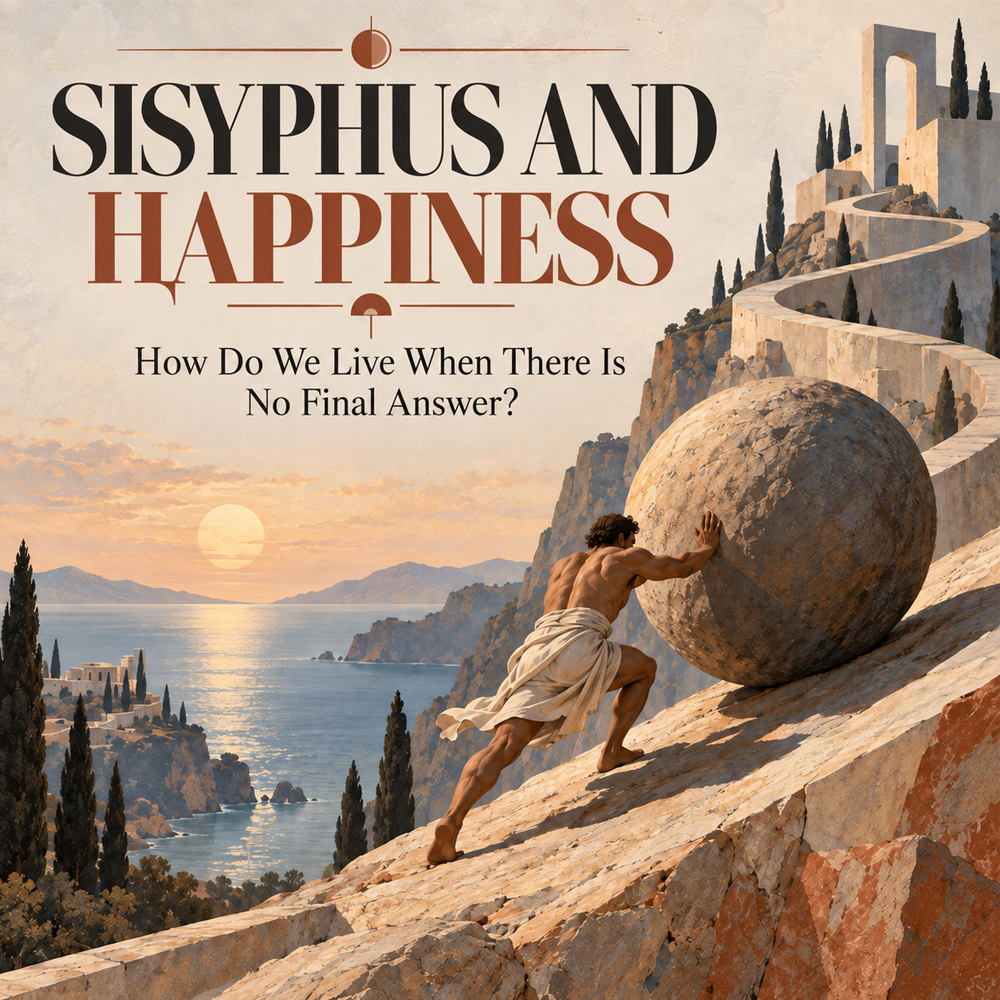
Part One: The Stone, the Mountain, and the Man Who Refuses to Surrender
The stone is already close to the summit. Sisyphus presses his shoulder against it, his feet searching for purchase, every movement demanding the full strength of his body. Only the final few metres remain before him, always resembling a promise that the ordeal will end. He knows every irregularity of this slope and knows exactly what will follow, yet he continues pushing the weight towards the place from which it will fall again.
Then the stone slips away. For an instant, it seems suspended between two destinies before its own weight drags it downwards. The impacts echo along the slope, dust rises, and everything he has accomplished becomes a distance that must be travelled once more. At the summit, the man remains, confronting the cruellest feature of his punishment: his effort will never accumulate into a completed achievement.
He has no final working day. There is no evening when he can return home and say that the task is finished. There is no reward to justify the exhaustion, no future moment that will transform the torment into necessary preparation for happiness. There is a stone, a slope, and a consciousness that remembers the previous ascent and sees the next one coming.
This is the man Albert Camus chooses when searching for an image of the human condition. In his essay The Myth of Sisyphus, published in 1942, the ancient punishment becomes the setting for a philosophical question that cannot be postponed indefinitely. If life offers us no final explanation of itself, how should we live it? And if no victory abolishes death, loss, and uncertainty, where do we find a reason to continue?
Camus’s answer will sound almost outrageous to anyone watching only the stone. He will ask us to imagine Sisyphus happy. But to understand this thought, we must remain beside the mountain long enough, without concealing the cruelty of what is happening. We must see what the punishment takes from the man and what, despite everything, it cannot claim.
The Punishment of the Man Who Loved the Earth
In ancient Greek stories, Sisyphus is a cunning ruler who defies the gods and attempts to outwit death. Different versions of the myth describe different deceptions, but one consistent trait emerges: he does not leave life willingly and obediently. In Camus’s reading, this defiance is bound to a passion for earthly existence. Before becoming the man of the stone, Sisyphus is the man who refuses to part with the world.
This detail changes everything. If he despised life, his punishment would be the story of a being trapped in a world he already hated. But Sisyphus is attached to everything from which he has been torn: the movement of water, the warmth of the earth, human faces, the pleasure of being among the living. His tragedy arises from a love that encounters an insurmountable boundary.
Let us imagine what returning to the living would mean for such a man. After the darkness of the underworld, an ordinary morning would have the force of a revelation. The noise of the harbour would be enough to hold him there, and the touch of air against his skin would carry more weight than any command to return. This imaginative scene reveals what is at stake in the myth: the man resists because existence is already precious to him, before he has received an explanation for it.
The gods respond with labour that destroys the very possibility of completion. They do not assign him a difficult task that centuries of effort will eventually accomplish. The sentence is designed to erase every achievement at the moment it appears final. The stone must come close enough to the summit for the end to be visible, and fall inevitably enough for there never to be an end.
This is where the punishment begins to feel familiar. We know the effort that must begin again, even though we made it conscientiously yesterday. We know the order that falls apart, the peace we must restore, and the care that never becomes unnecessary. The myth concentrates these experiences into one merciless image and makes us ask whether the value of an action depends entirely on its definitive completion.
The Morning When Life Stops Seeming Self-Evident
We do not need to descend into the underworld to encounter Camus’s question. An ordinary morning is enough, one in which everything happens as before, yet we suddenly see it from the outside. The alarm rings, water runs, a cup fills, and the street has already received the thousands of people heading towards their obligations. The body knows these movements so well that consciousness barely has anything to do.
Imagine someone who has travelled the same route for years. He recognises the traffic lights, the shop windows, and the place where the traffic always slows. Usually, he uses the journey to organise his tasks, answer a message, or calculate his expenses until the end of the month. But this morning, he looks at his reflection in the window and, for the first time in a long while, does not think about what he needs to do.
He asks himself why he is doing it. Not why he needs to go to work today, because that question has plenty of clear answers. He asks where this entire procession of days is leading, what he is actually waiting for, and when the life for which he is making all these preparations will begin. The question arrives without warning and, for a few seconds, turns the familiar route into foreign territory.
This scene does not prove that everyday life is meaningless. The man has real responsibilities, and his work produces something and sustains someone’s life. What has changed is that practical explanations no longer satisfy his deeper inquiry. He sees the difference between the reason for completing the next task and the grounds for embracing his existence as a whole.
The most unsettling thing is that the world continues as before. The bus stops, the doors open, and someone apologises for stepping on another passenger’s shoe. Nothing in the outward scene reveals that one person has just lost his confidence in life’s apparent self-evidence. As the others get off, he realises how easily the daily routine can carry us forwards without telling us where we are going.
What the Absurd Actually Means
The word “absurd” is often used for something ridiculous, contradictory, or amusing. For Camus, it names a deeper tension: the encounter between the human need for meaning and a world that does not provide the final explanation we demand. We seek unity, justice, and an intelligible order, while reality does not undertake to meet these expectations. The absurd arises in this encounter, rather than simply in a particular bad day or an unpleasant event.
When someone loses a person they love, they often ask why. On one level, the question has an answer: an illness, an accident, a sequence of identifiable causes. But behind it lies another question, one that a medical explanation or a technical report does not satisfy. Why was this particular life cut short, why was this bond destroyed, and what makes the event acceptable within some greater order?
Explaining the causes is not the same as justifying the loss. We can learn every detail of an event and still remain without the answer we were seeking. The human heart wants more than a sequence of preceding conditions and consequences. It wants to understand why reality permits what love experiences as unbearable.
The same tension appears beyond tragedy. Someone can achieve a goal they have worked towards for ten years and discover that success does not resolve the question of how to live afterwards. The photograph from the ceremony remains, the congratulations end, and the following morning they must get out of bed again. The achievement is real, but the promise attached to it turns out to exceed what it can deliver.
Precision matters here. The absence of a final answer does not mean that every explanation is useless or that all human values are fraudulent. Science continues to investigate the world, thought continues to distinguish good reasons from bad ones, and care continues to change someone’s day. The philosophical problem begins when we demand that these genuine achievements also provide an ultimate guarantee for existence as a whole.
The Boy from Algeria and the Price of Sunlight
Albert Camus was born in 1913 in what was then French Algeria and grew up in poverty. His father died in the First World War while his son was still an infant, and his mother worked to support the family. Camus later studied philosophy, but tuberculosis placed restrictions on his plans and opportunities. Behind the writer who would receive the Nobel Prize in Literature in 1957 stood a man who had known insecurity long before turning it into a philosophical subject.
These facts do not automatically explain his work. Poverty does not produce the same philosophy in everyone, and illness does not necessarily lead to the same attitude towards the world. But they help us understand why the question of life carries a bodily weight in Camus’s writing. When health cannot be taken for granted, tomorrow ceases to be an infinitely expandable territory into which everything can be postponed.
In his Mediterranean essays, the earthly world is present with extraordinary force. The sea, the light, the stone, and the bodily sensation of existence do not merely provide a backdrop for abstract reflection. They belong to what thought must remain faithful to. Read alongside The Myth of Sisyphus, these texts show why his question about the absurd is also bound to the question of happiness.
Imagine someone leaving a room filled with anxious thoughts and walking to the shore. His questions do not disappear when he sees the water. The horizon does not explain death, and the sun does not repair the injustice he has been thinking about all night. But his body feels the air, his gaze opens out, and for a few minutes existence ceases to be merely a problem that must be solved.
This scene allows us to distinguish two needs that we often confuse. One is to understand life, and the other is to participate in it. The first can remain unsatisfied while the second already finds expression in walking, conversation, work, or intimacy. Not possessing the whole truth about the world does not mean being denied access to everything valuable within it.
The Dangerous Bargain with the Future
Much of our life unfolds through a bargain that no one else has signed. We promise ourselves that after a certain achievement we will relax, after earning a certain amount we will feel secure, and after a particular change we will begin living fully. The future becomes the place to which we have sent our right to satisfaction. The present remains a corridor we hurry through because our real home supposedly lies further ahead.
Imagine a man who spends years working towards a promotion. He turns down invitations, misses evenings with people close to him, and makes every free Saturday another working day. He is convinced that these sacrifices have an expiry date and that after the next step he will reclaim his time. When he finally receives the position he wanted, it arrives with new responsibilities, higher expectations, and another rung that already seems necessary.
The problem in this story is not ambition. Work and long-term plans can enrich life, and some sacrifices are reasonable and unavoidable. The problem is the promise of a final arrival that the man has invested in his promotion. He has asked a professional milestone to end his inner uncertainty and give him permission to be alive.
The same bargain appears in love. Someone expects a future partner to answer every question they themselves have been unable to endure. Another postpones peace until they can be understood completely, with nothing left over and no effort required. When actual intimacy arrives with its differences and difficulties, it seems inadequate beside the impossible task assigned to it.
Recognising this mechanism means reconsidering what we demand of the future. It can bring change, treatment, an encounter, success, or a new opportunity, but it is not obliged to turn human existence into a question definitively resolved. If we make our lives dependent on such a guarantee, every achieved goal will be followed by another condition. We will reach the summit only to discover that we have sent happiness ahead to the next one.
Why the Descent Matters More Than the Summit
Let us return to Sisyphus when the stone is already below. While pushing it upwards, his attention is entirely absorbed by the resistance of its weight. His muscles, breathing, and balance are subordinated to the immediate task. But during the descent, his hands are free, and a distance opens between the man and his burden.
Camus directs our attention precisely towards this interval. For him, the descent is the hour of consciousness, when Sisyphus sees his sentence and knows its full cruelty. He does not believe that the next ascent will be the last. His lucidity removes the illusion, yet at the same time becomes the foundation of his defiance.
Let us follow this descent as a scene. The man walks along the path the stone has just travelled at destructive speed. Every step returns him to his labour, but leaves him time to recognise what is happening. He cannot change the incline, the weight, or the law governing the fall, yet he is no longer entirely fused with the movement of the stone.
There is no sudden miracle here. The gods do not revoke the sentence, the mountain does not become lower, and the body does not stop growing tired. The change lies in the relationship between the imposed fate and the consciousness that confronts it. That relationship is a narrow space, but it is precisely where the philosophical story begins searching for freedom.
Applied to human life, this image requires a careful reading. Our tasks often produce results, our circumstances can change, and help from others is a real possibility. Recognising ourselves in Sisyphus therefore does not mean declaring every form of suffering an eternal sentence. It means seeing what happens when a person stops waiting for life to be fully resolved before beginning to choose their relationship with it.
Sisyphus walks downwards and sees the stone awaiting him. If happiness is possible only after a definitive victory, his story ended before the first ascent. But Camus places the question elsewhere: what remains available to a person when the victory they have demanded does not exist? Here begins the most difficult part of the story – discovering how the lucidity that takes away consolation can place life back in our own hands.
Part Two: The Freedom to Live Without Guarantees
Sisyphus reaches the foot of the mountain and places his palms against the stone. There is no new command, because the sentence has long since made repetition a law. The same weight stands before him, but after the descent he encounters it with a clear understanding of what lies ahead. It is precisely this clarity that raises the hardest question: how does a person continue when they can no longer console themselves with the promise of a definitive end?
In the human world, there are countless ways to silence this question. One person immerses themselves in work until exhaustion leaves no room for thought. Another continually seeks a new experience so that silence never catches up with them. A third clings to an explanation that assigns every event its proper place and allows them to believe that nothing truly unforeseen can happen.
Imagine a woman spending the evening organising photographs from the past ten years. Journeys, birthdays, embraces, and faces no longer present in her life pass across the screen. The individual moments were real, but seeing them together, she feels how little they resemble the orderly story she once expected. Instead of a steady movement towards security, she discovers a succession of beginnings, losses, detours, and decisions made without sufficient knowledge.
She can hurry to turn all this into a comforting narrative. She can declare that every disappointment was necessary, that every loss arrived for a particular purpose, and that the entire journey inevitably led to the present moment. Such a narrative offers reassurance because it transforms the unknown into intention. But if she has no grounds for accepting it, that reassurance is purchased by abandoning the distinction between what she knows and what she wants to be true.
Camus insists on precisely this boundary. In The Myth of Sisyphus, he criticises the leap through which a person first acknowledges the limits of reason and then turns those limits into grounds for absolute certainty beyond them. He calls such a retreat “philosophical suicide,” because, in his view, thought abandons the tension it has discovered instead of remaining faithful to it. This is his position in a dispute with particular religious and philosophical responses, rather than proof that every form of faith is insincere.
For the woman looking at the photographs, honesty would take a more modest and demanding form. She can acknowledge that certain experiences changed her without claiming they were sent in order to change her. She can draw something valuable from a loss without declaring the loss itself good. In doing so, she preserves the right to love the present without justifying everything that brought her to it.
Life Is Not a Defendant Awaiting Acquittal
At the beginning of The Myth of Sisyphus, Camus asks whether life is worth living. He treats the question with the utmost seriousness because, for him, philosophy must bear upon the way we exist. But the essay moves towards an affirmation of life: the absence of ultimate meaning does not lead him to conclude that life should be ended. He seeks the possibility of remaining alive and awake within the unresolved contradiction.
Here, a hidden demand we often place upon existence comes into view. We want it to present a convincing justification before we give it our consent. We insist on knowing the ultimate purpose before accepting the time we have been given. Life thus finds itself in the dock, while we wait for evidence that will acquit it once and for all.
Yet many of the things we already value do not work this way. When we listen to music, its significance does not depend on whether the final note will resolve every question of human existence. When we speak with someone close to us, we do not demand that the conversation be recorded for eternity before it deserves our attention. The experience has value in the relationships, feelings, and possibilities it actually creates.
These examples do not, by themselves, prove Camus’s philosophy. They do, however, reveal how strange it is to demand an eternal guarantee for everything temporary before recognising its value. An hour of closeness does not become something that never happened simply because it ended. Help given to someone on a difficult day does not lose its significance because, years later, no one will remember the precise words.
For Camus, ending life does not resolve the absurd, because it removes the human consciousness that experiences it. His response is to preserve the encounter between the question and the silence without destroying either the question or the person asking it. This means continuing without presenting that continuation as proof that everything is all right. Life remains difficult, but difficulty is no longer automatically granted the right to pass the final judgement upon it.
Revolt Without the Expectation of a Final Victory
The word “revolt” summons images of public squares, banners, and a power that must be overthrown. In The Myth of Sisyphus, it also has a more intimate meaning: the human being’s sustained, conscious resistance to their condition. Sisyphus does not overturn the sentence, but he refuses to let imposed suffering become complete inward submission. His defiance exists in the way he understands and bears his fate.
It is easy to turn this image into advice about endurance. A person should grit their teeth, work harder, and call their resignation dignity. Such a reading misses the crucial tension within revolt: acknowledging a fact does not mean approving it. Knowing that suffering exists does not oblige you to accept it as just.
Imagine a worker who has endured humiliation from his employer for years. If we tell him to be like Sisyphus and simply change his attitude, we turn philosophy into a convenient instrument for the person humiliating him. The worker has reason to seek another job, find support, or resist the abuse. His actual stone is not necessarily eternal, and someone else’s desire to keep him beneath its weight is not a law of the universe.
The distinction between an unavoidable limit and a changeable circumstance is essential. Mortality belongs to the human condition, but the specific cruelty of a particular person does not have the same status. Uncertainty cannot be eliminated entirely, but a dangerous environment can be left or transformed. Lucidity requires us to distinguish these things, because otherwise we call something fate when we are capable of acting against it.
Revolt begins where a person stops surrendering their entire being to what has been imposed upon them. It can be a refusal to lie in order to preserve comfort, or a decision to defend someone despite having no guarantee of success. It can also be the persistent continuation of work that genuinely helps, even when its results are limited. In each case, the person acts without waiting for the world to promise a just outcome in advance.
The Stone Is Not the Whole Person
Watching Sisyphus from a distance, we mainly see his task. The man is reduced to the straining body, and his life to the movement between the foot of the mountain and its summit. The same thing happens in everyday life when someone’s role consumes our understanding of them. We see the employee, the parent, the patient, or the caregiver, and forget how much of their existence lies beyond that label.
Imagine a man who has spent years caring for his elderly father. His day is divided between medication, meals, telephone calls, and small difficulties requiring constant attention. Gradually, people begin asking him only about his father’s health. Even he begins speaking about himself as though his personal life has disappeared inside this care.
One evening, his father falls asleep earlier than usual, and an unfamiliar quiet settles over the home. The man opens the window, hears music from the neighbouring apartment, and remembers that he once used to play. He has not touched the instrument stored in the cupboard for a long time. He takes it out, tunes it slowly, and spends half an hour playing imperfectly, interrupted by mistakes and long pauses.
None of his responsibilities has disappeared. In the morning, he will have to get up early again, and his father’s illness will not be altered by this evening. Yet the experience restores a dimension of the man that the burden had pushed aside. He remembers that he is capable of more than attending to necessities: he can also listen, create, and experience pleasure.
This is a contemporary application of the question raised by the image of Sisyphus, rather than a scene from Camus’s work. It shows why freedom does not always begin with a great liberation. Sometimes it appears as a specific action that interrupts complete identification with a burden. The person continues to carry their responsibility, but reclaims the right to inhabit their own life in more than one role.
Living More Does Not Mean Moving Faster
Camus connects his response to the absurd with revolt, freedom, and a passion for experience. That passion is easily confused with a relentless pursuit of intense sensations. It can sound as though a person must collect enough journeys, loves, risks, and adventures to overcome the brevity of life. But accumulating events is not the same as consciously participating in them.
Someone can travel halfway around the world and spend the entire time proving that they have done so. They can sit opposite someone they love while thinking all evening about their next achievement. They can fill their calendar so completely that, between one experience and the next, neither has time to touch them. Speed creates movement, but it does not guarantee presence.
Imagine two friends walking beside the sea after a long separation. One continually checks his phone because he is expecting a message that could change his plans. The other speaks about someone he has lost and falls silent several times while searching for the right words. The first hears the story in fragments and only later realises that he missed an encounter that cannot simply be repeated on demand.
To be present means allowing something particular to matter before measuring it against a distant goal. This requires an attention that cannot be counted in the number of events ticked off a list. It also requires a willingness to endure what is unpleasant, because a genuine encounter with life includes fatigue, discomfort, and other people’s pain. A passion for existence becomes impoverished when we admit only what promises a pleasant sensation.
Here lies the distinction between the present as a refuge and the present as a responsibility. Living today does not mean forgetting the consequences of your actions or abandoning the people who rely on you. Tomorrow is prepared through the decisions you make now. But that preparation should not consume every opportunity to experience today as an actual life.
Happiness That Does Not Erase Tragedy
At the foot of the mountain, Sisyphus strains his body once again. If we watch him carefully, there is no reason to imagine a perpetual smile on his face. The happiness towards which Camus directs our thought does not require us to erase pain from the image. It must be understood alongside a lucid awareness of limits, or the entire philosophical difficulty disappears.
This is what makes the essay’s famous ending so challenging. Camus is not describing an observable psychological state in the ancient hero, nor proving that sufficient awareness inevitably produces joy. He offers a philosophical and artistic image of a person whose fate cannot exhaust their relationship with existence. To imagine Sisyphus happy is to explore the possibility of a life that does not wait for tragedy to be abolished.
In human experience, this coexistence is more familiar than it first appears. A family can laugh over dinner while knowing that one of its members is seriously ill. A person can feel joy at a reunion without their grief having ended. Pleasure does not refute loss, and loss does not make every pleasure a betrayal.
Here, another condition we place upon happiness falls away. We expect all our important anxieties to be resolved before allowing ourselves any lightness. But anxieties run on different timescales, some have no definitive solution, and life continues to offer possibilities between them. If we refuse every joy until the world has been fully put in order, we turn our own sensitivity into a prison whose release date is continually postponed.
This is not a command to be happy. No philosophical image gives us the right to demand cheerfulness from someone who is suffering, or to turn their pain into a character flaw. The question concerns permission to live more broadly than our suffering when such an opportunity appears. Joy can be small, brief, and vulnerable, but those qualities do not make it unreal.
Sisyphus has already begun the ascent, and the stone obscures part of the sky before him. The mountain remains the same, but our question has changed: we are no longer seeking a promise that everything will end well. We are asking how a person preserves the ability to love, act, and recognise what matters when that promise is absent. And once we look beyond the solitary slope, another question emerges – how this fidelity to life becomes care for others who are also carrying their burdens.
Part Three: What We Do for One Another Beneath a Silent Sky
At the beginning of The Plague, a doctor notices a dead rat. The incident seems minor, an almost inconvenient detail in the ordinary life of the Algerian city of Oran. Then more rats appear, people begin falling ill, and what everyone wants to regard as a temporary disturbance takes on the shape of a catastrophe. When the city closes its gates, its inhabitants discover that their ordinary lives have been interrupted without their consent.
Husbands and wives, parents and children are separated, along with people who did not know at their last meeting that they needed to say goodbye. An unfinished conversation suddenly becomes all that someone remembers of a loved one. A journey planned for the following week now belongs to an inaccessible world. Habits continue for a time, but gradually lose their footing, because they were all built upon the confidence that tomorrow would sufficiently resemble yesterday.
Camus moves the ordeal from the solitary mountain into a space inhabited by other people’s destinies. Here, no one suffers in complete isolation, even when they feel abandoned. One person’s decision to help or remain idle changes another person’s circumstances. The question of how to live acquires an immediate weight, because the answer now affects someone’s breathing, someone’s pain, and someone’s chances of surviving the night.
At the centre of the novel stands Dr Bernard Rieux. He has no means of guaranteeing victory over the epidemic, nor an explanation capable of justifying the suffering before his eyes. Nevertheless, he visits the sick, organises the work, and continues to treat patients. His actions give the philosophical question a visible form: one person bends over another and does what is needed.
The Doctor Who Does Not Wait to Understand Everything
Rieux is not portrayed as an invulnerable hero. He grows tired, experiences personal anxiety, and works under conditions that gradually exhaust his strength. He does not stand above the catastrophe, passing judgement from a place of safety. He is present within it, among bodies, faces, and specific tasks that cannot be postponed until the larger questions have been resolved.
This presence places a limit on a dangerous form of thinking. A person can discuss the meaning of suffering for so long that they overlook the sufferer before them. They can turn another person’s pain into an illustration of a theory, evidence for a worldview, or an opportunity to display their own insight. But for the patient, the significance of the person beside them also depends on whether that person will offer water, call for help, and stay when things become difficult.
In one of the novel’s most agonising episodes, the doctor and other characters witness the death of a child. The scene does not allow the reader to hide behind general statements about the human condition. The suffering has a body, a duration, and witnesses who cannot bring it to an end. After such an encounter, any explanation that too readily places the event within a benevolent design must bear the weight of its own claims.
Rieux refuses to reconcile himself to an order in which such suffering must be approved. His refusal does not make him omnipotent or promise that the next child will be saved. It does, however, determine which side the doctor will take with the knowledge and strength available to him. Sometimes the most important response to an unbearable event is precisely this choice of where to stand.
Here, a distinction emerges between a final explanation and sufficient grounds for action. To help someone, you do not first need to establish the purpose of the universe. You need to recognise their need and assess what you can actually do. Limited knowledge leaves many questions open, but it does not invalidate every decision we must make in the meantime.
The Man Who Wants to Leave
Among those trapped in Oran is the journalist Rambert. He does not belong to the city, and beyond its walls the woman he loves is waiting for him. Initially, he therefore experiences the quarantine as someone else’s tragedy that has unjustly taken possession of his private life. He seeks a way out because, for him, freedom has a very specific address.
His desire is understandable. His love is real, and the separation does not become less painful because other people are suffering too. Camus does not turn him into a caricature of selfishness merely to make his subsequent decision easy to approve. If what awaited him outside the city were insignificant, staying would reveal nothing essential about the man.
While searching for an escape, Rambert joins the work against the epidemic. Gradually, the city ceases to be merely the barrier between him and the woman he loves. The people he encounters acquire faces, and the shared catastrophe becomes part of his own experience. When an opportunity to escape finally arises, he decides to stay and continue helping.
His decision does not prove that personal happiness is shameful. It shows how someone can discover a sense of belonging they did not choose in advance. Rambert realises that what is happening now concerns him through the relationships he has entered and the work he is doing. His love beyond the city remains real, but it ceases to be the only truth capable of guiding his actions.
This change gives freedom another dimension. The free person is not always the one who manages to escape every attachment. Sometimes freedom manifests itself in voluntarily accepting a responsibility that could be avoided. The choice then acquires its weight precisely because another possibility exists and the person consciously declines it.
When Being Right Begins to Demand Sacrifices
The path from personal ordeal to shared life leads Camus towards an even more dangerous question. If someone rejects injustice, how far are they entitled to go in fighting it? In The Rebel, he explores how a protest against humiliation can turn into a justification for further humiliation. History has witnessed movements that begin by demanding dignity and end with authorities distributing the right to live according to allegiance to a doctrine.
At the beginning lies real suffering. People are oppressed, deprived of opportunities, and treated as instruments of other people’s purposes. Their refusal is justified because it affirms a boundary beyond which a human being must not be pushed. The danger emerges when that boundary is abolished for those whom the new cause declares an obstacle.
Imagine a gathering at which a future world of justice is being discussed. Gradually, the conversation moves from people’s rights to the number of people who must be sacrificed for that world to arrive. Someone objects and is told that they are thinking too narrowly, that they do not understand historical necessity, and that true goodness requires determination. The living person thus disappears behind the promise of a future humanity.
Camus’s criticism strikes precisely at this transformation. If revolt begins by recognising human dignity, it undermines its own foundation when it permits the unrestricted destruction of human beings. The nobility of a stated goal does not make every means noble. The struggle must retain the ability to set limits upon itself, or it reproduces the very thing against which it arose.
This difficulty does not belong solely to political history. It also appears when someone is so certain they are right that they stop listening to what they are doing to others. Within a family, a public disagreement, or a friendship, conviction can become permission for cruelty. Acknowledging that we do not possess the final word then has practical significance: it leaves room to correct a mistake before it becomes irreparable.
The Sea Between Two Shifts
Amid illness and ceaseless work, Camus makes room for a quiet scene. Rieux and his friend Tarrou go swimming in the sea. For a brief time, they step out of the rhythm of medical duties and enter the water as two people sharing movement, coolness, and silence. The city has not been saved, and behind them remains everything to which they must soon return.
The scene’s power lies in its precision. It does not need an extraordinary event to reveal what connects two people. After so many hours spent amid others’ pain, they share something that does not have to be repaired or managed. The sea allows them, briefly, to be together outside the roles the catastrophe has imposed.
Friendship here has a significance that no collective slogan can replace. It has developed through shared work, conversations, and gradually coming to know one another. In the water, that closeness is experienced directly, without any need for explanation. The two men do not solve the mystery of the human condition, but they share part of it in a way that weakens their solitude.
Afterwards, they will return. It is precisely this return that preserves the episode’s honesty, because rest does not become forgetfulness of everyone else. The experience has its place within responsibility, rather than beyond it. The novel thus portrays a life in which care and personal closeness sustain a person together, instead of one consuming the other.
After the Gates Open
When the epidemic recedes, Oran opens again. Separated people reunite, the streets fill with movement, and the city celebrates the return of possibilities that until recently seemed lost. But the celebration does not bring back everyone who is absent. Amid the joy remain people for whom the opening of the gates cannot restore the person they are waiting for.
The novel also ends with a warning that the plague bacillus has not disappeared for good. This knowledge does not invalidate the efforts of those who fought the disease. The lives saved are real, just as the reunions in the streets are real. But success does not release people from the need for vigilance.
Here, a more mature relationship with achievement emerges. Work can succeed without its success becoming permanent. Justice can be defended in a particular case without every future injustice having been prevented. We are called upon to recognise what has been achieved and protect it, rather than dismiss it because it lacks finality.
This attitude also changes the question of the mark we leave behind. Not everyone will be remembered for long, but everyone contributes to consequences that extend beyond their own awareness. Someone’s timely intervention can prevent humiliation, someone’s patience can help another person learn, and someone’s refusal to sustain a lie can interrupt its spread. The world we inhabit is also built from these actions, whose authors often remain unnamed.
The Answer Made of Actions
Sisyphus remains alone on his slope, but human beings do not live only within solitary sentences. They obstruct, support, abandon, and save one another within the limits of what is possible. The question of happiness therefore cannot be settled solely through an individual’s inward attitude. It also concerns the environment we create for those whose lives intersect with ours.
Living without a final answer means making decisions whose full significance we cannot foresee. This demands attention to consequences and a willingness to be corrected. It also demands courage, because uncertainty does not abolish the moments when we must stand beside someone. The person before us is not to blame for the universe’s failure to satisfy our need for clarity.
At the end of this path, no formula awaits that will turn every loss into a necessity. What remains is a series of human actions undertaken without that protection: the doctor visits the next patient, the journalist stays in the closed city, and two friends share a brief swim between difficult days. Each action responds to a particular circumstance. Together, they outline a life in which the unknown has not been granted the power to bring care to an end.
Imagine an ordinary corridor at the end of the day. Someone who has finished work sees another person struggling alone and stops. They will not remember this evening as a great event, and tomorrow they will have their own anxieties and unanswered questions. But they stay long enough to help, and in one small part of the world, the weight no longer falls upon a single person.
No final answer has sounded in that corridor. No one has established why we exist or promised that every kindness will be rewarded. Yet one person leaves feeling less abandoned than before. The other goes home with the life they have actually lived – still unresolved, but now containing this encounter.
Author: Vasil Stoyanov