
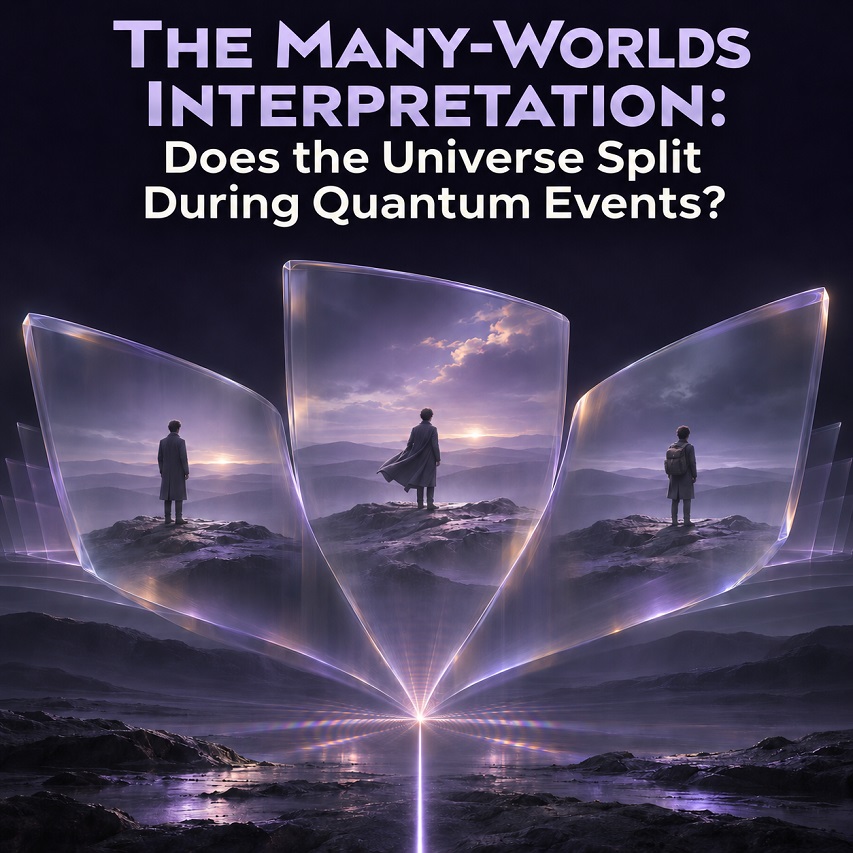
Imagine standing before a closed door. Behind it is a laboratory where a small device is about to measure a single quantum particle. The measurement can produce one of two possible outcomes. You press a button, open the door, and see one result. Everything seems perfectly ordinary: the experiment is over, the instrument displays a value, and you can write it down in your notebook.
But what happened to the other possibility? Did it disappear at the moment of measurement? Was it never anything more than a probability? Or, strange as it sounds, does it continue to exist as part of a larger quantum reality in which another version of the laboratory records the other result?
That third possibility lies at the heart of the many-worlds interpretation, associated with physicist Hugh Everett III. It is one of the boldest ideas in the history of quantum mechanics. According to this interpretation, a quantum state need not undergo a special physical “collapse” when a measurement occurs. Instead, the entire system-the particle, the instrument, the observer, and the environment-continues evolving according to quantum laws.
The popular description says that the universe “splits” at every quantum event. It is a powerful image, but it can also be misleading. We need not imagine a cosmic machine manufacturing fully formed new universes at precisely defined moments. More accurately, we can speak of different branches of a single quantum state that, under certain conditions, effectively cease to interfere with one another.
To understand why anyone would accept such an extraordinary picture of reality, we must begin not with parallel worlds but with a very real problem: quantum theory predicts experimental results with extraordinary success, yet it offers no single universally accepted philosophical account of what its mathematical symbols ultimately mean. Everett’s story begins precisely where accurate calculations meet an uncomfortable question: what actually happens when we observe?
A World Unlike Our Everyday Experience

When you leave a cup on a table, you expect it to occupy a definite position. If you toss a coin, it will land heads or tails. Before looking, you might not know which outcome occurred, but you normally imagine that the coin has already settled into one definite state. That is the natural logic of everyday life.
Quantum systems do not always permit such a description. An electron, photon, or atom can be prepared in a state mathematically represented as a combination of several possible outcomes of a future measurement. This combination is called a superposition. It is not merely a list of things we do not know: its different components can exhibit interference.
Imagine two waves moving across water. In some places their crests reinforce each other; elsewhere a crest and a trough weaken each other. Quantum amplitudes can likewise combine constructively and destructively. This interference is what distinguishes quantum superposition from the ordinary situation of hiding a coin beneath a cup and simply not knowing its result.
It is important not to take the analogy with water waves too literally. A quantum state is not necessarily a physical wave spreading through space in the same way water does. It is described by a mathematical object called a wave function or, more generally, a state vector. Different interpretations disagree about the status of this object in reality.
Here the mystery begins. Before measurement, the quantum description may contain several components. When we perform a measurement, we ordinarily see one specific outcome. How do we move from a mathematical description that allows superposition to our experience of instruments displaying definite readings? This is the heart of the quantum measurement problem.
The Double-Slit Experiment: An Experiment That Changes Our Questions

Imagine a wall containing two narrow slits, with a screen behind it. If you throw ordinary little balls at the wall, you expect two approximate regions of impacts on the screen. The balls pass through one opening or the other. But if you use light or particles such as electrons under suitable conditions, an interference pattern appears-alternating regions with more and fewer detections.
Even more surprisingly, this pattern can accumulate when particles arrive one at a time. Each individual detection looks localized, like a small dot on the screen. Yet after many repetitions the dots form a regular pattern that cannot be explained by the simple picture of particles following predetermined classical routes without quantum interference.
When we attempt to determine which slit a particle passed through, the experimental situation changes. If information about the path becomes sufficiently distinguishable, the interference pattern disappears or weakens. No human needs to consciously inspect the data. A physical interaction that correlates path information with a measuring system or the environment is enough.
People often say that the particle “passes through both slits at once.” This can be useful shorthand, but it is not an undisputed literal description. Quantum theory provides amplitudes for possible alternatives and rules for combining them. What those amplitudes mean for the particle’s actual path depends on the interpretation.
For Everett, experiments like these suggest something important. If superposition is essential to describing the microscopic world, why assume it suddenly stops applying when we introduce a measuring device? Is that device not itself made of atoms governed by quantum laws? And if so, why should the observer be an exception?
The Measurement Problem: Where Do the Other Possibilities Go?

Let us imagine a quantum particle that can produce the result “up” or “down” when a particular component of its spin is measured. Before measurement, its state can be a superposition of the two possibilities. We connect it to an instrument whose pointer initially indicates zero. What should quantum mechanics predict for the combined system?
If we apply ordinary linear quantum evolution to the particle and instrument together, we obtain a correlated state: the “up” component is associated with an instrument displaying “up,” while the “down” component is associated with an instrument displaying “down.” This connection is a form of quantum entanglement. The system can no longer be described as two completely independent parts.
Yet when we look at the actual instrument, we do not see a pointer reporting two incompatible readings at once. We see one. In many traditional presentations of quantum theory, this is described through collapse of the state: one outcome is selected during measurement according to particular probabilities. Mathematically, this is a useful rule for predicting observations.
The uncomfortable question is what this collapse actually represents. Is it a real physical process? If so, when does it occur and under what conditions? What counts as a measuring device? Is an observer required? Different interpretations provide different answers, and some do not accept collapse as a fundamental process at all.
Everett proposes a radical simplification in one respect and a radical complication in another. Let us not add a special law of collapse. Let us apply quantum dynamics to everything. The price is that we must take the entire correlated state seriously-including the different components in which the instrument displays different results.
Hugh Everett: The Young Physicist Who Refused to Erase Half the Equation

By the 1950s, quantum mechanics was already an extraordinarily successful theory. It explained atomic phenomena and provided the foundation for new technologies. Yet the question of how to understand measurement remained open. In this intellectual setting, a young American physicist named Hugh Everett III, working at Princeton, developed an idea that would provoke decades of debate.
In 1957, Everett published his relative-state formulation. The central thought was that we can describe the observer as part of the quantum system rather than placing the observer outside it. If the particle and measuring device become entangled, the observer reading the device also becomes part of the correlation. In one component the observer sees one result; in another, the other result.
Imagine a novel in which the author does not erase alternative developments of the plot. Instead, the complete work contains several diverging storylines. The character in each storyline has consistent memories of events within it. This analogy helps us picture the idea, but we should not mistake it for a literal mechanism of cosmic storytelling.
Everett himself did not present his theory simply as the popular image of countless universes appearing whenever someone makes a decision. The expression “many worlds” became established later, particularly through the work of physicist Bryce DeWitt and subsequent discussions. Historically, it matters that we distinguish the original relative-state formulation from later interpretations of it.
The idea did not initially receive universal recognition. Everett left academic physics and continued his career outside it. But the questions he raised did not disappear. As research into quantum entanglement and decoherence developed, the many-worlds interpretation attracted renewed attention. Today it is a seriously discussed position, although it is not an established scientific consensus.
What Does a Measurement Look Like in the Many-Worlds Picture?

Let us return to our laboratory and the particle’s spin. Initially we have a superposition of two possible results and an instrument ready to measure them. After the interaction, the combined state contains two correlated components. In one, the instrument displays “up”; in the other, “down.” When the observer reads the display, the observer becomes part of the corresponding correlations too.
From the observer’s perspective within each component, the experience is entirely definite. The observer does not see a blurry mixture of two values. In one component, the result “up” is recorded; in the other, “down.” Each observer has a memory of a specific measurement and can continue the experiment. This is how the interpretation attempts to explain the definiteness of our experience without fundamental collapse.
It is easy to be misled here by the word “copy.” Do not imagine an invisible machine first creating a second person and then sending that person into another cosmic room. Within the interpretation, we describe one overall quantum state with different correlated components. Speaking of separate observers is a way of describing the structure of those components.
Equally importantly, we cannot simply choose which branch to enter or use supposed other branches to send messages to ourselves. Under the ordinary conditions in which strong decoherence occurs, different branches provide no accessible communication channel. The idea of parallel worlds does not mean that we can build a doorway between them.
When popular accounts say that “every quantum event creates a new universe,” they omit important details. What exactly is a branch? When does one form? How many are there? In contemporary versions of the interpretation, these questions generally have no simple, exact answers. To understand why, we need to discuss decoherence.
Decoherence: Why We Do Not See Cats That Are Both Here and There

Imagine making two small waves in a calm lake. While the surroundings are sufficiently orderly, you can follow how the waves overlap. Now imagine turbulent water in which countless other movements constantly disturb the surface. Maintaining a clear interference pattern becomes much harder. This is only an analogy, but it points toward the role of the environment in the quantum world.
Real objects constantly interact with their surroundings. Light reflects from them, air molecules collide with their surfaces, and thermal radiation is exchanged with the environment. These interactions can entangle the quantum state of an object with an enormous number of external degrees of freedom. Information about different possible states spreads into the environment.
As a result, interference between certain components of the system becomes effectively inaccessible to local observations. This phenomenon is called quantum decoherence. It helps explain why macroscopic objects appear classical and why measuring devices have stable readings. Decoherence is a physically investigated process, not merely a philosophical conjecture.
Imagine a footprint in wet sand. Before anything disturbs it, its shape is clear. If thousands of footsteps, wind, and water alter the surface, reconstructing the original impression becomes almost impossible. Similarly, recovering quantum interference after entanglement has spread widely into the environment may require control over an unimaginably large number of details. The analogy does not reproduce the mathematics, but it illustrates why the process is practically irreversible.
And yet decoherence does not by itself prove that many worlds exist. It explains why certain quantum alternatives cease to interfere in an observable way, but the question of why we experience one outcome and how all the components should be interpreted remains open. Different philosophical and physical approaches make use of decoherence without necessarily accepting the ontology of many worlds.
Does the Universe Really Split-and How Many Times?

Our central question sounds as though a cosmic counter exists somewhere. One quantum event-click. Two universes. Another event-several more. But that picture is far too mechanical. In many contemporary accounts, branches are understood as emergent, approximately autonomous structures within a continuously evolving quantum state, rather than fundamental objects with absolutely precise boundaries.
Think of a great river dividing into channels in a delta. From a distance you can clearly see separate streams. Up close, however, it may be difficult to identify the one exact moment when the river “officially” became two rivers. That does not make the channels imaginary, but it shows that division can be an approximate concept. In quantum branching, the analogy is even more limited, because we are not talking about water flowing through ordinary space.
Branches depend on which stable distinctions are preserved through interactions with the environment. Different ways of describing a system may emphasize different details. That is why the question “Exactly how many universes exist at this instant?” may not have a well-defined answer in the usual sense. The interpretation does not necessarily require a numbered list of separate cosmoses.
Another popular misunderstanding is that every human decision automatically creates a world in which we made the opposite choice. Human decisions are complex physical processes, but the theory does not promise that every imaginable alternative is realized. Which components are present depends on the actual quantum state and its dynamics. Our imagination is not a generator of physical branches.
So the most accurate short answer is this: according to the many-worlds interpretation, the universal quantum state does not collapse; instead, effectively autonomous, decohered branches emerge within it and can be described as different worlds. Whether those branches should be called separate universes is partly a question of terminology and partly a philosophical judgment.
Schrödinger’s Cat: Why the Thought Experiment Still Troubles Us

One of the most famous stories in quantum physics begins with a cat inside a closed box. In Erwin Schrödinger’s thought experiment, a quantum event is connected to a mechanism on which the animal’s fate depends. If we apply the quantum description to the whole system without an additional collapse, a superposition of different macroscopic outcomes appears. Schrödinger used the example to reveal how strange it seems to extend quantum rules uncritically into the everyday world.
The familiar phrase says that the cat is “both alive and dead.” But that does not mean opening the box would necessarily reveal some fantastical creature halfway between the two conditions. In a real macroscopic system, interactions with the environment produce extremely rapid decoherence. Different possible outcomes become effectively distinguishable, without observable interference between them under ordinary conditions.
In the many-worlds interpretation, the overall state contains components associated with the different outcomes, and the observer opening the box becomes correlated with them. Within each decohered branch, the observer finds a definite condition. This does not make the thought experiment harmless or easy. It shows how one interpretation attempts to preserve quantum dynamics without a special act of collapse.
We must make an important distinction here: Schrödinger’s cat is a thought experiment, not proof that parallel worlds actually exist. Experiments involving quantum superpositions and controlled decoherence are performed with various physical systems, but they do not establish by themselves that Everett’s interpretation is the only correct one.
The real power of Schrödinger’s cat is that it forces us to ask a question we usually avoid: where exactly does the boundary lie between quantum and classical descriptions? The many-worlds interpretation answers that no fundamental boundary of this kind is required. Whether that answer resolves every difficulty remains the subject of lively debate.
If Every Outcome Happens, What Does Probability Mean?

Let us return to our laboratory. Before the measurement, you can calculate the probability of obtaining “up” and the probability of obtaining “down.” In standard quantum mechanics, these probabilities are determined by the Born rule: they are related to the squared magnitudes of the corresponding amplitudes. This rule works extraordinarily well when compared with experiments.
But the many-worlds picture raises a difficult question. If both outcomes are present in different branches, what does it mean to say that one is “more probable”? We cannot simply count the worlds and divide by their number, because branches are not necessarily exactly countable and do not all carry equal quantum weight.
Imagine a game in which you know there will be different continuations of the story, but do not know how to determine what you should expect before the branching. Does probability describe uncertainty about which future observer you will be? Should it be understood as the rational weight you assign to different future experiences? Or is some further principle needed to justify the usual quantum probabilities?
Supporters of many worlds have proposed several approaches, including arguments from decision theory, symmetry, and self-locating uncertainty. These attempts seek to explain why a rational observer should use the weights specified by the Born rule. They remain the subject of serious philosophical and mathematical discussion.
Critics object that some arguments may assume what they are supposed to prove, or that it is unclear how objective probability emerges if all possible outcomes are realized. This is one of the interpretation’s most substantial open difficulties. Saying that “everything happens” is not enough. We must explain why observations follow precisely the statistical regularities that they do.
Are There Other Versions of Us?

This is the question that most readily turns quantum physics into the plot of a novel. Somewhere, is there another person with your name, memories, and face who obtained a different result in an experiment? In certain descriptions of many worlds, we can speak of different future versions of an observer whose histories branch after an interaction with a quantum system. But this language must be used carefully.
Imagine writing down plans for the following week on a Monday. By Tuesday, events have unfolded in a way you did not expect. Ordinarily, this does not mean that another week necessarily exists somewhere in which every plan succeeded. Many worlds does not turn every unfulfilled wish into a real alternative biography. It concerns the structure of the quantum state, not the free invention of life scenarios.
When a quantum measurement becomes associated with different stable records and memories, the description can contain different correlated observers. But whether they are “the same person” before and after branching is a philosophical question about personal identity. Our usual picture of one continuous future may prove inadequate.
There is no scientific basis here for claiming that we can talk to other versions of ourselves, alter their decisions, or receive information from their histories. Such ideas are popular in fiction, but they do not follow from the standard description of decohered branches. Physics imposes constraints that imagination easily leaps over.
Perhaps the most interesting question is not whether there is “another me” who chose a different breakfast today. The deeper question is what personal continuity means if the fundamental description of the world allows several future correlated continuations. This is where physics and philosophy meet, and neither offers an easy, final answer.
Free Will, Choice, and the Dangerous Idea of Quantum Immortality

If different branches exist, someone might ask whether our decisions matter at all. Why be careful if another version of the story exists somewhere? That conclusion does not follow from the interpretation. Even if we accept many worlds, our actions have real consequences for people and environments within the corresponding future histories. Quantum descriptions do not cancel ethics or responsibility.
Imagine a driver deciding whether to obey a speed limit. The question is not whether the driver can imagine a world without an accident. The question is how the driver’s behavior affects risks and consequences for actual road users. No interpretation of quantum mechanics makes dangerous behavior sensible merely because we can tell stories about alternative outcomes.
Online discussions sometimes promote “quantum immortality”-the claim that a person must always continue experiencing only branches in which they survive. This is not an established consequence of many worlds and provides no scientifically justified guarantee of survival. It relies on disputed assumptions about probability, identity, and subjective experience. It should never be used as a reason to take risks.
Many worlds does not automatically settle free will either. Whether freedom requires fundamental randomness, whether it is compatible with deterministic laws, and what it means to be the author of our decisions are much older philosophical questions. Everett’s picture changes part of the context but does not eliminate the debates.
Perhaps the more useful conclusion is a modest one: quantum physics forces us to be careful with words such as “possibility,” “choice,” and “future.” They seem clear in everyday life, but in fundamental descriptions of nature they can acquire unexpected meanings. That does not make our lives less real. It makes the philosophical questions more interesting.
Many Worlds and Other Interpretations: The Same Equations, Different Stories

Imagine several mapmakers using the same measurements but disagreeing about how best to represent a complex landscape. One emphasizes elevations, another rivers, and a third roads. The analogy is limited because quantum interpretations are not merely different drawings of terrain we already understand completely. But it illustrates why the same experimental results can accompany different accounts of reality.
In some traditional approaches to quantum mechanics, collapse is used as a rule associated with measurement, and the emphasis falls on predicting observable outcomes. There are different versions of these approaches, and it would be inaccurate to reduce them all to one perfectly defined “Copenhagen interpretation” with universally agreed principles.
In de Broglie–Bohm theory, also called pilot-wave theory, particles have definite positions, and their motion is guided by a quantum description. It therefore proposes a different ontology and treats measurement differently. The theory has its own conceptual features, including pronounced nonlocality in its usual formulations.
Objective-collapse theories, including certain GRW-type models, modify standard dynamics by introducing real physical collapse mechanisms. This is a substantial difference: some such models can yield experimentally distinguishable predictions and can therefore be constrained by measurements. They are not merely different words for the same thing.
The many-worlds interpretation seeks to preserve universal unitary evolution without fundamental collapse. Its supporters see theoretical consistency in this. Critics regard the price as a difficult ontology and unresolved questions about probability and branching. At present, there is no generally accepted experiment that unambiguously selects Everett’s interpretation over all other approaches compatible with the same observed predictions.
Can We Prove That Other Worlds Exist?

This is the question that turns curiosity into careful science. If an idea describes reality, we want to know what observations support it and what might refute it. With many worlds, the situation is complicated because many of its central empirical predictions coincide with those of standard quantum mechanics.
Experiments confirm quantum superposition, interference, and entanglement across an enormous range of situations. Studies of decoherence also show how environmental interactions influence observable quantum effects. These are important physical results. But they do not logically establish that only the many-worlds interpretation can be correct.
Imagine two explanations that predict identical readings on every available instrument. However accurate the measurements become, if both explanations continue to give the same results, experiments alone cannot distinguish them. Questions of theoretical simplicity, clear ontology, internal consistency, and connections with other theories then enter the discussion.
This does not mean that all interpretations are equally good or that physicists can choose arbitrarily. Some approaches have mathematical difficulties, others require additional assumptions, and still others attempt to produce new testable predictions. The debate is real and demands both physics and philosophical clarity.
Sometimes people argue that because we cannot visit other worlds, the idea must be meaningless. That conclusion is too quick. Science often studies things we cannot observe directly through their consequences. But declaring many worlds a proven fact is equally premature. The responsible position is to distinguish well-confirmed quantum theory from the disputed interpretation of what exists according to that theory.
Why Does This Idea Fascinate So Many Physicists and Philosophers?

At first glance, many worlds seems like the most extravagant explanation imaginable. Why accept an enormous multiplicity of branches when we experience only one outcome? Everett’s supporters turn the question around. Why introduce a special process of collapse if the ordinary quantum equations can be applied to the entire system?
Imagine a clock whose mechanism works consistently, except that at one particular moment we must assume an invisible hand changes its rules. If we can explain the readings without that hand, the explanation may seem more elegant. For some physicists, this is exactly the appeal of many worlds: one universal dynamics instead of separate rules for measured and unmeasured systems.
But simplicity has different faces. A theory can be simple in its equations and complicated in its picture of what exists. Many worlds may dispense with the collapse postulate, but it asks us to take many decohered components seriously. Whether that is a good trade depends on the criteria we use.
The interpretation is also attractive because it consistently treats quantum theory as a description that applies to observers themselves. We need not identify a magical boundary beyond which atoms suddenly stop obeying the same laws. This creates the sense of a unified picture of nature, although the details of how classical worlds emerge remain complex.
For philosophers, the idea opens an immense field of questions: what is real, what identity means, how probability should be understood, and how our sense of a single history arises. These are not decorative additions to physics. They show how difficult it is to translate a mathematical theory into the language of everyday concepts.
If Many Worlds Is True, What Changes About Our Picture of Reality?

Let us imagine that Everett’s interpretation is correct. Then the world we experience would not be the whole fundamental description of reality. It would be one stable, decohered history within a larger quantum state. This profoundly challenges our intuition because we are accustomed to treating the outcome we experience as the only one that exists.
And yet everyday life would not descend into chaos. Your cup would remain on the table, your train would arrive on time or be delayed, and your thermometer would display a definite temperature. The interpretation does not deny the stability of the ordinary world. It offers a different explanation for why that world appears definite despite the quantum structure of a deeper description.
Imagine someone who has known only one street in a vast city. Discovering that other streets exist does not make that person’s street any less real. But it changes the person’s understanding of the place they inhabit. The analogy is useful only up to a point: quantum branches are not streets between which we can freely wander.
Perhaps the deepest change concerns the relationship between possibility and actuality. In ordinary thinking, possibilities compete and only one becomes real. In Everett’s picture, different components can remain part of reality while observers within each have definite experiences. This changes how we think about the future without removing the need to make sensible decisions.
But this picture should not become a new dogma. It is a serious philosophical and physical proposal, not a confirmed discovery of accessible parallel universes. Genuine respect for science means admiring bold ideas while recognizing where the evidence ends.
The Final Door: One Result Before Our Eyes, Many Questions Beyond It

Let us return to the laboratory where our story began. You press the button, open the door, and read the instrument. For you, the result is definite. You can record it, repeat the experiment, and compare the statistics with the predictions of quantum mechanics. Nothing in your everyday experience necessarily hints that a philosophical abyss lies beneath this moment.
But the question remains: what happened to the other components of the quantum description? Some interpretations speak of collapse. Others describe definite trajectories or modify the dynamics. Everett’s interpretation proposes that we erase nothing from the universal quantum state and understand our definite experience through correlations, decoherence, and branching.
This proposal is both elegant and unsettling. Elegant because it seeks to preserve the same fundamental quantum laws everywhere. Unsettling because it makes us wonder whether the word “world” is more complicated than we assumed, and whether our history is the only one that exists within the complete quantum description.
Most importantly, we must not confuse an inspiring metaphor with an established fact. Superposition and decoherence are parts of serious physics. Many worlds is one way of interpreting what that physics means. Whether it is the right way remains an open question. That is precisely what makes the subject so alive: it is not a story science has already finished, but a debate about the meaning of one of the most successful theories ever created.
The next time you watch a coin land on a table, you need not imagine an infinite factory producing universes. But you might remember that behind our ordinary sense of a single outcome stands a theory that describes nature in a way profoundly different from our intuition. And perhaps the most beautiful part of this story is not the promise of other versions of our lives, but the courage to ask a question we still cannot answer definitively: when nature allows several quantum possibilities, what exactly does it mean for only one of them to be our reality?
Author: Vasil Stoyanov