
Imagine tossing a coin onto a table. It lands heads, and a few seconds later you decide exactly how you are going to observe it – except your future decision somehow seems to determine what happened to the coin before it even landed. In our everyday world, such an idea sounds absurd, yet in quantum physics there are real experiments whose results can appear just as strange.
These are known as delayed-choice experiments. In these experiments, the way we choose to measure a quantum system can be decided only after the particle has already passed through a crucial part of the experiment. This raises one of the most provocative questions in modern physics: Can a decision made in the present somehow determine what happened in the past?
The answer is far more interesting than a simple “yes” or “no.”
Why Does Time Normally Flow in Only One Direction?

In our everyday experience, causes come before effects. We flip a switch and then the light turns on; we drop a glass and then it shatters, not the other way around. Our entire intuitive understanding of causality is built around this sequence.
Quantum mechanics, however, describes nature in a way that often prevents us from assigning definite classical properties to particles independently of how we measure them. This is where the problem begins. When we ask, “What exactly was the particle doing before we measured it?”, the question itself can sometimes assume a classical picture that quantum theory does not provide.
To understand why, we first need to look at one of the most famous experiments in the history of physics.
The Double-Slit Experiment: Where the Mystery Begins
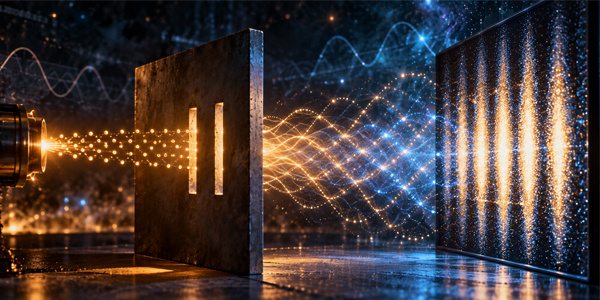
Imagine a barrier containing two very narrow slits, with a detection screen positioned behind it. If we fired tiny classical particles toward the barrier, we would expect roughly two regions to form on the screen where the particles land most frequently. This is approximately the behavior we would expect from tiny balls.
With light and quantum particles, however, something very different can happen. If no information is available about which slit the particle passed through, the appropriate experimental setup can gradually produce an interference pattern – alternating regions where particles are more or less likely to appear. Such patterns are characteristic of waves.
Even stranger, the particles can be sent through the apparatus one at a time. Each produces an individual point on the detector, yet after many repetitions those points gradually build up an interference pattern. Quantum theory describes this through a superposition of possible paths rather than the classical idea that the particle must have selected one predetermined route.
But if the experiment is arranged so that we can determine which slit the particle passed through, the interference disappears.
And this raises the question: When exactly is it determined whether a quantum object will display wave-like or particle-like behavior?
John Wheeler and the “Delayed-Choice” Experiment
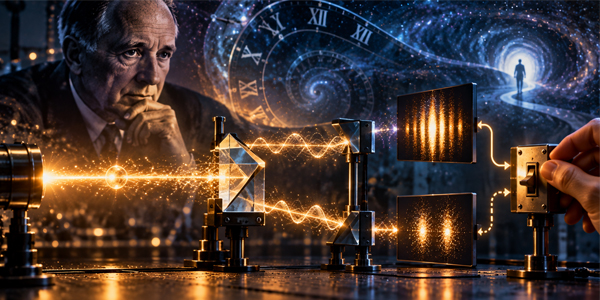
What would happen if we decided what to measure only after a photon had already begun its journey through an experiment? This question lies at the heart of one of the most provocative ideas proposed by American physicist John Archibald Wheeler – one of the major figures in 20th-century physics, whose work ranged from nuclear physics to general relativity and black holes. His “delayed-choice” experiment challenges the seemingly obvious idea that a quantum particle must have a clearly defined history in advance.
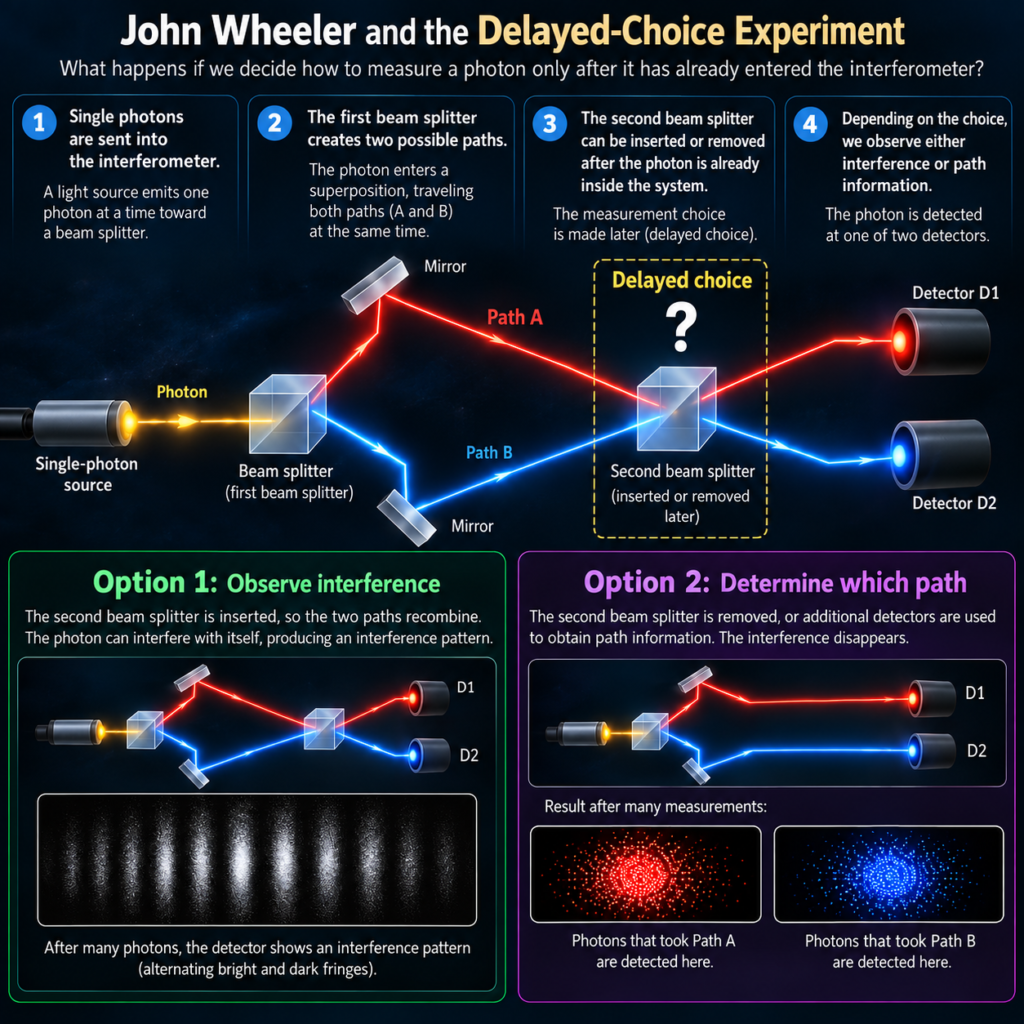
The easiest way to understand the idea is through a device called an interferometer. Inside it, a photon reaches a special optical component called a beam splitter, which creates two possible paths. Our classical intuition immediately tempts us to imagine that the photon simply chooses one route, but quantum mechanics allows for a different description: the two possibilities can remain in a superposition.
The experiment can then be completed in two different ways. If the two possible paths are recombined in the appropriate way, they can interfere, and the outcome depends on the relative phase between them. If, however, the system is configured so that we can distinguish which path the photon was detected through, we obtain path information and do not observe the same interference result.
This alone already shows how different the quantum world is from our everyday experience. Wheeler, however, made the idea far more radical by proposing that the experimenter should not decide in advance which of the two types of measurement to perform. Instead, the choice is delayed until a moment when the photon has already passed through the first beam splitter and entered the system.
This is where the name delayed-choice experiment comes from. The final configuration is determined so late that, if we think of the photon as an ordinary classical particle, we would expect it to have already “decided” how it traveled. Yet only afterward does the experimenter choose whether to use a configuration that allows interference to be observed or one that allows the paths to be distinguished.
This creates the apparent paradox. Suppose the photon had chosen a specific route at the first beam splitter and behaved like a tiny classical particle throughout the experiment. How, then, could a measurement configuration chosen later be compatible with an interference result? On the other hand, if we assume that the photon had already “decided” to behave as a superposition of both paths, it seems as though it would somehow have needed to know how the future measurement would be arranged.
From here, it is easy to arrive at the sensational idea that the photon “knows what will happen in the future.” Another possibility sounds even stranger – perhaps the decision made by the experimenter later travels backward through time and changes what the photon did earlier. The experiment, however, does not force us to accept either of these explanations.
The real problem appears when we try to give the quantum system a classical biography. We assume that at every moment the photon must have been a tiny object traveling along one specific route and that this route must have existed as a definite fact independently of the future measurement. Quantum mechanics does not require such a predetermined classical history.
Instead of telling us that the photon necessarily traveled along one precisely defined classical trajectory, the theory describes its quantum state and the probabilities of possible outcomes for a given type of measurement. What we can experimentally establish about the system is connected to the entire measurement configuration. Therefore, the question “Which path did the photon really take before we decided how to measure it?” does not necessarily have the same unambiguous answer that it would have for a classical particle.
This is where the true power of Wheeler’s proposal lies. The delayed-choice experiment does not require the present to literally rewrite the past. Rather, it exposes the problem with our assumption that a quantum object must have possessed one definite classical past independently of the measurement. This distinction is crucial because it removes the need to imagine a signal mysteriously traveling backward through time.
Later, different versions of Wheeler’s idea were actually realized in laboratory experiments using photons and optical systems. The measurement configuration can be chosen after the photon has already entered the interferometer. The observed results agree with the predictions of quantum mechanics and do not require a predetermined classical behavior that is later altered by the future.
Wheeler went even further and proposed a cosmic version of the thought experiment. Imagine a photon arriving from an extremely distant quasar, whose light has been traveling toward us for billions of years. Between the quasar and Earth lies a massive galaxy whose gravitational lensing can bend the light in such a way that multiple possible paths toward us exist.
The measurement can be chosen only when the light finally reaches Earth – billions of years after it passed the intervening galaxy. If we insist on the classical picture in which the photon must have definitively “chosen” what it was doing back then, a remarkable problem emerges. Our choice of measurement today seems to have some connection to whether the light followed a specific path or a quantum description involving multiple possibilities during an era when Earth, or even the Solar System, may not yet have existed.
This cosmic picture demonstrates why Wheeler’s question is so profound. If we assume from the beginning that the photon must have possessed one completely definite classical history, the results begin to look as though the future measurement somehow had to be “taken into account” in the distant past. The quantum description does not require this conclusion because it does not force us to assign such a classical history to the photon in the first place.
This also means that the delayed-choice experiment is not a time machine. It does not allow us to send information to yesterday, nor can we use it to warn our past selves about an event that has not yet happened. In this practical sense, the experiment does not violate causality.
Yet a far more interesting question remains. Perhaps the problem is not our understanding of the direction of time, but our expectation that the quantum world must possess the same kind of clearly defined past as the objects of everyday experience. Wheeler’s experiment does not necessarily show that the future changes the past – it shows how difficult it is, at the quantum level, to speak about “what has already happened” using entirely classical ideas.
Does the Particle Know What We Will Do in the Future?
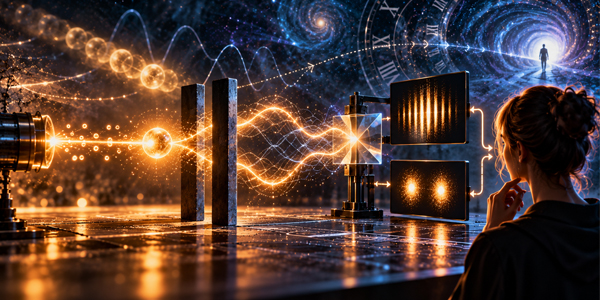
That is the tempting way to interpret the results. It can appear as though the photon somehow “knows” in advance which measurement we will perform and adjusts its past behavior according to our future experimental choice. But the word “knows” is deeply misleading here.
Quantum mechanics does not say that a particle thinks, predicts the future, or mysteriously receives information backward through time. Instead, the theory warns us against automatically assuming that the particle possessed one uniquely defined classical behavior before it was measured. This is one of the reasons delayed-choice experiments are so philosophically provocative.
In short:
-
A future measurement has not been shown to physically “rewrite” the past.
-
The experiment reveals the limitations of the classical idea of a predetermined path.
-
Different experimental configurations reveal different quantum relationships.
-
The results can be described by standard quantum mechanics without sending a signal backward through time.
Even Stranger: The Quantum Eraser
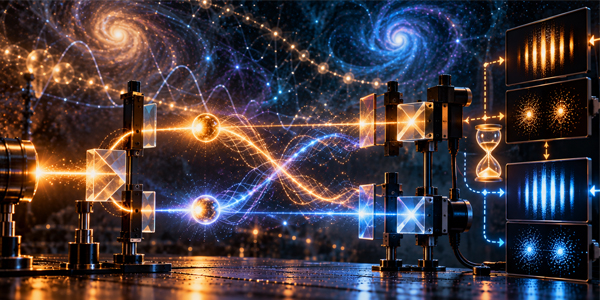
If John Wheeler’s delayed-choice experiment seems strange, the quantum eraser takes the idea even further. Here, it is no longer simply a question of whether we measure the path of a single photon or allow its different possibilities to interfere. In some versions of the experiment, pairs of related quantum particles are used, and information about the path of one can be preserved or “erased” through the way the other is measured.
The name “quantum eraser” can easily create the wrong impression. Nothing is erased from the past, and previously recorded results are not physically changed. What is “erased” is the possibility of determining which path is associated with a particular quantum result.
To understand why this matters, we need to return to interference. When a quantum system has two indistinguishable possibilities – for example, when a photon can be associated with Path A or Path B – those possibilities can participate in interference. If, however, information exists within the experiment that makes the two paths distinguishable, the interference can disappear.
There is a very important detail here: a human observer does not actually need to look at the path information. What matters is the physical setup and whether the different alternatives have become distinguishable within the quantum state of the entire system. Therefore, the popular idea that human consciousness somehow “causes the wave function to collapse” does not follow from this experiment.
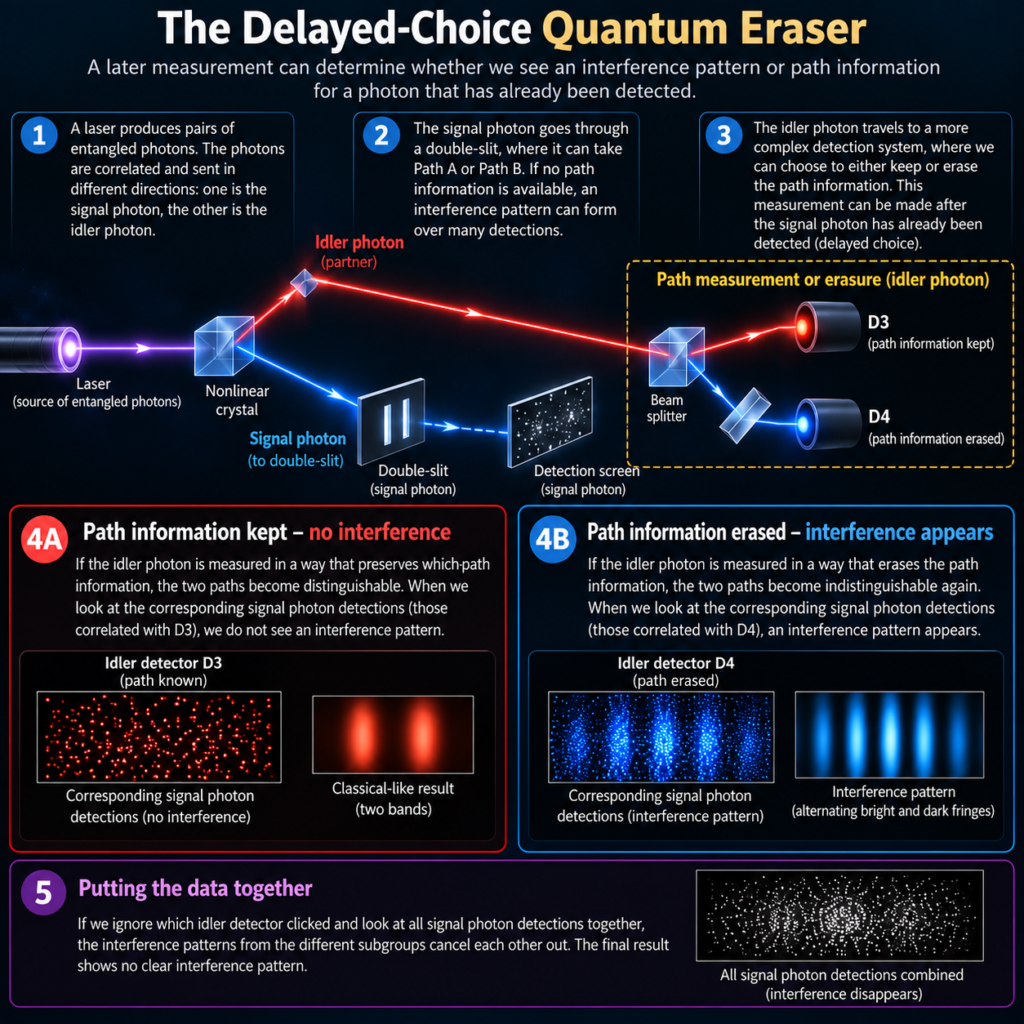
The quantum eraser exploits precisely this relationship between path information and interference. One of the best-known ways to perform the experiment involves creating pairs of photons that are quantum-correlated and, in suitable experimental arrangements, entangled. For convenience, the two photons are often called the signal photon and the idler photon.
Imagine that the signal photon is sent directly toward a detector that records the position where it arrives. Its partner – the idler photon – is sent through a more complicated system of optical components and detectors. This system is designed so that, for some outcomes, it remains possible to determine which alternative the photon pair is associated with, while for other outcomes that information becomes unavailable.
And this is where things begin to get strange. The signal photon may already have reached its detector and its result may already have been recorded while the idler photon is still traveling through its part of the apparatus. The idler photon can therefore be measured later.
At first glance, this creates an astonishing situation. The later measurement of the second photon determines whether the data can be grouped in a way that reveals an interference structure or in a way that provides information associated with the path. If we think entirely in classical terms, it can appear as though a decision or event in the future determines how the first photon behaved in the past.
But this is where we need to be extremely careful.
Imagine that the signal detector has recorded 100,000 photons. If we examine all of those detections together, they do not reveal a hidden interference pattern that suddenly appears or disappears depending on the later measurement. The complete dataset looks in such a way that an observer cannot determine from it alone what happened – or what will happen – to the partner photons.
We then take the information from the idler detectors and compare which photon pairs belong together. Only then can we divide the original signal-photon detections into different subgroups according to the outcomes of their idler partners. And it is within some of these subgroups that interference structures can appear.
This is one of the most frequently overlooked details of the delayed-choice quantum eraser. We do not usually obtain one single interference pattern hidden inside the complete dataset. Different subgroups can form complementary interference patterns, sometimes described as “fringe” and “anti-fringe.”
Where one subgroup has a maximum, another may have a minimum. When all of the results are mixed together, these structures obscure one another and the overall interference pattern disappears. Only when the results are sorted according to the correlations between the signal and idler photons does the structure become visible.
This is extremely important because it means that the person observing the first detector cannot simply look at the data and determine how the second photon was, or will be, measured. The results on their own contain no readable message from the future. Additional information from the other detectors is required, and the two datasets must be compared.
We can imagine this using a simplified analogy. Suppose you have a huge box containing red and blue cards, but you view them under lighting that makes the colors indistinguishable. At first glance, the cards appear to form one chaotic collection with no visible structure.
Later, you receive a list that allows you to separate the cards into two groups. After sorting them, you discover that one group contains a particular pattern while the other contains an opposite pattern. This does not mean that the list you received later somehow changed the cards that were already inside the box.
The situation in the quantum eraser is considerably deeper than this analogy because we are dealing with genuine quantum superpositions, entanglement, and interference. But the basic idea remains useful: later sorting of the results can reveal structure in the correlations that is not visible in the original data by itself.
This is precisely why the term “quantum eraser” must be understood carefully. We are not taking an event that has already occurred and erasing it from history. What changes is the way information about the different quantum alternatives is available and the way the results can be correlated.
Even more provocative is the delayed-choice version of the experiment. In this version, the apparatus is arranged so that the signal photon can be detected before its idler partner reaches the corresponding detector. It is precisely this sequence in time that makes the experiment appear as though something happening later determines an earlier behavior.
In 2000, a famous experimental realization of the delayed-choice quantum eraser was published by Yoon-Ho Kim and his colleagues. In the experiment, correlated photons traveled through different optical paths so that the detection of one could occur before the corresponding measurement of the other. The results demonstrated the predicted quantum correlations, but they did not provide any way to send information backward through time.
That final clarification is crucial. If the second photon could be used to controllably alter the pattern already recorded at the first detector, we could theoretically encode information. For example, we could use one type of measurement to represent “0” and another to represent “1,” thereby transmitting a message to a moment before our choice was made.
But this does not work. The observer at the signal detector cannot determine whether the other side obtained an outcome associated with preserved or erased path information. The relevant relationships become visible only after the two sets of results are compared through ordinary communication, which neither travels backward through time nor exceeds the speed of light.
The delayed-choice quantum eraser is therefore not evidence that we can send messages into the past. It does not allow us to change an event that has already been recorded, nor can we make yesterday’s detector display a different result depending on a decision we make today. Causality, in this practical sense, remains intact.
So why is the experiment so important? Because it demonstrates how misleading it can be to try to give quantum particles a simple classical history. If we insist that every photon must have decided in advance whether it traveled along one particular path and whether it behaved like a particle or a wave, the sequence of events begins to appear almost paradoxical.
Quantum mechanics offers a different way of thinking about what happens. Instead of assigning each particle a completely definite classical biography, we describe the overall quantum state and the correlations between the possible outcomes of measurements. In this picture, the future does not need to literally travel backward and “correct” the past.
Yet this does not make the experiment any less astonishing. On the contrary, it raises an even deeper question: Can we really talk about the past of a quantum system in the same way that we talk about the past of a classical object?
With a football, we can comfortably say where it was five seconds ago regardless of whether anyone was watching it. With a quantum system, however, questions such as “Which path did it take?” and “What exactly was it doing before the measurement?” can become inseparably connected to the experiment we performed and to what information is physically available.
The most accurate conclusion from the quantum eraser, therefore, is not that “the future changes the past.” Rather, the experiment shows that quantum reality cannot always be described as a sequence of predetermined classical events simply waiting to be discovered.
And this is precisely what makes the delayed-choice quantum eraser so remarkable. It does not give us a time machine, but it forces us to question something almost as fundamental – what it actually means to say that an event “has already happened” in the quantum world.
Does This Mean We Can Change a Result That Has Already Been Recorded?
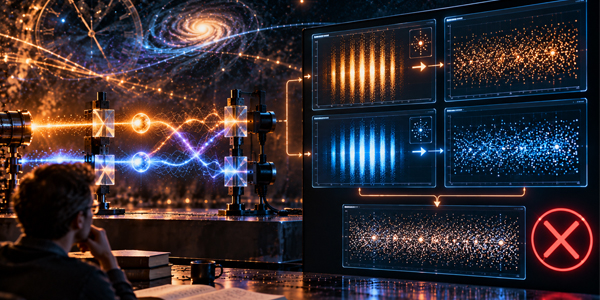
No. This is perhaps the most important clarification in the entire discussion.
If we examine only the results from the first detector, we do not see a future choice magically transforming events that have already been recorded. The interference structure appears when the results are sorted according to their correlations with measurements of the other photon. Different subsets of the data can display complementary interference structures that obscure one another when all of the results are viewed together.
This means that a person observing the first detector cannot simply look at the screen and discover which choice will be made later. To reveal the relevant correlations, the data from the different detectors must be compared. For this reason, the delayed-choice quantum eraser does not provide a mechanism for sending usable information into the past.
This is precisely where many popular explanations of the experiment become misleading.
Imagine It as Two Piles of Hidden Photographs

We can use a simplified analogy. Imagine receiving a huge pile of photographs that, at first glance, appear completely random. Looking at the entire pile, you cannot see any meaningful pattern.
Later, someone gives you information that allows you to divide those photographs into different groups. Once they are sorted, you discover that one group contains a particular pattern while another contains an opposite pattern. This does not mean that the future act of sorting physically changed the photographs in the past.
The analogy does not reproduce quantum mechanics perfectly, but it illustrates one crucial idea: A structure that is invisible in the complete dataset can emerge through correlations between different parts of that data.
This is why the claim that “scientists have proven that the future changes the past” goes too far.
But Why Does the Experiment Seem So Paradoxical?
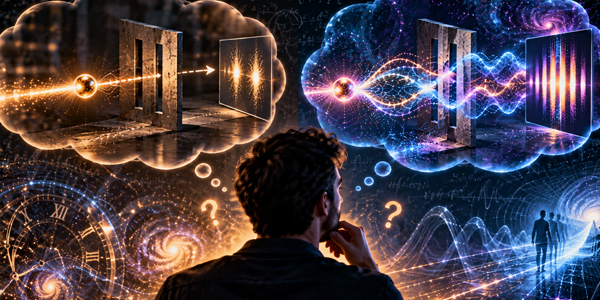
Because intuitively, we want to imagine the photon as a tiny ball with a clear history. It must have traveled somewhere, so we naturally assume that even before the measurement there should have been one definite answer to the question, “Which path did it take?”
Quantum mechanics does not always allow us to tell the story in this way. It predicts probabilities and correlations between possible measurements, while some properties cannot simply be treated as pre-existing classical facts independent of the measurement context.
Delayed-choice experiments can therefore be understood not as proof that the future changes the past, but as a warning that classical concepts such as “what happened” and “which path the particle took” cannot always be transferred directly into the quantum world.
But Is True Retrocausality Possible?
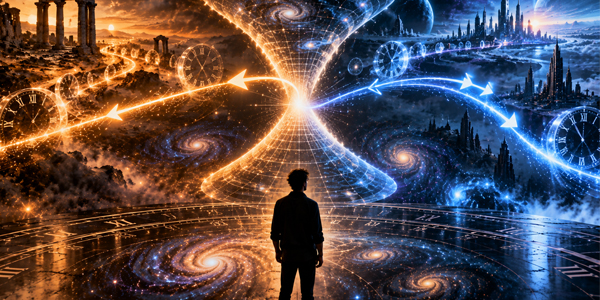
This is where the subject becomes even more fascinating. There are interpretations and theoretical approaches to quantum mechanics in which time symmetry or influences described as retrocausal are taken seriously. However, this is very different from claiming that the delayed-choice quantum eraser has experimentally proven that information can travel backward through time.
Retrocausality, broadly speaking, is the idea that future conditions or events may somehow participate in the causal description of earlier events. It is a subject of serious discussion within research on the foundations and interpretations of quantum theory, but it is not an established experimental fact in the sense that “we can change the past.” Analyses of delayed-choice quantum eraser experiments show that the observed results can be understood without assuming a physical signal traveling backward through time.
We therefore need to separate two very different claims:
-
“Quantum physics contains strange relationships involving time and causality.” – Yes, and they remain the subject of serious scientific research.
-
“Experiments prove that we can send information into the past.” – No.
That distinction is essential.
Could We Send a Message to Ourselves in the Past?

If the quantum eraser really allowed controlled information to be sent backward through time, the consequences would be extraordinary. We could, for example, send tomorrow’s winning lottery numbers to ourselves today or warn someone about an event that has not yet happened. This would immediately introduce the famous paradoxes associated with time travel.
But the experiments do not allow us to do this. The local results appear random, and the relevant structure becomes visible only after different sets of data are appropriately compared. There is no known way to control these quantum outcomes so that a meaningful message can be encoded and transmitted to our own past.
Quantum mechanics can be extraordinarily strange without becoming a time machine.
Quantum Entanglement Makes the Mystery Even Deeper
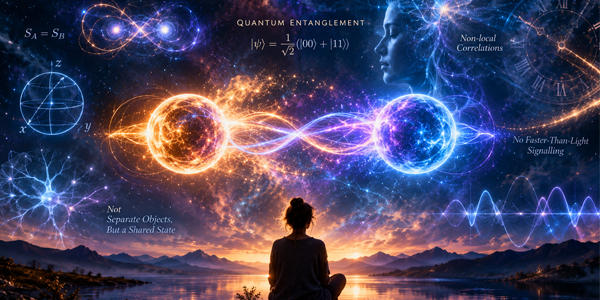
At the heart of many of these experiments lies quantum entanglement. When two quantum systems are entangled, their combined state cannot always be described simply as two independent systems, each possessing its own separate set of properties. Measurements performed on them reveal correlations that are a fundamental part of quantum theory.
This does not mean that one particle sends a controllable message to the other faster than the speed of light. In the same way, delayed-choice experiments do not automatically mean that information is being sent backward through time. What quantum mechanics challenges is our intuitive picture of how independent objects should possess definite properties before they are measured.
And this is precisely why quantum physics remains so philosophically fascinating more than a century after its creation.
What If the Problem Is Our Concept of the Past Itself?

This brings us to the deepest part of the question. When we say, “The photon traveled along this path,” we are describing a quantum system using the language of the everyday world. But perhaps nature at the microscopic level simply does not possess one completely definite classical history of the kind we intuitively expect.
Delayed-choice experiments demonstrate how dangerous it can be to assume that all the properties we measure at the end of an experiment must necessarily have existed in exactly the same form throughout the entire process. In the standard quantum-mechanical description, the measurement context plays a fundamental role in determining what probabilities and correlations can be observed.
The question therefore begins to change. Instead of asking “How does the future change the past?”, perhaps the more appropriate question is “Was there ever a single classical version of the past that the quantum system followed?”
What Do the Experiments Actually Show?
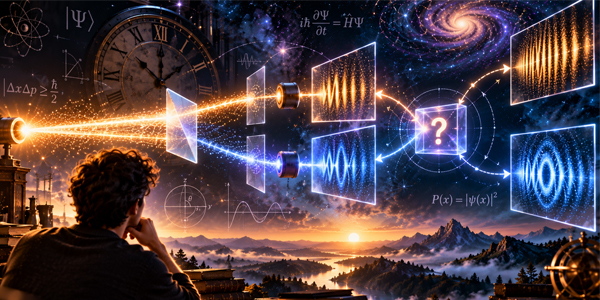
After all the strangeness, we can reduce the results to several key conclusions:
-
Quantum systems cannot always be described as classical particles following predetermined trajectories.
-
The way a system is measured determines what type of information can be extracted from it.
-
The choice of measurement can be made very late in the experiment.
-
Delayed-choice experiments can create the powerful impression that a future decision determines past behavior.
-
This impression does not mean that an event already recorded has literally been changed.
-
The delayed-choice quantum eraser does not allow controlled information to be sent backward through time.
-
Retrocausal ideas remain an interesting part of discussions about the foundations and interpretations of quantum mechanics, but they have not been proven by these experiments.
Does the Future Change the Past?
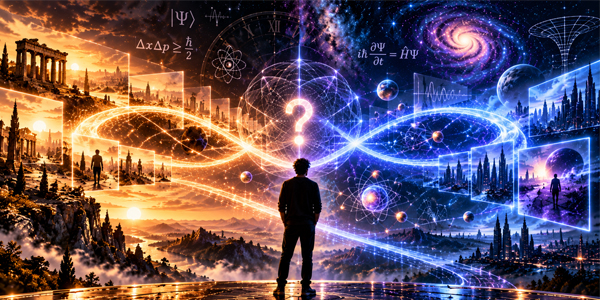
If by “changing the past” we mean that a decision made today can physically alter an event that already happened yesterday, we have no experimental evidence that this is possible. Neither Wheeler’s delayed-choice experiment nor the delayed-choice quantum eraser gives us a machine capable of rewriting history. Their results can be described within quantum theory without requiring a usable signal traveling backward through time.
But if the question is whether quantum physics challenges our simple assumption that every particle always possesses one clearly defined classical history independent of how we measure it, then the answer becomes much more provocative. This is one of the great lessons of delayed-choice experiments and one reason they continue to fascinate both physicists and philosophers.
Conclusion: The Past May Be Stranger Than It Seems

Quantum physics has not given us evidence that we can travel backward through time or alter events that have already happened. Instead, it has given us something perhaps even more unusual – a reason to question whether our everyday concepts of “path,” “event,” “cause,” and even “what happened” can be applied seamlessly to the fundamental level of nature.
Delayed-choice experiments demonstrate that quantum reality does not fit easily into the story our classical intuition wants to tell. A measurement made later can determine what kinds of correlations we can reveal about a system that has already been detected, without implying that information actually traveled backward through time.
And perhaps this is where the most fascinating idea lies. Quantum physics may not be showing us that the future changes the past – it may be showing us that the very concept of a completely definite past is far more subtle than we ever imagined.
Read more:
- Quantum Field Theory – Does Anything Truly Exist?
- The Genius of Albert Einstein: Understanding the Special Theory of Relativity
- Einstein’s General Theory of Relativity: How Gravity Shapes Space, Time, and the Universe
- What Does the Fourth Dimension Look Like? Science, Mathematics, and the Mystery of an Invisible Reality
Author: Vasil Stoyanov