Introduction
In the history of Islamic thought, few figures have had as deep and lasting an influence as Abu Hamid Muhammad al-Ghazali. He was at once a theologian, philosopher, jurist, teacher, spiritual guide, and mystic who devoted his life to the search for certain knowledge. His works transformed the way generations of Muslims understood the relationship between reason and faith, external religious law and inner spiritual life.
Al-Ghazali was not a thinker who arrived at his convictions through blind acceptance of tradition. On the contrary, his path passed through radical doubt, intellectual crisis, renunciation of social status, and long years of solitude. He explored the various schools of his time, studied philosophy so thoroughly that he could present it more clearly than many of its defenders, and ultimately concluded that only knowledge that transforms the human heart deserves to be called true wisdom.
Because of his immense influence, later generations gave him the honorary title “Hujjat al-Islam,” meaning “The Proof of Islam.” This title is not due solely to his defense of religion against the philosophical and theological challenges of his era. It also expresses the belief that al-Ghazali succeeded in restoring the living connection between knowledge, morality, and spiritual experience.
For him, religion is not exhausted by the correct performance of rituals, and philosophy should not become an endless play of concepts. A person may know the law, quote sacred texts, and defeat opponents in debate, yet remain inwardly governed by pride, greed, and envy. True knowledge begins when it transforms the one who possesses it.
It is precisely in this that al-Ghazali’s extraordinary relevance lies. He lived in the 11th century, yet posed questions that continue to trouble modern people. Can reason reach absolute truth? How can we distinguish genuine faith from inherited belief? Why does success not necessarily bring inner peace, and how can a person purify the heart from the forces that distance it from its own spiritual essence?
Childhood in Tus and the Beginning of the Spiritual Quest
Al-Ghazali was born around 1058 in the city of Tus, located in the region of Khorasan in present-day Iran. His full name was Abu Hamid Muhammad ibn Muhammad al-Ghazali, and his family lived modestly, not belonging to the political or social elite. Nevertheless, his father held deep respect for religious knowledge and wished his sons to receive the education he himself had never had.
According to traditional accounts, his father entrusted al-Ghazali and his brother Ahmad to a close friend associated with the Sufi way of life. After the father’s death, the remaining funds were gradually exhausted, and the two brothers were sent to a religious school where they could receive food and education. Thus, poverty, which might have interrupted their studies, unexpectedly became the reason they devoted themselves even more deeply to knowledge.
From a young age, al-Ghazali displayed remarkable memory, a sharp mind, and an extraordinary ability to understand complex arguments. He studied Islamic law, theology, logic, and the Arabic language, gradually distinguishing himself among his peers. For him, however, learning was not merely a means of social advancement, but a way to attain certainty in a world filled with conflicting teachings.
Later, al-Ghazali admitted that his quest for truth began in his early years. He observed that most people accept the religion of their family and society without questioning why it is true. Christian children grow up as Christians, Jewish children as Jews, and Muslim children as Muslims, which led him to question whether inherited faith is a sufficient foundation for certain knowledge.
This question did not turn him into an opponent of religion, but into an uncompromising seeker. Al-Ghazali did not wish simply to repeat the beliefs of his surroundings. He wanted to discover a truth that would not collapse at the first serious doubt and that could withstand both philosophical objections and the inner uncertainties of the human soul.
Education in Nishapur and the Rise of a Young Scholar
After his initial education, al-Ghazali traveled to Nishapur, one of the great intellectual centers of the Islamic world. There he became a student of the renowned theologian and jurist al-Juwayni, known by the honorary title Imam al-Haramayn. Under his guidance, the young scholar studied Shafi‘i law, Ash‘arite theology, logic, dialectics, and the methods of philosophical debate.
Al-Juwayni quickly recognized the extraordinary abilities of his student. Al-Ghazali was not satisfied with memorizing ready-made answers, but sought out the weaknesses in every argument and compared opposing positions. This intellectual independence sometimes made him an uncomfortable interlocutor, but at the same time turned him into one of the most brilliant minds of his generation.
After the death of his teacher, al-Ghazali joined the court of the influential Seljuk vizier Nizam al-Mulk. There he participated in discussions with the most prominent scholars of the time and gained a reputation as an unmatched theologian and polemicist. His ability to defend a position with logical precision and eloquence opened the way to the most prestigious academic post in the Islamic world.
In 1091, when he was just over thirty years old, al-Ghazali was appointed chief professor at the famous Nizamiyya in Baghdad. This institution attracted students from across the Muslim world and played a major role in the religious and intellectual life of the era. His lectures were attended by hundreds, and his opinions began to influence theological, legal, and social matters.
Outwardly, he appeared to have reached the pinnacle of success. He possessed fame, authority, respect, and material security, and his words were heeded by rulers and scholars. Yet inwardly, he began to feel that this success rested on an uncertain foundation, for behind his pursuit of knowledge he discovered a desire for prestige and approval.
Doubt and the Crisis of Certain Knowledge
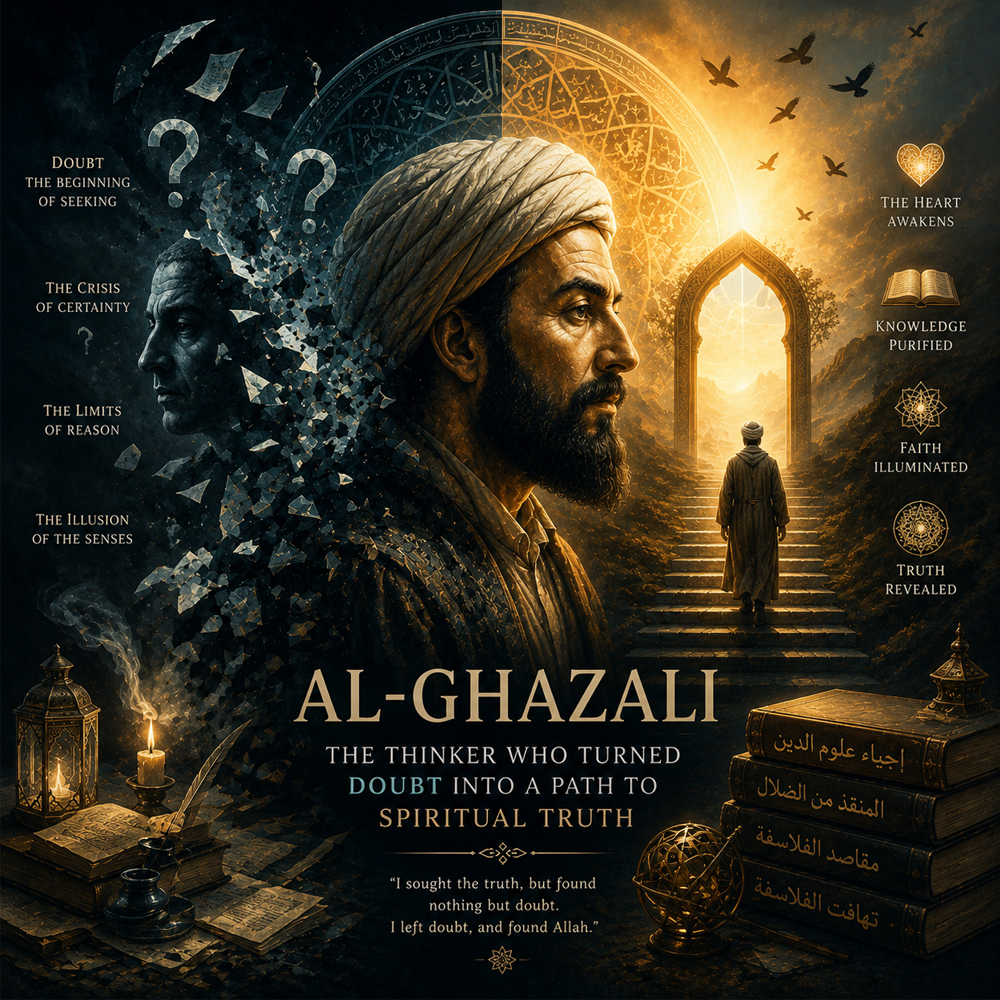
Al-Ghazali recounts his intellectual crisis in his autobiographical work “Deliverance from Error.” In it, he describes how he began to question not only religious teachings but also the very faculties through which humans acquire knowledge. He sought a certainty in which the possibility of error would be completely excluded.
He first doubted the senses. For example, the eye shows us that a shadow stands still, yet careful observation reveals that it is gradually moving. The stars appear small, although reason proves they are far larger than what we directly perceive.
Thus, sensory perception cannot be the ultimate foundation of certainty. Al-Ghazali turned to reason and to self-evident logical principles, but soon an even deeper doubt arose. Just as reason refutes the senses, might there not exist a higher faculty that could one day reveal the limitations of reason itself?
He compared ordinary consciousness to dreaming. While a person dreams, experiences seem real, but upon waking, one realizes they belonged to a different state. Could earthly life also resemble a dream from which one awakens through spiritual insight or after death?
This crisis lasted for months and could not be resolved by logical arguments alone. Al-Ghazali writes that certainty in fundamental truths returned through a light that God cast into his heart. In this, he does not reject reason, but acknowledges that reason alone cannot prove its own absolute reliability.
Thus, doubt becomes not the end of faith, but a means of its purification. Al-Ghazali does not return to the naive acceptance of tradition with which he began. He arrives at a deeper faith that recognizes the limits of human faculties and does not confuse intellectual confidence with complete knowledge of truth.
Exploring the Different Paths to Truth
In his search, al-Ghazali examined four main groups that claimed to possess true knowledge: theologians, philosophers, adherents of esoteric teachings, and Sufis. He refused to reject any school before understanding its arguments from within.
The theologians defended the core tenets of faith through rational arguments. Al-Ghazali acknowledged the importance of their work, especially in refuting opponents of religious tradition. However, he believed that theology often remained limited by its aim of defending pre-established beliefs and did not always lead to direct spiritual knowledge.
Esoteric teachings claimed that truth could be obtained only from an infallible spiritual authority. Al-Ghazali analyzed their arguments but rejected dependence on a person whose infallibility itself must be proven. In his view, such a position does not solve the problem of certainty but merely shifts it to another foundation.
The most serious intellectual challenge came from the philosophers. To evaluate them fairly, al-Ghazali studied their works for years. He became deeply acquainted with the legacy of Aristotle and Neoplatonism, as well as with the teachings of major Islamic philosophers such as al-Farabi and Ibn Sina.
The result was the book “The Intentions of the Philosophers,” in which he presented their ideas so clearly that it was later used as an introduction to philosophy. Only after demonstrating that he understood their system did al-Ghazali publish his critique. This approach reflects his conviction that one has no right to reject a doctrine that has not been studied in its strongest form.
“The Incoherence of the Philosophers”
Al-Ghazali’s most famous philosophical work is “The Incoherence of the Philosophers.” In it, he examines twenty propositions related to metaphysics and nature, attempting to show that philosophers have not proven their conclusions with the necessity they claim. His aim is not to destroy reason, but to distinguish convincing proof from assumptions presented as absolute truth.
Al-Ghazali does not reject mathematics, logic, or medicine. He acknowledges that these sciences can reach reliable results and warns religious people not to deny them without reason. If someone attacks a proven mathematical truth in the name of faith, they do not defend religion but make it appear hostile to evident knowledge.
His disagreement is directed primarily at the metaphysical claims of philosophers. He criticizes ideas about the eternity of the world, the way God knows particular events, and the nature of resurrection. In his view, these teachings do not necessarily follow from reason but represent unproven interpretations.
Particularly well known is his critique of necessary causality. When fire touches cotton and it burns, people assume that fire itself causes the burning. Al-Ghazali argues that we observe only the constant conjunction of the two events, not any invisible necessity linking them.
For him, God is the immediate source of everything that occurs. Fire has no independent creative power, and the regular order of nature is maintained by divine will. This does not mean the world is chaotic, because God consistently creates phenomena according to an established order that allows humans to study nature and act rationally.
Later, some interpreters accused al-Ghazali of dealing a blow to science in the Islamic world. Such claims oversimplify both his position and the complex history of Islamic civilization. He does not reject the study of nature but questions the philosophical belief that natural laws exist entirely independently of God.
The Spiritual Crisis in Baghdad
As his intellectual influence continued to grow, al-Ghazali’s inner crisis deepened. He began to examine his own motives and discovered that the love of fame had infiltrated even his religious activity. Teaching and writing appeared noble, yet behind them he sensed a desire to be recognized as the greatest scholar of his time.
This realization placed him before a painful choice. His reason told him to leave Baghdad and devote himself to spiritual purification, but attachment to status, family, and security held him back. For months, he wavered between the voice of conscience and the pull of his social ambitions.
The crisis gradually affected his body as well. Al-Ghazali lost the ability to speak before his students and could not swallow food normally. Physicians found no purely physical cause and concluded that his condition was linked to deep psychological distress.
In 1095, he left Baghdad, renouncing his prestigious position, wealth, and influence. Officially, he declared that he was going on pilgrimage, likely to avoid interference from authorities and social pressure. In reality, he began a period of wandering, solitude, and spiritual practice that would transform his entire understanding of religion.
This decision lies at the heart of his life. Al-Ghazali no longer wished merely to know what the Sufis said about purifying the soul. He wanted to walk their path himself and turn intellectual convictions into direct experience.
Encounter with Sufism
Al-Ghazali concluded that the Sufis were not merely people who possessed a particular theory. Their path was based on practice, inner discipline, remembrance of God, and liberation from selfish attachments. Sufism cannot be fully understood through reading, just as the taste of honey cannot be known solely through definition.
He spent periods of seclusion in Damascus, Jerusalem, and other places associated with religious life. He withdrew from society, devoted himself to prayer, reflection, and observation of his own heart. He sought not extraordinary visions, but freedom from pride, hypocrisy, and the hidden desire for superiority.
According to al-Ghazali, the human heart is like a mirror. When it is covered with the dust of passions, it cannot reflect spiritual truth. Through sincerity, self-observation, and moral discipline, the mirror is gradually cleansed, and a person begins to perceive reality in a way inaccessible to purely theoretical knowledge.
The Sufi experience allowed him to reconcile what had previously seemed divided. Religious law provides the necessary form for human actions, but inner purification gives them life. Reason protects against error and superstition, but spiritual insight reveals dimensions of truth that logic alone cannot produce.
Al-Ghazali did not wish Sufism to be separated from Islamic tradition. He criticized both the dry formalism of some legal scholars and the mysticism that neglects moral and religious obligations. In his view, the true spiritual path combines external discipline, correct understanding, and inner transformation.
“The Revival of the Religious Sciences”
Al-Ghazali’s most influential work is “The Revival of the Religious Sciences.” In it, he seeks to restore a comprehensive understanding of religion that unites rituals, morality, knowledge, and spiritual life. The book is not merely a theological manual, but a map of the human soul and its journey toward God.
The work is organized around various aspects of religious and everyday life. Al-Ghazali discusses prayer, fasting, charity, marriage, work, eating, friendship, and social conduct. In each topic, however, his focus is not only on the external act, but on the intention that animates it.
A prayer may be performed correctly according to the law, yet remain spiritually empty if the mind is distracted and the heart seeks human approval. Charity may appear generous but be driven by pride. Silence may be a sign of wisdom, but it may also arise from fear.
Thus, al-Ghazali turns morality into a profound psychology of intention. For him, the spiritual value of an action is not determined solely by its visible form. One must examine the hidden motives that often remain unnoticed even by oneself.
“The Revival of the Religious Sciences” also examines the destructive qualities of the soul, including pride, envy, greed, anger, and excessive attachment to the world. Al-Ghazali does not describe them as abstract sins, but as diseases of the heart. Like bodily illnesses, they have causes, symptoms, and methods of treatment.
Against them, he sets the saving virtues: repentance, patience, gratitude, hope, reverence, love, and trust in God. These qualities are not acquired through a single decision. They must be practiced until they gradually become a stable part of one’s character.
Knowledge of the Heart
At the center of al-Ghazali’s teaching stands the heart, not merely as a physical organ or the seat of emotions. For him, the heart is the spiritual center of the human person, capable of knowing, choosing, and turning toward God. Reason, desires, and the senses are forces that can serve it, but can also enslave it.
According to him, the human soul is constantly in motion. If it submits to unrestrained desires, it gradually loses its freedom and becomes dependent on fleeting pleasures. If it is guided by reason, discipline, and spiritual awareness, it begins to restore its original purity.
Al-Ghazali does not regard bodily desires as evil in themselves. Hunger, sexual impulse, the drive for security, and even anger have their natural function. The problem arises when these forces cease to be means and become masters of the person.
True moderation does not mean destroying desires, but placing them in proper order. A person incapable of anger could not defend justice, but one ruled by anger becomes a source of injustice. Likewise, wealth can serve good, but love of wealth can enslave the heart.
This psychological depth makes al-Ghazali close to modern quests for self-knowledge. He understands that people often deceive themselves about their own motives and turn their vices into virtues. Pride can disguise itself as dignity, envy as a desire for justice, and the thirst for power as concern for others.
Happiness and Self-Knowledge
In “The Alchemy of Happiness,” al-Ghazali explains that the path to God begins with self-knowledge. A person cannot understand their Creator without knowing their own nature, limitations, and deepest aspirations. Yet self-knowledge does not simply mean knowing what we like or what kind of character we have.
To know oneself means to realize that one is not limited to the body, social role, and transient desires. A person carries a spiritual dimension that cannot be satisfied by wealth, pleasures, or fame. The more one tries to fill inner emptiness with external acquisitions, the more strongly one feels their insufficiency.
Al-Ghazali compares the transformation of the soul to alchemy. Just as alchemists seek to turn base metal into gold, the spiritual person transforms lower impulses into virtues. Anger can become courage, desire can become focused energy, and suffering can become a means of humility and awakening.
Happiness is not momentary pleasure, but harmony between human life and its deepest nature. Every being finds fulfillment when it realizes its purpose. The eyes delight in beauty, the intellect in knowledge, and the heart finds its highest joy in closeness to God.
This happiness does not necessarily require withdrawal from the world. Al-Ghazali does not teach that every person must abandon family, work, and society. The danger lies not in possessing things, but in being possessed by them.
Education as Transformation of the Person
As one of the greatest teachers of his era, al-Ghazali devoted special attention to education. In his view, the goal of knowledge is not for the student to accumulate information or gain social prestige. True education must build character and guide a person toward goodness.
The teacher is not merely a transmitter of facts. He bears responsibility to demonstrate through his own example how knowledge becomes a moral life. If a teacher speaks of humility but seeks fame, or preaches sincerity while using students for personal gain, his words lose their transformative power.
At the same time, the student must free themselves from the pride that makes them believe they already know enough. Al-Ghazali believes that receiving guidance requires trust, patience, and a willingness to see one’s own shortcomings. Knowledge does not penetrate deeply into a heart concerned only with winning arguments.
He distinguishes between useful and useless knowledge. Useful knowledge helps a person fulfill their duties, understand the world, and move toward moral perfection. Useless knowledge may be impressive, but if it feeds pride and distracts from more important questions, it becomes a spiritual burden.
This is not a call to ignorance or intellectual limitation. Al-Ghazali himself possessed encyclopedic knowledge and used logic with exceptional precision. His warning is directed at the illusion that one becomes wise simply by speaking in complex ways.
Return to Teaching and Final Years
After years of wandering and seclusion, al-Ghazali gradually returned to public life. He agreed to teach again for a time in Nishapur, convinced that spiritual withdrawal should not become an escape from responsibility. If knowledge can help others, complete silence may also become a form of selfishness.
Nevertheless, he never fully returned to his former life as a court scholar and celebrated teacher. Fame was no longer his primary goal. During his final years, he settled in his native Tus, where he established a place for the education of students and the spiritual practice of Sufis.
Al-Ghazali continued to write and teach students until the end of his life. He died in 1111, leaving behind an immense literary legacy in the fields of theology, philosophy, law, logic, ethics, and mysticism. His influence soon extended far beyond the boundaries of the Islamic world.
Some of his works were translated into Latin and became known to medieval European thinkers under the name Algazel. His ideas indirectly contributed to the dialogue between Islamic, Jewish, and Christian philosophy. Although his reception in the West was sometimes based on incomplete translations, his presence in the history of global thought remains significant.
Al-Ghazali Between Reason and Faith
Al-Ghazali is often portrayed as an enemy of philosophy, but this characterization fails to capture the complexity of his position. He criticized certain philosophical conclusions while at the same time using logic, philosophical psychology, and rational analysis in his own works. His aim was not to abolish reason, but to place it within a comprehensive understanding of human knowledge.
For him, reason is necessary because without it a person can easily fall victim to superstition, contradiction, and manipulation. Yet reason alone cannot cleanse the heart of pride or produce direct spiritual experience. It can reveal the path leading to the door, but passing through it requires inner transformation.
Faith, for its part, should not fear honest inquiry. A belief that can survive only by forbidding questions remains fragile. Al-Ghazali passed through doubt because he was seeking a faith that was not merely a psychological refuge, but a response to the whole of human nature.
In his teaching, reason, revelation, and spiritual experience are not necessarily enemies. Each has its own domain and its own function. Conflict arises when one faculty claims that it alone can encompass the whole of reality.
The Legacy of Al-Ghazali
Al-Ghazali’s influence on Sunni Islam is difficult to overstate. He helped Sufism become accepted as an essential dimension of religious life while connecting it with theology and religious law. Thanks to him, spiritual purification ceased to appear as the pursuit of a small group of mystics and became a central task for every believer.
His analysis of intention, self-deception, and the diseases of the heart continues to influence Islamic ethics and spiritual psychology. Al-Ghazali demonstrates that a person may appear outwardly righteous while remaining inwardly corrupt, and that genuine change does not take place through the image we present to society. It begins in the hidden realm where our motives are born.
His philosophical criticism also left a lasting mark. Ibn Rushd later responded to The Incoherence of the Philosophers with his own work, The Incoherence of the Incoherence, turning the dispute into one of the great intellectual confrontations of the Middle Ages. This debate reveals the vitality and diversity of Islamic thought, which was never a single, motionless system.
For some, al-Ghazali is primarily a defender of tradition, while for others he is a philosopher of doubt and inner experience. In reality, his strength lies precisely in the combination of these roles. He understands the authority of tradition but refuses to be satisfied with its mechanical repetition; he uses reason but does not turn it into an idol; he follows the mystical path but does not abandon moral discipline.
Why Al-Ghazali Remains Relevant Today
Modern human beings live amid an unprecedented amount of information, but this does not mean that they possess wisdom. We can receive an answer to almost any factual question within seconds, yet we continue to struggle with questions about how we should live and what gives meaning to existence. It is precisely here that al-Ghazali speaks with particular power to our age.
His life demonstrates that external success cannot resolve inner division. He reached the summit of the academic world and nevertheless discovered that public recognition had not made him free. The more people admired his knowledge, the more clearly he saw his own dependence on their admiration.
Contemporary culture constantly encourages people to construct an image, attract attention, and measure their worth through the reactions of others. Al-Ghazali would have recognized in this the ancient disease of the love of fame, clothed in new technological forms. His warning is that a person may gradually lose themselves while trying to become visible to everyone.
He also reminds us of the need to distinguish knowledge from transformation. Reading about humility does not mean that we are humble, just as speaking about compassion does not mean that we are compassionate. Between understanding a truth and turning it into a way of life lies a long process of practice and self-observation.
Finally, al-Ghazali demonstrates that doubt is not always the enemy of spirituality. Sometimes it destroys superficial certainty in order to make deeper knowledge possible. A person who has never questioned their beliefs may possess peace of mind, but not necessarily truth.
Conclusion
Al-Ghazali remains one of the greatest figures in the history of spiritual and philosophical thought because he turned his own life into a test of the ideas he defended. He was not content merely to speak about sincerity, but abandoned his position when he realized that he had become dependent on fame. He was not content to study Sufism through books, but passed through solitude, discipline, and inner purification.
His path began with the pursuit of absolutely certain knowledge and ended with the realization that truth is not merely an object of the intellect. It must be experienced by the whole human being. Reason can recognize arguments, but only a transformed heart can turn knowledge into wisdom.
Al-Ghazali does not call on people to choose between the world and the spirit, between reason and faith, or between law and love. He seeks the proper order in which each faculty occupies its rightful place. The world becomes a problem not when we live within it, but when we allow its fleeting promises to conquer our hearts.
His most important message is both simple and difficult: a person must begin the spiritual search with themselves. Not with the mistakes of others, not with victory in debates, and not with the accumulation of prestigious knowledge, but with the honest observation of their own intentions. There, within the hidden movements of the heart, it is decided whether knowledge will become light or merely another form of pride.
More than nine centuries after his death, al-Ghazali continues to remind us that the longest journey is not the one between cities, countries, or cultures. It is the journey from the surface of our own existence toward its spiritual center. Perhaps the true “alchemy of happiness” begins at the moment when we stop asking only what we can acquire from the world and begin asking what kind of person we are becoming.
Read more:
- Sufism: The Mystical Path to God – History, Secrets, and Great Sufi Teachers
- Jalal ad-Din Rumi – “The Poet Who Turned Pain into a Path to God”
- Farid ud-Din Attar – “The Mystic Who Turned the Soul into a Journey”
- G.I. Gurdjieff – The Mystic, Occultist, and Teacher of the Fourth Way
Author: Vasil Stoyanov