
Who is Krishna?
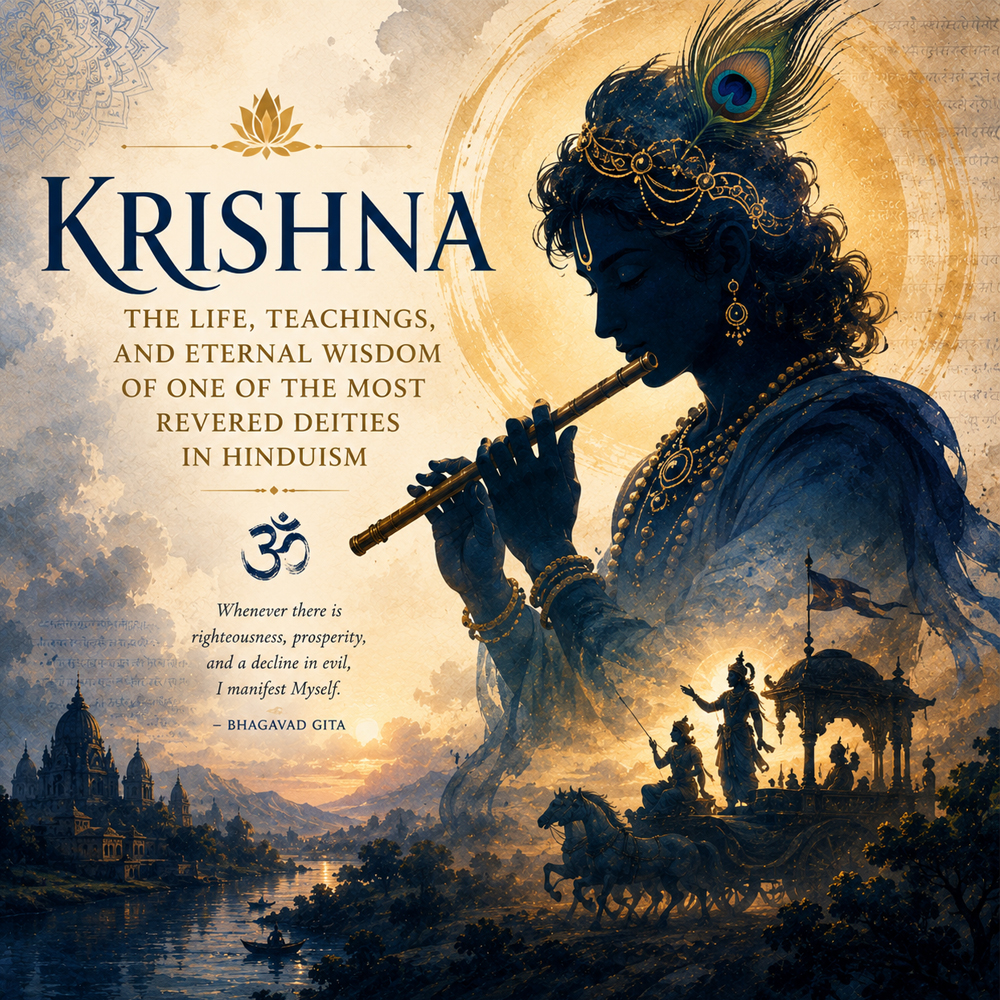
Krishna is one of the most influential and revered figures in the history of global spirituality. For millions of people around the world, he is not merely a mythological hero or a religious symbol, but the embodiment of God himself, a source of unconditional love, wisdom, and compassion. His name is associated with some of the deepest philosophical ideas known to humanity, and his teachings continue to inspire not only religious followers, but also philosophers, scholars, psychologists, and individuals seeking a deeper meaning in life.
The story of Krishna uniquely blends the human and the divine. He is a child who plays among shepherds, a musician who enchants the world with his flute, a friend who remains loyal to the end, a diplomat striving for peace, and a spiritual teacher who reveals the nature of the universe. It is precisely this diversity that makes his image so relatable. He does not stand apart from human experience, but transforms it and gives it spiritual meaning.
In Hinduism, Krishna is considered the eighth incarnation of the god Vishnu or, according to some traditions, the Supreme God himself, from whom all other manifestations of the divine originate. The most famous text in which his teachings reach their peak is the “Bhagavad Gita” – a philosophical dialogue between Krishna and the warrior Arjuna, regarded as one of the greatest spiritual works in human history.
Today, Krishna’s influence extends far beyond the borders of India. His ideas about inner peace, love, freedom from fear, the meaning of action, and the nature of consciousness find a place in modern psychology, philosophy, and spiritual practice. Whether one perceives Krishna as a historical figure, a mythological hero, or a symbol of divine consciousness, his message remains remarkably relevant.
The Historical and Spiritual Context of Ancient India
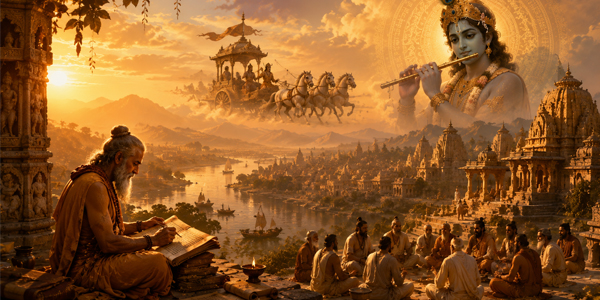
To understand the figure of Krishna, it is necessary to look at the world in which the stories about him emerged. Ancient India represents one of the richest spiritual civilizations in history. Over thousands of years, philosophical schools, religious traditions, and spiritual practices developed there, exploring the nature of humanity, the universe, and consciousness with extraordinary depth.
The earliest layers of Indian spirituality are found in the Vedas – ancient sacred texts that describe the cosmic order, natural forces, and the relationship between humans and the divine. Later came the Upanishads, which turned attention inward toward the essence of consciousness and posed the question of who the true Self really is. It is upon this philosophical foundation that Hinduism gradually took shape as an exceptionally diverse spiritual tradition.
By the time the stories of Krishna developed, India already possessed a complex cultural and philosophical system. Society was organized around kingdoms, spiritual teachers, temples, and various schools that discussed questions such as destiny, karma, rebirth, and liberation. It was a world in which spirituality was not separate from daily life, but permeated every aspect of it.
One of the most important ideas of this period is the concept of dharma – the universal order that maintains harmony in the universe. Dharma does not simply mean moral rules or religious duties. It represents the natural law according to which every being has its place and purpose. This idea would become central to Krishna’s teachings.
At the same time, ancient India experienced periods of political conflict, struggles for power, and social change. This shows that spiritual development has never existed separately from human challenges. The story of Krishna unfolds against this very backdrop – a world in which good and evil constantly intertwine, and people must discover the right path for themselves.
The Birth of Krishna and the Prophecy
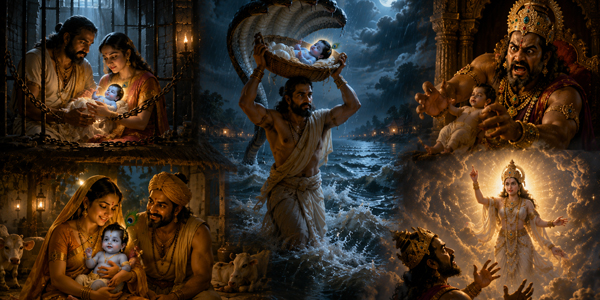
The story of Krishna’s birth begins with a prophecy that changes the fate of an entire kingdom. The ruler Kamsa learns that the eighth child of his sister Devaki will be the cause of his downfall. Driven by fear, he imprisons Devaki and her husband Vasudeva and decides to kill each of their newborn children in order to prevent the prophecy from being fulfilled.
This story carries powerful symbolism. Kamsa does not represent merely a cruel ruler, but the embodiment of ego, fear, and the desire to control the future. The more he tries to avoid his fate through violence, the more he contributes to its realization. This is a theme found in many spiritual traditions – fear gives rise to actions that ultimately lead to what one is trying to escape.
When Krishna is born, according to tradition, many miracles occur. The chains of his parents fall away on their own, the prison doors open, and the guards fall into a deep sleep. Vasudeva receives inner guidance to carry the newborn across the flooded Yamuna River to the village of Gokula, where the child will be raised by the pastoral family of Nanda and Yashoda.
The scene of crossing the river is particularly striking. Although the waters are swollen, they part enough to allow the father to pass safely with the child. Above them, the great serpent Shesha spreads its hoods and protects them from the pouring rain. This image appears in countless works of Indian art and symbolizes the protection of the cosmic order over divine consciousness.
After arriving in Gokula, Vasudeva exchanges the newborn Krishna with a baby girl who has just been born. When Kamsa attempts to kill the child, she transforms into the goddess Yoga Maya and tells him that his true adversary is already beyond his reach. Thus begins Krishna’s life far from the palace, among ordinary people who do not yet realize whom they are raising.
Childhood in Gokula – Games, Miracles, and Spiritual Symbols
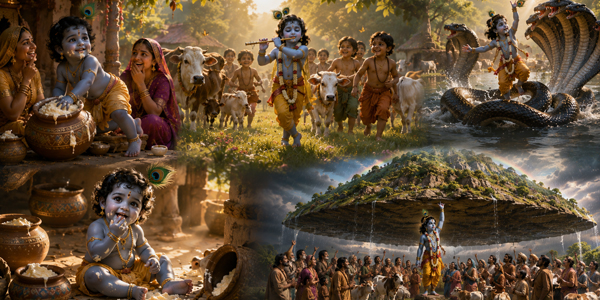
One of the reasons Krishna is so beloved is his extraordinary childhood. Unlike many other divine figures who appear distant and majestic, Krishna is portrayed as a lively, smiling, and playful child. He runs through the fields, plays with his friends, tends the cows, and constantly creates mischief that brings smiles to everyone around him.
The most famous stories tell how the young Krishna steals butter from the villagers’ pots. At first glance, this seems like a simple childish prank, but spiritual tradition sees a much deeper meaning in it. The butter symbolizes the purified human heart, and Krishna “steals” precisely the love and devotion of his followers. Thus, what appears to be a playful story becomes a parable about the relationship between humans and God.
Over time, extraordinary events begin to occur around the child. Demons sent by Kamsa repeatedly attempt to kill him, but each attack ends in their defeat. Krishna defeats monsters even as a young boy, but these battles are rarely viewed solely as physical confrontations. In Hindu philosophy, demons often symbolize human weaknesses – anger, greed, pride, fear, and ignorance.
Among the most famous is the story of the great serpent Kaliya, who poisoned the waters of the Yamuna River. Krishna jumps into the water, defeats the creature, and begins to dance upon its heads. Instead of killing the serpent, he forgives it and sends it away from the village. This shows that true spiritual power does not destroy indiscriminately, but transforms destructive energy into harmony.
Another iconic episode is the lifting of Mount Govardhana. When the god Indra sends destructive storms against the inhabitants of Gokula, Krishna lifts the entire mountain with his little finger and protects the people and animals beneath it for seven days. This story symbolizes the idea that true protection does not come from fear of natural forces, but from an inner connection with the divine. The mountain becomes a symbol of spiritual resilience that can protect a person even in the greatest trials of life.
Krishna and Radha – The Symbol of Divine Love
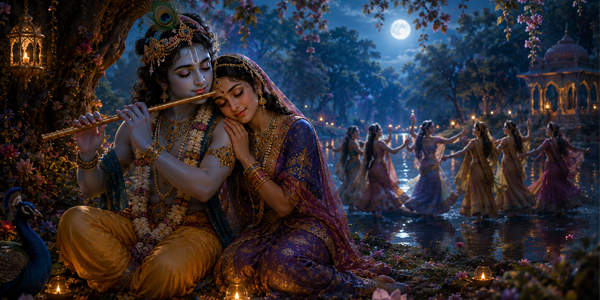
Among all the stories associated with Krishna, none has inspired as many poets, artists, and mystics as the tale of his love for Radha. In traditional Hindu texts, Radha does not always occupy a central role, but over the centuries she has become one of the most profound symbols of spiritual love. For millions of followers, their relationship is not an ordinary romantic story, but an allegory of the connection between the human soul and the Divine.
According to tradition, Radha lives in Vrindavan and, from her very first meeting with Krishna, feels an inexplicable attraction toward him. Their love is portrayed as pure, unconditional, and free from possession. It does not depend on social rules, wealth, or external circumstances, but arises as a natural longing of the soul for its source. For this reason, the story is not seen as a worldly love drama, but as a mystical narrative about the union between the human being and God.
Particularly famous are the scenes in which Krishna plays his flute, and its sound draws the cowherd maidens, the gopis, from all corners of the village. Among them, Radha is always the one who most deeply understands his presence. In spiritual tradition, the flute symbolizes the human heart, emptied of ego and therefore allowing the divine to flow through it like music. The freer a person is from pride, the more clearly they can hear the inner voice of truth.
One of the most remarkable aspects of this story is that Krishna eventually leaves Vrindavan to fulfill his destiny. Radha remains, but her love does not diminish. Their separation becomes a symbol of spiritual longing-the feeling that a person is always searching for something higher, something difficult to express in words. In Indian philosophy, this deep inner yearning is considered one of the most powerful forces on the path to enlightenment.
The love between Radha and Krishna has had a profound influence on the bhakti tradition-the path of devotion to God. Unlike purely intellectual pursuits of truth, bhakti emphasizes that the deepest spiritual knowledge arises through love, trust, and surrender. For this reason, the images of Radha and Krishna have been present in temples, songs, poetry, and religious festivals throughout India for more than a thousand years.
From Cowherd to Statesman
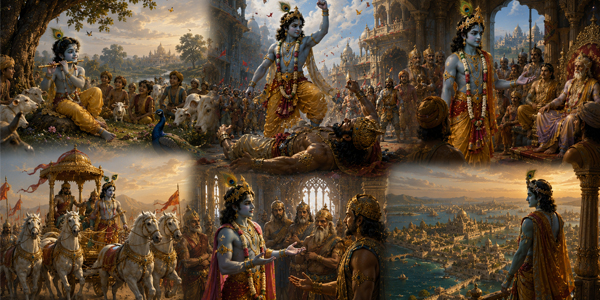
After his years in Vrindavan, Krishna’s life undergoes a dramatic transformation. He leaves behind the idyllic world of his childhood and travels to Mathura to confront the tyrannical king Kamsa. This marks the transition from a carefree cowherd to a mature leader who takes responsibility for the fate of his people.
According to legend, Krishna and his brother Balarama arrive in Mathura at Kamsa’s invitation, though the king secretly plans to kill them. Instead, Krishna defeats all the wrestlers sent against him, enters the palace, and after a fierce battle, kills the tyrant. Thus, the prophecy Kamsa had tried to avoid throughout his life is fulfilled precisely because of his own actions.
After his victory, Krishna does not claim the throne for himself. Instead, he restores the rightful ruler and seeks to bring justice back to the kingdom. This detail is particularly important, as it shows that his goal was never personal power. In Krishna’s philosophy, governance should serve the people, not the ego of the ruler.
Later, Krishna establishes the city of Dvaraka, which, according to tradition, becomes one of the most prosperous and well-organized kingdoms of ancient India. There, he rules as a wise king, diplomat, and protector of peace. Although he possesses immense power, he prefers negotiation over war and repeatedly attempts to prevent future conflicts between rival royal families.
This period of his life is often overshadowed by the stories of his childhood, yet it reveals another dimension of his character. Krishna demonstrates that spirituality does not require withdrawal from society. On the contrary, a person can be actively engaged in the world while maintaining inner peace, as long as their actions are guided by wisdom rather than personal ambition.
Krishna and the Great Epic “Mahabharata”
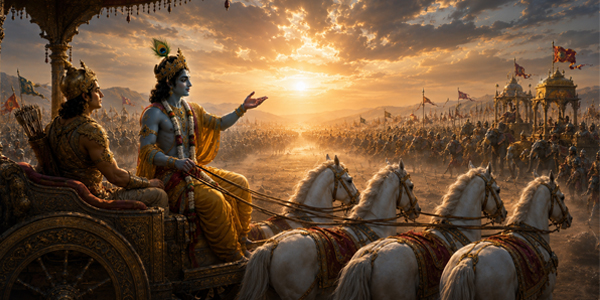
Krishna’s most significant role unfolds in the epic poem “Mahabharata,” one of the largest literary works in human history. This masterpiece contains more verses than the “Iliad” and the “Odyssey” combined and describes the struggle between two related royal families-the Pandavas and the Kauravas.
The conflict begins as a political dispute over the inheritance of a kingdom but gradually evolves into a clash between justice and greed. Krishna is a relative and friend of the Pandavas, yet he does everything possible to prevent the war. He personally visits the court of the Kauravas and proposes a peaceful solution that would save thousands of lives.
However, his proposals are rejected. Pride, the desire for power, and hatred prevail over reason. Thus, war becomes inevitable. It is here that Krishna reveals one of the deepest ideas in his teaching-that not every battle can be avoided, but every battle can be fought with awareness, compassion, and a sense of duty.
Before the battle begins, both sides seek Krishna’s support. He offers an unusual choice: one side may have his vast army, while the other may have him alone, without weapons. Duryodhana chooses the army, believing that numerical superiority guarantees victory. Arjuna chooses Krishna himself, understanding that true strength lies in wisdom.
Thus, Krishna becomes Arjuna’s charioteer. At first glance, this may seem like a humble role, but it is from this position that he will deliver one of the greatest spiritual teachings in human history.
Bhagavad Gita – The Conversation That Changed the World
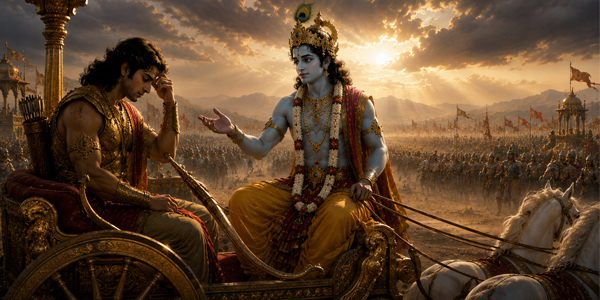
When the two armies stand facing each other on the battlefield of Kurukshetra, Arjuna asks Krishna to place the chariot between them. Looking at the opposing ranks, he sees his relatives, teachers, friends, and loved ones. Instead of a desire for victory, his heart fills with fear, sorrow, and doubt.
Arjuna declares that he does not want to fight. He lays down his bow and admits that he sees no meaning in a victory achieved at the cost of so many human lives. This moment transcends the historical narrative. Every person, sooner or later, finds themselves on their own battlefield, faced with a decision that seems impossible.
Rather than giving him a simple command, Krishna begins a philosophical dialogue that later becomes known as the “Bhagavad Gita.” Over the course of eighteen chapters, he explores questions such as the meaning of life, the nature of the soul, freedom, death, duty, consciousness, God, and the path to liberation. It is this text that transforms Krishna not only into a hero of ancient legends but also into one of the greatest spiritual teachers in world history.
The first thing Krishna explains to Arjuna is that his suffering arises from a mistaken identification with temporary forms. People see their bodies, roles, and relationships as ultimate reality, forgetting that their true essence is the eternal soul. According to Krishna, it is never born and never dies. Death is merely a change of external form, like a person replacing old clothes with new ones.
This idea is not a call to indifference, but to a deeper understanding of life. If a person realizes that something exists beyond the constant changes of the world, they gradually cease to be governed by fear. It is this inner freedom that allows their actions to become wiser, more compassionate, and more responsible.
Krishna does not encourage Arjuna toward violence for its own sake. He urges him to fulfill his dharma-his duty-without hatred, without desire for personal gain, and without attachment to the outcome. This distinction is one of the most important in the entire work. The problem is not the action itself, but the motive from which it arises.
It is here that one of the most famous ideas in world philosophy appears-a person has the right to their actions, but must never become attached to their fruits. True freedom arises when one does what is right simply because it is right, not because they expect reward, recognition, or success.
Karma – the Law of Cause and Effect
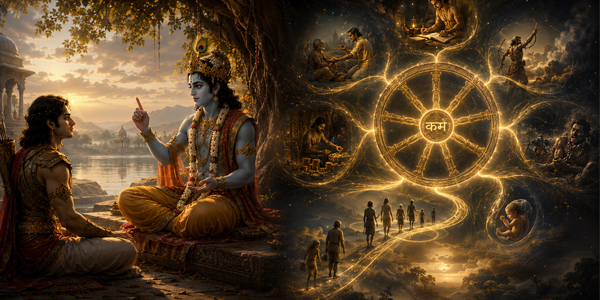
One of the most well-known ideas in Krishna’s teachings is the law of karma. In modern culture, the word “karma” is often used as a synonym for fate or punishment, but in the Bhagavad Gita it has a much deeper meaning. Karma represents the universal law of cause and effect, according to which every thought, every word, and every action produces certain consequences.
Krishna explains that a person is constantly creating karma because life is an ongoing stream of choices. Not only external actions, but also inner intentions shape our future experiences. Therefore, true spiritual practice does not begin with changing the world, but with transforming one’s own consciousness. When motivations become purer, the results a person attracts into their life gradually change as well.
It is important to understand that karma is not a mechanical system of reward and punishment. It does not function like a judge who monitors every mistake, but rather like a natural law, similar to gravity. Just as a thrown stone inevitably falls to the ground, every action leaves an imprint on a person’s character and influences their future. That is why Krishna emphasizes that the greatest freedom lies in the conscious choices made in the present moment.
According to him, a person cannot always control the circumstances they encounter, as these are often the result of past actions. However, they can always choose how to respond to them. It is precisely this ability that transforms a person into an active creator of their life, rather than a passive victim of fate.
This understanding has had a profound influence on Indian philosophy. Instead of searching for someone to blame for suffering, a person begins to see life as an opportunity for learning and growth. Every success and every challenge becomes part of a larger process of spiritual development.
Dharma – Living in Harmony with Inner Truth
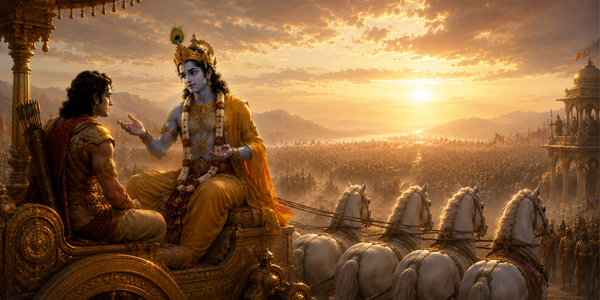
If karma describes the law of cause and effect, dharma shows the right direction for human life. It is one of the most difficult Sanskrit words to translate because it encompasses many meanings-duty, purpose, natural order, moral law, and inner truth. In Krishna’s teachings, all these meanings are woven into a single idea.
Krishna explains to Arjuna that every person has their own dharma. It is not determined solely by profession, social status, or family obligations. True dharma arises from a person’s nature and from the way they can most meaningfully contribute to the harmony of the world.
According to Krishna, the greatest mistake is to try to live someone else’s life. Even an imperfectly fulfilled personal dharma is better than perfectly fulfilling someone else’s. This message is especially relevant today, when many people compare their lives to others and strive for external definitions of success.
Living in accordance with dharma does not mean the absence of difficulties. On the contrary, fulfilling one’s inner duty sometimes requires the greatest courage. Arjuna must face people he loves, not because he desires war, but because he believes that defending justice is his calling.
This idea points to a deeper understanding of freedom. Freedom does not mean doing whatever one desires, but acting in alignment with the highest truth within oneself. When a person discovers their dharma, life gradually gains clarity, meaning, and inner coherence.
Karma Yoga – The Path of Selfless Action
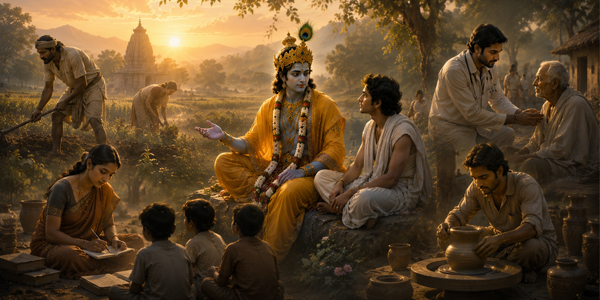
Among the various spiritual paths described by Krishna, karma yoga holds a special place. It is the practice of fulfilling one’s duties without attachment to the results and without seeking personal gain. At first glance, this idea may seem paradoxical, since most people act precisely with the hope of achieving a certain success.
Krishna does not say that a person should not have goals. He only warns against turning results into the source of one’s self-worth. When all happiness depends on external success, life inevitably becomes a constant oscillation between hope and disappointment.
Karma yoga teaches that a person should invest their full attention, knowledge, and heart into the present action. Once they have done everything possible, they should calmly accept the outcome, regardless of whether it meets their expectations. In this way, work ceases to be a source of constant stress and becomes a spiritual practice.
This principle applies far beyond religious life. A doctor who treats patients with dedication, a teacher who educates students with love, or an artist who creates without seeking fame-all can practice karma yoga. Spirituality does not necessarily require retreating into the mountains; it can be expressed in every sincere and conscious action.
That is why Krishna’s teachings remain so relevant. They offer a way to live actively in the world without being consumed by its constant changes. Work, family, and social responsibilities do not become obstacles to the spiritual path, but the path itself.
Jnana Yoga – The Path of Knowledge
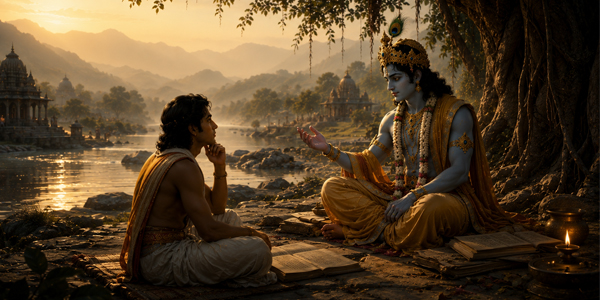
In addition to action, a person can reach truth through knowledge. Jnana yoga represents the path of philosophical inquiry, inner observation, and the pursuit of understanding reality. Krishna does not oppose knowledge to faith, but shows that true wisdom arises when a person begins to see beyond external forms.
The central question of jnana yoga is: “Who am I?” Most people naturally identify with their body, name, profession, nationality, or social role. According to Krishna, all these things are temporary. The true essence of a person is Atman-the immortal consciousness that remains unchanged regardless of age, success, or loss.
This understanding is not merely a philosophical theory. It transforms the way a person perceives life. If true identity does not depend on external circumstances, then the fear of failure gradually loses its power. A person begins to act more freely because they no longer define their worth through the opinions of others.
Jnana yoga encourages continuous exploration of one’s own consciousness. Instead of accepting everything on faith, the seeker observes their thoughts, desires, and fears. Gradually, they begin to distinguish between temporary mental states and the unchanging awareness that observes them.
Krishna emphasizes that true knowledge never leads to pride. The more a person understands reality, the more humble they become, realizing how limited individual perceptions are in comparison to the infinity of the universe.
Bhakti Yoga – The Power of Love and Devotion
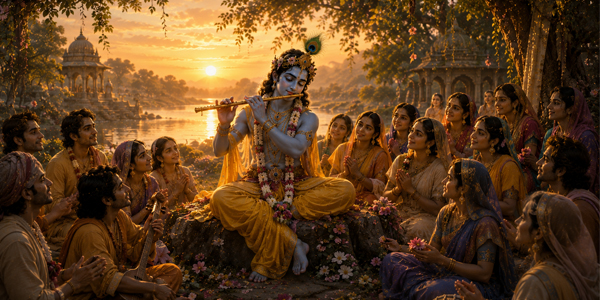
If karma yoga is the path of action and jnana yoga the path of knowledge, then bhakti yoga is the path of love. This aspect of Krishna’s teaching has had the strongest influence on the spiritual life of India over the past two millennia. For millions of people, the relationship with God is based not primarily on philosophical reasoning, but on a deep sense of trust and devotion.
Krishna explains that God is not impressed by wealth, rituals, or social status. The most valuable offering is a sincere heart. Even the simplest gift, offered with pure intention, has greater value than the most expensive sacrifice made out of vanity or a desire for recognition.
This idea transforms religious thinking. Spiritual life is no longer the privilege of scholars or priests. Every person, regardless of origin, education, or social position, can build a direct relationship with the divine through love, sincerity, and perseverance.
Bhakti yoga does not require a person to withdraw from the world. On the contrary, it teaches that every action can be performed as an expression of love for God. Caring for one’s family, honest work, helping those in need, and showing respect to all living beings gradually become forms of spiritual practice.
That is why Krishna is often depicted with a smile and a flute, rather than as a strict judge. He embodies a God who draws people through love, not fear. This image has had a profound influence on Indian literature, music, and art, making Krishna one of the most beloved spiritual figures in the world.
Maya – Why People Forget Their True Nature
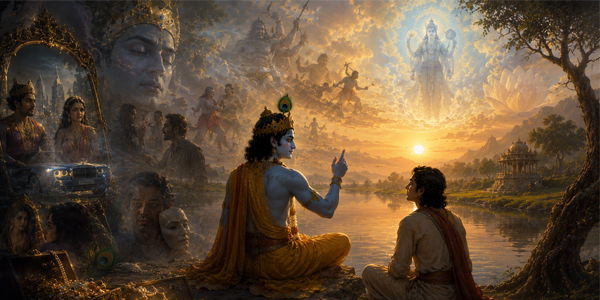
One of the deepest ideas in Krishna’s teachings is the concept of “maya.” The word is often translated as illusion, but this does not mean that the world does not exist. Rather, maya represents the way limited human consciousness perceives reality without seeing its true essence.
According to Krishna, people constantly identify with the changing aspects of life-wealth, beauty, power, reputation, or material possessions. However, all these things are temporary. When a person sees them as the foundation of their happiness, they inevitably experience fear of losing them.
Maya is not an enemy that must be destroyed. It is a state of unawareness that is gradually overcome through knowledge, love, and spiritual practice. When a person begins to perceive the deeper unity behind external differences, the influence of maya weakens.
This idea finds remarkable parallels in modern psychology. Much of human suffering arises not so much from events themselves, but from the way the mind interprets them. Krishna’s teachings encourage liberation from these automatic patterns of perception and a gradual awakening to a broader perspective.
For Krishna, true freedom does not mean escaping the world, but the ability to live within it without being enslaved by its illusions. This inner liberation represents one of the highest goals of spiritual life.
Atman and Brahman – the unity between the individual and ultimate reality
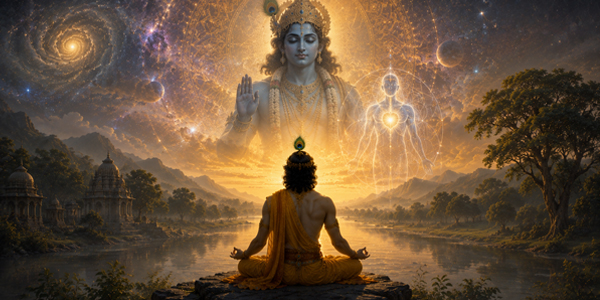
At the heart of Krishna’s teaching lies an idea that has profoundly influenced all of Indian philosophy – the unity between the individual soul and the supreme reality. In the Bhagavad Gita, Krishna repeatedly speaks about the immortal nature of Atman-the true Self, which is never born and never dies. The body changes, thoughts change, emotions come and go, but the consciousness that observes them remains unchanged.
The concept of Brahman refers to the infinite, eternal, and all-encompassing reality that underlies all existence. Although different philosophical schools interpret the relationship between Atman and Brahman in various ways, Krishna shows that the individual is not separate from the divine, but rather a manifestation of it. It is the forgetting of this truth that gives rise to feelings of loneliness, fear, and separation.
This teaching invites us to look beyond the external differences between people. If the same divine essence exists in every being, then compassion and respect for others are not merely moral principles, but natural consequences of a deeper understanding of life. To harm another is, in a sense, to harm oneself.
This idea is why many scholars consider the Bhagavad Gita not only a religious text, but also a philosophical work of universal significance. Its reflections on the nature of consciousness, identity, and reality continue to inspire philosophers, psychologists, and scientists seeking a deeper understanding of the human mind.
Vishvarupa – when Krishna reveals his cosmic form
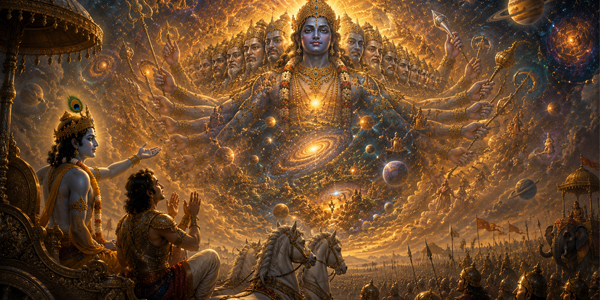
One of the most striking moments in the Bhagavad Gita occurs when Arjuna wishes to see the true nature of his teacher. Until that point, he perceives Krishna as a friend, relative, and wise guide. Krishna then grants him the ability to behold his cosmic form, known as Vishvarupa.
The description of this vision is among the most magnificent in world literature. Arjuna sees an infinite universe filled with countless worlds, stars, gods, humans, and beings, all existing simultaneously within Krishna’s body. Past, present, and future merge into one, and all processes of creation and destruction are revealed as parts of a continuous cosmic rhythm.
The vision is so powerful that Arjuna experiences both awe and fear. He realizes how limited human perspective is and how small a portion of reality the ordinary mind can perceive. This experience is not meant to instill terror, but humility-a reminder that the universe is far greater and deeper than we can imagine.
The symbolism of Vishvarupa remains relevant today. It encourages us not to see ourselves as isolated beings, but as part of a vast network of interconnectedness. Every life, every action, and every thought participates in a greater cosmic process that far transcends individual interests.
The symbols of Krishna and their meaning
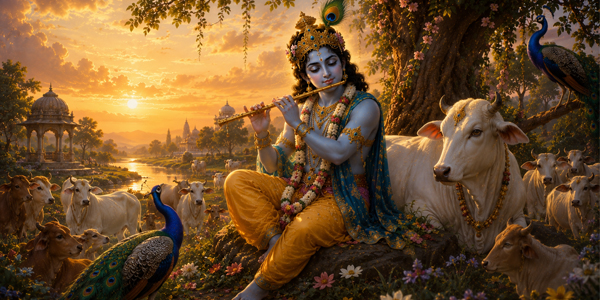
The image of Krishna is filled with symbols that carry deep spiritual messages. Every detail in traditional depictions has its own meaning and reveals a particular aspect of his teaching.
The most recognizable symbol is the flute. It is not merely a musical instrument, but a representation of the human heart. An empty flute can produce beautiful music only when it allows air to pass freely through it. In the same way, a person discovers their true nature when they free their consciousness from pride, fear, and the constant desire for control. Then life begins to flow with naturalness and harmony.
The peacock feather that adorns Krishna’s hair symbolizes beauty, joy, and the unity between humans and nature. Unlike a royal crown, it reminds us that true greatness is not based on power, but on inner harmony. The feather also expresses the idea that spirituality does not reject the beauty of the world, but sees it as a reflection of the divine.
The blue color of Krishna’s skin is another powerful symbol. The sky and the ocean appear blue because they evoke a sense of infinity. In the same way, Krishna’s blue form does not describe a physical appearance, but his boundless nature. It reminds us that the divine cannot be confined to a specific form or place.
The cows that often appear around Krishna also carry spiritual meaning. In Indian tradition, they symbolize life, abundance, maternal care, and the interdependence between humans and nature. Krishna’s care for the herds shows that a true leader does not rule through fear, but protects and sustains life in all its forms.
The influence of Krishna on philosophy, yoga, and global culture
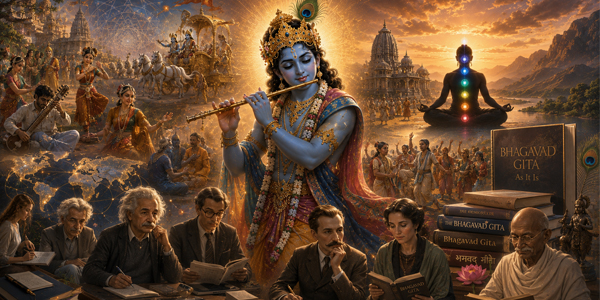
Few spiritual figures have had such a wide-reaching influence across different areas of human culture. Krishna’s teachings have shaped the development of numerous philosophical schools in India and have inspired generations of thinkers, poets, musicians, and artists. His ideas have permeated literature, classical dance, theater, and religious festivals, becoming an integral part of India’s cultural identity.
In the field of yoga, his influence is especially strong. Although today yoga is often associated primarily with physical exercises, the Bhagavad Gita presents a much broader understanding of the concept. For Krishna, yoga is a path to inner unity. Whether one reaches it through action, knowledge, meditation, or devotion, the ultimate goal remains the same-liberation from ignorance and realization of the true nature of existence.
Over the past two centuries, Krishna’s teachings have gradually become known in the West. Philosophers, writers, and scholars have begun to study the Bhagavad Gita, impressed by its psychological depth and universal ideas. Today it is translated into dozens of languages and continues to be one of the most widely read spiritual texts in the world.
Interest in Krishna is not limited to religious communities. His reflections on fear, inner freedom, the meaning of action, and the nature of consciousness find a place in contemporary discussions in philosophy, psychology, leadership, and personal development. This demonstrates that great spiritual ideas can transcend cultural and historical boundaries because they address universal human questions.
What we can learn from Krishna today
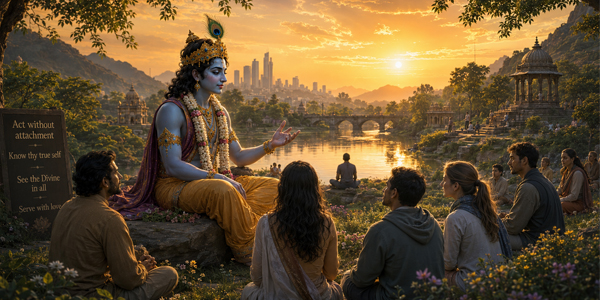
Although we live in a world very different from ancient India, many of the challenges we face remain the same. People continue to fear the future, seek recognition, struggle with choices, and question the meaning of life. This is precisely why Krishna’s teachings still resonate so strongly today.
One of his most valuable lessons is that inner peace does not depend entirely on external circumstances. Life inevitably brings successes and failures, joys and losses, but a person can develop a state of inner balance that is not shattered by every change. This does not mean indifference, but the ability to respond calmly and consciously.
Krishna also reminds us that true strength does not come from power over others, but from the ability to master one’s own mind. One who has overcome greed, fear, and hatred within themselves possesses far greater strength than someone who rules entire kingdoms but remains a slave to their passions.
The idea of selfless action is especially relevant today. In a society that often measures a person’s worth by their achievements, Krishna’s teaching offers a different perspective. The true value of an action is determined not only by its result, but also by the intention behind it. When a person works honestly, with respect for others and without a constant need for recognition, they discover a deeper sense of fulfillment.
His message about the unity of all living beings is also becoming increasingly important. In an era of global conflicts, environmental challenges, and social divisions, the idea that life is interconnected is more relevant than ever. Recognizing this interdependence can serve as a foundation for greater compassion, responsibility, and respect for the world we share.
Conclusion
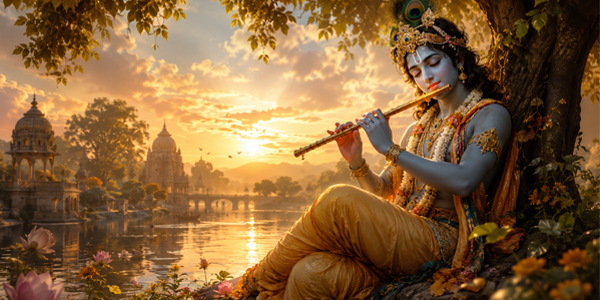
Krishna is far more than a hero in an ancient epic or a central figure in a religious tradition. He is a symbol of wisdom, love, inner freedom, and spiritual awakening. His life combines the human and the divine in a way that has inspired people from different cultures and beliefs for thousands of years.
The Bhagavad Gita remains one of the most remarkable philosophical works because it does not offer easy answers, but encourages individuals to explore their own consciousness. Krishna’s teaching shows that true transformation begins within-through awareness, discipline, love, and a willingness to live in harmony with our deepest values.
Whether Krishna is seen as a historical figure, an incarnation of Vishnu, or a universal spiritual symbol, his message remains timeless. It reminds us that behind the constant changes of life lies a deeper reality to which we can turn at any moment. This is precisely why his teaching has remained alive for more than two thousand years-because it speaks not only about the world around us, but above all about the world within us.
Read more:
- Sadhguru: The Story of His Enlightenment, Vijji, and the Mission of the Dhyanalinga
- Shiva – The First Yogi and Guru, the Originator of Spirituality
- Yoga: Karma, Life, Death, and Rebirth
Author: Vasil Stoyanov