
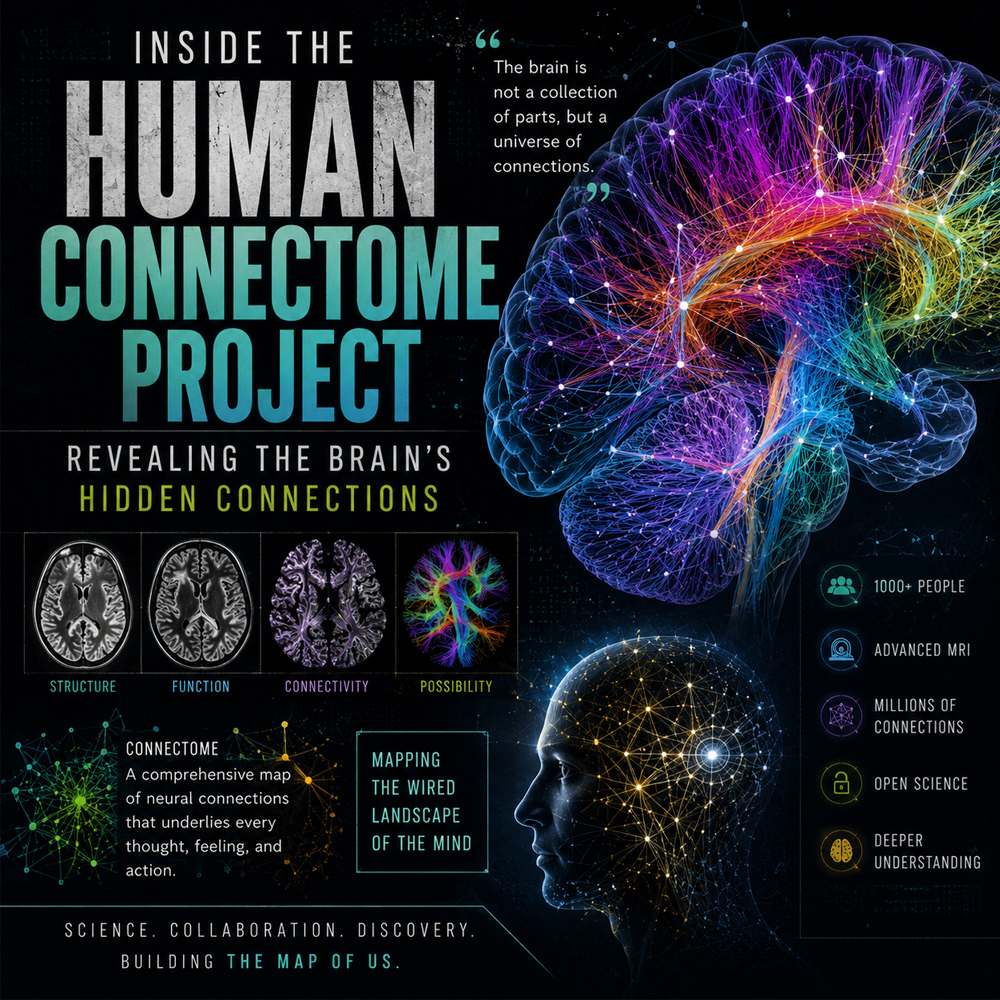
Brain mapping is an attempt to create a map of the most complex territory known to us: the human brain. Scientists do not want to understand only which parts exist there, such as the frontal lobe, hippocampus, thalamus, cerebellum, and cortex. They also want to understand how these regions communicate, cooperate, and create the extraordinary range of human experience, from memory and emotion to language, creativity, attention, and consciousness itself.
Sometimes researchers study only the structure of the brain. They use magnetic resonance imaging, or MRI, to examine the shape, size, and organization of different brain regions. At other times, they focus on activity and ask which areas become active when we think, speak, remember, move, dream, or feel emotions. For this, scientists use functional MRI, or fMRI, which measures changes in blood flow related to brain activity.
The most fascinating part of modern brain mapping is the study of how different areas of the brain are connected. This is almost like studying the social network of the brain, where each brain region is a person and the nerve fibers are the relationships between them. The brain is not simply a collection of separate parts. It is a living network, and understanding this network is one of the greatest scientific challenges of our time.
The Human Connectome Project
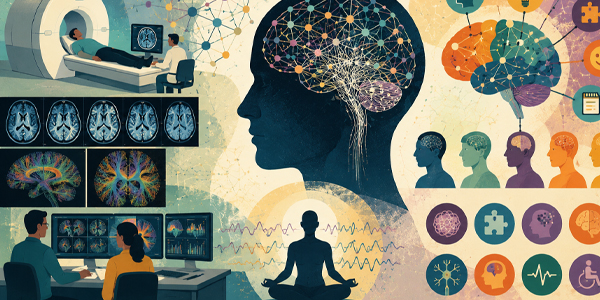
This is where the Human Connectome Project becomes especially important. Launched in 2009 with funding from the U.S. National Institutes of Health, the project was designed to create one of the most detailed maps ever made of the connections within the human brain. This complete map of neural connections is known as the connectome.
The project collected enormous amounts of data from MRI and fMRI scans. It also used diffusion imaging techniques to trace the white matter fibers that connect different brain regions. These fibers act like information highways, allowing distant areas of the brain to communicate with one another. Researchers also studied how the brain behaves when a person is not performing any specific task, but simply resting. This resting-state activity revealed that the brain remains highly organized even when we are not consciously focusing on anything.
With this information, scientists can study how structural and functional connections influence behavior, personality, intelligence, emotional regulation, memory, attention, and cognitive ability. The project also makes it possible to understand individual differences between people. For example, one person may have stronger concentration, while another may be more easily distracted, partly because their brain networks are organized and connected differently.
The Human Connectome Project is also extremely valuable for medicine. Maps of brain networks help researchers study conditions such as schizophrenia, autism, Alzheimer’s disease, depression, epilepsy, and traumatic brain injury. The project does not merely collect data; it makes much of that data available to researchers around the world. In this way, science is slowly but steadily beginning to decode the mystery of the most complex organ in the human body.
A Mental Visualization of Brain Mapping
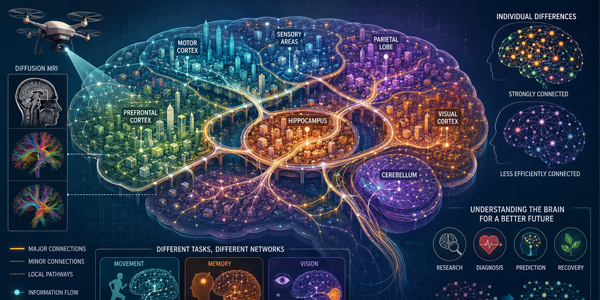
One of the easiest ways to imagine brain mapping is to picture the brain as a vast city. In this city, the buildings are brain regions, and the streets are nerve fibers through which information travels. Some of these streets are wide highways connecting major districts, while others are narrow paths linking nearby neighborhoods. The Human Connectome Project uses advanced imaging methods, like diffusion MRI, almost like special drones that can trace where each road leads.
When scientists look at a map of the connectome, they do not see only “buildings and streets.” They see networks that become active in different ways depending on what the brain is doing. When we think about movement, connections between the motor cortex, cerebellum, and other movement-related areas become more involved. When we remember something, networks connected to the hippocampus and memory systems become active.
This kind of visualization helps researchers understand why the brain works differently in different people. Some networks may be strongly connected, while others may communicate less efficiently. These differences may help explain variations in attention, memory, emotional response, learning style, creativity, and even aspects of personality. In the future, scientists may be able not only to read these brain maps but also to predict how changes in brain connections might contribute to disease and recovery.
Structural and Functional Connectivity
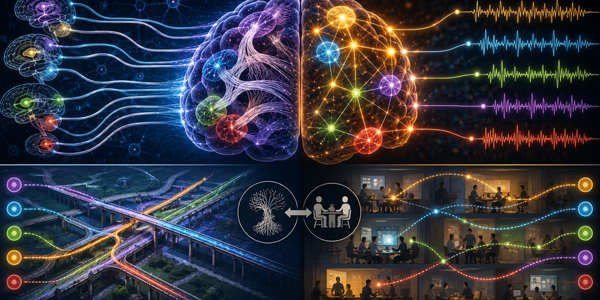
Modern neuroscience often distinguishes between two major types of brain connectivity: structural connectivity and functional connectivity. Structural connectivity refers to the physical wiring of the brain. It includes the white matter fibers that connect one region to another and allow signals to travel across the nervous system.
Functional connectivity, on the other hand, refers to how different regions work together. Two brain areas may show coordinated activity even if they are not directly connected by a single physical fiber. This is similar to two departments in a company working together on the same project, even if they are located in different buildings.
Both forms of connectivity are important. Structural connections show the possible roads information can take, while functional connections show how those roads are actually used. By combining these two perspectives, scientists gain a much deeper understanding of how the brain produces behavior, thought, emotion, and perception.
The Most Interesting Discoveries
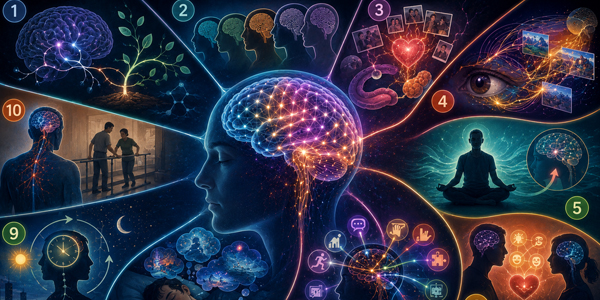
1. The brain is plastic and adaptive
Neuroplasticity allows the brain to change its structure and function throughout life. This means that the brain is not fixed after childhood, as scientists once believed. Learning, training, meditation, therapy, injury, and life experience can all reshape neural connections. This plasticity is one of the reasons people can recover abilities after brain injury or develop new skills even in adulthood.
2. Every brain is unique
Although all human brains share a common basic structure, no two brains are exactly the same. The same task may activate slightly different patterns of activity in different people. This helps explain why individuals learn, think, remember, and solve problems in different ways. The Human Connectome Project showed that each brain has something like a unique “connectivity fingerprint.”
3. Emotions influence memory
Emotionally meaningful events tend to be remembered more strongly than neutral ones. This happens because emotional systems in the brain, especially regions such as the amygdala, interact with memory-related structures like the hippocampus. This is why moments of fear, joy, grief, or love can leave such powerful traces in memory.
4. Visual information activates large brain networks
Vision is not limited to one small part of the brain. Visual information activates many regions involved in recognition, attention, movement, interpretation, and memory. This is why images can be such powerful tools for learning, analysis, creativity, and emotional response. The brain does not merely “see” the world; it interprets it.
5. Meditation can change the brain
Studies suggest that regular meditation can influence brain networks involved in attention, emotional regulation, and stress response. Some forms of meditation appear to reduce activity in networks associated with excessive self-referential thinking and anxiety. At the same time, meditation may strengthen regions related to focus, awareness, and emotional balance.
6. The social brain and empathy
Brain mapping has helped scientists identify networks involved in social interaction, empathy, and understanding other people’s emotions. These networks allow us to read facial expressions, interpret intentions, feel compassion, and cooperate with others. Human beings are deeply social creatures, and the brain reflects this through specialized systems for connection and communication.
7. The brain processes information in parallel
The brain does not process information in a simple step-by-step manner. Many regions work at the same time, sharing and comparing information across multiple networks. This parallel processing helps explain how we can react quickly, recognize complex situations, understand language, move our bodies, and make decisions almost instantly.
8. Dreams activate multiple brain networks
Dreaming involves networks connected to emotion, memory, imagery, and creativity. During dreams, the brain can combine old memories, emotional material, and symbolic images in unusual ways. This supports the idea that dreams may help process emotions, organize memories, and simulate experiences. Although the exact purpose of dreaming is still debated, brain mapping has shown that sleep is far from a passive state.
9. The brain has an internal clock
Certain neural systems help regulate circadian rhythms, sleep, wakefulness, hormone cycles, and daily patterns of energy. This internal clock is influenced by light, behavior, and biological signals. When it becomes disrupted, people may experience sleep problems, mood changes, difficulty concentrating, and reduced mental performance.
10. The brain can reorganize after injury
After trauma or neurological disease, the brain can sometimes compensate by activating other networks or strengthening alternative pathways. This ability is essential for rehabilitation after stroke, brain injury, or certain neurological disorders. Recovery depends on many factors, including the severity of damage, age, therapy, and the brain’s capacity for reorganization.
Why Brain Mapping Matters
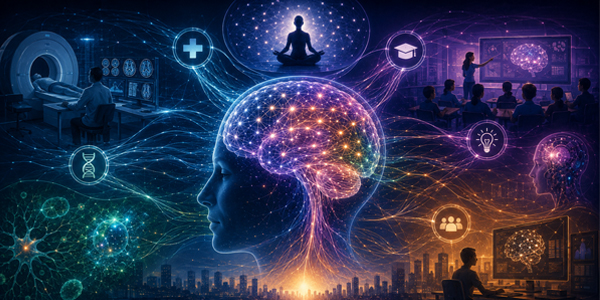
Brain mapping is important because it helps scientists move beyond a simple view of the brain as a collection of isolated parts. Instead, it reveals the brain as a dynamic and interconnected system. Memory, attention, emotion, intelligence, and consciousness do not arise from one single region alone. They emerge from the cooperation of many networks working together.
This has major implications for medicine, psychology, education, and artificial intelligence. If researchers understand how brain networks differ between healthy and diseased states, they may be able to develop better treatments. If they understand how learning changes the brain, they may improve education. If they understand how networks create perception and decision-making, they may also gain deeper insight into the nature of consciousness itself.
The Human Connectome Project is only one step in this larger journey, but it is a historic one. It gives scientists a new kind of map – not a map of countries, mountains, or oceans, but a map of the living architecture of thought itself. The more clearly we understand the brain’s hidden connections, the closer we come to understanding what makes us human.
Read More:
- Why the Brain Searches for Meaning in Everything – The Scientific Explanation
- DMT: The Spirit Molecule and the Mystery of Consciousness
- How Consciousness Emerged: Why Humans Developed It and What It Means
- How Social Media Changes the Brain: Dopamine, Attention, and the Collapse of the Inner World
Author: Vasil Stoyanov