
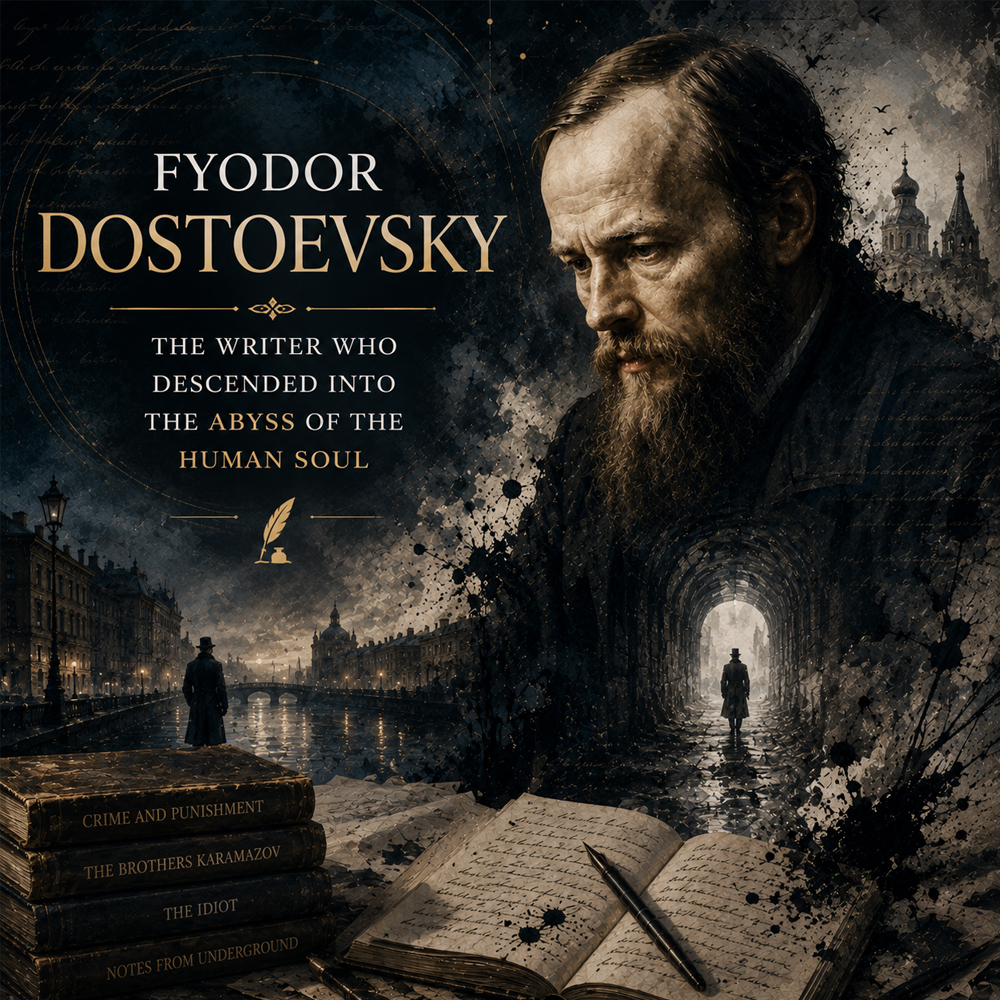
Introduction: The Voice of Man Before the Abyss
Fyodor Mikhailovich Dostoevsky is one of those writers who cannot be reduced to literature alone. He is not merely the author of great novels, but an explorer of the human soul – of suffering, freedom, guilt, faith, evil, love, and despair. His books are not read simply as stories, but as spiritual trials, because they confront the reader with questions from which one cannot easily escape.
Dostoevsky writes about man not as a rational machine that always seeks benefit and happiness, but as a deeply contradictory being. In his world, a person may desire good and at the same time move toward destruction; may seek God and simultaneously rebel against Him; may long for love and yet wound those who love him. It is precisely this tragic complexity that makes his work so powerful and so alive.
He offers no easy comfort. He does not tell us that man is simply good, nor that evil is merely an external flaw of society. Dostoevsky shows that the greatest battles are fought within the human being, in that dark space where pride, fear, conscience, desire, and hope collide.
A Life Marked by Suffering and Spiritual Transformation
Dostoevsky’s life itself resembles a novel, filled with dramatic turns, losses, and inner transformations. He was born in 1821 in Moscow and early on encountered the tension between poverty, illness, family strictness, and intellectual awakening. Even in his youth, a sensitivity to human suffering began to take shape – one that would later become one of the central forces in his work.
As a young writer, Dostoevsky quickly gained recognition with the novel Poor Folk, which was welcomed as an important voice in Russian literature. But this early success did not bring him peace. Soon his life would be overturned by political persecution, arrest, and a sentence that would bring him face to face with death.
The most dramatic moment in his life came when he was sentenced to death for participating in a circle of intellectuals discussing forbidden ideas. He and the others were led before a firing squad, prepared for execution, and only at the last moment was the sentence commuted to exile in Siberia. That moment – when a man has already accepted that he will die and then suddenly receives his life back – left an indelible mark on his consciousness.
The Siberian penal servitude profoundly changed Dostoevsky. There he encountered criminals, murderers, sufferers – rough and broken people – but also saw in them something that civilized society often refuses to see: a spark of humanity. This encounter with the fallen, humiliated, and punished human being would become the foundation of his future work.
Dostoevsky and the Mystery of Suffering
Suffering is one of the central themes in Dostoevsky, but it is never presented as something merely meaningless or external. For him, suffering can be destructive, but it can also be a path to insight. It can crush a person, but it can also break their pride, open them to compassion, and lead them toward a deeper truth.
This does not mean that Dostoevsky glorifies pain in a superficial way. He knows very well the horror of suffering – its injustice and cruelty. Yet in his novels we often see that the person who has never suffered remains trapped in the illusion of self-sufficiency.
In Dostoevsky, suffering is the place where masks fall away. A person may pretend to be strong, intelligent, virtuous, or independent, but when pushed to the extreme, their true nature is revealed. There, in deep crisis, one can no longer hide from oneself.
This idea is especially important for understanding his characters. They often do not develop through calm moral growth, but through downfall, fever, guilt, repentance, and inner disintegration. In Dostoevsky, the soul often must pass through hell before it begins to long for light.
Freedom as Blessing and Curse
One of the deepest themes in Dostoevsky’s work is freedom. He understands that man does not want only bread, security, and comfort. Man wants to be free – even when that freedom leads to suffering, error, and self-destruction.
This is especially clear in Notes from Underground, where the protagonist opposes the idea that man can be explained solely through rational self-interest. If someone proves to him mathematically what is best for him, he may consciously choose the opposite, simply to prove that he is not a mechanism. This is a dark but profoundly deep critique of all systems that reduce man to a rational formula.
For Dostoevsky, freedom is frightening because it makes man responsible. If a person is merely a product of environment, biology, or society, then their guilt can be explained and almost eliminated. But if he is free, then even in his darkest choices he bears some responsibility – to himself, to others, and to God.
This freedom is not romantic ease. It is a burden, because man can choose evil. But without this possibility of choice, there would be no true love, no true faith, and no true repentance.
Crime and Punishment and the Drama of Proud Reason
Crime and Punishment is one of Dostoevsky’s greatest novels because it shows how an idea can become a crime. Rodion Raskolnikov does not kill only out of poverty or despair. He kills because he wants to test whether he is an extraordinary man – whether he stands above the ordinary moral law.
There is philosophical pride in his crime. He believes that great individuals have the right to transgress boundaries if it serves a higher purpose. This idea places him in a dangerous zone where reason no longer serves conscience but attempts to replace it.
After the murder, however, Raskolnikov finds not liberation but disintegration. The most terrible punishment does not come first from outside, but from within. His conscience begins to haunt him – not as an abstract moral law, but as a living force that cannot be silenced.
Sonya Marmeladova is Raskolnikov’s spiritual counterpart. She is humiliated, poor, and suffering, yet within her there is humility and love that he cannot understand. Through her, Dostoevsky shows that salvation does not come through proud reason that places itself above humanity, but through humility that accepts suffering and does not abandon love.
The Brothers Karamazov and the Question of God
The Brothers Karamazov is perhaps Dostoevsky’s deepest spiritual novel, because it brings together nearly all the great themes of his world. Here there is faith and unbelief, flesh and spirit, paternal fall, fraternal guilt, murder, love, jealousy, holiness, and rebellion against God. It is a novel not only about one family, but about the entire human soul.
The three Karamazov brothers can be seen as different forces within man. Dmitri is passion, flesh, chaos, and the thirst for life. Ivan is reason, rebellion, intellectual suffering, and the inability to accept a world in which the innocent suffer. Alyosha is faith, compassion, and the quiet presence of love.
Ivan Karamazov is one of the most powerful representations of human rebellion against God. He does not reject God lightly, but because he cannot accept the suffering of the innocent, especially children. His rebellion is moral, painful, and deeply human.
Dostoevsky does not offer a cheap answer to this question. He does not diminish suffering or provide an easy theodicy. Instead, he opposes rebellion not with logical proof, but with the image of love, humility, and living holiness.
The Legend of the Grand Inquisitor
One of the most famous and profound passages in The Brothers Karamazov is “The Legend of the Grand Inquisitor.” In it, Ivan tells how Christ returns to earth during the Inquisition, but instead of being welcomed with joy by religious authority, He is arrested. The Grand Inquisitor tells Him that people cannot bear the freedom He has given them.
This legend is one of the strongest critiques of religious, political, and psychological power. The Inquisitor claims that people do not want freedom, but bread, miracle, authority, and security. They want someone else to bear the burden of choice for them.
Here Dostoevsky poses a terrifying question: Does man truly want freedom, or does he prefer peaceful slavery? Are we not ready to give up our spiritual responsibility if someone promises us order, comfort, and relief from the anxiety of choice?
Christ in the legend does not respond with arguments. He remains silent and finally kisses the Inquisitor. This silence is more powerful than any philosophical defense, because it shows that love does not act through violence, does not compel, and does not destroy freedom – even when freedom is frightening.
The Underground Man and the Collapse of Modern Consciousness
Notes from Underground is one of Dostoevsky’s most prophetic works, because it introduces the image of the modern man – detached from God, from others, and from himself. The Underground Man is intelligent, painfully self-aware, proud, humiliated, and incapable of living simply. He thinks too much, but this thinking does not liberate him – it paralyzes him.
He is a man who destroys himself through excessive reflection. Every feeling immediately becomes analysis, every action becomes doubt, every relationship becomes a field of humiliation and power. He cannot love, because love requires openness, and he is locked within his wounded ego.
This figure is extremely relevant today. Modern man often lives in a similar underground of the mind, where everything is analyzed, compared, ironized, and questioned. He may be highly informed and yet deeply incapable of immediate, authentic living.
Dostoevsky shows that intelligence alone does not save man. If it is not connected with humility, love, and spiritual truth, it can become a tool of self-destruction. The Underground Man is a warning about a civilization that develops the mind but loses the heart.
Evil as a Spiritual Illness
In Dostoevsky, evil is not merely a violation of law or a social error. It is a spiritual illness that begins with the separation of man from love, from conscience, and from living connection with others. Evil often appears as pride – as the desire for man to become his own god.
This idea is clearly seen in many of his characters. They do not fall only because they are poor, unhappy, or pressured by circumstances. They fall because an inner pride arises within them, telling them that they can stand above good and evil.
Yet Dostoevsky does not portray evil superficially. He understands its attraction, its logic, and its psychological power. That is why his evil or fallen characters are so convincing.
At the same time, Dostoevsky believes that man is never completely exhausted by his evil. Even the most fallen person can be touched by conscience, suffering, or love. In this lies the deep Christian hope of his work.
Dostoevsky’s Christianity
Christianity in Dostoevsky is not merely a doctrine or cultural identity. It is a drama of freedom, love, fall, and salvation. He does not present faith as easy comfort, but as a path that passes through suffering, doubt, and inner struggle.
Dostoevsky understands that a person cannot be forced to believe. Faith imposed from outside ceases to be alive. True faith must be a free response of the soul, not mechanical submission.
That is why his believing characters are not simply people without doubts. They often live amid suffering and darkness, yet carry a quiet light. For them, faith is not ideology, but the ability to love, to forgive, and to see the human being beyond their fall.
The deepest Christianity in Dostoevsky appears not in abstract sermons, but in images of compassion. Sonya, Alyosha, and Elder Zosima do not triumph through power or argument, but through presence, humility, and love. They show that spiritual strength is often quiet and unobtrusive.
Love as the Only Possibility of Salvation
In Dostoevsky’s world, love is not a sentimental feeling, but a spiritual force. It is the only thing that can break through the prison of the ego. A person may be intelligent, strong, talented, and outwardly free, but if they cannot love, they remain imprisoned within themselves.
Love in Dostoevsky is often painful, because it encounters the human being in their imperfection. To love does not mean to see only the beautiful, but to bear the truth of the other without reducing them to their fall. This is a very difficult love, because it requires humility.
Dostoevsky shows that without love, freedom turns into destruction. The person who seeks only to assert themselves inevitably begins to use others. But the one who learns to love discovers a form of freedom that is not isolation, but communion.
Thus, salvation in his novels is never purely individual. A person is saved through connection, through confession, through tears, through forgiveness, and through the restoration of broken human community. Dostoevsky understands that hell is self-enclosure, and salvation is a return to love.
Guilt, Conscience, and Repentance
Guilt is one of the most powerful psychological and spiritual themes in Dostoevsky. His characters often try to escape guilt, to explain it, justify it, or silence it. But the more they flee, the more strongly it pursues them.
Conscience in Dostoevsky is not merely social conditioning. It is a deep inner voice that connects a person to the truth of their actions. One may deceive others, deceive the law, even temporarily deceive oneself – but one cannot completely destroy conscience.
Repentance in his world is not humiliation, but the beginning of restoration. To acknowledge one’s guilt means to stop living in falsehood. It is painful, because pride must be broken, but it is precisely there that the possibility of a new life begins.
Raskolnikov must go through this path. He cannot be saved only through external punishment, because external punishment is not enough. He must inwardly recognize the truth, open himself to suffering, and accept the possibility of spiritual rebirth.
Dostoevsky and the Modern World
Dostoevsky is a prophetic writer because he foresaw dangers that would become even clearer in the 20th and 21st centuries. He sensed what might happen when man loses God but does not find a true spiritual foundation for his freedom. He understood that the empty place of faith can be filled by ideology, power, utopia, or the cult of human will.
The modern world often believes that all problems can be solved through science, politics, economics, or social organization. Dostoevsky does not deny the importance of these things, but he warns that they cannot heal the human soul on their own. If man remains proud, alienated, and spiritually empty, even the most perfect systems can become instruments of violence.
This makes Dostoevsky extremely relevant. Today, man has more comfort, information, and opportunities than ever before, yet often suffers from loneliness, anxiety, meaninglessness, and inner fragmentation. These are precisely the themes Dostoevsky explores with extraordinary depth.
His work warns us that external progress does not guarantee inner salvation. We may develop technologies, transform societies, and create new systems, but if we do not understand the human soul, we will repeat old tragedies in new forms.
The Psychological Depth of His Characters
Dostoevsky is one of the greatest psychologists in literature because his characters are not merely carriers of ideas, but living, contradictory, and painfully real people. They can speak like philosophers, suffer like saints, fall like criminals, and tear themselves apart like ordinary individuals. There is no flat simplicity in them.
His characters often live on the edge – between faith and unbelief, love and hatred, freedom and slavery, pride and repentance. That is why they are so powerful: in them we see not only literary figures, but possibilities hidden within ourselves.
Dostoevsky understands that a person is rarely fully transparent to themselves. We often do not know why we do what we do. We may disguise envy as justice, pride as principle, fear as reason, and weakness as moral superiority.
This psychological insight makes his novels difficult, but extraordinarily true. He does not allow the reader to remain on the surface. Reading him, one inevitably begins to recognize something of one’s own inner contradictions.
Beauty and Salvation
One of the most famous ideas associated with Dostoevsky is the thought that beauty will save the world. This phrase is often quoted superficially, but in his world it has a deep spiritual meaning. Beauty is not merely aesthetic pleasure, but a revelation of a higher meaning.
For Dostoevsky, true beauty is connected with goodness, love, and the image of God in man. It is not merely external harmony, but a light that can break through suffering and sin. Such beauty does not decorate the world – it redeems it.
Yet Dostoevsky knows that beauty can also be dangerous if separated from truth and goodness. A person may be drawn to external beauty that leads to passion, destruction, and illusion. Therefore, true saving beauty is spiritual, not merely sensory.
This idea is central to his entire work. Even in his darkest scenes, there is a glimmer of light. Even in the most fallen individuals, there is the possibility of resurrection. Even in the deepest abyss, the human soul is not completely abandoned.
Why Dostoevsky Remains Eternal
Dostoevsky remains eternal because he does not write only about 19th-century Russia, but about man as such. The historical circumstances in his novels are specific, but the spiritual questions are universal. Who am I? Am I free? Is there a God? What is evil? Can a person be forgiven? How does one live with conscience?
These questions do not grow old, because each generation experiences them in its own way. Even as language, society, and technology change, the human soul remains the arena of the same fundamental struggles. That is why Dostoevsky continues to speak to people from different cultures, eras, and worldviews.
His books are not easy, because the truth they seek is not easy. They require from the reader the courage to look into the darkness. Yet it is precisely there, in that darkness, that Dostoevsky seeks not final despair, but the possibility of light.
He is great not because he gives easy answers, but because he poses the most difficult questions with such honesty that one cannot remain the same. His work is like a mirror in which the soul sees both its fall and its possibility for salvation.
Conclusion: Dostoevsky and the Abyss Where Hope Is Born
Fyodor Dostoevsky is a writer of the abyss, but not a writer of final despair. He descends into the darkest places of the human soul to show that man cannot be understood superficially. Within him there is sin and holiness, pride and humility, cruelty and compassion, rebellion and longing for God.
His greatness lies in the fact that he does not fear human complexity. He does not embellish man, but neither does he destroy him. He shows him fallen, contradictory, and often terrifying, yet also capable of repentance, love, and spiritual rebirth.
Dostoevsky reminds us that the greatest drama is not external history, but the inner battle for the soul. A person may possess reason, freedom, and strength, but if they lose love, they become a prisoner of their own ego. Conversely, even the most fallen individual can begin a new life if they open themselves to truth, repentance, and compassion.
That is why Dostoevsky remains one of the deepest spiritual writers in history. He does not allow us to hide behind easy explanations. He places us before ourselves and asks whether we are ready to bear our freedom, acknowledge our guilt, love our neighbor, and seek the light even where everything seems lost.
Author: Vasil Stoyanov