
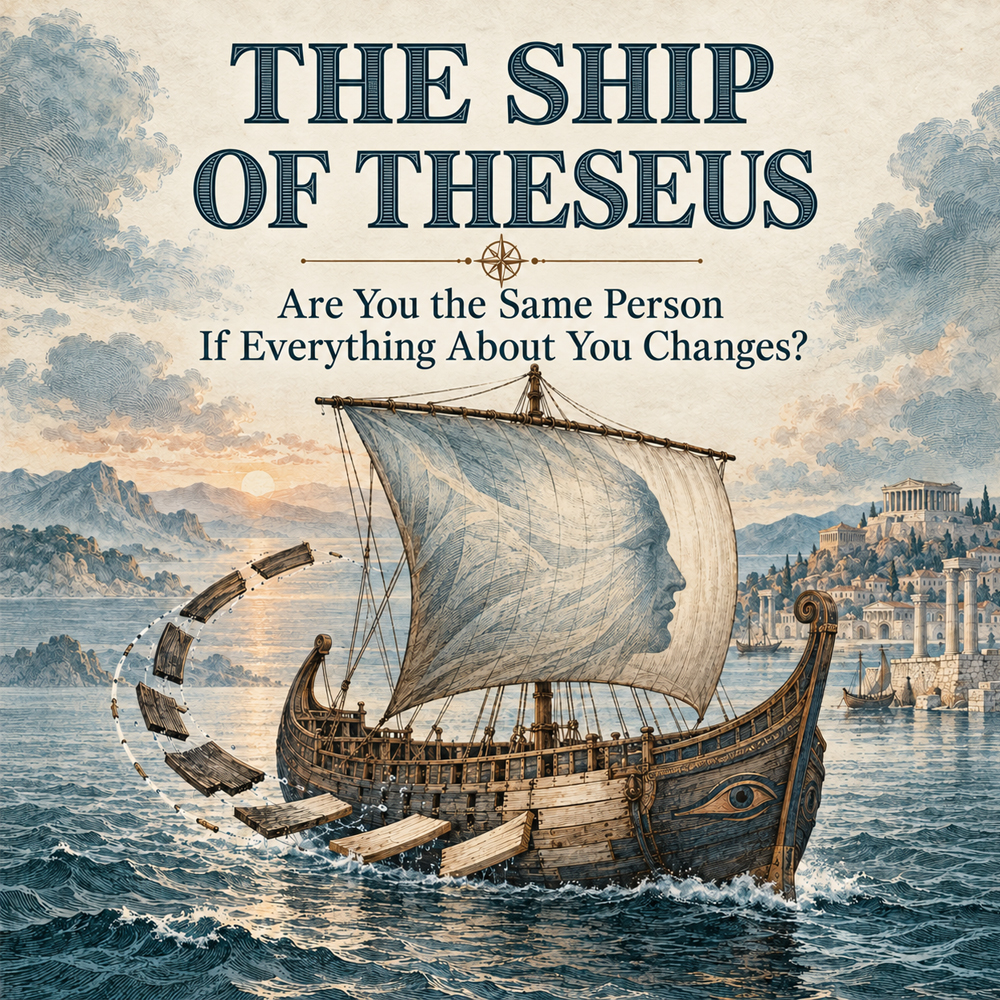
The Ship That Returned Home
Imagine an old wooden ship slowly entering the harbor of Athens. Its sails have been lowered, its hull bears the marks of salt and long voyages, and the people standing on the shore recognize it even before it drops anchor. This is the ship of Theseus – the hero who, according to ancient Greek tradition, returned from Crete after killing the Minotaur and finding his way out of the labyrinth. To the Athenians, the ship is not merely a structure of wood, rope, and sailcloth, but a physical witness to a story that has already become part of the city’s memory. And so they preserve it, caring for it long after Theseus himself has disappeared from the world of the living.
But wood has no respect for legends. It rots, cracks, absorbs water, and gradually loses its strength. Whenever one plank begins to decay, the craftsmen remove it and replace it with a new one. Years later, they replace another, then another, followed by part of the deck, the mast, the beams, and the remaining components. No individual repair seems significant enough for anyone to declare that the vessel is no longer the ship of Theseus. It was his ship yesterday, one plank has been replaced today, and tomorrow it will still be his ship.
Decades pass. The repairs continue for so long that a day eventually arrives when not a single original plank remains in its place. The ship stands in the harbor with the same name, the same form, the same history, and an uninterrupted biography, yet the material from which it was originally built has vanished completely. And it is precisely here that the ancient tale ceases to be a story about shipbuilding and becomes one of the most persistent philosophical problems in the history of human thought. Is the ship before us still the same ship?
At first glance, the question sounds like an intellectual game suited to philosophers with far too much time on their hands. In reality, it points directly toward one of the most intimate convictions every human being carries: the conviction that throughout all the years of our lives, we somehow remain the same “self.” When you look at a photograph from your childhood, you do not say that you are looking at an unfamiliar child who once existed and who, through some strange coincidence, happens to be connected to you. You say, “That is me.” And yet almost everything you see in that photograph has changed.
The Ship of Theseus, then, is not sitting in some distant ancient Greek harbor. It stands before the mirror every morning. Its planks are our bodies, its sails are our beliefs, the marks on its hull are our memories, and the route it has traveled is the story we call our life. Every day, something within this ship is replaced, damaged, repaired, or lost. And still, whenever we pronounce the word “I,” we speak as though we were naming something permanent.
One Plank Does Not Destroy the Ship
Let us begin the repairs again. A craftsman removes one rotten plank from the hull of the ship and replaces it with a new one. No reasonable observer would claim that at the exact moment the final nail is driven into place, the old ship has ceased to exist and an entirely different ship has suddenly appeared in its place. The change is too small. The history continues without interruption, the crew recognizes the vessel, its owner considers it the same ship, and the ship itself continues its journey.
The following year, five more planks are replaced. Then twenty. After a storm, part of the deck is rebuilt; after another, the mast is replaced, and given enough time, the repairs eventually reach almost every part of the vessel. At what point did it stop being itself? When ten percent of its material had been replaced, when half of it was gone, when the final original plank disappeared, or long before that? Every attempt to draw an exact boundary seems arbitrary, because the difference between any two consecutive moments is always small.
This is the power of the paradox. It does not allow us to point easily to the moment when identity dies. If the ship remains the same after one plank is replaced, and remains the same after another plank is replaced, logic gradually leads us to a ship in which none of the original material remains. We arrive at continuity without material permanence. The thing remains the same precisely while its parts are continually changing.
Something even more radical happens with human beings, because we are not museum objects slowly damaged by time. Change is not a defect in human existence; it is its normal condition. The organism constantly exchanges matter with its environment, tissues renew themselves at different rates, neural connections change, while hormones, experiences, illness, habits, and age transform the way we feel and respond to the world. A forty-year-old is not simply an enlarged version of the four-year-old child they once were.
And yet there is a connection between them that we accept as so obvious that we rarely question it. The child had a different body, a different voice, a different vocabulary, different fears, and almost no understanding of the world the adult now knows. That child loved things that may seem meaningless today and feared dangers that no longer exist. If that child could sit across from you as a separate person, the differences between the two of you would be enormous. But when you see that child’s face in an old photo album, you have no doubt whose life began there.
The Child in the Old Photograph
Somewhere in the family archives, there are photographs with a peculiar power. In one of them, a child stands outside a school, on a beach, in a garden, or beside a birthday cake. The child looks toward the camera without knowing what kind of person they will become, whom they will meet, what they will lose, or what they will learn. Their world contains people who will later disappear, problems that will eventually be forgotten, and dreams that will never come true. The child knows almost nothing about the person who will one day hold this photograph in their hands.
The adult looking at the picture knows the endings of countless stories whose beginnings the child is only starting to experience. They know which friendships will fall apart, which decisions will turn out to be mistakes, and which accidental encounters will transform their life. They know betrayal, disappointment, success, death, love, loneliness, and responsibilities of which the child has no conception. Between those two faces lies an entire universe of experience. And yet language connects them with the shortest possible word: “I.”
That word accomplishes something remarkable. It gathers many different versions of a human being into a single biography. The infant, the schoolchild, the young person in love, the disappointed adult, the parent, and the elderly person can have different bodies, beliefs, and personalities, yet all of them say “I,” as though the same traveler were passing through each of them. Intuitively, we imagine life as a train in which the passenger remains the same while the landscape outside changes. The Ship of Theseus introduces a more unsettling possibility: the passenger is changing too.
Think about your own beliefs fifteen or twenty years ago. Some of them you would still defend today, others you would reject, and still others might now strike you as naïve. The same is true of taste, relationships, ambitions, ideas of success, attitudes toward love, fear, and death. We do not simply acquire new facts while some completed personality remains untouched beneath them. New experiences alter the very system through which those facts are interpreted.
This is why the question “Am I the same person?” contains a hidden problem. What exactly has to remain the same for me to remain me? If the answer is the body, the body changes. If the answer is character, character changes too. If the answer is memory, we forget enormous portions of our lives, and memories themselves are not motionless archives. The more carefully we search for the permanent owner of the biography, the more it begins to resemble the last original plank of the Ship of Theseus – something we expect to find, yet which continually slips away from us.
The Body as a Ship Under Constant Repair
The body creates the strongest sense of personal continuity because we never leave it. We wake up within it, carry its scars, recognize our hands, and experience its pain directly. The world may change completely, but our point of view remains situated behind the same pair of eyes. It therefore seems natural to conclude that the physical organism itself is the anchor of identity.
But the body is not a statue. It is a process that must continually work in order to remain alive. Cells die and are replaced, molecules enter and leave the organism, bone is remodeled, skin renews itself, blood circulates, and every meal introduces into the body matter that yesterday belonged to something else. Biological stability does not consist in preserving exactly the same atoms, but in maintaining a particular organization through continuous exchange.
This is an important distinction. A waterfall remains recognizable even though the water flowing through it is never the same. A flame retains its form even though the substance feeding it is continually consumed and replaced. A whirlpool can persist for minutes while the particles of water forming it constantly pass through. A living organism belongs to the same strange family of enduring processes: its identity seems to depend less on particular matter than on the way that matter is organized and continues its history.
The Ship of Theseus therefore begins to look less like a paradox and more like a description of life. We are structures that persist through change, not despite it. The heart remains a heart not because it contains the same matter forever, but because it continues to function as part of an organized system with a particular history. The human body exists because it possesses the ability to replace, repair, and transform itself continuously.
But this does not solve the problem. If bodily continuity were enough, then every change in personality and memory should be irrelevant to personal identity. Yet our intuition refuses such a simple answer. Imagine a person who remains physically alive but undergoes such a profound transformation of memory and personality that they no longer recognize their family, remember their past, or respond to the world in anything like the way they once did. Their loved ones can experience a painful contradiction: the person is standing before them, and yet the person they knew seems somehow absent.
The body, then, is part of the answer, but it is not the whole answer. We associate a person not only with an organism but with a particular psychological history carried by that organism. A scar on the hand matters not simply as an area of altered skin, but because a story lies behind it. An old song can shake us not because of its acoustic properties, but because it opens a door to a previous version of ourselves. The body is the ship, but human identity appears to include the logbook of its voyage as well.
If We Reassemble the Old Planks
The paradox becomes even more disturbing when we add one detail. Imagine that the craftsmen never threw away the old planks from the Ship of Theseus. Someone carefully collected them in a warehouse – every beam, every piece of the deck, the old mast, everything that had gradually been replaced. Years later, that person takes the original parts and uses them to build a ship according to the original design. There are now two ships standing in the harbor.
The first possesses an uninterrupted history. It never stopped being used, repaired, and called the Ship of Theseus, but none of its original material remains. The second is made from the original planks that actually sailed with Theseus, but in the meantime those planks spent years lying disassembled in storage. Which one is the true ship? If we choose the first, history seems more important than matter; if we choose the second, matter suddenly takes precedence over continuity.
The same dilemma can be transferred to human life in ways that sound like science fiction but reveal genuine philosophical intuitions. Imagine a technology capable of scanning your brain with absolute precision and creating a second body with identical memories, personality, habits, and beliefs. The new person opens their eyes and claims to be you. They remember your first day at school, know your passwords, recognize your parents, love the people you love, and can finish a sentence you began seconds before the copying occurred.
But you are still there as well. Nothing has happened to your original body, and you continue to experience the world from your own point of view. At that moment, it becomes obvious that similarity – even perfect psychological similarity – is not automatically enough to make two people one and the same person. The copy possesses your past up to the moment of separation, but from that instant onward there are two futures. One person can walk through the door on the left and the other through the door on the right, and after only a minute their biographies will already contain different events.
Here one of the deepest features of personal identity reveals itself. Being someone does not simply mean possessing a list of that person’s characteristics. Identity also involves a history of causal continuity – the present person must somehow arise from the previous one, just as the present state of a river emerges from the flow that came before it. We are not static objects possessing eternal properties, but stories continually writing their next sentence.
Memory – The Inner Archive That Is Constantly Rewritten
If the body is not enough, it is natural to look for identity in memory. Memories seem to form the bridges between our different versions. I know that the child in the old photograph is me because I can remember the room, my grandmother’s voice, the garden, the school corridor, or the feeling of some summer day that vanished long ago. Memory creates the sense that the past does not merely belong to a person we have read about, but to us.
This idea has a powerful philosophical history. If a person remembers performing an action as their own, it seems natural to connect them with the person who performed it. Memory does more than preserve information; it marks certain events with a special quality: “This happened to me.” I can learn every detail about another person’s childhood, but that knowledge does not have the same structure as my own memory. A biography can be learned, while an autobiography is experienced as a continuation of the observer.
Yet memory is far less stable than our experience suggests. We forget enormous portions of our lives. Out of thousands of breakfasts, conversations, journeys to work, evenings, and accidental encounters, only scattered islands remain. The earliest years of life almost completely disappear from accessible autobiographical memory, yet no one concludes that a person began to exist only with their first clear memory. If memory were the sole condition of identity, every forgotten experience would have to belong to somebody else.
More importantly, memory does not function like a video file that the brain opens in an unchanged form. Remembering is a process of reconstruction. Present knowledge, emotions, and beliefs participate in the way the past is rebuilt, and repeated recollection itself can alter the story. A person does not carry a flawless archive of who they once were inside their head. They carry a living interpretation of the past that grows older with them.
This means that our connection to the child in the photograph cannot depend solely on the accuracy of memory. You may have no recollection whatsoever of the day the photograph was taken and still know that the child is you. Between you and that child lies a causal chain of days, sleep, growth, decisions, experiences, and bodily continuity, even when individual links in that chain are inaccessible to consciousness. The biography is larger than the memories of the biography.
And yet without memory, the sense of self begins to lose its density. Memories give content to identity because they explain why certain places make us sad, why certain people matter, and why we carry fears that another person cannot understand. They transform bare biological continuity into a story. The body carries us through time, but memory allows us to experience that journey as our own.
The Person Who Wakes Up Every Morning
Every night, something happens that we rarely perceive as a philosophical problem. We lie down, close our eyes, and our conscious experience of the world either disappears or is radically transformed. Hours later, consciousness once again organizes reality around a single point of view, and our first reaction is not panic over the question of who has awakened. We automatically assume that the person who opened their eyes in the morning is the same person who closed them the night before.
This trust runs so deep that practically the whole of human life is built upon it. We leave unfinished work for tomorrow because we expect the future person to continue it. We save money, study, exercise, care for our health, and make long-term commitments for the benefit of versions of ourselves that do not yet exist. The person we are today tolerates discomfort for the sake of the person we will be tomorrow, as though a contract existed between them that was never formally signed. The entire idea of personal responsibility assumes that the one who will bear the consequences tomorrow is, in a sufficiently meaningful sense, the same person who acts today.
Viewed on a larger scale, however, the transformation is enormous. Today’s adult and the seven-year-old child they once were are separated by thousands of interruptions of consciousness, billions of small bodily changes, and countless psychological transformations. There was no single moment when the child was removed like an old plank and the adult installed in its place. There was an uninterrupted sequence of almost imperceptible transitions. It is precisely this continuity that creates a bridge across radical change.
Here the Ship of Theseus begins to offer a deeper way of thinking about the human being. The question is not necessarily what part of us never changes. No such thing may be required for personal identity to exist. What matters more is the way each successive state arises from the one before it, carries its traces, and passes some of them onward. A life can possess unity not because it contains an immovable center, but because it never stops continuing its own story.
The Character We Call the “True Self”
People often speak about character as though beneath all our social roles there were a final version of the person. We say that someone has “shown their true colors,” as though a single action had suddenly revealed an unchanging essence that had always been hidden underneath. We search for our “true self” as though it were an object lost somewhere in childhood, waiting to be recovered. But character has a history too.
A shy child can become an adult capable of speaking before thousands of people. An impulsive young person can develop extraordinary discipline. Someone who has lived for years with a particular prejudice can experience something that destroys their entire previous understanding of the world. Loss, love, parenthood, war, illness, education, power, poverty, success, and failure can bring to the surface capacities and weaknesses that an earlier version of the person never knew existed.
Which version, then, is the real one? The child who was afraid to speak or the adult who confidently walks onto a stage? The person before the great loss or the person after it? The naïve idealist at twenty or the skeptic at fifty? If we choose one version as authentic and declare all the others deviations, we turn life into an attempt to freeze movement.
It is more accurate to think of character as a relatively stable pattern that nevertheless remains capable of transformation. Some traits can remain remarkably persistent, others weaken or grow stronger, and still others emerge under the pressure of circumstances. A person is not a blank sheet, but neither are they a finished sculpture. They are a system with a history, limitations, and possibilities, continually interacting with the world and being changed by that interaction.
This perspective has an uncomfortable consequence. We cannot completely rely on the sentence “That is just who I am.” It often describes a habit rather than an eternal truth. When we repeat it long enough, we turn yesterday’s version of ourselves into an obligation imposed upon tomorrow’s. The ship begins defending its rotten planks simply because they are old.
The Paradox Turns Toward Us
At the beginning, we asked whether the ship remains the same after all of its parts have been replaced. Now the question sounds different. If a person continually changes their body, memory, beliefs, relationships, and character, why does the sense of a unified “self” remain so powerful? What exactly continues from the child to the adult if we cannot point to one unchanging part and say, “There – that is the person”?
One possible answer begins to emerge. We search for identity in the wrong place when we search for it as though it were an object. The ship is not one special plank hidden among all the others, but an organized whole with a history. A melody is not one particular note that remains unchanged from beginning to end, but a relationship between different notes unfolding through time. In the same way, the human “self” can be understood not as an immovable substance, but as a particular kind of continuing organization.
Yet this opens the next and more difficult door. If identity is a story, how radically can that story change before we are forced to speak of a different person? If we lose all our memories but retain the same body, who are we? If our character changes completely, should old promises continue to bind the new person? If someone commits something terrible at twenty and becomes radically different by sixty, in what sense does the sixty-year-old still bear the responsibility of the young person?
Here the ancient ship leaves the harbor of abstract philosophy and sails into morality, love, guilt, forgiveness, and the fear of death. Because behind the question “Am I the same person?” stands another, even more personal question: what do I owe to the person I once was, and what do I owe to the person I will become? To reach that answer, we must examine not only what the ship is made of, but how a biography manages to remain one biography when the person at its end barely resembles the person at its beginning.
The Person Without a Past
Imagine waking up one morning in a room you do not recognize. Beside the bed stands someone who looks at you with relief and calls you by name, but the name awakens nothing within you. They tell you they have known you for twenty years, show you photographs from trips you took together, and begin recounting stories in which you are the main character. You see your own face in the photographs, you understand the words, you know what the sea is, what a car is, what love and family are, yet none of the events before you feel like part of your life.
Then more people arrive. One claims to be your brother, another embraces you like an old friend, and a third begins to cry when they realize you do not remember them. All of them possess pieces of your biography that, to you, are nothing more than stories about a stranger. They know what you loved, what frightened you, to whom you made promises, and whom you disappointed. Around you exists an entire network of evidence proving that you lived a particular life, yet your inner access to that life has been severed.
The body is the same. The scars remain in the same places, the fingerprints have not changed, the face in the mirror matches the face on your documents, and the people around you have no doubt about whom they are looking at. The law would also treat you as the same person: your property would remain yours, your contracts would still be binding, your debts would not disappear, and your marriage would not automatically cease to exist. From society’s point of view, the ship has entered the harbor bearing the same name.
But from inside consciousness, the situation is different. What is missing is that intimate feeling through which the past is recognized as “mine.” The biography has survived externally but has been lost internally. Other people can tell you who you were, but they cannot restore the immediate experience that this person was you. The paradox of Theseus no longer asks whether the new planks belong to the old ship, but whether the ship remains the same after losing its own logbook.
This is precisely where it becomes clear why memory occupies such a special place in our understanding of personal identity. Without it, a person does not necessarily lose the ability to think, speak, or act, but loses much of the thread connecting the present to the past. The question “Who am I?” suddenly ceases to have an obvious answer. And if identity depends upon that thread, then forgetting becomes far more than a loss of information – it becomes a rupture in the very structure of the self.
John Locke and the Prince Who Wakes Up as a Shoemaker
In the seventeenth century, the English philosopher John Locke placed personal identity at the center of a thought experiment that sounds remarkably like modern science fiction. Imagine a prince with all his memories, intentions, habits, and consciousness. Now imagine a shoemaker whose body is entirely different and who has a life of his own. Suppose that the consciousness of the prince, together with the memories of his past, somehow finds itself inside the shoemaker’s body.
Who wakes up in that body? From a purely physical perspective, the person before us is the shoemaker. His face, hands, and voice are there, and anyone who knows only his appearance will call him by the shoemaker’s old name. But the moment he begins to speak, he will tell stories about a palace, recognize people from the royal court, and insist that he remembers the prince’s life as his own. Our intuition immediately becomes divided between body and consciousness.
For Locke, the psychological connection – and consciousness of past actions in particular – plays a decisive role. A person cannot simply be reduced to the persistence of the same human matter. To be the same person means that present consciousness can extend backward toward previous thoughts and actions and recognize them as its own. In this sense, the prince, in the personally significant meaning of the term, follows his consciousness into the shoemaker’s body.
The idea seems convincing until we place it under pressure. If identity depends on memory, what happens to all the periods of our lives that we have forgotten? A seventy-year-old may clearly remember an event that occurred at fifty while having completely forgotten something that happened at twenty, even though the fifty-year-old version of that person still remembered it. We are left with a strange chain in which younger and older versions of a person remain psychologically connected through intermediate versions, even though the person at the end of the chain has no direct memory of every point in the past.
This reveals that a personal history is not like a rope made from one continuous strand. It is more like a rope composed of many overlapping fibers. No single fiber necessarily runs from beginning to end, yet each overlaps with the next for long enough to create a strong whole. Memory, character, intentions, habits, relationships, and bodily history intertwine. Unity arises not from the permanence of one part, but from the continuous overlapping of many different connections.
When Character Changes More Than the Face
There are people we meet after twenty years and recognize immediately. Their hair has turned gray, their face carries new lines, their voice has deepened, yet a gesture or a familiar laugh suddenly restores the feeling of knowing them. After a few minutes of conversation, however, a stranger discovery sometimes occurs. The same face is sitting before us, but the person behind it seems entirely different.
They were once impulsive and are now calm. They once chased recognition and today find it uninteresting. They once believed with absolute certainty in ideas they now reject and despised people they have since learned to respect. No dramatic event is required for such a transformation, because twenty years of ordinary life are enough to rearrange an enormous part of a person’s inner world.
This creates a problem for the familiar idea of the “true personality.” If we say the younger person was the real one, we turn their maturity into some kind of deviation. If we say the present person has finally become their true self, we must explain why the decades before that belonged to a false person. A more coherent conclusion is that both versions are authentic states within one developing history.
Of course, change does not mean that everything is equally malleable. Temperament, early experience, biological characteristics, and deeply established habits impose real constraints. But identity is not imprisoned within them. A person is also shaped by their responses to what happens to them, and the same underlying trait can acquire entirely different meanings at different stages of life.
A child who finds it difficult to trust others can grow into an adult who turns that caution into discernment or into destructive suspicion. Strong ambition can become discipline or an obsessive need for superiority. Sensitivity can develop into compassion or permanent vulnerability. The original material matters, but it does not determine the final shape of the ship.
This is precisely why a person can look back at an earlier version of themselves and experience not merely embarrassment, but genuine alienation. “How could I ever have thought that way?” is a sentence that contains the entire paradox of personal identity. The person asking the question and the person being questioned are one individual in the biographical sense, yet enough psychological distance exists between them for them to seem almost like two different people. The ship recognizes its old planks, but no longer wishes to sail with them.
The Young Man’s Crime and the Old Man’s Guilt
Imagine a man who commits a serious crime at the age of twenty and succeeds in escaping punishment. Forty years pass. During that time, he transforms his life, builds a family, helps other people, abandons the values that guided him in his youth, and feels profound remorse for what he did. At sixty, he no longer psychologically resembles the young man who committed the crime.
Four decades later, the truth comes to light. Standing before the court is an elderly man who would never commit the same act today and who looks upon his younger self with horror. Yet almost every legal and moral system would say that he is the one who bears responsibility. We do not punish the character that existed forty years ago as though it were a separate being; we hold responsible the person whose continuous biography contains the crime.
This example reveals something fundamental. Personal identity has not only a psychological dimension but a moral one. If every significant transformation could release a person from their past, moral responsibility would collapse. A criminal would only need to change their beliefs and declare that they are now a different person. Society instead understands identity as sufficiently stable to carry the consequences of actions across time.
At the same time, change is not morally irrelevant. There is a difference between someone who remains cruel after committing a crime and someone who understands what they did, genuinely regrets it, and devotes decades to living differently. Both remain connected to the past, but who they are in the present changes the way we evaluate the story as a whole. Responsibility remains, while the moral meaning of the person does not remain frozen in their worst moment.
This protects us from one of the cruelest mistakes we make toward ourselves and others. We sometimes transform a past action into a final definition of a person. Someone lied and therefore must forever be a liar; they failed and therefore they are a failure; they acted cowardly and therefore fear is their essence. In doing so, we take one plank from a long voyage and declare that it is the entire ship.
A mature perspective is more difficult because it must preserve two truths at once. The past cannot be erased simply because the present person dislikes it, but the present person is not condemned forever to be reduced to the past. Responsibility and change are not opposites. Precisely because the same life continues, a person can take responsibility for who they were and, through their actions, transform who they are becoming.
The Promise We Make to a Stranger in the Future
Identity does not look only backward. Every decision we make today sends consequences toward someone we have never met – our own future self. That person may live five, twenty, or fifty years from now and may have different priorities, a different body, and a different character. Yet we expect them to bear almost everything we leave behind.
When someone takes on enormous debt, their future self will have to repay it. When they care for their health for years, an older version of the same person receives the benefit. When they study a difficult skill, refuse immediate pleasure, or save money, they sacrifice resources in the present for someone who does not yet exist in their future form. A large part of maturity consists precisely in the ability to treat this future person as someone whose interests matter.
But the further into the future we look, the more abstract that recipient becomes. Today’s pleasure is immediate, while health thirty years from now is an idea. Something purchased today can be held in the hand, while the financial security of a seventy-year-old future self is merely an image. Psychological distance makes the future self resemble a distant relative to whom we continually send bills.
This explains why the question of personal identity has practical consequences. If we experience the future person as completely the same “self,” self-control appears to be a reasonable exchange between present and future. If we experience them as almost a stranger, the temptation to transfer the cost of today’s decisions onto them becomes much stronger. Distance in time becomes distance between persons.
Here an unusual moral idea emerges. Caring for your future means practicing a form of solidarity with the person who will inherit your life. They will not be identical to you in every respect, but they will receive the body, relationships, financial consequences, habits, and reputation you pass on to them. You are their past before they become your present.
Every day therefore resembles a brief period of command over a ship that will eventually be handed forward. Today’s captain has no right to behave as though they were the last. Tomorrow’s captain will wake up on the deck we leave behind and will have to sail with the damage or improvements made today. Personal responsibility toward the future begins to resemble an ethics between generations, except that every generation bears the same name.
Derek Parfit and the Person Who Enters the Teleporter
In the twentieth century, philosopher Derek Parfit transformed the problem of personal identity through a series of thought experiments that carried the Ship of Theseus into the technological age. Imagine a teleporter capable of scanning the complete physical state of your body. The machine records your structure with extraordinary precision, sends the information to Mars, and there constructs a person out of new matter. That person possesses the organization of your brain, your memories, character, plans, and the final thought you had before the scan.
In the standard version of the experiment, the body on Earth is destroyed during the process. You enter the machine, press the button, and a moment later the person on Mars opens their eyes. They remember entering the teleporter, expect the meetings you had planned, and feel love toward your family. From their perspective, the journey was successful.
Now change one detail. The machine scans your body and transmits the information, but because of a technical malfunction, it does not destroy you. You step out of the chamber on Earth and learn that a person is already standing on Mars who, in every psychological sense, is your continuation up to the moment of copying. They are convinced that they arrived successfully, while you are equally convinced that you never left Earth.
You cannot both be numerically one and the same person because, from this moment onward, you exist simultaneously. You can have a conversation with one another, disagree about something, and accumulate different memories. If one of you breaks an arm, the other will not feel the pain. A single life has branched into two psychological continuations.
This is precisely what led Parfit to question the assumption that personal identity is always the most important thing we are trying to preserve. In some thought experiments, all the psychological connections we value – memory, character, intentions, attachments – can survive without there being a simple answer to the question of who the “original” is. The philosophical problem is no longer reduced to discovering some hidden substance traveling from one body to another. The focus shifts toward the degree and structure of psychological continuity.
This is a radical reversal. Instead of asking whether the future person is absolutely the same “self,” we begin asking what of the present person continues within them. Memories, projects, love for particular people, moral beliefs, and ways of thinking can persist to different degrees. Identity, which we once imagined as a switch with only two positions – same or different – begins to reveal a far more complex structure.
Two Heirs to One Life
Let us make the experiment even more uncomfortable. Imagine that instead of producing one copy, the teleporter creates two. Two people wake up on Mars with identical memories up to the exact second of the scan. Both remember your childhood, your first love, yesterday’s conversation, and your decision to enter the machine.
Each of them says, “I am the person who entered the teleporter.” Each has equal grounds for making that claim. We cannot say that one possesses the real memories while the other possesses false ones, because their psychological connection to the original is symmetrical. And yet they cannot be one and the same person as each other, because from the moment they awaken, two different lives begin.
One looks through a window and sees a dust storm. The other remains inside the laboratory. Ten minutes later, one already possesses a memory the other will never have. After a year, they may have different friends, different beliefs, and different personalities, and after twenty years their shared past will be nothing more than the beginning of two separate biographies.
This experiment destroys the idea that psychological continuity alone can always provide a simple answer to the question of identity. If one continuation is sufficient, why should two continuations suddenly destroy the connection? The problem is not that there is no heir to the previous person. The problem is that there are too many heirs.
The Ship of Theseus appears once again in a new form. Imagine that from the history of one ship, two ships emerge, each with a serious claim to its inheritance. The very desire to discover one single “true” ship begins to look like a demand we impose upon the world rather than a fact the world is obligated to provide. Nature can contain continuities, branches, and degrees of similarity, while language insists upon one name and one owner.
The Self as a Story That Tells Itself
A person does not merely have a past. They tell the story of that past. From the millions of events they have experienced, they select certain ones, connect them causally, and use them to construct an explanation of who they are.
“I have always been this way.” “After that happened, I changed.” “That was when I understood what I wanted.” “That person made me stronger.” Sentences like these transform the chaotic mass of experience into a plot. We create defining moments, turning points, victories, traumas, losses, and periods of life that we later use to explain the present.
But every story depends on the perspective of the storyteller. An event that appears catastrophic at twenty may be retold at forty as the beginning of a necessary transformation. A relationship we once described as wasted time can later appear as the period in which we learned something essential about ourselves. The facts of the past do not change, but their place within the story does.
The present self therefore does not merely inherit the past; it constantly edits it. It decides which events are important, which were accidental, which define it, and which it refuses to use as definitions any longer. A person cannot change what happened, but they can radically change the meaning that what happened occupies within the structure of their life. This is not a falsification of biography but an unavoidable part of the way consciousness organizes time.
This is why two people with nearly identical experiences can construct entirely different identities. One turns failure into proof that they are worthless; another turns it into the moment that forced them to become more capable. One turns betrayal into a reason never to trust again; another uses it to build stronger boundaries without abandoning intimacy. The event is part of the story, but its meaning is not automatically written into it.
In this sense, a person resembles not only the Ship of Theseus but also the story told about that ship. The planks are replaced, the route changes, the captains grow older, but the logbook connects separate voyages into one history. Except the logbook itself is also being edited. And the storyteller editing it is the very character who is changing within the story.
When Others Preserve Versions of Us That No Longer Exist
There is another archive of identity that does not exist inside our own minds. It lives in the memories of other people. Our parents remember a version of us that we ourselves barely remember, a childhood friend carries an image we have long outgrown, and a former partner knows reactions and vulnerabilities that the people close to us today may never have seen. Everyone with whom we have been sufficiently close preserves a fragment of a ship that no longer exists in quite the same form.
This is why encounters with people from our distant past can feel so strange. They may relate to us according to a map created twenty years ago. They expect the old humor, the old ambitions, the old insecurities, and the old conflicts. For them, a particular version of us remained frozen at the moment the relationship ended.
Sometimes this is comforting. Someone from childhood can restore the feeling of a forgotten world with a single word. At other times it feels suffocating because another person’s memory refuses to acknowledge our transformation. Someone continues to see us as the frightened child, the irresponsible young adult, or the person who made a particular mistake, even though decades have passed.
Here personal identity proves to be social rather than purely internal. We construct ourselves in relationships with people who recognize us, expect certain things from us, and confirm parts of our history. Our name matters because other people use it to refer to the continuous line of our life. Even when our own memory weakens, family, documents, photographs, letters, and stories can preserve parts of our biography.
Yet none of these external archives possesses the final version of the person. A parent knows one face, a partner another, a colleague a third, while the person themselves sees a fourth. All are real, but none is the whole. To be a person means to be larger than the image preserved in any single memory – including our own.
Forgiveness as the Recognition That a Person Can Change
The paradox of personal identity has an unexpected connection to forgiveness. To truly forgive someone, we must accept two things that appear contradictory. The person before us must be sufficiently the same person for responsibility to make sense, and sufficiently changed for it to make sense not to imprison them forever within their past. If they are an entirely different person, there is no one to forgive; if they cannot change at all, there is no reason for our relationship toward them to change.
The same is true of forgiving ourselves. It does not mean declaring that the person who made the mistake has nothing to do with us. That would be an escape from our own history. Genuine change demands the opposite – to acknowledge our connection with the past clearly enough to take responsibility without transforming responsibility into a sentence imposed upon an unchangeable essence.
The person who says, “I did that, but I am not required to remain the person who did it,” describes the structure of the Ship of Theseus with remarkable precision. The old planks were part of the ship. There is no point in denying that they existed. But the ship is not required to preserve every rotten plank in order to remain faithful to its history.
On the contrary, the ability to replace what has been damaged is a condition of continuing the voyage. Human identity is not protected through immobility either. It is preserved through the ability to integrate the past without endlessly repeating it. A person remains the heir to who they were, but they are not its prisoner.
If Change Does Not Destroy the Person, What Preserves Them?
By now, we have replaced almost every obvious candidate. The matter of the body changes. Memories fade and are reconstructed. Character transforms, beliefs can reverse, and a life story acquires different meanings depending on the perspective from which it is told. If we search for an immovable core that never changes, the ship once again appears to contain no final original plank.
But the absence of such a plank does not mean the absence of a person. A river does not cease to be real simply because we cannot point to one molecule of water and declare it the river’s true essence. A melody is not an illusion simply because no single note sounds throughout the entire composition. A life can also possess unity without that unity requiring an immovable material or psychological center.
This points toward a deeper idea: a person is a continuous pattern through time. Body, memory, character, relationships, goals, and social recognition form different lines that overlap and sustain one history. Some lines break, others appear, and still others continue for decades. None of them needs to remain absolutely unchanged from birth until death for a sufficiently strong connection to exist between the different stages.
And it is here that the paradox begins to reverse direction. At first, we worried that if everything changed, the person would disappear. Now we can see that if nothing could change, human life as we know it would not be possible at all. To learn is to change, to love is to allow another person to change you, to overcome fear is to become different from the person who obeyed it, and to mature is to allow some of your old reactions to stop governing your life.
Change, then, is not the enemy of identity. It is the material from which identity is constructed through time. The question is not how to remain untouched by life, but how our different versions can belong to one meaningful story. And when this question is followed all the way to its conclusion, it inevitably reaches the final boundary – death, the fear of disappearance, and the unsettling possibility that the permanent “self” we try so desperately to preserve has never existed in quite the way we imagined.
The Fear That One Day We Will No Longer Be Ourselves
There is a reason why the question of personal identity is far more than an intellectual puzzle. Behind it lies the fear of disappearance. When we ask what makes us the same person through time, we are not merely searching for a philosophical definition; we are trying to understand what exactly we are protecting when we protect our own life. If the body changes, memory fades, character transforms, and beliefs can be replaced, then what is it that we are so determined not to lose?
The fear becomes especially clear when we imagine our own distant future. The face will be different, the body will bear the marks of decades, the people around us will have changed, and some of them will no longer exist. Interests that seem central today may become distant memories, while the problems that now occupy our minds will have been replaced by others. And yet we look toward that future person with a peculiar concern, because we believe that when their day arrives, it will be we who look through their eyes.
Here lies one of the strangest characteristics of human consciousness. We do not experience ourselves as a succession of separate beings appearing one after another. We experience ourselves as a single observer moving through time and gradually growing older. Photographs show different faces, memory preserves different personalities, and biography contains contradictory versions of us, yet the inner sense continues to say: “All of this happened to me.”
From this perspective, death appears as the final interruption of the line. Not merely another transformation, but the moment after which there is no next version to inherit the story. There is no captain tomorrow who will awaken on the deck. There is no next page on which yesterday’s sentence can continue.
But the paradox of Theseus has already taught us to be suspicious of the idea of some motionless passenger who has remained hidden behind all these changes throughout an entire life. The more carefully we search for such a passenger, the more we discover processes, relationships, and continuities instead of an unchanging essence. This does not make life any less real. It merely changes the way we understand the one who lives it.
Buddhism and the Person Who Cannot Be Found
Many centuries before modern philosophical debates, Buddhist thought arrived at a radical conclusion about the human self. According to the teaching of anatta, there is no permanent, independent, and unchanging essence within a person that can be identified as the ultimate owner of all experience. This does not mean that the person does not exist in a practical sense or that individual life is a meaningless illusion. The claim is more precise: what we call the “self” consists of changing processes and contains no eternal, motionless center.
Imagine that you begin removing everything that changes. You cannot be only the body, because it transforms from birth to old age. You cannot be only your sensations, because they continually arise and disappear. You cannot be your thoughts, because one thought replaces another, nor can you be your emotions, because fear becomes calm, love can become indifference, and sadness can give way to joy.
Even the image we have of ourselves is not fixed. At ten, a person understands themselves in one way; at twenty, in another; and at sixty, they may look back at both versions from an enormous distance. Self-image changes, social roles shift, relationships begin and end, and desires weaken or are replaced. When we remove everything changeable in search of a permanent self, we do not discover one final indivisible part remaining beneath everything else.
This bears a striking resemblance to the Ship of Theseus. If we search for the true ship among its parts, we will not discover a special plank containing its “shipness.” The mast alone is not the ship, the deck alone is not the ship, the sail is not the ship, nor is the name painted on the hull. The ship exists as a particular organization, a history, and a relationship among all these elements.
In the same way, a person is not one secret component standing behind the body and consciousness. A person is the living relationship among bodily processes, memory, perception, desires, habits, relationships, and history. That relationship is entirely real, just as a whirlpool is real even though the water within it is constantly changing. The mistake begins when we conclude from the reality of the process that there must necessarily be something motionless behind it.
The River We Never Enter Twice
The ancient Greek philosopher Heraclitus remains associated with one of the most famous metaphors of change – the river. The water flows and never remains in one place. A person steps into the river, steps out again, and when they return, the water is already different. Yet we continue to call the river by the same name.
This is not a contradiction, because the river’s identity does not depend on preserving particular molecules of water. It depends on the continuity of a certain process – on the riverbed, the movement, the source, the direction, and the history. If the water stopped flowing permanently, the river would cease to be a river. What preserves it, therefore, is precisely the movement that continuously changes it.
Human life has the same structure. We often think that change threatens identity because we imagine identity as stillness. But a living person exists only through continuous change. The brain learns, the organism adapts, memory is updated, relationships alter behavior, and experiences rearrange our understanding of the world.
A person who literally could not change would not be a perfectly stable personality. They would be incapable of learning. No experience could make them wiser, no mistake could teach them anything, no love could leave a mark, and no encounter could change the way they understand the world. Absolute psychological immobility is not perfect identity; it is the negation of development.
And so the paradox gradually turns itself inside out. At first, we asked how a person could remain the same while continually changing. Now we see that a person remains themselves precisely through a certain kind of continuous change. The river does not survive despite the flow; it exists as the flow.
The Past Is Not a Sentence
One of the most liberating consequences of this idea concerns the way people turn their past into destiny. A person experiences failure and begins saying, “I am someone who fails.” They experience rejection and conclude, “I am not someone who can be loved.” They make a mistake and, instead of describing an action, construct an identity from it.
Language easily transforms temporary states into permanent definitions. “I acted cowardly” becomes “I am a coward.” “I failed” becomes “I am a failure.” “I do not know how to do this” becomes “I cannot do it.” In this way, particular moments in a biography begin claiming the right to represent the entire person.
The Ship of Theseus shows why this logic is mistaken. No single plank is the whole ship. No single storm is the entire voyage. No single harbor determines the route forever.
This does not mean pretending that the past never happened. Damage to the hull must be seen before it can be repaired. A person who refuses to acknowledge their mistakes does not free themselves from the past; they remain governed by it in ways they do not fully understand. Genuine freedom begins with the ability to say: “This is part of my story, but the story is not finished.”
Here the difference between guilt and responsibility becomes crucial. Guilt can easily become an identity: “I am bad because of what I did.” Responsibility preserves the action and its consequences while leaving room for movement: “I did this, I understand the consequences, and what I do from here is now my responsibility.” The first locks the ship inside one old plank; the second acknowledges the plank and continues the repair.
The Freedom to Betray an Older Version of Yourself
Change often carries a strange sense of disloyalty toward our own past. A person spends years pursuing a particular career and one day realizes that they no longer want it. They maintain a friendship that was once central to their life, but the relationship gradually loses its meaning. They defend an idea with enormous passion and later realize that they no longer believe in it.
At such moments, the temptation arises to remain the same simply because we have invested years in that version of ourselves. “I have always been this way” begins to sound like a moral argument. The past demands loyalty, as though change would amount to betraying the person we once were. But loyalty to the past does not require its endless repetition.
Imagine a young person who devotes ten years to a dream. Those years do not become meaningless if, in the eleventh year, they realize that they want a different life. Those years brought them to the point where they became capable of making the new choice. The past version has not been defeated by the present one; it is part of the reason the present version exists at all.
This changes the way we can think about personal growth. To outgrow something does not mean declaring it a mistake. A child does not betray childhood by ceasing to be a child. A student does not betray their first book when they begin to understand more complex ideas. The old ship is not desecrated when a rotten plank is replaced.
True loyalty to life is not loyalty to every previous form it has taken. It is loyalty to its continuation. A person can honor who they once were without being required to remain that person.
Why Old Photographs Sometimes Make Us Sad
There is a particular kind of sadness that appears when we look at old photographs. In the picture, everyone is young, the room still exists, summer seems endless, and the person behind the camera may have been dead for years. For a brief moment, the photograph creates the impossible sensation that the past is still there, preserved behind the thin surface of the image.
The sadness does not come only from the fact that time has passed. It also comes from encountering a person we once were and who can never be restored. We recognize the face as our own, but we know things that this person does not yet know. We look at them with the tenderness with which we might look at someone walking toward a future whose losses they cannot yet imagine.
In that moment, personal identity divides in a remarkable way. We are the child in the photograph, and at the same time we are no longer that child. Their fears were once ours, yet today they may feel distant. Their dreams belonged to our life, but some of them no longer belong to the person looking at the photograph.
And yet there is no tragedy in the fact that the child has disappeared as a particular present version. They were not destroyed and replaced by a stranger. Parts of them traveled forward – gestures, sensitivity, fears, a way of laughing, memories, habits, reactions, stories that other people continue to tell. Some remained, others were transformed, and still others disappeared completely.
That is precisely what it means to have a past. The past is not a warehouse in which our previous selves wait intact. It is a process whose consequences continue to operate in the present. The child no longer exists as a child, but without that child, the person standing before the photograph would not exist.
The Name on the Hull
The Ship of Theseus bears a name. The planks are replaced, the ropes are changed, the sails tear and are sewn again, yet people continue to point toward it and use the same name. The name connects different states of the ship into a single history.
A human name performs a similar function. It is given to a baby who does not yet possess a fully formed character, beliefs, profession, or autobiographical memory. Decades later, the same name belongs to someone who has experienced thousands of things the baby could never have understood. The difference between the two is enormous, yet society connects them within a single biographical line.
Documents do the same. Family stories do the same. The memories of loved ones, photographs, letters, old possessions, and the places where we once lived all maintain bridges between versions of a person that can never meet directly. We live not only within our own consciousness but within many external systems of memory.
This means that identity is never an entirely private construction. A person may forget a story that their brother still remembers. They may lose an old photograph that a friend continues to keep. They may never realize how profoundly they affected someone’s life, even though for that other person, the encounter became part of their own identity.
The ship therefore sails not only through its own history but through the histories of others. We leave traces in people that we will never fully see. Parts of us continue to exist as words, habits, memories, and consequences beyond the boundaries of our own consciousness.
If You Could Meet Yourself at Ten Years Old
Imagine that a door opens and, on the other side, you are standing there at ten years old. The child does not know who you are. They see an unfamiliar adult who somehow knows their favorite games, their secret fears, and the name of the teacher they dislike.
You, however, know what lies ahead. You know which of their worries will disappear on their own and which will leave lasting marks. You know which friends will be forgotten, which people will remain, which dreams will come true, and which will be replaced by dreams the child is not yet capable of imagining. You also know the mistakes they will make, because you are the person who made them.
How would you speak to that child? It is difficult to imagine judging them with the same harshness with which adults sometimes judge their own past. You would not tell them they were foolish because they did not know things they would learn twenty years later. You would not despise them for fears they did not yet possess the tools to understand.
You would see the context. You would understand their limitations. You would know that they were making decisions with the amount of knowledge, experience, and strength available to them at that moment.
This perspective does not erase responsibility for the past, but it adds something self-criticism often lacks – historical fairness. We judge earlier versions of ourselves using information they never possessed. We judge them according to lessons that were learned precisely because of their mistakes. We demand that the old captain know the map that was drawn only after the voyage.
If we could meet that child, the most important thing would probably not be to give them a list of instructions. We would want to tell them that they do not have to remain exactly as they are. Their fears are not destiny, their character is not finished, and no failure has the right to write the entire story in advance. And when the door closes, we would understand that the same message applies to the person standing on this side.
If You Could Meet Yourself Thirty Years From Now
Now reverse the experiment. The door opens again, but this time the person standing on the other side is who you will be thirty years from now. They bear your name, remember this day, and know what happened after it.
Their body has aged. Some of the people who are part of your daily life today are no longer part of theirs. Others, whom you have not yet met, have become central figures in their life. They know the consequences of decisions that, for you, still remain open possibilities.
To them, you are the past. Your anxieties are their memories, your present habits are the causes of part of their present reality, and decisions that seem small to you have already traveled a long distance through their life. They are the ship that inherited your planks, repairs, and damage.
What would that person want from you? Certainly not complete self-sacrifice for their sake, because then the present would become nothing more than preparation for the future. But they would probably ask you not to destroy their possibilities for the sake of conveniences you will forget within a week. They would ask you to care for the body that will one day be theirs, the relationships they will inherit, and their freedom to choose.
Personal identity thus creates a kind of chain of responsibility. The child handed us a life they did not fully understand. We inherited its consequences, and now we are preparing the conditions for a person who does not yet exist in their final form. Every present self is both an heir and a guardian.
This is one of the most practical lessons of the entire paradox. The future person does not need to be psychologically identical to us in order to deserve our care. It is enough that their life will emerge from ours. The captain may change, but the ship they receive depends on the way we sail today.
Loving Someone Who Is Constantly Becoming Someone Else
The Ship of Theseus has another unexpected application – love. When we tell someone that we will love them decades from now, the promise contains a strangeness we rarely notice. The person thirty years from now will not be entirely the same person we love today.
Their body will change. Their character will be shaped by events that have not yet happened. Some qualities will deepen, others will disappear, and the world will leave marks that no one can predict. To love a person through time therefore does not mean loving a motionless object.
Long relationships are encounters between continually changing people. Two individuals begin the journey as particular versions of themselves and, years later, discover that both have replaced countless “planks.” Successful intimacy does not consist in ensuring that neither person ever changes, but in being able to recognize those changes and rebuild the relationship around them.
This explains why people sometimes say, “You are no longer the person I fell in love with.” The statement can be completely true and still miss something important. No one, after twenty years, is exactly the person they were at the beginning. The real question is whether the new versions can still meet one another.
Love through time, then, is not a promise made to a frozen personality. It is a willingness to keep discovering a person who continues to change. To insist that they remain forever as they were when you first met is to love an old plank more than the living ship.
There Is No Final Plank
After all of this, we can return to the ancient harbor. Before us stands the Ship of Theseus once again. Not a single original plank remains, the sails are new, the mast has been replaced, and the ropes have long since rotted away and been exchanged for others.
Is it the same ship?
If by “the same” we mean an absolutely unchanged material object, the answer is no. But such a ship did not exist even between two consecutive voyages. Wood ages, surfaces wear down, moisture enters the material, and every journey leaves marks. Absolute stillness is an abstraction we impose upon a world in which everything has a history.
If by “the same” we mean a continuously existing organization that passes through changes while preserving a causal connection with its own past, then the ship can be the same in the sense that matters to its history. Not because it preserved some secret original plank, but because each of its states emerged from the one before it. There is no magical moment at which one ship disappears and another suddenly appears in its place.
The same is true of a human being. There is no need to discover one unchanging thought, cell, memory, or trait that has remained present from childhood to old age. The unity of a life is created by continuity among its different states. Yesterday’s person caused part of today’s, and today’s person will participate in creating tomorrow’s.
This does not mean that all versions are alike. They can differ dramatically. But difference does not destroy the historical connection between them.
Are You the Same Person?
Now we can return to the child from the beginning. The child stands in the old photograph and looks toward the camera. They know nothing of the Ship of Theseus, philosophical problems of personal identity, or the person who will one day hold the photograph.
They have a different body. Much of the material that made up their organism is long gone. Their voice is different, their knowledge is limited, their character is still developing, and the overwhelming majority of their life lies ahead.
You are not the same as that child in the sense of complete similarity. You do not think in the same way, you do not look the same, and you do not want the same things. If the two of you could sit at the same table, enormous psychological differences would separate you.
But you are the same person in another, deeper sense. Your life did not begin after theirs. It is the continuation of theirs. There is no empty space in which the child disappeared and you suddenly appeared.
Each version passed something on to the next. The body grew, experiences left traces, decisions created consequences, and character was shaped through the interaction between what already existed and what was new. No single element had to remain unchanged because the connection existed within the process itself.
That is also why you can look at the child with both recognition and distance. The child is yours without being your present self. They belong to your story without determining its final ending.
The Ship Keeps Sailing
The deepest lesson of the Ship of Theseus is not that we do not know who we are. It is that for too long we have asked the question as though a person had to be an object in order to be real. We search for a permanent core because we believe that without it, change will dissolve us.
But a song does not need one note to sound continuously from beginning to end in order to remain one song. A river does not need an eternal drop of water in order to remain one river. A ship does not need a sacred plank that can never be replaced in order to possess a history.
And a person does not need an unchanging version of themselves to defend against time.
We are the same, and we are not the same. The child has disappeared as a present form, yet continues to live in the causes that produced the person who exists today. Today’s person will also disappear as a present form and become the past of someone who will one day speak the same name and say, “I.”
This does not make identity weaker. It makes it more alive. Instead of a stone, we find movement; instead of a motionless essence, a story; instead of a final definition, a continuation.
That is why we do not need to remain loyal to every older version of ourselves. We are not required to preserve every fear simply because it once belonged to us. We are not required to repeat every mistake in order to prove that we are the same person, nor must we defend a belief we have already outgrown.
Our past belongs to us, but it does not own us.
And when, years from now, we look back at the person we are today, that person too will resemble an old photograph. We will remember some of their worries and have forgotten others. We will understand some of their decisions and wonder at others. We will carry the consequences of their choices without fully sharing the way they once saw the world.
That future person will not be a stranger.
But they will not be entirely the same either.
They will be the next form of a story that began long before today.
The ship will have new planks, new marks left by storms, and new repairs. Some of its cargo will have been thrown overboard, other cargo will have been brought aboard, some harbors will remain forever behind it, while others will not yet be visible on the horizon.
And despite all of this, the ship will continue to carry its history.
Not because it never changed.
But because it never stopped continuing.
Author: Vasil Stoyanov