
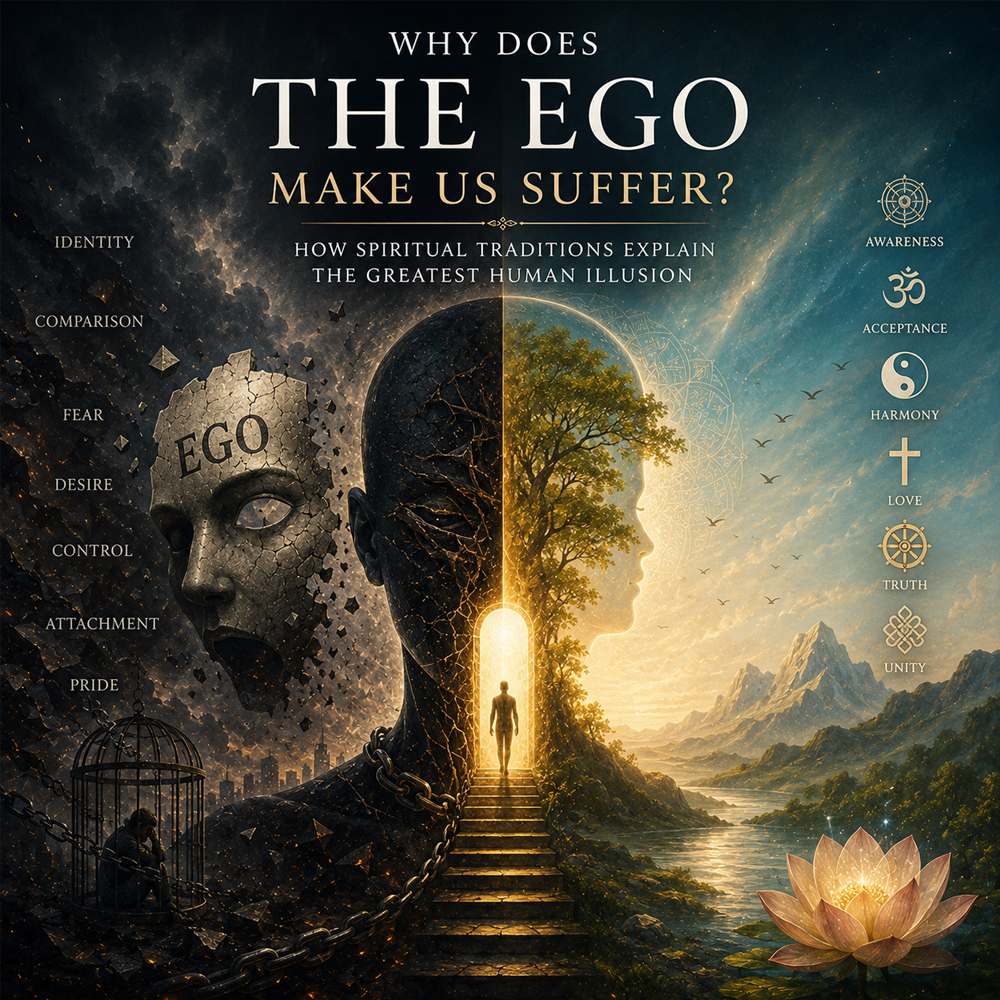
Almost everyone is familiar with the feeling of inner tension that arises when things do not unfold according to our expectations. We suffer when we are criticized, when we lose something we consider ours, when we do not receive the recognition we believe we deserve, or when the future seems uncertain. At first glance, the causes appear different, but spiritual traditions around the world claim that behind all of them stands a common force – the ego.
Buddhism, Hinduism, Taoism, Sufism, Christian mysticism, and even some branches of modern psychology arrive at a remarkably similar conclusion. According to them, the primary source of human suffering is not the external world, but the way we perceive ourselves. We identify with a mental construct that we take to be our true essence – namely, the ego.
This idea sounds paradoxical. Most people believe that a strong ego helps us survive, develop, and protect our interests. Spiritual teachers, however, make an important distinction. They do not deny the practical personality necessary for everyday life, but they warn against the illusion that this personality represents our entire being. It is precisely this misunderstanding that gives rise to the endless sense of lack, fear, and dissatisfaction.
What Is the Ego, Really?
When people hear the word “ego,” many imagine an arrogant, self-centered individual who constantly places themselves above others. In the spiritual sense, however, the ego means something much deeper. It represents the psychological image we have of ourselves – the story we constantly tell about who we are.
This story includes our name, profession, nationality, successes, failures, memories, desires, fears, and beliefs. Gradually, we begin to believe that we are exactly this collection of characteristics. If someone questions any part of this story, we feel pain, as if our very essence has been attacked.
The problem is that this identity is constantly changing. The child we once were no longer exists. Our bodies change, our thoughts change, our desires change, and yet the sense of a constant “self” remains. It is upon this apparent stability that the ego builds its power.
Buddhism: The Illusion of a Separate Self
Perhaps no spiritual tradition analyzes the ego as thoroughly as Buddhism. According to the teachings of the Buddha, the deepest cause of suffering is attachment to the idea of an independent and permanent self. Buddhism calls this illusion anatta – the absence of a fixed ego.
From a Buddhist perspective, a human being is a continuous flow of physical and mental processes. The body changes every second, emotions arise and pass away, thoughts shift one after another, and memories are constantly rearranged. Nowhere in this flow can a permanent “self” be found that exists independently of these processes.
And yet, the mind desperately tries to create such a center. This very illusion gives rise to the desire to constantly defend ourselves, accumulate possessions, gain respect, and avoid anything that threatens our image. Thus, the endless cycle of desire, fear, and disappointment is born.
Why the Ego Is Never Satisfied
One of the most interesting characteristics of the ego is that it never experiences lasting satisfaction. If a person receives a promotion, they soon begin to desire an even higher position. If they become wealthy, they start to fear losing their wealth. If they are praised, they begin to worry whether they will receive the same recognition next time.
This happens because the ego exists through comparison. It cannot simply be at peace. It constantly measures itself against others and against some imagined ideal of perfection. As long as this comparison exists, there will always be a sense of insufficiency.
Buddhism calls this process craving or attachment. It is not desire itself that causes suffering, but the belief that happiness depends on fulfilling the endless desires of the ego. Since these desires never end, suffering continues as well.
Hinduism: The Forgotten True Nature
In Hindu philosophy, the problem is viewed in a different but closely related way. According to the Upanishads and Vedanta, a person possesses a true nature called Atman, which is eternal, infinite, and inseparable from the absolute reality – Brahman. The ego is the temporary identity that covers this deeper reality, like clouds hiding the sun.
When a person forgets their true nature, they begin to perceive themselves as a separate being struggling for survival among others. This gives rise to fear, jealousy, greed, and a constant desire for control. Every victory seems temporary because the ego knows that everything material will one day be lost.
According to Hindu sages, the spiritual path does not involve creating a new identity, but gradually recognizing what has always existed beyond all roles. Awareness does not create the true nature – it simply removes the ignorance that conceals it.
Taoism: When We Stop Fighting the World
Taoism views the ego as a source of constant resistance. Instead of living in the natural flow of life, a person begins to oppose everything that does not match their expectations. They strive to control the future, manage other people, and bend nature to their own desires.
Lao Tzu describes the Tao as the natural order of the universe, which exists independently of human ambitions. The more the ego insists that the world should be different, the more suffering it creates. Inner tension arises precisely from the mismatch between reality and our expectations.
The practice of wu wei, often translated as “non-action” or “effortless action,” does not mean passivity. It means freeing oneself from the compulsive desire of the ego to control every situation. When a person begins to act in harmony with life rather than against it, inner tension gradually diminishes.
Sufism: The Greatest Barrier Between Humans and God
Sufi mystics speak of the nafs – the lower nature of the human being – which in many ways resembles the concept of the ego. The nafs constantly demands recognition, power, pleasure, and security. It continually places its own desires at the center of the world.
According to Sufi teachers, it is precisely the nafs that prevents a person from experiencing direct closeness to God. As long as attention is consumed by personal ambitions, there is no room for love, humility, and inner freedom. Ego-centeredness becomes a kind of veil that hides the divine presence.
That is why Sufism places great emphasis on the purification of the heart. It is not about destroying the personality, but about gradually freeing oneself from everything that separates a person from true love. The weaker the ego becomes, the stronger compassion manifests.
Christian Mysticism and Humility
Although the term “ego” is not commonly used in traditional Christianity, many mystics describe the same phenomenon. They warn against pride, self-centeredness, and the constant placing of one’s own will above everything else.
Humility in the Christian tradition does not mean humiliation or lack of dignity. It represents a clear perception of reality without the constant need for everything to revolve around the personal “self.” A humble person stops measuring their worth through social recognition and begins to live according to deeper spiritual values.
Many Christian mystics describe the spiritual path as a gradual dying of the false self. This does not mean losing individuality, but freeing oneself from the illusions that separate us from God and from other people.
How the Ego Uses Fear
Fear is one of the most powerful fuels of the ego. It constantly imagines possible future dangers and builds strategies for protection. Some of these fears are realistic and useful, but a large portion exists only in the imagination.
The ego fears losing its social status, youth, wealth, relationships, or the good opinion of others. It continuously constructs defense mechanisms against events that may never occur. As a result, a person begins to live more in the future than in the present moment.
Spiritual traditions emphasize that fear weakens when we stop fully identifying with the temporary personality. If our identity does not depend entirely on external circumstances, they lose their power to destroy us from within.
The Ego and the Constant Need to Be Right
One of the most subtle manifestations of the ego is the need to always defend our own opinions. Sometimes a person would rather destroy a friendship than admit they were wrong. This shows how deeply we have merged with our beliefs.
In reality, beliefs are just thoughts that we have adopted as part of our identity. When someone questions them, the ego perceives it as a personal attack. Instead of listening, we begin to defend ourselves.
True inner freedom arises when we no longer feel the need to constantly prove that we are right. A person can calmly change their opinion because they know their worth does not depend on winning the next argument.
Modern Psychology and the Illusory Self
Interestingly, some branches of modern psychology and neuroscience arrive at ideas that strikingly resemble ancient spiritual teachings. Research shows that the sense of a continuous and unchanging “self” is constructed by the brain through the integration of memories, perceptions, and expectations.
Our inner narrative is constantly being edited. Memories are not exact recordings of the past, and each time we recall them, they change. Yet the mind creates the impression that there is a constant protagonist moving through all events.
These findings do not directly prove spiritual teachings, but they show that human identity is far more flexible and dynamic than it appears. This opens an interesting dialogue between science and spirituality regarding the nature of consciousness.
Can a Person Live Without an Ego?
This question often leads to misunderstandings. Spiritual traditions do not call for a person to completely lose their practical individuality. We still have a name, a profession, a family, and responsibilities. These are necessary for functioning in society.
The change occurs when we stop believing that these temporary roles define our entire being. The ego ceases to be the master and becomes a useful tool. Instead of controlling our lives, it begins to serve a deeper awareness.
Such a person continues to act, work, and create, but their inner peace no longer depends entirely on external success. This is one of the most essential differences between spiritual freedom and ordinary psychological satisfaction.
Practices for Recognizing the Ego
All major spiritual traditions offer different practices, yet there are remarkable similarities among them. Meditation teaches a person to observe their thoughts without immediately identifying with them. Prayer directs attention beyond personal desires toward a higher reality. Contemplation of nature gradually weakens the sense that we are the center of the world.
Another important practice is honest self-observation. Instead of automatically justifying our reactions, we can ask ourselves why a particular situation affected us so strongly. Often we discover that behind anger, envy, or fear lies a threatened image of our own identity.
Developing compassion also gradually weakens the power of the ego. When we begin to see that all people experience the same fears, hopes, and suffering, the sense of absolute separation begins to dissolve.
The Greatest Illusion
Perhaps the deepest message of spiritual traditions is that suffering does not arise solely from difficult events in life. It arises mainly from the way the ego interprets them. Two different individuals can experience the same loss, yet their inner experience can be completely different depending on how strongly they identify with their ego.
This does not mean that pain disappears. Loss, illness, and death remain part of human life. However, spiritual traditions claim that it is possible to go through them without the additional suffering created by the ego’s constant resistance.
True freedom does not consist in the world always fulfilling our desires. It arises when we stop taking the temporary story about ourselves as the ultimate truth of who we are.
Conclusion
Although Buddhism, Hinduism, Taoism, Sufism, and Christian mysticism use different language, they all convey a remarkably similar message. The ego is not an enemy to be destroyed, but an illusion to be recognized. It is a useful tool for navigating the world, but it becomes a source of suffering when we begin to believe that it represents our true essence.
The more we cling to our self-image, the more easily we are hurt by criticism, loss, or change. The more we realize the transient nature of the ego, the more space opens for peace, compassion, and inner freedom. That is why the greatest spiritual teachers throughout history have not sought to make a person more important, but more free from the need to constantly defend their imagined “self.”
Perhaps the greatest human illusion is not that the world is imperfect. Perhaps it is the belief that we are separate from it and that our happiness depends solely on the endless satisfaction of the ego’s desires. When this illusion begins to dissolve, a person discovers not a new identity, but a much deeper inner stillness that has always been there.
Author: Vasil Stoyanov