
Introduction
In recent years, a particular trend has emerged:
People are returning to ancient philosophies, as if they contain something the modern world has failed to replace. Among the most frequently mentioned are Stoicism and Buddhism. They appear in podcasts, self-help books, business strategies, and even in everyday conversations about how to deal with stress.
People are returning to ancient philosophies, as if they contain something the modern world has failed to replace. Among the most frequently mentioned are Stoicism and Buddhism. They appear in podcasts, self-help books, business strategies, and even in everyday conversations about how to deal with stress.
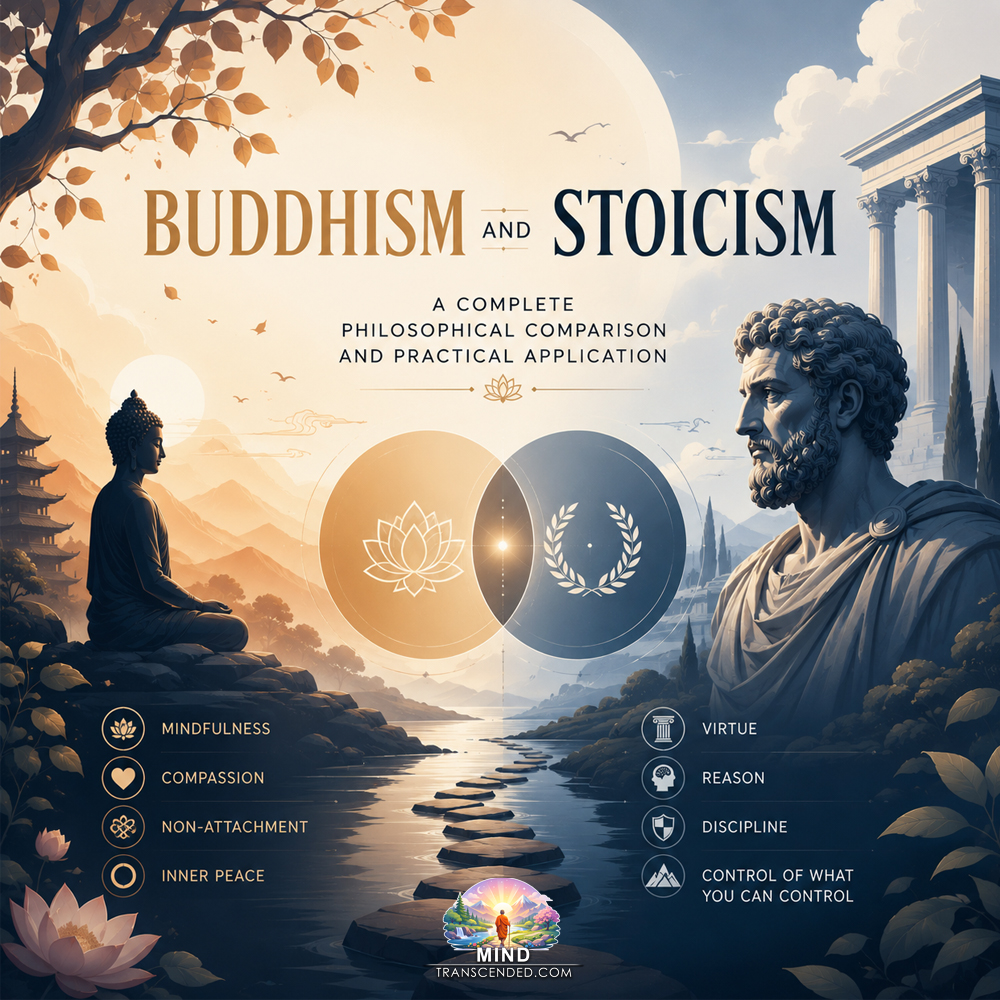
On the surface, it seems that these two systems are saying almost the same thing: do not worry about what you cannot control, accept reality as it is, and seek inner peace. This similarity, however, is deceptive. If we go deeper, we will see that Stoicism and Buddhism do not merely differ – they begin from completely different understandings of reality and the human being.
And here a more interesting question appears than the standard “which philosophy is better?” Is it possible that one is a continuation of the other? Is it possible that Stoicism reaches a boundary beyond which Buddhism begins to answer questions the Stoics never asked themselves?
The Historical Distance That Creates the Philosophical Difference
Buddhism appeared in a world where questions of suffering, rebirth, and liberation were central. Siddhartha Gautama was not looking simply for a way to live better. He was seeking a way out of existence itself as we know it.
Stoicism, founded by Zeno of Citium, arose in an entirely different context. It was a world of collapsing political structures, uncertainty, and personal vulnerability. The Stoics were not trying to escape existence. They were trying to endure it with dignity.
This difference is not merely historical. It is fundamental. Buddhism begins with the question “how do we end suffering forever,” while Stoicism begins with the question “how do we live well despite suffering.”
Already here, a certain tension can be felt. Stoicism accepts the world and seeks a way to adapt to it. Buddhism questions the very foundation of that world.
Stoic Strength and Its Limit
Stoicism is extremely appealing to the modern person because it offers clarity. It says: there are things that depend on you, and things that do not. Focus on the first and accept the second.
This idea, developed by thinkers such as Epictetus and Marcus Aurelius, is powerful. It gives a sense of control in a world that often seems chaotic.
But the more we look into it, the more a quiet boundary begins to appear. Stoicism teaches how to accept pain, but it does not ask deeply enough why that pain exists in the first place. It teaches how to live with your desires, but it does not reach the idea that desires themselves may be the root of the problem.
The Stoic becomes resilient. The Buddhist questions the need for that resilience.
Here a line begins to form that will gradually become clearer: Stoicism is a philosophy of adaptation, while Buddhism is a philosophy of transformation.
Buddhism as a Radical Continuation
Buddhism is not satisfied with making life more bearable. It questions the very structure of experience.
At its foundation stands the idea that suffering is not simply the result of external circumstances or mistaken judgments. It is built into the very way we perceive reality. Desire, attachment, and the illusion of a permanent “Self” create a cycle from which we cannot escape through rational thinking.
Here Stoicism begins to look like a first step. It teaches discipline, control over reactions, and clarity of thought. But Buddhism goes further and says: even this “controlling mind” you rely on is not stable.
This is the moment when many people feel a rupture. Stoicism gives strength. Buddhism shakes the very idea of who possesses that strength.
The Question of the “Self” as a Point of Divergence
Stoicism assumes that there is a core within the human being that can be refined. This core is reason. It is stable, reliable, and capable of making correct decisions.
Buddhism sees this as an illusion. The idea of a permanent “Self” is something we create in order to orient ourselves in the world, but it does not exist independently.
This is not merely a philosophical dispute. It is a difference that changes the entire experience of life. If you accept the Stoic position, you will strive to become a better version of yourself. If you accept the Buddhist one, you will begin to ask whether there is even a “self” to improve.
And it is precisely here that the feeling begins that Stoicism reaches its limit. It can build a strong, resilient person, but it cannot destroy the very foundation of suffering, because it does not question the subject who suffers.
Emotions: Control Versus Liberation
Stoicism is often interpreted as a philosophy that suppresses emotions, but this is not entirely accurate. It seeks to manage them through reason. Anger, fear, and anxiety are seen as the result of incorrect judgments.
Buddhism offers something different. It does not try to replace emotion with rational thought, but to observe it to the point where it loses its power. This is not control, but gradual dissolution.
Here the difference is subtle but essential. The Stoic remains in the position of an observer who governs. The Buddhist reaches a point where the observer itself begins to blur.
And again the sense of continuation appears. Stoicism teaches how not to be a slave to emotions. Buddhism raises the question of who this one is who could be a slave.
Suffering as a Door, Not as an Obstacle
For the Stoics, suffering is an inevitable part of life. Wisdom consists in accepting it and not allowing it to break you.
Buddhism does not stop there. It sees suffering as a key to understanding reality. Not merely something to be endured, but something to be investigated completely.
This difference is important. Stoicism makes life more bearable. Buddhism tries to change the very experience of life.
And it is precisely here that a bolder claim begins to take shape: Stoicism prepares the mind, but Buddhism transforms it.
Practical Dimensions in the Modern World
In the modern context, Stoicism is extremely useful. It provides tools for dealing with stress, uncertainty, and external pressure. It is direct, clear, and applicable.
Buddhism requires more. It is not exhausted by techniques. It requires a change in the way you perceive reality.
Perhaps that is why many people begin with Stoicism. It is accessible. It does not shake the foundations too much. But over time, some begin to feel that something is missing. That there are questions that remain unanswered.
And then the gaze turns toward Buddhism.
Where They Meet and Where They Part Ways
Stoicism seems like a necessary step, but not a final destination. It builds stability, but it does not offer a final solution to the problem of suffering.
Buddhism, on the other hand, is more difficult, more radical, and sometimes even uncomfortable. It does not merely offer techniques, but undermines the very assumptions on which we build our identity.
That is precisely why it begins to look like a continuation. Not in the sense that Stoicism inevitably leads to Buddhism, but in the sense that where Stoicism stops asking questions, Buddhism begins to deepen them.
Conclusion
The comparison between Buddhism and Stoicism is often made superficially, as if they were two versions of the same idea. In reality, they represent two different approaches to life.
Stoicism teaches how to live well in the world. Buddhism asks whether we even understand what this world is.
And perhaps the most accurate summary is not that one is better than the other, but that they exist at different levels of inquiry. Stoicism reaches the boundary of rational understanding and inner control. Buddhism begins where that control is no longer enough.
Read More:
- Zen: The Path Beyond Words – History, Development, and the Living Presence of Awakening
- Buddhism, Hinduism, and Taoism – “The Deep Differences Behind the Apparent Similarities
- Stoicism: A Complete Guide to Inner Strength, Philosophy, and Resilience
Author: Vasil Stoyanov