
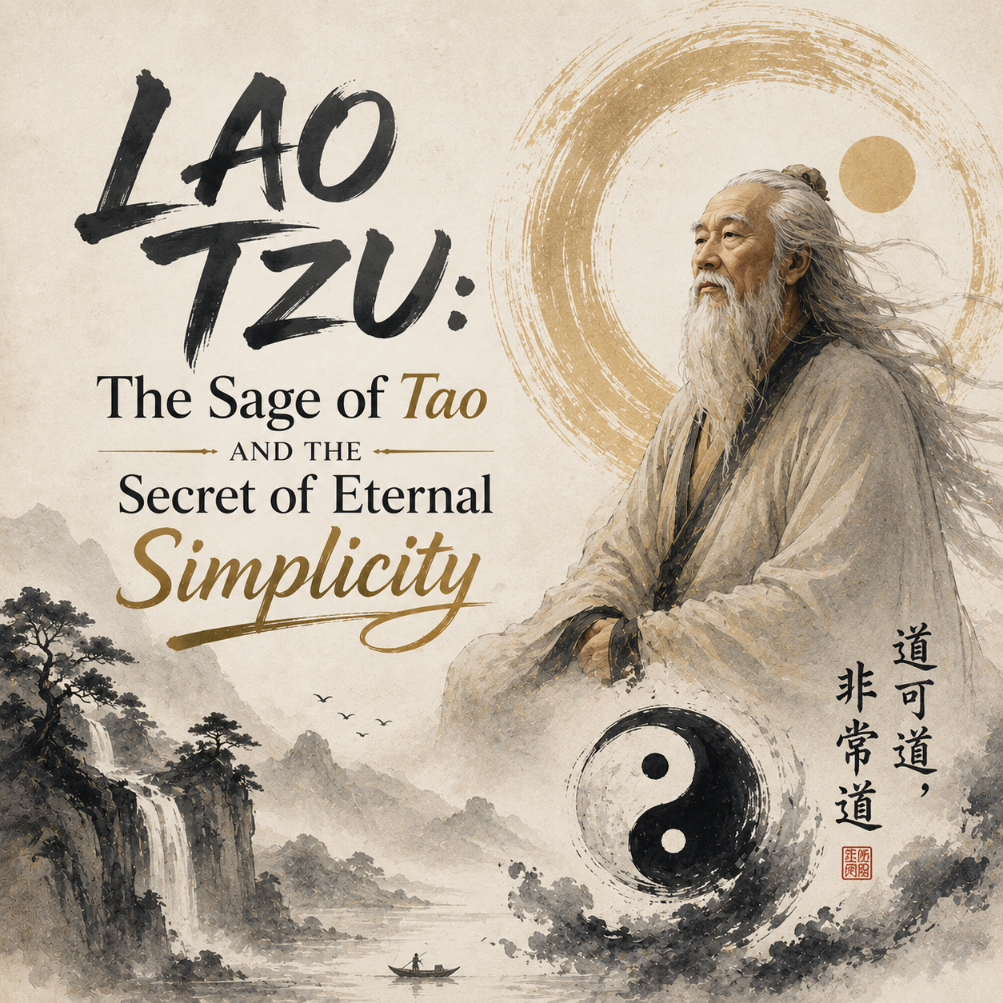
Introduction: Who Was Lao Tzu?
The name Lao Tzu echoes through the millennia as a symbol of profound wisdom, inner peace, and philosophical simplicity. He is regarded as one of the most influential thinkers in human history and as the founder of Taoism-a philosophical and religious tradition that has had an immense influence on Chinese culture, thought, medicine, politics, and spirituality.
Yet as great as his image is, his identity remains equally mysterious. Historical information about him is scarce, interwoven with legends, myths, and philosophical interpretations. This makes Lao Tzu not merely a historical figure, but an almost mythological archetype of the sage who understands the nature of existence.
This article will explore everything that is known-and assumed-about Lao Tzu: his life, his philosophy, his main work, the Tao Te Ching, his influence on the world, and his significance today.
The Historical Context: China in the 6th Century BCE
To understand Lao Tzu, we must immerse ourselves in the age in which he is believed to have lived. This was the period of the Zhou dynasty, when China was divided into numerous warring states. Political instability, social tensions, and moral decline created a need for new philosophical systems.
This was the time of the so-called “Hundred Schools of Thought,” when various philosophers such as Confucius, Mozi, and others appeared. Each of them offered his own model for harmony and order.
Lao Tzu, however, chose a different approach. Instead of creating social rules and moral codes, he turned to nature and the cosmic order as a source of truth.
Origins and Legends
Historical data about Lao Tzu is extremely limited. The earliest source is the historian Sima Qian, who wrote about him several centuries later.
According to him, Lao Tzu was born in the state of Chu, probably in the 6th century BCE, and served as an archivist at the imperial court. This suggests that he was well educated and familiar with ancient texts.
But the legends go much further.
One of the most famous legends claims that he was born after a 72-year pregnancy and entered the world as an old man with white hair. This is why the name “Lao Tzu” means “Old Master.” Another legend tells of his meeting with Confucius, who was astonished by his wisdom and compared him to a dragon-a being that cannot be fully understood.
The Departure from Civilization
One of the most iconic moments in Lao Tzu’s life is his departure from society. According to tradition, he saw the moral decline of the world and decided to withdraw. He mounted an ox and set out toward the western borders of China.
At the border, he was stopped by the gatekeeper Yin Xi, who recognized his wisdom and asked him to leave his teachings in writing before departing. Thus the Tao Te Ching was born.
After that, Lao Tzu disappeared. There is no record of what happened to him-whether he died, continued to live as a hermit, or became a legend.
The Tao Te Ching became one of the shortest and most profound philosophical works in history. It consists of about 5,000 Chinese characters, divided into 81 short chapters. The text is written in a poetic and often paradoxical style, which allows for many interpretations.
Wu Wei: Non-Action
When Lao Tzu speaks of “wu wei,” he is not inviting us to become passive or inactive. On the contrary-this is one of the deepest and most frequently misunderstood ideas in Taoism. “Wu wei” means action that is so natural it appears effortless. It is a state in which a person acts in complete harmony with the Tao-with the natural order of things.
The literal translation of “wu wei” is “without action,” but this is misleading if understood superficially. Its true meaning is “without forced action” or “without artificial effort.” It means not interfering where interference is unnecessary. Not fighting against the natural course of events. Not imposing your will upon the world in an aggressive way.
Lao Tzu sees human problems precisely as the result of excessive interference-of the desire to control, manage, and fix everything around us.
One of the most beautiful paradoxes in Lao Tzu’s teaching is that through “non-action,” the most is achieved. This means that when you stop struggling, you often achieve better results. When you do not force things, they arrange themselves. For example, if you try to force a plant to grow faster, you will destroy it. But if you create the right conditions for it and let it follow its own nature, it will grow naturally.
This is precisely what wu wei is-creating conditions instead of imposing control.
Core Ideas in Lao Tzu’s Philosophy
Lao Tzu’s philosophy is not a system of strict rules, but rather a living understanding of how a person can be in harmony with the world. His ideas are not taught as dogmas; they are experienced. Among them, three stand out as fundamental: simplicity and naturalness, humility, and the relativity of opposites. They are interconnected and together form the core of Taoism.
Simplicity and Naturalness: Returning to the Original State
For Lao Tzu, simplicity is not merely the absence of complexity. It is a state of inner purity in which a person is not burdened by unnecessary desires, ambitions, and social roles. He believes that human beings are naturally in harmony with the Tao, but society diverts them through artificial values.
In other words, we do not need to “become” something more, but to return to what we already are.
This idea is often expressed through the image of the “uncarved block”-a symbol of potential that has not been deformed by external influences. The more we “shape” ourselves according to social standards, the more we lose touch with our true nature.
Naturalness as a Way of Being
Naturalness means living in accordance with your own nature and with the rhythm of the world. It is a state in which actions are not forced, but arise spontaneously.
In Taoism, this is called “ziran”-“such as it is.” It describes something authentic, uncontrived, and free from artificiality. When a person is natural, they do not pretend, compare themselves, or try to be something else. This leads to inner peace and clarity.
Today, the idea of simplicity is especially relevant. We live in a world of overstimulation-information, social media, ambition, competition. All of this creates inner tension. Lao Tzu would say that this chaos comes from our disconnection from what is natural.
The more we seek external recognition, the more we lose inner stability. Simplicity does not mean giving up the world, but removing what is unnecessary.
Lao Tzu’s Influence on Chinese Culture
Lao Tzu’s influence on Chinese civilization is difficult to measure in ordinary categories. It is not merely philosophical or religious-it penetrates the way people think, feel, create art, heal, govern, and even perceive reality itself. Through the development of Taoism, his ideas became part of China’s cultural “genetic code.”
Influence on Traditional Chinese Medicine
One of the most practical areas in which Lao Tzu’s philosophy finds expression is medicine.
Traditional Chinese medicine does not view illness as an isolated problem, but as a disturbance of balance in the body. This approach is directly connected to the Taoist idea of harmony with nature.
The concept of Yin and Yang occupies a central place-the dynamic equilibrium between opposing forces. Health is understood as balance between these forces, and treatment aims to restore that balance rather than merely remove symptoms.
Influence on Martial Arts
Lao Tzu’s philosophy has had a tremendous influence on Chinese martial arts, especially internal styles such as tai chi. Instead of relying on brute force, they use the principle of softness, flexibility, and adaptability. This is a direct reflection of the idea that the soft overcomes the hard.
The practitioner does not directly oppose the opponent’s force, but redirects, uses, and transforms it. This is a living application of wu wei-action without violence. The movements are fluid, circular, and economical. The goal is not aggression, but balance, control, and inner harmony.
In this way, martial arts become not only a technique of self-defense, but also a spiritual practice.
Also important is the concept of vital energy, “qi”-the flow that must move freely through the body. Here the connection with the idea of wu wei is clearly visible: when there are no blockages or forced interventions, the organism self-regulates. Methods such as acupuncture, herbal medicine, and tai chi are not merely techniques, but practices based on a Taoist understanding of naturalness and balance.
Influence on Art and Aesthetics
Chinese aesthetics is deeply influenced by Taoist ideas. In painting, for example, we often see minimalism, empty space, and a focus on nature. Emptiness is not perceived as absence, but as potential.
This is a direct reflection of Lao Tzu’s philosophy, according to which it is precisely emptiness that gives meaning to fullness. A vessel is useful not because of its walls, but because of the empty space within it.
In poetry, simplicity and suggestion are valued. Poems are often short, yet rich in meaning. The goal is not to explain everything, but to leave room for experience.
Influence on Architecture and Space
Taoist philosophy also influences the way spaces are built. Traditional Chinese architecture seeks harmony with nature rather than domination over it. Buildings are integrated into the landscape instead of drastically altering it.
Here we also encounter the practice of feng shui-a system for arranging space in accordance with energy flows. The goal is to create an environment that supports the natural flow of “qi” rather than blocking it.
Once again, we see the principle of wu wei: you do not impose form upon space, but align yourself with its nature.
Conclusion: Wisdom That Does Not Grow Old
The figure of Lao Tzu remains shrouded in mystery, but his influence is entirely real and tangible. Whether we view him as a historical person, a philosophical symbol, or a spiritual archetype, one thing is clear-his teaching continues to speak to people across the centuries.
In a world that is constantly accelerating, where success is often measured by achievements, control, and external results, the philosophy of Taoism offers a different perspective. It points us toward the inner, the simple, and the natural. Instead of fighting the world, it teaches us to move with it. Instead of seeking strength in tension, it shows us the power of softness.
The core ideas we have examined-wu wei, simplicity, humility, and the balance between opposites-are not abstract concepts, but practical guidelines for living. They do not require radical changes, but rather a subtle readjustment in the way we perceive reality.
Perhaps Lao Tzu’s greatest value today is that he does not offer ready-made answers. He does not impose truths, but opens a space for understanding. His philosophy is not a system to be followed blindly, but a path that each person must discover for themselves.
This is precisely where its power lies-in freedom.
To follow the Tao does not mean escaping the world, but living in it more deeply, more consciously, and more harmoniously. It is an invitation to balance, to trust, and to a quieter yet more meaningful existence.
Ultimately, Lao Tzu does not teach us how to control life.
He teaches us how to be part of it.
Read More:
- Zhuangzi – The Sage of the Free Spirit and the Infinite Tao
- Liezi – The Sage of Wind and Freedom
- Buddhism, Hinduism, and Taoism – “The Deep Differences Behind the Apparent Similarities”
- Confucianism as a Living Philosophy: The Profound Art of Being Human