
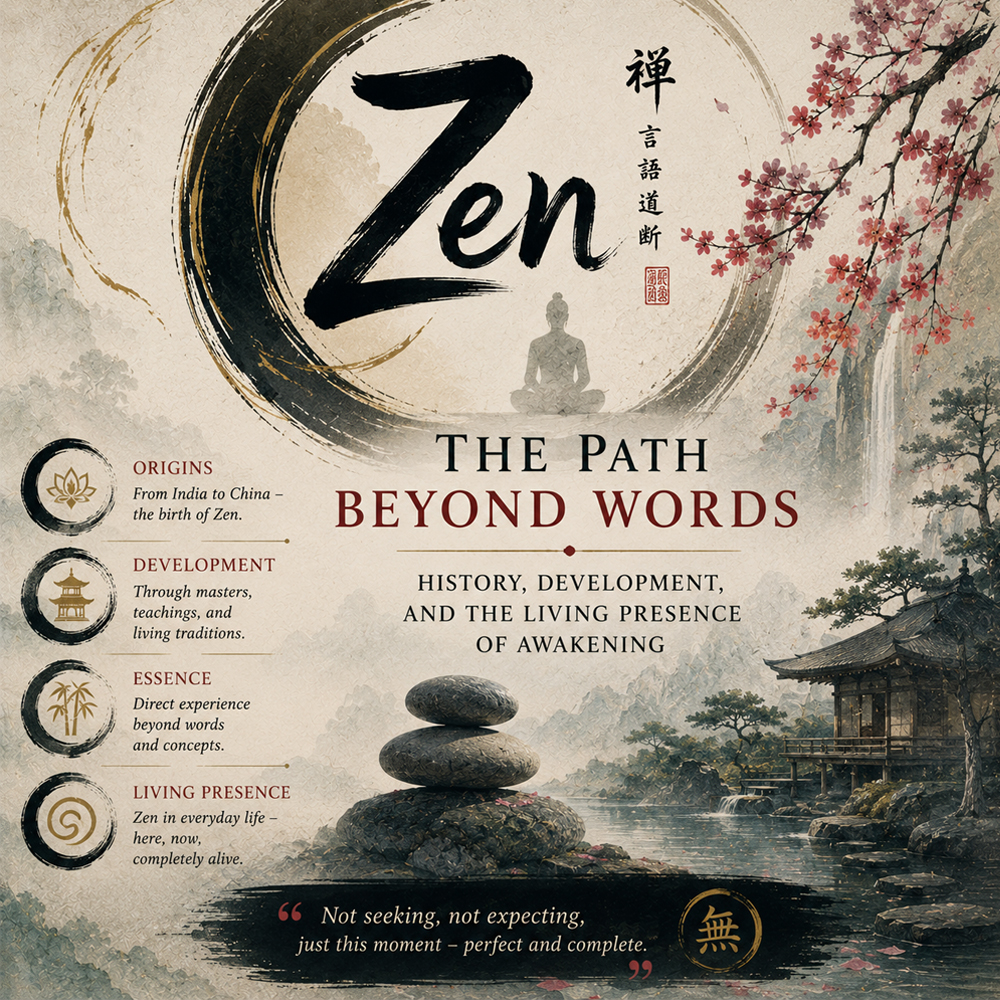
The Beginning of Silence: From Siddhartha Gautama Buddha to the First Smile
The history of Zen does not begin with a system or a dogma, but with a single moment – quiet, almost imperceptible, yet containing the entire essence of the teaching.
It is said that during a gathering of his disciples, Siddhartha Gautama Buddha simply held up a flower and said nothing. This was highly unusual from the perspective of his students. Until then, Gautama had always spoken during such gatherings, but this time was different. Everyone remained puzzled except for one disciple – Mahākāśyapa – who simply smiled.
According to tradition, something beyond words was transmitted in that smile: a direct understanding of reality itself. Gautama Buddha then passed his robe and begging bowl to Mahākāśyapa, symbolizing his recognition of him as fully enlightened and no different from himself.
When this occurred, Ānanda – the Buddha’s cousin and disciple – approached Mahākāśyapa and asked what the Buddha had transmitted to him besides the robe and bowl.
Mahākāśyapa replied:
„Ānanda, it is getting late. Go and take down the flag from the pole.“
This is considered the second Zen act, in which Mahākāśyapa directly points Zen out to Ānanda, indicating that what was truly transmitted was neither the bowl nor the robe, but the Buddha Mind – the One Mind itself.
These moments are regarded as the symbolic beginning of Zen: a teaching that does not rely on texts but on direct experience. Here we encounter one of Zen’s deepest characteristics – its distrust of language as a vehicle for ultimate truth. Words may point, but they can never capture the essence.
Early Buddhism established the foundations: the Four Noble Truths, the Noble Eightfold Path, and the teachings on suffering and liberation. Zen, however, would extract not the theory but the practice. Not the concept, but the experience. Not belief, but direct seeing.
The Journey to China: Bodhidharma and the Birth of Chan
In the sixth century, a mysterious monk from India named Bodhidharma arrived in China. The stories surrounding him are so legendary that the boundary between history and myth becomes blurred.
According to tradition, upon hearing that a successor to the Buddha had arrived on Chinese soil, the Emperor immediately invited him to court. During their meeting, the Emperor proudly asked Bodhidharma:
„How much good karma have I accumulated through my efforts in promoting Buddhism throughout my kingdom?“
Bodhidharma replied:
„None at all. You will burn in hell.“
After another misguided question from the Emperor, Bodhidharma added:
„There is nothing holy. No high and no low. Everything is empty.“
Enraged, the Emperor expelled him.
It is said that Bodhidharma then spent nine years meditating in a cave near the Shaolin Monastery, facing a wall without moving. During this period, Huike – the future Zen patriarch – cut off his own arm to demonstrate the sincerity of his wish to become Bodhidharma’s disciple and realize Zen at any cost.
Only then did Bodhidharma accept him. After years of training, Huike attained complete enlightenment, became Bodhidharma’s successor, and continued the transmission of the One Mind.
More important than the biographical details, however, is what Bodhidharma brought with him: a teaching centered on direct realization of the mind.
Bodhidharma formulated four principles that would define Zen forever:
- A special transmission outside the scriptures
- Independence from words and letters
- Direct pointing to the human mind
- Seeing one’s true nature and attaining enlightenment
These ideas were revolutionary for their time, especially in China, where philosophy was deeply tied to texts and traditions.
In China, Zen became known as Chan and evolved through a unique synthesis with Taoism. Taoist spontaneity, naturalness, and paradox merged with Buddhist discipline and meditation. As a result, Chan became more alive, more elusive, and more intimately connected to everyday life.
The Sixth Patriarch: Huineng and the Revolution of Sudden Awakening
Among all the early patriarchs, Huineng occupies a special place.
He was an illiterate woodcutter who accidentally heard a sutra and experienced awakening. His story is deeply symbolic: enlightenment depends neither on education nor status nor effort, but on direct seeing.
The famous contest between Huineng and another monk illustrates the distinction between gradual and sudden enlightenment. While the other monk composed a verse describing the gradual purification of the mind, Huineng responded that there is no mirror to polish because, fundamentally, there is nothing there.
This idea of sudden enlightenment would become one of the central pillars of Zen.
With Huineng, Zen became democratized. It was no longer an elite practice but a path accessible to anyone willing to see.
The Golden Age of Chan: Linji, Nansen, and Paradox as Method
During the Tang Dynasty, Chan reached its golden age. Masters such as Linji and Nansen developed a style that was radical and often shocking.
Linji became famous for shouting at or striking his students to jolt them out of their intellectual traps. He famously declared:
„If you meet the Buddha, kill him.“
This was not meant literally but as a warning against attachment – even to sacred ideas.
Nansen remains famous for the story of the cat. When his students were arguing, he seized a cat and declared that if anyone could speak a true word, he would spare it. No one responded, and he killed the cat.
Later, the monk Zhaozhou placed his sandal on top of his head – a gesture that Nansen recognized as genuine understanding.
These stories are not about cruelty but about breaking the dominance of logical thinking.
The Journey to Japan: Zen as Culture
When Zen reached Japan, it transformed once again.
There it became intertwined with the arts: the tea ceremony, calligraphy, poetry, and martial arts. Zen evolved from a philosophy into a complete way of life.
Masters such as Ikkyū embodied this spirit. A rebel by nature, Ikkyū drank alcohol, wrote erotic poetry, and rejected institutional authority. Through this, he demonstrated that Zen is not found in rules but in authenticity.
Hakuin Ekaku was another pivotal figure. He revitalized the Rinzai school and systematized kōan practice. His kōan, „What is the sound of one hand clapping?“ remains among the most famous in Zen history.
Another influential Japanese master, Bankei Yōtaku, offered a unique approach. He spoke of the Unborn Mind – a state that is inherently pure and free.
Bankei did not rely on complicated practices. He taught that enlightenment is not something to be achieved but something already present. This radical simplicity made Zen accessible to ordinary people.
Bassui Tokushō focused on the question:
„Who am I?“
His teachings often revolved around direct investigation of the mind, especially in relation to death. He emphasized that fear of death arises from misunderstanding our true nature. Once that nature is seen, fear disappears.
Zen in the West: From D.T. Suzuki and Alan Watts to Osho, Krishnamurti, and Sadhguru
During the twentieth century, Zen began spreading throughout the Western world.
D.T. Suzuki played a crucial role by translating and interpreting Zen for Western audiences. He presented Zen as a mystical experience closely related to psychology.
Soon afterward, Alan Watts popularized Zen through lectures and books. He possessed a remarkable ability to explain profound ideas with clarity, humor, and elegance. For Watts, Zen was a dance with reality – a playful engagement with existence.
Osho interpreted Zen in his own way: free, provocative, and often controversial. He viewed Zen as a celebration of life itself.
Jiddu Krishnamurti went even further, rejecting all traditions and systems. For him, truth was a „pathless land“ – an idea that resonates deeply with Zen.
Sadhguru presents Zen-like insights within a contemporary framework, blending ancient wisdom with modern psychological understanding.
Conclusion: Zen as a Living Experience
Zen is not a religion, a philosophy, or a system.
It is a living experience.
Its history is rich and filled with remarkable individuals who helped shape it, yet its essence remains unchanged: direct seeing of what is.
From the Buddha’s silence to the words of contemporary teachers, Zen continues to offer an invitation.
Not to believe, but to see.
Not to follow, but to be.
We also encourage you to explore more of our articles on Zen to deepen your understanding of the great masters and the diverse approaches that have given Zen its unique flavor – a flavor that continues to inspire people to this day.
Read More:
- If You Meet the Buddha, Kill Him: The Radical Zen of Linji
- Hakuin Ekaku – The Great Master Who Revived Zen in Japan
- Buddha – The Story of Siddhartha Gautama and His Enlightenment
- Huineng – The Extraordinary Story of the Sixth Zen Patriarch
- Bassui Tokushō – From Demon Child to Great Zen Master
- Bodhidharma – The Fierce Zen Master Who Brought Buddhism to China
- Bankei Yōtaku and the Unborn Mind: Suffering and Truth in Zen
Author: Vasil Stoyanov