
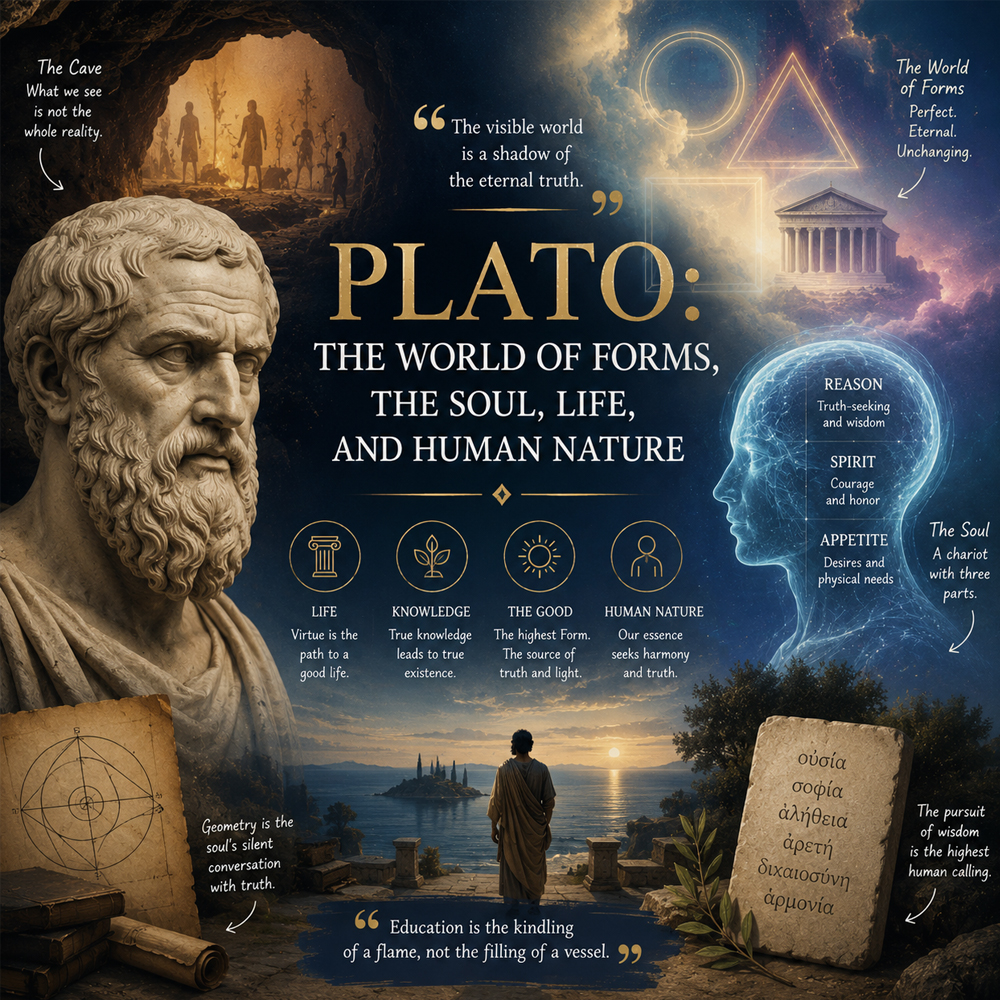
Plato is one of the most influential philosophers of ancient Greece, a thinker whose ideas permanently transformed the course of Western thought. At the heart of Platonism lies the belief that the material world we perceive through our senses is only an imperfect reflection of a higher and more fundamental reality – a realm Plato called the World of Forms.
To understand Plato’s perspective on existence, we can begin by examining the objects around us.
Consider living organisms. There are millions of different species, each distinct from the others. Even individuals belonging to the same species differ from one another, just as no two human beings are exactly alike.
Every object is unique. Yet despite this diversity, the human mind rarely confuses one category with another. A healthy mind does not mistake a human being for an elephant, nor a fly for a lion.
According to Plato, the human being consists of both a physical body and a soul. In Ancient Greek philosophy, the distinction between mind and soul was often less pronounced than it is today. The rational aspect of the human being – the capacity for reason – was considered part of the soul itself.
The physical body exists within the material world, while the rational soul participates in the World of Forms. Our eyes perceive physical objects, but the mind recognizes and categorizes them.
For Plato, every act of creation begins with an idea. Before something can be brought into existence, the mind must first grasp its form. In other words, one must possess the idea of a thing before attempting to create it. The idea precedes the material object.
The World of Forms contains the perfect archetypes of all things capable of existing in the physical world. Because the soul has access to these Forms, the mind is able to recognize patterns and categories among the objects perceived by the senses.
When we encounter an organism possessing the characteristics associated with the concept of an ant, we recognize it as an ant. Countless individual objects can therefore be grouped under a single universal Form. The eyes perceive, the mind classifies, and consciousness experiences the result.
The Imperfection of the Physical World
Every object in the physical world can be improved. A computer, for example, may become faster, more efficient, and more sophisticated as technology advances. Yet regardless of how much it evolves, we continue to recognize it as a computer because it participates in the Form of „computer.“
For Plato, physical objects are never perfect. They are temporary manifestations of eternal Forms. The Forms themselves are unchanging, while material objects are constantly subject to growth, decay, and transformation.
This distinction led Plato to conclude that the physical world is characterized by becoming, while the World of Forms is characterized by being. Material things change because they are imperfect. The Forms do not change because they are already complete.
A perfect circle, for example, does not exist in nature. Every circle we draw contains imperfections. Yet the mind can conceive of a perfect circle. Plato would argue that this ideal circle belongs to the World of Forms, while every physical circle merely approximates it.
Because physical objects are always changing, they can never fully embody perfection. They participate in the Forms without ever becoming identical to them.
Abstract Forms
Not all Forms correspond to physical objects. Some represent abstract principles such as Justice, Beauty, Goodness, Courage, and Truth.
Human beings participate in these Forms through thought and action. The more a person aligns themselves with Justice, the more just they become. The more they orient their life toward Goodness, the more virtuous they become.
This idea forms the foundation of Plato’s ethics.
Interestingly, Plato often presents wrongdoing not as a deliberate embrace of evil but as a consequence of ignorance. In dialogues such as The Republic, he argues that people act wrongly because they fail to understand what is truly good.
From this perspective, evil is not an independent force competing with goodness. Rather, it is a deficiency of knowledge and understanding. People become unjust because they do not fully grasp justice; they become morally corrupted because they fail to perceive the Good.\
The Allegory of the Cave
Perhaps Plato’s most famous illustration of these ideas is the Allegory of the Cave.
He asks us to imagine prisoners chained inside a cave from birth. Behind them burns a fire, and between the fire and the prisoners people carry various objects. The prisoners cannot see the objects themselves – only their shadows projected onto the wall before them.
Because the prisoners have never seen anything else, they mistake the shadows for reality.
If one prisoner escapes and reaches the outside world, he gradually discovers the true objects casting the shadows. Eventually he sees the sun itself and realizes that what he once believed to be reality was merely an illusion.
For Plato, most people live among shadows. Philosophy is the process of turning toward the light and seeking genuine knowledge.
The Purpose of Life
Plato also believed that the soul is immortal. Unlike the body, which is subject to decay and death, the soul belongs to a higher order of reality.
In dialogues such as Phaedo and Meno, Plato suggests that learning is not the acquisition of entirely new knowledge but a process of recollection. Before entering the physical world, the soul existed in the presence of the Forms and possessed true knowledge of them. Birth causes the soul to forget this knowledge, and education becomes a process of remembering what was once known.
From this perspective, the purpose of life is not merely to accumulate information but to awaken the soul to deeper truths. Through philosophy, reflection, and the pursuit of wisdom, human beings gradually move closer to understanding the Forms and, ultimately, the Form of the Good – the highest principle in Plato’s philosophy.
For Plato, a meaningful life is one devoted to truth, wisdom, justice, and self-knowledge. The philosopher’s task is not simply to understand the world but to ascend beyond appearances and seek the reality that lies behind them.
More than two thousand years later, Plato’s vision continues to shape philosophy, religion, politics, and science. Whether one agrees with him or not, his central question remains as powerful as ever:
Is the reality we see truly the whole of reality, or merely a shadow of something deeper?
Author: Vasil Stoyanov