
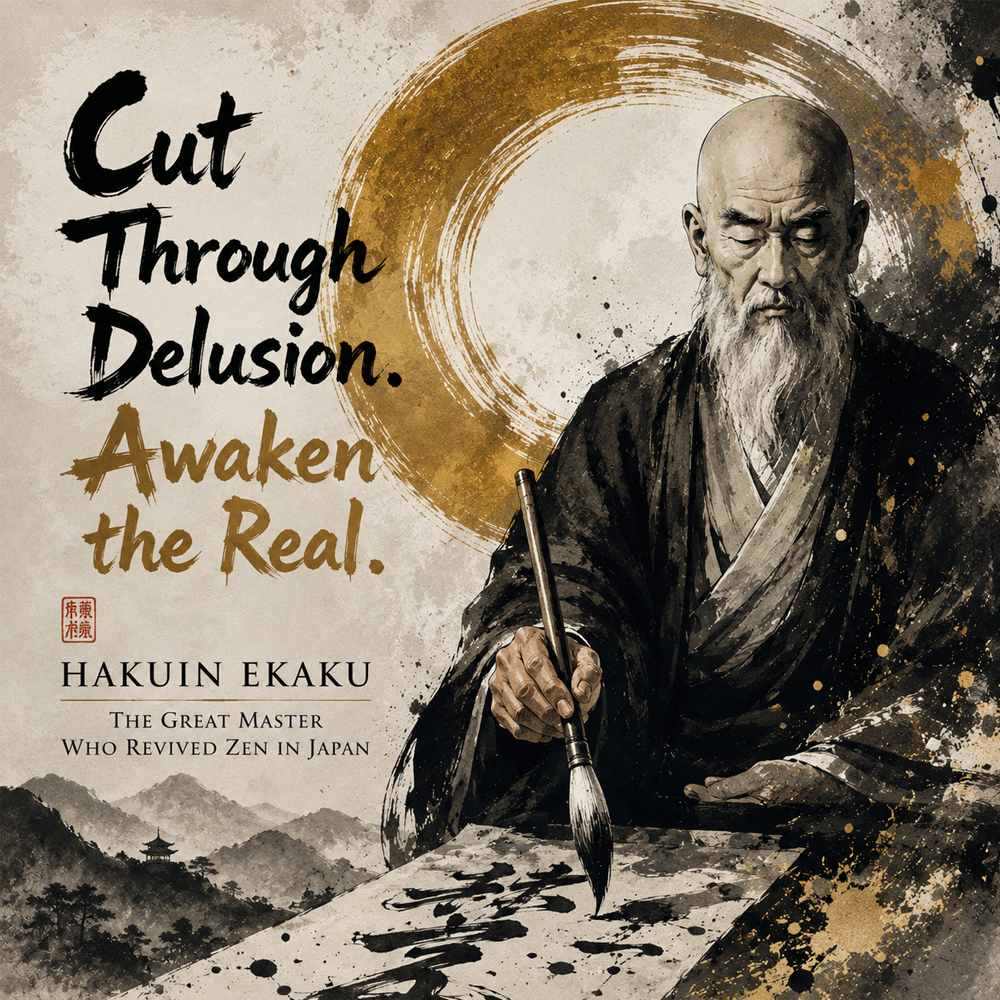
The Beginning of the Journey
Hakuin Ekaku was born in 1686 into a rural family in Japan. From an early age, he displayed a deep curiosity about the spiritual world, and at seventeen he decided to dedicate his life to the monastic path. The young Hakuin began his training in various temples, striving to understand the true meaning of enlightenment.
During his early years, he endured intense spiritual struggles and profound doubts, feeling that the traditional methods of meditation were not bringing him complete awakening.
Attaining Enlightenment
After many years of diligent practice, wrestling with his mind, and searching for genuine enlightenment, Hakuin experienced a powerful moment of insight that changed his life forever.
This realization led him to understand that enlightenment is neither distant nor abstract – it is present in every action, every thought, and every breath.
From that point onward, he developed a unique style of teaching. He used sharp shouts, sudden blows with a stick, and seemingly irrational actions to break through his students’ mental barriers and awaken them. For Hakuin, humor, sarcasm, and even mild provocation were powerful tools for stimulating intuition and direct realization.
Hakuin as a Teacher
Hakuin did not limit himself to words and actions alone. He also wrote poetry and practiced calligraphy, using art as a means of expressing and transmitting his spiritual experience.
He recorded dialogues and encounters with students, revealing the methods and principles of his teaching. His students were often confronted with paradoxes and riddles that could be resolved only through direct experience and inner insight.
These writings became the foundation of his teaching and were passed down to future generations of Zen practitioners.
Throughout his life, Hakuin encountered many students. Some were deeply inspired by his energy and methods, while others were shocked by his unconventional approach. Yet those who remained with him sensed that beneath his intensity and eccentricity lay profound wisdom.
Hakuin believed that every moment of life – even the most ordinary activities, such as washing dishes or walking down a road – could become a gateway to awakening if approached with complete awareness.
The Expression of His Essence
Hakuin lived a long life devoted to practice, teaching, and creativity. He left behind a legacy that transformed Rinzai Zen into a vibrant and powerful tradition, accessible even to modern people.
He demonstrated that enlightenment is not a mystery hidden behind temple walls, but a state of mind that can manifest in every thought, movement, and breath.
Many stories illustrating Hakuin’s behavior reveal the kind of person he truly was. His extraordinary calmness and lack of attachment to reputation are reflected in one of the most famous stories from his life.
A young woman became pregnant and, in order to avoid punishment, falsely accused Hakuin of being the father. Her parents were furious and left the baby in his care.
Hakuin simply replied:
– „Is that so?“
He cared for the child without complaint.
Some time later, the young woman confessed the truth: another man was the real father. Her parents apologized and took the child back.
Again, Hakuin simply said:
– „Is that so?“
In other situations, however, he could be extremely strict with his students.
Later in life, Hakuin wrote that he had nearly fallen into the trap of pride over having „attained enlightenment.“ Before his final awakening, he suffered from what he called „Zen sickness.“
This condition arose from excessive tension and relentless effort to achieve enlightenment. It manifested as severe mental and physical strain.
Eventually, he met a Taoist hermit named Hakuyu, who shattered his illusions. Through this encounter, Hakuin attained a complete and irreversible awakening – one that freed him even from the feeling that he had achieved something.
Little is known about Hakuyu, except that he possessed deep knowledge of Taoist longevity practices and principles. Through that wisdom, he helped restore Hakuin’s psychological and physical balance.
On one occasion, a student declared that he had attained enlightenment.
Hakuin asked him several simple questions, which the student failed to answer spontaneously.
Rather than comforting him, Hakuin temporarily expelled him from the monastery, telling him to return only when he understood not merely with his mind, but with his entire being.
Stories from His Life
Hakuin also left behind numerous letters addressed to ordinary people – samurai, merchants, and householders.
In these letters, he often used simple language and humor.
In one letter to a man who complained that he had no time for meditation, Hakuin replied that if he had time to worry, then he also had time to practice.
On another occasion, an illiterate man asked how he could attain enlightenment without being able to read sutras or complex philosophical texts.
Hakuin did not give him a sophisticated answer. Instead, he simply told him to observe his breathing and be fully present in his work.
In yet another case, a student attempted to provide a „profound“ answer to a koan using elaborate intellectual explanations.
Hakuin burst into laughter and remarked that it was merely intellectual gymnastics.
Then he made a simple gesture and suggested that the entire truth the student was trying to express with words was already contained within that gesture.
According to preserved accounts, Hakuin remained calm and mentally clear during his final days.
He continued interacting with his students almost until the very end, showing neither fear nor attachment to life.
There are no legends of supernatural phenomena surrounding his death. In itself, this is significant. His life was filled with intensity, yet his end was quiet and ordinary – something Zen regards as a sign of genuine understanding.
Hakuin Ekaku died in 1769 at approximately eighty-three years of age.
Read More:
- Zen: The Path Beyond Words – History, Development, and the Living Presence of Awakening
- Buddha – The Story of Siddhartha Gautama and His Enlightenment
- Huineng – The Extraordinary Story of the Sixth Zen Patriarch
- Bassui Tokushō – From Demon Child to Great Zen Master
- Bodhidharma – The Fierce Zen Master Who Brought Buddhism to China
- Bankei Yōtaku and the Unborn Mind: Suffering and Truth in Zen
Author: Vasil Stoyanov