
The Beginning of the Universe and the Big Bang Theory
When we talk about the beginning of the Universe, it is difficult to ignore the scientific evidence supporting the Big Bang. Facts often prevail over human beliefs and opinions without requiring effort. Truth does not need to be defended – it defends itself.
As early as 1912, Vesto Slipher measured the speed and direction of spiral nebulae by analyzing changes in the wavelength of the light they emitted. His observations showed that these objects were moving away from us. At the time, they were still considered part of the Milky Way, but later it became clear that they were separate galaxies.
In 1924, Edwin Hubble proved that these “nebulae” were actually galaxies located millions of light-years away. This discovery led to the revolutionary idea that the Universe is expanding. If galaxies are moving away from one another, it is logical to assume that in the past the Universe was concentrated in an extremely small point.
In the 1960s, Arno Penzias and Robert Wilson made a key discovery. Using a radio telescope, they detected constant radiation regardless of the direction in which they pointed it. The temperature of this radiation was only a few degrees above absolute zero (-273.15°C).
This phenomenon matched the predictions of the Big Bang theory – that in the beginning, an enormous amount of radiation was emitted. Over time, as the Universe expanded, this radiation was “stretched” and reached us as microwave radiation. This process is known as redshift.
When we view light as a wave, the expansion of space increases its wavelength and lowers its frequency. This means lower energy, which shifts into the red part of the spectrum, and with even greater stretching – into infrared, microwave, and radio waves. It is precisely this radiation, discovered by Penzias and Wilson, that is considered a remnant from the beginning of the Universe.
All these observations are among the clearest pieces of evidence supporting the Big Bang theory. However, the question of how the Universe will end remains open.
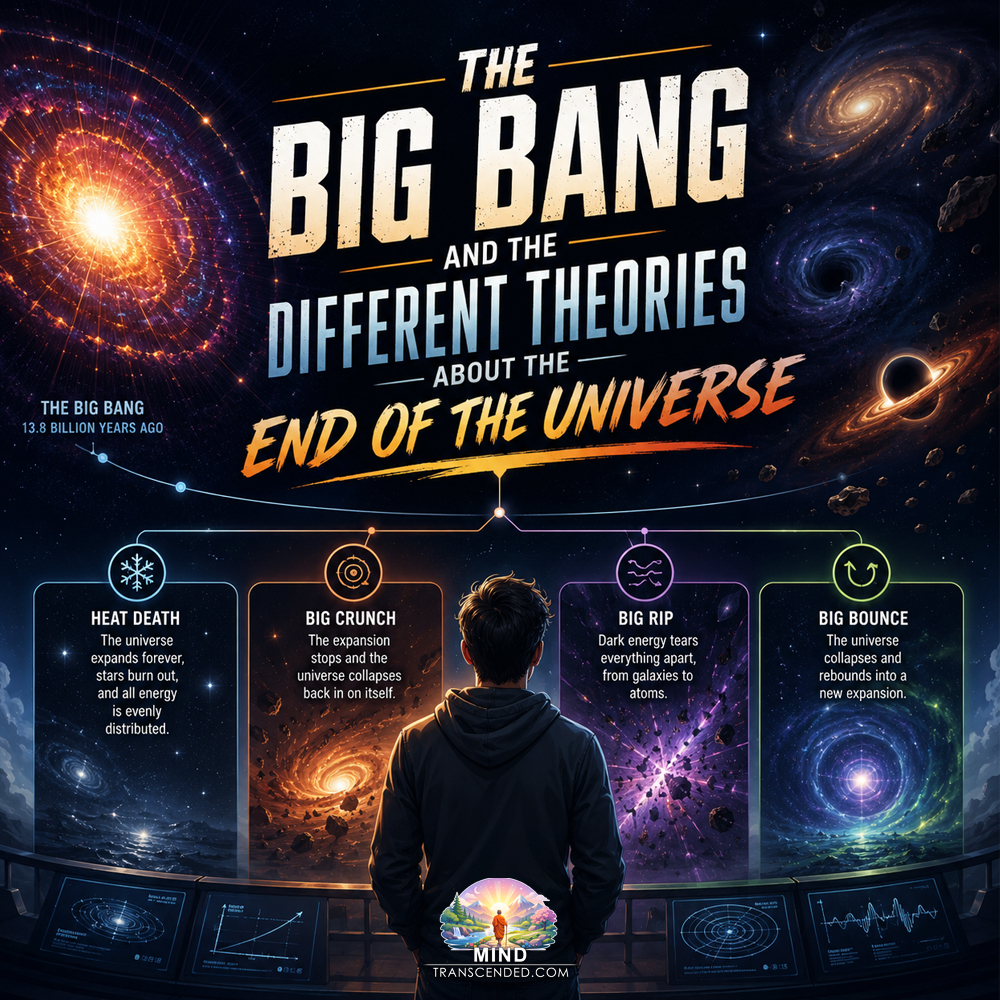
Possible Scenarios for the End of the Universe
The Big Freeze and the Big Rip
Gravity is the force that keeps moons around planets, planets around stars, and star systems within galaxies. It constantly opposes the expansion of the Universe.
Today we know that the expansion not only continues, but is also accelerating – a discovery that surprised scientists. According to initial expectations, gravity should have gradually slowed and stopped the expansion, much like a thrown ball that loses speed and falls back down.
In reality, however, the expansion is accelerating. If this trend continues, in the extremely distant future the Universe may reach a state known as the “Big Freeze” – a time when all galaxies will be so far apart that the sky will become dark and cold, with no visible stars.
In an even more extreme scenario – the “Big Rip” – the expansion may become so fast that even atoms will break apart. Electrons will separate from their nuclei because electromagnetic forces will no longer be able to hold them together.
The Big Crunch and the Big Bounce
There is also an opposite scenario, in which gravity overcomes expansion. In this case, galaxies would gradually begin to move closer together, merge, and form increasingly massive structures.
Eventually, it is possible that all matter in the Universe could contract into a single point of infinite density – a state similar to a black hole. This state would be characterized by such strong gravity that even light could not escape it.
An interesting hypothesis is that such a contraction could lead to a new Big Bang – the so-called “Big Bounce.” This suggests that the Universe may pass through cycles of expansion and contraction. This means that other universes may have existed before ours, and more may appear after it.
Despite the significant progress of science, the question of the fate of the Universe remains one of the greatest mysteries humanity continues to explore.
Read more:
Read more:
Author: Vasil Stoyanov