
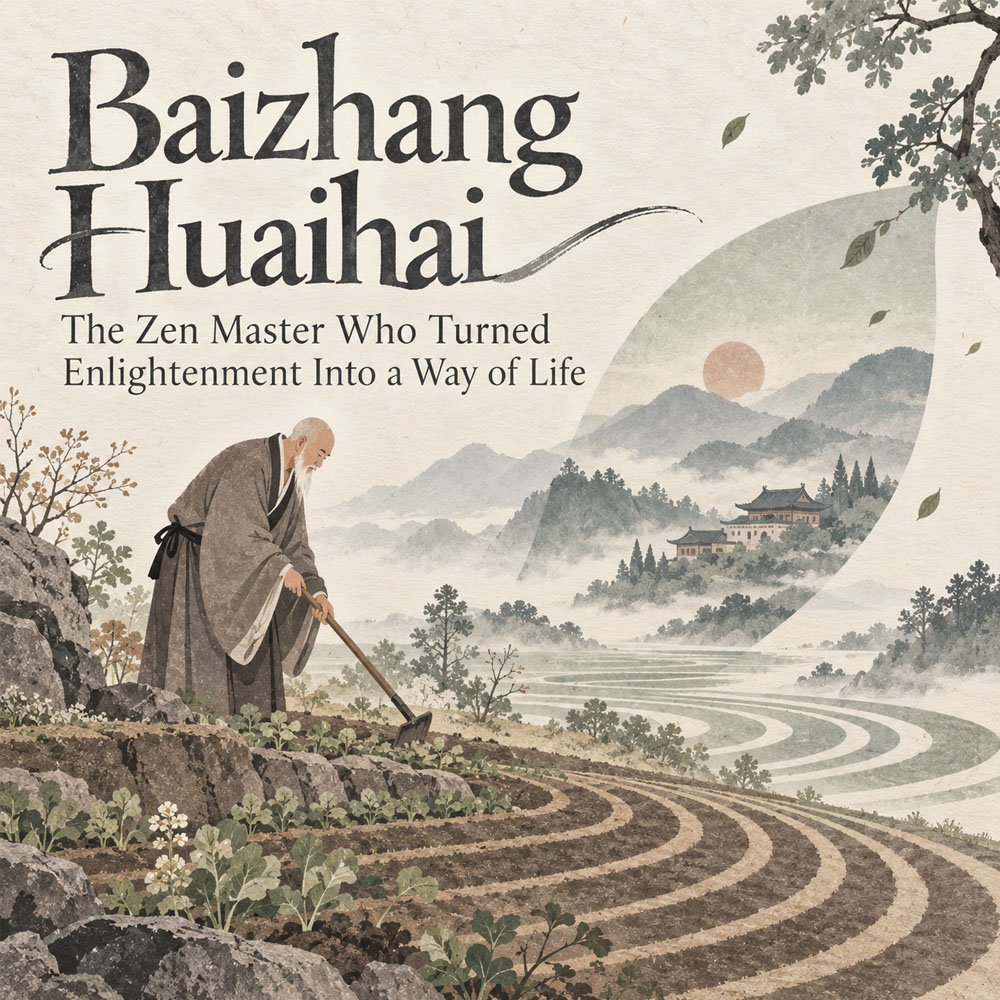
Part I: Wild Ducks, a Painful Lesson, and the Birth of a Zen Master
When we speak of the great Zen masters of ancient China, it is easy to imagine them as motionless figures from a distant age – old men in monastic robes sitting among mist-covered mountains, uttering mysterious sentences that generations of students would later struggle to understand. Baizhang Huaihai, however, does not fit comfortably into that picture. In the stories preserved about him, he works, argues, asks uncomfortable questions, refuses to eat when he is unable to labor, buries a fox as though it were a monk, and learns one of the most important lessons of his life when his teacher suddenly grabs his nose and twists it so hard that he cries out in pain.
Behind these strange stories stands a man whose influence on the development of Chan Buddhism – the Chinese tradition later known in Japan as Zen – is difficult to overstate. Baizhang lived during the Tang dynasty, in the period later remembered as one of the great formative ages of Chinese Chan. He was a disciple of the legendary Mazu Daoyi and became the teacher of another remarkable generation of masters, including Huangbo Xiyun, through whom his lineage would eventually reach Linji Yixuan and help shape one of the most influential traditions in the history of Zen.
Yet Baizhang left behind much more than a lineage of celebrated teachers. Tradition closely associates his name with the development of Chan monastic life, with the elevation of physical labor into an integral part of spiritual practice, and with the famous principle later remembered as “A day without work is a day without food.” Modern historians are more cautious about the traditional account and point out that the monastic regulations attributed to Baizhang probably developed gradually, while the later surviving texts cannot simply be treated as an original rulebook written by him.
Even after legend is separated from history, however, something important remains. Generations of Zen practitioners remembered Baizhang as the man who demonstrated that awakening should not exist separately from the hoe, the kitchen, the meal, the discipline of community life, or the work required to keep that community alive. For him, Zen was not an escape from ordinary existence into some sacred realm where truth could finally be discovered; ordinary existence itself was precisely where truth had to be found.
Before Baizhang Became Baizhang
The historical Baizhang is surrounded by the same uncertainty that covers much of the early history of Chan. Even the chronology of his life is not entirely uncontested in the surviving sources and modern scholarship, although the traditional dates most commonly associated with him are 720 to 814. This uncertainty offers a useful warning before entering the famous stories about him: what has survived belongs both to history and to the literary memory of Zen, and many celebrated encounters were written down or shaped generations after the people involved had died.
That does not make the stories unimportant. The Zen tradition did not preserve accounts of the old masters merely to tell later generations what happened on a particular afternoon centuries earlier. These stories became instruments of practice, designed to place the listener before the same question that once confronted the person inside the story.
A Zen story therefore asks for something more than passive understanding. It is not enough to explain what the master meant, identify the philosophical doctrine behind his words, and move on. The encounter must somehow happen again within the mind of the person hearing it, which is why seemingly simple scenes involving birds, bowls, doors, stones, shouts, or ordinary work became so important in Chan literature.
As a young monk, Huaihai eventually entered the spiritual orbit of Mazu Daoyi, one of the most influential figures in the development of Tang-dynasty Chan. Around Mazu emerged a tradition later associated with the Hongzhou school, famous for a direct and sometimes startling style of teaching. In this environment, philosophical knowledge was not enough, elegant explanations were not enough, and even a perfectly orthodox Buddhist answer could become an obstacle if the student merely repeated it without directly seeing what the words were meant to reveal.
Baizhang entered precisely this world. One of the most famous stories in the Zen tradition tells how Mazu transformed an entirely ordinary walk into a lesson that would still be discussed more than a thousand years later. There was no formal sermon, no sacred ceremony, and no complicated philosophical argument – only two monks walking together and a flock of birds passing through the sky.
The Wild Ducks
Mazu and Baizhang were walking together when wild ducks flew past them. Nothing extraordinary seemed to be happening: two monks were walking, birds crossed the sky, and within a few moments they disappeared into the distance. Yet in Zen, the moment that appears too ordinary to deserve attention sometimes becomes the very place where everything familiar is suddenly overturned.
Mazu asked:
“What are those?”
Baizhang looked at them and replied:
“Wild ducks.”
Mazu then asked:
“Where have they gone?”
The answer seemed obvious.
“They have flown away.”
At that moment Mazu reached out, grabbed Baizhang by the nose, and twisted it violently. The pain was so sudden that Baizhang cried out, whereupon Mazu confronted him with the point of the entire exchange: if that was so, how could he say that the ducks had flown away? In the later Zen tradition, this encounter became one of the decisive moments associated with Baizhang’s awakening.
On the surface, the scene is almost absurd. The ducks really had flown away, Baizhang had given a factually correct answer, and if this had been a test of ordinary observation, he would have had no reason to expect anything other than approval. The only person behaving strangely appears to be Mazu.
But Mazu was not testing Baizhang’s knowledge of birds. He was testing where Baizhang’s mind had gone. The moment the student said that the ducks had flown away, his awareness followed them into a conceptual story about what had just happened: the birds had been here, they had passed overhead, and now they were somewhere else.
Mazu suddenly dragged him back from the description of experience into experience itself. There are few more efficient ways of returning someone to the immediate present than an unexpected burst of pain in his own nose. In that instant there was no need to theorize about the past or speculate about where the birds had gone, because the immediacy of the moment demanded everything.
Later Zen commentators would draw countless interpretations from this brief encounter, but much of its power lies in its simplicity. Mazu does not give Baizhang a new philosophical idea with which to replace an old one. Instead, he attacks the habit of constantly replacing immediate reality with a description of reality.
The distinction is subtle but crucial. Concepts are necessary for ordinary life, and Zen does not require a person to become incapable of saying that birds have flown away. The problem begins when the mind becomes so absorbed in its conceptual representation of experience that it no longer notices the living experience from which the representation arose.
For Baizhang, the lesson did not remain an abstract principle. According to the later stories, what happened next was almost as strange as the twisting of his nose itself.
The Man Who Cried and Laughed for the Same Reason
After the encounter with Mazu, Baizhang returned to the monks’ quarters and began to cry. Another monk noticed him and tried to understand what had happened, because such behavior was obviously unusual. He first asked whether Baizhang was grieving for his parents, but Baizhang said that was not the reason.
The monk tried another explanation. Perhaps someone had insulted or reprimanded him, but Baizhang again said no. Eventually he explained that Mazu had twisted his nose and that the pain had been unbearable.
Confused, the monk went to Mazu and tried to discover what Baizhang had done to provoke such treatment. Mazu did not offer an explanation and simply told him that Baizhang himself understood. The monk returned to the quarters and repeated those words.
Then something even stranger happened.
Baizhang began to laugh.
Only moments earlier he had been crying, and now he was laughing. His companion naturally wanted to know how his mood could have changed so completely, but Baizhang’s answer did little to make the situation more ordinary. His crying before, he said, was the same as his laughing now.
It would be easy to turn this response into another mystical formula and immediately begin searching for its hidden meaning. Yet perhaps something simpler and more important is happening. Baizhang is no longer trying so desperately to construct a permanent identity around what passes through him.
The pain had been real, and so had the tears. Now the laughter was equally real, and there was no need to force the two moments into a rigid story in which one must invalidate the other. Yesterday’s pain does not need to be denied because today’s laughter has appeared, just as today’s laughter does not erase yesterday’s pain.
This kind of freedom would later become deeply characteristic of the Zen associated with Baizhang. Experience is allowed to arise and pass without every moment being turned into another piece of evidence for the story a person tells about himself. What changes is not necessarily the appearance of emotion, but the degree to which the mind needs to seize it and declare, “This is who I am.”
“Today My Nose Doesn’t Hurt Anymore”
The following day Mazu prepared to address the assembled monks. Before the teacher could begin his sermon, Baizhang stepped forward and rolled up the mat associated with the gathering, effectively signaling that the teaching was over before it had even begun. Mazu understood the gesture, descended from his seat, and withdrew, while Baizhang followed him.
The teacher then asked why Baizhang had ended the gathering before a single word had been spoken. Baizhang referred to what had happened the previous day, when Mazu had twisted his nose. Mazu asked what understanding he had gained from the experience.
Baizhang replied:
“Today my nose doesn’t hurt anymore.”
Mazu recognized that something in his student had changed. Once again, Baizhang did not respond with an elaborate declaration about emptiness, nonduality, Buddha-nature, or the nature of enlightenment. His answer was almost comically concrete: yesterday his nose hurt, and today it did not.
Yet that concreteness comes remarkably close to the heart of the Zen later associated with him. The human mind continually insists that immediate life cannot possibly be enough and that somewhere behind it there must be a final explanation, a secret teaching, or a higher reality that will make everything complete. Zen repeatedly reverses that movement, drawing attention away from abstraction and back toward the immediacy from which abstraction arises.
Many years later, the same principle would appear in the way Baizhang organized and taught his own community. If Zen were true only while a person sat in meditation, what would happen when he stood up and had to chop wood? If Buddha-nature were truly present everywhere, why should it be sought only inside a meditation hall?
Those questions would eventually become inseparable from the image of Baizhang. The young monk who had once been dragged back to the present by pain would become a teacher famous for insisting that spiritual realization had to survive contact with the ordinary world.
The Shout That Echoed for Three Days
Another story from Baizhang’s training under Mazu describes an encounter that the later tradition remembered with almost mythic intensity. As with many early Chan accounts, the story survives through literature shaped after the lifetime of the masters themselves, and its details should therefore not automatically be treated as a literal transcript. Yet the image it preserves is so powerful that it became part of the legendary portrait of Baizhang.
Mazu and Baizhang were discussing the teaching of the Dharma. At a certain moment Mazu gave one of the powerful shouts for which the teaching style of his lineage became famous. According to the story, the experience was so overwhelming that Baizhang was left deaf for three days.
Whether every detail is taken literally is less important than what the tradition is trying to communicate. The relationship between teacher and student is presented not as an academic exchange in which information passes from one mind to another, but as a collision capable of destabilizing the student’s habitual way of perceiving. Mazu does not want Baizhang simply to know more about Zen; he wants to shake the very mechanism by which Baizhang turns everything into something he can intellectually possess.
A person can read a thousand books about fire without ever feeling heat. He can study the concept of water without quenching his thirst, just as he can speak about awakening for decades without ever questioning the mind that wants to possess awakening as another achievement. The problem is not knowledge itself, but the tendency to mistake knowledge about something for the thing itself.
This helps explain why Chan masters of this period became associated with language, silence, gestures, questions, shouts, and other unexpected responses. Such methods were not valuable because strangeness itself was sacred, but because an unexpected response could interrupt the student’s automatic conceptual movement. Baizhang would inherit this uncompromising quality from Mazu, but he would eventually combine it with another emphasis that became especially associated with his name: the discipline of everyday life.
The Mountain That Gave the Master His Name
After his years of training under Mazu, Huaihai gradually moved from the role of disciple into that of teacher. He eventually became associated with Mount Daxiong in Jiangxi, whose towering landscape was connected with the name Baizhang, literally suggesting the image of a great height measured in hundreds of zhang. As often happened in Chinese Buddhism, the name of the place became inseparable from the person, and Huaihai entered history as Baizhang.
The world of a mountain monastery was very different from the romantic image of a peaceful spiritual retreat. The mountain was not simply a beautiful background for meditation; it was an environment in which a community had to survive. Someone had to bring water, prepare food, maintain the buildings, tend the land, organize communal life, and perform countless ordinary tasks regardless of whether anyone felt spiritually inspired that day.
It was here that Baizhang’s legacy became especially important. Earlier Chan monks often lived within broader Buddhist monastic institutions rather than in communities organized around a distinct Chan identity. Later tradition credited Baizhang with a decisive role in shaping a more specifically Chan form of communal monastic life.
The historical development was almost certainly more gradual than the traditional story suggests. The famous “pure rules” associated with Baizhang survive through later sources, and historians caution against imagining that a complete and uniquely Chan monastic system was suddenly invented by one man. Nevertheless, Baizhang’s name became inseparable from the idea that the organization of everyday communal life could itself express the spirit of Chan.
The legend survived because it captured something essential about how later generations understood him. Zen should not remain a doctrine discussed by teachers and students while the practical necessities of life are treated as spiritually irrelevant. The way a community wakes, eats, works, practices, rests, and lives together can itself become part of the teaching.
A Day Without Work, a Day Without Food
As Baizhang grew older, his students began to worry about him. He continued to participate in physical labor despite his age and apparently did not believe that his position as teacher entitled him to stand aside while younger monks performed the necessary work. For Baizhang, spiritual authority was not a privilege that allowed a person to watch others carry the burden of communal life.
His students, however, saw an aging man and decided to intervene. They wanted him to rest, but they apparently knew that simply asking him to stop working would not be enough. According to the famous story, they therefore hid his tools so that he could no longer join them in their labor.
Baizhang responded in a way they had not expected. If he could not work, he would not eat. When the students realized what was happening, the point became impossible to ignore.
The story eventually became associated with one of the most famous sayings attributed to Baizhang:
“A day without work is a day without food.”
It is easy to misunderstand this as an ancient celebration of relentless productivity, but that reading misses the spirit of the story. Baizhang is not arguing that a human being possesses value only when he produces something. The deeper point concerns participation and the refusal to separate spiritual practice from responsibility for the conditions that sustain one’s life.
If you eat the rice, participate in the life that makes the rice possible. If you belong to the community, participate in maintaining the community. If you speak about nonduality, do not create an artificial division between meditation and washing a bowl, between spiritual realization and carrying water, or between the revered teacher and the ordinary monk doing the work.
This connection between physical labor and spiritual practice would become an enduring feature of Zen culture. Work could be understood not merely as an unpleasant necessity interrupting periods of “real” practice, but as another place in which practice itself unfolds. The question was no longer whether the activity looked spiritual from the outside, but whether the mind meeting that activity was awake.
In this sense, Baizhang’s life on the mountain can be seen as the natural continuation of the lesson of the wild ducks. Truth is not hiding somewhere else, waiting for the ordinary world to disappear. The challenge is to discover what happens when the distinction between the sacred moment and the ordinary moment begins to collapse.
When the Sacred Hides Inside the Ordinary
It is difficult to appreciate how radical this approach can be if Zen is imagined merely as a method of meditation. For Baizhang, the point was not to manufacture a special state of consciousness and then protect it from the disturbances of ordinary life. If awakening exists only under particular conditions – on a cushion, inside a quiet hall, surrounded by silence – then it remains dependent on those conditions.
The real test begins when the meditation ends. A person becomes hungry, tired, irritated, bored, disappointed, or confronted with work he would rather avoid, and suddenly all the beautiful ideas about awareness are forced into contact with life. What remains of one’s understanding when the moment no longer feels spiritual?
That question makes Baizhang’s teaching uncomfortable in a productive way. It is much easier to love the idea of enlightenment than to examine what remains of it when an unpleasant task must be done. It is easier to speak about the absence of ego than to work beside others without believing that one’s own contribution deserves special recognition.
The monastery therefore becomes a laboratory for realization. Every ordinary activity can expose the distance between what a person believes he has understood and the way he actually responds. Philosophy eventually has to enter the kitchen, and the person who speaks of awakening must still pick up the tools.
The Teacher Who Would Not Let His Students Cling Even to Buddha
It would nevertheless be a mistake to reduce Baizhang to monastic regulations and physical labor. Teachings preserved under his name reveal a much more subtle thinker than the popular image of a stern old monk with a hoe might suggest. Again and again, one central concern appears: liberation requires letting go not only of worldly attachments but also of attachment to what we call spiritual.
This second form of attachment is far more difficult to recognize. A spiritual practitioner readily understands warnings against greed, status, possessions, and pleasure, but what about attachment to purity, wisdom, enlightenment, meditation, or the idea of being a person who has understood? The mind is capable of constructing a prison from almost anything, including the teachings originally intended to free it.
For this reason, the teachings associated with Baizhang repeatedly undermine the student’s desire to find a final conceptual resting place. First, a teaching may be used to loosen an obvious attachment, but eventually the attachment to the teaching itself must also be seen. Medicine is valuable while there is an illness, yet medicine taken forever after the illness has passed can become another burden.
This principle would echo through later Zen. A person should not cling to the world, but neither should he cling to the rejection of the world. He should not be enslaved by thoughts, but neither should he make thoughtlessness into a sacred ideal; he should not search for Buddha as an object somewhere outside himself, but neither should he cling to the concept that there is no Buddha.
Step by step, the places where the mind wants to settle are removed. Just when the student believes he has finally discovered the correct position, the teacher may take even that position away. Baizhang’s Zen does not merely replace one set of beliefs with another; it continually examines the impulse that wants to turn any belief into permanent ground.
The Old Man Who Remained After the Teaching
One evening Baizhang finished giving a teaching to the monks. The assembly began to disperse, and little by little the hall emptied. One elderly man, however, remained behind.
Baizhang had noticed him before. The old man had attended previous teachings, standing among the monks and leaving with them when the talks ended. This time he did not move.
Baizhang asked who he was.
The answer transformed an ordinary evening into one of the most famous stories in the history of Zen.
“I am not a human being.”
The old man began to explain. Long ago, in the age of the ancient Buddha Kashyapa, he himself had been a spiritual teacher living on that same mountain. One day a student had approached him with a question that seemed almost technical but concealed an enormous problem.
“Is a person of great practice subject to cause and effect?”
The old teacher had replied:
“He does not fall under cause and effect.”
It was only one sentence, but according to the story, because of that answer he had been condemned to five hundred lives as a wild fox. Now, after all those lives, he stood before Baizhang asking for a single turning word that might finally release him from his error.
The old man asked the question again:
“Is a person of great practice subject to cause and effect?”
Baizhang answered him.
But he changed the words.
The difference between the two answers seemed almost insignificant, yet according to the Zen tradition it was the difference between five hundred lives as a wild fox and liberation.
And with that answer, one of Baizhang’s most important teachings was about to reveal itself.
Part II: The Wild Fox, Cause and Effect, and Freedom Without a Place to Hide
The old man stood before Baizhang waiting for the answer he had failed to find centuries earlier. According to the story, he himself had once been a teacher on that same mountain, and one of his students had asked whether a person of great practice was still subject to cause and effect. The old master had answered that such a person “does not fall under cause and effect,” and it was this seemingly profound statement that became his curse.
According to the legend, because of that answer he was reborn as a wild fox for five hundred lifetimes. Now, after countless years, he once again stood before a Chan master and asked the same question, as though time itself had closed into a circle. This time, however, the teacher standing before him was Baizhang.
“Is a person of great practice subject to cause and effect?”
Baizhang did not say that such a person was subject to it, but neither did he say that he was free from it. Instead, he uttered a few words that changed the entire direction of the question:
“He does not ignore cause and effect.”
According to the story, the old man awakened at that very moment. Five hundred lifetimes of confusion were brought to an end, not through an elaborate philosophical explanation, but through an almost imperceptible change in a single sentence. To understand why Baizhang’s answer became so important in Zen, however, we first have to understand what was wrong with the original answer.
The Mistake That Looked Like Enlightenment
At first glance, the old teacher had said nothing absurd. If enlightenment means complete freedom, it seems reasonable to assume that an enlightened person is no longer bound by the same laws that govern ordinary people. Yet hidden inside this idea is one of the most dangerous spiritual misunderstandings: the belief that freedom means somehow escaping reality itself.
If an awakened person truly stood beyond cause and effect, then his actions would have no consequences. His words would leave no traces, his behavior would not affect others, and moral responsibility would belong only to those who had not yet reached his level. Enlightenment could then easily become a kind of spiritual privilege through which a person justified whatever he happened to do.
Baizhang rejects precisely this idea. Awakening does not destroy cause and effect; it transforms the way a person sees and lives within them. An enlightened person is not someone who can place his hand in a fire without being burned, but someone who sees the fire so clearly that he no longer needs to fantasize about being immune to it.
Freedom, in this sense, does not mean becoming exempt from the consequences of life. It means no longer being blind to them and no longer trying to construct some mystical self that supposedly exists outside them. A person continues to act within the world, but ceases to imagine that he can separate himself from what his actions bring into being.
Five Hundred Lifetimes Because of One Answer
Imagine the old teacher on the day he first spoke those fatal words. He probably had no intention of misleading his student and almost certainly did not consider his answer superficial. On the contrary, he may have been convinced that he was expressing something extraordinarily profound about the freedom of an awakened person.
That is precisely what makes the story so merciless. The most dangerous delusions do not always sound foolish, and sometimes the hardest ones to recognize are those that sound remarkably wise. Spiritual language can conceal confusion just as effectively as any other language.
“Everything is empty,” a person may say, pointing toward one of the deepest ideas in Buddhist philosophy. But if he concludes from this that another person’s suffering does not matter, emptiness has already been turned into an excuse for indifference. In the same way, the statement that “there is no separate self” may express a profound insight, yet it can also become a convenient way of escaping responsibility for one’s actions.
This is the mistake the legend attributes to the old teacher. He transformed freedom into an exception from reality and placed the awakened person somewhere outside the web of causes and consequences. Baizhang did not give him a new metaphysical theory; he simply brought awakening back into the world.
The Burial of a Fox
After hearing Baizhang’s answer, the old man bowed and said that he had finally been released. Before leaving, however, he made an unusual request: on the other side of the mountain, Baizhang would find his body, and he asked that it be buried according to the rites given to a monk. Then the old man disappeared.
The following day Baizhang gathered the community and announced that after their usual duties the monks would attend the funeral of one of their own. The announcement caused understandable confusion because no one in the monastery had died, and there was not even a seriously ill monk whose death had been expected. Baizhang offered no further explanation and simply led his students up the mountain.
After searching for some time, they reached a place among the rocks. There, exactly where the old man had indicated, they discovered the body of a dead wild fox. Rather than treating the animal as something insignificant, Baizhang ordered that it be given a monk’s funeral.
Imagine the procession along the mountain path: monks in their robes following their teacher to bury a fox as one of their own. To an outside observer, the scene might have looked absurd, but for those who experienced it, a philosophical idea had suddenly taken on an almost physical form. Cause and effect were no longer merely an abstract doctrine; they had become a body that could be carried and buried.
Yet the story was still not finished. Among the monks was someone who would not be satisfied with the obvious lesson. His name was Huangbo Xiyun, the future Chan master who would become one of Baizhang’s most important disciples.
Huangbo’s Dangerous Question
Later, Baizhang told the community what had happened to the old man. He explained the question, the mistaken answer, the five hundred lives as a fox, and the words that had finally released him. For many of the monks, that might have been enough, but Huangbo noticed something that the others had missed.
He asked Baizhang what would have happened if the old man had never given the wrong answer. If, throughout those five hundred lifetimes, he had always answered correctly, where would he have been then? The question suddenly shifted the entire encounter away from the old man’s mistake and toward Baizhang himself.
It was a dangerous question because any answer that was too easy would reduce Zen to a system of correct and incorrect formulas. If Baizhang merely said that the right answer would have saved the old man, then his students could memorize the correct wording and imagine that they had understood the matter. Instead of becoming free from concepts, they would simply replace one concept with another.
Baizhang looked at Huangbo and told him to come closer so that he could give him the answer. Huangbo stepped forward, but he did not wait for his teacher to say anything.
He raised his hand and slapped Baizhang across the face.
The Slap That Delighted the Teacher
To someone unfamiliar with old Chan stories, the scene may appear to be nothing more than an act of disrespect. Within the tradition, however, Huangbo’s slap serves a very different purpose. He refuses to remain in the position of a passive student waiting for the teacher to hand him the correct answer.
Baizhang could have become angry or punished him. Instead, according to the story, he laughed and compared Huangbo to the red-bearded barbarian, a traditional reference to Bodhidharma, the legendary Indian patriarch associated with bringing Chan to China. In the man who had just struck him, Baizhang recognized not an insolent monk but an independent spirit.
It is one of the most revealing moments in the relationship between the two men. A genuine teacher does not want the student to remain forever in his shadow, because the ultimate purpose of training is not obedience but freedom. Baizhang did not need followers who could perfectly imitate his words and gestures.
Huangbo had not repeated Baizhang’s teaching; he had shown that he was capable of acting from his own understanding. That is why the teacher could laugh after being struck. At that moment, the success of the student was also the success of the teacher.
The Teacher Who Must Eventually Become Unnecessary
The relationship between teacher and student in Zen often appears paradoxical because the teacher is both necessary and potentially dangerous. Without guidance, a student can easily deceive himself, yet if he becomes too attached to the teacher, the teacher himself becomes another obstacle. A good teacher must therefore gradually dismantle the very dependence that may have been necessary at the beginning.
A direction can be indicated, but no one can walk the path for another person. A finger can point toward the moon, but if the student becomes fascinated with the finger, the entire gesture has been misunderstood. Eventually, a person must stop asking what the teacher would say and begin to see for himself.
This is precisely what happens between Baizhang and Huangbo. Baizhang is not trying to produce another Baizhang; he is trying to cultivate someone capable of eventually standing without him. Huangbo would later pass the same uncompromising spirit to his own student Linji, and through him that spirit would leave an enormous mark on the history of Zen.
The independence Baizhang points toward, however, is far more difficult than simple rebellion. A person may reject his teacher and still remain completely enslaved by his own opinions. Genuine freedom begins only when he no longer needs to cling either to an external authority or to his own cherished image of being free.
When the Spiritual Path Becomes a New Ego
In the teachings associated with Baizhang, warnings repeatedly appear about increasingly subtle forms of attachment. At first, people can recognize their obvious desires relatively easily: wealth, recognition, pleasure, security, victory over others, and the need to possess. Buddhist practice gradually helps them see how clinging to such things produces suffering.
After years of practice, however, a new identity can emerge that is much harder to recognize. A person may no longer take pride in wealth or social status, but instead begin to take pride in being spiritual, aware, disciplined, or unattached. The ego has not disappeared; it has simply learned a more sophisticated vocabulary.
A monk may begin to think that he understands things ordinary people cannot understand. He may look down upon those who pursue material pleasures while quietly admiring his own simplicity and discipline. In this way, the attempt to abandon superiority becomes a new source of superiority.
Baizhang sees the danger in the structure of the movement itself. As long as a person tries to turn awakening into something he can possess, the old pattern continues to operate. Previously he wanted wealth; now he wants enlightenment, but in both cases there remains an “I” that believes it will finally become complete when it acquires the desired object.
The Medicine Must Also Be Left Behind
Buddhist teaching can function as medicine for the mind, but medicine is meaningful because it treats an illness. If a person continues taking it after its purpose has been fulfilled, the medicine itself can become a problem. In the same way, an idea may first liberate someone from a particular delusion and later become a new object of attachment.
Imagine a traveler who reaches a wide river and has to cross it. He gathers wood, builds a raft, and after great effort finally reaches the opposite bank. The raft has effectively saved his life, so he has every reason to value it.
Beyond the river, however, a mountain path begins. If the traveler decides that the raft is too precious to abandon and carries it on his back, the very thing that helped him reach freedom becomes a burden. Baizhang approaches teachings, methods, and spiritual concepts in much the same way.
They can be used, but they should not become permanent places of refuge. Even ideas such as emptiness, Buddha, enlightenment, and nonattachment can become heavy if a person begins to wear them as an identity. Freedom requires not only leaving the old shore but also having the courage to leave the raft behind.
The Trap of Emptiness
Once a student understands that he should not cling to things, he can easily fall into the opposite extreme. If everything is impermanent and empty of independent existence, he may conclude that nothing matters. Instead of being freed from attachment to the world, he becomes attached to the rejection of the world.
Form is replaced by emptiness, desire by the desire to have no desires, and thought by a war against thinking. Even the idea of egolessness can become the foundation of a new ego that secretly takes pride in how little ego it supposedly has. The human mind possesses the remarkable ability to transform almost any teaching into another object of attachment.
Baizhang therefore does not allow the student to settle comfortably in emptiness either. It is not enough to stop clinging to existence if one immediately begins clinging to nonexistence. Destroying one extreme accomplishes little if a person simply builds a home in the opposite extreme.
This is where the story of the wild fox reveals its deeper meaning. The old teacher may have understood something about freedom, but he turned that understanding into an absolute position. By placing the enlightened person outside causality, he divided reality once again.
Why You Should Not Search for Buddha
Among the most provocative ideas in the tradition to which Baizhang belonged is the warning against the very search for enlightenment. At first this sounds absurd because a person enters a monastery precisely to practice, understand himself, and seek liberation. If awakening is not to be sought, why begin the path at all?
The problem is not practice itself but the psychological movement that can hide behind it. A person tells himself that he is not enough as he is now, that something is missing, and that somewhere in the future there exists a state that will finally make him complete. Enlightenment then becomes another object of desire.
One person believes he will finally be happy when he becomes wealthy, another when he receives recognition, and a third when he becomes enlightened. The objects are different, but the underlying structure may remain identical: the present moment is experienced as insufficient, while salvation is always placed somewhere ahead. A person spends his life chasing a future version of himself.
But if what you are searching for is the very nature of the mind that is doing the searching, the situation becomes strange. The seeker is trying to catch himself, and the faster he runs, the more convinced he becomes that the destination must still be somewhere in front of him. Zen therefore repeatedly turns attention back toward what is already happening.
The Mountain Where Philosophy Had to Carry Water
All these ideas could sound magnificent during a teaching, but Baizhang’s monastery provided a much more difficult test. When the discussion ended, the monks still had to return to their daily responsibilities because the water would not carry itself, food still had to be prepared, the land cultivated, and the buildings maintained. The mountain did not care how profoundly anyone understood emptiness.
This was where philosophy ceased to be merely philosophy. A monk could speak persuasively about the absence of ego, but if he became angry when assigned an unpleasant task, his own behavior revealed the limits of his understanding. He could speak about compassion for hours, yet the real test began when an exhausted fellow monk needed help.
Physical labor made spiritual posturing difficult to maintain. A piece of wood did not become lighter because someone knew the sutras, and a bucket of water was not impressed by the number of years a monk had spent in meditation. In such an environment, everyday life continually tested whatever a person believed he had understood.
This is one reason Baizhang became such an important figure in later Zen memory. Spirituality, in his world, could not remain isolated in a separate realm of elevated experiences. If insight was genuine, it had to be capable of entering the kitchen, working the earth, carrying water, and living alongside other people.
The Correct Answer That Can Still Be Wrong
The story of the wild fox contains another trap that is easy to miss. Once the student has heard it, he knows the answer Baizhang gave. If someone asks whether an enlightened person is subject to cause and effect, he can confidently repeat, “He does not ignore cause and effect.”
The words may be correct, but that does not mean the person has understood. If he has merely memorized the phrase, he remains inside the same trap, except that this time he is holding the officially approved answer. Zen has never been particularly impressed by the ability to repeat the words of old masters.
The old teacher did not become a fox merely because he selected the wrong sentence from two possible answers. The problem was the way he understood reality, and the correct formulation without that understanding would merely be borrowed wisdom spoken through someone else’s mouth. This is precisely why Zen cases cannot be solved like riddles with an answer printed at the back of a book.
The moment the student memorizes the solution, the real question moves somewhere else. It is no longer simply, “What are the correct words?” but rather, “From what place within you are these words coming?” The difference between those two questions can be enormous.
Freedom That Does Not Escape From Life
The story of the wild fox reveals how different Baizhang’s freedom is from the dream of spiritual invulnerability. Genuine freedom is not the ability to leave behind the laws of life, but the ability to participate in them without continually distorting what happens according to one’s fears and desires. Cause and effect remain, while the illusion that we somehow stand apart from them can disappear.
The body continues to age, words continue to affect other people, decisions continue to alter the future, and every action becomes part of the conditions from which the next moment arises. Awakening does not erase this web or place a person outside it. Instead, it allows that web to be seen without the fantasy of an independent self standing above everything else.
In this way, the story of the fox meets the story of the elderly Baizhang who refused to eat when his students hid his tools. Both express the same principle from different directions: do not separate yourself from the conditions that sustain your life. If you eat the rice, participate in the labor; if you act within the world, do not pretend that your actions are without consequences.
This is not a grim submission to some cosmic law. For Baizhang, clear awareness of interdependence is precisely what weakens the constant need to defend the fantasy of separateness. Freedom is not found by escaping life but by ceasing to stand at its threshold.
From Baizhang to Huangbo, and From Huangbo to Linji
Among the people gathered around Baizhang were students who would carry his influence far beyond the mountain. Two of the most famous were Huangbo Xiyun and Guishan Lingyou, and through them Baizhang’s legacy would branch into traditions that left a major mark on the history of Chan. From Guishan and his disciple Yangshan would emerge the Guiyang school, traditionally counted among the Five Houses of Chan.
The lineage through Huangbo would have an especially dramatic future. Huangbo became the teacher of Linji Yixuan, whose name would eventually be associated with one of the most influential schools of Chan Buddhism. When this lineage later became established in Japan, it would be known as Rinzai Zen.
A remarkable thread therefore runs from Mazu to Baizhang, from Baizhang to Huangbo, and from Huangbo to Linji. The style changes with each teacher, yet the same suspicion of ready-made answers remains, together with the insistence that truth must be directly seen rather than merely repeated. None of these great disciples was meant to become a copy of the master who came before him.
Before this inheritance could pass fully into the next generation, however, Baizhang still had to determine which of the people around him were ready to bear the responsibility of teaching others. Such a decision did not require a written examination or a philosophical treatise on Buddha-nature. In the spirit of old Chan, sometimes all that was necessary was a single object placed before the monks and one deceptively simple question.
One day Baizhang placed a water jug before his students and tested them in a way no textbook could have prepared them for. One student’s response would reveal why, in Zen, the best answer to a question sometimes has nothing to do with words. From that unusual scene would begin the story of another of Baizhang’s great heirs.
Read more:
- Dogen – The Zen Master Who Discovered Enlightenment in the Ordinary Moment
- Ikkyū Sōjun – The Zen Master Who Tore Away Every Mask
- Huineng – The Extraordinary Story of the Sixth Zen Patriarch
- If You Meet the Buddha, Kill Him: The Radical Zen of Linji
Author: Vasil Stoyanov