
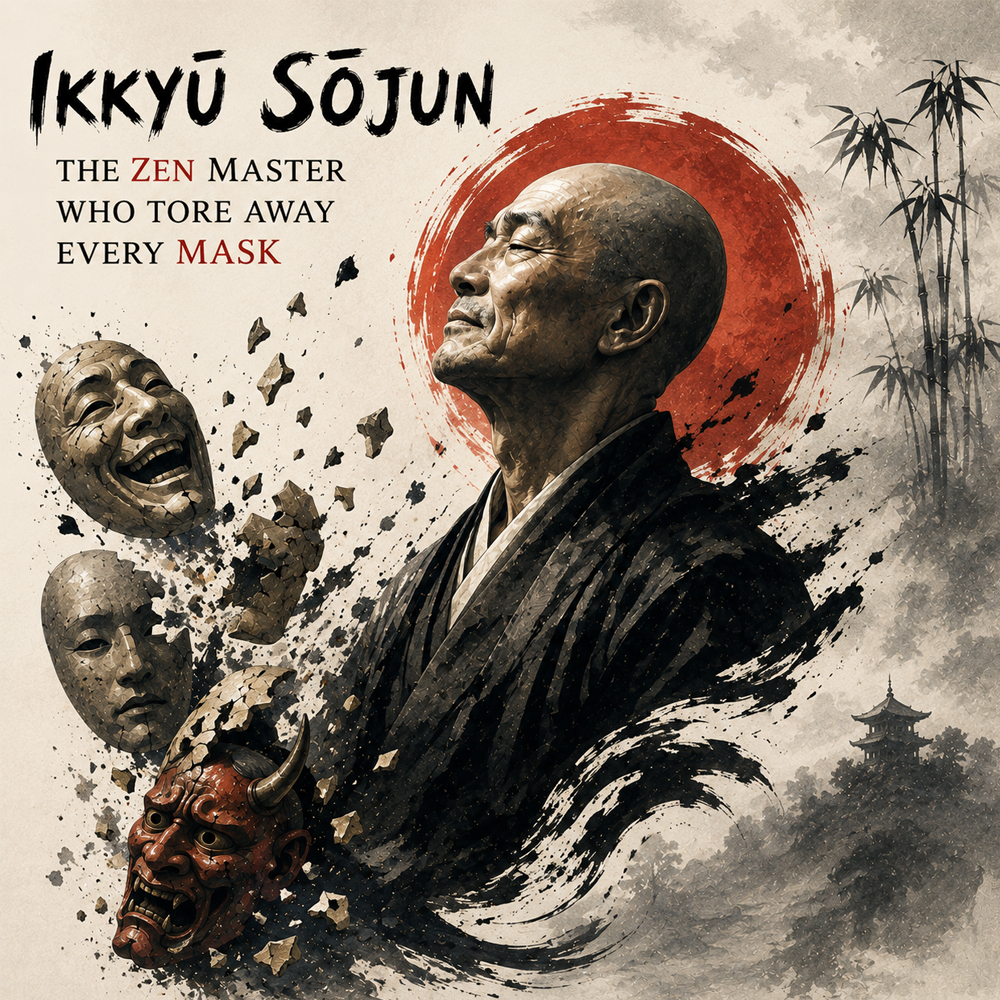
There are people who change history through armies, empires, or books. There are others who establish no new religion, create no philosophical school of their own, and leave behind no vast temples, yet continue to inspire people centuries later. They change the world in a much quieter way – by destroying the illusions behind which people hide. Among these rare figures stands Ikkyū Sōjun, one of the most extraordinary Zen masters in the history of Japan.
To some, he was a great spiritual teacher. To others, he was a dangerous rebel who undermined the authority of Buddhist institutions. To still others, he was simply a mad poet who spent more time in teahouses, taverns, and brothels than in monasteries. Ikkyū himself would probably have smiled at all these definitions, because throughout his life he refused to be placed in any category. He did not want people to believe in him. He wanted them to stop believing in their own delusions.
His story reads almost like a novel. Born in the shadow of the imperial court, raised as a child who never received true recognition, he spent his youth in austere monasteries, endured profound spiritual crises, attained enlightenment beside the dark waters of a lake, and then willingly turned his back on everything society called sacred. Instead of becoming a respected religious leader, he chose the life of a wandering poet who spoke with beggars, painters, musicians, woodcutters, fishermen, and women with the same respect others reserved for emperors.
It is precisely this extraordinary freedom that makes Ikkyū one of the most fascinating figures in the history of Zen. While most spiritual teachers show people how to escape the world, he reveals how truth can be discovered within its very noise, chaos, and imperfection. For him, enlightenment was not found somewhere far away, behind monastery walls or within elaborate religious rituals. It was hidden in the most ordinary human life – in a cup of tea, in the sound of rain, in a child’s laughter, in love, in loneliness, and even in pain.
The Child Who Belonged Nowhere
Ikkyū’s story begins in 1394 in Kyoto, then the capital of Japan. His very birth is wrapped in legend, and historians still debate which parts are true and which were shaped by later imagination. The most widespread tradition claims that he was the illegitimate son of Emperor Go-Komatsu and a court lady. If this was indeed the case, then his first breath was already marked by a painful contradiction. He was close enough to the summit of power to feel its presence, yet far enough away to understand that he would never truly belong to it.
His mother was forced to leave the palace, and the young Ikkyū grew up far from imperial splendor. Instead of grand ceremonies and luxurious robes, his childhood was filled with uncertainty, loneliness, and the feeling that he belonged to two worlds at once while truly belonging to neither. It was perhaps during those years that his deep distrust of public titles and social roles first began to take shape – a distrust that would later become one of his defining traits.
Even as a child, he showed unusual sensitivity and curiosity. While other boys dreamed of swords and military glory, he asked questions that rarely occurred even to adults. Why do people suffer? Why is everyone so afraid of losing their position? Why do some bow before the rich while ignoring the poor? These were questions no one could answer convincingly. Instead of answers, he was given rules. Instead of truth, traditions.
At the age of six, he was sent to a Zen monastery. For most children, such a decision would have meant separation from family and the end of a carefree childhood. For Ikkyū, it marked the beginning of a much deeper journey. The monastery became his home, his school, and at the same time a place that gradually began to disappoint him.
The Encounter with Zen
Monastic life was harsh. The day began before sunrise. It was followed by hours of meditation, the chanting of sutras, demanding physical labor, and endless exercises in discipline. Absolute obedience was expected from the monks. Outward silence was considered a sign of spiritual progress, and any departure from the rules was punished severely.
At first, Ikkyū accepted everything with a sincere desire to discover the truth. He studied Buddhist texts with immense dedication and impressed his teachers with his memory and intelligence. Even as a teenager, he wrote poetry that astonished the older monks with its depth. Yet the more deeply he entered monastic life, the more strongly he sensed a strange contradiction.
People spoke constantly about freedom from the ego while fiercely defending their own status. Teachers preached humility while secretly competing for influence. Monks spoke of renouncing attachment while clinging to their titles, robes, and reputations. The more carefully Ikkyū observed all this, the more he began to doubt whether external discipline truly led to inner freedom.
He would later write:
“How strange that people search for the Buddha while they cannot see their own face.”
This brief sentence already contains the essence of the philosophy of the future Ikkyū. In his view, the greatest obstacle to enlightenment was not desire, the world, or even suffering. The true obstacle was the constant desire to become someone else. While chasing the ideal image of a spiritual person, you cease to see who you actually are.
Master Kasō – The Man Who Offered No Ready-Made Answers
The young monk’s destiny changed when he met the Zen master Kasō Sōdon. Unlike many other teachers, Kasō did not impress his students with beautiful speeches. He was severe, direct, and at times seemed almost merciless. Rather than explaining the truth, he preferred to leave his students to confront it for themselves.
Their first meeting made a powerful impression on Ikkyū. He had expected to find a man with a majestic presence, but instead saw an elderly monk in ordinary clothes whose behavior was almost unremarkable. There was something unsettling about this. The teacher did not look like a great spiritual leader at all. For that very reason, the young monk began to feel that perhaps, for the first time, he was standing before a genuine one.
Kasō did not encourage blind reverence. When a student asked a question, he rarely received a direct answer. Instead, the teacher turned the question back toward him. If someone claimed to have understood Zen, Kasō immediately found a way to shatter that certainty. If someone fell into despair, he did not hurry to comfort him. He wanted each person to walk the path alone, because he knew that another person’s experience could never become one’s own realization.
Under his guidance, Ikkyū began to understand that Zen had almost nothing to do with accumulating knowledge. The more concepts the mind collects, the harder it becomes to see immediate reality. Truth cannot be possessed like a book or a theory. It reveals itself only when a person stops clinging to personal ideas and interpretations.
And yet the young monk was still not free. An inner struggle continued to rage within him. On the one hand, he longed for enlightenment; on the other, he sensed that this very longing was becoming a new form of attachment. The more intensely he strove for awakening, the more unreachable it seemed.
This tension gradually turned into despair. Ikkyū meditated to the point of exhaustion, studied diligently, and followed every instruction given by his teacher, yet inner clarity still did not come. He began to wonder whether he was chasing something that did not exist at all. It was precisely this crisis that would lead him to one of the most famous experiences in the history of Zen – the moment when the ordinary cry of a crow changed his life forever.
The Night a Crow Tore Through the Silence
In his early twenties, Ikkyū found himself in a state that many spiritual seekers know well. Outwardly, he appeared to be a devoted monk, while inwardly he was torn apart by doubt. Every day, he meditated for hours. Every day, he studied sutras, spoke with teachers, and searched for that moment everyone talked about – enlightenment. Yet the more desperately he pursued it, the more he felt it slipping away.
His teacher, Kasō, noticed this inner struggle. Instead of comforting him, he allowed his student to pass through it. He knew that the most dangerous moment on the spiritual path is not when a person suffers, but when he begins to believe that he understands. As long as Ikkyū still doubted, hope remained alive.
One night, the young monk sat alone in a small boat on Lake Biwa. Moonlight barely touched the surface of the water. The wind had almost stopped, and all of nature seemed suspended between two heartbeats. After hours of meditation, Ikkyū was no longer trying to achieve anything. He was too exhausted to keep chasing enlightenment. For the first time in a long while, he simply sat.
Then the cry of a crow was heard.
The sound was brief, ordinary, and seemingly insignificant. Nothing mystical happened. There was no radiant light, the sky did not open, and no supernatural voice spoke. Only a single harsh cry cut through the silence of the night.
But in that moment, something within him broke open.
Ikkyū would later say that it was not the crow that awakened him. What awakened him was the sudden disappearance of the person who had been waiting to be awakened. All the tension that had accumulated over the years dissolved at once. Every question that had tormented him vanished, because there was no longer anyone left to ask them.
Zen often teaches that enlightenment is not the acquisition of something new. It is the falling away of everything unnecessary. Ikkyū did not discover a new truth. For a moment, he simply stopped covering reality with his expectations.
When he told Kasō the next day what he had experienced, the teacher did not rush to congratulate him. Instead, he continued to test him. He wanted to know whether his student had undergone genuine insight or had merely fallen into a state of excitement. After a long conversation, the old master smiled and said that this time Ikkyū had truly seen something beyond words.
For many, this would have been the happy ending of the story. Enlightenment is attained, the student becomes a respected teacher, and he begins training the next generation of monks.
For Ikkyū, everything began precisely here.
Enlightenment Does Not Make a Person Holy
After his experience by Lake Biwa, Ikkyū did not become quieter, more obedient, or more revered. The exact opposite happened. He began to question everything around him with even greater boldness.
Many people believe that a spiritual person must always appear serious, speak slowly, and carefully choose every word. Ikkyū never fit this image. After his awakening, he became even more unpredictable. He laughed loudly. He wrote satirical poems. He mocked arrogant monks. He disappeared for days without telling anyone where he was going.
For him, enlightenment did not mean beginning to play the role of an enlightened person. It meant finally ceasing to play any role at all.
One of the most famous sayings associated with this spirit is:
“If you meet the Buddha, kill the Buddha.”
Although this expression is most often linked to Linji, Ikkyū frequently embodied the same spirit in his sermons and poetry. Its meaning was never literal. It was a warning not to turn even the Buddha into an idol. The moment you begin clinging to an image of enlightenment, you have already lost your freedom.
In his view, a person could become a prisoner not only of wealth and fame, but also of his own spirituality.
For his time, this was a revolutionary idea.
Why Ikkyū Declared War on Hypocrisy
The fifteenth century was a difficult period for Japan. Monasteries were no longer merely spiritual centers. Many owned land, accumulated wealth, and exercised political influence. Some even had their own armed monks, who took part in conflicts between rival rulers.
Ikkyū watched all this with growing disappointment.
He saw people who spoke daily about renouncing desire while living in luxury. He heard sermons about humility delivered by men obsessed with power. He watched monks bow before statues of the Buddha while ignoring the suffering of hungry people outside the temple gates.
Instead of remaining silent, he began to speak openly.
Naturally, this made him many enemies.
In one of his poems, he writes:
“It is easy to wear a monk’s robe.
It is far harder to strip away the ego.”
These few lines contain one of the deepest criticisms of religious hypocrisy. For Ikkyū, clothes did not make the monk, just as titles did not make the sage. True spirituality could not be displayed like an ornament.
The more he observed institutionalized Zen, the more he came to believe that monasteries themselves sometimes prevented people from finding the very thing they had originally been created to seek.
The Monk Who Preferred Taverns to Temples
After the death of his teacher, Ikkyū lived permanently in monasteries less and less often. Instead, he wandered through Japan and spent his time among many different kinds of people.
This shocked many.
While other respected monks were invited to palaces and wealthy temples, Ikkyū could be found in a small teahouse, a noisy tavern, or the home of a poor artist. He spoke just as naturally with nobles as he did with beggars. To him, there was no essential difference between them.
One day, a student asked him why he spent so much time among ordinary people.
Ikkyū replied:
“Because at least they do not pretend to be enlightened.”
This response captures his character perfectly. He did not despise people who made mistakes. He despised only pretense.
When a person admits his own ignorance, he has already taken the first step toward wisdom. But the moment he begins playing the role of a perfect teacher, he stops learning.
That is why Ikkyū often said that he preferred an honest sinner to a hypocritical saint.
Poetry as a Continuation of Zen
For Ikkyū, poetry was never decoration. It was a natural continuation of meditation.
While many Buddhist texts used complex philosophical language, his poems were brief, vivid, and sometimes even rough. They contained no desire to impress the reader. They carried only the desire to awaken him.
One of his best-known poems says:
“Do not seek the truth.
Simply stop clinging to your opinions.”
Within these few words lies the essence of Zen.
Most people imagine the spiritual path as an accumulation of knowledge. Ikkyū saw it in exactly the opposite way. In his view, the mind is like a mirror. The more dust from beliefs, fears, and ideas gathers upon it, the less clearly it can reflect reality.
Truth does not need to be invented.
It needs to be seen.
And in order to see it, sometimes all a person must do is stop looking through the filter of his own ideas.
The Love That Did Not Contradict Enlightenment
The most scandalous chapter of Ikkyū’s life began when he was already an old man. While many expected a renowned Zen master to withdraw from the world completely, he fell in love. His beloved was named Moriya – a gifted singer and musician who played the traditional Japanese instrument known as the biwa. She was decades younger than he was, yet an extraordinary intimacy developed between them and lasted until the end of his life.
To the monks of that time, such a relationship seemed like proof that Ikkyū had abandoned the spiritual path. To him, it meant precisely the opposite. He saw no contradiction between love and awakened consciousness. In his view, true spirituality does not destroy human feeling; it frees it from possession and fear.
Instead of hiding their relationship, he began writing love poems. They were not filled with guilt or excuses. In them, love appeared as a natural expression of life – as real as a tree blossoming in spring or snow falling in winter.
In one of his best-known poems, he writes:
“The hand that holds the brush
also holds the hand of the beloved.
Where does Zen end,
and where does love begin?”
These lines are not an attempt to romanticize spirituality. They reveal something much deeper. For Ikkyū, the division between the sacred and the ordinary exists only in the human mind. When a person truly sees reality as it is, every action can become an expression of awakened awareness.
The Hidden Meaning Behind His Scandals
Over the centuries, many people have seen Ikkyū as nothing more than an eccentric monk who broke the rules. Such an interpretation, however, misses the most essential point. He did not violate traditions because he enjoyed rebellion. He broke them whenever he believed they had become substitutes for truth.
Ikkyū understood perfectly how easily the ego can hide behind religion. A person may take pride in wealth, but can just as easily begin taking pride in humility. He may be vain about beautiful clothes, but also about a modest monk’s robe. He may be attached to pleasure, but equally attached to the idea that he has risen above it.
This idea appears constantly throughout his poems and conversations:
“Do not be proud
that you have defeated your desires.
That is merely another desire.”
In just a few words, he describes one of the most subtle traps on the spiritual path. The ego rarely disappears all at once. It simply changes its clothing. If it once took pride in wealth, it may later begin taking pride in spirituality.
Ikkyū devoted his life to exposing precisely this illusion.
The Story of the Wooden Statue
Among the most frequently told stories about Ikkyū is one that perfectly illustrates his way of thinking.
It is said that on a bitterly cold winter night, he stayed in a small temple. The temperature was so low that there was no firewood left. Ikkyū calmly picked up a wooden statue of the Buddha and threw it into the hearth.
The temple keeper was horrified.
“What are you doing? That is a sacred statue!”
Ikkyū calmly stirred the embers with a stick.
“I am looking for the Buddha’s bones.”
“What bones? It is only a wooden figure!”
“If there are no bones, then it is merely wood. And tonight, wood is more useful as fire.”
Whether or not the story is historically accurate, it perfectly conveys the spirit of his teaching. Ikkyū was not showing disrespect toward the Buddha. He was showing how easily people begin worshipping symbols instead of the living truth toward which those symbols point.
When Japan Descended into Chaos
The middle of the fifteenth century brought severe trials. The Ōnin War reduced Kyoto to ruins. Entire districts burned, temples were destroyed, and thousands of people lost their homes. In such times, spiritual ideas can easily remain nothing more than beautiful words.
Ikkyū chose another path.
He did not shut himself away in a monasteryZen in Japan. Although he criticized institutions throughout his life, when the moment came to help people, he did not refuse responsibility.
This is yet another of the great contradictions in his character. He never fought against temples themselves. His struggle was against hypocrisy, greed, and spiritual complacency. When an institution served people, he was willing to work for it. When it began serving only itself, he became its fiercest critic.
The Final Years
As he grew older, Ikkyū did not become gentler. His humor remained sharp, his poems remained bold, and his criticism remained uncompromising. Even after he was recognized as one of the greatest Zen teachers of his age, he continued to behave like a man who had nothing to defend.
One of his final reflections says:
“From birth until death,
everything is one story.
Do not waste it
pretending to be someone else.”
These words sound almost like a summary of his entire life. For him, the greatest tragedy was not death. The greatest tragedy was for a person to spend an entire life following other people’s ideas of who he should be.
Ikkyū died in 1481 at the age of eighty-seven – an extraordinary age for his time. He left behind hundreds of poems, works of calligraphy, letters, and stories that have continued to be told for more than five centuries.
Why Ikkyū Remains So Relevant Today
In a world obsessed with appearance, Ikkyū reminds us that a person can look spiritual without being free. In an age of endless advice about self-improvement, he warns us that the constant pursuit of a “better version” of ourselves can sometimes be nothing more than a subtler form of dissatisfaction with who we are.
His message is unusually simple. Do not try to be special. Do not strive to appear enlightened. Do not seek recognition for your virtue. See life as it is, and stop pretending.
Perhaps this is precisely why his words sound so contemporary. Today, people often construct carefully curated identities on social media, constantly compare themselves with others, and chase ideals they can never reach. Ikkyū would say that all these masks only distance us from the immediate experience of life.
For him, true freedom begins the moment we stop trying to become someone else.
Conclusion
The life of Ikkyū Sōjun cannot be reduced to a single simple lesson. He offers no system that promises a certain path to enlightenment and no list of rules that must be followed. Instead, he leaves behind something far more valuable – the example of a person who had the courage to be completely honest with himself.
He shows that Zen is not measured by the number of hours spent in meditation, nor by the number of sutras read or rituals observed. True practice begins when we stop hiding behind roles, titles, and ideas. When we cease dividing life into sacred and ordinary, spiritual and worldly, right and wrong, we begin to see reality with new eyes.
Perhaps this is why Ikkyū remains so different from almost every other Zen master. He does not invite us to escape the world, but to meet it without masks. He does not encourage us to become perfect human beings, but genuine ones. And within this seemingly simple yet deeply liberating idea lies the reason his voice continues to echo more than five hundred years after a crow tore through the silence above Lake Biwa.
Read more:
- 5 Zen Stories from Ikkyū Sōjun, the Rebel Monk Who Defied Tradition
- Zen: The Path Beyond Words – History, Development, and the Living Presence of Awakening
- Nansen: Zen Koans, the Story of the Cat, and the Power of the Ordinary Mind
- If You Meet the Buddha, Kill Him: The Radical Zen of Linji
- Life in a Zen Monastery: The Rigorous Path to Enlightenment, Satori, and One’s True Nature
Author: Vasil Stoyanov