
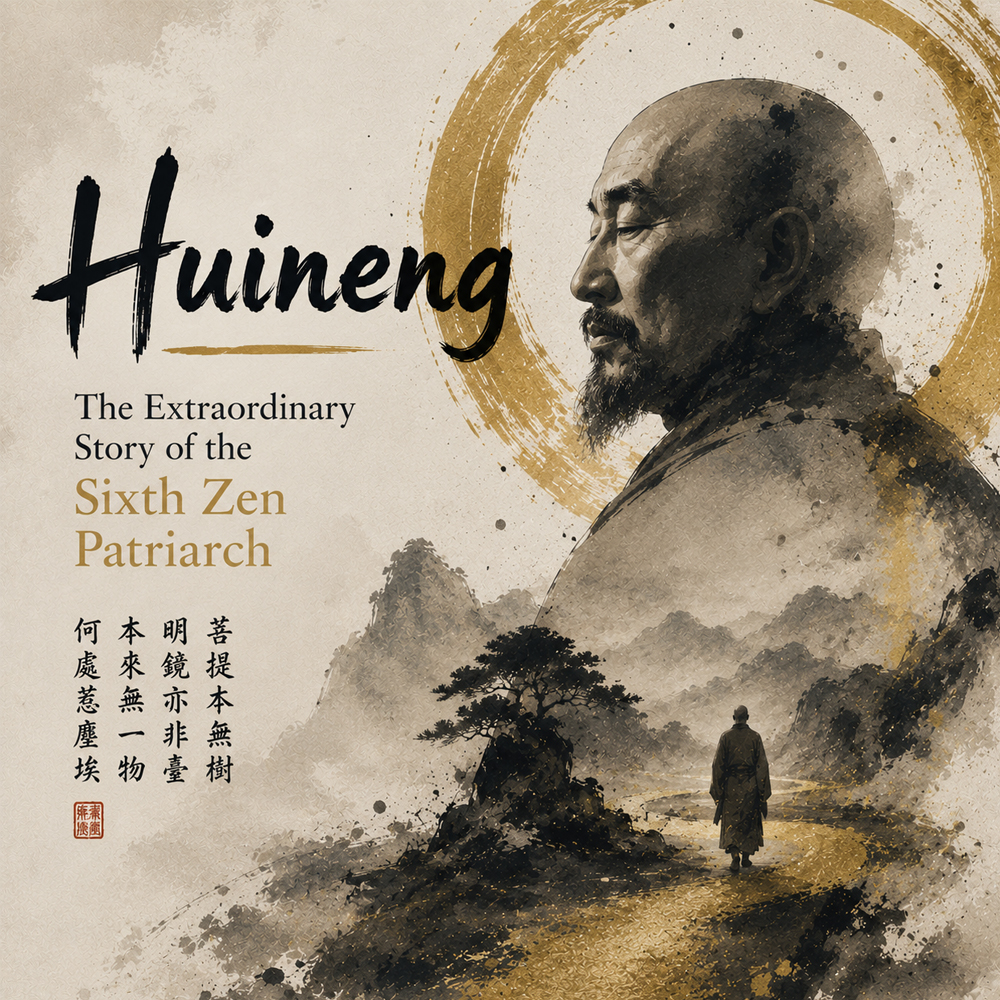
Dajian Huineng was the sixth Chan/Zen patriarch and one of the rarest exceptions in Buddhism. He was born in 638 and left his body in 713.
When he was still a child, his father died, leaving him alone with his mother in poverty. Although he was young, Huineng began selling firewood to help his mother. One day, when he was older, while delivering firewood to a customer, he met a man reciting the Diamond Sutra – a sacred Buddhist text. Even though Huineng himself could neither read nor write, he instantly understood what he heard and attained satori, sudden enlightenment.
Huineng asked the man why he was reciting the sutras, and through their conversation learned that he came from a monastery where the fifth Chan/Zen patriarch lived. The man suggested that Huineng visit him.
Arrival at the Monastery
After one month, Huineng reached the monastery, but at the gates he was stopped by the monks living there. Since Huineng looked like a poor, dirty barbarian, the monks tried to send him away, saying they could not allow such an unclean person into such a sacred place.
While this was happening, the best student of the fifth patriarch, Shenxiu, saw the situation and intervened, allowing Huineng to enter the monastery.
When he entered the room where the fifth patriarch was, the monks began speaking rudely and laughing at him. The fifth patriarch, Hongren, asked:
“Who are you, and what are you seeking?”
Huineng explained that he was an ordinary person who wished to become his student and realize his Buddha-nature.
Hongren asked him again:
“So you are an ordinary person, and on top of that a barbarian. How do you think you can become a Buddha?”
Huineng replied:
“The barbarian differs from Your Holiness only physically, but what difference is there in our Buddha-nature?”
The fifth patriarch understood what kind of person stood before him and ordered Huineng to be sent to chop wood and pound rice in the back of the monastery, so that he would stay away from the main hall. For eight months, the patriarch paid him no attention. He received no instructions, no teachings – he was simply an ordinary worker in the monastery, occasionally mocked by the ignorant monks.
Despite this, Huineng continued to do his daily work without asking questions, without wanting anything, and without troubling himself unnecessarily.
The Contest for a Successor
In the eighth month of Huineng’s stay at the monastery, Hongren realized that he did not have much time left before leaving this world and needed to find a successor to the Teaching.
For a person to become the successor of the “Teaching,” knowledge is not enough. The Teaching is transmitted only to an enlightened person. If there is no enlightened person to whom it can be transmitted, only writings, rituals, and methods remain, but the spirit is lost.
A “contest” was organized in which students were to write verses or poems through which they could show the depth of their understanding. The best student, Shenxiu, hesitated greatly about whether to participate, because he was not sufficiently certain of his own understanding and did not want to present something that might not please Hongren, even though everyone in the monastery was convinced of the depth of his realization.
Eventually, Shenxiu decided one evening to compose a poem, but since he did not have the courage to present it to the fifth patriarch, he anonymously posted it on the wall of one of the monastery corridors. The next morning, the monks saw the poem and gathered to admire it. It read:
The body is the Bodhi tree
– the tree under which Buddha attained enlightenment.
The mind is like a stand for a bright mirror.
We must constantly strive to polish it
and not allow dust to gather.
When the fifth patriarch saw the poem, he said that it was not good enough. This disturbed Shenxiu’s mind, and he did not wish to write another one.
Two days later, Huineng heard someone reciting this poem and asked about its context. The monk explained everything about Hongren, the “contest,” and the “successor,” after which Huineng wished to see the poem with his own eyes and pay his respects.
When he arrived before the poem, he asked a low-ranking clerk to read it to him, since he was illiterate. After hearing it again, he asked the clerk to write down a poem that he would recite, and then to post it beside Shenxiu’s. Huineng’s poem read:
Bodhi, in essence, has no tree.
The mirror has no stand.
Buddha-nature is always clear and pure.
Where could dust gather?
The monks were puzzled. They did not understand what it meant and considered it complete nonsense. Hongren saw the poem and removed it from the corridor, saying that the author of this poem had not attained enlightenment.
The next evening, the fifth patriarch secretly went to Huineng’s room and revealed to him the essence of the entire Diamond Sutra. When Huineng heard the words, “One should activate the mind in such a way that it has no attachments,” he attained complete enlightenment, realizing the self-nature of all things.
With this, Hongren handed him his bowl and robe, symbolizing the transmission of the Teaching, and Huineng became the sixth Chan/Zen patriarch. Hongren also explained to him that the true transmission of the Teaching happens from mind to mind. What is transmitted is Mind, not knowledge. The fifth patriarch secretly sent him far away from the monastery because he knew the monks would cause a great scandal and try to harm him.
Hundreds of people set out after Huineng, trying to steal the robe and bowl from him, but they failed. Later, when he was firmly established as the sixth patriarch of Chan/Zen, Huineng delivered a long speech before thousands of gathered monks and laypeople. It was so penetrating that it came to be classified as a “sutra.” This speech became a sacred Buddhist text known as the Platform Sutra.
Huineng
People like Huineng are born on Earth extremely rarely. To receive satori merely from hearing a certain phrase once, despite being illiterate, speaks of a very strong karmic connection with that teaching, as well as much work in that direction in previous existences, as he himself hinted about himself.
According to the Buddhist understanding, such an event can occur only in a person who has brought himself to the very edge and needs only one more small step, which may happen at any moment.
Any person who has invested much time and energy into something can have one word, one phrase related to that thing instantly unlock a deep feeling containing their entire life experience within it.
Here are some statements by Huineng as the sixth patriarch:
– “The capacity of the mind is broad and vast, like the boundless sky. Do not sit with a mind fixed on emptiness. If you do, you will fall into a neutral kind of emptiness. Emptiness includes the sun, the moon, the stars and planets, the great earth, mountains and rivers, all trees and grasses, bad people and good people, bad things and good things, heaven and hell; all of them are within emptiness. The emptiness of human nature is also like this.”
– “Truth must be lived, not merely spoken.”
– “Confused by thoughts, we experience duality in life. Unburdened by ideas, the enlightened one sees the single Reality.”
– “Before you think good or evil, who are you?”
– “Just as one lamp serves to dispel a thousand years of darkness, so one flash of wisdom destroys ten thousand years of ignorance.”
Read More:
- Bodhidharma – The Fierce Zen Master Who Brought Buddhism to China
- Hakuin Ekaku – The Great Master Who Revived Zen in Japan
- Bassui Tokushō: The Zen Master Who Asked “Who Sees and Hears?” – Life and Teachings
- If You Meet the Buddha, Kill Him: The Radical Zen of Linji
Author: Vasil Stoyanov