
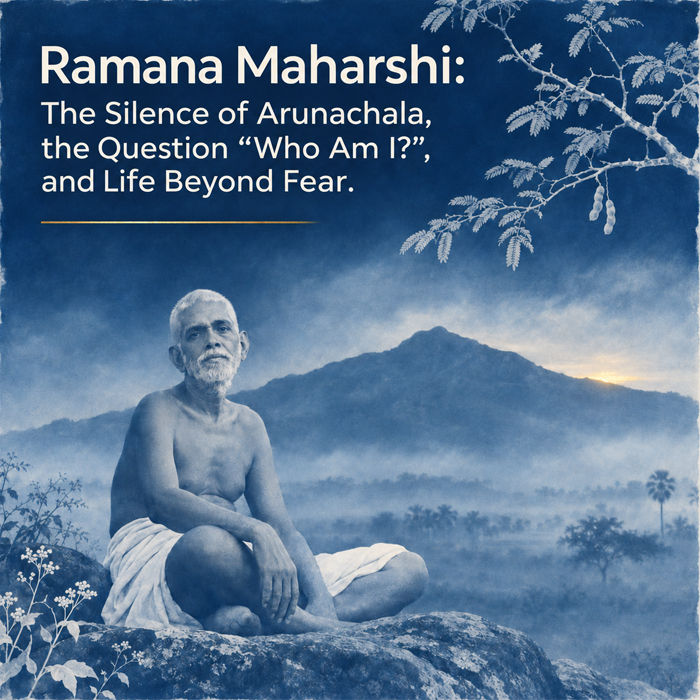
At the foot of the sacred mountain Arunachala, among the stone temples and sunlit landscapes of South India, a man made silence into a spiritual language understood far beyond the boundaries of religion. He did not construct an elaborate system of initiation, demand adherence to a new creed, or claim that liberation depended upon mastering a vast body of secret knowledge. His most direct instruction was a question that appears simple until one attempts to follow it to its source: “Who am I?” His name was Ramana Maharshi.
Visitors to his ashram during the first half of the twentieth century encountered something that could not be reduced to spoken teachings. Long intervals passed in silence. People arrived with philosophical doubts, grief, family responsibilities, fear of death, and questions about God. Some received a brief answer, others heard an illustrative story, and many simply sat in his presence. Ramana shared the ordinary rhythm of community life, paid attention to animals, and showed concern for practical needs. The simplicity of this setting expressed his central teaching: the deepest truth is not necessarily a distant achievement, but what remains when a person ceases to identify entirely with passing thoughts.
His biography contains episodes of exceptional intensity. As an adolescent, he experienced a sudden confrontation with the fear of death, after which his life changed irrevocably. During his earliest years at Arunachala, he remained so absorbed in contemplation that insects and parasites injured his body while he paid little attention to the wounds. Decades later, when a malignant growth developed on his arm, witnesses described his extraordinary composure during painful medical treatment; accounts of one intervention emphasize that he declined anesthesia. These episodes deserve careful presentation. The surviving descriptions differ in their details, and outward calm cannot establish the complete absence of physical pain.
Ramana left a body of short compositions, hymns, translations, and recorded conversations rather than a single comprehensive philosophical treatise. Important sources include Who Am I? (Nan Yar?), Forty Verses on Reality (Ulladu Narpadu), Upadesa Saram, Talks with Sri Ramana Maharshi, Day by Day with Bhagavan, and early biographies and recollections. Short sayings in this article are rendered in English according to their established sense rather than claimed as exact quotations from a particular edition. Historical events, eyewitness recollections, and devotional interpretations are distinguished wherever that distinction matters.
Venkataraman: The Boy Who Confronted Death
Ramana Maharshi was born on December 30, 1879, in Tiruchuli, in present-day Tamil Nadu, India. His birth name was Venkataraman. His father, Sundaram Iyer, worked in the legal profession, while his mother, Alagammal, cared for the family. He grew up within the religious culture of South India, where temples, festivals, devotion to Shiva, and stories of saints formed a natural part of everyday life. Nothing in his earliest years required the conclusion that he would become one of the most influential modern teachers of nondual spirituality.
Accounts of his childhood describe a physically robust boy who enjoyed ordinary activities and slept deeply. He was not known primarily as a precocious scholar of religious philosophy. This detail matters because his later teaching did not emerge from a conventional progression through monastic training. The central experience of his life preceded his systematic familiarity with the philosophical vocabulary subsequently used to explain it.
Following his father’s death in 1892, Venkataraman lived with relatives and continued his education in Madurai. There he encountered the famous Meenakshi Temple, which would become important in his inner life. The name Arunachala also made a powerful impression on him. When he learned that Arunachala was an actual sacred mountain rather than merely an exalted spiritual expression, the discovery awakened a strong desire to reach it.
Another important influence was the Periya Puranam, the Tamil collection of lives of the Shaivite saints known as the Nayanmars. These narratives described men and women whose devotion to Shiva transformed the direction of their lives. They gave the young Venkataraman examples of spiritual dedication as an immediate reality rather than a social convention. Although his mature teaching would emphasize direct self-enquiry, its early cultural roots were deeply connected to South Indian Shaivism.
In 1896, at the age of sixteen, a sudden fear of death overtook him while he was in a relative’s house in Madurai. In his later account, he emphasized that he was not physically ill and that no external danger had caused the fear. Instead of attempting to distract himself, he resolved to examine death directly. He lay motionless and imagined that his body had died. It would be carried away, lose the ability to move or speak, and eventually be cremated or buried. Yet another question arose: was the awareness that recognized these possibilities identical with the body?
He turned his attention toward the immediate sense of being. In his testimony, the fear of death gave way to the conviction that his true nature could not be reduced to the mortal organism. The episode became the foundation of his spiritual life. It was not, in his telling, the result of a formal breathing technique or an argument learned from scripture. It was an inward investigation of the apparent subject of experience. The experience itself is known through his testimony and the transformation of his subsequent life; its metaphysical interpretation belongs to his spiritual philosophy rather than to independently established scientific fact.
After this event, ordinary schoolwork lost much of its appeal. He spent increasing periods in silence and visited the Meenakshi Temple. Biographical accounts describe a young man absorbed in an inward condition that seemed more important to him than conventional ambitions. On August 29, 1896, he left home for Tiruvannamalai, leaving a brief note for his family. The journey involved trains, walking, limited funds, and the practical uncertainties of traveling alone. In the spiritual memory of his followers, this departure marked the end of one way of living and the beginning of another.
He reached Tiruvannamalai on September 1, 1896, and entered the great Arunachaleswarar Temple dedicated to Shiva. Soon he relinquished his remaining money and the outward signs of his former social identity. His head was shaved, and his clothing became extremely simple. From that time until his death more than fifty years later, his life remained connected with Arunachala. Unlike spiritual teachers who traveled continuously to gather followers, Ramana stayed in one place, and seekers gradually came to him.
Arunachala possesses an ancient sacred history. In Shaivite tradition, the mountain is associated with Shiva manifesting as a boundless column of light. Pilgrims circumambulate it, and the annual Karthigai Deepam festival celebrates its connection with divine radiance. For Ramana, the mountain was more than a geographical landmark. In his hymns it became a living image of the absolute, a presence drawing the mind toward its source. The physical mountain and the philosophical language of consciousness met in an unusually intimate way.
His devotion to a particular place did not contradict his teaching that the true Self is not limited by space. Rather, Arunachala became the visible symbol of inward stillness. The pilgrim’s journey suggested a return to the source, while the mountain’s immovability evoked the awareness that remains when thoughts come and go. In later life, Ramana saw no reason to leave this landscape in search of something elsewhere. His understanding of spiritual reality was rooted in the conviction that what is essential is already present.
The Underground Shrine, the Insects, and the Years of Silence
One of the most striking episodes in Ramana’s early life took place in the Patala Lingam shrine within the Arunachaleswarar Temple. Seeking seclusion after his arrival, the young ascetic withdrew into dark and neglected spaces where he could remain undisturbed. In the underground shrine he stayed absorbed in contemplation for prolonged periods. Early biographical accounts describe insects, ants, and other parasites injuring his skin while he remained unusually unresponsive to the condition of his body.
Popular retellings often say that worms were eating his flesh while he continued sitting in meditation. A historically careful description distinguishes the common core of the testimony from its more dramatic later forms. The early narratives speak of insect attacks, wounds, and severe neglect of bodily needs; some later accounts use the image of worms. What remains consistent is his extraordinary immobility and failure to attend to injuries that ordinarily demand immediate attention. The precise biological details of every wound cannot be established from devotional recollections alone.
The story also includes the intervention of other people. Seshadri Swamigal, a spiritual ascetic associated with Tiruvannamalai, appears in accounts of the young Venkataraman’s discovery and protection. Local devotees and other helpers noticed his condition, brought food, and moved him from places where he was vulnerable. Their actions were essential. An account focused only on the apparent indifference to pain would overlook the human care that enabled him to survive this difficult period.
His body suffered consequences from prolonged immobility, inadequate attention to hygiene, and exposure. Later devotional interpretations treated the episode as evidence of complete detachment from bodily identity. A responsible historical account need not convert the injuries into a miracle. The documented significance lies in the extraordinary nature of his conduct and the powerful impression it made on those who encountered him.
Over time he moved among temple precincts, gardens, shrines, and caves on Arunachala. Silence characterized his early life, but it was not necessarily a formal vow prescribed by a monastic rule. In his later explanations, speech and ordinary mental activity had simply lost their former central importance. Eventually he began answering questions and speaking more freely. The familiar image of a permanently mute sage is therefore inaccurate. His mature teaching valued silence without prohibiting words.
Among those drawn to him was Ganapati Muni, a Sanskrit scholar and spiritual practitioner. Their meeting in 1907 became important for the wider recognition of the young ascetic as Ramana Maharshi. Ganapati Muni sought clarification about the nature of spiritual effort and received instructions directing attention toward the source of the sense of “I.” The title Maharshi, meaning great sage, came through the regard of others rather than a career of self-promotion.
Ramana spent many of his early mature years at Virupaksha Cave on the slopes of Arunachala. Visitors began gathering around him in a setting that was far removed from an elaborate spiritual institution. They came to sit quietly, ask questions, and observe his way of life. His simplicity was central to their experience. He did not promise supernatural powers or demand membership in a new organization. When asked about spiritual realization, he returned attention to the one asking the question.
One recurring kind of exchange illustrates his method. A visitor asks for special instruction, and Ramana directs him to investigate who wants that instruction. This is not an attempt to evade the question. It is a change in the direction of attention. Rather than adding one more concept to the visitor’s collection, he asks the seeker to examine the seeker. The apparent simplicity of the response can be frustrating to someone expecting an elaborate doctrine, but it expresses the center of his teaching.
The underground-shrine episode should not be mistaken for a practice Ramana recommended to others. In later life he paid close attention to food, practical work, and the welfare of animals and visitors. His early disregard for his body was a biographical event, not a universal spiritual prescription. Deliberately exposing oneself to parasites or neglecting wounds would confuse an outward circumstance with the inward enquiry he actually taught.
There is an important contrast between the adolescent ascetic and the mature teacher. The former appears almost entirely absorbed in inward experience; the latter remains quiet while participating in a community and noticing the needs of living beings. His spiritual life did not culminate in indifference to others. It became a form of presence within ordinary relationships, and this development is essential to understanding the full human portrait rather than only its legendary scenes.
“Who Am I?”: Self-Enquiry and the Search for the Source of the Mind
Ramana’s best-known teaching is atma-vichara, or self-enquiry, usually introduced through the question “Who am I?” It is not an exercise in compiling a psychological autobiography. The practitioner is not asked to list occupations, family roles, memories, preferences, and personality traits in order to arrive at a final definition. Instead, the practice begins by recognizing that all these descriptions appear as contents of awareness. The question turns toward the one who knows them.
In the short work Who Am I?, Ramana examines the body, senses, vital functions, and mental activity as objects that can be known. If the body can be observed, if thoughts can be noticed, and if fear or joy can be recognized, what is the immediate “I” to which these experiences appear? His approach is contemplative rather than a sequence of abstract proofs. It asks attention to turn from the objects of experience toward the felt presence of the experiencing subject.
A philosophical discussion of identity can involve psychology, neuroscience, metaphysics, and logic. Ramana did not offer self-enquiry as a laboratory demonstration that would replace those disciplines. His purpose was to investigate immediate experience before it becomes entangled in statements such as “I am this person,” “I am my profession,” or “I am my thoughts.” The distinction is crucial for understanding both the depth and the limits of his method.
According to his teaching, the “I”-thought is the root around which other thoughts are organized. When a person says “I am afraid,” “I remember,” or “I desire,” the statement presupposes a personal subject. Ramana asks the practitioner to trace the arising of that subject-sense. Merely repeating “Who am I?” as a verbal formula is not the whole practice. The words point toward an actual movement of attention back to the source of the feeling “I.”
One of the most frequently repeated instructions concerns distracting thoughts. When a thought arises, ask to whom it has arisen. The answer is “to me.” Then enquire, “Who am I?” Rather than following the endless content of the thought, attention returns to the sense of the one experiencing it. This sequence gives self-enquiry a practical form without turning it into a mechanical ritual. The aim is not to win an argument with the mind but to understand its apparent center.
Ramana describes the mind as a movement of thoughts, with the “I”-thought providing the impression of a stable individual owner. When attention repeatedly turns toward that apparent owner, the separate ego, in his philosophical account, loses its assumed independence. This is not an instruction to destroy personality in the ordinary sense. A person continues to eat, speak, work, and meet responsibilities. What changes is the degree of identification with a mental image of oneself.
He also uses the term Heart, or hridaya, to refer to the source of the Self. Some recorded conversations associate the spiritual Heart with the right side of the chest. Such language belongs to his contemplative vocabulary and should not be mistaken for an anatomical theory replacing medical knowledge about the heart and brain. In the broader sense of his teaching, the Heart means the source of awareness, not merely emotional feeling.
A recurring idea in his discourses is that happiness belongs to the nature of the true Self, while people habitually seek it in external objects. Desire creates a sense of incompleteness, and its temporary satisfaction brings relief. In Ramana’s interpretation, the peace following fulfillment does not arise solely from the object obtained; it also appears because the agitation of wanting has momentarily subsided. This is a spiritual account of experience, not a universal scientific theory of happiness.
He frequently discusses deep sleep. In dreamless sleep, the usual stream of thoughts and social identities is absent, yet on waking a person may say that they slept well. Ramana uses this observation to direct attention toward the distinction between changing mental contents and what he understands as the deeper basis of existence. The philosophical argument is open to debate, but within his teaching its function is to stimulate direct investigation rather than close every question about consciousness or the brain.
Self-enquiry should not be confused with endless intellectual doubt about personal identity. If a practitioner answers “I am the body,” then “I am the mind,” then “I am the soul,” and continues inventing definitions, the activity remains conceptual. Ramana asks for a living turn of attention. A thought is noticed; the desire to analyze it is also noticed; and attention returns to the sense of the one to whom it appears. Progress is not measured by how often the question is spoken but by the clarity of observation.
This makes the teaching both accessible and demanding. It does not require a particular caste, special clothing, or mastery of Sanskrit. Yet the mind is accustomed to moving toward objects, stories, explanations, and desired results. Turning toward the apparent subject of experience challenges that habit. Ramana does not provide a spectacular substitute for the difficulty. He continues to direct the practitioner toward the same fundamental enquiry.
Visitors often asked what to do when they felt restless or believed they were making no progress. Ramana’s responses frequently brought attention to the thought “I am not progressing.” Who measures progress? Who compares today’s experience with yesterday’s? Who expects a special state? In this way, even spiritual ambition becomes material for enquiry. He does not reject perseverance, but he refuses to turn the search for liberation into another competition for a superior identity.
An important distinction in his teaching concerns temporary mental quiet and lasting understanding. Concentration, breathing practices, or forceful suppression can produce intervals of stillness. Yet when circumstances change, familiar reactions may return. Ramana distinguishes such temporary subsidence from recognition of the source of the “I”-thought. In his account, freedom is not merely an absence of thoughts for a limited period, but the ending of mistaken identification with them.
He did not dismiss other spiritual methods. Prayer, devotion, repetition of a divine name, and meditation could all be useful according to a person’s disposition. He understood them as possible approaches toward the inward turn at the heart of self-enquiry. This flexibility helps explain why people from different religious backgrounds felt able to approach him. He did not require everyone to abandon familiar forms of worship before examining the nature of their own experience.
The question of whether self-enquiry requires withdrawal from society arose repeatedly. Many visitors had families, professions, and responsibilities. They could not live in a cave. Ramana emphasized the inward nature of the practice. A person can fulfill ordinary duties while examining the sense of being the separate doer. This does not make practical problems disappear. It means that the question of awareness is not reserved for those who have renounced social life.
His discussions of fate and free will follow a similar pattern. He sometimes uses the traditional language of karma and predetermined circumstances, but repeatedly asks who regards himself as the actor affected by destiny. Instead of supplying a comprehensive theory of causation for every event, he directs the question toward the identity of the one who seeks freedom. Complex metaphysical problems thus become occasions for immediate enquiry.
His teaching is not a system of positive thinking. It does not promise that every desire will be fulfilled, that disease will disappear, or that the world will obey the meditator’s wishes. It asks a different question: what is the basis of the sense of “I” regardless of changing circumstances? This rigor prevents self-enquiry from being reduced to a technique for acquiring worldly success.
That is why his shortest answers can carry such force. Someone asks how to find God; Ramana asks who wishes to find God. Another asks how to acquire peace; he directs attention to the one who believes peace has been lost. A third asks what liberation means; the enquiry returns to the one who considers himself bound. These are not merely verbal puzzles. They express a consistent contemplative method applied to different forms of human distress.
Arunachala, Devotion, Silence, and the Ordinary Life of the Ashram
Ramana is closely associated with Advaita Vedanta, the philosophical tradition of nonduality. Yet his devotion to Arunachala demonstrates that nondual enquiry did not exclude love for a sacred form. He composed hymns addressing the mountain as Shiva, as an intimate divine presence, and as the power that draws the separate ego back toward its source. The language of love and the language of self-knowledge meet throughout these poems.
Among his best-known works is Aksharamanamalai, often translated as The Marital Garland of Letters, a devotional hymn to Arunachala. It combines the intimacy of spiritual longing with the desire for complete surrender. Ramana does not describe the mountain as an object to be mastered through intellectual knowledge. He addresses it as a presence that attracts and transforms. This poetic dimension is essential to understanding a teacher who is too often presented solely as a philosopher of the question “Who am I?”
In his spiritual perspective, devotion and knowledge are not rival paths. Devotion weakens the self-importance of the separate “I” through love and surrender; self-enquiry traces that same “I” toward its source. The emotional qualities differ, but the inward direction is related. A person engaged in sincere prayer is not automatically farther from truth than someone practicing silent enquiry. What matters is the depth of attention and the diminishing hold of self-centered identification.
Silence occupies a distinctive place in visitors’ recollections. Some describe their thoughts settling while they sat in Ramana’s hall without hearing a word. Others report a strong sense of peace or clarity. These are personal testimonies, not measurable proof that everyone would experience the same effect. Their historical significance lies in the fact that many visitors regarded silence not as the absence of teaching but as one of its principal expressions.
Ramana explained that words inevitably divide experience into concepts. Any description of ultimate reality imposes limits upon what it seeks to express. Silence, in his understanding, does not attempt to turn the inexpressible into an object. It leaves the person directly before awareness itself. He therefore did not consider a spoken answer necessary in every encounter. At times the most fitting response was the quiet presence that did not generate another chain of ideas.
This understanding recalls the traditional image of Dakshinamurti, Shiva as the teacher who communicates wisdom through silence. Devotees often associated Ramana with this figure. The story of Dakshinamurti is a religious teaching image rather than an episode from Ramana’s biography. It expresses the conviction that some kinds of understanding cannot be transmitted as ordinary information.
Yet Ramana’s silence was not a prohibition against speech. In later years he conversed, joked, told stories, explained scriptures, and corrected misunderstandings. A compulsory performance of silence could become as mechanical as constant talking. For him, the deeper quality was inward stillness rather than a rigid outward pose. His life illustrates the difference between an authentic contemplative disposition and a rule adopted for display.
Visitors also remembered his manner toward people of different backgrounds. Scholars, pilgrims, poor villagers, and travelers from abroad could sit in the same hall. The ashram existed within a real social and historical setting, and it should not be romanticized as free from every limitation of its time. Nevertheless, many recollections emphasize that Ramana did not measure spiritual worth by education, status, or ability to quote scripture.
His relationship with animals is especially revealing. Cows, dogs, monkeys, squirrels, and birds lived around the ashram. He noticed their habits and showed concern that they receive food and care. The cow Lakshmi became particularly important in the community’s memory. When she died in 1948, Ramana composed a text that his followers understood as recognizing her spiritual liberation. That interpretation belongs to devotional belief, while his affection and practical care for her are well-established features of the ashram’s life.
Stories about Lakshmi show how nonduality could take the form of attention to an individual creature. If someone speaks of the unity of life yet ignores a hungry or injured animal, the philosophy remains detached from conduct. Ramana did not turn compassion into a theatrical program. It appeared in small actions: making sure food was available, noticing distress, and responding gently to another living being.
Accounts of the kitchen and dining arrangements reveal a similar concern for fairness. He disliked waste and paid attention to whether people were fed properly. When supplies were limited, practical decisions mattered as much as philosophical discussion. These details prevent his image from becoming that of an abstract figure existing only in contemplation. He lived among others, and the teaching repeatedly met the material conditions of ordinary life.
Over time Sri Ramanasramam developed around him. Initially modest, the community gradually acquired facilities for visitors, a kitchen, halls, and places of worship. The resting place of his mother, Alagammal, became particularly significant. She had come to live near him during her later years and died in 1922. Ramana remained near the site, and the principal ashram gradually took shape there. Family history and spiritual community thus became intertwined.
His relationship with his mother was complex. When she first sought to bring him home, he refused to leave Arunachala. Later she joined the community, and he was present during her final hours. Followers attached spiritual significance to that presence. The episode shows that his renunciation of his earlier life did not result in a permanent absence of concern for his family. His biography contains both uncompromising inward dedication and concrete human relationships.
Despite growing fame, Ramana did not seek to turn the ashram into an instrument of personal power. Others handled many organizational matters, while he generally maintained a simple daily routine. This does not mean the community lacked hierarchy or disagreements. It means his personal style remained notably unadorned. Visitors saw him sitting among them, reading, taking part in ordinary tasks, and responding without the constant assertion of special status.
Visitors from India and Abroad: Questions About God, Suffering, and the Guru
During the 1930s and 1940s, Ramana’s reputation spread beyond India. The British writer Paul Brunton played an important role through his book A Search in Secret India, published in 1934. Brunton described his meeting with Ramana, the atmosphere of the hall, and the effect of the teacher’s silence upon him. His book introduced many English-language readers to Ramana and helped establish the international reputation of the sage of Arunachala.
Brunton approached Indian spirituality with curiosity and a desire to distinguish serious teachers from charlatans. His encounter with Ramana was not presented simply as a spectacular miracle. The impression came from the unusual stillness of the place and the way questions turned back toward the questioner. The book remains a personal travel narrative, not a neutral scientific report, but its cultural influence was considerable.
Arthur Osborne later became another important writer and editor associated with Ramana’s legacy. Much of what is known about the teacher’s everyday conversations survives because visitors recognized the value of recording them. Such texts are not flawless verbatim transcripts of every sentence spoken. They are historical witnesses that must be read in context and compared where necessary. Without them, much of his distinctive manner of teaching would have disappeared.
Visitors brought radically different concerns. One wanted proof of God’s existence. Another sought control over the mind. A third grieved for a deceased relative. Others worried about marriage, work, family obligations, or the purpose of spiritual discipline. Ramana did not always answer in the same words, but he often directed attention toward the person experiencing the problem. What appeared to be a change of subject was, from his standpoint, an investigation into the foundation of suffering.
When asked about God, he sometimes spoke within the religious language familiar to the visitor; on other occasions he asked who wanted to know. In his nondual philosophy, God, the true Self, and ultimate reality could be understood as expressions pointing toward the same contemplative horizon. This was his Advaitic perspective, not a claim that every religion teaches identical doctrines. Historical and philosophical differences among traditions remain real.
Questions about suffering also appeared repeatedly. Why do good people become ill? Why does injustice exist? How can someone remain peaceful after loss? Ramana did not offer a comprehensive social theory explaining every form of human misfortune. His approach remained spiritual: investigate the subject who suffers and the identification through which experience becomes a personal story. Such an approach does not eliminate the need for medical treatment, social support, or practical action against injustice.
Some visitors asked why a realized sage did not use spiritual power to transform society. Ramana did not present himself as a political reformer or miracle worker directing public affairs. His teaching centered on recognition of the true Self. This was not a universal solution to every social problem, but it explains why his life was organized around contemplation and individual instruction rather than political campaigns.
He did not require visitors to become members of a formal organization. They could return to their families and professions. His responses emphasized that inward enquiry does not depend on special clothing or residence at a sacred site. The ashram offered conditions favorable to quiet reflection, but awareness itself was not the property of a building. This helps explain the continuing relevance of his teachings to readers who have never visited India.
Ramana acknowledged that breathing practices can temporarily steady the mind. Yet he did not regard breath control as the final goal. The decisive turn, in his teaching, is toward the source of the sense of “I.” Similarly, he did not automatically reject the repetition of sacred names. A devoted practitioner could continue a familiar practice while investigating who repeats the name and who hears the sound. His interest was not in abolishing every religious form but in understanding whether a form leads toward deeper clarity.
Questions about the necessity of a guru were particularly common. Ramana described the teacher as a source of guidance that directs a person toward the true Self. Yet ultimate understanding cannot be transferred like a physical possession. The genuine teacher should not create permanent dependence but help the seeker recognize the basis of awareness directly. This is the meaning of his recurring teaching that the true guru is the Self.
That idea does not deny gratitude toward a human teacher. It establishes a limit upon treating another personality as the exclusive owner of truth. The deeper the student follows Ramana’s question, the less satisfactory mere repetition of Ramana’s words becomes. The instruction is fulfilled not by acquiring a borrowed identity but by examining the immediate experience of being.
Humor also appears in recollections of his conversations. A visitor asks when liberation will arrive; Ramana directs attention to the one expecting a date. Another seeks an extraordinary experience; the response returns to the immediate fact of existence. Such remarks are not intended to humiliate the questioner. They reveal how easily spiritual ambition becomes another form of self-preoccupation.
He likewise discouraged fascination with visions and unusual experiences as proofs of spiritual superiority. Lights, images, powerful emotions, and altered bodily sensations can arise in different practices. Ramana asked who experiences them. If an experience appears and disappears, it belongs to the changing contents of awareness. The central enquiry remains directed toward what knows its appearance and disappearance.
Stories of miracles also circulated around him, as they often do around celebrated spiritual figures. Yet supernatural display did not occupy the center of his own instruction. He did not present extraordinary powers as the measure of liberation. The question was whether the apparent individual who desires such powers had understood its own nature. In this respect his teaching resisted the temptation to turn spirituality into a collection of spectacles.
His everyday accessibility remained striking. Visitors saw him not only answering metaphysical questions but also attending to food, work, and animals. This combination of philosophical depth and ordinary action matters. Awareness was not confined to a designated meditation period. The question of the true Self remained relevant while performing the simplest task.
Illness, Surgery Without Anesthesia, and Composure Before Death
The final years of Ramana’s life placed his teaching in direct contact with serious physical suffering. In 1948, a growth appeared on his left arm. It was initially treated as a localized problem but was subsequently recognized as a malignant condition. Doctors performed operations and attempted other treatments. Biographical accounts identify the disease as a sarcoma, and despite repeated interventions it continued to progress.
The first operation took place in February 1949. Further procedures followed when the growth returned. Accounts of this period mention surgery, radiation treatment, and attempts to manage the wound. The medical history is complex and cannot be reduced to a single operation. Some witnesses emphasize that during a particular procedure Ramana declined anesthesia and remained remarkably composed. Other descriptions of separate operations refer to the use of local anesthetic. The careful conclusion is that there are accounts of an operation or painful intervention endured without anesthesia, not that every operation was performed without pain relief.
The episode that has remained most vivid in the memory of his followers depicts Ramana sitting calmly while doctors worked on his diseased arm. He did not make the pain into a public demonstration or insist that observers regard it as proof of a miracle. What impressed witnesses was the contrast between the seriousness of the procedure and his outward composure. Within his philosophy, they interpreted the scene as an illustration of the distinction between bodily sensation and identification with the body.
There is an essential medical qualification. Calm behavior does not establish that a person feels no pain, and the absence of visible reaction is not a reliable measure of suffering. People can respond to pain in unusual ways for many reasons. Ramana’s story remains significant without requiring the claim that his body had ceased to obey biological processes. Nor did he teach that refusing anesthesia should become a general spiritual practice.
As followers worried about his condition, Ramana repeatedly turned attention toward the impermanence of the body. This did not mean medical care was pointless. Physicians continued treatment, and the community organized assistance. But he did not accept illness as the final definition of his true nature. The attitude reflected the conviction he had described since adolescence: the body is an object of experience, while the enquiry into the Self is not exhausted by the body’s changing condition.
One of the best-known sayings associated with his final days is commonly rendered, “Where could I go? I am here.” Versions of the remark appear in recollections of his response to devotees afraid that he would leave them. Its force lies in its simplicity. He did not offer an elaborate map of an afterlife or promise physical immortality. He answered from his own understanding that true presence was not confined to an individual bodily form.
The illness advanced. His arm required care, his strength declined, and medical treatment did not stop the disease. These facts matter because spiritual practice does not guarantee immunity from biological processes. Ramana became ill, needed help, and died. His teaching did not abolish those realities; it offered a different interpretation of identity in relation to them.
During his final months, he continued receiving visitors as far as his condition permitted. Members of the community tried to protect him from exhaustion, while many people wished to see him. Recollections describe brief encounters, gestures, and words that remained deeply meaningful to those present. A historian cannot measure every witness’s inner experience, but the significance of these moments in the community’s memory is unmistakable.
Ramana Maharshi died on April 14, 1950, at his ashram in Tiruvannamalai. Followers recount devotional singing in praise of Arunachala during his final hours. Some also describe a brilliant light or celestial phenomenon around the time of his death. Such accounts belong to the devotional memory of the community and cannot be presented as independently established evidence of a supernatural event. His death and its profound effect upon those around him are historical facts.
For devotees, these final years revealed a continuity between instruction and conduct. The man who had confronted the fear of death at sixteen faced serious illness in old age without abandoning his central understanding. This continuity gives the stories of the operations their enduring power. It does not require denying medical reality or turning physical suffering into a spiritual ideal.
An ethical distinction is necessary. No one should feel obliged to refuse anesthesia, pain relief, or treatment in order to imitate Ramana. Medical decisions depend upon the individual condition, the procedure, and professional guidance. Admiration for another person’s composure should never become pressure on patients to conceal pain. The meaning of this episode lies in Ramana’s philosophy of identity, not in a prescription to endure avoidable suffering.
At the same time, the human significance of the scene should not be dismissed. A person who devoted his life to investigating fear and the sense of self remained unusually composed before severe illness. His philosophy was not confined to conversations in the hall. It shaped the way he met bodily limitations and the anxiety of those who loved him.
The Legacy of Ramana Maharshi: A Question That Outlives the Teacher
After Ramana’s death, the ashram in Tiruvannamalai continued as a place of pilgrimage and study. His writings and conversations were translated into numerous languages, and the question “Who am I?” reached people who had never traveled to India. His influence can be found in contemporary discussions of nonduality, meditation, and direct awareness. Some of that influence remains rooted in traditional Indian communities, while other interpretations circulate through modern spiritual movements that sometimes simplify his teaching considerably.
Simplification is one of the principal challenges to his legacy. “Who am I?” can become an attractive phrase detached from the rigor of actual enquiry. Some contemporary presentations reduce nonduality to the intellectual assertion that everything is one. Ramana did not teach that repeating such a claim was equivalent to realization. His question requires sustained attention to the felt subject of experience rather than the acquisition of another philosophical slogan.
Another danger is using spiritual language to neglect real human problems. A person suffering from illness, trauma, or injustice still needs appropriate treatment, support, and practical help. The assertion that the true Self does not suffer cannot substitute for these responsibilities. Ramana himself received medical care, and the ashram attended to the material needs of people and animals. His philosophical distinction between the Self and the body should not become an excuse for indifference.
His teaching can also be read as a profound challenge to the constant construction of personal identity. Modern life offers countless ways to define oneself through occupation, status, affiliation, opinion, and public image. Ramana did not deny the practical usefulness of such descriptions. He asked whether they exhaust what a person is. In this sense, his enquiry remains relevant even to readers who do not accept the metaphysical conclusions of Advaita Vedanta.
His attitude toward knowledge is equally important. He did not despise sacred texts, but he refused to let them replace immediate understanding. He could explain a passage from the Upanishads and then direct attention back to the one listening. Scriptures were pointers, not possessions guaranteeing liberation. The distinction matters wherever accumulating information risks being confused with actual insight.
Arunachala remains inseparable from his historical memory. Pilgrims continue visiting the mountain, the caves, and the places where he lived. Yet the most essential part of his instruction does not depend on traveling to a particular location. A person can sit in an ashram and remain entirely absorbed in thought; another, far from India, can begin examining the sense of existence directly. This independence from external form helps explain the durability of his work.
The story of the underground shrine and the story of the operations form a striking frame around his life. At the beginning, the young ascetic remained so absorbed in contemplation that he failed to respond ordinarily to injuries caused by insects. Near the end, the elderly teacher faced grave illness and painful medical interventions with remarkable calm. Between these episodes lie decades of conversation, poetry, care for animals, practical work, and quiet companionship. That entire span is needed to understand the person rather than only the legend.
Ramana did not continually insist upon his own importance. He did not travel the world seeking followers or construct an elaborate hierarchy of spiritual ranks. People came to him, and he directed them toward something that, according to his understanding, had always been close to them. This is one of the distinctive features of his position: the teacher does not promise a new title, secret possession, or superior identity. He asks that the very one who desires such things be examined.
His brief instructions continue to raise demanding questions. If thoughts change, why identify with them completely? If social roles shift throughout life, which one is our final nature? If fear of death shapes so many choices, what happens when that fear is faced directly? If peace is continually sought through external circumstances, how well do we understand the mechanism of our own restlessness? Ramana did not turn these questions into an academic examination. He left them open to attentive experience.
Many spiritual teachers leave vast institutions, detailed codes, and elaborate rituals. Ramana’s most enduring gift is a direction of attention. His biography is extraordinary, but its meaning does not depend upon imitating extraordinary outward conditions. He did not instruct everyone to live in a cave, endure wounds, or refuse medical assistance. He asked people not to accept without enquiry the assumption that they are merely a collection of thoughts, fears, and social definitions.
The silence of Arunachala continues through his texts not as an empty space but as an invitation to immediacy. “Who am I?” offers neither easy consolation nor a quick reward. It removes the convenient distractions through which people postpone examining their own experience. When explanations fall silent, the question remains close to the one that confronted the sixteen-year-old Venkataraman in the face of death: what is it that knows it exists?
Ramana Maharshi’s life thus brings together an adolescent encounter with mortality, the sacred mountain, years of silence, patient conversations, care for animals, and composure during illness into a coherent spiritual narrative. Its strength lies not in resolving every mystery of human existence, but in returning attention with unusual precision to the nearest and most difficult mystery: the immediate sense of “I.”
Author: Vasil Stoyanov