
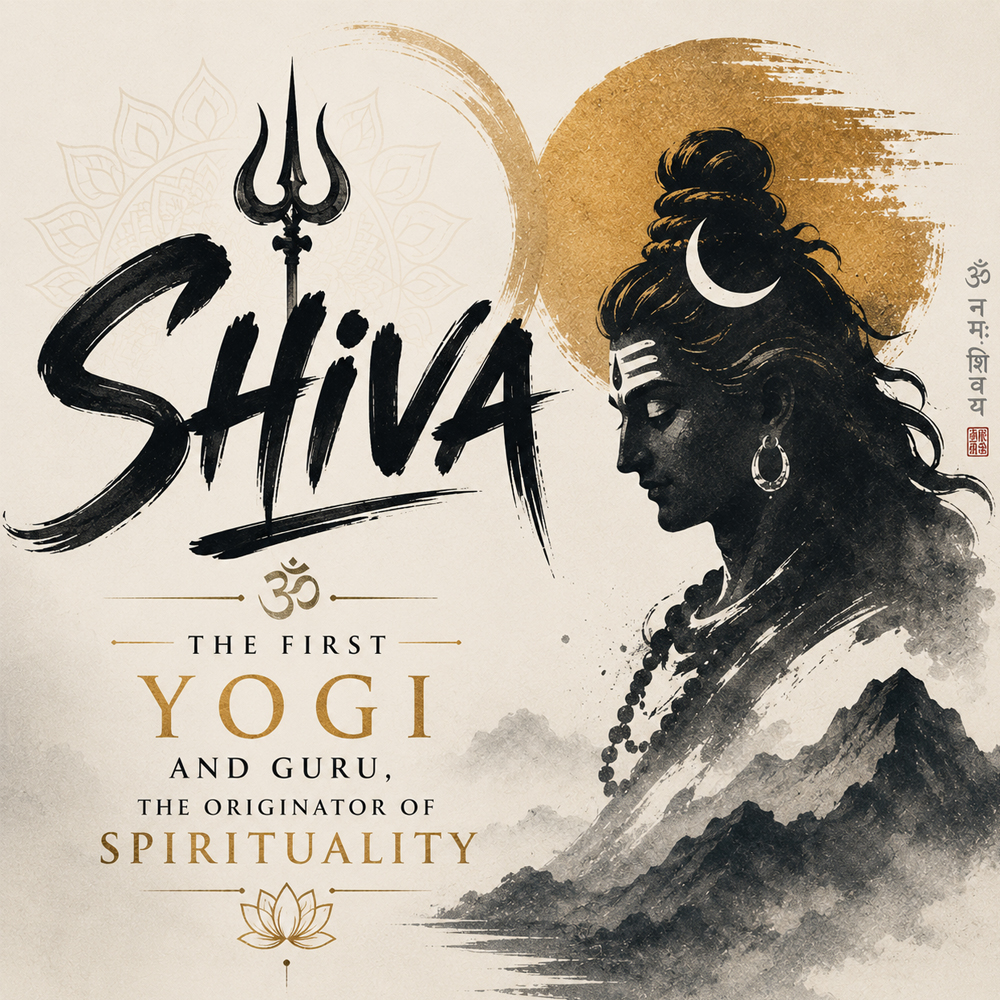
Before words became prayers, before temples raised their towers, and before humanity began to address the infinite by a thousand names, Indian spiritual imagination encountered a presence that no single image could contain. He sits motionless upon snow-covered heights, dances amid the flames of creation, dwells in places from which human beings turn away, and abides in the heart of the deepest contemplation. His name is Shiva: the auspicious one, the gracious one, in whom dissolution and compassion are not opposites but movements of one immeasurable reality.
Shiva belongs to more than one story. He is Mahadeva, the great god; Mahayogi, the great yogi; Nataraja, lord of the dance; Pashupati, lord of living beings; Nilakantha, the blue-throated one who holds the poison; Ardhanarishvara, the unity of masculine and feminine; Bhairava, the fierce freedom beyond boundaries; and Dakshinamurti, the teacher whose silence speaks beyond words. Each name opens a different door into the same vastness.
A particularly compelling interpretation comes from Sadhguru Jaggi Vasudev, the contemporary Indian spiritual teacher and founder of the Isha Foundation. In his discourses, Shiva is not merely a deity to whom requests are addressed. He is Adiyogi, the first yogi, and Adiguru, the first teacher, who revealed the possibility of transcending human limitations. Sadhguru also explains Shiva as ‘that which is not’: not another object among objects, but the boundless dimension in which forms arise and dissolve. This perspective forms a central thread of the present exploration.
To approach Shiva is to travel through Vedic hymns to Rudra, Upanishadic contemplation, Puranic stories, Tamil devotion, Kashmir Shaivism, tantric teachings, Himalayan traditions, and the living practice of yoga. The stories will be told in their spiritual language, without repeatedly interrupting their atmosphere to prescribe how readers must receive them. Where words are attributed to Shiva, the relevant textual or traditional setting will be identified. English renderings of teachings will convey their meaning without claiming to reproduce an exact ancient wording.
Shiva stands at the boundary between everything the human mind can name and the immensity before which names lose their power. Ascetic and husband, solitary meditator and cosmic dancer, stillness and thunder, tenderness and terrifying resolve coexist in him. He does not offer an image comfortably arranged around human expectations. His presence challenges the expectation that reality must fit within familiar categories.
The Name Shiva and the Ancient Layers of an Infinite Presence
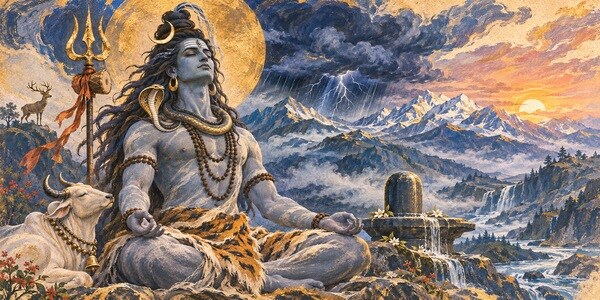
The earliest layers of the Shaiva tradition lead toward the Vedic Rudra, a formidable deity associated with storms, wilderness, disease, and healing. Hymns to Rudra combine reverence with appeals for protection, because the power that can wound can also restore. Fire warms and burns; storms nourish fields and uproot trees; time permits life and carries every form away. The ancient sacred imagination recognized that life’s fundamental powers do not exist merely to satisfy human preference.
In the Shvetashvatara Upanishad, Rudra assumes a profound position as a supreme principle pervading existence. The language moves from invocation toward contemplation of the ultimate ground of being. Later Shaiva traditions develop this vision in different directions. Shiva may be the supreme personal Lord who responds to devotion, the absolute consciousness whose freedom manifests as all phenomena, or a reality in which these two approaches meet without contradiction.
The name Shiva means auspicious, gracious, or beneficent. Yet the auspicious is not always the pleasant. The collapse of illusion may be painful, and freedom from attachment may initially feel like loss. When Shiva is called the destroyer, he is not simply an enemy of life. In Indian cosmological narratives, dissolution is inseparable from transformation. A form passes so that another may emerge; what has become rigid must sometimes be shaken before it can move again.
Sadhguru’s interpretation of Shiva as ‘that which is not’ overturns the habit of imagining divinity as one more being, however powerful. Looking into the night sky, we notice stars, clouds, and light, yet the space that contains them has no shape like an ordinary object. Shiva points toward the boundless dimension that cannot be captured by conventional distinctions. Sadhguru connects this insight with the possibility of moving beyond a narrow sense of individual identity.
Shiva’s iconographic forms are therefore doors rather than prisons. The third eye points toward perception beyond appearances. The crescent moon suggests a relationship with time. Serpents evoke awakened vitality. Ashes recall the destiny of all material forms. The trident and drum bring together stillness, power, and rhythm. Each symbol carries a story, while together they portray freedom from the identities through which people ordinarily define themselves.
Shiva is also worshipped as the lingam, a form that draws attention beyond the details of human representation. Across Shaiva traditions, the lingam can be understood as a sign, an axis of manifestation, a symbol of infinity, and a focus of worship. Sadhguru also approaches it through a yogic vocabulary of energetic form and consecration. Temple devotion and inward practice thus meet around a symbol whose meaning exceeds its visible material.
From the hymns to Rudra to the songs of Tamil saints, Shiva moves between grandeur and intimacy. He is addressed as lord of worlds, then approached as beloved, father, or intimate companion. The Nayanmar poets speak with such immediacy that the distance between the divine and the human seems to dissolve. Shiva becomes not merely a subject of philosophy but a presence to whom longing, gratitude, grief, and love may be offered without reservation.
Adiyogi: The First Yogi and the Transmission of the 112 Ways
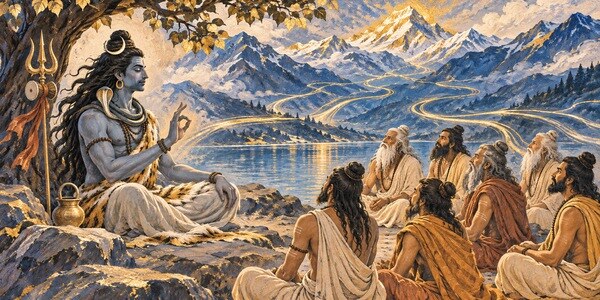
In Sadhguru’s telling, one of the most important stories begins in the Himalayas. Shiva sits in profound stillness, so absorbed in his own state that the world around him seems unable to draw his attention. People gather, attracted by his extraordinary presence. Some expect miracles, others blessings, still others knowledge. Time passes, and Shiva remains motionless. Most eventually leave. Seven seekers continue waiting.
These seekers become known as the Saptarishis, the seven great sages. Their patience is more than ordinary endurance. They wish to discover how a human being may reach a state in which dependence on external circumstances falls away. Shiva does not immediately instruct them. First they must become capable of receiving what he has to offer. Through prolonged preparation, curiosity ripens into discipline and desire into readiness for transformation.
When the moment arrives, Sadhguru recounts, Adiyogi turns south and becomes Adiguru, the first teacher. This south-facing aspect also resonates with the image of Dakshinamurti. The transmission is not merely a set of philosophical statements. It concerns the possibilities of the human system: body, breath, attention, energy, and consciousness can become means of moving beyond limited identity.
Central to this perspective are 112 approaches to the deepest dimension of human existence. Sadhguru associates this heritage with Adiyogi and the vast tradition of yogic knowledge. The Vijnana Bhairava Tantra preserves a celebrated series of 112 contemplative methods in a dialogue between Bhairava and Bhairavi. Attention turns toward breathing, intervals between thoughts, sound, space, sensation, and the sudden disclosure of awareness. The traditions organize and interpret this inheritance in different ways, yet they share an astonishing possibility: ordinary experience itself can become an entrance to the extraordinary.
One instruction in the Vijnana Bhairava tradition invites attention to rest where inhalation changes into exhalation, when the movement of breath becomes briefly still. Its meaning can be expressed: ‘Within the interval between breaths, discover the unmoving presence.’ This is not an invitation to forcefully stop breathing. It is a call to precise awareness of a natural transition usually overlooked. The interval becomes an image of what remains beyond constant activity.
Another approach follows a sound until it fades into silence. Its sense may be rendered: ‘Follow sound to the place where it dissolves.’ The method contains a remarkable reversal. Sound, which ordinarily distracts the mind, becomes a doorway toward the source of hearing. One need not flee the world to turn inward. The decisive factor is not merely what is experienced but the quality of attention brought to it.
Sadhguru emphasizes that Adiyogi did not prescribe one uniform belief for everyone. Human beings differ in temperament, capacity, sensitivity, and inclination. Some turn inward through stillness, others through action, devotion, or knowledge. Yoga is not confined to bodily postures; in his spiritual vocabulary, it is a comprehensive means of inner transformation. Asana, breathwork, concentration, and meditation belong to a wider possibility.
The seven sages carry the knowledge in different directions. In the Adiyogi narrative, their mission is not to construct an empire of doctrine but to make inner transformation available across cultures. Sadhguru invokes the story to emphasize yoga as a human possibility rather than the possession of a single institution. Knowledge travels beyond boundaries without losing its inward purpose.
Adiyogi matters, in this understanding, because he revealed a way. A person can believe in freedom while remaining bound by habitual reactions. One can praise consciousness while being unable to sustain attention for a few moments. The story directs the seeker from admiration toward practice. It is not the spectacular appearance of the teacher that completes the journey, but the willingness to transform one’s own experience.
The long preparation of the Saptarishis is an essential part of the teaching. It reminds us that spiritual possibility does not make discipline unnecessary. To see clearly requires more than wanting clarity. The mind accustomed to distraction must learn steadiness, and the person who seeks an extraordinary state must examine the motives behind that search. Adiyogi stands at the beginning of this demanding freedom.
Kailash: The Mountain of Silence and the Home of Shiva

Far to the north, beyond plains, passes, and high plateaus, rises Mount Kailash, sacred within Hindu, Buddhist, Jain, and Bon traditions. Its austere shape seems both near and unreachable. For devotees of Shiva, it is his dwelling, the landscape of his profound contemplation, and a place where earthly geography becomes a symbol of cosmic stillness.
In stories of Shiva and Parvati, Kailash is both refuge and home. The great yogi abides in meditation while the goddess approaches him with questions concerning existence. From this encounter between silence and enquiry emerge many tantric dialogues. Parvati is not merely a passive listener. She is Shakti, the dynamic power of manifestation, inseparable from the consciousness through which the world is known.
Sadhguru speaks of Kailash with particular reverence, presenting it as a place associated with an immense yogic inheritance. In his spiritual language, the mountain is more than a geographical elevation: it is a repository of experience connected with great practitioners. Approaching it becomes an encounter involving the whole of one’s inner condition rather than merely an accomplishment for a traveler.
The circumambulation of Kailash, called kora or parikrama in different traditions, is physically demanding at high altitude. Pilgrims cross stony valleys, face cold winds, and climb passes where each step requires attention. The journey is not simply about arriving somewhere. Walking, fatigue, vulnerability, and the immensity of the landscape bring the traveler into contact with the limits and possibilities of the body. Spiritually, the pilgrim moves around a center that remains still.
Nearby Lake Manasarovar bears a name associated with the mind. Water becomes an image of reflection, depth, and purity. When its surface is quiet, it mirrors the sky. In contemplative language, the mind is likewise compared to a lake whose clarity emerges when agitation subsides. The landscape around Kailash becomes a natural vocabulary for inner practice.
Stories set on Kailash unite extreme asceticism with the closeness of family life. Shiva can remain in samadhi beyond the ordinary measure of time, yet he is also Parvati’s husband and the father of Ganesha and Kartikeya. Love, domestic life, conflict, reconciliation, and meditation inhabit the same sacred landscape. The spiritual and the earthly are not permanently divided into incompatible worlds.
For Sadhguru, the pilgrim’s receptivity matters. Merely arriving at a sacred site does not replace inner preparation. Someone seeking only an impressive experience may overlook what the journey offers. Someone who approaches with discipline and openness may discover another dimension in the same path. External conditions can support transformation, but they do not undertake it on a person’s behalf.
Sati, Parvati, and the Love That Passes Through Death

Among the great stories of Shiva, the story of Sati occupies a special place. She is the daughter of Daksha, a powerful patriarch devoted to established order, ritual prestige, and social standing. Sati chooses Shiva, the ash-covered ascetic who lives among wild places and refuses conventional signs of royal grandeur. Her choice confronts two understandings of worth: one grounded in rank and appearance, the other recognizing greatness beyond them.
Daksha organizes a grand sacrifice without granting Shiva the respect due to him. In several versions, Shiva is not invited at all. Sati arrives and faces the insult directed toward her husband. Her anguish becomes a turning point: she leaves her body through the fire of yogic power. The scene brings devotion, pride, familial conflict, and the refusal to submit love to contempt into a single dramatic moment.
When Shiva learns of Sati’s death, his cosmic stillness becomes a terrible force. Virabhadra emerges and destroys Daksha’s sacrifice. In different versions Daksha is beheaded and later restored with the head of a goat. The story does not end with punishment alone. Order is eventually re-established after arrogance and devastation. Shiva’s power can be fearsome, yet its movement is not exhausted by wrath.
In another strand of the story, Shiva carries Sati’s body in overwhelming grief while the worlds tremble. Vishnu intervenes, and the parts of her body become associated with the sacred Shakti Pithas, centers of devotion to the Goddess. Love, loss, and sacred geography become inseparable. The presence of Shakti spreads through the earth, turning the landscape itself into a remembrance of the divine feminine.
Sati is reborn as Parvati, daughter of Himalaya and Mena. Her destiny leads once again toward Shiva, who is absorbed in meditation. Parvati does not seek him through outward splendor. She undertakes prolonged austerity, transforming desire into unwavering inner strength. Love here becomes more than attraction: it is the capacity to remake one’s own being.
Kama, the god of desire, is sent to awaken Shiva. When the arrow of desire reaches him, Shiva opens his third eye and Kama is consumed by fire. The story distinguishes love from the compulsion of desire. Kama attempts to force a response from outside; Parvati approaches through inner discipline. In later versions Kama continues as Ananga, the bodiless one, suggesting that desire changes its mode of existence rather than simply disappearing from the world.
The union of Shiva and Parvati is more than a divine wedding. It expresses the meeting of still consciousness and creative energy. In Shaiva and Shakta thought, Shiva and Shakti are inseparable: without Shakti, consciousness does not unfold as dynamic manifestation; without Shiva, energy lacks its foundation in awareness. Their love story is therefore also a philosophical vision of the universe.
Sadhguru often presents Shiva as one who refuses conventional social categories. He is an ascetic and a husband, beyond the world yet intimately present within it. His union with Parvati reveals that spiritual stillness need not be opposed to love. The great yogi does not cease to be a yogi when he embraces relationship, nor does meditation cancel his connection with life.
Ganesha, Kartikeya, and the Mysterious Divine Household
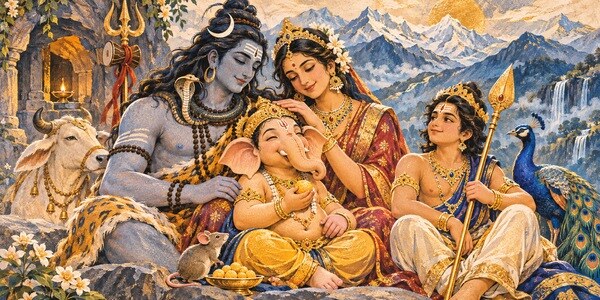
The story of Ganesha begins when Parvati creates a boy and instructs him to guard the entrance while she bathes. Shiva returns, but the boy refuses him entry, faithfully obeying his mother’s command. Neither yields. Shiva severs the guardian’s head, and Parvati’s grief shakes the worlds. To restore the child’s life, Shiva gives him the head of an elephant and acknowledges him as his son.
Ganesha becomes lord of beginnings and remover of obstacles. His elephant head, large ears, rounded body, and tiny mouse form an intricate language of symbols. The elephant suggests power and memory, the ears attentive listening, and the mouse the ability to enter the smallest spaces. Vastness and minuteness, gravity and agility, grandeur and simplicity coexist in one beloved form.
The story also explores the tension between duty and understanding. The boy obeys without knowing whom he confronts. Shiva acts with the authority of one who will not accept obstruction. Parvati insists that life and relationship be restored. The story does not leave the world in ruin. It culminates in a new order in which Ganesha receives the blessing of being honored at the beginning of countless undertakings.
Shiva and Parvati’s other son, Kartikeya, also called Skanda, Murugan, and Subrahmanya, embodies another kind of power. He is the youthful warrior and leader of divine forces, especially beloved in South India. His spear, the vel, symbolizes penetrating clarity that overcomes confusion. Where Ganesha stands at the threshold and clears obstacles, Kartikeya evokes discernment and decisive movement.
One well-known story tells how the brothers are challenged to circle the world. Kartikeya sets out swiftly upon his peacock. Ganesha circles his parents and declares that, for him, they are the whole world. Versions of the story emphasize wisdom, devotion, and the relationship between outward travel and inward understanding. Sometimes the greatest distance is crossed not through speed but through a change of vision.
Shiva’s household offers no conventional image of harmony through sameness. The father wears serpents, the mother embodies Shakti, one son has an elephant’s head, the other is a warrior, and their animal companions belong to strikingly different worlds. Yet they form a whole. Their differences need not be erased in order for them to belong together. The unusual divine family becomes an image of coexistence without uniformity.
Nilakantha: The Ocean’s Poison and the Compassion That Holds Destruction
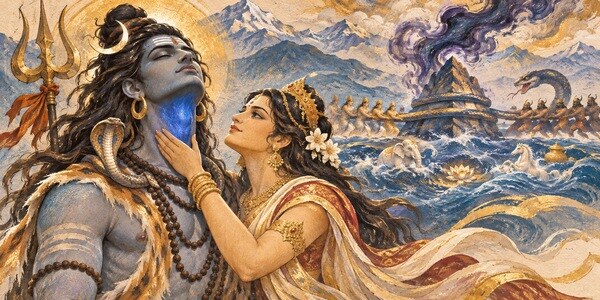
One of Shiva’s most powerful stories unfolds during the churning of the Ocean of Milk, Samudra Manthana. Gods and asuras join forces to obtain amrita, the nectar of immortality. Mount Mandara serves as the churning axis and the serpent Vasuki as the rope. Extraordinary beings and treasures emerge from the depths. But before the desired nectar appears, a deadly poison called halahala rises and threatens the worlds.
The poison spreads, and no one can contain it. The beings turn toward Shiva. He accepts the poison and drinks it, while Parvati holds it within his throat so that it does not pass farther into his body. His throat turns blue, and he becomes Nilakantha, the blue-throated one. The blue mark remains as a visible remembrance of the danger he has contained.
Shiva does not reach first for the nectar promising immortality. When danger emerges, he takes what everyone else fears. Compassion here is not a sentimental feeling but the willingness to stand before destructive force without transferring it to others. The poison does not become sweetness. It remains poison, held where it cannot engulf the world.
The throat has rich symbolic associations. It is the place of voice and expression, a passage between inward and outward. In the yogic chakra system, the throat region is associated with Vishuddhi, a name suggesting purification. Nilakantha thus becomes an image of the capacity to meet toxic forces without allowing them to define one’s innermost being.
In Sadhguru‘s perspective, Shiva does not choose only the pleasant dimensions of existence. He inhabits cremation grounds, wears ash, and accepts poison. His presence suggests freedom from the habitual cycle of attraction and aversion. People often organize life around avoiding what hurts and pursuing what delights. Shiva can face what others flee because his being is not governed by that automatic dependence.
The churning of the ocean also offers an image of spiritual practice. When the depths are stirred, poison may emerge before nectar. Attention directed inward can reveal fear, anger, envy, or sorrow that had long been concealed. The path toward clarity does not always begin with comfort. Nilakantha embodies the capacity to remain present when the depths reveal their weight.
Nataraja: The Dance in Which Worlds Arise and Dissolve
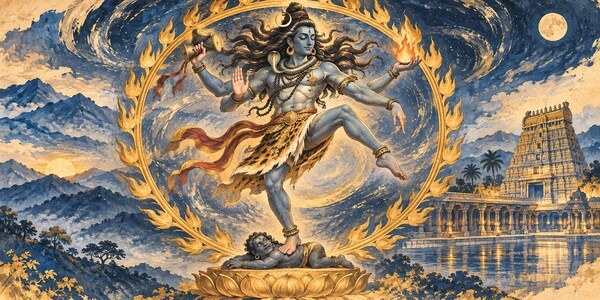
Among Shiva’s images, Nataraja, lord of the dance, is one of the most compelling. He dances within a circle of flames, one foot lifted, arms extended, hair streaming through the cosmic rhythm. One hand holds the small damaru drum, another fire. A palm offers fearlessness, while another gesture directs attention toward liberation. Beneath his foot lies Apasmara, associated with ignorance and forgetfulness. Every detail participates in a philosophical vision expressed through movement.
The drum evokes the rhythm of manifestation. Sound gives rise to sequence, and sequence allows forms to emerge. Fire recalls the transience of every form and the transforming power of dissolution. The circle of flames embraces the cosmic process. The lifted foot suggests liberation, while the foot resting on Apasmara indicates that ignorance no longer governs the dancer. Creation, preservation, dissolution, concealment, and grace meet in one figure.
Nataraja is especially associated with Chidambaram, the great temple center in Tamil Nadu. There Shiva’s dance occupies a central place in ritual and philosophy. The name Chidambaram is associated with the space of consciousness. The visible dance and the mystery of space complement each other. Movement directs the seeker toward its invisible ground, and the rhythm of the world toward the stillness that contains it.
Shiva’s dance is not chaotic destruction. It is a rhythm in which beginning and ending cannot be permanently separated. Seasons, breathing, birth, death, growth, and decay belong to an uninterrupted movement. Nataraja does not merely watch this process from a distance; he embodies it. Yet his face remains composed, as though the most intense motion arises from unchanging inward stillness.
This is one of Shiva’s deepest conjunctions: absolute silence and absolute dance. In Sadhguru’s understanding, yoga opens a dimension not dependent on the mind’s ceaseless activity. That does not mean life must stop. When action is no longer torn apart by inner compulsion, it can become more complete. Nataraja reveals movement without inner fragmentation, energy that never loses its center.
The image has fascinated thinkers and artists far beyond its religious setting. Its enduring power lies in expressing an intricate understanding of existence through a single form. Yet the deepest meaning remains within its spiritual context. The dance is not simply a metaphor for physical motion; it is a vision of existence as the continuous manifestation of power and consciousness.
The Third Eye, Ganga, the Crescent Moon, Serpents, and Ashes
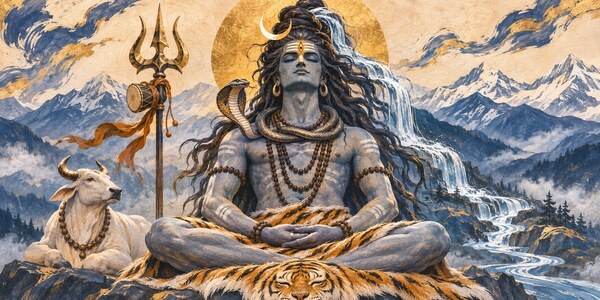
Shiva’s third eye is a powerful symbol of spiritual insight. The two ordinary eyes perceive distinctions: near and far, beautiful and ugly, desirable and undesirable. The third eye points toward perception beyond these immediate divisions. When Shiva opens it, the fire of insight consumes what cannot endure its clarity. In the story of Kama, that fire burns the compulsion of desire; more broadly, it dissolves the ignorance that confines consciousness to limited definitions.
Sadhguru uses the third eye to speak about a dimension of perception that is not exhausted by the five senses and intellectual analysis. Yoga, in his teaching, seeks to make deeper inward perception possible. The third eye is not a promise of theatrical powers or another physical organ. It is a symbol of a transformation in the way reality is experienced.
When the celestial Ganga descends toward earth, her force is so immense that it would devastate the world. Shiva receives the river in his matted hair and releases her gradually. Thus the heavenly waters reach the earth without destroying it. The story unites tremendous power with restraint. Shiva neither prevents the river from flowing nor permits its force to fall unchecked. He transforms an overwhelming descent into a life-giving current.
The crescent moon upon Shiva’s head is associated with time, rhythm, and cycles. The moon waxes and wanes while Shiva abides beyond the changes it measures. The image does not deny time. It reveals a relationship with time in which consciousness is not entirely captured by age, duration, and passing events. The moon becomes an ornament rather than a master.
The serpents surrounding Shiva evoke vitality, danger, renewal, and awakening. A snake sheds its skin and naturally becomes an image of transformation. In yogic traditions, serpentine energy is often associated with kundalini. Shiva does not recoil from the creatures that others fear. They rest beside him, suggesting a freedom from automatic aversion and an intimacy with life’s formidable powers.
The trident, trishula, is associated with threefold structures of existence: past, present, and future; creation, preservation, and dissolution; or the qualities of nature. Different schools unfold these associations in their own ways. The underlying image is of a power that penetrates multiplicity without becoming imprisoned by it. The trident is more than a weapon; it is a sign of mastery over the divisions by which the mind ordinarily organizes experience.
Ash, vibhuti, covers Shiva’s body and recalls the final destiny of material forms. Beauty, wealth, authority, and youth cannot escape time. At the cremation ground, outward distinctions lose their final claim. Shiva wears ash as a remembrance of freedom from forgetting death. Sadhguru frequently connects awareness of mortality with living more intensely and responsibly. When the body’s impermanence is clearly seen, small anxieties may lose some of their authority.
The tiger skin evokes mastery over untamed instinct; the damaru carries the rhythm of manifestation; and Nandi, Shiva’s bull, embodies strength, devotion, and unwavering attention. Each symbol has a distinct history, yet its full force appears within the whole. Shiva’s ornaments come from mountains, forests, animals, death, time, and the cosmos. Existence itself becomes his language.
Ardhanarishvara: Shiva and Shakti as One Indivisible Whole
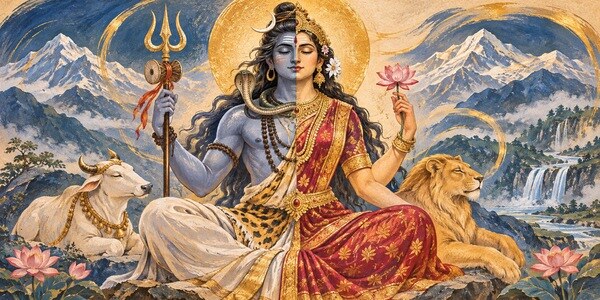
Ardhanarishvara is one of Shiva’s most extraordinary forms: one half of the body is masculine, the other feminine. Shiva and Parvati do not stand opposite each other as separate figures; they form one being. The image speaks of unity without erasing difference. Each half retains its distinctive signs, yet the form cannot be divided without destroying its wholeness.
In many tantric and Shaiva teachings, Shiva signifies the still principle of consciousness and Shakti the dynamic power of manifestation. Yet they are not two independent substances. Without awareness, movement lacks its experienced ground; without power, consciousness does not unfold as the manifold world. Ardhanarishvara makes this philosophical insight visible. Absolute silence and living creative energy need not be set against each other.
Sadhguru often draws on Ardhanarishvara to discuss inner wholeness beyond narrow social assumptions about masculinity and femininity. In his interpretation, these qualities concern dimensions of human energy and perception, not merely biological categories. The goal is not to impose a single model upon everyone, but to move beyond fragmentation and experience one’s existence more completely.
The story of the sage Bhringi expresses the idea dramatically. Bhringi wishes to worship only Shiva and refuses to circle Parvati. When Shiva and Parvati appear as one body, he attempts to pass between them to preserve his separation. The narrative exposes the impossibility of accepting still consciousness while rejecting the power through which life manifests. Spiritual wholeness cannot be reached by denying half of existence.
Ardhanarishvara also illuminates love in the stories of Shiva and Parvati. Their union is not simply a compromise between two personalities. It is an image of mutual interpenetration in which closeness does not demand the loss of one’s nature. Unity makes diversity possible. Love becomes not possession of another, but an expansion beyond the boundaries within which one habitually confines oneself.
In practice, the symbol suggests integrating apparently opposite capacities: stillness and action, clarity and sensitivity, resolve and receptivity, discipline and tenderness. People often cultivate one side at the expense of another. Ardhanarishvara reminds us that inner growth is not always greater specialization. Sometimes it is the capacity to contain the richness of one’s nature without breaking into hostile fragments.
Bhairava, Tantra, and the Mysteries of Immediate Awareness
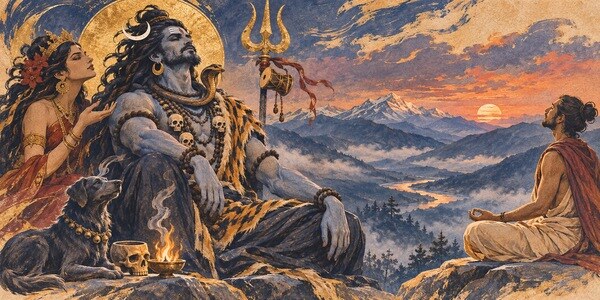
Bhairava is a fierce form of Shiva leading the spiritual imagination beyond familiar images of calm. Time, death, freedom, and indestructible presence meet in him. His name evokes awe, but the trembling he inspires is not merely fear of an external danger. It is the encounter with what exceeds the boundaries of the ordinary ‘I.’ Bhairava stands where customary categories cease to offer security.
In the Vijnana Bhairava Tantra, Bhairavi asks about ultimate reality and the ways of knowing it directly. Bhairava answers through contemplative approaches rather than philosophical definitions alone. Breath, sound, space, emptiness, joy, and astonishment may become starting points. Tantra here is not reducible to a popular association with sexuality. It belongs to a broad inheritance of methods, symbols, ritual disciplines, and inner practices that differ among traditions.
One instruction draws attention to the space between thoughts. When one thought has passed and another has not yet appeared, a brief interval remains without the usual mental content. The teaching’s sense may be expressed: ‘Recognize what shines in the interval.’ Thoughts need not be hated or violently suppressed. Attention learns to notice not only what appears, but the openness in which it appears.
Another approach makes use of wonder. A vast sky, a deep sound, or an unexpected encounter can interrupt habitual thinking and disclose a moment of uncontrived attention. Within the tantric perspective, that moment may become a contemplative doorway. The world is not necessarily an obstacle. The obstacle is the automatic habit of turning every experience into a familiar story.
Kashmir Shaivism develops an exceptionally rich philosophy of consciousness. Its schools speak of Paramashiva, the freedom of consciousness, recognition or pratyabhijna, and the dynamic power of manifestation. The opening aphorism of the Shiva Sutras, traditionally associated with Vasugupta, is commonly rendered ‘Consciousness is the Self.’ Here ‘Self’ does not refer to the ordinary social personality, but to the fundamental awareness through which experience is possible.
A central theme is svatantrya, the freedom of absolute consciousness. The world is understood not merely as a mechanical consequence of external causes, but as a manifestation of boundless creative power. Philosophical schools explain this through intricate categories, yet the contemplative impulse remains direct: one may recognize a nature deeper than the isolated personality.
In Sadhguru’s perspective, tantric and yogic methods call for preparation, precision, and responsibility. Inner practice is not a collection of unusual sensations gathered for entertainment. It engages attention, habits, breathing, and the structure of experience. Certain practices, he emphasizes, require appropriate transmission. Knowledge involves not only content but the manner in which it is received and embodied.
Bhairava reminds the seeker that spiritual life does not always look comforting. To face fear, mortality, and attachment may unsettle cherished self-images. But the dissolution of illusion is not the destruction of the human being. Shiva’s fierce face becomes a doorway to freedom because it refuses to let awareness remain confined to the pursuit of pleasant experiences alone.
Mahakala, the Cremation Grounds, and Freedom Beyond the Fear of Death
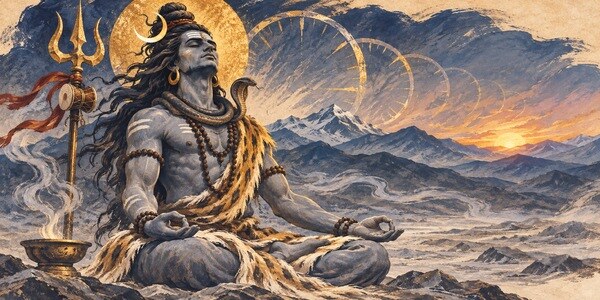
Shiva is Mahakala, the great time before which every measure of duration loses its final authority. People measure their lives in years, accomplishments, losses, and expectations. Yet time, which permits each experience, also carries every form away. Mahakala embodies this immensity. He does not belong to the clock; he belongs to the impermanence that the clock merely marks.
One of the best-known temples of Mahakaleshwar stands in Ujjain, an ancient city with a rich religious and astronomical history. Shiva is worshipped there as lord of time. Ritual and pilgrimage bring personal concerns into contact with a cosmic perspective. Visitors arrive with particular hopes and anxieties, but the name Mahakala points toward something larger than any individual biography.
The cremation grounds associated with Shiva are places that ordinarily provoke fear and aversion. There, social prestige, bodily beauty, and possessions lose their authority. Shiva dwells precisely where human impermanence becomes impossible to overlook. This is not contempt for life. It is the refusal to make forgetfulness of death a condition for happiness. When the body’s finitude is acknowledged, daily existence can acquire greater clarity.
Sadhguru often speaks of awareness of mortality as a means of awakening attention. People postpone important things as though time were inexhaustible: forgiveness, care, discipline, love, and inward enquiry. When life’s finitude becomes immediate, priorities can change. Mahakala does not diminish the value of time. He reveals the importance of what we do while living.
In certain Shaiva traditions, ascetics use ash and meditate near cremation grounds. These practices belong to particular religious communities with their own rules and symbolism. Their deeper purpose is not to seek shocking appearances but to face directly what ordinary life tends to hide. Ash says that every form is temporary; contemplation asks how to live when one no longer attempts to forget that fact.
Mahakala expresses one of Shiva’s defining freedoms: he does not require the reassurance of the familiar. He may appear amid mountain snow, at the cremation ground, in a temple, or in the silence of meditation. No place finally defines him. For a person accustomed to controlling external conditions, this becomes a demanding question: must inner steadiness always depend on the world being arranged according to one’s wishes?
Shiva and His Devotees: Markandeya, Ravana, and the Power of Devotion
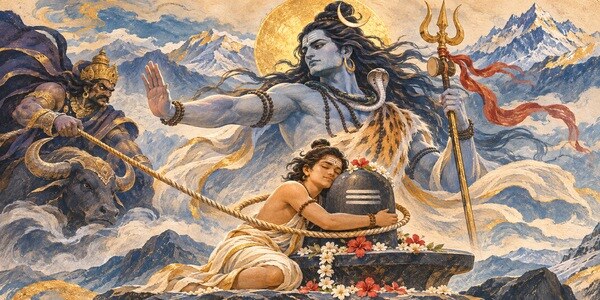
The story of Markandeya is among the most tender and powerful accounts of Shiva’s protection. The young devotee is destined to die at a particular age, yet dedicates his life to Shiva. When Yama, lord of death, arrives, Markandeya embraces the Shiva lingam and refuses to abandon his devotion. Yama’s noose encircles the lingam as well, and Shiva appears to protect his devotee.
In different versions Shiva defeats or restrains Yama and grants Markandeya an extraordinary extension of life or an enduring blessing. The story is more than an escape from death. It presents devotion as the capacity to hold fast to one’s deepest center when outward supports collapse. Markandeya does not prevail through physical strength. His power is the completeness of his turning toward Shiva.
Another account presents Ravana, the mighty ruler of Lanka, as an ardent devotee of Shiva. Ravana possesses immense strength, learning, and pride. When he attempts to lift Mount Kailash, Shiva presses it down with a toe, trapping the king beneath its weight. Ravana then begins to praise Shiva with such intensity that pride gives way to devotion. The famous Shiva Tandava Stotram is traditionally attributed to Ravana.
The episode explores the relationship between power and humility. Ravana is not weak or incapable. His extraordinary abilities have become grounds for self-forgetfulness. Kailash reveals a boundary that cannot be crossed by force. When an attempt at conquest becomes a hymn, his energy finds a different direction. Shiva is not moved by a display of dominance, but the character of the encounter changes through devotion.
Many Shaiva saints and poets speak of intimate encounters with Shiva. The Tamil Nayanmars praise him in songs of longing, closeness, and sometimes painful separation. Their stories include kings, workers, women, ascetics, and people from diverse social positions. This breadth matters: Shiva is not confined to scholars or possessors of ritual authority. Devotion may emerge in widely different human lives.
Especially memorable is Kannappa Nayanar, a hunter whose devotion does not follow refined temple conventions. He offers what he has and cares for the lingam in a direct, unconventional manner. When he sees one eye of the sacred image bleeding, he offers his own eye, then prepares to give the other. Shiva stops him and reveals his blessing. The story places the heart of devotion above outward perfection of ritual performance.
These narratives repeatedly show Shiva recognizing what society may fail to see. He receives the hunter’s devotion, humbles a powerful king, and protects a young worshipper before death. The common movement is clear: spiritual closeness is not measured solely by status, wealth, education, or impeccable outward conduct. It is expressed through the intensity and wholeness of one’s relationship.
Shiva in Living Practice: Mahashivaratri, Mantra, and Inner Discipline
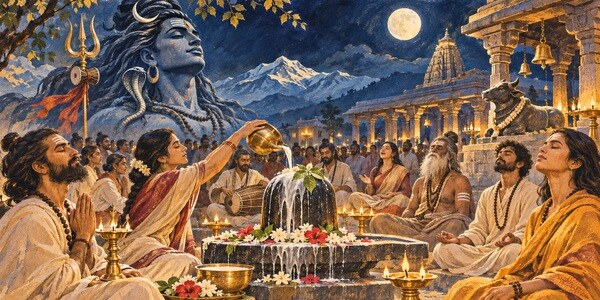
Mahashivaratri, the great night of Shiva, is among the most important celebrations in the Shaiva calendar. It is marked by vigil, prayer, chanting, worship of the lingam, and spiritual practice. Night carries a special symbolism. As the outer world grows dark, attention may turn toward what does not depend on the light illuminating objects. The festival becomes an opportunity for conscious stillness.
Sadhguru gives Mahashivaratri a prominent place in his contemporary spiritual work. At the Isha center, the night is marked by large gatherings, music, meditation, and wakefulness. He presents it as an auspicious occasion for inner elevation and encourages conscious uprightness and attention. Within his interpretation, the festival is connected to Adiyogi and the possibility of using particular conditions for deeper practice.
One of the most widespread Shaiva mantras is ‘Om Namah Shivaya.’ The five syllables of ‘Namah Shivaya’ hold an important place in tradition and are associated with the five elements and different dimensions of Shiva. The mantra is simultaneously sound, prayer, and a means of gathering attention. It may be voiced, whispered, or repeated inwardly according to the practice. Its significance comes not only from verbal meaning but from the steadiness with which attention returns to it.
‘Namah’ conveys bowing or offering oneself. In Shaiva devotion, this need not mean mere submission to an external authority. It may be understood as the loosening of the self-importance that places the individual ego at the center of everything. Repeating ‘Om Namah Shivaya’ turns attention toward a presence that exceeds personal desire. Sound becomes a rhythm through which scattered awareness gradually gathers.
Shiva is also honored through abhisheka, the ritual bathing of the lingam with water, milk, and other offerings according to local traditions. Water flows across stone while mantras are spoken and flowers or bilva leaves are offered. The outward gesture is simple yet symbolically rich: purification, offering, constancy, and return to the center. Body, voice, and attention participate together.
Sadhguru’s yogic perspective suggests that outward worship and inner practice need not be opposed. One may honor Shiva as a deity while exploring one’s own capacities through yoga. Yet when ritual becomes mechanical, it loses some of its transforming force. When meditation becomes a means of acquiring prestige, it too moves away from its purpose. The quality of participation is decisive.
Shaiva practice takes diverse regional forms. Kashmir nurtured philosophies of recognition, Tamil Nadu developed a remarkable poetry of devotion, North India preserves ancient pilgrimage centers, and ascetic communities maintain their own disciplines. This variety does not diminish Shiva. It reveals how different human temperaments may approach the same name through different doors.
Shiva as an Inner Possibility: The Freedom That Cannot Be Given
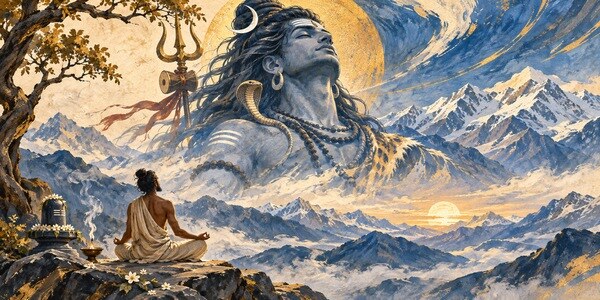
When Sadhguru speaks of Shiva as Adiyogi, he repeatedly turns attention from the external image toward human possibility. Admiring the great yogi is one thing; beginning to transform one’s habits is another. A person may know countless stories, recognize every symbol, and visit sacred sites while remaining governed by fear, anger, and the need for approval. In this sense, the story of Adiyogi does not end when it is told. It begins anew whenever someone undertakes the examination of their own experience.
A crucial distinction is that between information and transformation. Information can be collected, memorized, and repeated. Transformation requires seeing how attention functions, how reactions arise, and what sustains the feeling of separateness. Sadhguru presents yoga as a set of inner tools demanding practice rather than intellectual agreement alone. Shiva as Adiguru is the image of a teacher who does not wish the student to remain forever dependent upon his words, but to become capable of direct knowing.
Freedom in this setting is not merely the ability to do whatever comes to mind. Someone unable to release their own irritation is hardly free, however many outward choices they possess. If desire dictates every action, choice remains constrained. If fear determines every step, external security cannot provide inner independence. Yogic freedom is the possibility of no longer being entirely governed by automatic movements.
Shiva as ascetic reveals that inner fullness need not depend on possessions. Shiva as husband reveals that closeness need not obstruct spiritual life. Shiva as Nataraja shows that movement does not exclude stillness. Shiva as Nilakantha shows that compassion may require meeting the unpleasant. Shiva as Mahakala reveals that mortality need not be banished from awareness. Each form opens a different question, and all point beyond narrow definitions of ‘I.’
Sadhguru also describes the human system as an extraordinarily intricate instrument. Body, mind, emotions, and energy need not be enemies of spiritual development. They can become its means when understood and engaged attentively. This differs from the idea that liberation demands hatred of the body or suppression of vitality. Shiva is both the deepest yogi and the lord of the cosmic dance. He represents not lifeless immobility but inexhaustible possibility.
That helps explain why Shiva continues to draw people of different beliefs. Some honor him through prayer and ritual. Others approach him through meditation and philosophical enquiry. Still others find in his stories a language for fear and freedom, love and loss, time and eternity. These approaches need not be forcibly reduced to one. Shiva remains an image vast enough to hold many ways of approaching the sacred.
At the heart of Sadhguru’s interpretation lies the conviction that spirituality should not remain merely a consoling idea. Adiyogi is associated with the practical possibility of inner growth. Human beings need not remain permanently confined within their present experience of themselves. Yet this is not a promise of effortless change. The story of the Saptarishis begins with long preparation and discipline. The deepest habits do not dissolve through wishing alone.
And when the stories have been told-of Sati and Parvati, the ocean’s poison, Ganesha, Nataraja’s dance, the third eye, Kailash, and the seven sages-one remarkable impression remains. Shiva never fits entirely into the image just encountered. As soon as he appears as an ascetic, he becomes a husband. As soon as he appears as a destroyer, he saves the worlds. As soon as he becomes motionless silence, he begins to dance. As soon as he seems distant as a snowy summit, he becomes a question concerning the most immediate human experience.
Perhaps that is why his name continues to sound across Himalayan passes, temple courtyards, nocturnal chants, and the silence of meditation. Not because everyone has found one final formula for him, but because different paths repeatedly meet before something inexhaustible. Shiva is the mountain and the space around it, the dance and the stillness, the fire and the ash, love and freedom. In the perspective of Adiyogi, the deepest invitation is not merely to look toward this image, but to discover what within oneself can become quiet, clear, and vast enough to meet it.
Author: Vasil Stoyanov