
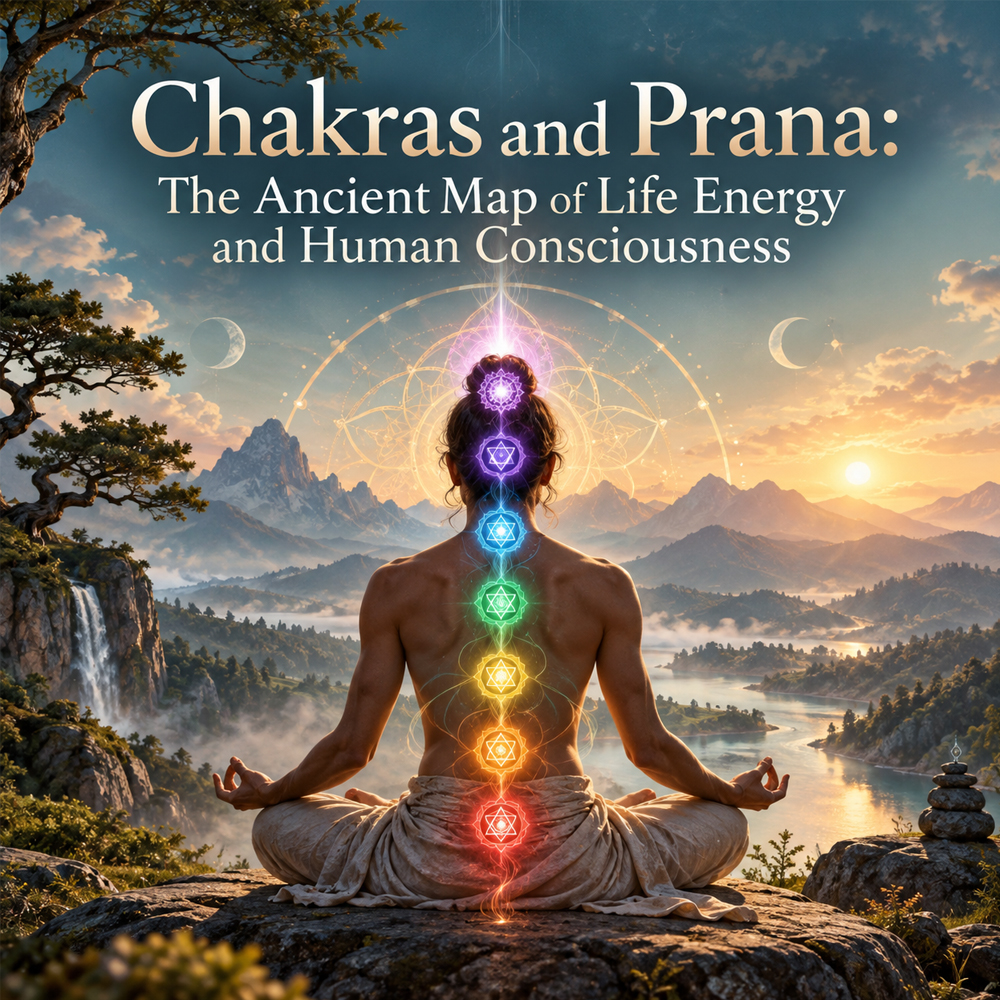
When we hear the word “chakra” today, we probably imagine seven colorful energy centers arranged along the human body. This image has become so popular in modern spiritual culture that it sometimes seems as though the chakra system has always existed in exactly this form. In reality, the Indian traditions present a much more complex, diverse, and philosophically profound picture in which the chakras cannot be understood separately from prana, the nadis, the breath, the mind, and consciousness itself.
Prana is one of the central ideas in Indian philosophy and the yogic tradition. The word is often translated as “life energy,” but such a translation is only approximate because the concept carries many meanings in different texts and schools. Prana is associated with life, breathing, and vital activity, while in yogic physiology its movement is part of the process through which the body, the senses, and the mind function as a unified whole.
The chakras, in turn, can be understood as important nodal points within this subtle map of the human being. They are not organs in the ordinary anatomical sense, and traditional teachings do not simply describe them as invisible “balls of energy.” In different Tantric and yogic systems, the chakras are associated with symbols, mantras, deities, elements, psychological states, and practices through which consciousness is gradually transformed.
To understand what the chakras truly mean, we first need to set aside some of the modern assumptions surrounding them. Their history is far more interesting than the popular diagram of seven rainbow-colored centers. It takes us into the ancient Upanishads, the development of yoga and Tantra, the concept of the subtle body, and one of the most mysterious images in Indian spirituality – the sleeping Kundalini, which, according to certain traditions, can rise through the central channel of the human being.
What Is Prana?
The Sanskrit word “prāṇa” comes from a root associated with breathing and vital movement. In the broadest sense, prana refers to the principle of life without which a living body ceases to be alive. This is why the relationship between prana and breath is so strong, even though traditional philosophy does not always treat the two as completely identical.
It is easy to understand why ancient cultures connected breathing with life. A person may survive for days without food and for some time without water, but the interruption of breathing very quickly places life in danger. At birth, one of the clearest signs of independent life is the first breath, while at death the cessation of breathing is one of the most obvious indications that life has left the body.
In Indian thought, however, prana gradually acquired a meaning that went far beyond the physical air entering and leaving the lungs. It became a principle through which vital functions and the interaction between the physical body, the senses, and the mind could be described. In some philosophical contexts, prana even takes on a cosmic dimension, because individual life is understood as part of a greater universal process.
An important distinction must be made here. Prana is not a scientifically established physical form of energy in the sense in which physics uses the word “energy.” No scientific measurement has demonstrated prana as a separate substance or force flowing through invisible channels in the human body.
This, however, does not make the concept meaningless. It belongs to a particular philosophical and contemplative map of human experience that developed within Indian traditions. If we want to understand it accurately, we must study it in its own context rather than automatically turning traditional concepts into pseudoscientific claims.
Prana in the Ancient Indian Texts
Ideas about prana are much older than many of the teachings about the seven chakras that are popular today. In the Upanishads, prana already occupies an extremely important place and is sometimes presented as the vital principle upon which the other functions of the human being depend. These texts often use dialogues, metaphors, and philosophical stories to reveal the fundamental significance of the life breath.
One characteristic idea is that the different faculties of the human being may argue over which of them is the most important. Sight, hearing, speech, mind, and the vital breath can symbolically be presented as separate powers. When prana prepares to leave, the others realize that their own functioning depends upon it.
Such stories should not necessarily be read as primitive physiology. They are philosophical ways of asking what truly makes a body alive and how many different functions form a single living organism. Prana becomes a conceptual bridge connecting breathing, vitality, sensory activity, and conscious life.
With the development of yogic and Tantric traditions, this idea became increasingly detailed. Prana began to be understood not simply as a single force but as a vital movement with different functions and directions. It is within this later context that the complex system of pranas, nadis, chakras, bindu, mantras, and Kundalini gradually took shape.
The Five Main Movements of the Vital Force
In classical descriptions, vital activity is often divided into five principal functions known as the five pranas or the five “winds.” This does not necessarily mean that five separate substances exist inside the human being. Rather, the same vital activity is viewed according to the ways in which it manifests through different processes.
Prana, in the narrower sense of the word, is mainly associated with the chest and with breathing processes. Apana is connected with downward movement, elimination, and functions in the lower part of the body. Samana is linked to the central region and to transformation and assimilation, while udana is described as an upward-moving force and vyana as a force spreading throughout the entire organism.
These categories show how different the traditional yogic map is from modern anatomy. It organizes human functions according to directions, qualities, and experiences rather than according to cells, nerves, organs, and biochemical mechanisms. It is a phenomenological and symbolic system rather than a precursor of modern medicine in the strict sense.
Even so, such a map has practical importance in yoga. The practitioner observes breathing, tension, the movement of the abdomen and chest, attention, and the psychological changes that arise during different exercises. In this way, the language of prana provides a framework through which these experiences can be organized within a unified spiritual discipline.
What Is the Subtle Body?
To understand the chakras, we first need to understand the idea of the subtle body. In many Indian traditions, the human being is not reduced solely to the visible physical body. Different models are used by philosophers and practitioners to describe various layers of human existence, and the terminology and number of these layers can differ considerably.
The subtle body should not automatically be understood as a second transparent physical body that could be detected by a medical scanner. It belongs to a traditional map through which vital, psychological, and contemplative processes are described. Within this model appear concepts such as prana, nadis, and chakras.
This is where one of the most common errors of modern interpretation arises. Chakras are sometimes searched for literally in the endocrine glands, while the nadis are identified with the nervous system. Metaphorical comparisons can be made between these systems, but there is not enough evidence to claim that ancient authors were simply describing the pituitary gland, the vagus nerve, or nerve plexuses in different words.
The traditional model follows its own internal logic. Within it, the body is simultaneously a place of physical life, psychological activity, symbolic transformation, and spiritual practice. This is why a chakra can be described at the same time through a bodily location, a geometric form, a sound, a deity, an element, and a particular state of consciousness.
What Are the Nadis?
If prana is the vital movement, the nadis are the channels through which this movement is described within the subtle body. The Sanskrit term “nāḍī” carries meanings connected with a tube, channel, or stream. Yogic texts refer to different numbers of these channels, once again showing that there is no single universal system shared in exactly the same way by all traditions.
Among the great number of nadis, three gradually came to hold special importance: Ida, Pingala, and Sushumna. Sushumna is the central channel and plays a key role in a number of Tantric and Hatha Yoga practices. Ida and Pingala are described as two lateral channels whose interaction is associated with the polarities of human existence.
In modern illustrations, Ida and Pingala are often shown as two serpent-like lines crossing around the central axis of the body. This visualization can be useful as a symbol, but it should not be confused with a medical diagram. No anatomical structures have been discovered that unequivocally correspond to the traditional nadis.
Within spiritual practice, their meaning is different. The ordinary human condition is described as one in which vital activity is scattered in many directions while attention continually follows sensory impressions, desires, and thoughts. Yogic discipline aims to gather and transform this scattered state, while Sushumna becomes both a symbol and a means of inner ascent.
Ida, Pingala, and Sushumna
Ida is traditionally associated with the left side, while Pingala is associated with the right. In some descriptions, they are also connected symbolically with the Moon and the Sun, cooling and heating, passivity and activity. Such correspondences are part of the broader Tantric language of polarity.
This does not mean that Ida is simply the “female nervous system” while Pingala is the “male nervous system,” as is sometimes claimed in popular writing. Traditional symbolism is far more subtle and cannot be reduced to modern psychological stereotypes. These polarities are principles that can be present in human experience regardless of biological sex.
Sushumna holds a special position because it is associated with the vertical axis and with the process of spiritual transformation. In some systems, Kundalini rises through it from the lower centers toward the crown of the head. The central channel is therefore not merely another pathway for prana but an essential component of the map of liberation.
There is an important idea contained within this symbolism. As long as a person is torn between opposites, the mind remains in constant movement. When these polarities become balanced, the possibility arises for attention to enter the central path, where ordinary oppositions gradually lose their power.
What Does the Word “Chakra” Actually Mean?
The Sanskrit word “cakra” means “wheel,” “circle,” or “disk.” In Tantric and yogic literature, the term acquired a special meaning and came to refer to specific centers within the structure of the subtle body. They are often represented as lotuses with different numbers of petals.
The petals are not merely decorative details. In different systems, Sanskrit sounds or letters may be placed upon them, while the center of the lotus may contain a geometric symbol, mantra, deity, or another sacred image. A chakra is therefore an entire symbolic mandala rather than merely an energetic circle.
This is essential for understanding historical Tantra. The practitioner does not simply imagine a colored light at a certain point in the body. He or she may visualize an intricate sacred structure, use mantras, perform internal rituals, and identify the body with cosmic principles.
In this way, the human body becomes a kind of map of the universe. What appears outwardly as gods, elements, cosmic forces, and sacred sounds may also be symbolically discovered within the practitioner. This idea lies at the heart of many Tantric practices and explains why chakras are far more than a popular system of psychological self-assessment.
Why Do We Speak of Seven Chakras?
Today, almost every popular discussion of the chakras begins with seven centers: Muladhara, Svadhisthana, Manipura, Anahata, Vishuddha, Ajna, and Sahasrara. This often creates the impression that this is the only ancient Indian system. The historical reality is much more diverse.
Different Tantric texts describe different numbers of chakras and different relationships among them. There are systems containing five, six, seven, nine, or more centers, as well as traditions that place emphasis on entirely different structures. Even when two systems use similar names, their symbolism and practical significance do not always fully correspond.
The seven-center model gradually became the one most familiar in the West and now functions as a kind of universal language of modern spirituality. This has its advantages because it makes a complicated tradition more accessible. The problem arises when the modern scheme is presented as the only authentic system, unchanged for thousands of years.
It is therefore more accurate to speak of traditions of chakras rather than one fixed chakra system. In this article, we will examine the most widely recognized seven-center map because it is the one most familiar to the modern reader. We should keep in mind, however, that it belongs to a much broader and historically diverse tradition.
Muladhara – The Root of the System
Muladhara is generally regarded as the lowest primary center in the popular seven-chakra system. Its name is connected with the idea of a “root support” or foundation. In traditional visualizations, this center is located at the base of the vertical structure of the subtle body and plays a major role in teachings concerning Kundalini.
Muladhara is often represented as a lotus with four petals. In some classical systems, it is associated with the earth element and with specific geometric and mantric symbolism. It is here that certain texts place the sleeping Kundalini, represented as a power coiled like a serpent.
In modern spiritual literature, the root chakra is usually associated with security, stability, survival, and the sense of having a place in the world. This psychological interpretation can be useful as a contemporary framework, but it should not automatically be attributed in this exact form to all ancient texts. Traditional symbolism is connected not only with personal psychology but also with cosmology, ritual, and yogic transformation.
At a deeper symbolic level, Muladhara reminds us that spirituality does not begin by escaping the body. The body is the very foundation from which practice begins. Before speaking of transcendence, a person must encounter the fundamental fact of embodied existence.
Svadhisthana – The Flow of Life
Above Muladhara is traditionally placed Svadhisthana. Its name carries several shades of meaning, and the center itself is represented as a lotus with six petals. In widely known systems, it is associated with the element of water.
The symbolism of water naturally suggests movement, fluidity, and change. In modern interpretations, Svadhisthana is often associated with sexuality, pleasure, emotionality, and creativity. These associations have become so popular that for many people today they largely define the meaning of the second chakra.
Traditional Tantric systems, however, are once again much more complex. The center may contain specific deities, mantras, geometric forms, and cosmological correspondences that cannot easily be translated solely into the language of psychology. It is part of an entire inner mandala rather than simply a category describing emotional health.
Svadhisthana can symbolically remind us of a fundamental aspect of life: nothing living remains completely still. The body changes, emotions come and go, relationships transform, and desires continually arise and disappear. To live is to participate in a flow that can never be completely fixed.
Manipura – The Fire of Transformation
The third primary center in the popular system is Manipura. It is associated with the area around the navel and with the element of fire. In traditional imagery, Manipura is usually represented as a lotus with ten petals.
Fire is a powerful symbol in Indian culture. It provides light and warmth, but it also transforms everything placed within it. In ritual contexts, fire acts as a mediator of sacrifice, while in bodily symbolism it is naturally associated with digestion and transformation.
Modern teachings often connect Manipura with willpower, confidence, personal strength, and the ability to act. Once again, such an interpretation represents a modern psychological development of older symbolism. It can be meaningful, as long as we do not forget the distinction between historical texts and contemporary systems of personal development.
The idea of inner fire also possesses a broader philosophical significance. Every genuine development requires transformation, and transformation means that something old must cease to exist in its previous form. Manipura can therefore be seen as a symbol of the power through which experience is “digested” and transformed into understanding.
Anahata – The Center of the Heart
Anahata is one of the most recognizable centers in the modern chakra system. It is placed in the region of the heart and traditionally represented as a lotus with twelve petals. In commonly known schemes, it is associated with the element of air.
The word “anāhata” is connected with the idea of an “unstruck” sound, or a sound that does not arise through impact. This is an exceptionally beautiful image because ordinary physical sound arises when two things interact or strike one another. Anahata points toward the idea of a subtler sound that does not depend on ordinary mechanical contact.
In modern spiritual culture, the heart chakra is almost always associated with love, compassion, acceptance, and the ability to form emotional bonds. This is one reason why it is often presented as a kind of bridge between the “lower” and “higher” chakras. Although such a scheme is largely a product of later interpretation, the symbolism of the heart naturally lends itself to this understanding.
The heart holds a special place in many spiritual traditions throughout the world. It is not merely a physical organ but a symbol of the deepest core of the human being, of love, and of direct inner knowledge. When we speak of Anahata, therefore, we enter a space where bodily symbolism, spiritual practice, and the universal human language of the heart meet.
Vishuddha – Purification and the Power of Sound
Vishuddha, or Vishuddhi, is located in the region of the throat. Traditionally, this center is represented as a lotus with sixteen petals, and in widely known systems it is associated with the element of space or ether. Its very name carries the idea of purity or purification.
The throat has an obvious connection with the voice and with sound. This is especially important in Indian spiritual traditions, where mantra is not simply a positive affirmation but a sacred sound with a specific function. Sanskrit phonemes may be placed upon the petals of the chakras, and in this way the human body itself symbolically becomes a field of sacred language.
Modern psychological interpretations connect Vishuddha with self-expression, truthfulness, and the ability to communicate clearly. This idea is easy to understand because the voice is indeed one of the primary ways in which our inner world becomes available to others. Yet the traditional meaning of the center is not exhausted by the idea of good communication.
In a deeper context, sound and consciousness can be intimately related. Mantra transforms attention through rhythm, repetition, and concentration, while speech is viewed as a force capable of shaping our world. Vishuddha can therefore be understood not simply as “the chakra of communication,” but as a symbol of purified expression and the sacred dimension of sound.
Ajna – The Center of Inner Vision
Ajna is located in the area between the eyebrows and is often called the “third eye.” Traditionally, it is represented as a lotus with two petals. Its name is connected with meanings such as command, authority, or control.
In popular spirituality, Ajna is associated with intuition, insight, and the ability to see beyond the surface. The expression “third eye” has become an almost universal symbol of spiritual perception. This does not necessarily imply literal paranormal vision, although in some traditional contexts yogic practices are also associated with unusual abilities.
The philosophical meaning of inner vision is perhaps even more interesting. A person may look at something every day and still fail to truly see it because perception is shaped by habits, expectations, and preconceived ideas. Spiritual vision implies the ability to recognize reality with less interference from the automatic patterns of the mind.
In this sense, Ajna can be understood as a symbol of integrated attention. When attention stops scattering constantly and begins to gather, the quality of perception changes. This is one of the fundamental aims of meditation, regardless of whether we use the language of chakras or the language of modern psychology.
Sahasrara – The Thousand-Petaled Lotus
At the summit of this map stands Sahasrara, known as the thousand-petaled lotus. It is usually located symbolically at or slightly above the crown of the head. In some traditional classifications, it does not function in exactly the same way as the other six centers and may instead be regarded as a culmination beyond the ordinary system.
Sahasrara is associated with the final goal of inner ascent. In certain Tantric interpretations, the rising of Kundalini culminates here in mystical union. The language differs among schools, but the common theme is a movement beyond limited individual consciousness.
Modern illustrations usually represent Sahasrara in violet or white. This color standardization, however, should not automatically be regarded as part of a universal ancient system. The association of the seven chakras with the sequence of rainbow colors is largely characteristic of modern Western interpretations.
The thousand-petaled lotus is a powerful symbol precisely because the number one thousand suggests immeasurable multiplicity. Consciousness, usually experienced as limited by the body, personal history, and thought, symbolically dissolves into something immeasurably greater. In this way, the vertical journey through the chakras becomes a metaphor for movement from limitation toward liberation.
Do the Chakras Have Specific Colors?
One of the most interesting differences between traditional systems and modern culture concerns the colors associated with the chakras. Today, we almost automatically accept red for Muladhara, orange for Svadhisthana, yellow for Manipura, green for Anahata, blue for Vishuddha, indigo for Ajna, and violet for Sahasrara. This sequence has become so widespread that it often appears ancient.
Historical Tantric texts, however, contain much more varied color symbolism. Colors may refer to petals, elements, deities, geometric forms, or other aspects of visualization and do not always correspond to the modern rainbow scheme. The contemporary standardization developed through the interaction between Indian concepts and Western esoteric movements.
This does not mean that using colors is “wrong.” If a particular color visualization helps a person focus attention, it may have practical value as a technique. It is simply important to distinguish between a modern spiritual practice and a historical claim about ancient traditions.
This distinction actually makes the subject even more interesting. Spiritual systems never exist in a vacuum, and when they move from one culture to another, they inevitably change. The modern chakra system is an excellent example of how ancient symbols can acquire a new life in a completely different historical world.
What Is Kundalini?
Few concepts in yoga inspire as much curiosity as Kundalini. It is often described as a latent spiritual power located at the base of the subtle body. The classical symbol is a serpent coiled around itself and resting in a dormant state.
Through certain yogic and Tantric practices, this force is described as awakening and rising upward. Its path passes through the central channel, Sushumna, and through the different chakras. The culmination is associated with a radical transformation of consciousness and, in some systems, with liberation or mystical union.
The serpent is an appropriate symbol for several reasons. It may remain coiled and motionless and then suddenly unfold into movement. Furthermore, the shedding of its skin makes it a natural symbol of renewal, the death of the old form, and the birth of something new.
In modern culture, the expression “Kundalini awakening” is sometimes used too loosely for any intense emotional, bodily, or mystical experience. Historical traditions, however, place such practices within the framework of long-term discipline and often under the guidance of a teacher. It is therefore wise not to automatically explain unusual physical or psychological symptoms as spiritual awakening, especially when they may have medical or psychological causes.
How Is Prana Connected to the Chakras?
Prana and the chakras are not two completely separate ideas. Within traditional subtle physiology, they belong to the same map. If the nadis can conditionally be imagined as channels, prana is the movement within them, while the chakras are important centers in the system.
This comparison is useful only to a certain degree. Chakras are not simply “batteries” storing a measurable amount of energy, and prana is not electricity that can literally be measured in volts. Such modern analogies can make the concepts easier to understand, but they can also create a false impression of scientific mechanics.
Yogic practice aims to change the way in which prana functions and is directed. Breathing, concentration, bodily postures, mantras, and other techniques can all be included in this process. The ultimate goal in traditional contexts is usually not merely to feel “more energetic,” but to transform the condition of the mind and consciousness.
This is an important difference between classical yoga and much of contemporary wellness culture. Traditional practices may have physical and psychological effects, but their historical purpose is often far more radical. Yoga in this context is a path toward liberation, and work with prana is a means within that larger process.
What Is Pranayama?
Pranayama is one of the best-known aspects of yoga and is often translated as breath control or breath regulation. The word itself allows for richer interpretations, but on a practical level it refers to disciplines involving conscious work with breathing. Different traditions contain many techniques, rhythms, and aims.
In the classical system of Patanjali, pranayama is part of the eightfold path of yoga. It comes after ethical discipline and asana and before the more inward practices of sensory withdrawal, concentration, and meditation. Its very position in the system suggests that breathing is understood as a bridge between bodily discipline and work with consciousness.
In later Hatha Yoga, pranayama acquires even greater importance. Here we encounter different forms of inhalation, exhalation, breath retention, and alternate-nostril breathing. These techniques are associated with the idea of purifying the nadis and creating the conditions under which prana can be directed into the central channel.
Modern science can study breathing practices without accepting the metaphysical concept of prana. The way we breathe truly interacts with physiology, cardiac function, gas exchange, and the autonomic nervous system. This creates an interesting opportunity to investigate ancient practices empirically without forcing the traditional and scientific languages to become the same thing.
The Breath as a Bridge Between Body and Mind
Breathing possesses an unusual quality. For most of the day, it happens automatically and we do not need to think about every inhalation. At the same time, we can consciously change its rhythm almost immediately.
This places breathing at the boundary between voluntary and automatic processes. We cannot directly command the stomach to change digestion in the same way, nor can we order the heart to stop beating for ten seconds. But we can lengthen the exhalation, slow the breath, or briefly hold it.
This particular quality is probably one reason breathing acquired such a central position in contemplative traditions. Through it, a person can simultaneously observe the body and influence his or her own state. The breath becomes a natural object of attention that is always available in the present moment.
When the mind is anxious, breathing often changes. When the body relaxes, the breath may also become slower and more subtle. The ancient language of prana and the modern language of physiology describe these phenomena differently, but both point toward an important truth: the body and the psyche do not function as two completely separate realities.
What Does a “Blocked Chakra” Mean?
The phrase “blocked chakra” is extremely common in modern spiritual culture. We may encounter claims that financial problems mean a blocked root chakra, relationship difficulties indicate a blocked heart chakra, while the inability to express oneself points to a blocked throat chakra. Such claims should be approached carefully.
Traditional texts do speak about obstacles, impurities, knots, and restrictions in the subtle body, but the modern psychological system of “one problem equals one blocked chakra” is considerably newer and simplified. Human problems almost always have multiple causes. Financial insecurity, for example, may result from economic conditions, professional decisions, education, chance, and dozens of other factors.
It is more useful to treat the chakras as a symbolic map for self-observation rather than as a universal diagnostic system. If the image of Anahata prompts us to ask whether we know how to give and receive love, this can be fruitful. But if we conclude that a physical illness must necessarily be caused by a “blocked chakra,” we are making a claim for which there is no reliable scientific basis.
Spiritual symbolism is strongest when it does not try to present itself as medicine. It can give us a language for reflecting on fear, desire, willpower, love, expression, and awareness. That alone is significant enough, and there is no need to turn the chakras into invisible anatomy in order to derive value from them.
Can Chakras Be Scientifically Proven?
From the perspective of modern science, there is no convincing evidence that chakras exist as distinct physical structures or measurable energy organs. Medical anatomy does not reveal seven chakras, and physics has not identified a form of energy directly corresponding to prana. This distinction is important in any responsible discussion of the subject.
It is sometimes claimed that the chakras correspond exactly to nerve plexuses or endocrine glands. Certain approximate spatial similarities can indeed be noticed, but similarity does not prove identity. To establish a scientific correspondence, much more specific and verifiable evidence would be required.
On the other hand, particular practices historically associated with yoga can legitimately be studied scientifically. Meditation, slow breathing, and physical exercises can influence measurable physiological and psychological variables. Scientific confirmation of some effects of a practice, however, does not automatically prove the entire traditional metaphysical system through which that practice was once explained.
This distinction allows for a more mature conversation between spirituality and science. One does not need to destroy the other. We can acknowledge both the historical and contemplative value of the chakra system while remaining precise about the limits of current scientific evidence.
Chakras as a Map of Consciousness
One of the most fruitful ways for a modern person to view the chakras is as a symbolic map of different dimensions of human experience. In such an interpretation, the movement from the base toward the crown can be understood as a gradual expansion of identity. This is not the only traditional meaning of the system, but it is a philosophically interesting interpretation.
At the foundation stands embodied life – the necessity of existing as an organism within a material world. Then come desire, pleasure, movement, and creative force. Higher in the symbolic map appear willpower, the heart, expression, inner vision, and finally the idea of consciousness transcending the ordinary sense of a separate self.
Seen in this way, the system describes not seven physical objects but seven perspectives on human existence. A person is simultaneously a body, desire, action, relationship, language, perception, and consciousness. None of these layers alone exhausts the meaning of human nature.
This may help explain some of the immense popularity of the chakras today. They provide a visually simple yet symbolically rich map through which people can think of themselves as multidimensional beings. Whether or not we accept the metaphysical assumptions of the tradition, this map can still serve as a serious invitation to self-observation.
Chakras and Psychology
During the twentieth and twenty-first centuries, the chakra system has increasingly been interpreted through psychological categories. The different centers are assigned themes such as security, sexuality, confidence, love, communication, intuition, and spirituality. In this way, the ancient Tantric map has gradually also become a model for personal development.
The appeal of this approach is obvious. Instead of complex Sanskrit mantras, deities, and ritual visualizations, the modern person receives an understandable system for analyzing his or her own life. One can ask whether one feels secure, whether one has a healthy relationship to pleasure, whether one is capable of acting, loving, speaking truthfully, and seeing clearly.
The problem appears only when this modern psychological interpretation is presented as a literal translation of ancient teachings. Historically, chakras belong to religious and Tantric systems with very different purposes and assumptions. Modern chakra psychology is better understood as a creative reinterpretation of the tradition.
Such reinterpretation is not necessarily a bad thing. Cultures have always transformed inherited symbols. What matters is recognizing when we are speaking about historical tradition and when we are creating a contemporary interpretation inspired by it.
Prana and the State of the Mind
In the yogic tradition, prana and the mind are closely connected. When one is restless, the other also finds it difficult to remain still. This idea lies behind many breathing practices in which regulating the breath is used as preparation for concentration and meditation.
Every person can observe at least part of this relationship directly. During fear, breathing may become rapid and shallow, during intense crying its rhythm becomes disrupted, while in deep rest it often becomes calmer. The breathing pattern and the psychological state clearly interact, even though traditional and modern scientific models explain that interaction in different ways.
Yoga uses this relationship intentionally. Instead of trying only to stop thoughts through an act of will, the practitioner also works with posture, the senses, and breathing. Calming the mind becomes a process involving the entire human being.
This is one of the deepest practical ideas we can take from the teaching of prana. Our psychological state is not isolated from the way we inhabit our bodies. Sometimes changing attention and breathing can provide a more effective entrance into the inner state than trying to argue directly with every thought.
Mantras and the Chakras
Sound plays a central role in many Tantric systems. Chakras may be associated with specific syllables, while their petals may correspond to Sanskrit phonemes. This shows that the traditional map of the subtle body is simultaneously bodily, visual, and sonic.
Especially well known are the so-called bija mantras, or “seed” syllables. In modern practices, correspondences such as LAM, VAM, RAM, YAM, and HAM are often encountered for certain lower centers. The historical use of mantras, however, belongs to specific traditions and should not be reduced to a universal chart that applies in exactly the same way everywhere.
In mantra practice, sound is not merely a carrier of semantic meaning. Pronunciation itself, rhythm, vibration, and repetition are part of the method. Attention gradually gathers around the sound, and the ordinary stream of thought may begin to lose some of its dominant power.
Thus mantra and prana meet through the breath. No spoken sound exists without exhalation, and control of the voice inevitably involves control of airflow. This makes mantra practice another example of the way body, breathing, attention, and symbolism intertwine within the yogic tradition.
Meditation on the Chakras
Meditation on the chakras can take many forms. In modern practice, it often involves directing attention sequentially toward different regions of the body while visualizing colors. In traditional Tantric systems, however, the practice can be considerably more complex and may include mantras, deities, geometric shapes, and ritual visualization.
The general principle is that attention stops moving chaotically and becomes organized around a particular inner structure. This alone is an important shift. In everyday life, our attention is continually drawn outward by sensory stimuli, memories, desires, fears, and plans.
When attention is held on a single area, sound, or image, we gradually begin to notice just how restless the mind is. Meditation does not create this restlessness; it reveals it. A person discovers that even a few minutes of sustained attention can be surprisingly difficult.
In this sense, the chakras can function as a map for concentration. Regardless of the question of their literal existence, they provide a symbolic architecture around which attention can be organized. For the traditional practitioner, however, this architecture carries much deeper sacred meaning and belongs to a particular path of transformation.
Mudras, Bandhas, and the Movement of Prana
Work with prana in Hatha Yoga is not limited to simple observation of the breath. Traditional texts describe practices known as mudras and bandhas, which are intended to influence the way vital force moves through the subtle body. Some of these involve specific bodily positions, muscular actions, breath retention, and concentration.
Bandhas are often translated as “locks.” The idea is that certain regions of the body are controlled in such a way that prana does not follow its ordinary directions. Within the traditional theory, this creates conditions in which the vital force can be directed toward Sushumna.
Such techniques show how bodily classical yoga actually is. Spiritual development is not presented simply as a change of beliefs or positive thinking. The body, the breath, the senses, attention, and imagination all participate in one unified discipline.
Some advanced breathing and retention practices, however, are not suitable for careless experimentation. Aggressive hyperventilation or prolonged breath retention can cause dizziness, fainting, and other unwanted reactions. Historically, many such practices were taught gradually, and this remains a sensible principle for modern practitioners as well.
Granthis – The Inner Knots
Certain yogic systems contain the concept of “granthi,” meaning knot. These are symbolic obstacles or bonds that must be overcome in the process of inner ascent. They show that spiritual transformation is not understood as a simple mechanical movement of energy from one point to another.
The knot is a powerful metaphor for the human condition. Our desires, fears, identities, and attachments are often so intertwined that it is difficult to understand what arises from what. When we attempt to loosen one part, we discover that it is connected to many others.
Tantric symbolism presents spiritual transformation as a gradual untying of these limitations. This does not necessarily mean the destruction of the human personality. Rather, it changes the way consciousness identifies with its own contents.
From a psychological perspective, we can see an interesting parallel without claiming that the two systems are identical. People often suffer not because of one isolated belief but because of an entire network of habits and interpretations. The symbol of the knot captures precisely this complexity.
The Chakras Are Not Simply a Ladder Upward
Popular illustrations can create the impression that the lower chakras are “bad” or primitive while the upper ones are “good” and spiritual. This can lead to the idea that a truly spiritual person should abandon sexuality, the body, desire, and earthly life and symbolically move into the higher centers. Such an understanding is far too simplistic.
Even if we use the system as a psychological metaphor, the higher functions cannot exist without the foundation. There is no speech without a body, no meditation without a functioning organism, and no compassion without the ability to interact with real human beings. Spirituality that despises embodied life can easily become a form of escape.
A more mature understanding is integrative. The point is not to destroy earth, water, or fire in order to reach heaven, but to include the different dimensions of the human being within a more complete form of consciousness. The body is not the enemy of the spirit but the field in which practice takes place.
This is where Tantric traditions offer a particularly interesting perspective. Instead of seeking liberation only through denial of the world, embodied existence itself can become a means of transformation. This makes the symbolism of the chakras not merely a vertical ladder but a map of integration.
Prana in Food, Nature, and Everyday Life
In modern yogic circles, people often speak of “pranic food,” places with high prana, or activities that increase vital energy. Part of this language derives from traditional ideas, while another part belongs to modern wellness culture. It is therefore useful to approach such claims with discernment.
At the simplest practical level, the relationship between lifestyle and the feeling of vitality is obvious. Sleep, nutrition, movement, breathing, stress, and time spent in nature can all influence the subjective sense of energy. We do not need to prove the physical existence of prana in order to recognize this fact.
Traditional language may describe certain conditions as favorable to prana, while modern physiology explains them through sleep, metabolism, the nervous system, hormones, and many other mechanisms. These two descriptions belong to different conceptual systems. The problem begins when one is presented as scientific proof of the other.
For the practitioner, immediate experience remains most important. How does the quality of attention change after sufficient sleep, after a walk in nature, or after calm breathing? This question can be explored without dogma, and this kind of observation is very much in the spirit of genuine inner practice.
Can We Feel Prana?
Yoga practitioners sometimes describe warmth, tingling, pulsation, lightness, movement, or other unusual bodily sensations during meditation and breathing practices. Within a traditional framework, some of these experiences may be interpreted as movements of prana. From a scientific perspective, such sensations may have a variety of physiological and neurological explanations.
It is important not to fall into two opposite extremes. One is to declare every sensation immediate proof of mystical energy. The other is to dismiss subjective experience as meaningless simply because its traditional interpretation has not been scientifically confirmed.
The experience is real as an experience even when its interpretation remains open. If a person feels warmth in the hands during meditation, that sensation genuinely occurs within consciousness. This does not automatically prove the existence of a specific invisible energy.
This is an especially important principle when studying mystical traditions. We can take human experience seriously without turning every interpretation into an objective fact. Such a position leaves room both for spiritual exploration and for intellectual honesty.
How Does Breathing Affect Consciousness?
Conscious regulation of breathing can alter our subjective state relatively quickly. Slow and calm breathing is often used for relaxation, while rapid breathing can produce intense bodily sensations. These effects help explain why the breath became such a powerful instrument in contemplative traditions.
Carbon dioxide plays a particularly important role. During excessive rapid and deep breathing, its level in the blood can fall, which may lead to dizziness, tingling, and other sensations. Not every unusual experience arising during intense breathing practice should therefore be interpreted as a spiritual event.
This does not diminish the value of breathing practices. On the contrary, it reveals just how strongly breathing interacts with physiology and why it should be used carefully. Practice is most beneficial when curiosity is combined with an understanding of personal limits.
Ancient yogis approached the breath through observation and discipline, while modern science studies it through measurement and experiment. The methods are different, but the subject is the same human organism. The meeting between these perspectives can be far more fruitful than trying to declare one of them scientific proof of the other.
Why Does the Chakra System Continue to Attract Us?
We live in a culture that possesses extraordinarily detailed information about the human body. We know about cells, neurons, genes, hormones, neurotransmitters, and complex brain networks. Yet such knowledge does not always give us a language through which to understand the subjective meaning of our lives.
The chakras offer precisely such a symbolic language. They transform questions of security, desire, power, love, speech, insight, and transcendence into a spatial map. Abstract dimensions of human life acquire an image, a location, and a direction.
The human mind does not think only through logical definitions but also through metaphor. We say that we are “heartbroken,” that something is “stuck in our throat,” that we are “grounded,” or that we have received an “illumination.” Such expressions reveal how naturally we connect bodily space with psychological experience.
The chakra system develops this human tendency into an extraordinarily complex spiritual architecture. It transforms the body into a cosmos and the cosmos into a body. This may be one reason why its images continue to speak to people living thousands of miles and many centuries away from the culture in which they developed.
Chakras Between Tradition and Modern Spirituality
The modern chakra system is the result of a long process of cultural exchange. Indian Tantric and yogic ideas were translated, interpreted, and combined with Western occultism, psychology, and movements of personal development. The result is a model that is both connected to ancient India and deeply shaped by modernity.
This explains why contemporary books contain ideas that would be difficult to find in the same form within a medieval Sanskrit text. For example, the strictly fixed rainbow color system, detailed psychological profiles of each chakra, and certain associations with endocrine glands are characteristic of modern developments of the concept. They should not be presented as an unchanged ancient doctrine.
Traditions, however, have always evolved. Indian spiritual history itself is filled with dialogue, adaptation, and the creation of new systems. The question, therefore, is not whether modern interpretations have a right to exist, but whether we clearly understand what they are.
When we distinguish historical tradition from contemporary adaptation, we can appreciate both more deeply. Ancient systems reveal an astonishingly complex world of philosophy and practice. Modern interpretations, in turn, demonstrate the ability of old symbols to be rediscovered under entirely new cultural conditions.
How Can We Approach the Chakras Without Superstition?
The most reasonable approach is simultaneously open and critical. We do not need to accept every claim about the chakras literally in order to explore the symbolism and practices associated with them. Nor do we need to dismiss an entire spiritual tradition simply because its language differs from that of modern science.
We can begin with what is immediately observable. Breathing exists, bodily sensations exist, attention exists, and emotional states possess a bodily dimension. Meditation upon these phenomena can be practiced without any prior belief in invisible structures.
The symbols can then be used as questions. What does it mean for us to feel “grounded”? How do we experience desire, strength, love, voice, and clarity of perception? The chakras then become not dogmas but mirrors for exploration.
This approach is close to the heart of contemplative practice. Instead of simply believing a theory, we observe what happens in experience. It is there that spiritual ideas gain or lose their true meaning.
Prana as a Metaphor for Vitality
Even if a person does not accept prana as a literal subtle energy, the concept can remain philosophically useful. We all intuitively understand the difference between feeling alive and feeling depleted. There are moments when we feel full of movement and clarity and others when every action seems heavy.
Scientific language can break these states down into many factors. Sleep, nutrition, physical activity, hormonal processes, mood, and the nervous system may all participate in them. The concept of prana, by contrast, gathers them under one holistic image of vital movement.
Of course, a metaphor should not replace specific knowledge. If a person is constantly exhausted, it is not wise to conclude automatically that he or she has “low prana” instead of investigating the actual causes. Spiritual language should complement observation, not close it off.
At its best, the idea of prana encourages us to pay attention to the quality of life itself. What makes us feel alive and what drains us? How do we breathe, move, rest, think, and interact with others? These questions are valuable regardless of our metaphysical beliefs.
From Muladhara to Sahasrara – The Symbolic Journey
If we view the seven chakras as a unified symbolic story, an impressive picture emerges. The journey begins with the earth, with heaviness and the fact of physical existence. It then passes through the waters of desire and the fire of transformation.
At the heart, the element of air appears and space begins to open. In the throat, the symbolism moves toward the subtler element of space and the power of sound. In the region of Ajna, the map turns toward perception itself and toward inner knowledge.
Finally, Sahasrara symbolically takes us beyond the ordinary elements and individual categories. The path that began with the densest aspect of existence ends with an image of boundlessness. The body becomes a vertical cosmology of consciousness.
This map does not need to be read as literal anatomy in order to possess depth. It can be understood as a meditation on the way the human being moves from simple survival toward questions of meaning and from individual identity toward the search for something that transcends it. This is what makes the chakras one of the most powerful symbolic models created within the Indian spiritual tradition.
The True Goal Is Not to “Activate” the Chakras
On the internet, we often encounter promises of “activating all chakras,” “opening the third eye,” or “awakening Kundalini” in a short period of time. Such language turns complex spiritual traditions into products promising quick results. Historical yoga generally takes a far more serious approach to inner transformation.
Practice requires discipline, attention, and gradual understanding of the mind. The goal is not simply to accumulate unusual experiences. Intense sensations can be interesting, but they do not automatically indicate wisdom, compassion, or liberation.
This is an important criterion for any spiritual practice. If someone claims to have “opened” all of the chakras but remains completely governed by fear, anger, greed, and self-deception, the claim itself has little value. Genuine transformation should reveal itself in some way through how a person sees himself and relates to the world.
From this perspective, the chakras are means rather than trophies. Prana is part of a practical map rather than a mystical currency that must be accumulated. At the center remains the fundamental spiritual question: can consciousness become free from its own limitations?
What Can We Learn from This Ancient Map Today?
The modern person possesses scientific knowledge that ancient yogis did not have. We know far more about anatomy, the brain, breathing, and physiology. It would be a mistake to abandon this knowledge and replace medicine with ancient subtle physiology.
But the opposite mistake is also possible. We can know an extraordinary amount about the mechanisms of the human organism and still be unable to remain with a single breath without the mind fleeing into the past or the future. Scientific knowledge about the human being and direct self-knowledge are not the same thing.
The yogic tradition reminds us that a human being can be not only an object of study but also an investigator of his or her own experience. The body, the breath, and attention become a laboratory. Instead of external instruments, the principal instrument is awareness itself.
This is not a substitute for science but a different kind of question. Science may ask what happens in the nervous system during meditation. The meditator asks what remains when thoughts are observed without automatically identifying with each of them.
Chakras as a Bridge Between Body and Consciousness
One of the strongest ideas in the chakra system is the refusal to separate the body completely from spiritual life. Every chakra is symbolically located in the body while simultaneously connected with something that transcends the purely physical. The body thus becomes the stage of spiritual transformation.
Western culture has long contained a tendency to oppose spirit and body. The body has often been regarded as lower, temporary, or even as an obstacle. Tantric systems frequently offer a different perspective in which the body itself can become a means toward liberation.
The breath is the perfect example of this. It is a completely physical process and at the same time can become an object of the most subtle contemplation. Through it, the practitioner does not leave the body but enters more deeply into immediate experience.
The chakras radicalize this idea. An entire spiritual cosmology can be symbolically located within the human form. What is sought beyond the human being is discovered through penetrating the very structure of human experience.
When the Symbol Becomes More Important Than the Literal Explanation
The modern mind often asks, “Are chakras real?” The question is understandable, but perhaps too narrow. The reality of a symbol does not always depend on whether it exists as a physical object.
Money, for example, has immense real power in human society even though its value depends on shared symbolic systems. National borders, language, and social roles also shape our lives without existing as natural organs in the human body. Symbols can be real in the way they organize experience and behavior.
This does not prove that chakras are or are not metaphysically real. It simply shows that the question has more than one level. Even if we understand chakras as symbols, we can still ask whether those symbols help us notice aspects of human existence that we might otherwise overlook.
When ancient traditions place love in the heart, sound in the throat, and inner vision between the eyes, they create a map that is remembered through the body. Abstract philosophy becomes experienced geography. It is perhaps this ability of a symbol to transform an idea into experience that helps explain why the chakra system has survived for so long.
Prana, Chakras, and the Art of Being Present
Behind all the complexity of Sanskrit terminology lies something surprisingly simple: attention to the life happening now. Prana is inseparably connected with the breath, and the breath always occurs in the present moment. We cannot take yesterday’s breath, nor can we breathe tomorrow’s breath in advance.
When attention returns to breathing, a person returns to the immediacy of the body. Thoughts may be in the past or the future, but the sensation of air passing through the nostrils is here. This simplicity lies at the foundation of many meditative practices.
The chakras add symbolic depth to this presence. Attention can be directed through different regions of the body, and each region can become an opportunity for observation. Instead of the body remaining a background that we barely notice, it becomes a map of awareness.
Perhaps this is one of the most practical values of the entire system. We do not need to immediately resolve every metaphysical question. We can first learn to remain present long enough to see what is actually happening within us.
Conclusion: An Ancient Map of the Inner World
Chakras and prana are part of one of the richest symbolic and practical traditions ever created in the history of humanity’s spiritual search. They emerged in a world that understood the human being differently from modern science and used a different language to describe the body, life, and consciousness. To understand them genuinely means respecting that difference rather than forcing ancient philosophy into the framework of modern physics.
Prana is not a scientifically established form of physical energy, and chakras are not proven anatomical organs. But this does not mean that the tradition has nothing to offer us. Its value can be found in the way it connects breathing, the body, attention, symbolism, and the question of the nature of consciousness.
The seven chakras familiar to us today can be viewed as one among many maps that developed around this tradition. From Muladhara to Sahasrara, the human body becomes a symbolic journey from the earth toward the boundless, from instinct toward awareness, and from limited individuality toward the question of whether there is a dimension of consciousness beyond the ordinary sense of self. Historical systems are far more diverse than this simple diagram, but that is precisely what makes their study so fascinating.
Perhaps the most valuable question is not whether we can “open” all of our chakras or accumulate more prana. The deeper question is what happens when we begin to truly observe the body, the breath, and the mind. What do we discover when attention stops chasing every thought for a moment and returns to immediate life?
Perhaps the ancient map of chakras should neither be accepted blindly nor dismissed too quickly. It can be understood as an invitation to exploration – a testimony to centuries of human attempts to understand the mysterious relationship between matter, life, and consciousness. And at the very center of this map stands not some distant mystical idea, but something happening at this very moment: the next breath.
Read more:
- Yoga: Karma, Life, Death, and Rebirth
- Sadhguru: The Story of His Enlightenment, Vijji, and the Mission of the Dhyanalinga
- Krishna – The Life, Teachings, and Eternal Wisdom of One of the Most Revered Deities in Hinduism
Author: Vasil Stoyanov