
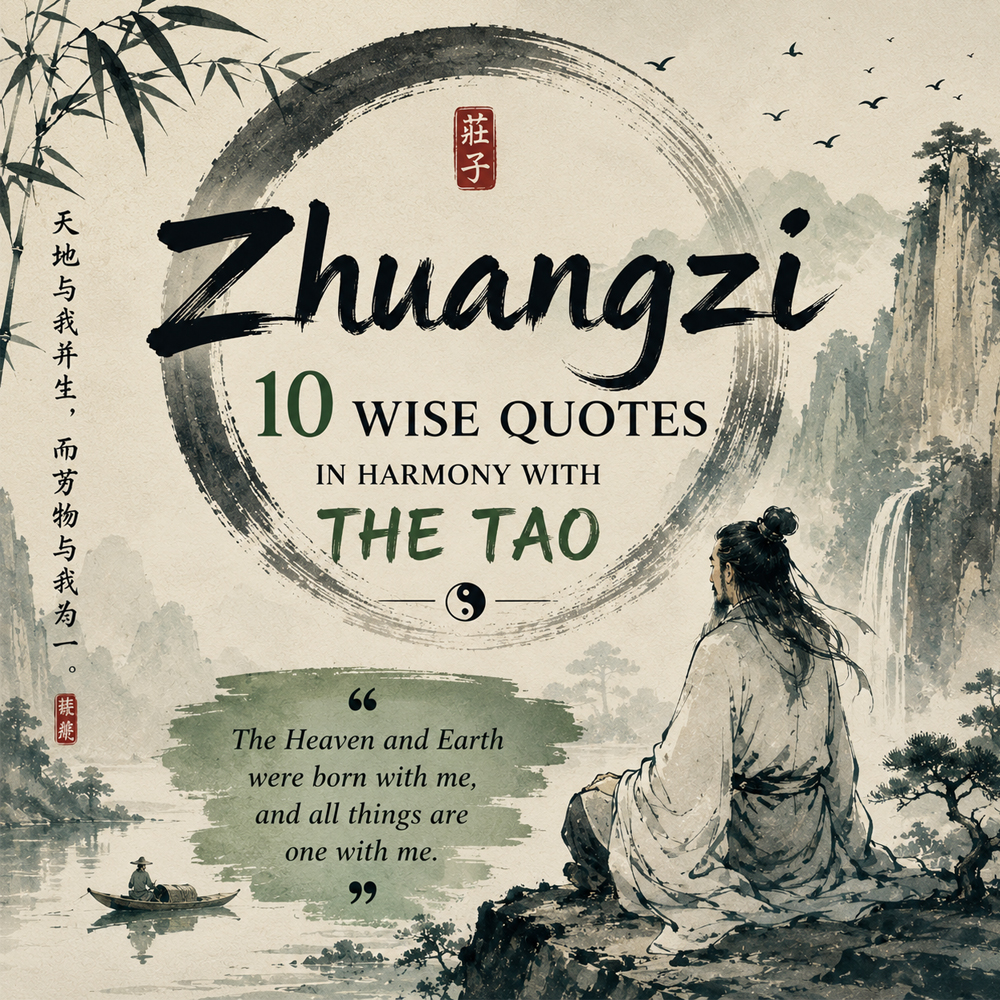
Zhuangzi is regarded as one of the founders of Taoism alongside Lao Tzu. Although he preferred to convey the essence of the Tao through stories, parables, and metaphors, many of his sayings – spoken in conversations with disciples and people from all walks of life – are what the Zen tradition would later call a “turning word.” These are words or brief statements that affect the listener’s heart in such a way that they turn attention back toward one’s own true nature. Sometimes even a single sound is enough to pull a person out of the chaos of the mind and leave them in a state of effortless harmony.
Communication requires two people, and ears are just as important as the mouth. The following sayings of this ancient sage carry the power to illuminate the natural nature of human beings and help us see more clearly.
- “Let your mind wander in simplicity, merge your spirit with the infinite, follow things as they are, and leave no room for personal opinions – then the world will become manageable.”
- “If water becomes clear when it is still, how much more true is this of the mind! The mind of the sage, when at rest, becomes a mirror of the Universe and of all creation.”
- “If a man is crossing a river and an empty boat collides with his own, he will not become angry, even if he is ill-tempered. But if he sees someone in the boat, he will shout for him to watch where he is going. If he is not heard, he will shout again and may even begin to curse. The reason for all this is that someone is in the boat. But if the boat is empty, he will neither shout nor become angry. If you can empty your own boat while crossing the river of the world, no one will oppose you and no one will try to harm you. The one who frees himself from ambition and the desire for fame and loses himself among the crowds of humanity will flow with the Tao, unseen. He will be like life itself – without name and without home, simple and unnoticed. In the eyes of others, he may seem foolish. His footsteps will leave no trace. He will possess neither power nor reputation and will accomplish nothing in the worldly sense. Because he judges no one, no one will judge him. Such is the perfect person – his boat is empty.”
- “The love of colors pierces the eye and prevents it from seeing clearly. The love of sounds disturbs the ear and prevents it from hearing properly. The love of fragrances intoxicates the head. The love of pleasant tastes spoils the natural taste of food. Desires confuse the heart until we lose our original nature. These are the five enemies of true life. Yet some refined people claim that they live for such things. I do not. If that is life, then the caged birds have already found happiness.”
- “When a person seeks to extend power over things, those things gain power over him. Whoever becomes a servant of possessions loses his inner essence. Prisoners of the world of things have no choice but to obey the demands of matter. They are pressed and crushed by external forces – fashion, markets, events, and public opinion. Such people rarely recover their sanity during their lifetime. How tragic.”
- “If you persist in trying to achieve what cannot be achieved, if you insist on obtaining what cannot be obtained through effort, if you struggle to understand what cannot be grasped through understanding, you will be destroyed by the very thing you seek. To know when to stop, to know when you cannot go further – this is the proper beginning.”
- “When the shoe fits, the foot is forgotten. When the belt fits, the waist is forgotten. When the heart is as it should be, ‘for’ and ‘against’ are forgotten. No striving, no compulsion, no need, no grasping. When you attain this, your affairs will be under control, and you will be a free person.”
- “I once heard my teacher say that where there are machines, there will be worries about machines; where there are mechanical worries, there will be mechanical hearts. With a mechanical heart in your chest, you corrupt what is pure and simple within you. Without purity and simplicity, the life of the spirit can never know rest.”
- “Value what is within you and close yourself to what is outside, for excessive knowledge can become a curse.”
- “For the sage, everything is in the process of falling apart and everything is in the process of being created. This is called peace in the midst of chaos. Peace in the midst of chaos means that peace is most complete precisely when it is surrounded by chaos.”
- 30 Timeless Lao Tzu Quotes on Wisdom, Life, and Inner Peace
- Alan Watts: 30 Inspiring Quotes on Life, Consciousness, and Happiness
- Osho: 40 Inspiring Quotes from the Master of Paradox
- 30 of Buddha’s Best Quotes: Timeless Wisdom from the Dhammapada and the Sutras
- 30 Inspiring Thich Nhat Hanh Quotes on Mindfulness, Peace, and Happiness
Author: Vasil Stoyanov