
Imagine a person who sees an object, reaches toward it, and confidently declares that they saw nothing. This is not deception, distraction, or defective eyesight. Under certain experimental conditions, the person’s brain processes information along two different pathways, and the ability to name what was seen does not coincide with the ability to respond to it. Observations of this kind turned split-brain research into one of the most fascinating adventures in neuroscience.
At its heart lies a deceptively simple question: if the two cerebral hemispheres can process information relatively independently, what makes them part of a single conscious self? The experiments of Roger Sperry, Michael Gazzaniga, and their colleagues demonstrate that the unity of the human mind is not as self-evident as it seems in everyday life. But they do not conclusively prove that surgical disconnection creates two entirely independent personalities. The real story is more interesting. It reveals the limits of language, the complex organization of attention, the brain’s ability to construct explanations, and the difficulty of defining exactly what we mean by consciousness.
The Two Hemispheres and the Bridge That Unites the Brain
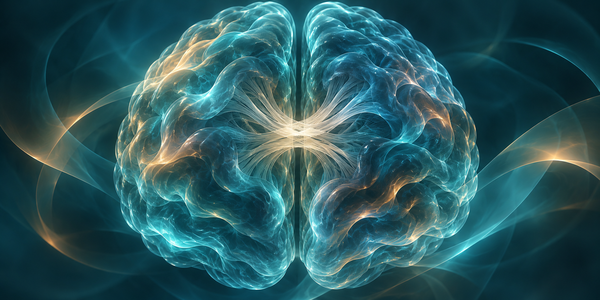
The human cerebrum has two large hemispheres that resemble mirrored halves of a single system. Each contains complex networks involved in perception, movement, memory, attention, and decision-making. The halves are not functionally identical. In most people, language abilities are represented more strongly in the left hemisphere, while certain aspects of spatial processing and visual attention receive a greater contribution from the right. This does not mean that one hemisphere is logical and the other creative. The popular opposition between left-brained and right-brained thinking is a crude simplification of a far more complicated neural organization.
The hemispheres constantly exchange information. Their largest connection is the corpus callosum, an extensive bundle of nerve fibers connecting corresponding and different regions on both sides. These pathways allow visual, motor, and cognitive processes to be coordinated into unified activity. When we recognize a face, speak, reach for a cup, or navigate an unfamiliar room, multiple brain regions participate in the shared task.
An important feature is the partial crossing of neural pathways. The left half of the visual field is initially processed mainly by visual areas in the right hemisphere, and the right half by the left hemisphere. This must not be confused with the claim that the left eye belongs to the right hemisphere. Each eye receives information from both halves of the visual field. The organization is subtler: particular fibers cross at the optic chiasm, distributing information according to the location of a stimulus in space.
Movement also involves a strongly crossed organization. The left hemisphere makes a major contribution to controlling the right side of the body, while the right contributes substantially to controlling the left. Control is not absolutely isolated: eye movements, posture, coordination, and bilateral actions involve multiple pathways and subcortical structures. Nevertheless, this functional arrangement offers researchers an extraordinary opportunity. When communication between hemispheres is severely restricted, different responses from the two hands can reveal what information reached each half of the brain.
The corpus callosum is not the only communication pathway. Other commissural connections exist, as do shared subcortical systems involved in regulating wakefulness, emotion, and behavior. This fact is essential for interpreting the experiments correctly. Severing the corpus callosum does not transform the brain into two completely isolated organs. It changes how particular types of information are transmitted without eliminating every possible mechanism of coordination.
In ordinary experience, this intricate architecture remains invisible. We do not experience the two hemispheres as a conversation between separate machines. We see one room, hear one voice, and recognize our intentions as parts of a continuous life story. That is why the split-brain question matters so much. It allows researchers to investigate what happens when a major route of integration stops functioning, and whether our sense of unity corresponds to the way information is actually organized.
Why Would Surgeons Disconnect the Hemispheres?
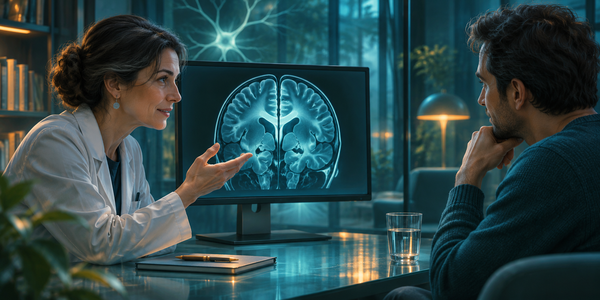
The history of the split brain begins not as a philosophical experiment but as an attempt to treat severe epilepsy. In some patients, seizures are so frequent, intense, and resistant to treatment that they profoundly disrupt ordinary life. Electrical activity associated with a seizure can spread between hemispheres along their communication pathways. In selected clinical circumstances, cutting part or all of the corpus callosum can reduce the spread of seizure activity and the severity of certain types of seizures.
The operation is called a corpus callosotomy. It has several forms and does not necessarily involve severing every connection between the hemispheres. In some patients, only a portion of the corpus callosum is cut; in others, the surgical approach is more extensive. Contemporary treatment decisions follow specialized assessment of seizure types, previous therapies, risks, and expected benefits. Callosotomy is not a standard procedure for everyone with epilepsy, nor does it guarantee that seizures will disappear entirely.
During the middle of the twentieth century, researchers began systematically studying people who had undergone operations interrupting communication between the hemispheres. Roger Sperry and his colleagues had already performed important experiments with animals, demonstrating how particular abilities could remain confined to one hemisphere when communication was interrupted. Later human investigations, to which Michael Gazzaniga made major contributions, revealed remarkable discrepancies between what a patient could say and what the patient could demonstrate through action.
Roger Sperry received the 1981 Nobel Prize in Physiology or Medicine for discoveries concerning the functional specialization of the cerebral hemispheres. That recognition reflects the enormous significance of the research, but it does not mean that every philosophical interpretation of the split brain has been conclusively established. Experimental findings and conclusions about the nature of personhood belong to different levels of analysis. One can be measured through tasks and responses; the other requires additional concepts of subjective experience, self-awareness, and personal identity.
After surgery, many patients continue speaking, moving, and interacting in ways that appear relatively unified to those around them. This is among the most important and frequently overlooked facts. If severing the corpus callosum automatically produced two wholly independent personalities, everyday behavior would be dramatically different. Instead, the most famous discrepancies emerge under carefully controlled conditions, when information is presented to only one hemisphere and ordinary opportunities for compensation are restricted.
These patients are not merely intriguing examples for a theory. They are people who underwent serious treatment for a severe illness. They differ in age, seizure history, surgical extent, language organization, and other neurological characteristics. Scientific ethics requires respect for their lives and attention to individual differences. The research does not justify sensational claims that every operated patient becomes two personalities at war with one another.
The Experiment That Separates Seeing from Speaking
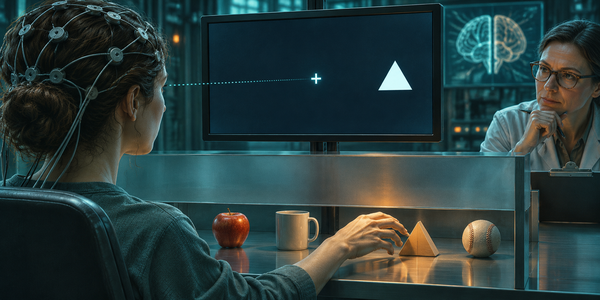
Picture a laboratory in which a patient sits before a screen, looking at a fixed point in the center. For a very brief interval, an image appears to the left of that point. If the gaze remains fixed and conditions are properly controlled, information from the left visual field reaches primarily the right hemisphere. In a person whose principal interhemispheric connections have been severed, that information cannot travel by its usual route to the language regions of the left hemisphere.
When the researcher asks what the patient saw, the patient may answer that nothing appeared. The answer sounds convincing. Yet if the patient is allowed to select a suitable object using the left hand, they may identify the correct item. A remarkable discrepancy emerges: the verbal report contains no information about the stimulus, while a particular motor response demonstrates that it was processed. The brain has responded to something the speaking system cannot name.
To understand the result, remember that in many studied patients language functions are predominantly located in the left hemisphere. The left hand is controlled to a substantial extent by the right hemisphere. One hemisphere can therefore guide the hand toward the correct response while the other lacks sufficient information to formulate that response verbally. This is not a universal rule for every person, and it does not mean that the right hemisphere has no language abilities whatsoever. Language organization varies, and different tasks demand different levels of comprehension and expression.
Classic experiments employ words, drawings, objects, and matching tasks. An image, for example, may be presented to one hemisphere while the patient must select a related object from several alternatives. When the information is directed toward the hemisphere that does not control the principal verbal response, the correct choice may remain without an adequate spoken explanation. Researchers observe knowledge expressed through action without necessarily becoming available to the patient’s ordinary verbal narrative.
Here lies one of neuroscience’s deepest lessons: being unable to say something is not identical to knowing nothing about it. Language is an extraordinarily powerful instrument for conscious reporting, but it is not the only window into information processing. A person can demonstrate recognition through movement, selection, or the direction of attention. Conversely, a correct response does not by itself prove a fully developed subjective experience. The experiment reveals processing and access to information; the philosophical question of exactly how that information was experienced remains more difficult.
The conditions of the task are decisive. If an image remains visible too long, the patient may shift their gaze and allow information to reach both hemispheres. If the object can be touched or described through other channels, additional routes of communication become available. If instructions are not carefully controlled, behavior itself may provide clues. This is why classic investigations use brief visual stimuli, fixation of the gaze, and different response methods. Their scientific significance comes from the precision of these conditions, not from the theatrical impact of the demonstration.
The results transform our understanding of what it means to see. Everyday language compresses several processes into a single word: visual perception, recognition, action guidance, verbal reporting, and subjective confidence. Split-brain research allows some of these processes to be distinguished. This is a valuable lesson not only for vision but also for memory, attention, and self-awareness. The unified experience we take for granted depends on coordination among different mechanisms.
Two Hands, Different Decisions, and the Mystery of the Brain’s Interpreter
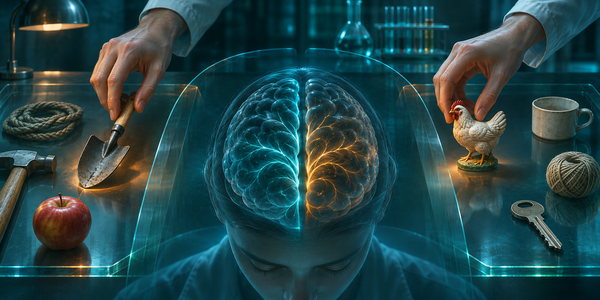
Some of the best-known split-brain observations concern actions that appear contradictory. One hand may carry out a task while the other interferes; a person may make a choice they cannot reliably explain. Such cases attract attention because they undermine our confidence that a single, clearly formulated intention stands behind every action. Yet different forms of intermanual conflict do not occur in every patient, and not every unusual movement should be interpreted as the action of a second personality.
Michael Gazzaniga’s work on the so-called left-hemisphere interpreter is especially famous. In some experiments, a patient makes a choice based on information unavailable to the speaking left hemisphere. Asked why that particular object was chosen, the patient offers a coherent and apparently reasonable explanation. The problem is that the explanation does not match the actual source of the choice. The system telling the story does not possess all the information about how the action arose.
In a celebrated demonstration, the two hemispheres were presented with different images associated with snow and a bird. The patient selected objects corresponding to those images, but the verbal explanation for one choice relied on information accessible to the speaking hemisphere rather than on the stimulus that had guided the other hand. This kind of finding shows how the brain can construct a meaningful story after an action. It does not prove that people always deceive themselves. It demonstrates that our explanations of our own motives do not invariably provide direct access to the causes of behavior.
The discovery matters enormously because the narrative of the self plays a central role in human life. We constantly explain why we chose a profession, why we like a particular person, why we became angry, or why we changed our minds. Often these explanations are useful and accurate. At other times they are orderly versions of processes that began outside our full conscious access. Split-brain research offers an unusually clear illustration of this limit to self-knowledge.
The term interpreter does not mean that a tiny storyteller lives inside the left hemisphere and controls the person. It is a functional description of the tendency of certain brain systems to connect events into causal and meaningful narratives. Narrative ability itself depends on distributed neural networks and the individual’s brain organization. There is no reason to imagine a single location containing the entire personality.
There is also an important difference between an explanation and a justification. When someone says why they acted, they may describe a real cause, propose a guess, or defend their self-image. The brain has a powerful tendency to maintain a coherent account of its own actions. This is useful for planning and social life, but it creates opportunities for error. The persuasiveness of a story does not guarantee its causal accuracy.
An important practical lesson follows. When reflecting on our own decisions, we should not always trust the first explanation that comes to mind. Sometimes we must examine circumstances, previous habits, emotions, and actual consequences. This approach does not diminish personal responsibility. On the contrary, it makes self-knowledge more demanding. Reason does not lose its value when we recognize that it lacks complete transparency regarding its own causes.
Two Streams of Consciousness or One Mind with Divided Access?
Now we reach the heart of the mystery. If the right hemisphere can recognize a stimulus and direct an action while the left cannot name it, does that mean two separate streams of consciousness exist in one person? Classic investigations provide strong grounds for speaking of partially independent information processing. But the transition from independent processing to two subjective perspectives is not automatic. To make that transition, we must first clarify what we mean by consciousness.
Consciousness can refer to wakefulness, the ability to respond, access to information, subjective feeling, or self-awareness. These meanings are related but not identical. One hemisphere can process a visual stimulus and control a choice without giving us a direct method for establishing the full character of its subjective experience. Neuroscience can measure responses and compare behavioral patterns. Whether a distinct experiencing subject exists behind them demands more cautious interpretation.
Early findings were often described as evidence of two separate conscious systems within one skull. That interpretation has a basis: when each hemisphere receives different information and responds independently, behavior appears organized around two informational centers. In certain tasks, one half of the brain cannot use what the other has received. In that sense, integration is disrupted and unified access to information is restricted.
Later investigations, however, complicate the picture. Some patients demonstrate coordination abilities that do not fit a simple model of two wholly independent minds. Under certain conditions, information about stimulus locations or the general guidance of actions can be used in ways requiring further explanation. Differences among tasks, patients, and surgical procedures are considerable. Scientific debate continues over whether a split brain creates two consciousnesses, one consciousness with divided channels of access, or a more complicated combination of partially integrated processes.
One important argument against taking the idea of two personalities too literally is everyday behavior. Many patients retain a relatively unified life story, recognize loved ones, maintain social relationships, and act as one person. This does not cancel the laboratory discrepancies, but it shows that identity cannot be reduced to the ability to name a briefly presented word. Memory, emotional regulation, bodily states, habits, and the social environment all help maintain coherent behavior.
We might imagine an organization with two departments possessing partly different information but sharing resources, history, and goals. Sometimes each department makes a decision using its own data. In other situations they act in coordination. This analogy does not prove anything about the nature of consciousness, but it helps explain why informational independence does not necessarily mean two completely autonomous personalities. The human brain is a biological system whose boundaries of functional division do not map neatly onto our everyday concepts of the self.
The most accurate conclusion is both more modest and more exciting than the sensational version. The experiments show that access to information, verbal reporting, and the control of actions can diverge within a single person. They challenge the picture of consciousness as entirely indivisible and transparent. Whether these divergences imply two subjective streams in every particular case remains a subject of philosophical and scientific dispute. This is not a weakness of the research. It is a sign of how difficult it is to connect objective measurements with inner experience.
What the Split Brain Reveals About Identity, Free Will, and Self-Knowledge

People ordinarily think of themselves as the single authors of their actions. We say I decided, I saw, I remember, as though every experience and intention passed through one common center. Split-brain research does not destroy this picture, but it shows that reality is more complex than our grammar suggests. Different brain systems can have different access to information, while the narrative of a decision may omit some of the mechanisms that produced it.
This has consequences for the philosophy of personal identity. What makes us the same person over time? The continuity of memory, a common body, character, social relationships, or the unity of conscious experience? Split-brain investigations show that these criteria can diverge. One body can contain partially independent processing systems without the person automatically losing their biographical and social identity. Personhood therefore cannot be defined through a single laboratory response.
Philosophical thought experiments frequently use the split brain to examine whether a person is an indivisible essence or a complex form of psychological continuity. If certain cognitive abilities separate while others remain shared, the boundary of the self becomes less obvious. But actual patients are not literal realizations of every philosophical scenario. Thought experiments can sharpen our concepts; clinical evidence limits how freely we may imagine what happens inside the brain.
The question of free will also acquires a new dimension. If someone can explain an action with a reason that was not its actual source, how accurately do they know their own decisions? The answer is not that free will has been disproved. These experiments do not conclusively settle the philosophical debate about freedom and causation. They show that conscious explanation and the causal mechanism of an action do not always coincide. If freedom is to be understood seriously, it must be discussed in light of the actual organization of thought and behavior.
The role of self-knowledge is especially interesting. We have immediate access to some experiences: pain, fear, desire, memory. But we do not possess a complete inner report of the neural processes that produce them. We often learn about ourselves by observing our behavior, speaking with others, and comparing intentions with results. Self-knowledge, in this sense, is not simply an inward glance. It is an ongoing process of testing, correction, and understanding.
The split brain also forces us to reconsider the word control. In everyday life, control resembles an order issued by a single central commander. In the nervous system, however, coordination emerges through interactions among numerous specialized mechanisms. Some processes unfold automatically, others depend on attention and learning, and still others are influenced by emotional and bodily states. Unity of behavior can be the result of cooperation rather than the absolute authority of one brain center.
This understanding does not make people helpless. On the contrary, it shows why habits, environment, education, and practice matter so much. If behavior emerges from many interactions, change is rarely achieved through a single internal promise. It requires conditions in which attention, motivation, and action can work together. The philosophical value of the split brain lies precisely in replacing the simple mythology of an inner commander with a more accurate picture of an organized, embodied, and dynamic person.
Modern Neuroscience and the Limits of Sensational Conclusions

Neuroscience has advanced enormously since the classic experiments. Modern imaging, electrophysiological measurement, and investigations of brain networks permit more detailed descriptions of functional connections. Nevertheless, the split brain remains a unique source of knowledge. It reveals what happens when particular communication pathways are interrupted and thus complements observations made in normally connected brains.
One of the main challenges is the small and heterogeneous population of suitable patients. People with extensively severed interhemispheric connections do not constitute a large, uniform group. Each has a distinct medical history, and results may be influenced by longstanding epilepsy, medication, neural plasticity, and surgical details. Conclusions from one remarkable case should not automatically be extended to everyone.
Another problem concerns the measurement of consciousness itself. When a patient speaks, the researcher receives a verbal report. When the patient points to an object, the researcher observes a behavioral response. When brain activity is measured, physiological processes are recorded. Each method provides different information. None is a direct window into the entirety of subjective experience. Serious investigations therefore combine methods and carefully distinguish what has been observed from what has been inferred.
Scientific literature continues to debate how to interpret the integrative abilities of certain split-brain patients. Some studies challenge the simple thesis of two completely separate conscious systems and propose more complex models of unity with restricted information exchange. Other researchers emphasize that the classic discrepancies remain compelling evidence of functional separation. These positions do not erase the underlying experimental observations; they disagree about precisely what model of consciousness follows from them.
It is particularly important not to confuse split-brain research with popular myths about left-brained and right-brained people. There is no sound basis for dividing the population into two psychological categories according to the supposed dominance of one hemisphere. It is equally mistaken to claim that every person carries two secret personalities constantly struggling for power. The normal brain is a highly integrated system, and functional specialization does not imply permanently divided consciousness.
The split brain also matters for contemporary theories of consciousness. Models emphasizing global access to information must explain what happens when different informational systems cannot share particular content. Theories emphasizing integration must clarify what forms of connectivity are required for unified experience. Other approaches investigate attention, self-representation, and relationships among brain networks. Split-brain findings test these theories, but do not serve as a final judge between them.
The greatest danger is turning an extraordinarily interesting scientific history into easy sensationalism. The sentence two minds live inside one person captures attention but misses the most important distinctions. Two systems can process information differently without that being sufficient proof of two personalities. A person can preserve social and biographical unity even when particular laboratory tasks reveal divided access. Science becomes more fascinating when we accept these complications rather than erase them.
What Does It Mean to Be One Self?

The strongest lesson of split-brain research is that the unity of human consciousness should not be taken as self-evident. It is an achievement of complex biological organization. The brain combines vision, hearing, movement, memory, emotions, language, and bodily sensations into the experience we ordinarily call my life. When some connections are interrupted, we discover that individual parts of this organization can continue functioning without their information becoming accessible everywhere.
This discovery changes how we think about the self. It is not necessarily a tiny observer sitting somewhere in the brain and receiving all information in one place. A more persuasive approach is to regard it as emerging from coordinated processes that create continuity of experience, memory, and action. This is an interpretation, not a conclusively established theory. But it corresponds to an important fact: when integration is disrupted, certain abilities separate while other forms of unity remain.
The story also has a human dimension. The patients who made these discoveries possible are not philosophical paradoxes confined to a laboratory. They are people with histories, families, fears, and hopes who underwent serious medical procedures. The research matters precisely because it connects clinical care with fundamental questions about human nature. It reminds us that behind every graph and every experimental task stands a real life.
Split-brain research also teaches intellectual humility. Someone can speak confidently without possessing all the information about the causes of their behavior. They can act correctly without being able to explain how they reached their decision. They can feel unified while different systems process information along partly independent routes. This is not a reason to abandon trust in reason. It is an invitation to use reason more carefully, distinguishing immediate certainty from verified knowledge.
Science does not yet offer a universal, undisputed answer to whether two streams of consciousness can exist in one person. Classic experiments demonstrate remarkable divisions of information and behavior. Later observations show that unity can persist in some respects even when communication between hemispheres is seriously restricted. Between these two findings lies one of the most intriguing fields in contemporary philosophy of mind.
That is why the story of Roger Sperry, Michael Gazzaniga, and split-brain patients continues to captivate us. It begins with surgery intended to relieve a devastating illness and leads to a question every human being carries, even without expressing it: what makes the multitude of thoughts, sensations, and actions part of one life? The answer is not found in the sensational claim that we are two people, nor in the comforting conviction that we are absolutely indivisible. It begins with recognizing that our unity is both a real experience and a complex task performed by the brain-a task whose mechanisms science continues to uncover.
Author: Vasil Stoyanov