
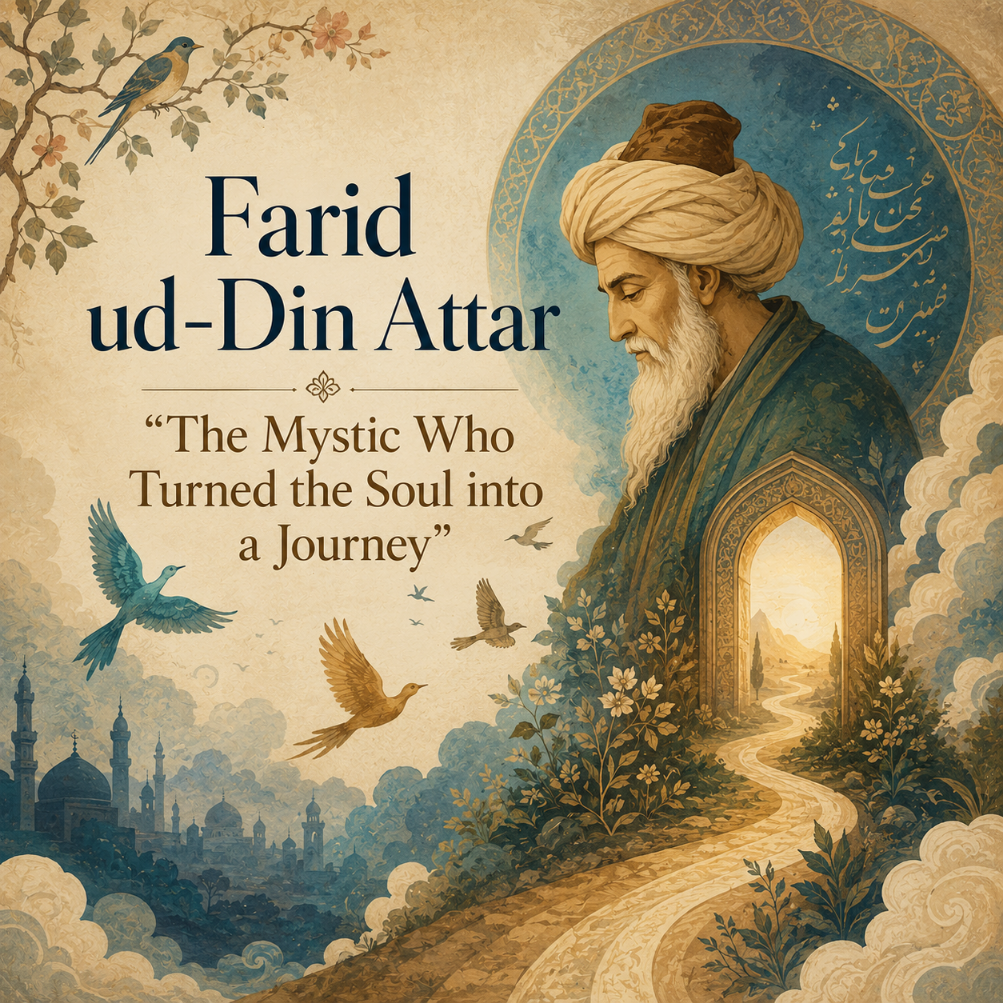
Introduction to the World of a Sufi Genius
In the history of Persian literature, there are names that do not simply belong to one era, but continue to live on as spiritual worlds. Among them shines the figure of Farid ad-Din Attar – a man whose poetry and wisdom have outlived the centuries and reach the modern reader with extraordinary power. Attar is not merely a poet. He is an alchemist of the human soul, a teller of parables, a healer of inner wounds, and one of the greatest mystics in the Islamic spiritual tradition.
His name is often associated with other giants of Sufism such as Jalal ad-Din Rumi and Hafez, but Attar’s role is unique. Without him, the spiritual world of Rumi would probably not exist in the form we know it today. Rumi himself wrote: “Attar passed through the seven cities of love, while we are still at the beginning of the first street.” This is not merely a tribute. It is an acknowledgment that Attar is one of the great architects of mystical knowledge.
Living in Persia during the 12th and 13th centuries, Attar witnessed turbulent times, but instead of seeking salvation in power or wealth, he chose the inner journey. His works were not intended only for scholars or clerics. They speak to every person who has asked what the meaning of life is, why we suffer, what love is, and where God is found.
His most famous work, “The Conference of the Birds,” is among the greatest spiritual works of humanity. In it, the birds set out on a journey toward their king, the Simurgh, but gradually discover that the divine presence they seek is hidden within themselves. This is a story that continues to inspire generations of readers because, in it, a person sees their own search.
Attar’s Childhood and Early Years
Relatively little is known about Attar’s life, and legends surround his biography. He is believed to have been born around 1145 in the city of Nishapur – one of the great cultural centers of Persia. His very name “Attar” means “perfumer” or “apothecary,” which points to his profession. He worked in a pharmacy and treated people with herbs, oils, and medicines.
But this very work became his first spiritual school. Sick, desperate, poor, and suffering people entered the pharmacy every day. Attar observed human pain up close. He saw how the rich and the poor die alike, how beauty fades, and how people often live under the illusion that they possess something lasting.
There is a well-known story about Attar’s spiritual awakening. A dervish entered his pharmacy and began to weep. Irritated, Attar asked him why he was crying. The dervish replied:
“You have a shop, wealth, and security. I have nothing. But I fear that you will leave this world with more difficulty than I will.”
These words shook Attar. Shortly afterward, he abandoned his trade and devoted himself to the spiritual search.
This story is typical of the Sufi tradition. Truth often comes through shock, through the shaking of the ego. Attar understood that life is not mere existence, but preparation for an encounter with eternity.
Sufism as the Path of Love
To understand Attar, we must understand Sufism. Sufism is the mystical dimension of Islam. It is not concerned only with external religious rules, but with the direct experience of God. Sufis believe that true knowledge does not come through dry logic, but through love, humility, and inner purification.
For Attar, love is the central force of the universe. He writes:
“Love is a fire. When it blazes, it burns everything except the Beloved.”
This love is not simply a romantic feeling. It is a cosmic energy that destroys the ego and connects the human being with the divine. According to Attar, a person suffers because they are separated from their source. The soul longs to return to God just as the drop longs to return to the ocean.
In Attar’s Sufi poetry, the image of intoxication often appears. But this is not literal drunkenness. It is spiritual ecstasy – a state in which a person loses their limited “I” and dissolves in love for God.
“The Conference of the Birds” – The Great Parable of the Human Soul
Attar’s most famous work is undoubtedly “The Conference of the Birds.” This work is at once a poem, a philosophical allegory, and a spiritual guide.
The story begins with the birds of the world realizing that they have no king. They decide to set out in search of the mystical Simurgh – a divine bird that lives beyond seven valleys.
The leader of the birds is the hoopoe – a symbol of the spiritual teacher. Each bird has an excuse for why it cannot begin the journey. The nightingale is obsessed with the rose. The peacock dreams of the lost paradise. The parrot desires immortality. The duck is attached to the water.
All these birds symbolize human weaknesses. Some people are prisoners of love, others of fear, and still others of wealth or pride.
The hoopoe tells them:
“The path is long. Few will survive. But whoever reaches the end will discover the truth.”
The birds pass through seven valleys: Search, Love, Knowledge, Detachment, Unity, Bewilderment, and Nothingness.
These valleys represent the stages of spiritual development. A person cannot reach God without losing their illusions.
The Valley of Love is especially powerful. There, reason proves powerless. Attar writes:
“In love, reason is like a donkey stuck in mud.”
This does not mean that reason is useless, but that it has limits. True spiritual experience cannot be reduced to logic.
In the end, only thirty of the thousands of birds remain. They reach the palace of the Simurgh and discover something astonishing – they themselves are the Simurgh. In Persian, “si morgh” means “thirty birds.”
In this way, Attar reveals the great mystical idea: God is not separate from the human being. The divine is present in the very being of the soul.
Attar and the Theme of Death
Death is constantly present in Attar’s work. But it is not presented as horror, but as transition. For him, the fear of death comes from attachment to illusions.
He writes:
“You are afraid to die because you have not yet truly lived.”
This thought is astonishingly relevant. Many people go through life mechanically – chasing money, status, and recognition without ever meeting their own soul.
For Attar, true life begins when a person realizes the transience of the world. Only then can they free themselves from fear.
In one story, a student asks the teacher:
“What will happen to me after death?”
The teacher replies:
“First tell me what you were before birth.”
This is a typical Sufi reversal of the question. It shows that a person’s true identity is not exhausted by the body.
Attar’s Influence on Rumi
One of the greatest proofs of Attar’s significance is his influence on Rumi. According to legend, the two met when Rumi was still a child. Attar gave the boy his book “The Book of Secrets” and said to his father:
“Your son will soon set the world on fire.”
Rumi later became the most famous Sufi poet in the world, but he never forgot his spiritual debt to Attar.
Many of the themes we see in Rumi – love as a path to God, the destruction of the ego, the spiritual journey – are already present in Attar.
The difference is that Attar is often harsher and more ascetic, while Rumi is more lyrical and ecstatic. Attar resembles a sage who cuts through illusions with a knife. Rumi is like music that melts the heart.
The Spiritual Journey as an Inner Revolution
One of Attar’s strongest ideas is that a person must pass through an inner death in order to be born spiritually.
He says:
“Die before you die.”
This phrase appears often in Sufism. It means that the false “I” must die – pride, greed, vanity, and attachment.
According to Attar, the spiritual path is painful. You cannot reach the truth without losing your old illusions. A person must be broken inwardly in order to become capable of receiving the light.
In one of his stories, a moth asks the flame what love is. The flame does not answer. The moth throws itself into the fire and burns. Then the other moths understand that only it had learned the secret.
This is an image of mystical union. True love requires complete self-surrender.
Attar and the Critique of Hypocrisy
Attar is merciless toward religious hypocrisy. He often mocks people who present themselves as righteous but are obsessed with power and ego.
In one story, a pious man prayed loudly in the mosque. A dervish said to him:
“If God were as far away as you think, your shouting would never reach Him.”
Here Attar emphasizes that spirituality is not theater. God is not impressed by showiness.
He believes that the true mystic is humble and quiet. The person who constantly displays their holiness is probably the furthest from the truth.
Symbolism in Attar’s Poetry
Attar’s poetry is filled with symbols. Birds, fire, the sea, the desert, and wine all carry deep spiritual meanings.
Fire symbolizes love that purifies the soul. The sea is the infinity of God. The desert is the loneliness of the spiritual search. Wine is mystical ecstasy.
One of the most beautiful images in Attar is the drop and the ocean. He writes:
“You are not a drop in the ocean. You are the entire ocean in one drop.”
This idea later became popular through Rumi as well, but it is already present in Attar. The human being carries within themselves a reflection of the infinite.
The Destruction of the Ego
The ego is the main enemy in Attar’s world. According to him, a person suffers because they are obsessed with their own identity.
In one story, a student asks a Sufi master:
“How can I reach God?”
The teacher replies:
“Between you and God there is only one obstacle – your ‘I.’”
This idea may seem extreme to the modern person, who has been raised to build individuality and self-confidence. But Attar is not speaking of the destruction of personality, but of the breaking of the illusion that a person is separate from the world.
The more a person clings to their ego, the lonelier they become.
Love as Divine Madness
In Attar’s world, love is a form of sacred madness. The lover appears insane to other people because he no longer obeys ordinary logic.
He writes:
“Love does not ask whether it is reasonable, but whether it is true.”
This is one of the reasons Sufi poetry remains so powerful today. It does not speak to the cold intellect, but to the deepest layers of the human being.
For Attar, love always requires sacrifice. You cannot truly love without being changed.
The Encounter with the Mongol Invasion
Attar’s fate ended tragically. He is believed to have died during the Mongol invasion of Nishapur around 1221.
Legend says that a Mongol soldier captured Attar and wanted to sell him as a slave. One man offered a thousand silver coins for him, but Attar said:
“Do not sell me yet. I am worth more.”
Later, another man offered only a sack of straw. Then Attar said:
“Sell me now. This is my true price.”
The enraged soldier killed the poet.
The story may be a legend, but it beautifully reflects Attar’s spirit. For him, human ego and pride are meaningless. In the end, we all turn to dust.
Why Attar Is Relevant Today
The world of the 21st century looks very different from Persia in the 12th century, but Attar’s words sound astonishingly contemporary.
Today, people are obsessed with identity, social media, success, and outward image. But behind all this often stands a deep inner emptiness. Attar would say that humanity has lost its connection with the soul.
His works remind us that true happiness does not come from possession, but from inner awakening.
In a world of noise, Attar speaks of silence. In a world of ego – of humility. In a world of division – of unity.
This is precisely why his poetry continues to be read. It is not merely literature. It is a spiritual mirror.
Attar’s Great Secret
If we had to reduce Attar’s teaching to one central idea, it would be this: the human being searches outside for what they already carry within.
The birds in “The Conference of the Birds” cross immense distances only to discover, in the end, their own reflection.
This is also the message to every human being. We search for meaning, love, and God in the world, but often fail to realize that the true journey is inward.
Attar writes:
“You wander the world in search of treasure, while the treasure is buried beneath your own house.”
This thought is perhaps his greatest legacy.
Conclusion
Farid ad-Din Attar remains one of the greatest spiritual writers in human history. His works do not grow old because they speak of eternal questions – love, death, the ego, God, and the meaning of life.
He does not offer easy answers. On the contrary, Attar destroys comfortable illusions. But this is precisely where his power lies. He makes us look beyond the surface.
In his world, spirituality is not religious dogma, but a living experience. Love is not a feeling, but a fire. Death is not an end, but a door. And the human being is not a separate creature, but a reflection of the infinite.
That is why, centuries later, his words continue to sound as if they were written for our own time.
Attar does not merely write poetry. He shows a path.
Read More:
- Sufism: The Mystical Path to God – History, Secrets, and Great Sufi Teachers
- G.I. Gurdjieff – The Mystic, Occultist, and Teacher of the Fourth Way
- Jalal ad-Din Rumi – “The Poet Who Turned Pain into a Path to God”
Author: Vasil Stoyanov