
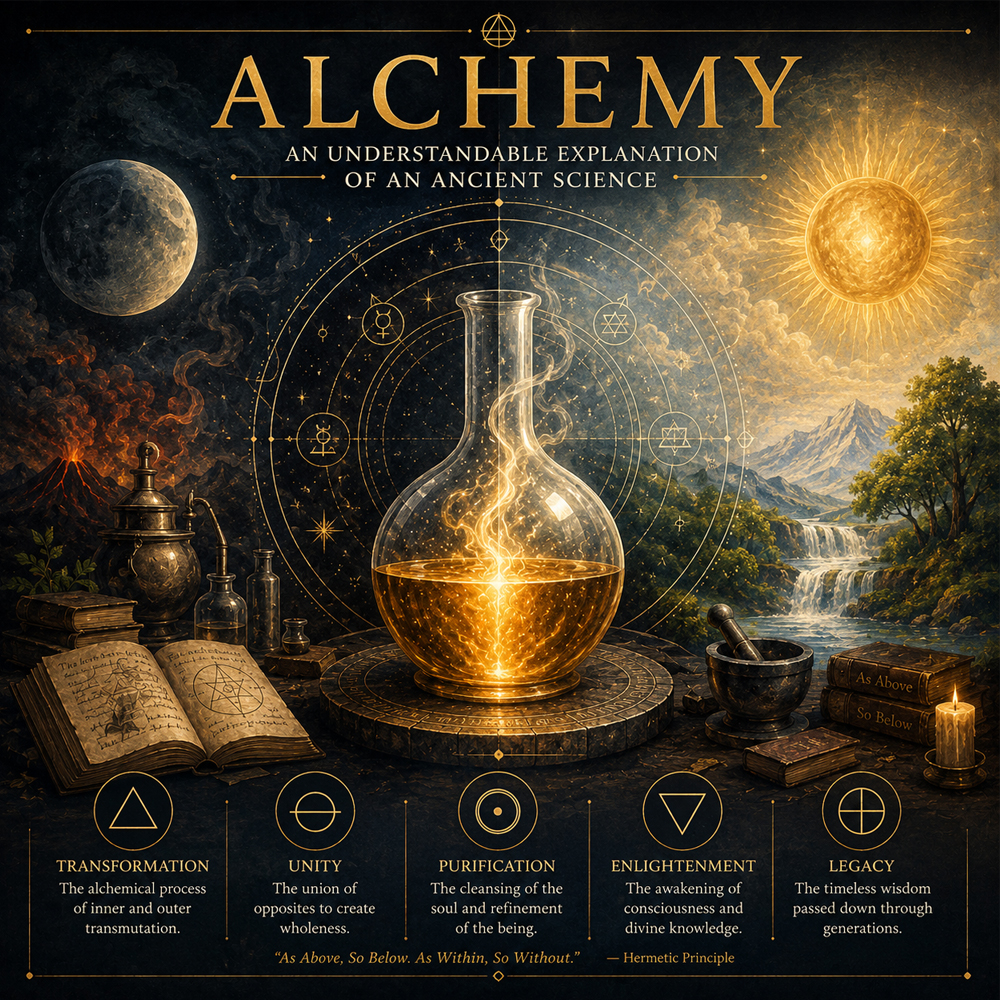
The Fire Before Which Humanity Seeks the Secret of Change
Imagine a workshop lit by fire, with the shadows of glass vessels trembling across its walls. Minerals, metal shavings, and a notebook filled with strange images of birds, kings, and serpents lie on the table. The person before the furnace watches a substance gradually change color, waiting for a sign that the work is moving in the right direction. There is no periodic table, electron microscope, or modern atomic theory at hand. There is experience, inherited ideas about nature, and the conviction that the visible world conceals patterns that patient investigation can reveal.
This imagined scene brings us closer to alchemy than the familiar image of a magician chanting over a cauldron. Alchemical work involves substances, instruments, observations, and prolonged experiments, yet it often unfolds in a world where religion, philosophy, and the investigation of nature have not yet become separate disciplines. For one practitioner, changing a metal is a technical question; for another, it belongs to a divine order; for a third, laboratory work and spiritual refinement intertwine. This complexity makes alchemy both deeply attractive and easily misunderstood. It is a story of the human desire to penetrate beneath the surface of things and discover how the imperfect acquires a new form.
An Ancient Art with Many Roots
Alchemy belongs among the old traditions of investigating and transforming substances, but it has no single birthday. The skills of working metals, preparing dyes, and changing materials predate the emergence of recognizable alchemical teachings. One important setting for the development of the Western alchemical tradition was the Greek-speaking world of Egypt during the first centuries of the Common Era. There, craft knowledge met philosophical ideas about matter, religious beliefs, and the pursuit of hidden knowledge. Later, alchemical texts and practices passed through the Arabic language and reached medieval and early modern Europe.
The word itself also carries traces of this journey. Its European forms come through the Arabic al-kimiya, with the initial particle being the Arabic definite article. The more distant origin of the root remains debated and is associated with Greek forms and hypotheses of an Egyptian connection. The expression “divine chemistry” is therefore suitable as a poetic description of certain alchemical aspirations, but it is not an established literal translation of the word. This distinction does not diminish the subject’s depth; it allows us to investigate without turning a beautiful explanation into an unproven historical fact.
The history becomes richer still when we look beyond Europe and the Mediterranean. Chinese and Indian traditions developed their own practices involving substances, longevity, vitality, and spiritual transformation. Similarities exist between them, but their different concepts and purposes cannot be contained within one common recipe. When we speak of alchemy, we are opening a door onto a family of historical traditions. Their shared question concerns how nature changes its forms and how human beings can participate in that change.
The World Before the Boundary Between Chemistry and Philosophy
Today, distinguishing a chemical reaction from a religious experience or a psychological change seems natural. For many people in the past, this separation was not obvious, because nature was understood within a broader cosmic and divine order. A metal has color, weight, and behavior when heated, but it could also be associated with a planet, a quality, or a position in the world’s hierarchy. This does not mean that every alchemist thought in the same way. It means that substances were often observed within a conceptual environment different from that of the modern laboratory.
Alchemical activity had practical applications in metallurgy, distillation, the processing of materials, and the preparation of medicinal substances. This history contains skilled observers, enterprising experimenters, philosophers, frauds, and people who lost years pursuing a mistaken theory. None of these figures represents the whole phenomenon. If we see only mystics, we miss the actual work with matter; if we see only failed chemistry, we miss the questions of meaning and perfection. To understand alchemy, we must allow the past to be more complex than our ready-made categories.
This complexity also explains why alchemy continues to attract people who have never held a retort. A substance is something to be studied, yet its transformation simultaneously invites reflection on human destiny. Fire reveals properties that cold metal does not display, and this sight naturally suggests a comparison with life’s trials. The comparison is powerful when we remember that it is a comparison. It loses its value when we begin using a spiritual image as evidence for a physical law.
Nature as Movement Rather Than a Motionless Scene
A seed can seem almost lifeless as we hold it between our fingers. Placed in suitable conditions, it begins absorbing water, activating processes, and forming roots, a stem, and leaves. The tree does not emerge from empty space, but through the interaction between the seed’s inherited organization and the environment in which it develops. Light, water, minerals, and air participate in its growth. This visible change is one reason nature so readily appears as a great teacher of transformation.
Within alchemical thinking, observations of this kind become part of a broader view of the world. Forms arise, change, break down, and give birth to new forms, while human beings seek to understand the order of these transitions. The image of a “divine seed” from which everything unfolds can express a philosophical or spiritual idea of a common origin. It is not a scientific description of the universe’s emergence, nor does it invariably belong to all alchemical authors. Its strength lies in the way it directs attention toward the hidden possibility of development.
Change, however, is not a promise that everything inevitably reaches its best state. A seed can dry out, a tree can be brought down, and a substance placed in unsuitable conditions can be destroyed. The image of natural transformation therefore also warns us of the importance of conditions. Potential is not a completed result locked inside an object like a gift in a box. It is a possibility realized through particular relationships, limitations, and processes.
The Stone, the Plant, the Animal, and the Human Being
In various older philosophical and esoteric systems, nature is arranged into mineral, plant, and animal kingdoms, with human beings occupying a special place. Such divisions provide a way to reflect upon different kinds of organization and life. A stone does not grow like a tree, a tree does not move and perceive like an animal, and a human being can reflect on his own behavior. This is an understandable framework for an observer seeking order within the world’s immense diversity. Yet it is neither a unified alchemical doctrine nor equivalent to modern biological classification.
Some alchemical views imagine metals as substances that mature within the earth and can be brought to a more perfect state. In such a conceptual world, gold becomes an image of completion, stability, and purity. This is a historical idea about the development of matter, rather than an established natural purpose. Geology does not describe all minerals as candidates for becoming gemstones, nor does biology assume that every organism strives to become human. Different forms have different properties and histories without being arranged on an inevitable ladder leading toward us.
A useful philosophical insight lies here that can be preserved without the old physical explanations. Development does not mean forcing everything into the same form. A person becomes more fulfilled by developing actual abilities rather than copying someone else’s idea of success. A teacher, a musician, and a researcher need not reach an identical destination to lead meaningful lives. Their differences belong to the world’s richness, rather than proving an inequality of human worth.
Transmutation and the Limits of Possibility
The word “transmutation” means transformation and, in an alchemical context, is often associated with turning one metal into another. Historically, many alchemists genuinely sought a way to obtain a precious metal from cheaper substances. They did not use gold solely as a symbol of wisdom, although symbolic meanings were also present. The hope of a material result was real and sometimes had enormous financial consequences. If we erase that hope to make alchemy more acceptable today, we replace history with a convenient spiritual version.
Modern chemistry explains why ordinary chemical operations do not turn lead into gold. They change the bonds and interactions between atoms, but an element’s identity depends on the number of protons in its atomic nucleus. Turning one element into another requires a nuclear process. Such processes exist, but they neither confirm old alchemical theories nor offer a practical furnace for manufacturing wealth. A resemblance between an ancient desire and a modern result does not imply a resemblance between their explanations.
In twenty twenty-five, the ALICE collaboration at CERN reported measurements of lead nuclei being transformed into gold nuclei through processes in the Large Hadron Collider. The quantities produced are exceptionally small, and the nuclei exist only briefly under the accelerator’s conditions. This is an achievement of nuclear physics that makes the old alchemical image particularly intriguing to a modern reader. It is not the discovery of the philosopher’s stone, nor does it validate the chemical transmutation of metals. The real wonder is how much more precisely we understand matter when the question of change is combined with a method that can be tested.
Why Not Every Stone Can Become a Diamond
A diamond is a magnificent image of transformation because it combines an ordinary chemical element with extraordinary properties. It is a crystalline form of carbon in which the atoms are arranged in a particular way. Suitable conditions are decisive for its formation, but those conditions do not remove the need for the right composition. An arbitrary stone does not become a diamond simply because it is subjected to sufficient pressure and temperature. Matter has specific possibilities that must be understood before they are used as philosophical metaphors.
This clarification carries an important lesson for human life as well. The popular saying that pressure makes diamonds can inspire, but it does not reliably describe how people develop. Excessive pressure can exhaust, injure, and diminish the capacity to act. Growth also depends on support, time, learning, safety, and recovery. Suffering does not automatically produce wisdom, and no one is obliged to justify pain through a promise of future greatness.
The more fruitful alchemical question is what conditions allow a particular possibility to unfold. Sometimes discipline is needed, sometimes rest, and sometimes a change in an environment that continually undermines effort. A talent can remain invisible for a long time if a person lacks access to tools or suitable education. This does not establish a lack of inner worth. It shows that development is a meeting between abilities and the world, rather than a solitary feat of willpower.
The Alchemist as Nature’s Collaborator
Imagine a gardener trying to open a bud with his fingers because he wants the flower to appear sooner. He may unfold the petals, but he will not produce the healthy blossoming he seeks. A good gardener works on the conditions, watches moisture and light, and intervenes according to the plant’s needs. This image helps us understand an enduring alchemical attitude: human art must learn from nature’s movements. This does not mean that old alchemical explanations are correct, but that observation takes priority over the impatient imposition of desire.
In the laboratory, this attitude appears as attention to time, quantity, sequence, and the behavior of substances. The same fire can assist an operation or destroy the contents of a vessel. The practitioner must learn to distinguish the change being sought from the change that simply happens. There is intellectual humility in this, because a substance does not obey the belief that we deserve success. It responds to conditions regardless of the story we have told ourselves about them.
Inner work requires similar attention to reality. Declaring that we want peace is not enough if we sustain habits that continually intensify irritation. Valuing knowledge is not enough if we accept every convenient claim without examination. Change begins when observing our own behavior becomes more important than defending our self-image. We then stop forcing the bud open and begin caring for the conditions of its blossoming.
The Great Work and the Dream of the Philosopher’s Stone
One of European alchemy’s most recognizable images is the philosopher’s stone. Different texts describe it as a special substance or agent capable of transforming base metals into precious ones. It is also associated with hopes of healing power, perfection, and longevity. The name “stone” does not mean that every author imagined an ordinary solid mineral with identical properties. Descriptions are diverse, symbolic, and sometimes deliberately difficult to decipher.
The work of attaining it is often presented as the Great Work. This name conveys a sense of an undertaking requiring more than one successful operation. The practitioner must choose a material, follow a process, recognize changes, and endure failure. No single sequence is accepted by all alchemical traditions, and different authors describe the work differently. Modern schemes should therefore be read as maps of particular texts and interpretations, rather than as a universal ancient handbook.
As a spiritual symbol, the philosopher’s stone can be understood as an image of inner steadiness. This is a state in which a person does not turn every obstacle into a destructive reaction or change values according to momentary advantage. Such steadiness does not remove pain or guarantee flawlessness. It allows experience to be worked through with attention, judgment, and responsibility. In this reading, the most valuable transformation is the capacity to give meaningful form to the material life places before us.
Mysterious Images and the Language of Symbols
When we open an alchemical manuscript, we may encounter a king immersed in water, a bird rising from flames, or a serpent biting its own tail. Such images look like scenes from a dream, but their purpose is not limited to decoration. They can point toward substances, operations, qualities, or philosophical relationships. Sometimes they protect knowledge from uninitiated readers, while at other times they gather a complex idea into an image more easily remembered than a technical description. Their meaning depends on the particular text and cannot be deciphered through a single universal dictionary.
This is especially important when a modern reader recognizes personal experiences within an image. A scene of disintegration may evoke a life crisis, but this does not prove that the author was describing a psychological process. Alchemical language is often ambiguous, and that ambiguity requires careful reading. Historical meaning and personal inspiration can coexist without being confused with one another. The best approach to a symbol is to let it raise questions rather than force it to confirm an explanation selected in advance.
The serpent closing its body into a circle is a particularly powerful image of the relationship between ending and beginning. For a modern person, it can suggest that habits produce consequences, while consequences in turn reinforce habits. If every conflict ends in withdrawal, withdrawal gradually makes communication more difficult, and the next conflict arises more readily. The circle changes when a new action enters it. In this way, the symbol becomes useful for reflection without being made into a mystical law explaining everything.
Prima Materia and What We Begin With
In alchemical texts, we encounter the concept of prima materia, or first matter, whose meanings differ according to the author and tradition. It can point toward a philosophical foundation of substances or the sought-after starting material of a particular work. Its very uncertainty sometimes turns the search into a long wandering among recipes, riddles, and conjectures. The beginning seems the simplest part of the work, yet often proves the hardest. If we do not know what we are actually working with, every subsequent operation rests on a misconception.
In an inward reading, first matter is everything we discover in our own lives before arranging it according to a desired image. This includes abilities and curiosity, but also envy, fear, shame, and conflicting needs. A person rarely begins change as pure and finished material. He begins as a history of habits, relationships, experiences, and explanations, some of which he does not even notice. The first task is therefore not to declare himself superior, but to become more accurate in observing himself.
Imagine a person who insists that he constantly loses his temper because those around him are unreasonable. His explanation contains an observation about other people’s behavior but leaves his own reaction outside the investigation. The work begins when he notices exhaustion, the need for recognition, and the fear that disagreement means humiliation. This does not excuse someone else’s rudeness or make him responsible for everything. It gives him access to the part of the process he can actually influence.
The Black Beginning – When the Old Image Falls Apart
In familiar European descriptions of the alchemical work, blackening is called nigredo. It is associated with darkening, decomposition, and the destruction of the material’s previous form. In a psychological interpretation, this image can express the moment when a familiar explanation of one’s identity stops working. Someone who has always considered himself calm sees how readily he punishes loved ones with silence. Another, convinced of his independence, discovers how strongly his decisions depend on other people’s approval.
Such discoveries are unpleasant because they remove the comfortable distance between ourselves and our problems. Until now, we have described weakness as something found in others; now we see it in our own actions. The first impulse is often to defend the old image through justification, accusation, or a quick promise to change. The harder work is to remain before the fact long enough to understand its structure. Darkness in this metaphor is the absence of earlier certainty, rather than proof that the person has lost his worth.
Not every life crisis is a spiritual initiation, and not every breakdown leads to beneficial development. Severe suffering can require help, treatment, and protection rather than symbolic glorification. The alchemical image makes sense when it helps us name an experience and seek support. It becomes cruel if it suggests that we must endure every destruction because it makes us more perfect. Inner honesty also begins with recognizing that sometimes a person needs support before being able to make sense of what has happened.
The White Clarification – Distinguishing Fact from Fear
Another familiar phase in symbolic descriptions is albedo, the whitening or lightening. An inward reading of this image is the gradual clarity that follows confusion. A person begins distinguishing what happened from the story constructed around it. Someone has not answered a message, and that is a fact; the conclusion that one is despised is an interpretation. Between the two lies a space in which other explanations can be considered and a more reasonable action chosen.
Such distinctions seem small, yet they change the way we experience everyday life. When an interpretation is presented as fact, an emotion acquires the weight of an inevitable response to reality. When we recognize it as an interpretation, the emotion remains real but no longer dictates the conclusion by itself. We can feel anxious while knowing that we do not yet have enough information. This is a form of maturity that does not require becoming unfeeling observers.
Clarification also involves the ability to name the need behind a reaction. Irritation following someone else’s remark may be connected with hunger, exhaustion, accumulated conflict, or a genuinely crossed boundary. Different causes require different responses, and there is no useful general recipe for all of them. Sometimes a conversation is needed, sometimes distance from a destructive situation, and sometimes simply enough sleep. Becoming more accurate in this discernment is more valuable than striving always to appear spiritually calm.
The Red Completion – When Understanding Becomes Action
Some schemes describe yellowing and reddening after darkening and whitening, with the latter called rubedo. The sequence and meaning of these colors vary and do not describe a universal psychological path. As a modern metaphor, reddening can signify the embodiment of what has been understood. A person no longer limits himself to explaining why he loses his temper, but gradually changes the way he acts. Knowledge takes bodily form in behavior and begins having consequences for his relationships.
This is precisely where many promising inner insights encounter their limits. It is easy to feel profound agreement with an idea while reading alone in a quiet room. It is harder to retain it when we are tired, under pressure, and hurt by someone whose opinion matters to us. If we believe in honesty, we must practice it even when truth disturbs our comfort. If we speak of compassion, it must also appear toward someone we do not like, without requiring us to abandon boundaries.
Completion in this reading is not final perfection. It is a moment when a particular change begins becoming a reliable part of life. A person apologizes sooner, notices irritation in time, or stops promising things he has no intention of doing. Then a new difficulty appears, and the work continues in another form. Maturity is recognized through the ability to sustain change and repair failures, rather than through the claim that we have finished working on ourselves.
Dissolve and Reunite – The Courage to Change Your Own Form
The Latin formula solve et coagula translates as “dissolve and coagulate” or, more freely, “break down and bring together again.” It is associated with operations and images of transformation, and modern spiritual readings use it to describe personal change. Its strength lies in combining two tasks we readily separate. Destroying an old structure is insufficient if a more workable organization does not emerge afterward. Preserving a structure at any cost is equally unhelpful when it already obstructs life.
Consider someone who has built his entire self-respect around the role of an indispensable helper. He continually takes on other people’s tasks, rarely says what he wants, and gradually begins feeling resentment. To change this, he must dissolve the belief that refusing makes him a bad person. Yet if he remains only in the breaking down, he may move toward harshly rejecting everyone. Reuniting requires a clearer form of care in which assistance and personal boundaries have room at the same time.
This is why real change often looks less conspicuous than a dramatic rejection of the past. It involves new agreements, practicing different responses, and tolerating the discomfort that others still expect the old behavior. A person must remain consistent long enough for the new form to become understandable both to himself and to others. In this work, he need not destroy everything he has been. He must distinguish what no longer serves life from what deserves to be preserved.
The Human Being as a Small Universe
The idea of the human being as a microcosm belongs to a broad range of older philosophical and religious views. It expresses the conviction that correspondences exist between the structure of the human being and the structure of the world. Different traditions explain these correspondences differently, and they should not be presented as one proven doctrine. For a modern reader, the image remains powerful because it reminds us that we do not stand outside nature. Our body is a material, living system sustained through continual exchange with its environment.
We contain water, chemical elements, and complex molecules, while our cells continually build and break down substances. Food is processed through biochemical mechanisms and contributes to maintaining the body and its activity. If we call this “everyday alchemy,” we are using a poetic image of transformation. The scientific description is metabolism, rather than the conversion of chemical elements into one another. The distinction allows us both to appreciate the wonder of the process and to understand it accurately.
The microcosm can also be a useful image of inner diversity. Within one person are impulses toward security, curiosity, closeness, dominance, creativity, and rest. They do not always move in one direction, and this is not evidence of a defective personality. Part of maturity is establishing relationships between these needs instead of allowing one to govern everything. Inner order resembles a well-organized city more than an empty room in which nothing happens.
The Invisible Is Not Necessarily Supernatural
When we say that alchemy seeks the invisible principles behind matter, we must be careful about what we mean by “invisible.” Many entirely natural processes are inaccessible to our direct sight. We do not see individual molecular interactions in digestion, but that does not make them mystical events. We do not see a memory as an object on a table, yet we can investigate its manifestations and conditions. Invisibility is a limitation of a particular way of observing, rather than automatic evidence of a world beyond the physical.
At the same time, human life includes meanings that are not exhausted by listing material composition. A wedding ring is a metal object, but for a person it can signify a promise, a loss, or belonging. These meanings do not change the number of atoms, but they change the way the object participates in life. Such a distinction allows us to speak of spiritual depth without making arbitrary physical claims. Material explanation and experienced meaning answer different questions about the same reality.
This is precisely where alchemical symbolism can become especially fruitful. It offers images for experiences difficult to describe through dry definitions and makes abstract change tangible. Darkening names confusion, purification points toward discernment, and uniting depicts the construction of a new wholeness. Images do not replace evidence or solve every philosophical question. They help us see structure within our experience and speak about it more fully.
Jung and the New Life of Alchemical Images
In the twentieth century, Carl Gustav Jung made the psychological interpretation of alchemy particularly influential. He examined its images and texts in connection with his own ideas about the psyche, the unconscious, and individuation. In this reading, the alchemical work becomes a rich symbolic parallel to inner development. The encounter between opposites, the breakdown of old forms, and the emergence of wholeness acquire psychological meaning. This strongly influenced how many contemporary readers understand alchemy.
Historians of science, however, place justified limits on turning this reading into an explanation of the entire tradition. In particular alchemical texts, enigmatic language can describe actual laboratory substances and operations. If every description is immediately translated into the language of psychology, its practical meaning disappears. The Jungian interpretation has its own intellectual history and must be considered an interpretation. It does not prove that all earlier alchemists were secretly practicing modern psychotherapy.
This distinction also frees today’s reader from an unnecessary claim. We need not assert that ancient authors thought exactly as we do to find value in their images. We can state openly that we are using alchemical language for contemporary reflection on change. In this way, we respect historical reality while creating our own meaningful connection with it. The most fruitful conversation with the past begins when we stop forcing it to be our reflection.
Maat – The Heart Before the Scales of Truth
In ancient Egyptian culture, Maat embodies truth, justice, and the proper order of the world. In familiar depictions of judgment after death, the deceased person’s heart is weighed against the feather associated with Maat. The scene presents moral judgment through an image both simple and deeply affecting. The heart carries the history of a life, while the scales place that history before an order that cannot be bribed with beautiful speech. This is a religious symbol within its own Egyptian context, rather than a universal rule established as the foundation of all alchemical teachings.
Its connection with inner transformation is philosophical and can be made openly. A person often wants to change without surrendering the convenient distortions through which he protects himself. He wants clarity but selects facts according to their usefulness; he wants harmony but leaves unfulfilled promises behind him. The image of the scales brings him back to the question of what actually carries weight in his life. Moral work begins where personal history ceases to be an excuse and becomes the subject of honest judgment.
The lightness of the heart in such a contemporary reading does not mean the absence of pain, grief, or complex feelings. An upright person can carry a devastating loss without this diminishing his moral worth. Lightness can be understood as having less need continually to conceal, manipulate, and maintain a double life. Admitting a mistake is often painful, but it releases the energy required to hide it endlessly. Truth thus becomes a condition for change rather than merely an ornament of spiritual vocabulary.
Why Spiritual Traditions Do Not All Say the Same Thing
When we consider alchemy as inner transformation, comparisons with other spiritual paths naturally arise. Different traditions speak of liberation, purification, salvation, awakening, or closeness to the divine. These words express an aspiration to move beyond the ordinary, limited human condition. The resemblance deserves attention because it shows how enduring the question of human change is. Yet it does not prove that all traditions describe the same goal or accept the same understanding of the person.
Different Buddhist teachings, Christian understandings, and Kabbalistic traditions have their own foundations, concepts, and practices. We cannot reduce them to a general “development of the soul” without losing important distinctions in how they understand human beings and their liberation. Nor are “Eastern teachings” one teaching with one goal. A more careful approach seeks particular parallels instead of declaring complete unity in advance. Comparison then becomes an encounter between different ways of thinking and preserves their actual depth.
For the reader, this means that an alchemical image can be a bridge without becoming a universal key. It can help us understand discipline, the purification of motives, and a change in our relationship with the world. It cannot, by itself, determine the nature of consciousness or whether an immortal soul exists. These questions require separate philosophical and religious consideration. An idea’s depth increases when we clearly see how far it reaches and where other questions begin.
Transforming Anger Without Denying Its Fire
Imagine someone interrupting you in front of other people and belittling your work. Tension appears in the body, thought accelerates, and you are already preparing an answer meant to restore your sense of dignity. If you react immediately, the conversation can easily become a struggle for dominance. If you forcibly suppress everything, the tension may remain and appear later in another form. Inner transformation begins with briefly recognizing what is happening before choosing an action.
Anger can indicate a crossed boundary, a sense of injustice, or an affected need. It is neither automatically an enemy to be destroyed nor an infallible judge of the situation. Once we notice it, we can examine what was actually said and what we added to it. We can then respond clearly, ask for a conversation, or end an interaction that has become humiliating. The fire remains energy, but it receives a form serving the actual need.
This is an alchemical metaphor in its most practical form. We are not turning emotion into some mysterious substance, but changing the way it participates in behavior. The same applies to fear, which can encourage preparation, and envy, which can reveal a neglected desire of our own. No transformation is guaranteed, and each requires working with the particular situation. Maturity is the ability to use the information within a feeling without handing the feeling complete control.
Discipline as the Vessel That Holds the Process
In an alchemical workshop, a vessel is a necessary condition for carrying out a particular operation. If it breaks or is unsuitable for the task, its contents are lost and the effort fails. In an inward reading, habits that give change stability play a similar role. Regular time for work, enough rest, and a willingness to return to a difficult task create support. Without them, even powerful inspiration often remains a brief event that does not change the organization of life.
Discipline does not require continual harshness toward oneself. If every deviation is followed by self-humiliation, a person gradually begins associating development with punishment. It is more useful to see the reason for the lapse and resume the next possible action. One missed day should not become proof that the whole undertaking is meaningless. The vessel of change must be steady, but also suitable for the person working within it.
Feedback also plays an important role here. If we constantly call stubbornness perseverance, we will not notice that we are repeating an approach that does not work. If we call every discomfort a sign of moving in the wrong direction, we will abandon the task at the first difficulty. Judgment between the two is necessary, and it develops through observing results. Sustained effort matters when it is connected with a willingness to learn rather than a need to prove that we were right from the beginning.
The Dark Side of the Promise of Perfection
The history of alchemy also contains a warning about the power of desire. The promise of gold, an extraordinary medicine, or secret knowledge can attract a person so strongly that he begins ignoring the obvious. Failure is explained through insufficient purity, the wrong moment, or incomplete initiation, while the promise remains untouchable. Every new disappointment then demands more time, more resources, and more trust. The problem is particularly serious when no possible result can refute the claim.
The contemporary spiritual world is also familiar with this mechanism. A person can be persuaded that he suffers because he is not sufficiently aware, and that the solution is always the next course or the next promise. This model turns the pursuit of development into a permanent obligation to someone else’s authority. Healthy inner work should increase the capacity for independent judgment. It should allow questions, boundaries, and examination of consequences rather than demanding unconditional submission.
Another trap is using spiritual words to conceal ordinary human difficulties. Calling indifference “nonattachment” does not make it wiser, and calling fear “intuition” does not make it more accurate. Inner transformation requires looking at the function of behavior rather than merely its noble name. If a practice makes us more dishonest, more dependent, or less able to acknowledge harm, it deserves reevaluation. The best sign of development is greater responsibility toward reality.
Newton and the Difficult Road to New Knowledge
Isaac Newton’s involvement in alchemical research is particularly revealing of this history’s complexity. His manuscripts testify to a serious interest in the field often called “chymistry” in the English context of his time, using the older sense of the word. This interest belonged to the same man whose work transformed physics and mathematics. That fact does not mean his alchemical convictions automatically receive scientific confirmation. It shows that an exceptional mind can work simultaneously in directions with very different future destinies.
The transition to modern chemistry was not a single expulsion of mystics from the laboratory. It involved the gradual development of concepts, measurements, methods, and criteria for explaining substances. A practical skill can be inherited while the theory used to explain it is abandoned. This is precisely what makes the history of knowledge so interesting: the useful and the mistaken are often intertwined within the same work. Later generations receive results, instruments, and questions, but must subject them to renewed examination.
This process also offers an ethical lesson about our relationship with our own ideas. We need not be infallible to contribute something valuable. We need to allow our convictions to encounter facts we have not selected in advance. Sometimes the most important change is abandoning a beautiful explanation that does not withstand examination. There is a particular kind of inner gold in this: the freedom to prefer truth to the prestige of our own mind.
The Gold Recognized in Ordinary Life
After all the furnaces, symbols, and philosophers’ stones, the question of transformation returns to the most ordinary moments. How we speak to someone who disagrees with us, how we act after a mistake, and what we do with time that nobody observes. This is where an abstract idea acquires consequences. One person can know a great deal about spiritual traditions and remain unable to bear an honest conversation. Another may know no alchemical symbols at all and still carry out the difficult work of responsibility every day.
Inner gold in this reading is not proof of belonging to a chosen circle. It is reliability expressed through our relationship with the world and recognized by those around us. An apology carries weight when followed by change, and knowledge has value when it improves judgment. Calm matters when it allows us to act clearly, rather than serving to distance us from another person’s pain. Transformation then ceases to be a private ornament of personality and becomes a quality of its relationships with others.
Alchemy remains valuable when we read it with both imagination and clarity. Its history reveals the persistence of human seeking, its errors expose the danger of an unexamined promise, and its symbols offer a language for change. Not every substance can become gold, and not every person should be forced toward someone else’s ideal. Yet a person can become more honest in observation, more attentive in action, and more capable of transforming experience into understanding. The fire of this work burns in everyday life, and its result can be seen in the way we live.
Read more:
- The Philosopher’s Stone: Alchemy, Transmutation, and the Path to Enlightenment
- Kabbalah – The Secret Map of Creation and the Hidden Language of God
- Freemasonry: History, Origins, Symbols, and Secrets of the Craft
- Hermeticism – The Secret Wisdom of the Universe and the Path to Divine Knowledge
Author: Vasil Stoyanov