
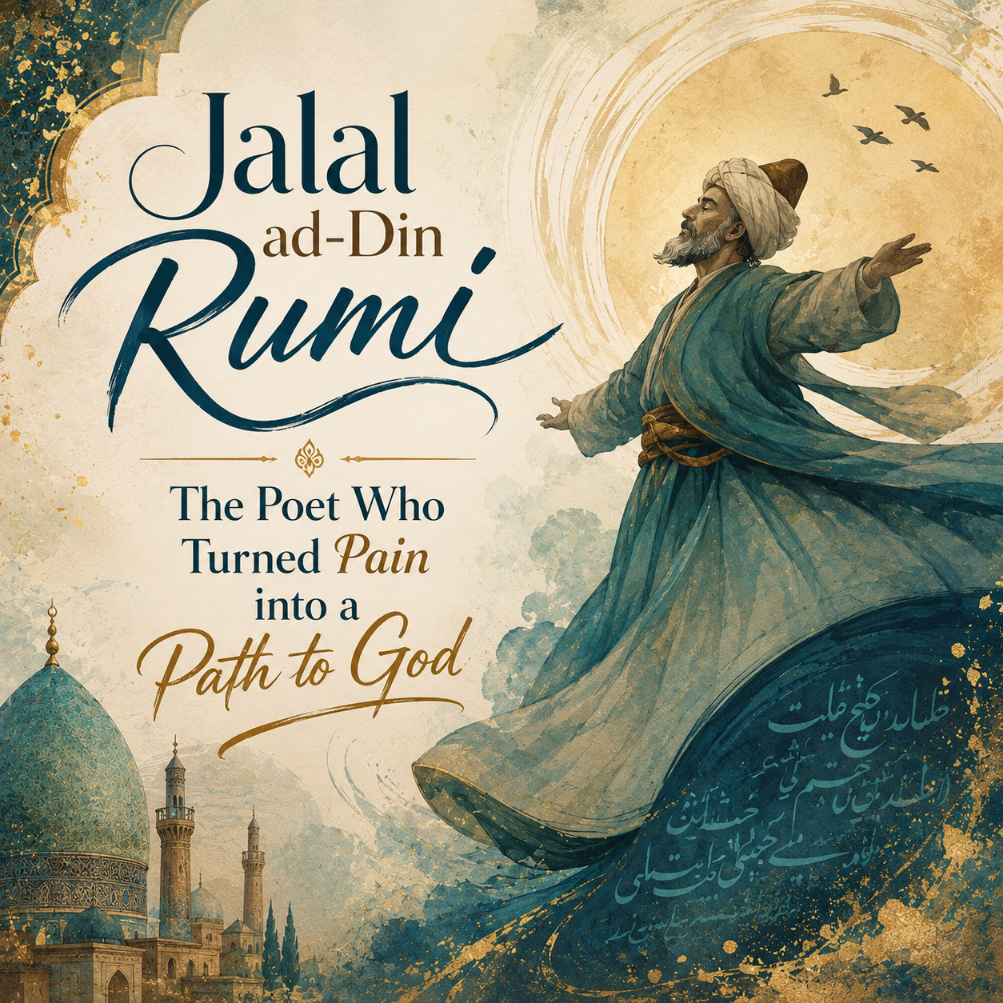
The Beginning of a Life Marked by Seeking
Jalal ad-Din Muhammad Rumi is one of those figures in human history who do not belong to just one era, religion, or culture. He is a poet, mystic, philosopher, and spiritual teacher whose words continue to feel relevant even eight centuries after his death. Born in 1207 in Balkh, a city within the borders of present-day Afghanistan, Rumi grew up in a world shaken by political conflicts, invasions, and spiritual crises. His family left their homeland because of the threat of the Mongol invasions, and this early exile left a lasting mark on the future poet’s consciousness. Traveling through different lands and encountering various cultures from childhood shaped that extraordinary worldview which would later become the foundation of his poetry.
Rumi’s father, Baha ad-Din Walad, was a respected theologian and spiritual teacher known for his wisdom and deep knowledge of Islamic philosophy. From an early age, Rumi was surrounded by books, conversations about God, and discussions about the human soul. Instead of receiving an ordinary education, he was raised in an environment that combined religious sciences, literature, philosophy, and spiritual practice. His family passed through Nishapur, Baghdad, and Damascus before settling in Konya, within the Seljuk Sultanate. It was there that the true spiritual maturation of the young scholar began.
In his early years, Rumi was known more as a theologian and teacher than as a poet. He gave lectures, guided students, and enjoyed the respect of society. His life appeared orderly, predictable, and stable until fate brought him face to face with the man who would change everything – Shams of Tabriz. This meeting became not only a turning point for Rumi but also one of the most significant spiritual events in the history of mystical literature.
The Meeting with Shams of Tabriz and the Destruction of the Old Self
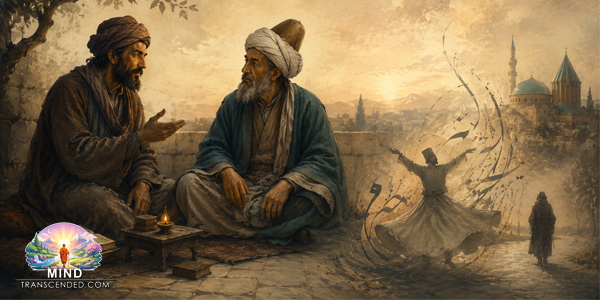
In 1244, the wandering dervish Shams of Tabriz entered Rumi’s life – a mysterious figure about whom little is known with certainty even today. Shams did not resemble traditional religious teachers. He did not seek recognition, care about social status, or speak the language of institutions. Instead, he asked uncomfortable questions and challenged people to destroy their own illusions. When he met Rumi, Shams saw in him enormous spiritual potential, but also a man trapped within the boundaries of knowledge.
According to a famous story, Shams asked Rumi: “Who is greater – the Prophet Muhammad or Bayazid Bastami?” The question shocked Rumi because it sounded almost blasphemous. But Shams wanted to reveal the difference between knowledge about God and the true experience of the divine. This conversation changed Rumi forever. He began to understand that spirituality is not merely learning, but the burning away of the ego, the destruction of inner walls, and complete immersion in love.
The two spent long hours in conversation, meditation, and spiritual practice. Rumi’s students and relatives became jealous of Shams’ influence, and tension gradually grew around them. For many, it was incomprehensible how the respected scholar had transformed into a man who danced, recited poetry, and spoke of love as the highest form of knowledge. But it was precisely through this transformation that the true Rumi was born – the poet the world knows today.
The disappearance of Shams became one of the most painful events in Rumi’s life. According to some accounts, he was murdered; according to others, he simply left Konya forever. Whatever the truth, Rumi experienced immense loss. Yet this pain became a source of inspiration. Instead of shutting himself away in suffering, he began writing poetry that searched for the meaning of absence, love, and union with God.
One of his most famous quotes says: “The wound is the place where the Light enters you.” These words are not merely a beautiful thought, but a reflection of his own life. Rumi discovered that spiritual maturity is not reached through comfort and security, but through loss, loneliness, and inner destruction. Pain is not the enemy, but a doorway to deeper understanding.
Love as the Center of the Universe
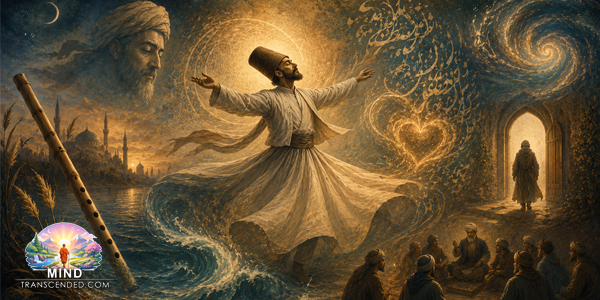
For Rumi, love was not romantic emotion in the ordinary sense of the word. It was a cosmic force that moves the world and connects human beings to God. In his poetry, love is simultaneously fire, sea, madness, and salvation. It destroys the ego, yet liberates the soul. According to Rumi, a person cannot truly know themselves unless they have experienced deep love.
He often used stories and metaphors to explain his spiritual ideas. In one of his most famous parables, he tells of the reed flute separated from its field. The flute cries because it has been cut off from the place where it belongs. This image symbolizes the human soul separated from its divine source. Human beings feel constant sadness and emptiness because, subconsciously, they long to return to God.
In another poem, Rumi writes: “What you seek is seeking you.” This thought remains so popular today because it contains a simple yet profound truth. According to him, the spiritual path is not a one-sided effort. If a person sincerely longs for truth, truth itself begins to move toward them. Love between humanity and God is a mutual movement, not a cold religious system.
Rumi believed that love is stronger than fear, dogma, and divisions between people. He lived during a time of religious conflict, but his poetry transcended the boundaries of Islam and spoke a universal language. That is why his words are read today by people of many beliefs. He did not call for fanaticism, but for inner awakening.
One of his most quoted thoughts says: “Come, come, whoever you are. Wanderer, worshiper, lover of leaving – it does not matter. Ours is not a caravan of despair.” In these words, one can feel immense humanity and acceptance. Rumi placed no conditions on spirituality. He believed that every person, no matter how lost, can find a path toward the light.
The Story of the Elephant in the Dark Room
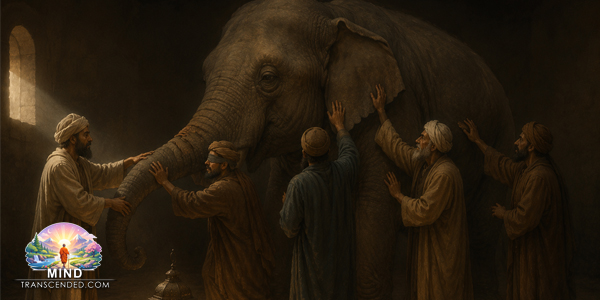
Among the most popular stories associated with Rumi is the parable of the elephant in the dark room. In it, a group of people enter a dark room where an elephant stands. Since there is no light, each person touches a different part of the animal and reaches their own conclusion. One touches the trunk and says the elephant is like a snake. Another touches the leg and claims it is like a column. A third touches the ear and decides it is like a giant fan.
The story reveals the limitations of human perception. Every person sees only part of the truth and often believes their own perspective is absolute. According to Rumi, true wisdom begins when a person realizes their own limitations. The light in the story symbolizes spiritual enlightenment, which allows people to see the whole.
This parable is especially relevant in the modern world, where society is divided by ideologies, religions, and political beliefs. People often argue fiercely because they defend only one fragment of reality. But Rumi reminds us that truth is greater than individual opinion. Only humility can open the way to deeper understanding.
The story of the elephant also reveals another truth – the need for inner light. Without it, a person remains trapped in the darkness of their own ego and misconceptions. That is why Rumi constantly emphasized the importance of spiritual work on oneself. He believed people must cleanse their hearts of pride, envy, and fear in order to see the world more clearly.
The Dance of the Dervishes and Spinning as Prayer
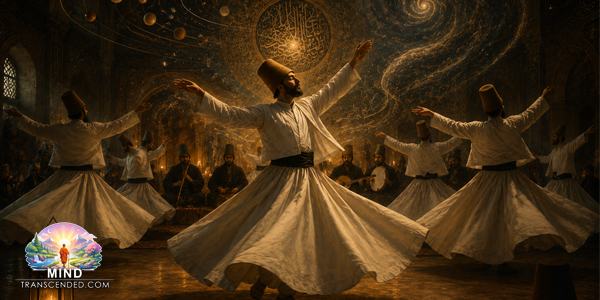
One of the most famous symbols associated with Rumi is the dance of the whirling dervishes. After his death, his followers created the Mevlevi order, which transformed spinning into a spiritual practice. To an outside observer, it may appear to be a dance, but for the dervishes it is a form of prayer and meditation.
The spinning symbolizes the movement of the universe. Planets revolve around the sun, blood circulates through the human body, and atoms move endlessly. Human beings are also part of this cosmic rhythm. When the dervish spins, he seeks to free himself from the ego and merge with the divine presence.
Rumi often used music as a spiritual language. For him, melody was not mere entertainment, but a means of awakening the soul. According to him, human beings carry within themselves a memory of paradise lost, and music can awaken that memory. This is why, during the rituals of the dervishes, music and movement are inseparable.
Many criticized these practices as overly emotional or even dangerous. But Rumi believed that cold religiosity cannot lead to genuine spiritual experience. He was not afraid of ecstasy because he saw in it the destruction of the false self. In his world, God is not a distant judge, but a living love that can be felt with one’s entire being.
Poetry as a Path to the Infinite
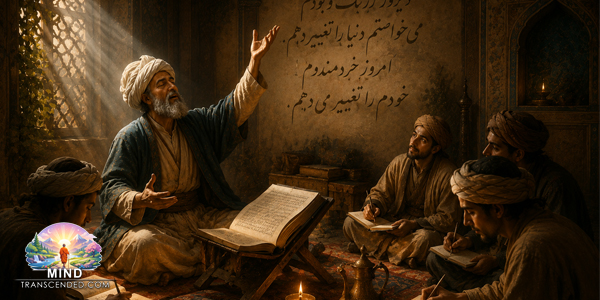
Rumi did not write poetry in order to impress readers with complicated literary techniques. His verses emerged as a natural outpouring of spiritual experience. He often dictated poems while in a state of inspiration, and his students wrote them down. This explains why his works contain such powerful emotional intensity and a sense of immediacy.
His most famous work is the “Masnavi” – a massive six-volume poem that many call “the Quran in Persian.” In it, Rumi combines stories, parables, philosophical reflections, and spiritual lessons. The text does not follow strict logical order, but rather resembles a stream of consciousness. This may appear chaotic to modern readers, but in fact it reflects the way mystical knowledge unfolds.
In the “Masnavi,” Rumi uses everyday situations to reveal spiritual truths. He tells stories about kings, beggars, merchants, animals, and lovers, but behind every story lies a deeper meaning. One reason his poetry is so powerful is precisely his ability to connect the ordinary with eternity.
Among his most beautiful thoughts is the following: “Yesterday I was clever and wanted to change the world. Today I am wise and am changing myself.” These words reflect a fundamental principle in Rumi’s teaching. True transformation begins within. A person cannot bring harmony to the world if they themselves are filled with chaos.
The Story of the Man Who Knocked from Outside
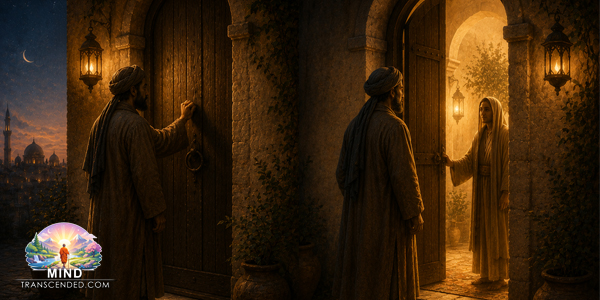
One of the deepest stories attributed to Rumi tells of a man who went to the house of his beloved and knocked on the door. A voice from inside asked, “Who is it?” The man answered, “It is I.” The door remained closed. After some time, he returned and knocked again. “Who is it?” asked the voice once more. This time the man answered, “It is you.” Then the door opened.
This short story contains an entire philosophy of love and spirituality. As long as a person is obsessed with their own ego, they remain separated from God and from other people. True union becomes possible only when the “I” dissolves. According to Rumi, the greatest obstacle to spiritual awakening is excessive attachment to one’s identity.
In the modern world, people constantly strive to construct images of themselves. Social media, ambition, and competition intensify the feeling of separateness. But Rumi offers the opposite path – a path toward humility and dissolution. This does not mean destroying the personality, but freeing oneself from false masks.
The story of the door also reminds us of something else – that love requires inner transformation. It is not enough simply to desire closeness. One must learn to move beyond their fears and pride. Only then can the “door” open.
Rumi and the Theme of Pain
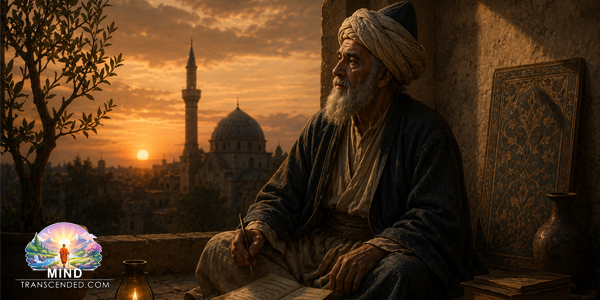
Few poets have spoken about pain with such honesty and depth as Rumi. For him, suffering was not punishment, but an opportunity for purification. He did not romanticize pain, but saw it as part of spiritual maturation. A person who has never suffered often remains superficial and trapped in illusions.
Rumi compared the human heart to a mirror that must be polished. Pain is precisely this polishing process. It removes accumulated pride and self-deception. In one of his poems he says: “Do not turn away from sorrow. One day it may become your teacher.”
After the disappearance of Shams, Rumi fell into deep sorrow. But instead of closing himself off in despair, he transformed pain into creativity. It was then that some of his most beautiful verses were born. This is also an important lesson for modern people – suffering can be destructive, but it can also become a source of inner strength.
Today, society often encourages escape from pain. People seek constant comfort, distraction, and instant pleasure. But Rumi reminds us that true growth requires confronting one’s wounds. Without this encounter, a person remains spiritually immature.
Rumi’s Influence on the World
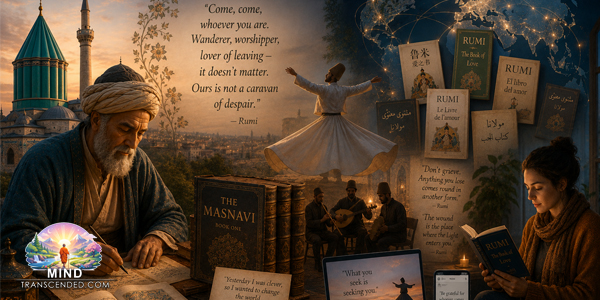
Although he lived in the thirteenth century, Rumi remains one of the most widely read poets in the modern world. His books have been translated into dozens of languages, and his quotes are constantly shared online. The reason for this popularity is not only the beauty of his poetry, but the universality of his messages. He speaks about themes that concern every human being – love, loss, meaning, fear, and the search for truth.
Interestingly, Rumi is often interpreted differently across cultures. In the West, he is frequently presented as a poet of love and spirituality, almost detached from the Islamic context. In the Muslim world, however, he remains above all a mystic and religious teacher. The truth probably lies somewhere in between. Rumi is deeply connected to Islamic tradition, yet at the same time transcends the narrow boundaries of religious identity.
His influence can be felt not only in literature, but also in psychology, music, and spiritual practices. Many contemporary therapists use quotes from Rumi because they touch deep human experiences. Musicians and artists also draw inspiration from his imagery and ideas.
It is fascinating that in a world dominated by technology and speed, Rumi’s words still sound relevant. Perhaps this is because he speaks about something modern people often lose – connection with their own soul. His poetry reminds us that beyond the noise of everyday life, there exists a deeper reality.
The Story of the Chickpea in the Pot
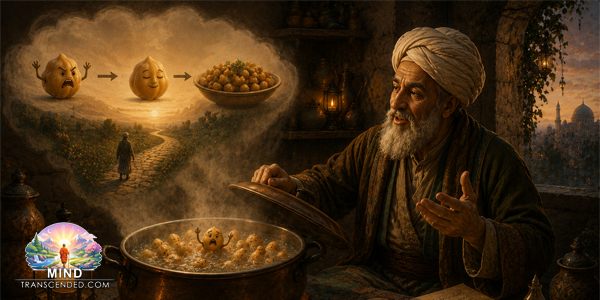
Among Rumi’s stories there is an unusual parable about a chickpea boiling in a pot. As it cooks in the boiling water, the chickpea begins to complain: “Why are you tormenting me?” The cook replies: “I am not boiling you out of cruelty. I want you to become nourishing and useful.” Behind this seemingly simple story lies an important spiritual lesson.
According to Rumi, life’s difficulties often appear meaningless when a person is immersed in them. But it is precisely through trials that the soul changes and matures. Just as the chickpea cannot become food without fire, a person cannot reach depth without suffering. This does not mean every pain is good, but that within it may lie the possibility of transformation.
The story also raises the question of trust. People rarely understand immediately why something difficult is happening to them. Sometimes meaning is revealed only years later. Rumi believed that life has a hidden order that transcends human understanding.
This parable is especially valuable today, when people often perceive every hardship as failure. Rumi offers a different perspective. Instead of asking, “Why am I suffering?” one can ask, “What is this experience trying to teach me?” In this shift of perspective lies the beginning of spiritual maturity.
Silence and the Power of the Inner World
Although he is famous for his poetry, Rumi often spoke of silence as the highest form of knowledge. According to him, words can only partially express truth. The deepest spiritual experiences remain beyond language. That is why many of his poems carry a longing for something that can never be fully spoken.
He writes: “Silence is the language of God, all else is poor translation.” This thought is incredibly powerful because it questions humanity’s obsession with constant talking. In the modern world, people are endlessly flooded with information, opinions, and noise. But Rumi reminds us that true wisdom is often born in silence.
For him, silence is not emptiness, but a space for inner listening. Only when the mind becomes calm can a person hear the deeper voice of the soul. That is why spiritual practices in Sufism often include meditation, contemplation, and withdrawal from external noise.
This idea is especially important in today’s age of constant distraction. People rarely remain alone with themselves. Phones, social media, and endless communication create the illusion of connection, but often lead to inner emptiness. Rumi reminds us that human beings must learn to be alone with their own soul.
Death as a Return
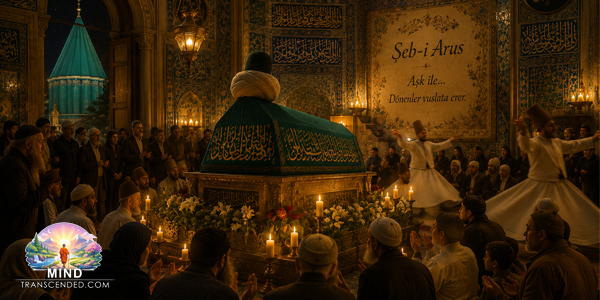
Rumi did not view death as a tragic end, but as a return to the source. In the Sufi tradition, death is often seen as a transition to a higher reality. That is why the day of his death is called “Shab-e Arus” – “The Wedding Night.” It symbolizes the soul’s union with God.
This perspective is completely different from the usual human fear of death. According to Rumi, fear arises from excessive attachment to the material world and the ego. If a person realizes that the soul is eternal, death loses its terrifying power.
In one of his poems he writes: “When I die, do not seek my grave in the earth. You will find it in the hearts of people.” These words reveal how deeply he understood the power of spiritual legacy. A person’s true life is measured not only by physical existence, but by the influence they leave upon the souls of others.
Interestingly, Rumi’s funeral brought together people of different religions. Muslims, Christians, and Jews all gathered to honor the poet. When some objected to the presence of non-Muslims, they replied: “We know Moses, Jesus, and all the prophets through him.” This is perhaps the most beautiful proof of the universal impact of his personality.
Why Rumi Continues to Move Us
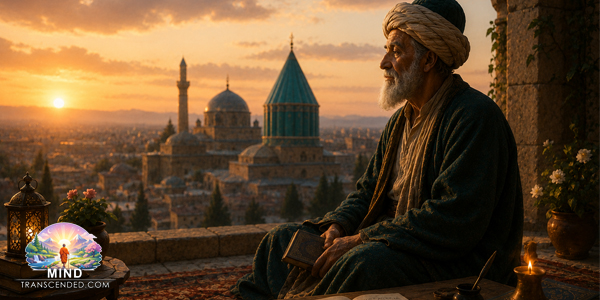
In a world where people increasingly feel lost, anxious, and disconnected from one another, Rumi’s words sound like a reminder of something essential. He does not offer easy solutions or superficial optimism. Instead, he invites people to turn inward and meet their own soul.
Many modern people feel inner emptiness despite material comfort and technological progress. Rumi would say this emptiness is a sign of spiritual hunger. Human beings cannot be truly fulfilled through external success alone. The soul longs for meaning, love, and connection with something greater.
His poetry has the power to touch people deeply precisely because it speaks not only to the mind, but also to the heart. Within it there is both tenderness and strength, pain and hope. Rumi does not hide human weakness, but shows that behind it lies the possibility of transformation.
Today, centuries after his death, millions of people continue to find comfort and inspiration in his words. This proves that true poetry does not belong to time. It touches something eternal in human nature. And Rumi, more than many other poets, succeeds in reaching that eternity.
Conclusion – The Path to the Heart
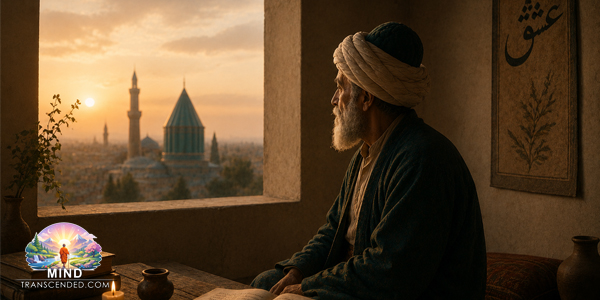
The life of Jalal ad-Din Rumi is a story of transformation. He began as a respected scholar, but became a mystic who placed love at the center of the universe. His meeting with Shams of Tabriz destroyed his old self and opened the way toward a much deeper understanding of life. From this inner revolution emerged verses that continue to transform people even today.
Rumi teaches that pain can become a doorway to light, that love is stronger than fear, and that true wisdom begins with humility. His stories and parables are not merely literary ornaments, but spiritual maps for the human soul. They reveal that behind everyday experiences lie profound truths.
Perhaps Rumi’s most important lesson is that human beings must learn to listen to their hearts. Not to the superficial desires that constantly change, but to the deep inner voice that seeks meaning and love. In a world filled with noise and division, his words sound like a quiet yet powerful reminder of humanity.
Rumi and the Connection Between Humanity and Nature
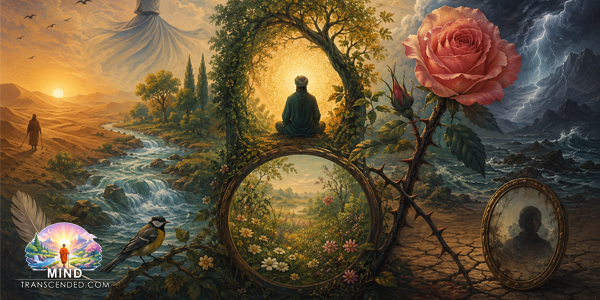
In Rumi’s poetry, nature is never merely a background. Trees, rivers, deserts, wind, and birds are living symbols through which he speaks about the soul and God. For him, the entire universe is filled with signs that human beings can read if their hearts are awake. While many people see nature as something external and separate from themselves, Rumi experiences it as part of one immense living whole.
He often compares the human soul to a garden. If a person does not care for their inner world, weeds begin to grow within it – fear, envy, anger, and greed. But if they water the soul with love and attention, it blossoms. In one of his poems, Rumi writes: “Sell your cleverness and buy bewilderment.” It is a call for people to return to that childlike sense of wonder which modern life so often destroys.
The image of the rose is especially powerful in his poetry. The rose symbolizes the beauty of the divine, while the thorns represent the difficulties on the spiritual path. According to Rumi, a person cannot reach the fragrance of the rose without accepting the presence of the thorns. In other words, beauty and pain often walk together.
Nature in Rumi’s verses is also a mirror of inner states. The storm symbolizes spiritual crisis, the river – the movement of life, and birds are often images of the liberated soul. This symbolism makes his poetry both simple and profound. Every natural image becomes a door to a deeper understanding of human existence.
Solitude as a Spiritual Trial
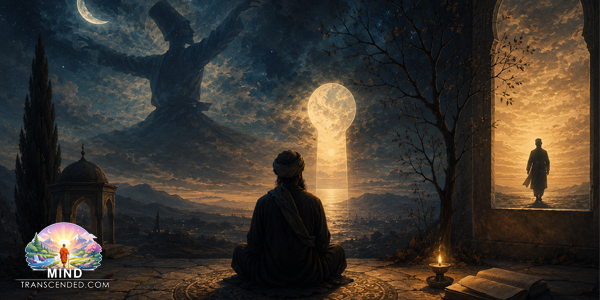
One of the themes constantly present in Rumi’s work is solitude. He understands that every person, at some point, faces the feeling of inner isolation. But instead of fleeing from this state, Rumi sees in it an opportunity for deeper self-knowledge. Solitude can be painful, but it can also become sacred.
After Shams’ disappearance, solitude became the poet’s constant companion. At first it was filled with grief and confusion. Gradually, however, Rumi began to discover that it is precisely in absence that a new presence is born. The beloved may be physically gone, but the love awakened through him remains alive.
In one of his poems, he says: “When you are left alone, it does not mean you have been abandoned. Sometimes God removes the noise so you can hear the truth.” These words have enormous meaning for modern people, who often fear silence and isolation.
For him, solitude is not merely a social condition, but a spiritual space. In it, a person meets their fears, desires, and wounds. This very encounter can lead to true inner change. Rumi teaches that a person who learns to be alone is no longer dependent on the constant approval of the world.
The Story of the Lost Key
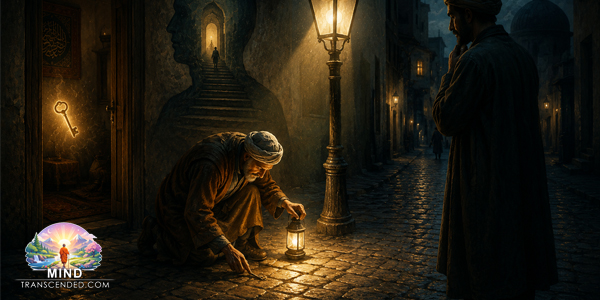
Among the stories often associated with the Sufi tradition and the spirit of Rumi is the parable of the man who lost his key. At night, he searched for the key under a streetlamp. A passerby asked him whether he had lost it there. The man replied: “No, I lost it at home, but there is more light here.”
People often look for solutions to their inner problems in the wrong places. Instead of turning inward, they try to fill the emptiness through external things – money, power, recognition, or constant entertainment. Rumi would say that this is like searching for the key under the lamp simply because it is easier.
The story also shows how difficult true self-knowledge is. It is much easier for a person to occupy themselves with the outside world than to face their own fears and weaknesses. But it is precisely the inner search that can lead to liberation. The key is not where it is easiest to look, but where it was lost.
This parable is especially relevant in contemporary culture, which constantly suggests that happiness is found outside us. Rumi offers a radically different approach. He believes that the person already carries within themselves what they seek, but must dare to enter the darkness of their own soul.
Rumi and the Relationship Between Religion and Spirituality
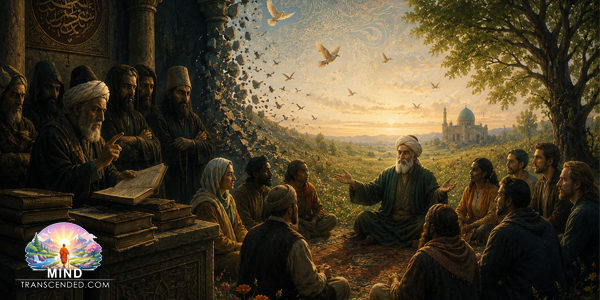
Although he was a deeply religious person, Rumi often criticized superficial religiosity. For him, there is no point in performing rituals if the heart is cold. He believed that true spirituality is not measured by outward behavior alone, but by the state of the soul.
In many of his stories, Rumi shows how people cling to the letter of the law and forget its spirit. He does not reject religion, but warns against fanaticism and pride. According to him, a person may appear pious outwardly and yet remain far from love. And without love, no ritual has true value.
One of his favorite ideas is that God cannot be confined within human concepts. In one of his verses he says: “Out beyond ideas of wrongdoing and rightdoing, there is a field. I’ll meet you there.” These words are often quoted because they speak of a space beyond judgment, where the soul can meet another soul without masks.
Rumi does not call for indifference toward morality, but for deeper understanding. He believes that true spirituality gives birth to compassion and love, not hatred toward those who are different. That is precisely why his words continue to be meaningful to people from many religious and cultural backgrounds.
The Story of the Chinese and Greek Painters
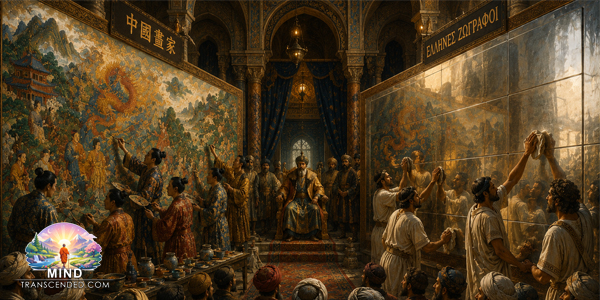
In the “Masnavi,” Rumi tells a story about a contest between Chinese and Greek painters. The ruler wanted to know who was better. The Chinese worked on one wall, and the Greeks on the other. The Chinese painted beautiful images, while the Greeks did something unusual – they polished their wall until it became like a mirror.
When the curtain was lifted, the polished wall of the Greeks reflected the Chinese paintings and made them appear even more beautiful. The story symbolizes the human heart. According to Rumi, true wisdom does not come only from accumulating knowledge, but from purifying the inner world.
A person may read countless books and still remain trapped in their own ego. But if they “polish” their heart through humility and love, they begin to reflect divine beauty. This is also the meaning of spiritual practice – not to decorate oneself outwardly, but to become inwardly clear.
This story is important for the modern world as well, where information is everywhere. People know more and more, yet often become more anxious and confused. Rumi reminds us that knowledge without inner wisdom is not enough. The heart must also be purified.
The Power of the Present Moment
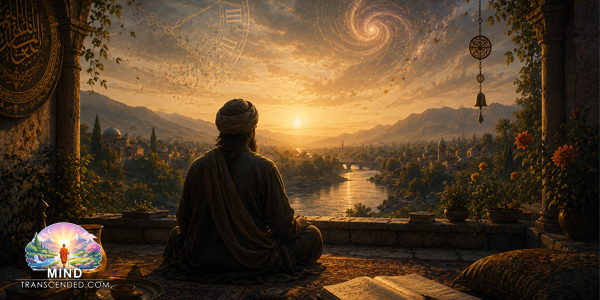
Rumi often speaks of the danger of living in the past or the future. The past brings guilt and regret, while the future brings fear and anxiety. True life, however, happens only in the present. That is why he encourages people to awaken to the moment they are already living.
In one of his verses, the poet says: “The past and the future veil God from our sight. Burn up both of them with fire.” These words do not mean that a person should forget their history or stop thinking about the future. Rather, they mean that a person must not become a prisoner of them.
Modern people often live in constant anxiety. They think about the next task, the next problem, or the next achievement. As a result, they lose the ability to experience life as it is in the moment. Rumi reminds us that the present is the only door through which a person can touch reality.
To be in the present, according to him, means to be present with one’s whole being. When eating, to taste the food. When listening to another person, to be truly attentive. When praying or meditating, to be fully there. This simple presence can become a form of spirituality.
The Legacy of an Immortal Poet
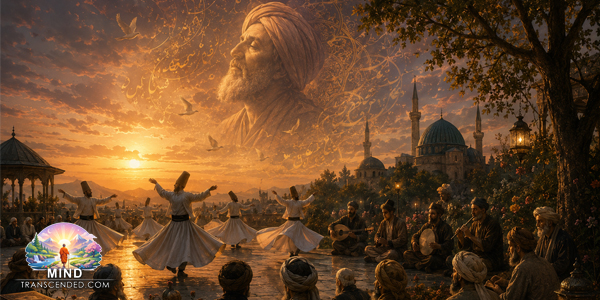
After Rumi’s death, his students and followers continued to spread his teaching. The order of the whirling dervishes became one of the most famous Sufi orders in the world. But Rumi’s true legacy is not only in the rituals, books, or historical monuments. It is in the transformation he continues to inspire.
For centuries, people have returned to his poetry in moments of crisis, love, loss, and seeking. This shows how deeply he understood the human soul. He does not offer ready-made formulas, but direction. Instead of giving simple answers, he opens doors to deeper questions.
Rumi remains relevant because he does not separate the spiritual from the human. In his verses there is laughter, tears, passion, pain, and tenderness. He does not present spirituality as an escape from life, but as a deeper immersion into it. That is why his poetry does not sound distant or abstract, but alive.
Today the world is different from the one in which Rumi lived, but the human heart remains the same. People still seek love, meaning, and belonging. They still suffer, lose, hope, and dream. That is why Rumi’s poetry continues to speak directly to them.
That is exactly why Rumi remains alive. Not only in books and quotations, but in his ability to awaken something deep within people. His poetry continues to shine like a lamp in the dark because it speaks of what cannot be destroyed – the longing of the soul for love, truth, and God.
Read More:
- Farid ud-Din Attar – “The Mystic Who Turned the Soul into a Journey”
- Sufism: The Mystical Path to God – History, Secrets, and Great Sufi Teachers
- G.I. Gurdjieff – The Mystic, Occultist, and Teacher of the Fourth Way
Author: Vasil Stoyanov