
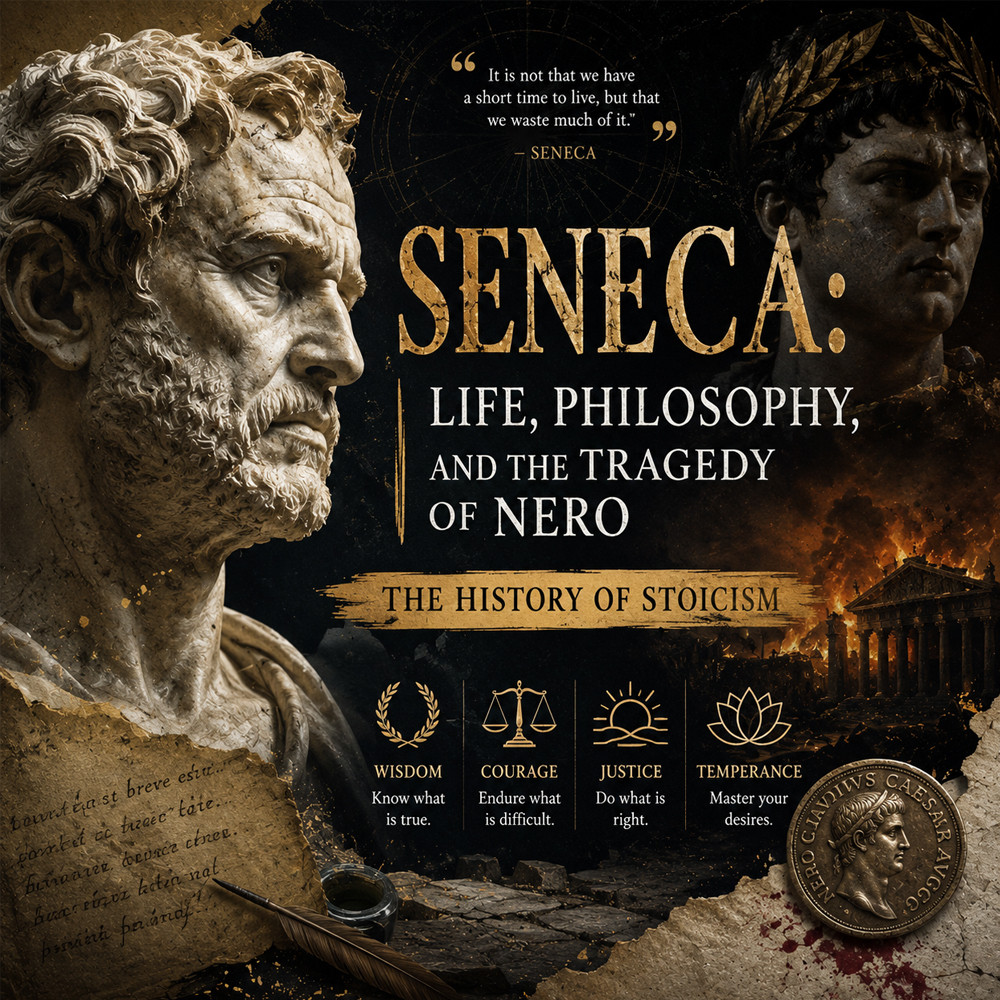
Part One: Between Wisdom and Power
In the early years of the Roman Empire, power had a face that could change overnight. A man could fall asleep as the emperor’s favorite and awaken as his enemy. Senators whose ancestors had once governed the Republic had learned to study the ruler’s expression before daring to voice their own opinions. Wealth, ancestry, and social standing offered no guarantee of safety, for above every law stood the will of a single man, and that will was often governed by suspicion, fear, and the desire for absolute dominion.
It was into this world that Lucius Annaeus Seneca emerged, a man whose name would outlive the emperors before whom he was forced to bow. He was not a military commander who conquered foreign lands, nor a ruler whose commands determined the fate of millions. His greatest weapon was language, and his longest battle was fought in the space between human reason and human passion. Seneca would become one of the most influential representatives of Stoicism, yet his life would bear little resemblance to the peaceful existence of a sage removed from worldly concerns. He would accumulate enormous wealth, rise to the heights of political power, endure exile, and ultimately receive an order to end his own life.
It is precisely this contradiction that makes his story far more significant than an ordinary biography of an ancient philosopher. Seneca preached moderation while living amid luxury. He warned of the dangers of power while participating in the government of the most powerful state of his age. He wrote about freedom of the spirit while his fate depended on the moods of emperors who could destroy his life with a single command. And despite everything, he left behind a philosophy that continues to raise an uncomfortable question: how can a person remain faithful to his principles when the world constantly forces him to compromise them?
To understand Seneca, one must also understand the Rome in which he lived. It was a world of magnificent temples, marble palaces, public baths, libraries, and splendid roads connecting distant provinces. Yet behind the brilliance of civilization stood a system built upon slave labor, military conquest, political rivalry, and an endless struggle for influence. The Romans revered virtue, discipline, and honor, but their rulers frequently displayed precisely the opposite qualities. In this environment, philosophy was not merely a pastime but a means by which a person sought to preserve his inner integrity within a society capable of rewarding vice and punishing virtue.
The Child from Corduba and the Road to the Eternal City
Seneca was born around 4 BC in Corduba, modern-day Córdoba, on the Iberian Peninsula. At the time, the city formed part of the Roman province of Baetica, a region where Roman culture had already become intertwined with local traditions. His family belonged to the wealthy and educated classes, which could provide their children with an education inaccessible to much of the population. His father, known as Seneca the Elder, was a respected authority on rhetoric and preserved numerous examples of the art of public speaking in his writings. His mother, Helvia, also came from a distinguished family and would later occupy an important place in her son’s life and philosophical reflections.
While still young, Seneca was sent to Rome, where he received the education necessary for a future public career. The imperial capital was an enormous stage upon which every ambitious young man could observe how influence, prestige, and wealth were acquired. Its streets were filled with merchants from distant provinces, senators accompanied by their attendants, soldiers, slaves, philosophers, and orators competing for the attention of influential citizens. Rome was a city where words could open the doors to political power, and a well-delivered speech could elevate a man beyond his social position. For the young Seneca, mastery of language was both an intellectual calling and a necessity.
His father wanted him to devote himself to rhetoric and public service, but the young Seneca was also drawn to philosophy. He attended the teachings of masters who represented different schools and offered different answers to the question of how one ought to live. Among those who particularly influenced him were the Stoic Attalus, the philosopher Sotion, and Papirius Fabianus, who was associated with the school of Sextius. From these teachers, Seneca adopted the conviction that philosophy should not be confined to elegant arguments but should transform a person’s everyday conduct. According to this view, genuine knowledge was demonstrated not by the ability to debate but by the capacity to govern one’s own life.
This idea left a lasting impression on the young Roman. He began to regard philosophy as a discipline requiring constant work upon oneself, observation of one’s reactions, and the deliberate restraint of desires. For a time, he followed an austere way of life, including abstinence from certain foods and bodily pleasures. Such practices were not merely matters of health or personal preference but a means of testing his independence from habit. A person who could not refuse a small pleasure would find it difficult to resist a greater temptation when wealth, prestige, or power was at stake.
Even then, the tension that would accompany Seneca throughout his life was beginning to take shape. On one side stood the path of the philosopher, striving for inner freedom and self-sufficiency. On the other stood the path of the Roman statesman, whose success depended upon political relationships, public expectations, and the favor of those in power. Seneca never definitively chose one path at the expense of the other. Instead, he spent his life attempting to reconcile them, and the price of that attempt gradually grew ever higher.
The First Lessons of Suffering
Long before he confronted the cruelty of the imperial court, Seneca encountered an adversary that cared nothing for his ancestry, education, or ambitions. That adversary was his own body. During his youth, he suffered from serious health problems, including severe respiratory attacks that he would later describe in his letters. At times, illness brought him to a state of extreme exhaustion and the sensation that death was immediately at hand. For a man who studied philosophy as preparation for life’s trials, suffering ceased to be an abstract subject and became an everyday reality.
In one of his letters to Lucilius, Seneca describes the severity of attacks in which breathing became an agonizing struggle. He knew what it felt like to believe that life might end not in decades but within the next few minutes. Such an experience transforms one’s attitude toward ordinary human anxieties, revealing how fragile are the plans people make in the conviction that they possess unlimited time. For Seneca, illness became a stern teacher, constantly reminding him of the body’s dependence upon circumstances beyond human control. It was precisely this dependence that deepened his interest in whether there existed a realm of life that suffering could not subjugate.
His health led him to spend some time in Egypt, where he stayed with his aunt and her husband, the Roman governor Gaius Galerius. Egypt was one of the empire’s most important provinces, an ancient land whose cultural monuments preceded Rome by thousands of years. For an educated man such as Seneca, his stay there offered an opportunity to observe different traditions and distance himself from the political environment of the capital. Recovery was among the reasons for his journey, but the experience also broadened his understanding of the world beyond Roman social ambitions. When he returned to Rome, he carried with him the experience of a man who had confronted his own mortality at close range.
Seneca never regarded philosophy as a promise of a life without pain. Stoicism, which gradually became the foundation of his thinking, did not deny the existence of illness, loss, and misfortune. It taught that human beings do not possess complete control over events, but they remain responsible for how they judge and confront them. The distinction between these two realms was decisive, for it freed a person from the impossible task of controlling the entire world. For Seneca, this was not a comforting theory but a practical necessity forged during periods when his own body refused to obey him.
What It Means to Be a Stoic
Stoicism emerged several centuries before Seneca, when Zeno of Citium began teaching in Athens around the beginning of the third century BC. The school took its name from the Stoa Poikile, or Painted Porch, where Zeno gathered his followers. Over time, the teaching developed into a comprehensive philosophical system encompassing logic, nature, and human conduct. The Stoics regarded the universe as an ordered whole in which a rational principle connected individual events and beings. As a creature capable of reasoning, man was expected to live in accordance with nature and reason rather than become a slave to his own impulses.
For the Stoics, the highest good was not wealth, fame, pleasure, or even physical health. The only true good was virtue, understood as the perfection of rational character. Wisdom, justice, courage, and temperance formed the foundations of a worthy life. Everything else could be preferred or avoided according to circumstances, but it did not determine a person’s moral worth. A wealthy man was not good merely because he possessed property, just as a poor man was not bad because he lacked it. The true measure depended on how a person used whatever fortune placed in his hands.
This philosophy is often misunderstood as a call to emotional indifference. The Stoics, however, did not insist that a person should cease to love, experience affection, or take joy in life. They sought to free reason from the destructive passions that arise when mistaken judgments take possession of the human mind. Anger, uncontrollable fear, envy, and insatiable greed were regarded as conditions in which a person surrendered control of his life to forces he had himself allowed to dominate him. The sage was not a stone statue devoid of humanity but a person who refused to allow emotional impulses to destroy his judgment.
Seneca gave these ideas a distinctive literary and psychological character. While some of the earlier Stoics constructed complex theoretical systems, he was interested in the specific weaknesses of real human beings. His writings examine the fear of death, the painful desire for recognition, the destructive power of anger, dependence on wealth, and the inability to use time wisely. Seneca wrote about people who grow angry with their servants, envy their neighbors, pursue honors, and worry about the future while allowing the present to slip away. It is precisely this closeness to everyday human experience that explains why his works continue to be read far beyond the historical age in which they were written.
At the heart of his philosophy stood the conviction that a person should make the development of his own character the most important undertaking of his life. Society might reward or reject him, fortune might grant him wealth or take it away, and his body might remain healthy or fall ill. None of these events removed the necessity of acting reasonably and justly. This was an extraordinarily demanding requirement, especially for someone seeking political influence in imperial Rome. Seneca would soon discover that between philosophical convictions and actual conduct lay a distance that eloquence alone could not overcome.
Caligula and the Danger of Being Noticed
After returning to Rome, Seneca began building a public career and established himself as a gifted orator. His style was distinguished by its energy, sharp contrasts, and ability to transform complex thoughts into memorable sentences. In a society where public speaking was one of the most important means of political advancement, such talent did not go unnoticed. Yet the attention of powerful men could prove dangerous, particularly when the most powerful among them was the emperor. Seneca entered political life at a time when Rome was gradually discovering the true price of absolute personal rule.
In AD 37, Gaius Caesar, remembered by history under the nickname Caligula, became emperor. His accession was initially greeted with hope, but his reign soon acquired a reputation for unpredictability, cruelty, and the humiliation of political institutions. Ancient authors describe numerous examples of his arrogance and suspicion, although some of their accounts were influenced by the hostility of later generations. For members of the senatorial class, the fundamental problem was clear: their lives depended upon a ruler who was under no obligation to tolerate independent personalities around him. Even intellectual success could be interpreted as a challenge.
According to the historian Cassius Dio, Seneca’s eloquence provoked Caligula’s irritation. The emperor regarded him as a man whose influence and abilities deserved suspicion, and the philosopher’s life was placed in danger. The ancient historian reports that Seneca was spared after a woman close to the emperor persuaded him that the philosopher’s poor health would soon bring about his natural death. How accurately this episode reflects what actually happened remains a matter of historical judgment, but the account itself reveals how later tradition understood Seneca’s position under Caligula. The talent that should have brought him recognition had also become a possible source of destruction.
For a Stoic, such danger represented a test of his fundamental convictions. If a person truly believed that external circumstances did not determine his moral worth, then the threat of death should not turn him into a slave of fear. Yet an enormous psychological distance separated the philosophical understanding of death from the immediate expectation of an imperial order. Seneca was not a flawless sage who had already conquered every human weakness. He was a man attempting to approach that ideal while living in an environment capable of constantly shattering his inner equilibrium.
In AD 41, Caligula was assassinated by conspirators, among whom were officers of the Praetorian Guard. His death demonstrated that even a man who appeared untouchable could not escape the violence upon which his own power rested. His uncle Claudius ascended the throne, and a new period of palace intrigue and political realignment began for Rome. For Seneca, the change did not bring the peace one might have expected following the removal of a dangerous ruler. Instead, his fate soon took a direction that would separate him from the capital and confront him with one of the most difficult trials of his life.
Exile in Corsica: When the World Shrinks to a Single Island
In that same year, AD 41, Seneca was accused of adultery with Julia Livilla, the sister of the late Caligula and niece of Emperor Claudius. The accusation arose amid palace rivalries in which Claudius’s wife, Messalina, played a significant role. The historical evidence does not allow Seneca’s guilt to be established with certainty, and the political circumstances provide good reason to regard the accusation with suspicion. The consequences, however, were entirely real. Seneca was removed from public life and sent into exile on the island of Corsica.
For a Roman accustomed to the intellectual and political life of the capital, Corsica represented a harsh change. The island was mountainous, relatively isolated, and far removed from the centers where the empire’s destiny was decided. Seneca lost the opportunity to participate in public affairs, meet influential figures, and continue the career he had spent years building. His life was no longer measured in speeches, political achievements, and new appointments, but in days spent far from Rome. What had once appeared to be a promising future was interrupted by a decision over which he had absolutely no control.
His exile lasted approximately eight years and left a profound mark on his writings. During this period, Seneca composed works of consolation, including texts addressed to his mother, Helvia, and to Polybius, an influential freedman at the imperial court. In his consolation to Helvia, he sought to convince her that exile was not a true misfortune for someone who had preserved his reason and character. He reflected upon the nature of one’s homeland, the human capacity to live in different places, and the independence of the spirit from geographical boundaries. According to this reasoning, a person does not lose his most important possession when forced to leave a particular city, because reason and virtue cannot be confiscated by political authority.
Yet the writings of his exile also reveal a more complicated human side of the philosopher. In his consolation to Polybius, Seneca employed flattering language toward Claudius, evidently hoping to secure imperial favor and facilitate his return. This work is frequently regarded as one of the most uncomfortable moments in his literary legacy, for it reveals a philosopher who preached independence from external circumstances while simultaneously seeking mercy from the very power that had punished him. The contradiction cannot be resolved by portraying Seneca as a faultless hero. His works testify both to his pursuit of moral resilience and to the difficulties he encountered when attempting to put his own principles into practice.
This is precisely what makes his experience so important for understanding Stoicism. Philosophy emerges not only from a person’s victories over his weaknesses but also from the recognition of how persistent those weaknesses can be. Seneca knew how a sage ought to reason, yet he continued to experience the pain of rejection, longing for home, and the desire to restore his social position. He did not cease to be human simply because he studied philosophy. Instead, he made his own imperfect nature one of the central subjects of his thinking.
A Man Can Be Banished from Rome, but Not from Himself
In the works he composed during his exile, Seneca developed one of the most essential ideas of Stoic philosophy: external loss is not equivalent to inner defeat. A person may lose his home, social position, wealth, and proximity to his friends, but this does not mean he has been deprived of the possibility of living with dignity. His reason remains his own, regardless of the geographical location in which he finds himself. Virtue does not depend upon the availability of comforts but upon how a person chooses to act under the circumstances presented to him. This is why the Stoic must prepare not only for success but also for the losses that inevitably accompany human existence.
This position did not mean that Seneca denied the natural human attachment to home and loved ones. He understood that a person experiences sorrow when separated from the people he loves and the places with which his life has become intertwined. Yet he insisted that suffering intensifies when the loss itself is accompanied by the conviction that life has no value without what has been lost. In his view, people are often tormented not only by what has happened but also by their own judgments about its significance. When a person begins to regard every change as an unbearable catastrophe, he transforms the world into a constant source of fear.
For Seneca, nature offered humanity a homeland far greater than the borders of any state. The sky, the stars, the seasons, and the laws of the universe did not belong exclusively to Rome. They remained accessible to the exile far from the capital, just as they did to someone deprived of wealth and political influence. This cosmopolitan understanding arose from the Stoic belief that all rational beings participate in a common natural order. A person was a citizen not only of his own city but also of a greater world whose order could not be overturned by an imperial decree.
These reflections also reveal an important limit to human power. The emperor could send Seneca to an island, strip him of his political position, and control whether he would ever return to Rome. But no command could, by itself, force him to regard injustice as justice or vice as virtue. Inner assent to a particular judgment remained a realm in which the individual bore personal responsibility. It was precisely this realm that the Stoics sought to strengthen through philosophy, because every other form of security could prove temporary.
Seneca gradually transformed his exile into a demonstration of one of his fundamental principles: a person must not postpone a worthy life until circumstances become favorable. If tranquility depended upon returning to Rome, then it remained hostage to the emperor’s will. If fulfillment depended upon the restoration of his social position, then every day spent outside the capital became a wasted day. Philosophy demanded that he find meaning in the present without making hope for the future his only reason for living. This was a difficult trial for a man who still longed to return to the world of politics.
Agrippina and the Return to the Heart of the Empire
In AD 49, Seneca’s fate underwent a sudden reversal. Following the death of Messalina, Emperor Claudius married Agrippina the Younger, a woman of extraordinary political ambition and powerful dynastic connections. Agrippina was determined to secure the future of her son Nero and began carefully constructing the environment that would support his rise. To achieve this, she needed influential allies capable of providing education, political legitimacy, and support among the Roman elite. Seneca, renowned for his eloquence and philosophical authority, proved a suitable choice.
At her insistence, he was recalled from exile and given the opportunity to participate in public life once again. He was soon appointed tutor to the young Nero, who already occupied an important place in the plans for succession to the throne. For Seneca, this meant more than simply recovering his former position; it meant entering the very center of imperial power. The man who had recently reflected upon the independence of the spirit on a remote island was now expected to educate a boy destined to govern an enormous empire. The contrast between these two circumstances was so dramatic that it seemed to mark a complete change in the direction of his life.
Nero had been born in AD 37 and, even as a child, had become entangled in the complex relationships of the imperial family. His mother, Agrippina, descended from the Julio-Claudian dynasty and understood the importance of ancestry, alliances, and public image. She wanted her son to be prepared for the role of ruler, and Seneca was expected to impart the knowledge and skills necessary for such a position. Rhetoric, literature, and moral instruction formed part of this education. Yet no teacher could completely control the character of a pupil growing up among people convinced that his future will should stand above the will of everyone else.
For Seneca, educating Nero represented an opportunity to apply philosophy on a scale rarely available to a thinker. If a ruler adopted moderation, justice, and self-control as the fundamental principles of government, the consequences would be felt by millions of subjects. Stoicism would no longer be merely a personal discipline but a potential source of political transformation. This was an attractive prospect for a man who believed that reason ought to guide human actions. Yet there was also an opposing danger: the philosopher might become an ornament of power without ever succeeding in changing its essential nature.
Seneca returned to Rome with a new social standing, but also with a new dependence. His position was now closely tied to Agrippina’s success and Nero’s future. The political changes that had brought him freedom could just as easily become a source of renewed danger. At the imperial court, gratitude, friendship, and loyalty were often intertwined with interests that shifted according to circumstances. Seneca entered this world as a philosopher, but he would soon be forced to act as a statesman.
The Boy Who Was Destined to Rule the World
In AD 54, Emperor Claudius died, and the seventeen-year-old Nero ascended the throne. Ancient sources associate Claudius’s death with suspicions of poisoning and direct those suspicions toward Agrippina, although the details surrounding the event remain the subject of historical debate. What is beyond dispute is that Nero’s accession resulted from prolonged preparation in which his mother played a decisive role. The young emperor inherited a degree of power that far exceeded his experience of life and personal maturity. At his side stood two particularly influential advisers: Seneca and the Praetorian prefect Sextus Afranius Burrus.
Burrus commanded the military force responsible for protecting the emperor, a force of enormous political importance. Seneca provided the intellectual and rhetorical guidance necessary to present the new ruler before the Senate and the public. Together, the two men sought to restrain the young emperor’s most dangerous impulses and direct his government toward a more moderate policy. The first years of Nero’s reign later received a relatively favorable assessment in parts of the historical tradition, particularly when compared with the events that followed. It was a period in which Seneca’s influence reached its height.
Yet the task before him was filled with contradictions. Stoic philosophy taught that reason must govern the passions, while the imperial system itself granted the ruler almost unlimited opportunities to satisfy his desires. Seneca had to convince a young man that moderation was more worthy than arbitrary rule, even though he was surrounded by people prepared to fulfill almost every whim. He had to cultivate respect for the law in a ruler whose position allowed him to stand above ordinary restrictions. And he had to preach self-control in an environment where public recognition and personal pleasure constantly nourished vanity.
During the early years, Seneca and Burrus succeeded in exercising considerable influence over the government. Relations with the Senate were presented as more respectful, and imperial authority demonstrated an intention to behave with greater moderation. Yet behind this appearance, rivalries, family conflicts, and struggles for control over the young ruler continued to exist. Agrippina had no intention of surrendering her influence merely because her son had become emperor. Nero, for his part, gradually began to regard his mother’s interference as a restriction upon his own authority.
Seneca found himself caught between competing centers of influence, each with its own expectations. Agrippina was the woman who had recalled him from exile and secured his new position. Nero was his pupil and now possessed supreme power. The Senate expected the philosopher to defend the traditional dignity of Roman institutions, while palace politics demanded flexibility and compromise. In such an environment, every decision carried a risk, because supporting one side could easily be interpreted as betrayal by another.
Clemency as the Highest Strength of a Ruler
Among the most significant works associated with Seneca’s political role is the treatise On Clemency, known by its Latin title De Clementia. Written early in Nero’s reign, it was intended to present the ideal of a just ruler. Seneca did not regard clemency as weakness or an inability to punish, but as rational moderation in the exercise of power. A ruler who possessed the ability to destroy a human life but consciously restrained his own severity demonstrated a higher form of strength than one who punished under the influence of anger. True greatness consisted not in the capacity to inflict suffering but in the ability to govern one’s power over the suffering of others.
This idea carried particular significance in Rome, where the emperor’s decisions could determine the fate of entire families and social groups. Seneca sought to show Nero that political stability could not be built through fear alone. A ruler who constantly threatened his subjects created an atmosphere of suspicion and hostility that ultimately endangered himself as well. Clemency, by contrast, could strengthen trust and transform power into a source of social order. It did not eliminate the necessity of punishment, but it required punishment to be guided by reason rather than the desire for revenge.
At the foundation of this understanding lay the Stoic idea that anger is an unsuitable adviser for anyone required to make just decisions. An enraged ruler cannot clearly perceive the action he must judge, because his own irritation distorts the way he sees reality. He begins to punish not according to the seriousness of the offense but according to the intensity of his personal outrage. In this way, the power of the state becomes an extension of private passions. Seneca insisted that a person who governs others must first possess the ability to govern himself.
The treatise was also a carefully constructed political message. Seneca praised the young Nero for the qualities he wished to see established in his government. This was a form of moral instruction in which the ruler was encouraged to identify himself with the ideal being presented. Rather than accusing him of shortcomings that had yet to emerge, the philosopher offered him the image of a just emperor toward which he should strive. Such an approach was understandable in a courtly environment where open confrontation could destroy an adviser’s influence.
Yet there was a limit that no treatise could overcome. Clemency possessed value only if the ruler genuinely wished to restrain his own power. A philosopher could present the most persuasive arguments in favor of justice, but he could not compel the emperor to follow them. Power gave Nero the opportunity to listen to Seneca, but also the freedom to disregard his teachings. Over time, it was precisely this freedom that would become one of the philosopher’s most difficult trials.
The Wealth of a Man Who Preached Moderation
As Seneca’s political influence grew, his material fortune also increased considerably. He owned estates and accumulated wealth that placed him among the richest men in the empire. Ancient authors mention enormous sums associated with his property and financial dealings, although the precise size of his fortune cannot be established with confidence. For his opponents, this wealth provided a convenient basis for accusations of hypocrisy. How could a man who warned against the dangers of greed and luxury simultaneously live as a member of Rome’s wealthiest elite?
The question was particularly uncomfortable because Seneca himself placed the relationship with wealth at the center of his moral reflections. He insisted that a person should not measure the value of his life by the amount of property he possessed. Wealth could provide comfort, but it could not guarantee tranquility, virtue, or freedom from fear. On the contrary, the more deeply a person became attached to his possessions, the more reasons for anxiety he created. Fear of loss could make a wealthy man more restless than a poor man who possessed little of significance to lose.
Seneca responded to such accusations most clearly in his work On the Happy Life, where he examined the relationship between philosophical virtue and material possessions. According to him, the sage was not obliged to reject wealth simply because it existed. What mattered was to possess it without belonging to it, and to remain prepared to lose it without allowing that loss to destroy one’s moral integrity. Wealth could be used for worthy purposes, just as it could become an instrument of wrongdoing. Possession itself was not the decisive question; what mattered was a person’s attitude toward it.
This defense possessed philosophical consistency, but it did not eliminate every question surrounding Seneca’s actual life. For the Stoics, wealth belonged among external things that could be preferred but were not morally good in themselves. Consequently, possessing it did not automatically contradict the teaching. Yet the manner in which wealth was acquired, used, and protected remained subject to moral judgment. When a philosopher participated in a political system founded upon inequality and coercion, his financial success inevitably raised questions that could not be resolved through theoretical distinctions alone.
Seneca himself recognized that his philosophy imposed demands he did not always fulfill. Throughout his works, he repeatedly acknowledged that he spoke not as someone who had attained perfection but as someone striving toward it. He described his own weaknesses, examined their causes, and insisted that moral progress required constant self-criticism. This did not absolve him of responsibility for his actions, but it demonstrated that his philosophical ideal was not founded upon a claim of personal infallibility. Seneca was both the author of demanding moral principles and a man whose decisions remained subject to those very principles.
Anger: The Most Dangerous Form of Human Madness
Among Seneca’s most powerful philosophical works is On Anger, known as De Ira. In it, he examines anger not as evidence of strength but as a destructive condition that deprives a person of rational judgment. For Seneca, anger was especially dangerous because it frequently presented itself as a justified response to insult or injustice. An angry person was convinced that he was defending his dignity, while in reality he was allowing someone else’s actions to govern his behavior. The more desperately he sought to demonstrate his power over another person, the more clearly he revealed that he had lost power over himself.
Seneca observed anger in all its manifestations, from minor everyday irritations to the cruelty of political rulers. He described people who erupted over an insignificant mistake by a servant, a delay, an offensive remark, or a wounded sense of pride. In such moments, the actual event was often far smaller than the reaction it provoked. A person added to what had happened his own conviction that he had been deliberately humiliated and that he absolutely had to restore his wounded sense of superiority. Thus, a brief unpleasant incident became a prolonged conflict sustained by imagination and pride.
Unlike philosophical traditions that accepted a certain degree of anger as useful for courage, Seneca insisted that reason had no need of such an ally. A person could oppose injustice without descending into rage. He could administer punishment without taking pleasure in another’s suffering and defend himself without seeking revenge. True determination required clear judgment, whereas anger clouded it. Action guided by reason was more reliable than action fueled by an emotional outburst.
Seneca also proposed practical methods for restraining anger. He recommended that a person should not immediately trust his first impression when he felt offended. He should allow reason time to examine whether the insult had truly been intentional, whether the event possessed the significance attributed to it, and whether retaliation would accomplish anything good. Delaying action was particularly important because intense anger often lost some of its power when denied immediate satisfaction. The person who succeeded in waiting had already begun to reclaim his freedom.
These reflections acquired even greater significance when placed in the context of imperial power. An angry ordinary citizen might hurt his loved ones or destroy his personal relationships. An angry emperor could send people to their deaths, confiscate property, and cause suffering on an enormous scale. For this reason, Seneca regarded self-control not merely as a personal virtue but as a necessity for anyone who possessed authority over others. The greater the power, the more terrifying the consequences of an inability to govern it rationally.
Time: The Only Wealth No One Can Restore
Among the works that most vividly reveal Seneca’s psychological insight is On the Shortness of Life. Dedicated to Paulinus, the treatise challenges one of the most widespread human convictions: that life is too short. According to Seneca, the fundamental problem is not that nature grants us insufficient time, but the way people choose to use it. They spend years pursuing public honors, wealth, and the approval of others, only to complain afterward that they never had enough time to live. Their lives slip away not because the days pass more quickly, but because their attention is constantly directed toward things that do not deserve their entire existence.
Seneca observed people who guarded their property with extraordinary jealousy while allowing others to dispose freely of their time. They were outraged when someone took their money, yet surrendered hours, days, and years without resistance to empty conversations, unnecessary obligations, and endless social ceremonies. A person could calculate the value of his land, count his coins, and defend his inheritance, yet rarely considered how much of his own life he had surrendered to the expectations of others. For Seneca, this represented a profound confusion of values. Time was humanity’s most irreplaceable possession, and yet it was precisely what people treated with the greatest carelessness.
His criticism was especially forceful toward those who continually postponed real living until some future moment. The young man waited to accumulate wealth before beginning to live peacefully. The statesman dreamed of the time after his political career, when he would finally devote himself to philosophy. The merchant promised to retire after securing one more profit, while the ambitious citizen postponed satisfaction until receiving the next recognition. Yet every achieved goal gave birth to another, and the future for which a person sacrificed the present continued to retreat into the distance.
In these reflections, Seneca did not condemn work, public duties, or the pursuit of useful achievements. He opposed the condition in which a person lost the ability to choose consciously what deserved his time. Activity alone did not constitute a fulfilled life, just as leisure did not guarantee wisdom. A person could remain constantly busy and nevertheless accomplish nothing of real significance. He could also withdraw from public affairs and squander his years in meaningless pleasures without ever confronting his deepest questions.
For Seneca, a truly free person was not necessarily someone with an empty schedule. Freedom belonged to the person who governed his attention and refused to allow his life to be entirely consumed by the desires of others. He could fulfill obligations, participate in public life, and care for his loved ones without losing sight of why he did these things. Time acquired value when it was used consciously, not merely when it passed. A person who understood this distinction ceased to measure his life solely by the number of years he had lived.
These ideas carried particular force when they came from the pen of a man like Seneca. He himself had spent years building a political career, endured eight years of exile, and then returned to an even more demanding public life. His days were filled with obligations, relationships with influential figures, and decisions whose consequences affected the entire empire. His reflections on time were therefore not merely a criticism of how others lived. They were also a warning directed at himself: a person could reach the heights of public success without ever mastering the art of living.
When Power Began to Devour Its Own Creators
As time passed, the relationship between Nero and his advisers began to change. The young emperor gradually displayed an increasingly powerful desire to rule independently of those who had helped him rise to power. Agrippina attempted to preserve her political influence, but her son regarded her interference as a threat to his own authority. Rivalries within the imperial court intensified, and decisions were increasingly shaped by personal fears and conflicts. For Seneca, this meant that his philosophical teachings were beginning to collide with a reality that could scarcely be controlled through rational arguments.
As early as AD 55, one of the darkest moments of Nero’s early reign occurred. Britannicus, the son of Claudius and a potential rival for the throne, died suddenly during a banquet. Ancient historians present his death as the result of poisoning carried out on Nero’s orders. Modern historical judgment must take into account the characteristics and biases of these sources, but the political significance of the event was clear to the Roman elite. One of the young emperor’s most important potential rivals had been eliminated, and the atmosphere surrounding the throne was becoming increasingly dangerous.
Seneca’s position was extraordinarily difficult. He was among the ruler’s closest advisers, but this did not mean that he controlled every decision Nero made. At the same time, his public standing associated him with the government and left him vulnerable to accusations that he bore responsibility for the actions of the imperial court. The philosopher who taught justice and moderation found himself in immediate proximity to a power that was beginning to display increasingly alarming tendencies. Even when he was not directly involved in a particular decision, his continued presence in office raised questions about the limits of acceptable compromise.
Over the following years, Nero pursued his own desires with growing determination, including his ambition for artistic fame and his wish to free himself from his mother’s influence. To the Roman political elite, the emperor’s public artistic ambitions were unusual and frequently regarded as unworthy of his position. Far more dangerous, however, were the escalating conflicts within the imperial family. Agrippina, who had once helped Seneca return from exile, was gradually losing her influence over her son. The confrontation between mother and son developed into a struggle that would not end with an ordinary political dismissal.
The Death of Agrippina and the Moral Limits of Compromise
In AD 59, Nero arranged the murder of his own mother, Agrippina. Ancient authors recount an unsuccessful attempt to kill her using a specially prepared ship, followed by her direct assassination on imperial orders. The details of these accounts are dramatic, and not all can be independently confirmed, but the murder itself stands among the gravest events of Nero’s reign. Agrippina, who had devoted enormous effort to securing the throne for her son, became a victim of the very power she had helped him acquire. Political ambition reached a tragic conclusion in which even the bond between mother and son failed to restrain imperial violence.
For Seneca, this event represented a profound moral crisis. According to Tacitus, he participated in composing a letter to the Senate in which Nero justified what had happened and portrayed Agrippina as a danger to the state. The account contained accusations intended to divert attention from the emperor’s actual responsibility. If Tacitus’s account is accurate, the philosopher who preached justice and reason used his own eloquence to assist in the political justification of a murder. This remains one of the most troubling questions in any assessment of his life.
Here, the contradiction between philosophy and politics was no longer a matter of possessing wealth or accepting public honors. It concerned participation in a system that demanded morally compromising actions in order to preserve its own stability. Seneca could have hoped that remaining close to Nero would prevent even greater atrocities. He could have believed that his departure would leave the emperor entirely under the influence of less scrupulous advisers. Yet such considerations did not eliminate responsibility for specific actions carried out in the name of political necessity.
Seneca left no work in which he openly explained his own role in Agrippina’s death. Historical assessment must therefore rely upon the testimony of other authors and the broader political context. His silence makes it impossible to reconstruct his motives fully or determine the extent of his private disagreement. Nevertheless, regardless of these uncertainties, the event reveals how dangerous the position of a moral teacher becomes when he turns into a servant of unlimited power. At a certain point, the desire to influence a ruler can become dependence upon his crimes.
For Stoic philosophy, this question carries particular weight. If virtue is the only true good, then political success cannot justify an unjust action. If reason must guide conduct, fear of losing influence cannot, in itself, provide sufficient grounds for moral surrender. Seneca had formulated these principles with exceptional clarity, yet his life demonstrated how difficult their application could become when the consequences affected not only personal well-being but also the fate of others. It is precisely here that his biography ceases to be the story of a philosopher instructing the world and becomes the story of a man confronted with his own most demanding principles.
The Shadow of Nero and the Beginning of Withdrawal
Following Agrippina’s murder, Seneca’s influence gradually began to decline. Nero was no longer the inexperienced young man who depended upon his tutors, but a ruler increasingly confident in his right to act according to his own desires. The environment of the imperial court was also changing, as people appeared around the emperor who were willing to support his ambitions without the moral restrictions Seneca had attempted to impose. In such circumstances, philosophical authority ceased to be an advantage and could become an irritating reminder of principles the ruler no longer wished to observe. Seneca gradually came to understand that the political role which had once seemed an opportunity to serve society was increasingly placing him in a position of helplessness.
In AD 62, Sextus Afranius Burrus, his longtime ally in government, died. His death removed one of the most important pillars of moderate influence over Nero. Within the leadership of the Praetorian Guard, Ofonius Tigellinus rose to prominence, a man whose name ancient historians associate with the harsher and more suspicious character of Nero’s later reign. Seneca no longer possessed the same political freedom of action he had enjoyed during the first years following Nero’s accession. His position became even more precarious because his wealth and former influence made him a convenient target for accusations within the court.
According to Tacitus, Seneca requested permission to withdraw from public life and offered to return a substantial portion of the wealth he had received through imperial favor. Nero did not openly accept this proposal and assured his former tutor of his respect. Yet behind such assurances there was no guarantee of safety. Seneca gradually limited his public appearances, reduced his presence at court, and directed his attention toward philosophical pursuits. The man who had once sought to transform the government of the empire began searching for refuge in private life and writing.
This withdrawal held particular significance within the context of Stoic philosophy. The Stoics did not regard political participation as an unconditional duty regardless of circumstances. Public life could provide a worthy field for the exercise of virtue when a person had the opportunity to contribute to the common good. But when political activity ceased to permit just actions and began demanding constant moral compromises, withdrawal could become a rational choice. For Seneca, this question was no longer a theoretical dispute between philosophical schools but a decision directly affecting his own fate.
His distance from the court gave him more time for literary work and philosophical reflection. It was during the final years of his life that he produced some of his most influential writings, including the Moral Letters to Lucilius. These letters were not ordinary correspondence confined to personal news and everyday events. They were a series of philosophical reflections in which Seneca examined nearly all the great questions of human existence: time, death, friendship, fear, wealth, freedom, suffering, and virtue. In them, his voice acquired a particular immediacy, for he spoke as a man who had already witnessed how easily outward success could become a source of danger.
The Letters to Lucilius and the Conversation with the Human Soul
Lucilius the Younger, to whom Seneca addressed his moral letters, was a Roman official and a man with philosophical interests. The letters were composed as a carefully crafted literary dialogue between mentor and friend, in which individual subjects gradually built a comprehensive vision of a worthy life. Seneca did not address the reader as a pupil expected to accept established truths without question. Instead, he often began with a specific situation, observation, or personal experience and gradually arrived at a broader philosophical conclusion. This approach made the work both intimate and universal, transforming everyday experiences into starting points for reflection upon human nature.
In the very first letter, Seneca directed attention toward time and urged Lucilius to begin preserving it. He described the various ways in which life slips away: part of our time is taken from us by other people, another part is wasted on meaningless activities, and yet another disappears through our own negligence. The greatest loss, in his view, is the one that occurs without a person even noticing that something is being lost. Days pass amid minor anxieties, meetings, desires, and obligations until they gradually become years. Only when a person recognizes the limitations of his life does he begin to understand the true value of time.
In other letters, Seneca examined friendship as a relationship requiring trust, sincerity, and mutual moral support. He warned that a person should not place his trust in others hastily, but once he had chosen a true friend, he should not constantly regard him with suspicion. Friendship was not founded solely upon the pleasure of companionship or mutual advantage. It represented a space in which people could help one another become more reasonable, courageous, and just. For Seneca, such a bond possessed value precisely because it was not entirely subject to the shifting interests that governed so much of public life.
The attitude toward suffering also occupied a particularly important place. Seneca did not promise Lucilius that philosophy would protect him from illness, disappointment, or loss. He insisted that a person should prepare for such experiences by understanding their nature and limitations in advance. Fear often magnifies suffering because it forces a person to experience, in imagination, events that have not yet occurred. By constantly expecting the worst, he allows the future to rob the present of its tranquility. Philosophy should help him distinguish actual danger from the anxiety he himself creates around it.
Seneca also examined the necessity of daily self-examination. He believed that a person should observe his own reactions, recognize his mistakes, and consider whether his actions corresponded to the principles he claimed to follow. Without such practice, philosophy could easily become an intellectual ornament that produced no change in actual behavior. A person might quote wise sayings and engage in impressive conversations about virtue, but if he continued to be governed by anger, envy, and fear, his knowledge remained fruitless. True progress revealed itself in the way he responded to everyday trials, especially when no one was watching his behavior.
These letters are particularly powerful because Seneca does not present himself as someone who has attained ultimate perfection. He repeatedly acknowledges that he continues to work upon himself and that philosophy remains necessary for him as well. This transforms the relationship between author and reader into a shared effort rather than a one-sided lesson. Seneca does not stand outside the human weaknesses he describes.
These letters are particularly powerful because Seneca does not present himself as someone who has attained ultimate perfection. He repeatedly acknowledges that he continues to work upon himself and that philosophy remains necessary for him as well. This transforms the relationship between author and reader into a shared effort rather than a one-sided lesson. Seneca does not stand apart from the human weaknesses he describes, but knows them from his own life. It is precisely for this reason that his words carry the weight of a man who has not merely reflected upon the dangers of power, wealth, and fear, but has lived among them.
The Most Difficult Art: Belonging to Yourself
During the final years of Seneca’s life, the idea of inner freedom acquired ever greater significance. He had already experienced the rise of his political career, the humiliation of exile, his return to power, and the gradual collapse of the hopes associated with Nero’s reign. All these changes had revealed to him how unstable the social position that people so often regard as the foundation of their identity truly is. Today, a man may be honored as an indispensable adviser, only to be regarded tomorrow as an unwelcome presence. If his self-respect depends entirely upon the recognition of others, every such change turns him into a prisoner of circumstances.
Seneca insisted that a person must learn to belong to himself. This meant refusing to allow the judgments of others, accidental events, and passing desires to determine his conduct. Inner freedom was not the right to do everything one wished, but the ability to resist blindly obeying every desire. It required discipline, because the most dangerous forms of dependence are often not imposed from outside. A person may be a free citizen under the law and nevertheless live as a slave to his own greed, vanity, or fear.
This idea possessed particular force in a society where slavery was part of everyday reality. Seneca did not reject the institution of slavery entirely as a social system, but in his letters he insisted upon humane treatment of slaves and emphasized the common human nature shared by masters and those they held in bondage. He reminded his readers that a slave was also a human being who lived beneath the same sky, breathed the same air, and was subject to the same mortality. Social position did not ultimately determine a person’s moral worth. A master could be enslaved by his passions, while a person in legal bondage could demonstrate greater inner resilience.
For Seneca, true freedom began with a proper understanding of what a person could control. He could not fully control Rome’s political destiny, Nero’s character, or the opinions of his enemies. He could not recover the years he had lost, undo his past compromises, or guarantee his own safety. But he remained responsible for his present judgments and decisions. It was precisely within this limited yet essential realm that he could preserve his dignity, even as external circumstances grew increasingly unfavorable.
The further Seneca withdrew from political life, the more clearly the final great theme of his philosophy began to emerge. He no longer reflected upon death merely as the inevitable conclusion of human existence. He lived under the rule of a man who possessed the power to transform that inevitability into an immediate command. In Rome, suspicions were multiplying, political rivals were disappearing, and former closeness to the emperor no longer offered protection. Seneca was approaching the trial that would raise the ultimate question concerning the value of his philosophy.
He had spent decades explaining how a person should confront suffering, loss, and death. He had written about freedom of the spirit, the transience of wealth, and the necessity of reason remaining master of human actions. Yet philosophical principles acquire their greatest significance at the moment when they cease to be subjects of discussion and become the only support available in the face of the inevitable. For Seneca, that moment was approaching. And when it arrived, he would no longer possess power, wealth, or political influence capable of protecting him from the emperor’s final command.
Part Two: Seneca’s Final Lesson
In AD 62, Seneca entered a period that differed sharply from the years of his greatest political influence. Following the death of Burrus and the weakening of his position at the imperial court, he gradually withdrew from the government he had helped direct for so many years. Nero no longer needed a mentor to remind him of moderation, justice, and responsibility. Around the emperor, men were gaining influence whose loyalty was measured by their willingness to fulfill his desires. For Seneca, this meant that his continued presence in political life now carried more dangers than opportunities for influence.
His withdrawal, however, was not simply a matter of resigning from public office. In Rome, a man who had once reached the highest circles of power could not simply disappear from the political calculations of others. Seneca’s wealth, his connections with the senatorial aristocracy, and his longstanding closeness to Nero continued to make him a significant figure. Even his silence could be interpreted as disapproval, while his absence from public events could be taken as evidence of political estrangement. In an atmosphere of suspicion, such circumstances could easily become grounds for accusation.
Seneca began spending more time on his estates, far from the daily life of the imperial court. There, he devoted himself to writing, reading, conversations with those close to him, and the study of nature. Among the works associated with his final years were the Moral Letters to Lucilius and Natural Questions, in which he examined phenomena such as earthquakes, thunder, comets, and the movement of water. His interest in nature was not a departure from philosophy, but part of his understanding that human existence should be considered within the wider order of the universe. For him, knowledge of natural phenomena helped people overcome superstition and fear of the unknown.
Yet the tranquility of this life was relative. Seneca knew that his political past could not be erased and that Nero continued to hold power over his fate. Every message from Rome might bring a new danger, and every change in relations between the emperor and the senatorial class could affect him as well. The philosopher who had once participated in the decisions of the state now observed events from a distance, without the ability to direct them. It was a position in which his political experience helped him understand the danger but offered him no means of eliminating it.
The Great Fire of Rome and the Empire of Suspicion
In July AD 64, Rome was engulfed by an enormous fire that became one of the most devastating disasters in the city’s history. The flames began in the area of the Circus Maximus and rapidly spread through densely built neighborhoods. Narrow streets, wooden structures, and large quantities of combustible materials helped the fire expand. Residents fled their homes, families were separated in the chaos, and entire districts were destroyed. According to Tacitus, the fire continued for several days, after which the flames reignited in other parts of the city.
The consequences were immense. Thousands of people lost their homes and possessions, and the destruction affected both impoverished neighborhoods and significant public spaces. Nero organized relief measures for those affected and initiated extensive reconstruction, including new building regulations. Nevertheless, rumors quickly emerged that the emperor himself was responsible for the disaster. Ancient sources offer different accounts, but there is insufficient reliable evidence that Nero ordered Rome to be set on fire.
Tacitus reports that, in order to divert suspicion from himself, Nero directed accusations toward the Christians, then a small and relatively unfamiliar religious community in the capital. Arrests and brutal punishments followed, which the historian describes with clear disapproval of the cruelty involved. These events reveal how dangerous the position of groups and individuals became when the authorities could transform them into convenient scapegoats. Public discontent did not lead to greater political openness, but to an intensification of repressive measures. Rome was gradually becoming a city in which suspicion alone could provide sufficient grounds for destruction.
Seneca did not participate in managing the crisis as he might have done several years earlier. His withdrawal from the court was already a reality, and his opportunities to influence Nero were severely limited. The fire and the events that followed, however, transformed the political environment in which he continued to live. Dissatisfaction with the emperor was growing, while among members of the aristocracy there was an increasing conviction that his government had taken a dangerous direction. In such an atmosphere, even people who took no open action against Nero could be suspected of involvement in a conspiracy.
The Pisonian Conspiracy: The Hope for a Different Rome
In AD 65, a conspiracy was organized against Nero that became known to history as the Pisonian Conspiracy. Its name came from Gaius Calpurnius Piso, an influential Roman aristocrat around whom dissatisfied members of the senatorial and military classes gathered. The participants had different motives, including political dissatisfaction, personal grievances, and a desire to restore the influence of the traditional Roman elite. Some were outraged by the emperor’s behavior, others feared for their own positions, while still others saw his removal as an opportunity for a new distribution of power. Their common objective was to assassinate Nero and replace him with another ruler.
Piso was a man of distinguished ancestry, wealth, and social connections. He had a reputation as a generous and sociable aristocrat capable of attracting followers. Yet his position alone offered no guarantee that government would become more just after Nero’s removal. The conspiracy was not a unified philosophical movement with a clearly developed program of political transformation. It was an alliance of people who wished to bring the existing government to an end without necessarily sharing the same vision of the empire’s future.
Among the conspirators, Subrius Flavus stood out, an officer of the Praetorian Guard who, according to Tacitus, expressed particularly fierce contempt for Nero. Another important participant was the centurion Sulpicius Asper, while among those connected with the conspiracy was the poet Marcus Annaeus Lucanus, Seneca’s nephew. Lucan had already fallen out of imperial favor after his relationship with Nero deteriorated amid literary rivalry and conflicts at court. His presence among the conspirators was particularly significant for Seneca because it connected the political conspiracy with his own family. This circumstance would increase the danger to the philosopher when the plot was uncovered.
Preparations continued for some time, but the participants struggled to determine the right moment to act. Assassinating an emperor guarded by the Praetorians and surrounded by courtiers required careful organization. The more people were drawn into the plan, the greater the likelihood that information would reach the authorities. Ultimately, it was precisely this weakness that brought about the failure of the undertaking. The conspiracy was exposed before its participants could accomplish their principal objective.
The revelations began with information connected to the freedman Milichus, who reported the suspicious behavior of his master, Flavius Scaevinus. Interrogations, confessions, and new accusations followed, gradually exposing much of the network. Under the pressure of the investigation, some participants named others in an attempt to ease their own circumstances. Nero responded with swift and severe measures, and the punishments affected numerous people. Among those accused was Seneca, whose name was already sufficiently associated with the former political leadership and the senatorial classes to attract the emperor’s attention.
The Accusation Against Seneca
The historical evidence does not convincingly establish that Seneca actively participated in the Pisonian Conspiracy. Tacitus relates that one of the participants, Antonius Natalis, was questioned about his contacts with the philosopher and reported messages exchanged between them. According to the account, Natalis visited Seneca and asked why he avoided meeting Piso, to which the philosopher replied that frequent meetings would be beneficial to neither of them. He added that his own safety was connected with Piso’s safety. These words could be interpreted in different ways, but in the atmosphere of the investigation, they were sufficient to arouse suspicion.
Nero sent the tribune Gavius Silvanus to question Seneca. At the time, the philosopher was outside Rome, at one of his estates, where he was spending time with those close to him. Silvanus was instructed to establish whether the words reported by Natalis were true and what they meant. Seneca did not deny that such a conversation had taken place, but explained that his health and desire for seclusion limited his social contacts. He rejected the suggestion that he had participated in a political conspiracy.
According to Tacitus, Seneca responded calmly and emphasized that he had no reason to place Piso’s interests above his own safety. Such a position was entirely understandable for a man who had spent years attempting to distance himself from political conflicts. But Nero was no longer inclined to accept such explanations as sufficient. The emperor consulted his close associates, including Tigellinus, and made a decision that would bring his former tutor’s life to an end. Silvanus was ordered to return and inform Seneca that he must die.
This moment was particularly cruel because of the history of their relationship. Seneca had been the man who educated Nero even before his accession to the throne. He had written instructions for him on clemency and justice, helped him construct his public image, and participated in government during the first years of his reign. Now that same ruler was ordering his death without a trial that could convincingly establish his involvement in the conspiracy. Years of service offered no protection against the suspicions of the man whose power Seneca had once attempted to guide.
The order was not unusual within the political practices of imperial Rome. High-ranking defendants were sometimes given the opportunity to end their own lives rather than face public execution. According to Roman values, this could allow for a more dignified death and, under certain circumstances, could have consequences for the fate of one’s family and property. Yet such an opportunity did not constitute a free choice in the ordinary sense of the term. The person was confronted with inevitable death, and only the manner in which it would occur remained partially within his control.
The Dinner Interrupted by a Death Sentence
Tacitus’s account of Seneca’s final hours is one of the most famous episodes in Roman historiography. According to him, the philosopher was dining with his wife, Pompeia Paulina, and two friends when soldiers arrived carrying the imperial order. The scene lacked the grandeur of an official trial or a public political ceremony. Death entered his home through an ordinary military message delivered by men carrying out the ruler’s will. For a man who had experienced so many reversals of fortune, the final trial arrived among those closest to him, far from senatorial debates and the halls of the imperial palace.
Seneca asked to draw up a will, but the military representative present refused to allow it. Then, according to Tacitus, the philosopher turned to his friends and declared that since he could leave them no material gift, he would leave them the most precious thing he possessed: the example of his life. These words were transmitted by a historian writing decades after the event and therefore cannot be regarded as a verbatim record. Yet they reflect the way ancient tradition remembered his final moments. Seneca was portrayed as a man striving to preserve his dignity when he had already been deprived of every possibility of changing the authorities’ decision.
His friends were deeply shaken by what was happening. Tacitus describes how Seneca urged them to master their grief and reminded them of the philosophical principles they had discussed over the years. He did not attempt to convince them that his death was insignificant, but insisted that they must not allow despair to destroy their own resilience. Such conduct corresponded to the Roman ideal of a dignified death, particularly among educated circles familiar with the example of Socrates. For Seneca, whose life had been devoted to the study of moral discipline, his final hours became a public test before the people who knew his convictions best.
Paulina refused to accept the approaching separation. According to Tacitus, she declared her wish to follow her husband in death rather than continue living without him. Seneca initially attempted to console her, but subsequently accepted her decision as an expression of devotion. The two had been married for years, and Paulina belonged to a respected family. At this moment, the political tragedy acquired a deeply personal dimension, because the imperial order threatened to take not only the life of the accused philosopher but also that of the woman who did not wish to abandon him.
Tacitus describes how both undertook actions to end their lives, but events did not unfold in the same way for each of them. Seneca’s death proved prolonged, while Paulina was saved following the intervention of imperial officials. The account belongs to the ancient literary tradition surrounding the deaths of philosophers and contains dramatic details that cannot be independently verified. Nevertheless, the fundamental sequence of events is clear: Seneca received an order to die, his wife wished to share his fate, and the imperial authorities intervened to prevent her death. Thus, the philosopher’s final evening became a scene in which personal devotion, political violence, and philosophical convictions were tragically intertwined.
The Death of the Philosopher
Seneca was approximately sixty-nine years old when he received the order to take his own life. According to Tacitus, he opened the veins in his arms, but because of his age and physical condition, the blood flowed slowly. Further incisions were then made, while the prolonged suffering gradually exhausted his body. The account emphasizes that death did not come quickly and that the philosopher was forced to endure an extended physical ordeal. His final hours were not a peaceful and painless farewell to life, but a difficult process that gradually drained his remaining strength.
Throughout this time, Seneca continued speaking to those present and dictating thoughts that, according to Tacitus, were recorded by his secretaries. The historian himself does not reproduce these final words, noting that they were already known from other writings. This means that the contents of his supposed final philosophical instruction have not survived in a reliable and complete form. Later generations frequently portrayed Seneca as a man who continued teaching wisdom until his final breath. What can be established historically, however, is more limited: ancient tradition preserved the image of a philosopher who retained his voice even in the face of an imposed death.
When death continued to be delayed, Seneca asked his friend and physician Statius Annaeus to administer poison. Tacitus reports that it failed to produce the intended result because his body was already severely weakened. Finally, the philosopher was carried into a warm bath, where his condition continued to deteriorate. According to the historian, he sprinkled those close to him with water and pronounced words symbolically connecting the act with an offering to Jupiter the Liberator. These details emphasize the ancient account’s intention to portray his death as an event possessing both moral and religious significance.
Seneca died in AD 65. In accordance with his wishes, his body was cremated without elaborate funeral ceremonies, as he had arranged even before the final events of his life. The man who had possessed enormous wealth and once stood among the most influential figures in the empire departed this world without public glorification. His death did not immediately change the political direction of Nero’s government, nor did it bring an end to the repressions. Yet it acquired a significance that extended far beyond the political circumstances of that particular year.
There is an important distinction between the historical Seneca and the literary portrayal of his death. Tacitus wrote as a historian who employed dramatic scenes, speeches, and moral contrasts to reveal the character of an age. His account should not be treated as a verbatim record of the philosopher’s final hours. At the same time, it remains the most important detailed testimony through which these events have reached later generations. Seneca’s story ends not with a completely recoverable sequence of words and gestures, but with an ancient account of a man compelled to confront the death about which he had written throughout his life.
The Fate of Paulina
While Seneca was dying, Pompeia Paulina was also in a critical condition. Her desire to follow her husband in death was thwarted when Nero ordered that she be saved. According to Tacitus, the emperor did not want her to die because her death would intensify public disapproval of his actions. Officials bandaged her wounds and took measures to preserve her life. Thus, the woman who had resolved to die alongside Seneca was forced to continue living after him.
Tacitus notes that Paulina retained an unusually pale appearance and that her physical condition bore witness to what she had endured. These details occupy an important place in his account because they transform her survival into a permanent reminder of her husband’s death. The historian does not provide a detailed biography of Paulina after the events of AD 65. Her later life remains poorly documented, and the circumstances surrounding her death are not known with sufficient certainty. Yet her presence in Seneca’s final scene demonstrates that the philosopher was not a solitary thinker detached from personal attachments.
Seneca’s relationship with his wife also appears in his letters. In one of them, he describes how Paulina worries about his health and how her concern encourages him to make greater efforts toward his own recovery. He acknowledges that a person does not live solely for himself when his well-being is connected to the lives of those close to him. This thought lends particular human depth to his character because it reveals a philosopher who does not reduce every relationship to abstract moral principles. His existence was intertwined with the feelings and anxieties of another person.
Paulina’s story also reveals a tension between the Roman ideal of marital devotion and the Stoic understanding of life. Tacitus presents her decision to die alongside Seneca as an expression of noble fidelity. Yet Stoicism itself did not require a person to follow a loved one in death simply because separation caused suffering. For the Stoics, every such decision had to be evaluated according to reason and the specific circumstances, rather than solely according to the intensity of emotion. This is precisely why the final scene of the two spouses cannot be reduced to a simple and unconditional glorification of self-sacrifice.
Lucan and the Destruction of a Literary Generation
Among the victims of the repression following the Pisonian Conspiracy was Marcus Annaeus Lucanus, Seneca’s nephew. Born in AD 39 in Corduba, Lucan became one of the most talented young poets of his time. His most famous work, the epic poem Pharsalia, examines the civil war between Caesar and Pompey and the destruction of Rome’s republican order. Unlike traditional heroic epics that glorify victory and fame, the poem portrays civil conflict as a tragedy in which Romans destroy their own state. This choice of subject acquired particular significance in an age when political power was once again producing fear and violence.
Lucan initially enjoyed Nero’s favor and participated in the literary life of the imperial court. Relations between them gradually deteriorated, however, and ancient sources associate their conflict with the emperor’s jealousy of the young author’s poetic talent. Such an explanation reflects the traditional image of Nero as a ruler unable to tolerate another person’s superiority and must therefore be approached with caution. Regardless of the precise reasons, Lucan lost imperial favor and subsequently joined the conspiracy. Following its discovery, he was condemned to death.
Tacitus relates that during the interrogations, Lucan even named his own mother among those connected with the conspiracy in an attempt to save his life. The historian presents this act as a particularly disturbing example of the moral degradation produced by fear. Later, the young poet received an order to end his life and, according to ancient tradition, died while reciting verses from his own work. He was only twenty-five years old. His death interrupted a literary career that had already left a significant mark upon Roman poetry.
The deaths of Seneca and Lucan during the same wave of repression possessed symbolic significance for educated Roman society. One was an elderly philosopher who had experienced decades of political triumphs and reversals. The other was a young poet whose work was still developing and whose ambitions were directed toward literary recognition. Both became victims of a government with which they had been connected in different ways. Their deaths demonstrated that intellectual talent and high social standing offered no security in an atmosphere of imperial suspicion.
How Nero’s Reign Came to an End
Seneca’s death did not bring an end to Rome’s political crises. Nero continued to rule for another three years, during which his relations with the senatorial classes and some military commanders deteriorated. Repression against actual and suspected opponents continued, while public dissatisfaction increased. The emperor devoted considerable attention to his artistic performances and public competitions, which provoked disapproval among the traditionally minded aristocracy. At the same time, the political stability of the empire depended increasingly upon the loyalty of the army and provincial governors.
In AD 68, a rebellion broke out in Gaul associated with the governor Gaius Julius Vindex. Although the uprising was suppressed, it contributed to the weakening of imperial authority. In Spain, Servius Sulpicius Galba also opposed Nero and gradually emerged as an alternative claimant to the throne. Support for the emperor began to collapse, and the Praetorian Guard no longer represented a reliable foundation of his power. Nero found himself in a position that only a few years earlier would have seemed unthinkable for a ruler possessing such enormous authority.
When the Senate declared him a public enemy, Nero fled Rome and sought refuge outside the city. In June AD 68, facing the danger of capture, he ended his life with the assistance of a close associate. Ancient authors recount dramatic details concerning his final words and behavior, but these too belong to the literary accounts surrounding the ruler’s death. Nero was thirty years old, and his reign had lasted almost fourteen years. His death brought the Julio-Claudian dynasty to an end, and Rome entered a period of civil wars known as the Year of the Four Emperors.
Nero’s historical fate created a striking contrast with that of his former tutor. The emperor, who had commanded enormous armies and possessed palaces and immense wealth, lost his power and was forced to flee his own capital. Seneca, who possessed no comparable political force, left behind writings whose influence would continue for centuries. Yet this contrast should not be transformed into a simplistic story of a good philosopher and an evil ruler. Their relationship was far more complicated, and Seneca had participated in the government long enough to bear part of the moral burden of its contradictions.
Seneca as a Writer: The Power of the Short Sentence
Seneca’s literary legacy is distinguished by a particular style that makes him recognizable among Roman authors. He favored short sentences rich in meaning, powerful contrasts, and images that transformed abstract ideas into concrete experiences. His texts frequently move between observations of everyday life and sudden moral conclusions. Rather than constructing lengthy and strictly systematic philosophical arguments, Seneca sought to influence the reader’s judgment directly. This approach was particularly suited to letters, essays, and moral instruction.
Among his best-known works are On Anger, On Clemency, On the Happy Life, On Tranquility of Mind, On the Shortness of Life, On Benefits, and the Moral Letters to Lucilius. Each examines a different aspect of human behavior, but all are connected by the conviction that philosophy must have practical applications. Seneca did not write exclusively for people who possessed the leisure to study complex philosophical systems. He also addressed statesmen, wealthy citizens, people experiencing grief, and readers searching for a way to bring order to their lives. This broad orientation contributed to the lasting circulation of his works.
His tragedies, written in Latin, occupy a special place in his literary output. Among them are Medea, Phaedra, Thyestes, Oedipus, and Agamemnon, which present mythological stories filled with violence, revenge, destructive passions, and family conflicts. Unlike his philosophical treatises, in which Seneca explains the necessity of self-control, the tragedies reveal what happens when human desires cease to recognize boundaries. His characters are frequently consumed by jealousy, anger, or the pursuit of power, gradually destroying everything around them. These works demonstrate not only the author’s philosophical interests but also his mastery of dramatic representations of the human psyche.
In Thyestes, for example, Seneca presents one of the darkest stories in ancient mythology. Atreus takes revenge upon his brother Thyestes through a cruelty that surpasses ordinary human vengeance. The tragedy explores how the desire for punishment can become an independent force that destroys every moral boundary. In Medea, destructive passion likewise reaches extremes in which the heroine commits acts that violate the deepest human attachments. Such stories allowed Seneca to explore, through artistic expression, the dangers he described in his philosophical writings.
For a long time, scholars debated whether his tragedies were intended primarily for theatrical performance or for recitation before an educated audience. Modern research considers different possibilities, and the question cannot be answered conclusively for every work. What is beyond dispute, however, is that his dramas exerted considerable influence upon European literature during the Renaissance and the early modern period. Their powerful monologues, scenes of psychological tension, and portrayals of destructive passions were adopted and transformed by later playwrights. Thus, Seneca continued to influence European culture not only as a philosopher but also as a writer of tragedies.
The Investigator of Nature
One of the less frequently discussed aspects of Seneca is his interest in the natural sciences. In his work Natural Questions, known in Latin as Naturales Quaestiones, he examines various natural phenomena and attempts to explain their causes. The text includes reflections upon atmospheric phenomena, water, earthquakes, comets, and other processes that inspired wonder and fear among ancient peoples. Seneca drew upon the knowledge available in his age and relied on earlier Greek philosophers and investigators. Although many of his explanations are incorrect according to modern science, the very attempt to seek natural causes represented an important part of the intellectual tradition of antiquity.
His reflections on earthquakes are particularly interesting. In the ancient world, such disasters were often associated with the actions of the gods or regarded as omens of future events. Seneca examined various natural explanations, including the movement of air through underground spaces, which some ancient theories regarded as the cause of earthquakes. He did not possess the knowledge of tectonic plates upon which modern geology is founded. Yet his approach demonstrated a desire to investigate natural phenomena through observation and reasoning rather than exclusively through mythological interpretations.
In his examination of comets, Seneca demonstrated particular curiosity about celestial phenomena. He did not unconditionally accept the widespread belief that comets were short-lived atmospheric formations. He considered the possibility that they belonged to the celestial realm and moved according to laws that human beings did not yet fully understand. In this context, he expressed the conviction that future generations would discover truths that remained inaccessible to his contemporaries. This was a remarkable acknowledgment of the limitations of existing knowledge and of the possibility that humanity’s understanding of nature would continue to develop.
Natural Questions reveals Seneca as a thinker who did not completely separate the investigation of the world from the examination of human behavior. For him, natural phenomena revealed the scale of the universe and the limited place occupied by human ambitions within it. When a person observes the movement of celestial bodies or the enormous forces operating beneath the earth, everyday political rivalries appear smaller. Yet this did not mean that Seneca used nature merely as an opportunity for moral instruction. He possessed a genuine interest in the causes of phenomena and in the possibility of explaining them in a consistent manner.
How Seneca Understood Happiness
For Seneca, happiness was not a state of uninterrupted pleasure, but the result of a life governed by rational and enduring principles. In On the Happy Life, he challenged the belief that human well-being could be measured by wealth, social position, or physical pleasures. Such things could be pleasant and desirable, but they were unstable because they depended upon circumstances that a person could not fully control. If happiness rested entirely upon them, it inevitably remained vulnerable. Seneca therefore sought a more reliable foundation in character and rational judgment.
He regarded pleasure as a natural part of life, but did not accept it as the highest goal. A person could enjoy food, friendship, beauty, and tranquility without allowing these experiences to become masters of his behavior. The problem arose when the desire for pleasure began determining every decision and demanding constant satisfaction. A person then gradually lost the ability to endure discomfort, disappointment, or deprivation. Seneca saw such dependence as a form of inner weakness concealed beneath the outward appearance of prosperity.
His writings frequently present the image of a man who possesses everything necessary for a comfortable life yet remains restless. He changes the places he visits, seeks new entertainments, increases his wealth, and constantly compares his position with that of others. Despite all these changes, dissatisfaction continues to follow him because its source does not lie in his surroundings. Seneca insisted that a person cannot escape his own habits and judgments merely by traveling or acquiring new possessions. External change may bring relief, but it cannot replace the necessity of inner work.
In this sense, happiness required the ability to establish limits upon one’s desires. Seneca did not preach the complete rejection of the material world, but a rational attitude toward its possibilities. A person had to distinguish what was necessary from what was excessive and avoid transforming every new desire into an indispensable need. The fewer things he regarded as absolutely essential to his well-being, the fewer reasons for anxiety he created. This was particularly important for someone living in a society where wealth and prestige were constantly used as measures of success.
Friendship and the Need for Other People
Although Stoic philosophy placed considerable emphasis on inner independence, Seneca did not regard human beings as creatures who ought to live without friends or loved ones. On the contrary, in his letters he repeatedly emphasized the importance of friendship and mutual support. According to him, a true friend was not simply someone who provided pleasure or practical assistance. A friend was someone with whom thoughts, anxieties, and moral aspirations could be shared. Such a relationship required trust, which could not be built through constant suspicion.
Seneca distinguished between choosing friends carefully and the way one should behave after a friendship had been established. Before placing trust in someone, a person should evaluate that individual’s character and reliability. But once he had accepted someone as a true friend, he should not continue treating him as a potential enemy. Constant suspicion destroyed the very foundation of closeness. For Seneca, trust was an inseparable part of friendship, not a reward granted only after endless demonstrations of loyalty.
He also opposed the belief that friends should be sought solely for the assistance they could provide in difficult times. Such an attitude transformed human relationships into a form of commerce. True friendship possessed value in itself and could not be reduced to an exchange of services. A person could receive support from his friends, but he should not choose them solely with the intention of making use of that support. Otherwise, the relationship ceased to rest upon mutual respect.
These ideas carried particular weight in the political environment Seneca knew so well. At the imperial court, friendships were frequently connected with social standing, influence, and opportunities for advancement. People drew closer to power when it appeared secure and distanced themselves when it began to present danger. Seneca had observed such changes throughout his career. His insistence upon sincerity and constancy in human relationships was therefore not an abstract ideal, but a response to a reality in which personal interest often prevailed over loyalty.
Old Age as the Final Period of Learning
In his later letters, Seneca devoted considerable attention to old age. He was already experiencing the physical limitations of advancing years and described changes in his own body with his characteristic powers of observation. The health problems that had accompanied him since his youth had not disappeared, and the passing years were gradually diminishing his strength. Yet rather than regarding old age exclusively as a period of decline, he presented it as an opportunity for a clearer assessment of life. A person who no longer possesses an endless horizon of future plans is compelled to concentrate upon what truly matters.
Seneca did not idealize physical aging. He understood that illness, fatigue, and the loss of strength could cause suffering. Yet he insisted that age did not automatically deprive a person of the capacity for rational thought and dignified conduct. A person could continue learning, developing his character, and being useful to others even when he no longer possessed the energy of youth. In this sense, old age did not represent the end of philosophical development. It was its continuation under different circumstances.
It was particularly important to Seneca that a person should not allow the fear of aging to become a reason for wasting the present. Youth did not guarantee a long life, just as old age did not mean that the remaining days were without value. Every stage of life had its own possibilities and limitations, and a rational person should understand them rather than constantly wishing to inhabit another period of his existence. He could not recover the years that had passed, but he could make better use of those still available to him. For Seneca, this was a natural continuation of his conviction that life should be evaluated according to its content, not merely its duration.
In one of his letters, he describes observing the old trees and buildings on one of his estates and realizing that he himself had grown old alongside them. Such scenes lend particular immediacy to his reflections. The philosopher does not speak of old age as a distant event awaiting someone else. He observes it in his own body and in the objects that have surrounded him for years. This personal perspective transforms the subject into part of his biography rather than simply another general moral lesson.
How Seneca’s Philosophy Reached the Middle Ages
After Seneca’s death, his works continued to be copied and circulated throughout the Roman world. His literary style influenced authors interested in rhetoric, moral philosophy, and drama. As time passed, the political circumstances surrounding his life began to fade, but individual ideas and writings retained their appeal. By late antiquity, Seneca was already regarded as an important moral author whose texts could be used for education and spiritual instruction. This secured his place within the literary tradition that survived the collapse of the Western Roman Empire.
The story of the supposed correspondence between Seneca and the Apostle Paul is particularly interesting. During late antiquity, a collection of letters appeared that purported to have been exchanged between the two men. Today, these letters are regarded as inauthentic, but during the Middle Ages some authors accepted them as evidence of a connection between the Roman philosopher and early Christianity. This belief facilitated Seneca’s reception within Christian intellectual circles. His reflections on virtue, moderation, and the transience of earthly possessions appeared close to certain Christian moral ideas.
This does not mean that Seneca was a Christian or that his philosophy coincided with Christian doctrine. He belonged to the Stoic tradition and shared its understanding of nature, reason, and the cosmic order. Yet similarities in certain moral themes allowed medieval thinkers to use his writings as sources of instruction. In his works, they found warnings against greed, pride, and excessive attachment to material possessions. Thus, the pagan philosopher acquired a place within a cultural environment founded upon a different religious tradition.
During the Middle Ages, some of his works were preserved in monastic libraries and copied by scribes. Certain texts circulated under his name even though their actual authorship was different. This contributed to the formation of Seneca’s image as a universal moral authority, but it also created difficulties for later scholars. Distinguishing authentic works from those incorrectly attributed to him became an important task of classical philology. Despite these complications, the principal body of his philosophical legacy succeeded in reaching the modern age.
The Renaissance and the Rediscovery of Stoicism
During the Renaissance, renewed interest in ancient literature and philosophy led to a fresh examination of Seneca. Humanist scholars sought to recover ancient texts, compare manuscripts, and understand authors within their historical contexts. Seneca’s works attracted attention both for their moral ideas and their expressive literary style. His letters and treatises were read as examples of practical wisdom applicable to public and private life. In an age of political conflicts and religious upheavals, his reflections on self-control and resilience acquired renewed significance.
Among the most important figures in the revival of Stoic philosophy was the Flemish humanist Justus Lipsius, who lived during the sixteenth and early seventeenth centuries. He sought to combine elements of ancient Stoicism with Christian thought and to propose a moral system suitable for a society shaken by wars and instability. In his works, Seneca occupied a central position as a source of reflections on constancy, the passions, and the proper response to unfavorable circumstances. This movement became known as Neostoicism. It influenced European political and moral culture during the early modern period.
Seneca also exerted a powerful influence upon drama. His tragedies were studied and imitated by authors seeking to establish a new European theatrical tradition. In England during the Elizabethan era, the influence of Senecan tragedy appeared in the fascination with revenge, powerful monologues, family conflicts, and extreme manifestations of passion. This influence did not mean that later playwrights simply copied his works. They adopted particular dramatic techniques and transformed them according to their own artistic purposes.
In the centuries that followed, Seneca continued to be read by philosophers, writers, and statesmen. His concise sentences and practical instructions were particularly suitable for quotation and inclusion in collections of moral reflections. Yet this popularity also had a disadvantage, because individual thoughts were frequently detached from the contexts of the works in which they had been written. As a result, Seneca’s image gradually became a symbol of serene wisdom, while his controversial political life receded into the background. The historical man was more complicated than this simplified representation.
Seneca and Marcus Aurelius: Two Stoics, Two Different Destinies
Among the most famous representatives of Roman Stoicism are Seneca, Epictetus, and Marcus Aurelius. The three belonged to different generations and occupied entirely different positions in society. Seneca was a wealthy statesman and adviser to an emperor, Epictetus experienced slavery and later became a respected philosophical teacher, while Marcus Aurelius himself ruled the Roman Empire. These differences lend particular value to a comparison of their writings. The same philosophical tradition finds expression in the lives of people confronted with entirely different circumstances.
Marcus Aurelius ascended the throne in AD 161, almost a century after Seneca’s death. His reign was marked by wars, epidemics, and constant military responsibilities along the empire’s frontiers. In his personal writings, known as Meditations, he reflected upon the necessity of self-discipline, justice, and acceptance of inevitable events. Unlike Seneca, who wrote works intended for readers, Marcus Aurelius composed much of these reflections as personal instructions to himself. This gives the two bodies of writing a different literary character.
Seneca was a man who attempted to influence a ruler but gradually lost the ability to guide him. Marcus Aurelius was himself the ruler and had to apply his philosophical principles when making political and military decisions. One confronted the danger of becoming dependent upon another person’s power, while the other faced the danger that his own power might lead him away from his moral convictions. Both understood that political position did not free a person from the necessity of governing his own reactions. Yet the historical circumstances in which they had to apply this understanding were substantially different.
Epictetus, for his part, represents another important contrast. He did not possess Seneca’s wealth or occupy the high political offices that marked his career. His teaching placed particularly strong emphasis on distinguishing between things that depend upon human will and those that remain beyond its control. His discourses were recorded by his student Arrian and became one of the principal sources for later Stoicism. Together, the three authors demonstrate how Stoic ideas can be formulated from the perspectives of a statesman, a former slave, and an emperor.
The Contradictory Legacy of an Imperfect Philosopher
Historical assessments of Seneca have never been entirely unanimous. Even in antiquity, he was accused of inconsistency between his own moral teachings and his way of life. His wealth, political influence, and participation in Nero’s government provided ample grounds for criticism. Particularly troubling remains the question of his role in justifying the murder of Agrippina. These circumstances cannot be ignored if the objective is to present the actual historical figure.
At the same time, such criticism does not automatically invalidate his philosophical works. A moral idea can be true and useful even when the person who formulated it does not always succeed in following it. Yet this does not mean that personal conduct is irrelevant when evaluating an author. In the case of a philosopher who insists that knowledge must manifest itself through action, the discrepancy between principles and deeds acquires particular significance. This is precisely why Seneca remains such an interesting figure for historians of philosophy.
His life demonstrates how difficult it is to reconcile moral convictions with participation in political power. Politics requires decisions that often have unpredictable consequences and affect large numbers of people. But it also provides opportunities to justify actions that would be regarded as unacceptable in private life. Seneca attempted to preserve his influence over Nero in the hope that his presence would restrain the most dangerous manifestations of the government. History does not allow us to establish how many acts of cruelty were prevented through his participation, nor whether his earlier withdrawal would have produced different results.
There is also the question of how successfully Seneca actually applied the Stoic idea of independence from wealth. His works contain consistent arguments that material possessions do not determine human worth. Yet his enormous fortune and financial dealings remain part of the historical reality that must be examined separately from his philosophical defense. Wealth itself did not constitute a violation of Stoic principles, but the manner in which it was acquired and used carried moral significance. Because of the limitations of the sources, not all accusations against Seneca can be confirmed, but neither can all of them be dismissed as political slander.
The greatest value of his biography lies precisely in the fact that it does not offer a flawless hero. Seneca was an educated, talented, and extraordinarily influential man, but he was also ambitious, vulnerable, and capable of compromise. He knew fear, the desire for recognition, and the difficulty of abandoning a position he had spent years building. Nevertheless, he continued to examine human weaknesses and search for ways to overcome them. His philosophy is not evidence of perfection achieved, but of a prolonged effort that does not end even after decades of learning.
What Seneca Truly Left to the World
After his death in AD 65, Seneca left no political school that would continue his influence upon the government of Rome. He did not create a new philosophical system to replace the teachings of the early Stoics, nor did he establish an institution capable of preserving his personal authority. His most significant legacy was literary. His works provided subsequent generations with an extraordinarily detailed portrait of human weaknesses, anxieties, and moral aspirations. They preserved not only the fundamental principles of Stoicism but also the ways in which those principles could be applied to specific situations in life.
Seneca possessed a particular talent for recognizing contradictions in human behavior. He saw how people pursued wealth they could not make use of and sought recognition from individuals they did not themselves respect. He observed how fear of the future destroyed the present and how the desire for revenge caused more suffering to the angry person than to his opponent. He described people who constantly changed their activities because they could not remain alone with their own thoughts. These observations were connected with the particular realities of Roman society, yet they concern enduring characteristics of human psychology.
His contribution also consisted in transforming philosophy into an accessible form of moral education. Seneca did not require readers to possess prior knowledge of the complex disputes between ancient philosophical schools in order to understand his fundamental ideas. He began with experiences familiar to almost everyone: fear of loss, disappointment, envy, exhaustion, illness, or anxiety about the future. He then demonstrated how these experiences could be examined through more careful judgment. In this way, philosophy ceased to be exclusively a theoretical discipline and became a means of investigating one’s own life.
Seneca also left an important example of the literary power of philosophical language. His texts are not limited to definitions and arguments but employ images, comparisons, and dramatic contrasts. He knew how to portray human fear as a prison, greed as an insatiable hunger, and wasted time as a loss that no amount of wealth could restore. These images do not replace arguments but make them clearer and more memorable. It is precisely this ability that explains why Seneca continues to be read not only by specialists in ancient philosophy but also by a broad audience.
The Final Question: Did Seneca Manage to Live According to His Own Words?
When Seneca’s life is considered in its entirety, no simple answer can be given to the question of whether he fulfilled his own philosophical demands. His biography contains examples of resilience, intellectual independence, and a striving for moral development. Yet it also contains decisions that are difficult to reconcile with the strictest Stoic principles. His political career gave him the opportunity to influence the government of the empire, but it also drew him into events that cast doubt upon his own moral consistency. This duality is an inseparable part of his historical legacy.
Seneca never convincingly claimed to have attained the state of a perfect Stoic sage. Throughout his works, he repeatedly distinguishes between the person who already possesses wisdom and the one who continues to strive toward it. He placed himself among those who were still learning and struggling with their own shortcomings. This admission does not remove his responsibility for particular actions, but it changes the way his philosophical position should be understood. He did not present moral development as a single achievement after which a person ceases to make mistakes.
His final hours cannot be used as conclusive proof of the flawlessness of his entire life, either. Tacitus describes his death through literary techniques that emphasize his dignity and philosophical resilience. This account is a valuable historical source, but it does not make it possible to establish all of Seneca’s inner experiences. He was compelled to die by political order and did not freely choose the circumstances of his end. This distinction is necessary if the tragic event is not to be transformed into an oversimplified legend.
And yet his life reveals something essential about the relationship between philosophy and human behavior. Seneca did not succeed in transforming Nero into a just ruler, nor did he manage to remain entirely independent of political compromises. But he succeeded in creating works that continue to raise important questions about power, fear, wealth, time, and responsibility. These works do not require readers to regard their author as an infallible man. Their value can be assessed through the strength of their arguments, the accuracy of their observations, and the applicability of their ideas, regardless of their creator’s imperfections.
The Man Who Outlived the Emperors
In the middle of the first century, Seneca was one of the most influential figures in Rome. His name was associated with the imperial court, the government of an enormous state, and wealth that few could attain. Yet all these forms of influence proved temporary. His political position disappeared, his possessions could not protect him, and his closeness to the ruler became a source of danger. Of everything he had once possessed, the most enduring proved to be what he had created through his thought and words.
After Nero’s death, Rome continued to experience wars, political changes, and the rise of new dynasties. Emperors ascended the throne and fell from power, while the boundaries of the state expanded and gradually began to change. Centuries later, the Western Roman Empire ceased to exist as a political structure. The cities, institutions, and social relationships that Seneca had known underwent profound transformations. Yet his works continued to be copied, studied, and discussed in cultures that differed considerably from the world in which they had been written.
The longevity of his influence cannot be attributed solely to his membership in the Stoic school. Seneca succeeded in presenting philosophical problems through human situations that do not disappear with a particular political age. People continue to fear the loss of social position, worry about the future, and postpone important decisions. They continue to experience anger, compare themselves with others, and seek security in possessions they cannot retain forever. This is why his observations remain understandable even when the historical circumstances that produced them have long since vanished.
The most significant aspect of Seneca’s story is not that he attained perfection, nor that he succeeded in overcoming all his weaknesses. His life bears witness to the difficulty of following moral principles in a world that constantly offers reasons to violate them. He experienced wealth and exile, influence and powerlessness, public recognition and political suspicion. At the end of his life, he was compelled to confront death by order of the man he had once educated. Yet his writings survived and continued to raise the questions he himself had never ceased to examine.
Almost two thousand years after his death, Seneca remains one of the most recognizable figures of ancient philosophy. Not because his life offers a flawless example, but because it combines extraordinary intellectual insight with the real contradictions of human existence. He knew both the attraction of power and the danger of becoming dependent upon it. He understood the value of time because he himself had lost years to exile and political struggles. He wrote about death with the persistence of a man who had repeatedly confronted its proximity.
Ultimately, Seneca left behind not a promise of a life without suffering, but a demand that human beings approach their own decisions with greater awareness. His works do not eliminate the inevitability of loss, old age, or death. They insist that between events and human actions there exists a space in which reason can exercise its influence. It is precisely there that the fundamental task of philosophy lies, as Seneca understood it. And it is for this reason that his voice continues to be heard long after the emperors, palaces, and political conflicts of his time have become nothing more than part of history.
Author: Vasil Stoyanov
Stoicism: The Path to Inner Freedom
Test your knowledge
Answer every question correctly to complete the journey and unlock your badge.
Mark the core articles as read to unlock the test. Supplemental Premium reading is optional.