

Imagine a man who leaves for work every morning firmly determined not to lose his temper. He knows how many unnecessary conflicts his irritation creates. He knows how he regrets his words in the evening. He promises himself to remain calm. But someone cuts him off in traffic, a colleague makes a familiar remark, and before he knows it, he has reacted in exactly the old way. It is almost as if someone else has pressed a button inside him.
Across the city, a woman receives news that changes her plans. Her first thought is that life always takes away what she loves. She remembers previous disappointments and feels her entire past gathering in this one moment. The new event has not yet acquired its final meaning, but her old experiences have already begun interpreting it for her.
Two people can find themselves in similar circumstances and experience entirely different worlds. One sees a threat where another sees an opportunity. One carries an insult for years; another turns it into a lesson. The difference cannot be explained by character alone. Behind our reactions lie memories, intentions, habits, values, fears, social circumstances, and countless previous choices. Ancient Indian thinkers tried to understand this intricate relationship between action and consequence through a word that almost everyone recognizes today: karma.
In popular culture, karma is often portrayed as an invisible judge. Do good and you will be rewarded. Do wrong and sooner or later the universe will repay you in kind. This image is easy to remember, but far too narrow to encompass the richness of ancient teachings. Across Indian traditions, karma can mean action, intention, moral causation, accumulated conditioning, ritual performance, or a force binding beings to the cycle of rebirth. None of these meanings should automatically be treated as identical to the others.
In his contemporary book Karma: A Yogi’s Guide to Crafting Your Destiny, spiritual teacher Sadhguru offers a particularly practical interpretation: karma is not a sentence imposed from outside, but a way in which our actions, intentions, and unconscious reactions shape our lives. This perspective will form one thread of our story, alongside ancient yoga, Hindu philosophy, Buddhism, Jainism, and modern knowledge about human habits. Our purpose is not to turn different traditions into a single doctrine or to present spiritual claims as scientifically proven facts. It is to understand why the question of karma continues to fascinate people and what it can teach us about the way we live.
Before Karma Became Destiny, It Meant Action

The word karma comes from a Sanskrit root associated with doing and acting. In its simplest sense, it refers to something done. This beginning matters because it brings us back from mystical speculation to something immediate: human beings are constantly acting. We speak, think, work, choose, avoid, approach, withdraw, help, or hurt. Even when we decide to do nothing, our inaction can have consequences.
In early Vedic culture, ritual actions were particularly important. A properly performed rite formed part of the relationship between human beings, the gods, and cosmic order. We should not mechanically project later ideas of personal moral karma onto every ancient text. The history of the concept developed gradually. From ritual efficacy and action, it acquired an increasingly strong association with ethics, individual destiny, and questions of birth and death.
As philosophical reflection developed, an uncomfortable problem emerged. Why do people live under such different circumstances? Why do the just sometimes suffer while the cruel prosper? Why do our deeds seem capable of leaving traces that extend beyond the immediate moment? Different traditions offer different answers. Karma became one way of thinking about the lasting consequences of action, but it was never merely an explanation for social inequality.
Consider an ordinary example. Someone plants a tree. The action takes a few minutes, but its consequences may unfold for decades. The tree grows, provides shade, changes the soil, attracts birds, and one day a stranger rests beneath it. The action is finished, yet its influence continues. This does not prove metaphysical karma, but it helps us understand why ancient thinkers did not regard an action as an isolated instant. They saw it as the beginning of a story.
The same is true of a harsh word. It may be spoken in a second and change a friendship. It may provoke another insult, silence, distance, or an unexpected conversation about forgiveness. Every action enters a web of conditions that we do not fully control. That is why two claims must be distinguished: that actions have consequences is evident and verifiable; that every experience results from moral actions in previous lives is a religious-philosophical belief that has not been established scientifically.
How One Word Became a Promise of Cosmic Justice
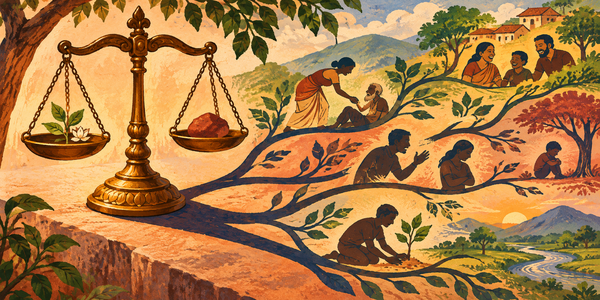
The human mind struggles with injustice. When we see a good person struck by misfortune, we want to find a reason. When we see an unscrupulous person succeed, we want to believe that retribution will eventually arrive. The idea of karma has often been used as a consolation: the world may appear unjust now, but somewhere within the larger picture, the accounts will be settled.
This way of thinking has powerful psychological appeal. It promises order where we see chaos. But it also carries a danger. If we assume that all suffering is deserved, compassion becomes easy to abandon. The sick person is blamed for illness, the poor person for poverty, and the victim of violence for the violence endured. Such conclusions are morally dangerous and logically unjustified.
Historical teachings about karma are considerably more complex than the popular slogan that everyone gets exactly what they deserve. Some schools discuss many conditions influencing the maturation of actions. In Buddhism, for example, not every experience is explained solely by past karma. Physical, natural, and social causes also exist, and the teaching of dependent origination must not become a universal accusation against people who suffer.
Imagine a child born in a region devastated by war. To declare that the child deserves suffering because of unknown deeds in a previous life is not knowledge. It is speculation that may conceal our unwillingness to act. It is more responsible to recognize concrete causes: political decisions, violence, economic interests, and historical circumstances. Spiritual practice, if it has ethical value, should strengthen our desire to help rather than release us from that obligation.
There is another way to understand karma: not as a guarantee that the world will reward good people, but as an invitation to notice how our actions participate in shaping the future. We cannot choose every event that affects us. We can examine how we respond, which habits we reinforce, and what we cause others to experience. Here karma ceases to be a tool for judging other people’s lives and becomes a question directed toward our own.
The Upanishads: Action, Desire, and the Long Story of the Human Being

In the Upanishads, philosophical texts associated with the Vedic heritage, reflections on action acquire new depth. Some of these texts develop connections between desire, intention, action, and a person’s future condition. They are not one book written by a single author, nor do they offer one unified system. They represent different voices in an extended conversation about the nature of the human being and reality.
One of their great themes is the relationship between the transient and the enduring. If a person identifies entirely with desires, possessions, and social roles, life inevitably moves between hope and fear. Desire gives rise to striving; striving leads to action; action has consequences. In this way, a person becomes bound to the ceaseless movement of the world they are trying to control.
Imagine a young merchant convinced that he will be happy once he owns a particular house. He works for years, buys it, and experiences genuine joy. But eventually a new comparison appears: his neighbor has a larger garden. Desire shifts its target. Nothing in this story proves that wealth is bad. It shows how the mind can turn an achievement into a new starting point for dissatisfaction.
In some Upanishadic thought, liberation is associated with knowledge of the deepest nature of the Self and its relationship to ultimate reality. This is a different perspective from simply accumulating good deeds. A person may seek not merely more favorable outcomes, but an understanding that changes their very dependence on desires and consequences. Different philosophical schools interpret that understanding differently.
An important distinction appears here and will accompany us throughout our journey. One thing is to improve the circumstances of life through wise action. Another is to investigate why our well-being has become so dependent on particular circumstances. The first is a question of practical wisdom. The second is a question of spiritual liberation. Ancient teachings about karma often address both, but do not completely collapse them into one.
The Bhagavad Gita: How to Act Without Becoming a Prisoner of the Result

One of the most influential stories about action begins on a battlefield. The warrior Arjuna stands between two armies and realizes that the coming battle will pit him against relatives, teachers, and people he knows. His strength deserts him. He is not merely afraid of death. He faces a moral crisis: how can he act when every possibility appears connected to suffering?
In the Bhagavad Gita, Krishna responds with a complex teaching about duty, knowledge, devotion, and action. One of its best-known principles is that a person is responsible for action but does not possess complete control over its fruits. This does not mean indifference to consequences or permission to act irresponsibly. It means not allowing the desire for a guaranteed outcome to become the only force driving our lives.
Imagine a physician who makes every reasonable effort to help a patient. The physician studies, assesses risks, communicates honestly, and acts carefully. But no physician can promise recovery in every case. If the value of the work depends exclusively on the final outcome, life becomes a pendulum between pride and despair. If attention remains on the quality of the action and the responsibility involved, dedication can survive uncertainty.
Karma yoga, the path of action, is not an excuse for passivity. On the contrary, it assumes participation in the world. A person performs their duties while attempting to free action from self-centered attachment. This may include service, self-discipline, and dedicating one’s deeds to a higher principle. Different interpreters of the Gita place different emphasis on devotion, knowledge, and selfless activity.
This teaching is particularly interesting in modern life because we are surrounded by constant evaluation: likes, salary, recognition, project performance, and other people’s approval. Results matter and are often necessary, but when they entirely determine our sense of worth, every action becomes a source of anxiety. The Gita asks a more difficult question: can you work with your whole heart without turning success into a condition for inner peace?
The Yoga Sutras: Traces That Remain After an Experience

When we hear the word yoga today, we often imagine a mat, stretching, and breathing exercises. But classical yoga, systematized in the Yoga Sutras attributed to Patanjali, is a much broader path of working with the mind and seeking liberation from suffering. Within it, karma is connected to inner causes, psychological traces, and the conditions that sustain the repetition of human experience.
This tradition speaks of kleshas, disturbing factors such as ignorance, ego-centered identification, attachment, aversion, and clinging to life. They nourish actions and leave karmic traces. The term karmashaya refers to an accumulation of such potentials, whose fruits are understood within the traditional doctrine of different lives and experiences. We are dealing here with a philosophical and religious system, not a mechanism measured in a laboratory.
Imagine someone who was publicly humiliated at school. Years later, another person laughs during their presentation. The laughter may have nothing to do with them, yet the old experience becomes active. Their heart races, their voice dries up, and the mind instantly creates a familiar story: “They are making fun of me again.” Modern psychology might describe this through memory, learning, and emotional reactivity. Yogic language might use it as an illustration of conditioning.
These two descriptions are not identical. We should not claim that scientific research on habits proves ancient ideas about karmic imprints extending across multiple lifetimes. Yet the analogy helps explain their practical orientation: the past is not only what we consciously remember. It also influences how we perceive the present, anticipate danger, and react to other people.
Classical yoga proposes disciplines of attention, ethical conduct, work with the body and breath, concentration, and meditation. The goal is not merely to become more effective in everyday life. It is more radical: to recognize the distinction between the changing states of mind and what this philosophical system regards as pure consciousness. The question of karma thereby becomes a question of freedom from automatic identification with mental processes.
Samskaras and Vasanas: When the Past Speaks in the Voice of the Present

Various Indian philosophical and yogic contexts use the concepts of samskara and vasana. They are not entirely interchangeable, and their meanings vary by school. Broadly speaking, we can think of samskaras as impressions or dispositions left behind, and vasanas as persistent tendencies that incline the mind toward particular experiences and actions. This is a simplified explanation of complex traditional concepts.
Imagine walking along the same path across a meadow every day. At first the grass is high and you have to force your way through. After a month the track is clear. After a year you no longer think about which way to go. Your feet seem to find the route on their own. Our habits often resemble such paths. Repetition makes particular responses easier and faster.
Not every trace is harmful. Someone who has practiced patience may find it easier to remain calm during a difficult conversation. A musician who has played for years no longer consciously thinks about every movement of the fingers. Kindness, attentiveness, and honesty can also become enduring ways of behaving. Conditioning, then, is not merely a prison; it is also the foundation upon which we build skills and character.
The problem begins when we cannot distinguish a useful habit from an automatic pattern that restricts us. Someone may be extremely organized yet unable to tolerate an unexpected change. They may be generous but help others only to be loved. They may speak constantly about independence while every decision is a reaction against someone else’s opinion. The external appearance of behavior does not reveal its entire inner cause.
Self-inquiry therefore does not mean declaring all habits bad. It means asking which habits serve our lives and which govern us without our participation. When we notice repetition, a small space appears between impulse and action. That space may be the beginning of change, even if change requires sustained practice, support, and sometimes professional help.
The Three Kinds of Karma in Popular Yogic Tradition
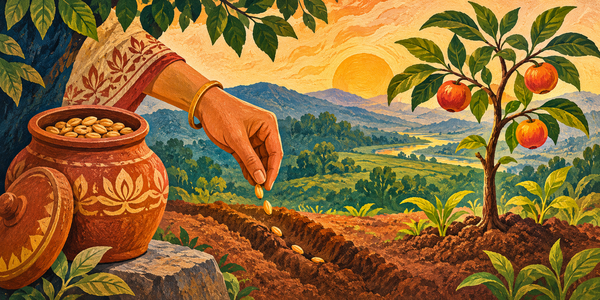
Later Hindu and yogic explanations often distinguish sanchita, prarabdha, and agami karma, with the related term kriyamana appearing in some classifications. This is not a universal framework used identically by all ancient schools. It is a teaching model for explaining the relationship between the accumulated past, consequences already unfolding, and new actions.
Sanchita generally denotes the accumulated store of karmic potentials. Imagine a large storehouse filled with seeds gathered over many seasons. Not every seed will germinate at once, and some may never encounter suitable conditions. The analogy illustrates accumulation, but should not be taken as evidence that a literal invisible warehouse of human destiny exists.
Prarabdha is described as that portion of accumulated karma whose consequences have already begun to manifest in the present existence. Continuing our seed analogy, these are plants that have already sprouted. Some circumstances cannot be undone through a single wish. A person cannot return to yesterday or change their origins. Yet they may respond differently to what is given and make decisions about the future.
Agami or kriyamana is associated with actions we perform now and the new consequences they generate. Imagine a gardener who inherits a neglected garden. The gardener did not choose the soil, the climate, or every plant growing there. But they can decide what to prune, what to plant, and how to care for the place. Not everything will succeed because nature has its own conditions. Nevertheless, their participation matters.
This framework is useful if it protects us from two extremes. The first is believing we are all-powerful and can change everything through correct thinking. The second is believing that nothing depends on us. Between them lies a field of real action: limited, but meaningful. That is where the practical value of the idea of karma can be found, whether or not we accept its metaphysical foundations.
Karma as Memory: A Contemporary Yogic Interpretation

One of the most interesting ideas in Sadhguru‘s contemporary account is that karma can be understood as accumulated memory and conditioning. In his book about karma, he emphasizes not celestial bookkeeping but the way past actions and reactions shape present experience. This approach makes the concept immediate: instead of wondering who is punishing us, we begin observing what we continuously reproduce.
The word “memory” has a broad spiritual and philosophical meaning here. Yogic explanations may include bodily tendencies, psychological impressions, and other forms of supposedly inherited or accumulated information. We must be careful when translating this language into science. Genetic information, immune memory, and neural learning are real, investigated processes, but they do not establish the existence of a single metaphysical karmic mechanism. Similarity of language does not make mechanisms identical.
Imagine someone who heard throughout childhood that mistakes were unacceptable. As an adult, they obtain a good job, yet every assignment exhausts them. They check an email ten times, postpone decisions, and experience minor criticism as a catastrophe. The past is not locked away in an old family album. It participates in how they perceive each new day. Even when the outside world offers opportunities, their internal model turns them into threats.
In such a case, change does not come from a positive thought alone. The person may need to recognize their beliefs, practice new responses, work with anxiety, and receive support. Spiritual language might say they are beginning to move beyond an old karmic pattern. Psychological language might describe changes in learned responses and interpretations. The two perspectives can enter a dialogue, provided we do not claim that they are scientifically identical.
The strength of this interpretation lies in refusing to reduce a person to their biography. The past has influence, but it is not necessarily a complete sentence. If certain reactions have become habits, we can gradually develop others. If we have taught ourselves to fear every uncertainty, we can practice remaining with uncertainty without immediately running away. Freedom does not mean having no past. It means that the past is no longer the sole author of the present.
Why Intention Changes the Meaning of an Action

Two people may perform the same outward action for entirely different reasons. One donates money because they have seen another person’s need. Another donates the same amount to gain recognition. A third makes the donation out of guilt. The recipient may benefit in all three cases, but the inner experience and consequences for the donor’s character are not identical. This difference lies at the heart of many teachings about karma.
Intention does not cancel real consequences. A person may mean well and still cause harm. A parent may exercise excessive control over a child out of genuine concern. A manager may demand an impossible pace because they believe they are helping the team succeed. The external result still matters. But intention reveals the inner process driving the action and the tendencies it may strengthen.
Consider another story. On the street, someone sees an elderly passerby who has fallen. Their first thought is that they will be late for a meeting. The second is that someone else will probably help. The third is uncomfortable: “What if nobody helps?” They stop, call for assistance, and remain with the injured person. From outside we see one action. Inside, a struggle has taken place between the habit of thinking only about one’s own schedule and the ability to widen one’s attention.
In traditional spiritual systems, intention often has a deeper meaning than psychological motivation. It may be understood as a factor shaping karmic consequences in this life and future lives. That claim belongs to the religious worldview of the particular tradition. In everyday experience, however, we can observe something more modest and concrete: repeated motives influence our decisions, relationships, and self-image.
A useful question before acting is therefore not only “What will I get?” but also “From what place within myself am I acting?” From fear, a desire for power, envy, love, responsibility, or a need to be seen? Sometimes motives are mixed, and that is normal. Recognizing them honestly does not make us perfect, but it protects us from the convenient illusion that every action of ours is selfless simply because it looks good.
Reaction: The Moment an Old Script Tries to Take Control

Imagine receiving a short message from a friend: “We need to talk.” Nothing more. One person assumes it concerns weekend plans. Another feels anxious. A third becomes angry, convinced they are about to be accused of something again. The message is identical, but the inner reactions reveal different histories.
In these seconds we can observe conditioning becoming action. First comes a sensation. Then thought gives it meaning. An impulse follows: attack, defend, flee, justify ourselves. If we act immediately, the old pattern receives another repetition. If we manage to notice the process, another possibility may appear: asking what is happening before deciding that we already know.
In contemporary yogic interpretation, karmic accumulation is closely linked to unconscious reactivity. This differs significantly from the notion that every physical movement automatically creates the same spiritual burden. Someone may be extremely active without being constantly imprisoned by personal insults and desires. Another person may sit motionless while experiencing endless inner conflicts.
We must not turn this approach into an accusation against people experiencing severe anxiety, trauma, or other mental health difficulties. Reactions can have complex biological and social causes. Not everyone can change them through willpower or meditation alone. Sometimes the most responsible action is to seek therapy, medical care, or a safe environment.
In ordinary situations, practice may begin with something very small. Before sending an angry message, put the phone down for a minute. Before answering criticism, notice what is happening in your body. Before deciding that the person opposite you is an enemy, allow for the possibility that you do not know the whole story. This is not a magical cleansing of karma. It is a concrete exercise in freedom from automatic behavior.
Buddhism: Karma Begins With Volition
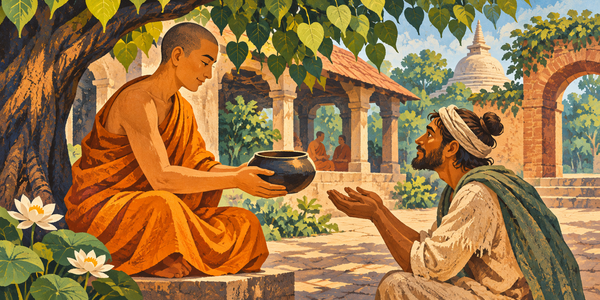
In Buddhism, karma, or kamma in Pali, occupies a central place, but does not mean precisely what it means in every Hindu school. In early Buddhist texts, intention, called cetana, is decisive for karmic action. In Anguttara Nikaya 6.63, the Buddha associates karma with volitional intention, after which a person acts through body, speech, and mind. This distinction matters: moral weight is not determined solely by the outward form of a deed.
Imagine accidentally stepping on an insect without noticing it. Now imagine someone deliberately killing the same insect out of cruelty. The external result may be the same, but the intention differs. In Buddhist ethics this matters. Of course, careful regard for life remains a value; the distinction is not permission to disregard consequences.
Buddhism regards actions as part of a network of dependent origination. Ignorance, craving, attachment, and other factors contribute to the arising of suffering. Practice is not simply an attempt to collect enough good deeds to receive a more pleasant future. It is also the gradual understanding of mechanisms that sustain suffering so that liberation from them becomes possible.
Crucially, Buddhism does not accept an eternal, unchanging individual soul in the way some Hindu schools speak of atman. The teaching of not-self, anatta, creates a different framework for the question of how actions have consequences beyond one lifetime. Different Buddhist traditions explain this continuity through causally conditioned processes rather than through the simple notion of one unchanged personality moving from body to body.
This distinction is often lost in popular accounts. When we say that “Eastern religions believe in karma and reincarnation,” we risk erasing essential philosophical disagreements. For Buddhist practice, the question is not only how to obtain a better next birth. It is how to stop nourishing greed, hatred, and delusion, which make suffering so persistent.
The Three Poisons and the Invisible Consequences of Everyday Choices

In Buddhist tradition, greed, hatred, and delusion are often described as three unwholesome roots of behavior. This is not a list of forbidden feelings we must hide from ourselves. Rather, it is a map of forces capable of distorting perception and action. When greed rules, nothing is enough. When hatred rules, another person stops appearing fully human. When delusion rules, we mistake our assumptions for unquestionable truth.
Imagine the owner of a small shop. The neighboring shop begins attracting more customers. Instead of exploring what could be improved, the owner starts speaking badly about the competitor. Every day he checks the neighboring window and becomes angry when he sees a line of customers. Initially, envy was a brief emotion. Gradually it becomes a habit of attention and then a pattern of action that damages relationships.
The same person could respond differently. He might acknowledge his envy without turning it into a moral condemnation of himself. He could learn something from his competitor’s success, improve his service, and perhaps even establish friendly relations with his neighbor. The external event has not changed. What has changed is the way it participates in his life.
Buddhist mindfulness practice does not simply mean relaxing. It involves observing the arising and passing of bodily sensations, feelings, and thoughts without necessarily obeying them. Ethical conduct, wisdom, and the cultivation of beneficial qualities such as goodwill and compassion accompany this observation. Observation alone does not replace moral responsibility.
Here karma has a very practical dimension. Each time we nourish hostility, we increase the likelihood that it will become our habitual response. Each time we practice generosity, we make generosity more accessible as a choice. This is a reasonable psychological analogy, but it does not exhaust traditional Buddhist teaching, which also includes karmic consequences within the cycle of rebirth.
Why Buddhism Does Not Say Every Pain Is Deserved

One of the most harmful misunderstandings is that if a person suffers, they must have done something bad. Buddhist texts do not support such a simplistic explanation of every pain. Early teachings distinguish different causes of bodily sensations and suffering, including physical conditions and external influences. Reducing everything to previous karma means overlooking the complexity of causation.
Imagine someone slipping on an icy sidewalk. Causes may include the temperature, lack of maintenance, unsuitable footwear, and momentary inattention. Saying that “karma caught up with them” does not explain the mechanism of the fall. Still less does it help the person stand up or persuade the authorities to clear the sidewalk. Sometimes a spiritual label merely disguises an unwillingness to think concretely.
Compassion is inseparable from serious Buddhist practice. If we encounter someone who is suffering, the immediate ethical question is not what they did in an unknown past, but how we can relieve their present pain. Offering water, listening, taking them to a doctor, or resisting injustice are actions with real significance.
This does not mean Buddhism abandons karmic causation. It means that karma belongs within a broader system of conditions. An outcome may depend on many factors rather than one moral cause. Intention and present action also continue to matter. The past is not a universal excuse for doing nothing now.
This idea is important for contemporary spiritual culture. When someone has experienced trauma, serious illness, or poverty, we should not tell them that they “attracted” the event through incorrect energy. Such claims can increase guilt and isolation. A responsible understanding of karma should begin with humility before the complexity of life and a willingness to help.
Jainism: Karma as Subtle Matter and Radical Responsibility

Jainism offers one of the most distinctive theories of karma in Indian philosophy. In classical Jain thought, karma is not merely a moral consequence or psychological habit. It is understood as a particularly subtle material substance that binds to the living soul, jiva, under the influence of actions and passions. This is a specific metaphysical doctrine and should not be presented as an established fact of physics.
According to this system, karmic particles limit the natural qualities of the soul and contribute to the conditioning of existence. Liberation requires stopping new karmic accumulation and becoming free from what has already accumulated. That is why ethical discipline, self-restraint, and ascetic practices occupy such an important place in Jain life.
The principle of ahimsa, nonviolence, is especially well known. In Jainism it is applied with extraordinary consistency, including attentiveness to even the smallest forms of life. This is more than a recommendation to be kind. It is a radical awareness that our actions may cause harm even when we are not paying attention to their consequences.
Imagine someone beginning to notice how many living beings depend on everyday decisions: what they buy, how they eat, how they use water, and what they discard. We need not accept the whole of Jain metaphysics to recognize the force of this ethical question. In a world of mass production and ecological crises, attention to the unseen consequences of consumption is particularly relevant.
The difference between Jainism and Buddhism, however, is substantial. Jainism accepts an enduring individual soul bound by karmic matter, while Buddhism rejects the idea of an unchanging self. Both traditions speak of liberation from karmic conditioning, but they explain differently who or what is liberated. These differences are part of the richness of the philosophical conversation, not minor details to be skipped.
Sikhism: Action, Grace, and Life Among Other People
In Sikh tradition, human actions also have moral significance, but karma is understood within the context of divine order, grace, and devotion to the One God. It is not a mechanical system in which salvation can be purchased through a sufficient number of good deeds. Emphasis falls on inner orientation, honest work, sharing, and remembrance of God.
Sikh spirituality is remarkable for its insistence that spiritual life does not necessarily require withdrawal from society. A person can have a family, work, participate in the community, and develop spiritual discipline at the same time. Ethical actions are not a side activity performed after meditation. They are part of the practice of faith itself.
Imagine a baker who rises early each morning to make bread. He may regard his work merely as a way to earn money. But he can also experience it as honest labor through which he supports his family and serves other people. If he shares some food with those in need, the everyday action gains another ethical dimension. It is not the profession itself that is spiritual or unspiritual, but the attitude with which it is practiced.
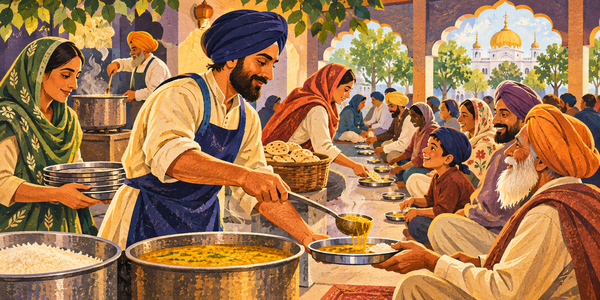
In Sikhism, seva, selfless service, has particular importance. The communal kitchen, langar, is a vivid example of community care and equality. People from different backgrounds can sit and eat together. Here spiritual understanding becomes social action rather than remaining enclosed within private experience.
This perspective reminds us that karma is not only a story about individual destiny. Our actions also shape the world inhabited by others. A community can encourage generosity or suspicion, dignity or humiliation. In this sense moral causation has a social dimension that should not be lost amid conversations about personal energies and invisible debts.
Different Traditions, Different Answers to Who Carries Karma

At first glance, all these teachings seem to say the same thing: we do something, and consequences follow. But behind this apparent similarity lie different understandings of the human being. Some Hindu philosophies accept an enduring spiritual principle or Self whose nature must be recognized. Buddhism emphasizes the absence of an unchanging individual essence. Jainism regards the soul as real and bound by karmic matter. Sikhism considers action in relation to God and grace.
These are not merely theoretical differences. If you believe an unchanged soul passes through different lives, you will approach responsibility in one way. If you accept causal continuity without a permanent self, you must explain how actions bear fruit without an eternal carrier of personality. If you see salvation as also dependent on grace, you will not reduce it to a mechanical accumulation of merit.
Imagine three maps of the same mountain. One shows the paths, another the geological layers, and the third places local people consider sacred. The maps are not simply identical pictures in different colors. They express different purposes and assumptions. The same is true of teachings about karma. We can compare the questions they share without erasing their individual logic.
When contemporary authors use karma as a general name for all habits, emotional reactions, and life consequences, they offer a useful practical vocabulary. But that vocabulary does not exhaust classical teachings. Ancient traditions often include ideas about rebirth, liberation, ritual, cosmic order, and the metaphysical nature of personhood that cannot be reduced to psychology.
Respect for spiritual heritage requires two things at once: searching for meaning that can be applied today, and not attributing to ancient teachers claims they did not make. If we extract only the ideas convenient to us, we risk turning complex philosophical systems into a collection of motivational slogans. Genuine understanding begins when we are prepared to notice differences as well as similarities.
Karma and Rebirth: What Traditions Claim and What We Know

For many ancient Indian schools, karma cannot be fully understood without the idea of a cycle of births and deaths called samsara. Within this framework, the consequences of actions are not limited to one human lifetime. Different traditions develop complex explanations of how karmic potentials contribute to future existences and how spiritual practice can lead to liberation from the cycle.
Here we enter territory where belief, philosophical argument, personal testimony, and scientific evidence must be clearly distinguished. There are accounts of memories of previous lives, and researchers have studied them. But there is no generally accepted scientific proof that human personality is reborn or that particular events in a present life result from actions in a previous existence. This limitation does not render religious teachings meaningless, but it determines how we should speak about them accurately.
Imagine someone experiencing an unexplained fear of water. A spiritual interpreter might suggest a connection to a previous life. A psychologist might investigate experiences, learned associations, temperament, and other factors. Without reliable evidence, we cannot declare the first explanation an established cause. It would be even more dangerous to suggest an unverified story that begins defining the person’s identity.
Some believers find comfort and a broader perspective in the idea of rebirth. Others fear it or consider it unjust. The philosophical question of personal continuity remains complex even within the traditions. What does it mean to be responsible for an action you cannot remember? What exactly continues if there is no unchanging person? Different schools give different answers.
We can approach these ideas respectfully without abandoning critical thinking. Spiritual practice does not necessarily require us to explain every difficulty through a previous incarnation. We can begin with what we actually know: our actions have consequences, habits influence our future, and the way we treat others matters morally. Whether there is a larger metaphysical story is a separate question.
Free Will: If We Are Conditioned, Who Is Actually Choosing?

Imagine someone raised to believe that authority must never be challenged. One day they become a manager and discover that they cannot bring themselves to refuse an unjust demand. Formally, they have the right to say no. Nobody is physically controlling their hand. But internally, the fear of disapproval seems stronger than their own judgment. How free is this choice?
The question of free will is much older than modern psychology. If our decisions arise from character, habits, desires, and previous causes, what does it mean to be their authors? Spiritual teachings about karma often regard human beings as conditioned yet capable, through discipline, knowledge, or insight, of changing their relationship to that conditioning.
This is not necessarily a promise of absolute independence from causes. Nobody chooses their parents, historical era, first language, or every feature of their body. Freedom may be more modest and more practical: recognizing more possibilities, delaying impulsive reactions, changing habits, and acting in accordance with consciously chosen values.
Imagine a pianist. At first the movements are awkward and limited. After years of practice, the musician can play freely. Paradoxically, discipline has expanded their possibilities. Similarly, someone who develops attention and self-regulation may acquire greater freedom in responding. Not because they have eliminated all causes, but because they have developed new abilities.
Contemporary philosophy and science continue to debate exactly how free will should be understood. There is no reason to declare that meditation has resolved the debate. In everyday life, however, we can distinguish between action taken after reflection and a reaction we barely notice. Practical work with karma begins precisely with this distinction.
Responsibility Without Blame: The Difficult Balance

The idea that we can take responsibility for our inner lives is liberating. But expressed carelessly, it can become a heavy accusation. There is an enormous difference between “I can participate in how I respond to what happens” and “I am to blame for everything that has happened to me.” The first opens space for action. The second denies the reality of violence, chance, and other people’s decisions.
Imagine a woman who loses her job because her company closes. She did not make the decision to shut it down, did not control the market, and could not prevent everything. It would be unfair to tell her that she created the situation through incorrect thoughts. But she may gradually decide how to seek help, what skills to develop, and how to care for herself during the transition.
Responsibility is the capacity to respond to reality, not an obligation to be all-powerful. We can acknowledge that circumstances are difficult and unjust without abandoning our own participation. We can seek support, establish boundaries, demand justice, and take the next reasonable step. Sometimes the bravest action is admitting that we cannot manage alone.
This balance is especially important in cases of trauma and mental suffering. A person who has experienced violence is under no moral obligation to be calm, grateful, or immediately forgiving. Their reactions may be part of how the nervous system tries to protect itself. Support, safety, and professional care may matter more than any abstract spiritual formula.
A mature understanding of karma must not be used to transfer responsibility from the perpetrator to the victim. If someone commits an injustice, that action remains theirs. If social structures create suffering, those structures should be changed. Personal work on our reactions does not cancel the need for social responsibility. The two can and should coexist.
Why Good Intentions Sometimes Create Bad Consequences

A father wants his child to succeed. He helps with homework, monitors grades, and insists on constant achievement. He believes he is preparing the child for life. Years later, the child has become a successful adult but is afraid to begin anything new because failure feels unbearable. The father did not intend to create fear. But good intentions did not guarantee a good outcome.
This story reminds us that the moral evaluation of an action has several dimensions. Motive matters, as do the knowledge available to us, the actual consequences, and our willingness to repair harm. Excusing ourselves solely through intention means failing to notice our effect on others. Evaluating everything solely by the result, however, may make us unfair to people who acted reasonably under uncertainty.
In spiritual practice, this question appears in another form. Someone may help everyone while secretly expecting recognition. When gratitude does not arrive, bitterness grows. Someone may pursue humility while beginning to feel superior to people who do not meditate. Someone may speak of nonattachment while remaining intensely attached to the image of being spiritually advanced.
This does not mean good actions are pointless. On the contrary, it invites greater honesty. Have we truly listened to the needs of the person before us? Are we willing to accept feedback? Can we help without turning another person into a debtor who owes us gratitude?
In this sense, karma is not only a story about wrong actions. It is also a question about the subtle ways ego can hide behind virtue. Sometimes the most important change is not performing another good deed, but changing the attitude with which we already perform it.
Work, Ambition, and Success: When Achievement Becomes a Trap

Modern life often unfolds in a continuous pursuit of the next goal: a degree, a career, a home, a higher position, financial security, recognition. There is nothing inherently wrong with these aspirations. They can express creativity, responsibility, and care for loved ones. But when identity merges entirely with success, every obstacle begins to feel like a threat to our very existence.
Imagine an architect who loves the profession. At first, drawing brings curiosity and joy. Gradually, the architect begins comparing achievements with colleagues, following awards, publications, and other people’s projects. The question is no longer whether the buildings are beautiful and useful, but whether they will impress enough people. The work remains the same, yet its inner meaning has changed. Creativity has become a constant examination of personal worth.
Karma yoga offers the possibility of a different relationship. We can aim for high quality, plan wisely, and work diligently without turning every outcome into a final verdict on ourselves. This is not a rejection of ambition but a release from some of the fear that accompanies it. Paradoxically, less attachment can sometimes allow us to act more effectively.
In contemporary yogic interpretation, joyful participation in action has special value. If we do everything only for a future reward, much of life passes in waiting. If we can be present in the process itself, even difficult work acquires another quality. Of course, this does not mean romanticizing exploitation or telling people to endure unjust working conditions with a smile.
The useful question is whether our work expands our life or gradually consumes it. Do we have time for relationships, rest, curiosity, and care for the body? Can we experience failure without completely devaluing ourselves? If the answer is no, perhaps our goals are not the problem, but the way we have become attached to them.
Love and Karma: Why We Repeat the Same Relationships

Sometimes a person changes partners yet continues living almost the same story. At first there is strong attraction. Then comes fear of abandonment, jealousy, or the need for constant proof of love. Conflict follows, and eventually separation. In the next relationship the names are different, but the familiar script returns. We do not need to explain this through a mystical debt between souls to recognize the power of repetition.
Relationships are where our habits meet the habits of another person. Each of us brings expectations, learned ways of protecting ourselves, ideas about intimacy, and boundaries. Sometimes what we call fate is a pattern we have not recognized. Someone accustomed to earning love through constant effort may feel strangely uncomfortable with a partner who accepts them calmly. Familiar tension feels more real than unfamiliar peace.
Recognizing such a pattern does not mean blaming ourselves for other people’s behavior. If a partner is abusive or manipulative, responsibility for their actions belongs to them. Our task is to protect our safety and dignity. Spiritual language about karmic relationships must never be used to justify remaining in dangerous situations.
In healthy relationships, awareness can look very simple: saying how we feel instead of expecting the other person to guess; admitting a mistake without collapsing into shame; listening to criticism without immediately attacking; setting a boundary without humiliating someone. These actions gradually change the quality of a relationship because they change the repetitions from which it is built.
If karma concerns action and the traces it leaves, love is one of the clearest places to observe this process. Tenderness creates trust, honesty creates predictability, and persistent hostility creates fear. There is no guarantee that good conduct will save every relationship. But it changes how we participate in relationships and who we become through them.
Family Stories: What We Inherit Without Choosing

In some families, anger is the normal language of disagreement. In others, nobody raises their voice, but important subjects are never discussed. Somewhere, money is a constant source of anxiety even when the family is financially secure. Elsewhere, children learn that they must always be strong and never ask for help. Such patterns can be transmitted through upbringing, observation, social conditions, and family stories.
Imagine a grandfather who experienced severe poverty. He learned that every coin must be saved. His son grows up believing that pleasure is dangerous extravagance. The grandson lives under very different economic circumstances but feels guilty whenever he buys something enjoyable. Nobody formally sat him down to teach him this rule. He learned it from expressions, conversations, fears, and everyday decisions.
Sometimes people call this “ancestral karma.” The term can be used metaphorically for inherited family patterns, but it should not be presented as evidence of a proven mystical mechanism. Modern research examines the intergenerational transmission of behavior and the effects of stress through various psychological, social, and biological pathways. It does not prove spiritual guilt passed down between generations.
Most importantly, inheritance does not mean inevitable repetition. Someone can recognize their family history, appreciate what helped previous generations survive, and choose what they no longer wish to pass on. They may preserve diligence while releasing constant fear. They may preserve care for loved ones while ceasing to express it through control.
This is a special form of responsibility toward the future. We cannot change how our ancestors lived. But we can influence the stories received by the next generations. Sometimes one calm response, one honest conversation, or one apology interrupts a pattern repeated for decades. We need not call that a miracle to recognize its significance.
Can Karma Be Burned, Cleansed, or Brought to an End?

Spiritual literature often uses expressions such as “burning karma,” “cleansing karma,” and “liberation from karmic bonds.” They can mean different things in different traditions. In some systems they refer to a real metaphysical release from accumulated karmic potentials. In others the emphasis falls on overcoming ignorance, attachment, or passions that sustain further accumulation.
Classical yoga places particular emphasis on practice and nonattachment. Buddhist paths cultivate ethical conduct, concentration, and wisdom directed toward the cessation of suffering. Jain tradition offers disciplines understood as limiting and removing karmic bondage. There is no single universal method accepted identically by all these schools.
Imagine someone who has carried resentment for years. They continually replay an old conversation, invent new replies, and relive the humiliation. One day they understand that they cannot change what happened, but they can stop sustaining the same inner war. This decision may take time and does not amount to excusing the injustice. Gradually, however, the resentment may lose its power over everyday life.
In a practical sense, such a change can be described as freedom from an old pattern. It does not prove that an invisible karmic substance has disappeared. It shows that a person no longer responds in the same way. If spiritual language helps us understand the process, we may use it, provided we maintain the distinction between personal experience and verifiable causation.
It is particularly important to beware promises of instantly cleansing all consequences through a paid ritual, secret technique, or single experience. Serious traditions generally emphasize long-term discipline, ethics, and changes in understanding. Nobody can reliably guarantee that one ceremony will remove an illness, financial problem, or the consequences of violence. Spiritual hope should not become a business built on fear.
Meditation: Observing a Thought Without Immediately Becoming Its Servant

Imagine sitting quietly for five minutes. You have decided simply to observe your breathing. After ten seconds a thought about tomorrow’s meeting appears. Then you remember yesterday’s conversation. Next comes a plan for dinner, a worry about money, and sudden irritation at a noise outside. You did not consciously invite each thought, but they appear one after another. This is a familiar experience for many people who try meditation.
One possible benefit of such practice is recognizing that a thought is not a command. We can experience anger without immediately speaking harshly. We can feel fear without necessarily running away. We can have a desire without immediately satisfying it. This ability does not develop equally easily for everyone and is not absolute, but it can be cultivated.
Different yogic and Buddhist meditation practices have different aims and methods. Some use concentration on a particular object. Others observe sensations and thoughts. Still others cultivate goodwill, compassion, or inquiry into the nature of the self. It is inaccurate to present all these practices as one identical technique for “cleansing karma.”
Modern studies suggest that certain meditation programs can benefit some people in managing stress and supporting psychological well-being, but effects vary, and the strength of the evidence depends on the specific practice and study. Meditation is not a universal treatment, and some people may experience distressing or intense effects. For serious mental health difficulties, seeking qualified support is sensible.
The practical meaning for our subject is clear. If karma also manifests through automatic reactions, attention may help us notice them earlier. This does not eliminate every difficulty or guarantee enlightenment. But even the small shift from “I am my anger” to “Anger is arising within me” can create room for a wiser response.
The Body, Breathing, and Everyday Discipline

Spiritual teachings often remind us that a person is not merely a stream of ideas. When we are sleep-deprived, hungry, or exhausted, our patience often decreases. Under persistent stress, we may react more sharply to minor events. That is why working with habits cannot be entirely separated from caring for the body.
Imagine two colleagues receiving the same unpleasant assignment. One has slept well, eaten breakfast, and has time to plan. The other worked late, skipped a meal, and has already received several worrying calls. The second may react more irritably not because they are a “bad person,” but because their resources for self-regulation have been reduced. This reminds us to be careful with moral and psychological judgments.
Yogic traditions include diverse practices involving posture, breathing, discipline, and concentration. Some aim at stability of attention, while others have religious and liberating purposes. We do not need to accept every traditional physiological explanation as scientifically established to acknowledge that moderate movement, regular sleep, and certain safe breathing exercises can support well-being.
It is especially useful to regard discipline not as punishment, but as the creation of conditions. If we want to be more patient, we should ask whether our lives allow enough rest. If we want to think clearly, constant overload matters. If we want to be kind to loved ones, we need to notice when exhaustion turns every request into a threat.
This does not mean someone with an illness or limited resources is to blame for their condition. Nor does everyone have equal access to a healthy environment. On the contrary, recognizing bodily and social conditions makes us more compassionate. The practice of responsibility begins with the real possibilities available to us, not an idealized image of a person capable of controlling everything.
Can a Person Act Without Being Attached to the Action?

Imagine a gardener tending roses. They prepare the soil, water, prune, and observe the plants. They do everything necessary but cannot command every bud to open on a particular day. If the weather is cold, flowering will be delayed. If a storm destroys part of the garden, their effort will not be fully rewarded. Yet the care was not meaningless.
This is a useful image of nonattached action. It does not mean having no wish to achieve something. The gardener wants the flowers to grow. But they do not turn every deviation from expectation into proof that life is against them. They continue tending the plants and learning from conditions. Their action is wholehearted without claiming absolute power over the result.
In karma yoga, this principle has spiritual depth. Action can be dedicated to something beyond narrow personal interest, and its fruits need not be appropriated as proof of the actor’s greatness. In modern life, this might mean working responsibly, caring for others, and developing skills without constantly turning everything into a comparison with other people.
There is, however, a subtle danger. Someone may use nonattachment as an excuse to avoid responsibility for mistakes. “I am not attached to the result” is not an acceptable response if we have acted carelessly and harmed someone. Genuine nonattachment does not eliminate attention to consequences. It removes some ego-centered clinging while preserving responsibility.
Perhaps the hardest lesson is distinguishing care from control. Care asks what is needed and what we can do. Control insists that the world obey our plan. The first connects us with reality. The second often traps us in endless disappointment. When this difference becomes clear, action can become both freer and more mature.
Karma and Forgiveness: Not Carrying the Past as a Permanent Sentence

One of the heaviest forms of conditioning is the endless return to an old injury. Someone may leave the place where they were hurt, end the relationship, and begin a new life. Yet the old conversation continues inside their thoughts. Every reminder opens the same wound. The past no longer exists as a present event, but it continues to influence the present.
Forgiveness is sometimes presented as a compulsory spiritual virtue. But it cannot be ordered into existence. A person has a right to anger, boundaries, and the pursuit of justice. Forgiving does not mean denying harm, restoring an unsafe relationship, or removing consequences for the person who caused it. Sometimes healing begins not with forgiveness, but with clearly acknowledging what happened.
Imagine someone deceived by a close friend. For years they tell themselves that nobody can be trusted. One betrayal gradually begins to govern every future relationship. Becoming cautious is understandable. But if caution turns into a complete inability to experience closeness, another person’s past action continues to define their life. Freedom may mean preserving boundaries without turning distrust into the only truth.
In spiritual language, we might say they stop feeding a particular karmic chain. In psychological language, we can speak of changing beliefs and emotional responses. Neither description means the process is easy. After serious trauma, it may require considerable time and professional support.
Most importantly, liberation from the past does not mean erasing memory. We can remember clearly without allowing the memory to determine every new experience. We can draw wisdom from pain without turning pain into a permanent identity. This is one of the most human possibilities that a practical understanding of karma helps us recognize.
Collective Karma: Does Society Remember Its Actions?

The word karma is sometimes applied to communities, nations, and entire societies. Here we must be especially careful. Different spiritual traditions do not offer one universally accepted theory of collective karma, and attributing shared mystical guilt to groups of people can be dangerous. Yet there is a real sense in which social actions leave consequences that outlive the individuals involved.
Imagine a city that has discharged waste into its river for decades. The people who made the original decisions may no longer be alive. But the water remains polluted, the soil is damaged, and later generations pay the price. This is not evidence of a supernatural law. It is material causation, in which past decisions shape the conditions of future life.
The same can happen within institutions. If an organization rewards the concealment of mistakes for years, a culture of fear gradually develops. New employees learn that honesty is dangerous. If another organization encourages open discussion of problems, it builds a different pattern. No single act explains the entire culture, but repeated actions create it.
Historical injustices can also have lasting consequences through laws, property, education, economic opportunities, and social attitudes. Calling them “collective karma” may be a poetic metaphor, but it should not replace concrete historical analysis. It is especially important not to blame descendants of those who suffered for conditions created by other people’s actions.
The practical conclusion is that responsibility does not end with personal tranquility. If we want a better future, we must participate in changing institutions, consumption habits, and social relationships. The good intention of one person cannot solve every systemic problem, but coordinated actions by many people can transform conditions that once appeared inevitable.
Ecology: The Most Visible Lesson in Action and Consequence

Perhaps nowhere is the relationship between action and consequence more tangible than in our relationship with nature. We use energy, produce waste, alter land, cut down forests, and extract resources. Many of these actions are convenient in the moment, but their consequences accumulate. Some become visible only after years, when the original decisions have been forgotten.
Imagine a family living beside a lake. When the parents were children, they swam in clean water. Gradually more buildings appear around the lake, wastewater increases, and the ecosystem changes. Decades later their children can no longer swim there. No single person may have intended to destroy the lake. Yet many actions combined with a lack of care have created a new reality.
Here the spiritual idea of karma can serve as a moral reminder: consequences do not disappear merely because we cannot see them immediately. But understanding specific ecological processes requires science, measurements, and policy rather than mystical explanations. Climate change, for example, is studied through atmospheric physics, observations, and models. There is no need to call it punishment from the universe.
Ecological responsibility must not be reduced to individual guilt either. Personal choices matter, but infrastructure, laws, and industrial practices determine much of what is possible. Someone may wish to live sustainably but have no access to public transportation or suitable services. Both personal change and collective action are therefore necessary.
In this context, karma reminds us of the time horizon of ethics. Not everything we do comes back to us personally. Sometimes consequences reach strangers or future generations. Mature responsibility includes care for those we will never meet and who will never thank us.
The Science of Habits and the Limits of Spiritual Analogies

When we speak about karma as the repetition of patterns, it is easy to connect the idea with modern psychology. Research on learning shows that behavior can be shaped through repetition, rewards, context, and expectations. Neuroscience investigates how brain systems participate in the formation of habits, emotional responses, and memory. These are real fields of scientific research.
Imagine someone who reaches for their phone every evening as soon as they feel lonely. Initially, the action provides brief distraction. Over time, loneliness begins almost automatically to lead toward the screen. If they want to change the habit, they can investigate when the impulse arises, what they are seeking through it, and what other activity might address the underlying need. This work does not require belief in rebirth.
But it would be incorrect to say scientists have discovered samskaras in the brain or that neural connections prove karmic memory. Spiritual concepts arose in different historical and philosophical contexts. They can serve as metaphors, but scientific theories are evaluated through specific definitions, observations, and testable predictions.
Not every difficulty is a habit, either. Depression, chronic pain, social discrimination, and economic insecurity cannot be explained simply as incorrect thinking. Real life includes biological, psychological, and social causes. Responsible spiritual thinking must acknowledge them rather than promising that enough awareness will eliminate every problem.
We can find a useful meeting point between the two perspectives. Ancient traditions raise questions about habits, intention, and freedom from automatic behavior. Modern science offers methods for investigating some mechanisms of behavior and change. If we keep them in dialogue without confusing them, we gain a richer understanding of human beings and fewer reasons to make reckless promises.
The Spiritual Trap: When the Idea of Karma Becomes Another Form of Conditioning

Sometimes someone begins studying karma because they want to be free, but gradually develops a new fear. Every thought seems dangerous. Every misfortune becomes a sign that they have done something wrong. They begin searching for hidden messages in random events and blaming themselves for everything that does not go according to plan. A teaching intended to help them live more consciously has become another source of anxiety.
Imagine a woman who feels guilty because she became angry with someone close to her. She read that negative emotions create bad karma and now fears her own feelings. Instead of understanding why she is angry and how to respond responsibly, she tries to suppress the emotion. But suppressed anger may appear in another form: tension, withdrawal, or sudden conflict.
Awareness does not mean pretending we never experience difficult feelings. It means recognizing them and choosing what to do with them. We can feel envy without harming the person we envy. We can experience fear without being ashamed of it. We can acknowledge a mistake without turning our entire identity into a mistake.
Another trap is spiritual superiority. Someone may begin dividing people into the “aware” and “unaware,” explaining other people’s difficulties through bad karma, and feeling superior because of their own practices. In this way, the idea of liberation from ego quietly becomes another form of egocentrism. The true ethical value of a spiritual teaching should also be visible in how we treat people who do not share our beliefs.
It is worth asking periodically what a spiritual idea is doing to us. Are we becoming more attentive, responsible, and compassionate? Or more fearful, judgmental, and dependent on outside authorities? The answer may matter more than the beautiful words we use to describe our practice.
A Story About Two Travelers and Their Heavy Luggage
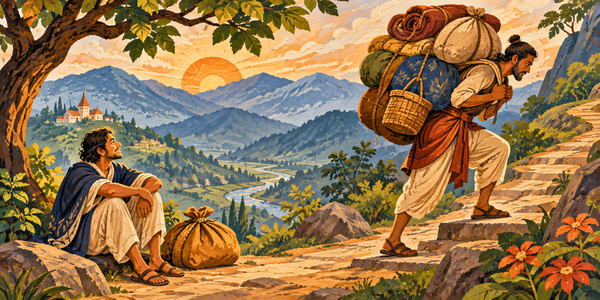
Imagine two travelers boarding a train. Both carry heavy suitcases. The first places the suitcase on the luggage rack, sits by the window, and begins watching the scenery. The second keeps the suitcase on their lap. After an hour their arms are numb, but they refuse to put it down. They fear that something bad will happen if they stop holding it. The train is carrying both the traveler and the luggage anyway, yet the traveler adds unnecessary strain to the journey.
This is an original retelling using the familiar spiritual image of a burden carried unnecessarily. It helps us distinguish real responsibility from inner clinging. The first traveler has not thrown away the luggage or denied that it exists. They have simply placed it where it belongs. The second tries to create security through constant control, but only exhausts themselves.
We carry many such suitcases in life. We endlessly replay old conversations. We try to predict every possible danger. We demand that we never make mistakes. We believe that if we stop worrying, we will become irresponsible. But worry and responsibility are not the same. We can plan carefully without experiencing the future as a continuous catastrophe.
Of course, some burdens are real and heavy. Illness, caring for a loved one, financial obligations, or an unsafe environment do not disappear when we change our attitude. The story should not be used to minimize suffering. It concerns the additional weight we sometimes create through continuous mental resistance to what already exists.
If karma is also the way we accumulate reactions, liberation may begin by asking which burden we truly need to carry and which we keep holding out of habit. Sometimes we cannot change the direction of the train. But we can change how we sit within it and what actions we take at the next station.
How to Begin Changing Karmic Patterns in Everyday Life

There is no need to begin with grand promises. Someone who decides overnight to become perfectly calm, selfless, and free from every habit will probably soon be disappointed. It is more useful to choose one specific pattern that repeats often. It might be quick anger, constant procrastination, a need for approval, or a tendency to interpret every criticism as an attack.
The first step is observation. When does the pattern appear? What precedes it? What bodily sensations accompany it? What story does the mind create? For example, someone may notice that they always become abrupt at the end of the working day when they are tired and hungry. The solution may not require a profound philosophical transformation. It might begin with rest, food, and a more reasonable distribution of tasks.
The second step is creating a small alternative. If we usually answer provocative messages immediately, we can wait ten minutes. If we automatically say yes to every request, we can ask for time to think. If we constantly compare our lives with other people’s posts, we can limit time on social media. The small change matters because it creates a new experience.
The third step is an ethical check. How does our pattern affect others? We may have learned to avoid conflict, but that might mean never defending important boundaries. We may be very disciplined but demand the same pace from people with different abilities. Freedom from conditioning is not merely personal comfort. It includes the capacity to act more justly.
The fourth step is patience. Old habits often took years to develop. There is no reason to expect them to vanish in a few days. Setbacks and difficult periods are possible. They do not prove that we have failed. What matters is gradually expanding our space for choice and seeking help when our own efforts are insufficient.
What Does It Really Mean to Create Your Own Destiny?

The phrase “create your own destiny” sounds inspiring, but it can easily be misunderstood. Nobody creates their life from a blank page. We are born into a particular time, family, and society. We receive bodies, abilities, and limitations we did not choose. We encounter chance events, other people’s decisions, and historical developments that can change everything. Acknowledging these facts is not pessimism; it is respect for reality.
Yet life is not only what happens to us. It is also what we gradually build through our decisions. Someone may not have chosen to grow up in an environment where nobody discussed feelings calmly. But as an adult, they can begin learning a new language of communication. They may not have chosen their initial fear of failure, but they can practice a healthier relationship with mistakes.
Imagine a sailor who does not control the wind. The sailor cannot command a storm to stop. But they can study the sea, maintain the vessel, choose a route, and respond to changing conditions. Sometimes even the best decisions will not prevent loss. That does not make the sailor’s skill meaningless. It shows that responsibility is real without being all-powerful.
In this sense, the contemporary yogic interpretation of karma offers an important change of perspective. Instead of asking only why fate has treated us this way, we can ask what participation we have in the next moment. What can we do more wisely? Which habit can we weaken? What care can we offer? What is it time to accept, and what is it time to change?
This is not a promise that every dream will come true. Nor is it a guarantee that good people will never suffer. It is a more sober and perhaps more powerful idea: we do not own the entire future, but we participate in creating it. Even when circumstances are limited, the way we act can matter to us and to others.
From Karma to Liberation: Why the Ultimate Goal Is Not Simply a Better Life

If we regard karma only as a way to become more successful, calm, or productive, we miss much of its spiritual context. In many Indian traditions, the ultimate goal is not to accumulate enough favorable consequences to enjoy an endlessly comfortable life. It is liberation from the conditioning that keeps us within the cycle of desire, action, attachment, and suffering.
In some Hindu schools, this liberation is associated with knowledge of the true nature of the Self and ultimate reality. In classical yoga, it is described through distinguishing pure consciousness from the changing processes of nature. In Buddhism, the focus is on the cessation of ignorance, craving, and suffering without accepting an eternal individual self. In Jainism, liberation includes freeing the soul from karmic bondage.
These differences cannot be reduced to one universal formula. But they share a tension: as long as a person continually seeks final satisfaction in changing conditions, they remain vulnerable to loss and disappointment. Even the greatest success cannot make the world completely predictable. Even the strongest love cannot remove mortality. Even the best plan cannot eliminate uncertainty.
Imagine someone who has spent a lifetime collecting keys. They believe that behind the next door they will find final peace. They open one room and discover another corridor. Then another door, another goal, and another promise. One day they begin wondering whether the problem is the absence of the right key or the belief that peace must always lie behind some future door.
Spiritual liberation, as understood by different traditions, is not merely a psychological technique for improving mood. It includes profound metaphysical and existential claims that remain subjects of faith, practice, and philosophical debate. Yet the question it raises is understandable to modern people: can we live fully without endlessly postponing our inner peace until the next achievement?
Karma Without Superstition, Responsibility Without Fear

After this journey through ancient texts, philosophical schools, and everyday stories, we can return to the simplest question: what does karma mean to someone who will get up tomorrow morning, make coffee, and face the usual tasks? They do not need to imagine an invisible judge recording every thought. They do not need to search for a secret punishment behind every difficulty. They can begin by observing the actions they repeat.
If they greet loved ones with irritation every morning, that has consequences. If they take time each day to listen to their child, that also has consequences. If they constantly postpone difficult conversations, their relationships gradually change. If they begin acknowledging mistakes, they create other possibilities. Not every outcome is predictable and not every outcome depends solely on them, but action is never entirely isolated from the world.
Ancient traditions add to this evident causation much broader teachings about liberation, rebirth, soul, not-self, and moral maturation. They deserve to be studied in their own contexts. The contemporary yogic interpretation of karma as accumulated conditioning offers an additional practical perspective: we can begin recognizing the reactions through which we continually reproduce our past.
But the most mature attitude toward karma also requires compassion. There is no justification for declaring another person’s suffering deserved. There is no justification for promising that the right meditation will eliminate every illness or injustice. There is no justification for blaming ourselves for every accident of life. Responsibility is valuable precisely when combined with a realistic understanding of our limitations.
Perhaps the most important question is not what we did in an unknown past, but what we are doing with this moment. When anger arises, will we turn it into another insult? When we encounter suffering, will we explain it from a distance or offer help? When an old habit tries to decide for us, will we notice that we can pause and choose? In these small, ordinary moments, karma stops being distant philosophy and becomes a living question about human freedom.
Conclusion: The Past Shapes Us, but It Does Not Have to Have the Final Word

Let us return to the man from the beginning who promised every morning not to become angry. Perhaps tomorrow he will encounter the same traffic, the same remark, and the same irritation. The difference may not be dramatic. He might simply feel anger rising before speaking the first harsh word. He might remain silent for a moment, ask a question, or admit that he is tired. At first glance, almost nothing has happened. But an old story has not been repeated in quite the same way.
That is what makes the practical understanding of karma so interesting. It does not require us to deny our past. On the contrary, it invites us to see it more clearly: in our fears, desires, habits, and ways of interpreting the world. But clarity should not become self-condemnation. We can acknowledge our limitations without defining ourselves entirely through them.
From Vedic rituals and the Upanishads to the Bhagavad Gita, classical yoga, Buddhism, Jainism, and Sikh tradition, karma has acquired different meanings. Sometimes it is action, sometimes moral causation, sometimes metaphysical bondage, and sometimes a question of intention and liberation. We need not erase the differences to recognize the shared human concern: how does what we do shape what we become?
Contemporary accounts of karma remind us that we do not have to be merely the sum of yesterday’s reactions. Ancient teachings add the deeper question of whether we can move beyond dependence on habits, desires, and attachment itself. Science, in turn, teaches us to distinguish verifiable mechanisms of behavior from metaphysical beliefs. When these perspectives meet respectfully, the subject becomes richer rather than more confused.
And perhaps this is where the most human meaning of karma lies. Not in the promise that the universe will give everyone exactly what they deserve. Not in the fear that every mistake will pursue us forever. But in understanding that actions leave traces and awareness can change the direction in which we travel. The past is part of us, but it does not have to be our only voice. Every new moment brings us face to face with the consequences of what has already been done-and, at the same time, with the possibility of beginning something different.
Sources and Suggestions for Further Reading

Sadhguru, Karma: A Yogi’s Guide to Crafting Your Destiny (2021)-a contemporary yogic interpretation of karma as action, conditioning, intention, and the possibility of conscious change. Official information about the book: Isha Foundation.
The Bhagavad Gita, especially chapters 2, 3, 4, and 5-for action, duty, nonattachment, and karma yoga. Patanjali’s Yoga Sutras, especially the second chapter-for the kleshas, karmic potentials, and practice. The Brihadaranyaka Upanishad and other Upanishads-for the relationship between desire, action, and existence. Interpretations vary among schools and translations.
Early Buddhist texts, including Anguttara Nikaya 6.63, known as the Nibbedhika Sutta-for intention as decisive in karmic action. For Jain tradition: the Tattvartha Sutra and classical teachings about jiva, karmic bondage, and ahimsa. For Sikhism: the Guru Granth Sahib and teachings about honest work, service, and grace. These sources represent different philosophical systems, not entirely interchangeable ones.
Author: Vasil Stoyanov